



Abstract
Hybrid learning, which integrates the face-to-face classroom-based teaching with an online mode, is at its incipient stage in Africa. A study exploring institutional support services provided for students and informal peer support among peers of hybrid learning is a very significant academic exercise since it has implications for sustainability of hybrid teaching and learning in Africa and Ghanaian universities in particular. This study empirically examined 21 postgraduate students’ views of an institutional support system and peer support they received and the challenges associated with blended learning at University of Ghana (Legon) in the 2013/2014 and 2015/2016 academic years. First-year PhD students (n = 7) were all interviewed. Besides, all the 14 Master of Arts (MA) students were available for an in-depth interview. A case study design was used. Judgmental sampling was employed because it was found to be suitable for the research context. Thematic analysis was used for data analysis. The findings revealed that learner support had made a positive impact on the postgraduate blended learning students, although students also lamented over unpleasant challenges. Appropriate learner-support elements such as power supply, fast Internet connectivity, expert advice on the use of a particular Learning Management System, accessible e-library materials and workshops that address students’ needs were recommended for students on blended learning engagement.
Introduction
Opportunity that makes the current study important
The influx and advancement of Information and Communication Technologies have posed a major challenge to higher educational institutions in Africa. Particularly, with regards to their deployment for online or blended learning education and the related learner support services. Despite these challenges, their effective embracement and uses have incredible benefits. McLoughlin and Lee (2010), Sun (2014) and Voogt et al. (2011) observed that the global educational platform of the twenty-first century was undergoing rapid changes engineered by the advent of digital communication technologies, cyber-networked devices and applications. Additionally, the internationalization of higher education, the demand for learner-centred education and desire of students to learn everywhere without barriers have also necessitated technology-based distance education and hybrid learning. These have created opportunities for web-based teaching and e-learning education by incorporating the use of tools such as Learning Management System and compact disc read only memory (CD-ROM).
As a result of the relevance of technologies for educational development, higher educational institutions have been on the global agenda and been consistently encouraged to develop more effective and flexible teaching delivery models that enhance quality learning experience more than is possible with the use of only traditional on‐campus face-to-face teaching and learning (De George‐Walker and Mary Keeffe, 2010). This goal has prompted the need for effective blended learning programme augmented by a learner-support system, especially for postgraduate students who are usually student-workers, church leaders, community leaders and married, with very busy schedules that will not allow them to regularly commute to campus for face-to-face teaching and learning.
There are certain terms and concepts in the paper that need definition or explanation. These include learner support, web-based learning, e-learning education, CD-ROM teaching and learning, Sakai Learning Management System, blended learning and constructivist theory. Learner support is a set of formal services given to students on blended learning by an institution or informally by peers to enhance learning. From the institutional perspectives, this includes course advise, academic counselling, tutorials, how to access computers, Internet availability, technical support and so on. Peer support on the other hand implies informal arrangements by peers to get encouragement, overcome loneliness, receive an explanation of something or even to benefit from financial help from friends. In this paper, peer support and institutional support have been classified as support from colleague students and from the university itself. The learner support for hybrid and web-based learning enshrined in the University of Ghana's e-learning policy includes financial aid, registration, career services, academic advising, provision of centre coordinators, adaptive service for the physically challenged, open computer laboratory, library facilities with enhanced capacities for e-library services and career placement assistance. The policy includes provision of electronic periodicals and databases, electronic reserve materials, student access to books and articles through inter-library loan, and document services. Unfortunately, a number of the provisions in the above e-learning policy have not been implemented.
Thorpe (2002) has listed learner-support elements as encompass handling personal difficulties, particularly exceptional ones which grow too great for the student to handle alone. This means all aspects of an institution’s provision, from the enquiry desk through to the quality of the interface on the CD-ROM, the Learning Management System, e-library, Internet accessibility, etc. should be supportive in the sense of fostering high quality teaching and learning. This may include provision of guidance about course choice, preparatory diagnosis, study skills, access to group learning in seminars and tutorials, career guidance and study skills that are relevant to the student body as a whole (Thorpe, 2002).
Web-based learning comprises the use of educational technologies that support traditional classroom teaching and online learning environments. ‘Fully’ web-based courses are wholly based on computer and online possibilities. E-learning education is a teaching and learning encounter aided by for instance, a Learning Management System. Sakai Learning Management System, is an example of an Open-Source LMS that enhances the organization of courses and students’ assessment online. Technologically-based distance education courses are online distance learning courses facilitated by the use of tools such as Learning Management System, CD-ROM, etc. CD-ROM teaching and learning implies employing CD-ROM as an innovation in teaching, learning and research. The CD-ROM has motivated students to research topics on, for example, Arts, Science, Languages, Education and Computer courses. Blended learning integrates face-to-face teaching and learning and online learning possibilities. Constructivist theory posits that a teacher should establish a learning setting where students can work together for personal and social meaning construction and seek to integrate their own experience with resources provided by the instructor. In this study, the use of constructivist theory is meant to demonstrate how a lecturer teaching a blendedlearning course used it to organize his pedagogy and not to show how it applies to learner support per se.
Goals of the study and the benefits of blended learning to postgraduate education
A learner-support system is of paramount importance in running a blended learning programme. There are a number of learner-support systems in the extant literature. However, the best practice for learner support for blended learning is not clear in the literature. Besides, very little research has been conducted on blended learning and learner support in higher education in Ghana, and in Africa in general (Minnaar, 2011). In addition, University of Ghana (2012) Policies and Procedures of Technology-Mediated Courses capture issues that will enhance e-learning in general.
The objectives of the study are to explore peer and institutional learner-support systems carried out and enjoyed by the students, and more importantly tackle the challenges students face, since that has more research value. It is hoped that necessary recommendations resulting from the findings will revamp a learner-support policy for blended learning education in Ghana and other parts of the world, and motivate future studies in the domain.
A critical-minded person may question the originality of this study on the grounds that it appears dated since studies about learner support for blended learning date back to more than two decades. Additionally, the literature is diverse and many studies have already established the importance of learner-support systems and the challenges, especially in technology-enhanced learning. Besides, one may say that the research questions in the methodology section of the current study which poses the question, ‘What learner support system was available to you as blended learning students?’ may not have much research value. Therefore, one may think that the current study should focus on the deployment and impact of learner-support systems rather than exploring the availability and implementation of a learner-support system for the student and the associated challenges, which are the focus of this paper.
These are unfounded and shallow arguments in that before one may find out the challenges associated with learner support and its overall implications on the blended learning education in Africa, one needs to know what learner support is actually available and administered to the blended learner. This study is a timely and important venture especially as it focuses on Ghana and Africa, where technology adoption for teaching and learning is slow and learner support for blended learning is weak. In addition, there are scanty studies on the subject-matter in Africa.
It is expedient to point out that the study does not aim at developing a new theory, challenge an existing paradigm, present extensions or build on previous studies. It simply and reasonably tries to develop a learner-support conceptual framework that addresses conditions that depict poor learner support with the aim of impacting on the behaviour of researchers, educators and policymakers. For example, educators and policymakers can learn from the findings of the study to inform their blended learning planning and policymaking in Africa. They can also ensure best practices and provision of guidelines for learner support of students of blended learning in Ghana and other parts of our world. This will increase and ensure the sustainability of blended learning education in Ghana as well as some other African countries.
The current study may be of great importance and interest mainly because it depicts the real, everyday problems related to the use of the paradigm of blended learning education in areas where some basic resources (mainly electricity) can be unavailable for a prolonged period of time, Internet connectivity poses a challenge, and there is slow adoption and use of open source LMS for teaching and learning, to just mention a few.
The unique angles of this study could broadly include: the African context, graduate students and blended learning. However, the researcher seeks to find out graduate students’ experiences with Learner Support for blended learning and the challenges involved. Therefore, the current research questions focus on Learner Support for blended learning students and the challenges only.
Background of ADLT704 and ADLT602 courses as blended learning courses
University of Ghana has encouraged the use of digital technologies (e.g. Sakai Learning Management System) for teaching and learning among its faculty members and students. This has been possible because the University has acquired infrastructural facilities for the Internet and other digital technologies, and has also developed a maintenance culture and asset replacement policy to support learners of its blended learning education. In addition, it has digital training facilities for its faculty and students to prepare and motivate them to adopt and use ICT for teaching and learning. The current work looks at a particular department in the University that mounts blended learning courses.
An Educational Technology and Innovation Course (ADLT704) was designed for first-year PhD students of the Department of Adult Education and Human Resources Studies of University of Ghana to use and manage appropriate technological processes and resources such as cutting-edge technology in the area of the Sakai Learning Management System. Students were to create a class website, engage in forum discussions, take MOOCs courses, watch online videos, listen to audio lectures, take interactive quizzes, complete peer-graded assessments and interact live with their classmates and teachers online. They were also to review a book and make a PowerPoint presentation on a topic. Again, students were to learn how to legally use copyrighted materials for the purposes of education in a way that is compliant with Copyright Law. They were also to review a set of Copyright Guidelines and take a Copyright Quiz. Students were also required to know how to legally use music websites, as well as be able to copy and print images.
In addition, the Contemporary Issues in Adult Education (ADLT602) course was designed for Master of Arts (MA) students of the Department of Adult Education and Human Resources Studies (also in University of Ghana). It was a blended learning course which followed a similar course outline to the first-year PhD students’ ADLT704 course described earlier. The exceptions were that the MA students were not required to create a class website; they had different books to review; and their assessment was relatively a little more flexible. ADLT704 and ADLT602 were mounted in a period when Ghana was experiencing an energy crisis which resulted in consistent power outages; the Ghanaian currency was steadily depreciating against the US dollar and the pound sterling; and there was poor Internet access. There was a critical need for learner support under these unfavorable situations. However, ADLT602 (2015) was mounted at a time when a standby generator had been donated to the University. Despite this difference, whenever there was a power outage, the generator was operated for no more than two hours and then it was switched off in order to save on fuel. This was a challenge to blended learning students.
Due to several assignments to be attended to, the deadlines for ADLT602, and the pressure from other courses in terms of completion of assignments, all the students and the instructor found themselves in a difficult situation. Learner Support needed under such conditions for a blended learning programme was an entirely different matter altogether. However, it is pertinent to mention that the instructor’s pedagogical strategy for these courses was built on a constructivist’s approach. The instructor created an environment where students could work together intensively for personal and social meaning construction in which learners sought to integrate their own experience with resources provided by the instructor. The instructor’s relationship with the first-year PhD students and the MA students was cordial. This approach emphasized the values of peer facilitation and mutual support through construction of an online learning community (Asamoah and Oheneba-Sakyi, 2017). In this context, not only did the students get to know one another online quickly and deeply, but they also received peer and institutional support. This enabled everyone of them to finish the programme on time.
Let it be known to readers that the researcher was just interested in pointing out how the lecturer(s) taught using constructivist approach, thus indicating the focus on the learner as the pivot of the teaching and learning transaction and not to expatiate on how the use of constructivist theory enhanced learner support, although the tenets of the theory have direct bearing on learner support in general.
Literature review
Blended learning and benefits for postgraduate students
Beer et al. (2010), Blackmore et al. (2010) and Picciano (2009) describe blended learning courses as classes in which there is face-to-face teaching and learning supported or augmented by aspects of online learning possibilities. For example, courses organized on a Learning Management System are integrated to or seamlessly amalgamated with a face-to-face pedagogical design. Norberg et al. (2011) and Smith (2001) maintain that blended learning provides better interaction among learners than the traditional mode because it makes it easier for shy and slow learners who need more response time to participate. Blended learning has freed students and educators from the locked-in classroom learning atmosphere, thereby emphasizing learning rather than teaching in the teaching process. This mode of teaching and learning has been found very significant and suitable for postgraduate students who are normally adult workers with spouses and children, with a busy schedule that will not permit them to always commute to campus for lectures and learning. De George‐Walker and Mary Keeffe (2010) posit that adopting a blended learning approach is an effective and low‐risk strategy towards meeting the challenge of the developmental shifts that technological advancement brings to higher education. The blended teaching and learning mode aims to leverage the advantages of face-to-face interaction, and provides students with some element of control over time, place, path and pace of their own learning. This is an opportunity for postgraduate students (Staker and Horn, 2012). The use of educational technology in blended learning permits students’ access to electronic resources and to be in regular contact with the content, peers and the instructor online. In addition, blended learning provides the opportunity to enhance students’ engagement – shifting and reinforcing a structure for the student’s role in their own education as an active learner (Mosca et al., 2010; Venadakis et al., 2011). The principal goal for blended learning is to enhance access to under-represented groups such as students with disability, those with a low socio-economic status and those mature in age who combine studies with work and family responsibilities because they cannot be on campus regularly. The other goal is to reduce the cost of education and to improve the quality of education (Francis and Shannon, 2013).
Blended learning has now made it possible to integrate knowledge and the settings of a physical classroom with a hardware and software interface. It has also offered many tools of interaction such as discussion forums, chatrooms and study groups on social networks, as well as learning management platforms (Oheneba-Sakyi, 2014). These possibilities offered by blended learning also provide greater accessibility and opportunities for interaction and feedback, and have therefore enabled more student-centred learning (Halabi et al., 2014), which is important for postgraduate students. Also, blended learning promotes a two-way communication between a teacher and students, facilitates the educational process, promotes the development of important skills, and impacts on teaching and learning (Bebell et al., 2010; Jossey-Bass Higher Education Series, 1989; Lee et al., 2011). Whether learning is face-to-face, blended or fully online, learner interaction and participation, group communication, information sharing and institutional support are of crucial relevance to successful teaching and learning (Sun, 2011). For effective blended learning, the following items must be managed well: technology, the structure of the course, the instructor, technical support, assignments, students engagement, learning flexibility, and the ability to combine the best of both modes – traditional education and online (Alebaikan and Troudi, 2010).
Challenges of blended learning and learner support in Africa
Challenges
Despite the numerous advantages associated with blended learning, there are equally a number of challenges that confront blended learning education. Thorpe (2002) asserts that blended learning and technologically based distance education courses raise interesting challenges about course design and learner support. An online dimension of blended learning calls for students and the instructors to learn typing, acquire skills and knowledge in computing, learn the applications of the relevant Learning Management System, learn how to access the electronic library for e-resources including various journal article data bases, learn the tools for PowerPoint presentations and the creation of sound and image files (Asamoah and Mackin, 2016; Asamoah and Oheneba-Sakyi, 2017). All these require time, money, skill and knowledge, which may pose a challenge to the student and the instructor.
In addition, there is inadequate provision of ICT and library professionals to assist learners on ICT skills, and to help them access e-library learning materials; there is shortage of up-to-date computers; students lack adequate digital training and orientation, and have no cubicles for private study (Asamoah and Mackin, 2016; Asamoah and Oheneba-Sakyi, 2017). Spontaneous feedback from the instructors, easy access to academic information, ability to explore the Internet for information and to communicate through e-mails have been a challenge due to regular power outages although improving measures have been put in place; and low Internet connections resulting from insufficient bandwidth (Asamoah and Mackin, 2016; Asamoah and Oheneba-Sakyi, 2017). Besides, there is difficulty posting assignments to the forum platform and getting signed up for the online class with Coursera and Edx owing to power fluctuations and outages. Currently, this has been improved immensely.
Also, Hanisch et al. (2011) and Ludwig-Hardman and Dunlap (2003) have observed that off-campus students have expressed concern about their feelings of isolation, lack of self-direction and management, and decreased motivation levels. In addition, poor information flow, poor guidance by teachers and lack of training for students to acquire technological skills are also reported as issues confronting online/blended learning. These unpleasant experiences cause fear and despair in students, leading to rampant dropouts from the programme (El Mansour and Mupinga, 2007; Eshet-Alkalai, 2004). Thus Yorke (2002) suggested that increasing students’ interaction with instructors and peers through a merger of face-to-face and online modes could promote a sense of “belonging”.
However, Bonk et al. (2006) asserted that the primary concern of the blended learning programme is the pedagogy and the learning. It is about rethinking and redesigning the teaching and learning relationship and not just the actual technologies deployed. Integrating a skilful teaching design with the use of educational technologies has posed a serious problem for many instructors.
Simpson (2003) asserts that regulating dropout rates and controlling ‘at-risk’ learners on blended and online learning is a critical issue in higher education. The increasing use of blended, online, open and distance learning in higher education contributes to the unease over retention, as there is evidence that attrition rates may be higher with these modes of delivery compared to on-campus education (Simpson, 2003). A recommended solution is to provide good Learner Support – an issue which is critical for postgraduate students based on their demographic characteristics.
Advancement of educational technologies and the necessity of learner support
Educational technologies such as the Internet, Skype, teleconference infrastructure, Learning Management Systems and mobile phone usage have increased remarkably in Africa. The growth of new technologies and the expansion of the World Wide Web during the 1990s opened up opportunities for the development of blended and fully online postgraduate distance learning courses (Gemmell et al., 2015). However, enrolling students in blended or online learning must be accompanied by effective Learner Support in order to ensure effectiveness and sustainability. Learner Support aims at enabling learners to study successfully in order to develop their own understanding of the material and the whole learning encounter. For example, Tait (2000) submits that learner/student support is the range of services both for individuals and for students in groups which complement the course materials or learning resources that are uniform for all learners, and which are often perceived as the major offering of institutions using online and distance learning.
Tait (1996) and Thorpe (2002) maintain that since technological tools can be used for a blended learning education, peer and institutional support system for the course, advisory and infrastructural issues are also indispensable for the achievement of blended learning goals. Tait (1996) argues that learner support is meant to improve the learning encounter of students, lessen the difficulty about how to learn online, and provide a solution that can augment student–lecturer interaction, increase access and flexibility and address institutional imperatives in higher education.
Tait (1996) posits that learner support engages interpersonal interaction, conversation and community as values which should not be lost in technicist approaches to either a System Management or Learning Management System. Learner support agents encompass ‘intermediaries’ who are able to talk about the language of the student and interpret the materials and procedures of complex bureaucratic organizations. It is a means through which individuals are enabled to make use of institutionalized provisions. It includes all those elements capable of responding to a known learner or group of learners, before, during and after the learning process.
Thorpe (2002) asserts that institutional course support systems include making prospective and existing students know what is on offer, how to apply, how to claim a refund, make payments, and choose a course. Besides, before and during a course study, students must be informed of how best to complete a particular assignment and how to contact and work with other students on the course. Thorpe (2002) also maintains that a learner-support system is meant to make sense of something in the course materials, whether its contributions to the course is relevant, well-conceived or otherwise. Students must be well informed about this so as to help them make a reasonable request or follow-up for a learner support item. Thorpe (2002) posits that it is in this area, in particular, that Virtual and Web-Based Learning pose a serious challenge to our concept of learner support.
Methodology
Research approach
Qualitative study
The researcher used a qualitative approach in order to explore students’ experiences and viewpoints concerning learner support for a blended learning course. Qualitative data are important because they allow an understanding of how the experiences of people are interpreted and what meanings people have generated from those experiences (Merriam, 2009).
Study design
A case study design was chosen as the suitable technique since it makes it possible to capture the conditions within the settings of the phenomenon, thus giving meaning to the particular unit studied. The researcher’s aim was to fully understand a particular case and the related bounded unit that needed description, illustration or exploration, and this is consistent with literature (Yin, 2003).
Data collection strategy
For the first-year PhD group, all the seven students in the class were interviewed face-to-face and on the phone. It is important to mention that it was the students’ choice to use the telephone interview alongside the face-to-face medium since they found it convenient, comfortable and the easiest way to connect to them for the oral dialogue. Nevertheless, the use of the telephone for the interview never negated or diminished the value of their responses since all the facts they needed to mention were raised and probes for further responses were made.
An interview is used for exploring a phenomenon so that a detailed description could be made about it for a better understanding of the phenomenon (Golafshani, 2003; ; Risjord et al., 2001). Each interview lasted 40 minutes. Overall, seven one-on-one interviews were carried out through telephone and the face-to-face approach. The face-to-face interview was important in that grasping the essence of an everyday activity and how people live in their lifeworld can be best understood by being in the setting where they live (Hinck, 2004).
Besides, all the 14 MA students in class were available to be thoroughly interviewed face-to-face. It took each person one hour to complete the interview. What it means is that data were collected in two iterative stages. The first one on first-year PhD students (n = 7) was carried out in May 2013 and the second phase on MA students was carried out in May 2015. The interviews were conducted in English and were recorded verbatim. They were conducted one at a time. In the end, a total of 21 interviews were conducted. Fatigue and the willingness of the interviewees to devote up to an hour of their time for the interviews were taken into account. Prior arrangements were made with interviewees before they were engaged. All the participants (interviewees) were Ghanaians working with various organizations, married and within the age range of 30–60 years. One might ask if interrogating 21 participants triggered a point of saturation. Although the interviews were quite long and reached saturation point, the responses were meaningful, significant and adequate for learner support planning decision and policy making for blended learning education. It is also pertinent to let readers know that the names used for the participants’ responses are not their actual names.
Inclusion criteria
The participants selected were first-year MA and PhD students who were information-rich subjects willing to participate in the study, and using Sakai LMS for their blended learning. While the students’ views comprise rich data, one may argue that, it may not suffice to use them as the only unit of interview and analysis in this study in that their views are subjective, and lecturers could also serve as analytical units to be included in such a study because they are the most important group when it comes to educational technology adoption and use for teaching and learning. Although these arguments may be reasonable, the focus of the current study was not meant to include lecturers. Every academic study has an objective. As a result, not everything deemed relevant is captured in one research paper. In this paper, the researcher wanted to see the views of postgraduate students alone. Additionally, triangulating interviews with other data collection strategies (such as questionnaires) was not possible since the PhD and the MA students were all interviewed and yet the number was not too large. On a more serious note, the employment of the concept of saturation, the use of thematic analysis and the research approach did not call for huge numbers but depth of information. Fortunately, the data collected were adequate to explain the viewpoints of the students regarding learner support.
The main question raised was: What are the viewpoints of postgraduate students of blended learning regarding learner support?
The following interview questions were addressed in this paper:
What learner-support elements did you receive as a blended learning student? What challenges did you face going through the blended learning education?
Sampling
Judgmental sampling was deployed because it was found to be suitable for the research context. This is notable for collecting experiential data. Judgmental sampling is a type of non-probability sampling method in which interviewees are selected from their natural setting; and they are considered because they are found to be information-rich cases. The participants/interviewees had adequate knowledge and experience of the subject matter. And being adults (mature) and young academics, their views could not be underrated. Based on this, all the seven first-year PhD and all the fourteen MA students were sampled and interviewed, thus was amounting to a census strategy. The interviewees were made up of 12 males and 9 females. This limited number of students does not fairly represent the wider population of blended-learning students in the higher education sector of Ghana, but their experiential data contain enough implications that may be extrapolated for other universities in Ghana. They were all information-rich cases and were willing to join the interview process. It is worth noting that in qualitative research sampling, the emphasis is on analytical generalization rather than statistical power, which makes statements about the general population on the basis of a sample (Curtis et al., 2000).
In a qualitative study, only small samples are needed and samples are evaluated based on the ability to provide important and rich information, not because they are representative of a larger group (Hellström, 2008). This accounts for the small sample size. The evidence that the sampled participants could provide rich information is due to the fact that the participants, being adults on a postgraduate blended learning programme using a Learning Management System are indeed the actual people who can really express their views better on learner-support issues for blended learning education as opposed to those without the experience of using an LMS. In fact, the responses also indicate that their information is rich enough to inform policy on learner support for the blended learning education in Ghana and in Africa generally.
Data analysis
Thematic analysis was applied to the data. This method allowed for interpretation of meanings from interview responses. The rich, detailed answers were electronically recorded for transcription and analysis in order to identify themes by coding and categorizing their essential meanings. The researcher also carried a field notebook in which other key issues were documented. The researcher started the analysis by meticulously examining the data for patterns of meaning and issues of potential interest, and converging them into meaningful coding groups. The different codes were subsequently sorted into themes which were related to the overall research questions. It also involved stepping back from the experience of the individual to look for the characteristics in these experiences which might reveal several aspects of the phenomenon being investigated, following Mackey (2004). Thematic analysis is flexible and could be applied across a range of theoretical and epistemological approaches (Braun and Clarke, 2006).
Ethics
Ethical clearance was acquired from the Ethical Clearance Unit of the College of Humanities of University of Ghana after following the due process. The verbal consent of each interviewee was obtained before the interviews were conducted and before the data were used for research purposes. The interviewees found the oral consent to be adequate and thus were not interested in completing the participants’ consent form. Interviewees suggested the time, the venue and interview duration convenient for them. Fortunately, all their suggestions were favourable to the researcher. Confidentiality of their information was considered. It must be recalled that the names stated against the respective interviewees’ responses in the results section are not their actual names. The necessary confidentiality requirements were thus adhered to.
Rigour
The different year periods, different cohorts and different sets of interviewees with whom the research was carried out allowed triangulation of the data and made findings richer and more meaningful. The target population who were graduate students on blended learning was few. In order to focus the study on a few people, the researcher found it reasonable to adopt a qualitative study approach. The interest was to use an in-depth interview that draws deep information from the interviewees and not to use a structured questionnaire which provides a response set without explaining the ‘why’ of the selected answers. Triangulating questionnaire and interview data would not have made sense in the current study due to the small number of the graduate students in the study area. Although blending observation, documentation of practices on the list of learner support activities, and interviews, would have served as an alternative to enhance rigour, that was not the focus of the study. Although the interview as a strategy for data collection has been surpassed by newer, more powerful methods that provide more robust results, it still is an excellent method of collecting data that provides in-depth insights of a phenomenon being studied without necessarily triangulating with other strategies for data collection.
One may suggest that the use of an existing learning framework such as the Activity Theory as an example would have helped to direct the study and augment interpretation of data. Yes, but the interest of the researcher was not to use theory and to test variables but to rather make strides to establish a conceptual framework from the data in order to inform effective learners support for students on blended learning in Ghana, Africa. Thus the research process dictated the adoption of this path for the current study. Future studies can address some of the possible suggestions above by factoring in the activity theory and even to use a longitudinal study to augment data for wider application of the findings.
Additionally, the study would still have been reasonable and publishable if the researcher had focused on one cohort, say the PhD students or the MA students alone. Therefore, triangulating the data sources of two cohorts provided rich data for the study. In order to achieve accuracy of information, the findings were discussed with interviewees for their feedback. Learned peers were also engaged for peer review of the manuscript. The valuable views of the interviewees contributed significantly to the shaping and structuring of the current work.
Results
First-year PhD students’ (2013) interview data on Learner Support
A blended learning structure must include learner support in order to enable it to survive in Africa, where educational technology adoption is in its infancy while its use is not widespread. It is also in this regard that this study was conducted to ascertain the preparedness of universities in Ghana and Africa for a blended leaning education. Regarding learner support, two main themes emerged from the data, namely Peer Support and Institutional Support.
It is worth mentioning that the name attached to each narrative in the results section is not the actual name of the research participant.
Peer Support
It must be emphasized that the peer support usage here is not a system provided by the institution which supported blended learning, but rather the unstructured, informal relationship between and among students, and the help they derived from that in support of their programme of study.
Interviewees were asked to share their opinions and experience of peer support for the blended learning. Their responses showed that they enjoyed some peer support. An interviewee explained: ‘The group discussions among peers were fantastic. The knowledge creation and information sharing on the forum was very illuminating.’ (A. Danso, personal communication).
One may argue that group discussion is not learner support. Yes, it may be true when viewed from a certain angle. However, coming from the background of the definition of learner support given above, helping other colleagues in a group engaged in a discussion to appreciate and understand a topic is substantial peer support. From the above response, it can be observed that information sharing and collaborative learning enable successful blended learning.
A similar position is expressed by the quotation: ‘The sharing of experiences and notes from peers was useful to guide areas where there was difficulty. Additionally, there were instances where peers actually gave one-on-one guidance, advice; encouragement and other support in kind.’ (A. Takyi, personal communication).
Another interviewee explained: ‘I noticed that because of the deadline associated with postings to the forum platform, everybody was making efforts to meet the deadline, so no one had time to help his/her colleague.’ (F. Deku, personal communication). ‘I realized that individualism and insensitivity were dominant among peers. This obviously did not create room for peer support needed for teamwork and collaboration.’ (E. Peters, personal communication).
The two views directly above differ from the two preceding ones. This indicates that not all the students had support from their colleagues. This is normal in a human society.
Institutional support
Interviewees were asked to describe how the institution provided them the requisite support for effective blended learning. The quotations below illustrate some of their views. I had access to the University’s ICT laboratory where two computer experts were always available to help us go through the various tools on the Sakai Learning Management System (LMS) to enable us do what was required of us. This was a great assistance to me because I was able to access other resources online. In addition, a professional university librarian came as a facilitator to help us log on to several databases of internationally reputed journals subscribed by the University of Ghana. (C. Harry, personal communication) ICT specialists were engaged to take us through relevant aspects of the Sakai LMS to enable us to completely use the technology. Additionally, sometimes, some technical staff were available to restore the computers for us if they developed problems. Their commitment and dedication merits commendation. (Q. Williams, personal communication) The syllabus was made available to us on time, assignments and exams papers were marked and returned on time. Professionals helped us in specific areas. There were several times the professor (instructor) of the course called me on phone and helped me to do a lot relating to the course work. He also provided me timely feedback. This was highly appreciated. (A. Danso, personal communication)
Challenges of institutional support
Interviewees were also asked to state any kind of learner support they expected but were not administered to them: I think teaching and technical assistants for tutorial support were scarcely available to us and therefore they must be introduced in the next academic year. The reason is that the instructor, ICT and library professionals are not going to be available to us all the time but the teaching and technical assistants will be more available to take us through the instructions and training given by the lecturer and other experts. (C. Buabeng, personal communication) There were no newer versions of computers for us to use, no back up for electricity
MA students (2015) interview data
Peer Support
An interviewee provided the following response to the question: ‘What peer support was administered to you during the blended MA Contemporary Issues in Adult Education course?’ ‘The peer support I enjoyed was the group discussions and the opportunity to communicate with my peers for advice through the social media. There was no other peer support that I was expecting aside from these two.’ (N. Mackin, personal communication).
Another interviewee provided the following response regarding peer support: The peer support I enjoyed was students’ interaction with me through the Chat Room and critiquing of my paper posted into the forum platform. I am glad to say that there was not any peer support I was looking for apart from these two. (O, Asamoah, personal communication) ‘Some colleagues helped me to master the use of the Sakai platform. I could call them at any time and they responded positively.’ (A. Marfo, personal communication).
Institutional support
Students attested to the significance of the Sakai Learning Management System, which made learning convenient and cheaper for them. This is evidenced by the comment below: With the use of the Sakai Learning Management System, we gained several advantages. We became more responsible for the learning. There was easy access to information. Ambiguity was less and our skills in information technology were improved. I felt I was also gaining the same kind of knowledge that international students gain, as my critical thinking and learning skills were ignited. (E. Kelvin, personal communication) With the use of the Sakai Learning Management System, lectures were delivered online without face-to-face interaction between the instructor and students. Students could review the work of their colleagues and share ideas. Learning materials could be easily accessed online. (E. Akotsen, personal communication)
Challenges of institutional support
Although several students spoke positively about the advantages associated with blended learning, several of them also pointed out that there were equally several challenges that needed to be addressed in order to maximize the benefit from blended learning in an undeveloped economy. An interviewee expressed this in the following quotation: Although we enjoyed several institutional “supports”, we faced some challenges. Assignments were too many, coupled with short interval deadlines. The consequence was that we had to over concentrate on ADLT 602 course in particular to the neglect of other courses. (Q. Peters, personal communication) Accessing MOOCs video courses was sometimes challenging as lectures that could be listened to in a period of thirty (30) minutes stretched to over an hour and a half due to network challenges. We also had challenges in electricity cuts which made access to the internet difficult sometimes. (N. (Mackin, personal communication) Although we enjoyed several institutional “supports”, there were challenges accessing the Internet. Sometimes, the link was very slow, making it difficult to accomplish a task within a stated period of time. The MOOCs assignment consumed so much of my time due to the power fluctuations and the slowness of the Internet. (D. Kyei, personal communications)
It can be seen from the interviewees’ responses above that although there were learner support items provided by the University, there were also several challenges (unmet learner support) that the learners faced which negated the learner support provision in general. The slow Internet connectivity, power fluctuation and power outages are very fundamental and critical issues that must be resolved in a blended learning programme before authorities may attend to other learner-support items. It is also important to point out that the learners/students managed to finish the blended learning course amidst the challenges. If there are still challenges in these areas, then universities in Ghana and the government of Ghana must be sensitized enough to address the issues relating to blended learning in Ghana. Such a move can go a long way to enhance blended learning in Ghana.
Discussion
The purpose of the investigation was to diagnose the learner-support services (peer and institutional support) administered to postgraduate students on hybrid learning in University of Ghana (Legon) as well the challenges. The rationale is to suggest remedies for the challenges in order to enhance blended learning for postgraduate students in Ghana, and for a possible replication by some countries in Africa and beyond. A number of the participants together remarked that flow of information and note-sharing; giving guidance, advice and encouragement; group assignments, discussions, debates and construction of knowledge; and peer coaching, were pillars of the peer support they enjoyed. These learner-support items are consistent with the literature (Tait, 1996; Thorpe, 2002). To a large extent, the participants demonstrated great care and concern for one another based on respect and a sense of responsibility they felt for one another. Participants were motivated by the care they received from peers. This is consistent with the position of Leung et al. (2013) and Mead et al. (2001), who state that peer support is a system of giving and receiving assistance based on certain key principles of (1) respect, (2) shared responsibility and (3) mutual agreement of what is helpful. It is a source of social support and encompasses emotional, instrumental and information support (Dennis, 2003; Tait, 1996). This support includes encouraging telephone calls and face-to-face support systems which have been observed by other studies (Hughes, 2007).
The group assignments, the discussions engaged in, and the academic debates among colleagues, created the path for both cognitive and social constructivism. Although cognitive constructivism is the key to knowledge construction, it is more beneficial when learners interact with their peers and environment in order to absorb or assimilate ideas that agree with their current cognitive structures or are better than their own worldview. This perspective was extended by Vygotsky’s (1978) social constructivism, traced to the work of Dewey (1933) which posits that knowledge construction is invented culturally through collaboration with other people within a social milieu (Rogoff, 1990). It is pertinent to point out that the group tasks that were assigned to students and the collaborative learning involved, triggered peer support among the students which was pivotal to social constructionism and problem-solving.
Advice, encouragement and interaction between and among peers motivated learners and helped them break away from isolation and instead feel a sense of belonging. This supports the findings of Hanisch et al. (2011) and Ludwig-Hardman and Dunlap (2003) who observed that the lack of encouragement and interaction among peers leads to loneliness and isolation; and these observations are of crucial relevance for consideration for successful teaching and learning (Sun, 2011). Other studies have maintained that effective use of the face-to-face mode alongside the online mode will enhance students interaction with instructors and peers, and promote a sense of belonging (e.g. Yorke, 2002). Simpson (2003) attests to the relevance of learner support in blended or pure online learning. He argues that it is the only way students would feel comfortable and be motivated to pursue the course relentlessly. It is also the only way in which the rate of attrition could be minimized significantly.
It is very important to reiterate the observation that some students did not benefit from any peer support, and that they attributed the situation to either the selfishness of peers or the pressure on them to meet deadlines. Probably, these students were not connecting properly with their classmates. It is also possible they themselves were not sharing their own learning materials and ideas with their colleagues. As a result, no-one reciprocated. However, if they had been sharing, then it is regrettable that they were treated like that. University administrators can encourage peer support during student ori entation, and lecturers can also talk about that during teaching and course advisory sessions. This is very important in order to make peer support an issue that has management support.
Institutional learner support
Aside from the peer support, it was also noted that students gained from a diverse institutional learner-support system including access to a Learning Management System, an equipped computer laboratory (although only outdated computers were available); software engineers to help them navigate through the computer tools and to fix computer problems, were also available although not always. These are consistent with the literature (Asamoah and Mackin, 2016; Asamoah and Oheneba-Sakyi, 2017, 2008; Singh and Hardeiker, 2012; Voogt et al., 2011).
Participants also had access to a professional university librarian to help them use both the manual and the e-library resources. ICT experts and technical staff were there to train and offer them tutorials, although rarely. Gunga and Rickketts (2007) support the position that technology-based education sponsors, policymakers and telecommunication network service providers are needed to solve the problem of technology-based distance, blended, open and online education in Africa.
To the students, the detailed course syllabus, lecture notes and other learning materials placed on the online resource tool were also very helpful. This is consistent with other findings, including Tait (1996) and Thorpe (2002). Students also maintained that they received examination results and other feedback promptly, and teacher–students interaction was good. This is consistent with the finding that learner–learner, learner–content and learner–instructor interactions have been increasingly accessible to those at a distance (Hilton III et al., 2010).
Preparing learners for the digital age requires space and associated pedagogical approaches that enhance learner engagement and involvement in the learning process (Sharpe and Benfield, 2012). Pedagogical approaches that are expected to be important in the knowledge society should include learner-centred learning, providing variety in learning activities, offering opportunities for students to learn at their own pace, encouraging collaborative work, focusing on problem-solving activities and involving students in the assessment of their learning (Asamoah and Mackin, 2016; Foyle, 1995; Halabi et al., 2014; Salter et al., 2006). Instructional techniques and learning methods are critical factors in a blended learning programme (Bonk et al., 2006). There is value in listening to the learner’s voice and engaging them in decisions that impact on their experience in the learning environment.
It is clear from the interviewees’ narratives that a university’s role in ensuring prompt dissemination of information, and to provide conducive classrooms, cubicles, a modern library, a Learning Management System, a high-speed Internet connectivity, fully-equipped ICT laboratories, ICT experts, and technical support (to mention just a few) has been partially fulfilled. The nature of the group assignment which requires critical thinking, problem-solving, access to the Internet, and the Learning Management System enhanced individual and collaborative learning. Salter et al. (2006) observed in their study that student learning is enhanced by opportunities to work collaboratively.
In addition, it supports other studies that assert that a supportive infrastructure is perceived to be an important factor in facilitating the adoption of e-learning education (Palaskas, 2006 cited in Singh and Hardeiker, 2012). It has also been found that institutions’ investment in skills and knowledge of the students promotes development (World Bank, 2011 cited in Anamuah-Mensah, 2014). Using an active learning design in the classroom implies that students are always involved in a discovery process via proactive searches for knowledge such as library searches and computer simulation (Bucur, 2000). This confirms the study that the capacity of the online education technology to improve interactivity (Barry, 2001) through the provision of instant feedback on students’ examination results facilitates a student’s excellent achievement of high scores. Shih et al. (2008) also assert that ICT-mediated teaching and learning sustain techniques such as collaborative learning, problem-based learning, contextual learning, cooperative learning and situated learning.
The synthesis of the above discussions indicates that the interviewees attested to a learner-support system given to them by the institution/university. This is commendable because one of the cardinal reasons for a very high level of attrition in online and blended-learning education is a poor learner-support system. Appropriate support systems must therefore be put in place. Interactivity through social and academic integration must also be pursued (Stevenson, 2002 cited in Simpson, 2003).
One interesting finding of the current study is that students also grumbled and lamented deeply about the struggles they encountered in terms of areas they needed learner support in but did not get it. These challenges included lack of regular training on how to access other tools of the LMS and e-library facilities, slow downloading of learning materials, power fluctuations and outages, Internet connectivity interruptions, outdated computers, lack of classroom which are conducive to learning, lack of backup power in case of electric power failure/power fluctuations and assistance during network challenges in joining the MOOCs classroom. These factors cannot be ignored while huge investments are channelled into technological and communication infrastructural facilities for blended learning.
Academic institutions must realize that migrating to or embracing online education is not an easy task. It calls for determination, patience, resilience and all-round commitment from the authorities, instructors and students as well. Anderson (2010) observes that making a transition from a traditional to a technology-rich learning environment is a challenge to teachers and students, because it generally requires a shift in their roles and responsibility for learning. Effective teaching depends on flexible access to rich, well-organised, and integrated knowledge from different domains. This includes knowledge of students’ critical thinking and learning skills; knowledge of subject matter; and increasingly, knowledge of technology (Putnam and Borko, 2000). By harnessing students’ enthusiasm and engagement with technology in learning activities, teachers also learn more. Teachers and learners progress through two phases: (a) assimilation, where new tools are used like the old ones, and (b) accommodation, where ICT finds its own niche (Underwood and Dillon, 2011). This creates a challenge which has implications on academic quality and future enrolment if not quickly addressed. These challenges are not peculiar to University of Ghana or other institutions in sub-Saharan Africa running blended learning or pure online programme, who must provide the relevant learner-support system.
It must be re-stated in a broader sense that the challenge of Internet accessibility is very critical. For instance, it is an indisputable fact that students need to have easy and convenient access to the Internet for various learning purposes. In view of this fact, there is a global debate about Internet access as a right of citizens (Oyedem, 2013). For example, in European countries such as France, Estonia and Finland (Melanson, 2010) Internet access has been declared a human right. This is in tandem with the liberal, egalitarian notion of citizenship, which claims equality and social justice for all to participate in society’s good. Nevertheless, there is an argument levelled against the notion that African nations have a lot of competing social needs to meet, and therefore access to the Internet by all citizens should not be given a priority over these needs. However, it is justified that for blended learning programme to succeed and thrive, the Internet is an indispensable push factor.
The lack of system reliability, technical problems and malfunctions (including slow downloads), time and bandwidth issues, and outdated hardware or software are consistent with the literature (Asamoah and Mackin, 2016; Asamoah and Oheneba-Sakyi, 2017; Singh and Hardeiker, 2012). Ghana’s energy crisis situation, poor power distribution and the introduction of blended and online e-learning in the country have posed a great challenge.
An important factor to be taken into account is the fact that the MA students in this study were not expecting other peer support apart from the group discussion, information sharing and some advice from peers. The PhD students were more mature, more ambitious, more quality-oriented and therefore were more expectant of learner support. For these reasons, the latter needed more institutional support to make the learning more convenient and flexible. Again, their fees were very high – over US$12,000 per year, apart from the cost of data collection, as against the MA students who paid just about US$4,000 for the same period. This is consistent with the literature (Daniel et al., 2009) that the higher the cost of education, the higher the quality expected. However, lower fees attract more enrolment as shown by the PhD class of 7 compared to the MA class of 14. How to break the iron triangle of access, quality and cost of education is another issue that calls for further research.
In summary, group discussions, interaction through the use of the social media and the chat room were the main peer support systems. Institutional support included easy access to information and interactivity with the use of the online network system. The power crisis, with daily electric power failures and load-shedding regulations affected blended learning and the economic activities in general. Internet connectivity in Africa is extremely unstable. There are many places in Africa that have no access to power so students in these areas are cut off from local blended learning activities. Some universities in Africa still lack a modern e-library system. Access to broadband or Wi-Fi networks is also expensive. Buying pre-paid credit or paying for a subscription to data connection networks for Internet access has always been a burden for students on the programme. In the current study, learners’ maturity levels enabled them to graduate within the timeframe. It could be inferred that the results would have been different if the students were undergraduate students. This is because the undergraduate students are normally not yet mature and could probably not have been able to cope with the pressures of learning tension within the context.
Limitation of the study and direction of future studies
Although qualitative study is still possible with the use of even only one case, a sample size of 21 postgraduate students for the current study still does not make the findings globally generalizable. Nevertheless, blended learning/online learning in Africa is still very young so the small sample size used in this study makes it meaningful. Besides, the fact that the sample comprises graduate students who normally have much lower enrolment levels than undergraduate students makes the sample size reasonable. Moreover, the programme is not a Master’s in Business Administration, which has increasingly high enrolment every academic year. This is a postgraduate programme in Adult Education for which the market is slow in Africa. The importance of an empirical research like this with data triangulation from different time periods of PhD and MA students cannot be overemphasized. However, future studies should look at student/teacher support for blended learning based on a lager sample size and also triangulating interview data with questionnaire administration data where there is a huge number willing to participate in the study. Using a questionnaire alone to collect huge amounts of data from a large sample size could also be pursued in future studies in order to achieve significant outcomes.
Conclusion and recommendations
Although students attested to an available peer and institutional support system, they also raised several concerns about its inadequacy. The recommendations below, which are derived from the results, must be taken into serious consideration if blended learning and pure online studies are to be successfully managed in Africa where, with the exception of South Africa and Egypt, technological advancement has just started.
Appropriate support systems such as an expert advice on the use of a particular Learning Management System (LMS) and access to e-library materials must all be made available to blended learning students. This means that the services of relevant resource persons (ICT experts and library experts) must be fully engaged in order to guide the students – especially, the novices – in the use of computers, the preparation of PowerPoint presentations and the use of LMS. Experts in computer repairs must also be available to fix computer problems effectively while they are in use by the students. The process of accessing online resources must be taught during the first semester instead of the second semester. This would help prepare the students for the resources in the subsequent semesters. Up-to-date computers, laptops (and relevant software) must be made available at a subsidized rate for the blended learning/online learners. The software interface and the design of websites and conferencing architecture are new and powerful tools that institutions can use to shape the learning ‘space’ and influence the learner’s use of the tools. The government of Ghana must speed up its effort to provide and maintain an alternative power supply (solar power) in Ghana in order to avoid the recurrence of the frequent power outages, Additionally, all academic institutions running blended or pure online programmes must have power generators available on campus for use whenever the public power supply is shut down. This is to improve power reliability and enhance the downloading of learning materials. Instructors must be mindful of power outages and slow Internet connectivity and give sufficient time for submission of assignments in order to create room for peer support. Managers of the programme must be serious about organizing orientation programmes that properly instil in cohorts the spirit of sharing and collaboration. This will enhance interactions and teamwork. Many of the institutions’ courses should be administered on a blended-learning basis to provide some kind of uniformity in the learning process. The number of assignments given to students as well as the deadlines for these assignments given for the blended courses per semester should be reviewed taking into consideration technical distortions and the demands of other courses. When such a step is taken, it will help avoid a situation where students devote all their time to one blended learning course. It is very important to note that blended learning is not all about using educational technology; it is also about the need to continually review the teaching mode and assessment methods, and to make a timely provision of learner support so as to enhance the learners’ understanding of the subject-matter of all the courses. Course advisers and academic counsellors in the University must all be found to be playing their advisory roles which are necessary for students to be able to achieve learner support goals. Poorly designed online environments and lack of guidance and support for learners on how to learn online must be corrected by the blended learning programme managers and instructors. The infrastructural facilities for blended learning such as computers, Learning Management Systems and their associated technical support, stable power supply and Internet connectivity, access to an e-library system, and proper ICT training for students and lecturers must all be available as a learner support package in order to increase the success of blended learning in Africa and Ghana in particular. Besides, an educational policy that requires instructors to report on how they motivate students to finish the course will improve the retention rate of the blended learning students. Offering orientation workshops to students before a programme of study is run will equip students with relevant information for their course and prepare them effectively for it. Instructors have an important role to play here. They need to demonstrate a greater sense of optimism by encouraging students to persevere. Instructors must be conscientious enough to avoid the tendency to instil any feelings of negativity in the students that may result in failure to complete the course.
What the researcher is earnestly pointing out is that all students on a blended-learning programme need some support, including institutional support, peer support, family support and government support in order to achieve their goals. All the recommendations made are critical for international readership and application.
Contribution to knowledge
The current research contributes significantly to the scholarly debate within the literature on learner support because it brings out clearly the challenges of learner support at the infrastructural and advisory level. It thus calls for all stakeholders to find long lasting solutions to the problem of poor learner support which is so prevalent in Africa. The major contribution to the existing literature is the Learner Support Conceptual Framework developed from the results by the researcher as shown in Figure 1 below.
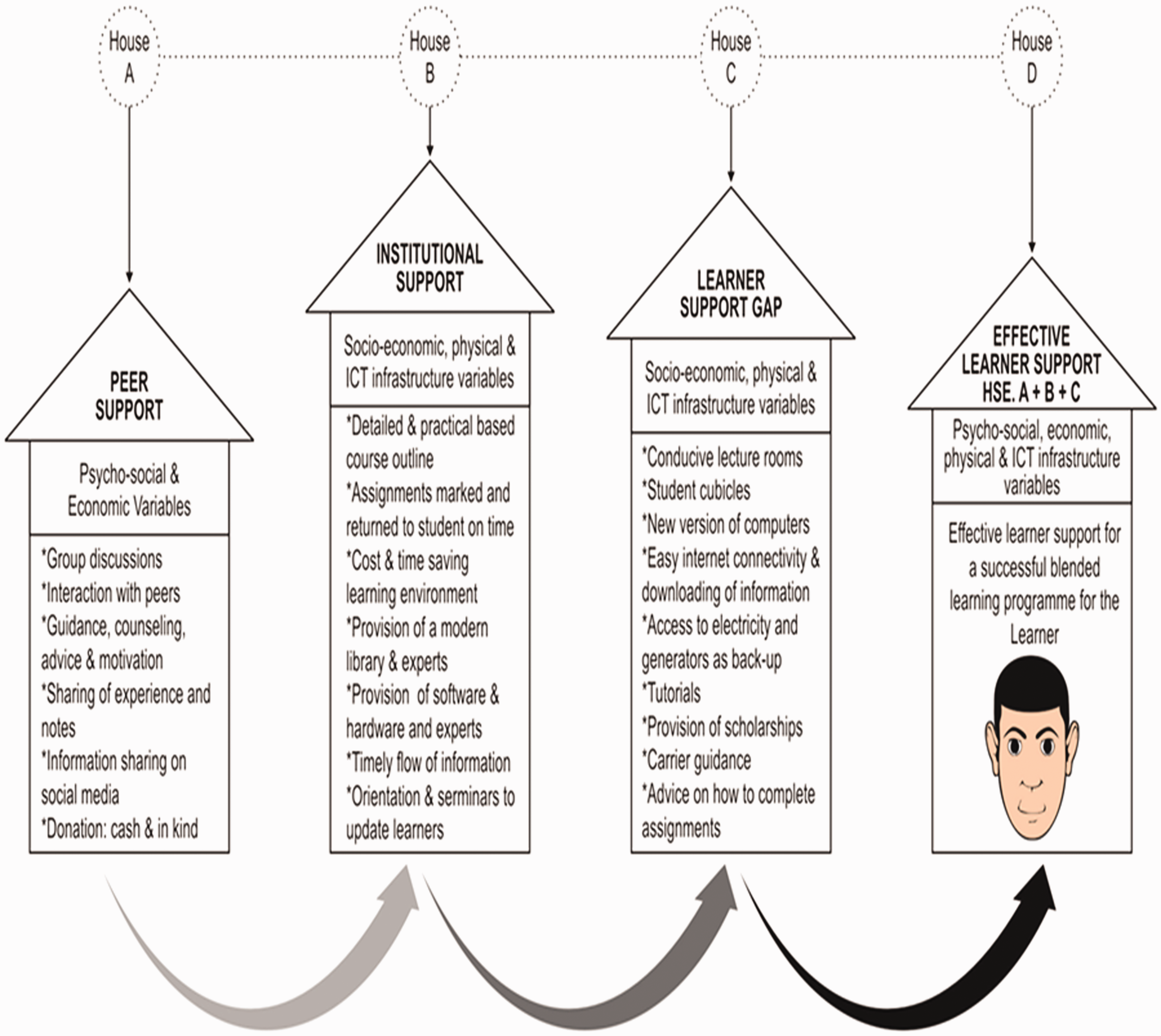
Learner Support Conceptual Framework (researcher’s own formulation).
Learner Support in this context (see Figure 1 below) is made up of peer support (labelled A) and institutional support (labelled B). The peer support is normally psychosocial and the economic variables that support students learning. It is important to take note of some of its elements per the framework below which are consistent with the literature (Hughes, 2007; Tait, 1996; Yorke, 2002). The institutional support relates to socio-economic, physical and ICT infrastructure variables that students need in order to enjoy blended education. See the conceptual framework below (labelled B) for some of its support elements which are in consonance with literature (Thorpe, 2002).
It is also important that the institutional support operates to promote the emotional well-being of the learners in order to enhance their self-efficacy. Providing care, empowerment and an enabling environment for self-determination will ensure self-confidence and control for the students. From blended learning practice, the peer and institutional support made available for the students pertaining to the current study were not adequate. There is a significant Learner Support Gap which is primarily an institutional performance gap that must be addressed. See Learner Support Gap labelled ‘C’ on the Learner Support Conceptual Framework above. This confirms reports from contemporary studies on students’ views on learner support (Asamoah and Mackin, 2016; Asamoah and Oheneba-Sakyi, 2017) which suggest that institutions should make learner support available for an effective blended learning programme. The greater the extent to which the learner-support gap is addressed, the more effective the outcomes that a learner-support system could achieve on a blended learning programme. The unique support needed by graduate students engaged in a blended learning programme is the provision of the Learner Support Gap items labelled ‘C’ (see Figure 1). These unique support requirements must inform the best design for blended learning in Ghana, Africa and the world at large. For example, where there are frequent power outages, solar power technology must be considered as an alternative. Where there is limited or no Internet connectivity in students’ homes, the university could partner with Internet cafes around student's neighbourhood and absorb some of the students’ costs in using them, as a way of improving Internet access for learners.
Final assertion
There is a global challenge to break the iron triangle through increasing access to education, reducing the cost of education and improving the quality of education concurrently. The panacea is the deployment of blended and online learning. However, learner support is crucial for successful ICT-driven education. Although fast Internet access, constant supply of power, communication infrastructure, availability of hardware and software, e-library, and access to ICT experts or technical staff are very important for blended and online learning, the more critical issues are the teaching design, the learning and numerous other forms of learner support needed such as providing guidance, advice, counselling and motivation to the blended/online learning student (Dennis, 2003; Hughes, 2007; Tait, 1996); and providing the infrastructure and technical services to the students as stated earlier.
Footnotes
Declaration of Conflicting Interests
The author(s) declared no potential conflicts of interest with respect to the research, authorship, and/or publication of this article.
Funding
The author(s) received no financial support for the research, authorship, and/or publication of this article.