



Abstract
The process of studying a foreign language in Russian higher education institutions is carried out in a specially organized linguo-didactic language environment which is understood as a methodological framework designed in accordance with the peculiarities of a linguo-cultural community. It is aimed at combining learning methods and techniques to implement them into pedagogical practice, ensuring the level-by-level development of students’ language skills and complying with the international standards of language proficiency. The necessary modern basis for a linguo-didactic language environment is the use of Information and Communications Technology, which makes it possible to access the world of native speakers. The linguo-didacticlanguage environment creates socio-cultural communication patterns, provides an opportunity to become familiar with a different communication behavior, ensures students’ participation in real communication expanding the boundaries of language learning situations and enriching their communication experience. The attributes of the language environment include audiovisual materials, speaking practice, spoken and written language as well as cultural background knowledge and different learning components. The subjective attributes of the language environment include students’ cognitive activity, motivation and individual learning abilities. The conceptual model is aimed at teaching oral communication in a second foreign language in an artificial language environment which is based on the analysis and description of a current situation in the field of teaching a second foreign language at Russian universities, on perceiving a language situation as a basic education unit; on choosing the model of cross-cultural communication; on selecting the components of a natural language environment which have teaching potential and comply with the learning aims; on defining the learning methods; on creating the model of the designed environment.
Keywords
Introduction
In the last few years, the Russian educational system has been intensively developing. As learning a second foreign language is becoming more popular, the language requirements are becoming stricter as well. The system of higher professional education in Russia has recently undergone a lot of reforms which have been inspired by other countries’ experience. In particular, the changes concern the shift of linguistic education to a competency-based approach and one’s language assessment in accordance with the European standards for grading. Thus, the process of learning a second language should correspond to European standards and the communicative competence should correspond to the accepted international level. In the modern world the bilingual approach to education is regarded as a necessity. Moreover, taking up a second or a third foreign language at Russian universities is becoming more and more popular.
Nowadays, the choice of a foreign language depends on its practical application and on how it can contribute to one’s personal professional development. In most cases English is the first foreign language one studies; however, many students also choose to study French.
Teaching a foreign language to Russian students should involve the use of authentic multimedia resources. The teacher defines their place and role in the course of education. It is vital to select appropriate materials, adapt and make sure they possess the necessary didactic properties and integrate the materials into the learning environment. Thus, we may conclude that adapting the European standards to the realities of Russian education is currently a topical issue.
Discussion
In a linguistic higher education institution, a second foreign language (French in particular) is a compulsory basic course. It is aimed at forming foreign language competence in different types of language activity (listening, speaking, reading, writing, translation) and comprises different training levels (phonetic, grammatical, lexical). The program includes a number of interactive tasks (team work, role play, presentations, brainstorming, round table discussion) and is based on interaction between the teacher and students.
The process of learning a second foreign language (French) ensures the rotation of speech and linguistic material, includes a cognitive component of teaching French, implies students’ independent research and autonomous activity in language learning. The final objective of learning and teaching a second foreign language is the formation of a foreign language competence which allows to handle successfully professional and personal tasks in the sphere of cross-cultural and interlingual communication.
The French language is taught and learnt in a linguo-didactic language environment which reflects the realities of the target country; audiovisual component; speech situation; text (printed, spoken, electronic). However, speech situation is considered to be the main component aimed at the development of spoken communication in class. We distinguish between educational speech situations and natural speech situations. A speech situation represents specifically arranged conditions and relations which for the sake of communication are imposed on the learners in order to use speech material in a phonetically and grammatically correct way (Orekhova, 2004: 21). Based on the definition we can say that the educational speech situation is created with the help of a teacher. We regard the educational situation as a paradigm where the teacher provides students with certain conditions with the aim of communication.
According to many researchers it is possible to reach a linguistically correct behavior under conditions of educational speech communication (Lyakhovitskii, 1981: 34–38; Milrud and Maksimova, 2000). Unlike the artificial language environment, the natural language environment significantly widens the range of speech situations; it presents a number of authentic speech situations which demonstrate the language skills to be obtained in the course of learning providing an idea of the desired proficiency in the target language.
Speech situations, according to Evgeny Vereshchaginand Vitaly Kostomarov, may be divided into standard and variable (Vereshchagin and Kostomarov, 1999: 20–64; 65–79). Both types of speech situations exist in language environment in real communication, but variable speech situations dominate. In standard speech situations verbal and non-verbal behavior is regulated, which makes it easy to reproduce them in the classroom by using visual textbooks. However, the presence of a natural language environment gives an opportunity to extend the boundaries of the learning process and helps to learn the language faster as well as use the behavior patterns more effectively. The problem lies in the fact that the changes taking place in France lead to changes of common situations. For example, the subway ticket or Carte orange can be bought at terminals, not at the ticket window, as it used to be before; in order to have a medical appointment one has to wait for three months and more, which was not the case before; if calling SAMU (Urgent Medical Aid Service), it may be impossible due to lunch break. The authentic common situation may be different from the one taught in class in terms of its topicality, therefore, only the natural language environment allows to go through “observation – mastering – practice – self-control and self-correction” (here we may refer to Aleksei Leontiev’s idea about the diagnostic function).
In the framework of the current research a particular emphasis is put on the national communicative behavior, which is defined as a collection of norms and traditions in national communication of a certain linguacultural community (Lemyaskina and Sternin, 2000; Prokhorov and Sternin, 2007). It is believed that the description of communicative behavior may be successfully used in the process of teaching and learning a second foreign language. (Prokhorov and Sternin, 2007: 54–55). The contextual model of communicative behavior includes: (1) verbal communicative behavior: standard communicative situations (greetings, farewells, address, compliments, condolences etc.); communicative spheres (communication with familiar people, neighbors, unfamiliar people, communication in public transport, church etc.); (2) non-verbal communicative behavior: the body language (look, mimics, postures, nominative and emotional evaluation gestures etc.); silence in communication (its functions and its acceptance in communication); non-verbal symbols (wealth, poverty, solidity, high social status) (Prokhorov and Sternin, 2007: 126–142). The major task of the learning process in a linguo-didactic environment is to master speech communication skills. Thus, it is important to draw one’s attention to the native speakers’ communicative behavior and to refer to it while teaching the French language using the contextual principle. Communicative behavior is closely related to the national socio-cultural stereotype of the speech communication. Juri Prokhorov regards a stereotype as a mental linguistic unit, a normative socio-cultural unit of communication between representatives of a certain ethnos (Prokhorov, 1997: 84–87). A stereotype may take a form of either a cliché or a verbalized/non-verbalized pattern of conscience (Morkovkin, 1988). The term “stereotype” represents well-established familiar patterns of communication, which were formed in the course of time and therefore, have been used by native speakers in communication for a long period of time (Orekhova, 2004: 27). Correspondingly, the socio-cultural stereotypes of speech communication, as well as communicative behavior, are primarily reflected in literature.
Juri Prokhorov provides four models of cross-cultural contacts: (1) first contact, (2) awareness, (3) immersion, (4) interaction (Prokhorov, 1997: 104–112). The “first contact” is regarded as a divergence of communication stereotypes in different cultures. In spite of this, communication can still take place even if certain communication rules and patterns are not complied with. The “awareness” implies that both interlocutors are aware of existing stereotypes, but one of them uses two types of communication stereotypes (one’s own and the other interlocutor’s one), while the other uses only one type of communication stereotypes (his or her own one). The “immersion” implies acceptance of new communication stereotypes and as a result, mastering them (Prokhorov, 1997: 104–109). This type of cross-cultural contact allows students to assimilate new communication stereotypes which do not exist in their culture. This contributes to the development of necessary skills in French and allows students to move to the level of “interaction”.
Thus, speech situations, communicative behavior, socio-cultural stereotypes of the speech behavior and cross-cultural linguistic contacts allow to consider the target component of the linguo-didactic language sphere as a contextual model.
Another significant component of the linguo-didactic language sphere is the text (printed, spoken or electronic), which is represented by books, materials of the French printed media, booklets, signboards, advertisements etc. It creates the basis for developing speech skills in both native language and the foreign one. The Internet offers numerous opportunities to access a foreign text in all its variety of genres.
The text belongs to the class of language phenomena which has always attracted linguists’ attention. Juri Prokhorov points out that each researcher has his or her own understanding of the notion “text” and gives his or her own definition to this term, according to the scientific field the researcher belongs to and the researcher’s own views and preferences (Prokhorov, 2004: 11).
VV Krasnykh distinguishes the following functional parameters of the text. According to her, the text is: (1) a product of verbal and cogitative activity, which is symbolically represented in either oral or written form; (2) a verbally and symbolically represented “reaction” to a situation; (3) a verbal reflection of the situation; (4) a verbal and cogitative product which is complete and independent in terms of information; (5) a verbal and cogitative product which possesses thematic, structural and communicative unity; (6) something objectively essential, material and possible to be represented via extralinguistic means (letters, audio/video recordings etc.); (7) a predicative unit, where predication means a verbal act with which the author uses in order to describe the surrounding environment and his or her outlook of the world, which changes the existing objective world; (8) something which changes the outside world and the extralinguistic reality by the fact of its existence; (9) in terms of the formal structure of the content and the extraction of elements of discourse, the text is the production of speech which starts as a non-verbally expressed idea and ends as a verbally expressed phrase (Krasnykh, 1998: 198).
Juri Prokhorov demonstrates the content of the text as a language unit. According to him, the text belongs to the phenomenon of a linguistic and extralinguistic reality which represents a complex phenomenon: this is a means of communication, a way of storing and transferring information, a reflection of the individual psychological state, a historically based product, a form of cultural existence, a reflection of national culture and traditions (Prokhorov, 2004: 46–53).
Nowadays, thanks to the opportunity to have access to the websites of French magazines, newspapers, radio and television, the field of the text functions is significantly wider. Hypertext is a specific type of text, which serves as a source of information for cross-cultural communication in the electronic virtual reality. It provides an opportunity to manage discourse, as a means of access to educational resources, where the language is used and where one may effectively form linguistic and communicative skills. In the hypertext educational environment students may – according to the teacher’s directions or independently – search and select the necessary information and communicate in the virtual network, assimilate French national mentality and form a linguistic world outlook. The work with the multimedia hypertext network allows to individualize the learning process, make it more interactive and entertaining and prepare the student for French linguistic culture. Moreover, it helps to enrich one’s vocabulary and stimulate learning activity and students’ motivation. In other words, it allows to form a system of objectives for mastering the foreign language. Aleksei Leontiev views this system as “the process of meeting students’ needs in a certain form, which encourages students to start learning activity” (Leontiev, 1975: 202–204).
The main objective factors which motivate one to learn a foreign language are the necessity to use the language for work, to have access to the information available in a foreign language, to communicate in the language with native speakers. The objective factors unite and influence the person, thus becoming a source of motivation for learning the language. Irina Zimnaya defines the motivation to learn languages as a set of different needs, motives, senses, norms, wishes etc. All these factors unite and form an inner motive to learn a foreign language (Zimnaya, 1999: 130).
The above-mentioned poll conducted among students has allowed to bring out the hierarchy of inner motives while learning French as a second foreign language. These motives include centuries-long historical and cultural bonds between Russia and France; the beauty of the language; the opportunity to continue studying at a French university; the wish to travel and communicate with native speakers. It should be noted that the upper position in the hierarchy is occupied by the cultural motive In this respect, it is relevant to refer to Pyotr Galperin, who pointed out that at the heart of learning motivation lies one’s cultural interest as well as spiritual needs and creative approach towards acquiring new knowledge (Galperin, 1972: 109–133).
Teaching speech communication in a foreign language in terms of culture is carried out with the help of the following fundamental principles: the principle of methodological correspondence; the principle of analyzing the native (Russian) language and the studied (French) language; the principle of the unity of the language and speech culture; the principle of speech orientated education; the principle of conscious and active learning of a foreign language using modern information and communication technology (ICT); the principle of setting communicative tasks; the principle of bilingual control in education. Let us consider these principles in more detail.
The principle of methodic correspondence. The formation of a bilingual identity in students is based on mastering a range of general professional and humanitarian disciplines and is thus considered an integrated process. The mastered disciplines are therefore united in a conceptual functional unity. Such organization allows to link different subjects, to develop students’ ability to comprehend and analyze the phenomena from different points of view and to understand the interconnection between the analyzed phenomena.
The principle of analyzing the native (Russian) and the studied (French) languages. While organizing the learning process for the students of linguistic professions, it is necessary to understand that language education takes place in the artificial bilingual environment, i.e. it is realized in two languages – the native language (Russian) and the studied one (French). While learning the French language, students have to learn how to think in it. The application of the given principle develops linguistic thinking, forms switching mechanisms between languages, helps to make the right choice of language means in the communication process and to concentrate on the semantic component of speech. The level of foreign language proficiency depends on how well the native language is developed. The native language is the basis for learning a foreign language and ways of expressing thoughts in a foreign language. In order to make the communication in a foreign language more effective, it is important to achieve a high level of language skills which will ensure a positive influence on the student’s behavior. The students possess such a (comprehensive) level in their native language. Thus, in the process of learning a foreign language it is necessary to rely upon students’ native language, to use both (native and foreign) languages in the communication process, to pay special attention to the semantic component of speech and the adequate choice of language means in both Russian and French. The comparative and contrastive analysis plays an important role. It contributes to the effective communication in both native and studied languages, to understanding similarities and differences in Russian and French speech and language behavior.
The principle of the unity of the language and speech culture. Communication in a foreign language implies an ability to carry out a cross-cultural conversation, which contributes to the mutual understanding and mutual cultural enrichment. A cross-cultural conversation implies not only language proficiency but also cultural knowledge about the native country and the country of the language studied. In order to get to know a new culture, it is important to be familiar with one’s own native language and the traditions of one’s own language culture, since they influence the development of bilingualism and help to assimilate a new language and culture. Thus, if one knows the norms of one’s native language and culture, one is better at overcoming the difficulties presented by bilingualism and enters a new language culture more easily. Mastering the language and cultural skills allows the student to take part in cross-cultural communication following the norms of language behavior which exist in the native country and in the country of the studied language. It is important to be aware of the national and cultural peculiarities, ethical norms, rules of behavior. Knowing and applying this knowledge allows students to enter the foreign language environment and follow the rules of language behavior. Following the rules and norms shows respect of native speakers, helps to adapt to a new cultural and language environment and contributes to the mutual understanding in communication.
The principle of speech-oriented communication. The given principle promotes the conscious assimilation of speech knowledge and the formation of necessary skills. The formation and development of speech skills requires students’ regular speech practice. This principle implies that students are actively involved in the process of communication in class, express their personal opinion and prove it, discuss other students’ points of view. The students’ verbal and cogitative activity is intensified through communicative tasks.
The principle of conscious and active learning of a foreign language with the use of modern Information and Communication Technology implies referring to the digital sphere of language functioning. This approach allows students to look at the (French) language from a new point of view and observe the peculiarities of social interaction between native speakers and to get to know the foreign culture in the natural environment.
It should also be noted that foreigners receiving education and language training both in the country of the studied language and at home are now simultaneously immersed in two foreign-language environments – in real and virtual environments. In this regard, the teacher is obliged to take this situation into account and systematically assess the interaction between these two environments and suggest the rational ways of integrating them into the learning process. Ignoring such an important sphere as a foreign-language environment of global networks impoverishes the course of a foreign language and makes it incomplete and irrelevant (Vishniakov and Dunaeva, 2017: 128–129).
The principle of setting communicative tasks. Dealing with communicative tasks during the learning process means to motivate students to learn the French language, to use it for communicative interaction in both real and virtual spheres of life. Moreover, this principle contributes to personal development.
The principle of bilingual control in education. The given principle allows to assess the students’ initial level of communicative, verbal and bilingual skills and to provide help with overcoming any difficulties. Regular testing helps to determine students’ level of communicative, verbal and bilingual skills and communicative behavior in general, to see their strong and weak points in the process of communication in French. The students are not always able to evaluate their communication level, to name the strengths and weaknesses of their speaking skills. By analyzing the test results, we have an opportunity to give an objective evaluation of the skills development among students of linguistic professions and to give them advice on how to achieve better progress.
An important role in organizing oral communication and teaching a foreign language is played by methods and ways of achieving the goals. In the learning process we may define the basic methods (the methods of acquiring knowledge) and the supporting methods (the methods which form skills). During the learning process the basic theoretical educational methods are represented by explanation, comparative and contrastive analysis, conversation. Visual material, video- and audio-recordings are used as well. The final aim of learning is to master communicative skills in a second foreign language which will allow students to compare and contrast the phenomena of their native and non-native languages and the speech norms. The teacher uses the comparative and contrastive analysis which allows to see the similarities and differences between the native and the foreign languages and language cultures, which helps to understand better the language peculiarities. This method is carried out via such activities as: comparison, contrast, translation from Russian into French and vice versa, selection of the language means in Russian and French. The tasks involving the above-mentioned activities form observation skills, develop concentration and thinking, teach to work with texts and to select necessary information. The use of comparative and contrastive analysis motivates the students to learn the language and to know more about the foreign culture, hence expands the world outlook.
The practical methods include those which are used in the process of completing written and oral pre-communicative, communicative and post-communicative tasks. While the task is being fulfilled, the students receive all necessary theoretical information which contributes to the formation of communicative and oral bilingual skills.
By educational means we understand the texts in student books and guidebooks, articles taken from French newspapers and magazines, French radio and television; French media sites which demonstrate the examples of cross-cultural interaction. They comprise different communicative situation models, which show the patterns of language behavior. They contribute to the comprehension of language behavior and the formation of communicative oral bilingual skills. The given educational means increase students’ motivation to learn a foreign language. The supporting didactic material includes tests. By assessing students and analyzing the results, the teacher is able to determine each student’s level of communicative and oral bilingual skills. With the help of analytical, comparative and contrastive tasks, the teacher develops students’ abilities to compare, to make conclusions, to follow the language behavior rules which are accepted in the native country and the country of the studied language.
The model of education environment in learning French as a second foreign language is presented in Figure 1.
Figure 1 shows that students are trained using authentic multimedia components of the linguistic environment, they are immersed in French. Thanks to this environment, students achieve a high level of French language proficiency and successfully pass international DELF/DALF exams.
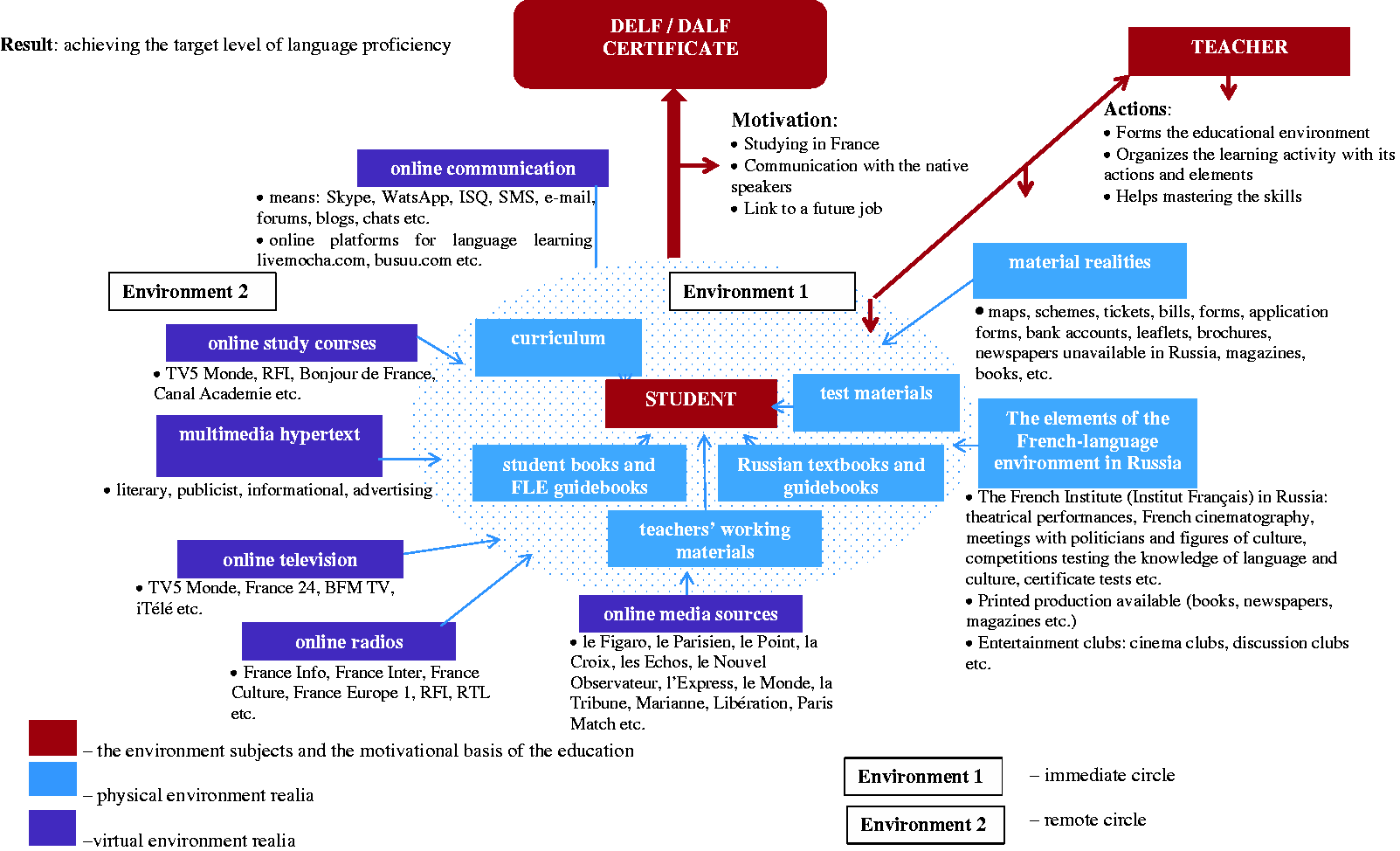
The model of the language environment of teaching/learning the French language as a second foreign one.
In order to create an intense language environment, we have defined the authentic multimedia components of the linguo-didactic environment, which we have been selected according to the following criteria: brevity of the news, repetition, availability of the resource in the country where the language is learned, multiple formats and genre variety. Thus, we have integrated France Info, Europe 1, RFI, France Inter, France Culture and RTL radio stations in the educational environment. These radio stations broadcast brief news items, which are repeated over a certain period of time; talk shows; interviews with the guests from various spheres of life including literature, culture, politics, economy; sports; health programs. In turn, the TV5 Monde, iTélé, France 24, BFM TV, Canal plus television channels offer different genres of discourse (interview, abstracts, reports, conversation, discussion, commentary, review); Le Figaro, Le Parisien, Le Monde, Le Point, l’Express, La Croix, Le Nouvel Observateur, Courrier International, Paris Match, La Tribune, Marianne, 20 Minutes, Notre temps newspapers and magazines offer texts in different formats (audio, video, graphics, photography) and genres (interview, abstracts, reports, conversation, discussion, commentary, review). The above-listed points ensure that the student is plunged into French language environment and acquires communicative and oral bilingual skills.
Moreover, we have considered the education-centered criterion and the following education program sites to be included in the environment: “7 jours sur la planète” (TV5 Monde site) with audio- and video-recordings of the current news reports and exercises which are aimed at developing listening, writing and speaking skills correspondingly (A1-B2 levels); “Le journal enfrançais facile” (RFI site) offers audio-news and commentary in a simplified language (A1–A2 levels); “Apprendre à écouter” (RFI site) offers news reports aimed at improving listening skills, tasks with automated online-keys and questions to the audio-texts; “Bonjour de France.com” is designed for leaners with different levels of French (vocabulary, grammar, listening, country studies, business language).
Results
As we have mentioned before, the process of learning French by Russian students of linguistic professions should involve the use of authentic multimedia resources. The teacher defines their place and their role in the profession-oriented education, which involves selection, methodic adaptation, addition of didactic properties and environmental integration in the process of learning based on students’ needs.
Communication and Information Technology serves as an inexhaustible source of acquiring communicative and oral bilingual skills. It demonstrates the French language as it is used in real everyday social life, opposing it to the language in the classroom – flawless and ready to fulfill didactic functions.
Learning a foreign language via ICT and mass media becomes more and more attractive. The use of satellite dishes allow to watch television programs from anywhere in the world. If the language is no longer available through mass media, it will immediately lose its power in the global competition.
The greatest learning potential is provided by such information resources as websites for television, radio, newspapers and magazines.
The French TV5 Monde television embraces the entire planet. The half of 250 thousand teachers have never been to France (Porcher, 1995: 93). Many of them have never talked to a native speaker. Nevertheless, they have to pay attention to colloquial speech and understand it in order to pass on their knowledge to students. TV5 Monde makes a great contribution to this process. It serves as an ultimate source of motivation in teaching and learning the French language. TV5 Monde offers the programs shown in All right Table 1.
TV5 Monde programs.
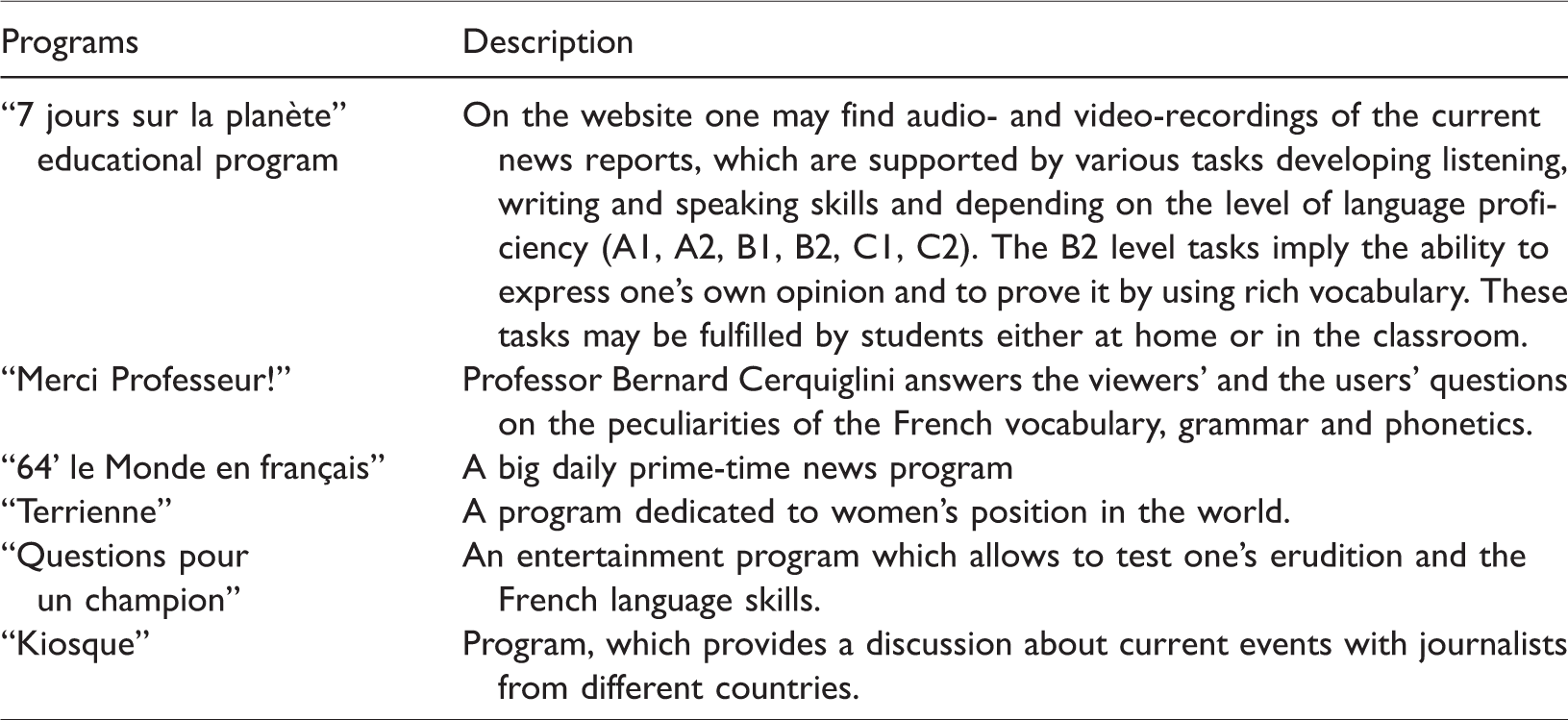
Moreover, the channel broadcasts French documentaries and feature films.
TV5 Monde stimulates the mind and the learning process; it has positive influence on students’ motivation to learn the French language. It allows to keep up students’ cognitive motivation with the help of verbal and non-verbal activities, which are provided in the on-screen communicative situations (the on-screen situations encourage an active use of acquired knowledge, support personal cognitive interest and promotes further development).
France 24 is a television news channel broadcasting the latest news, reports and interviews around the clock. From the methodical point of view repetition of short news items is extremely useful.
BFM TV is a round the clock news channel offering reports and interviews.
The information resources of French television allow learners to use the authentic ways of communicating with native speakers, to plunge into the natural language environment. All the changes which take place in semantics and the structure of the language are reflected on television. The French television reflects the peculiarities of national mentality, social life and national stereotypes. Thus, television serves as an information source which allows to study the cultural background of France in the process of educational interaction. The students are able to compare how a certain piece of information is highlighted in Russian and French mass media.
The next mass media resource which is useful in French learning is the radio. The Internet makes it possible to listen to any French radio station, e.g., RFI (Radio France Internationale) – the French international radio which contributes to the French language and French culture spreading all over the world. The main advantage of this radio station is online educational programs for each language level (A1, A2, B1, B2, C1, C2). The site section is called “Radio France International, apprendre, enseigner la langue française”. The educational programs shown in Table 2 were selected.
RFI educational programs.
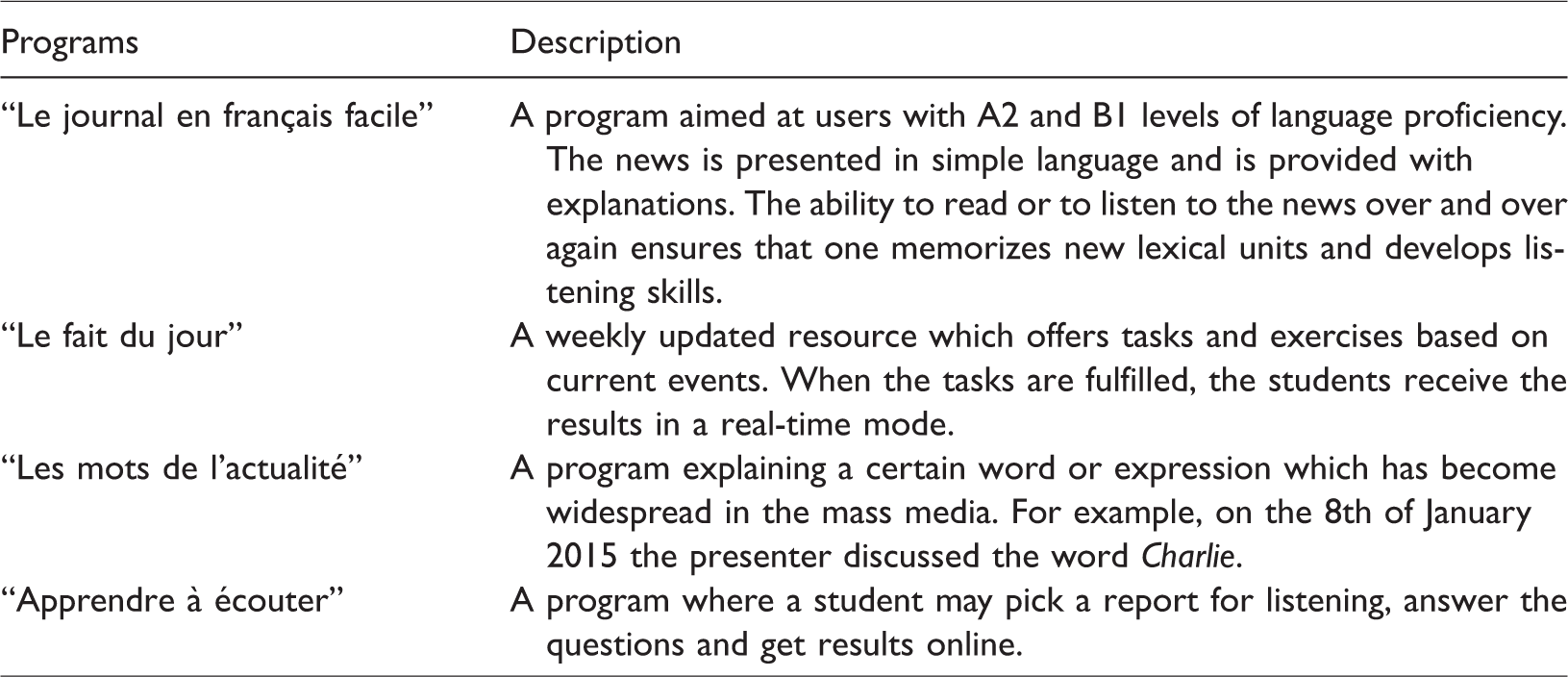
RFI is another source that contributes to French learning. By listening to this radio station, the students not only keep up with current events but also have an opportunity to improve their level of language proficiency. They may complete different tasks online and evaluate their level of language skills (Table 3).
French radio station.
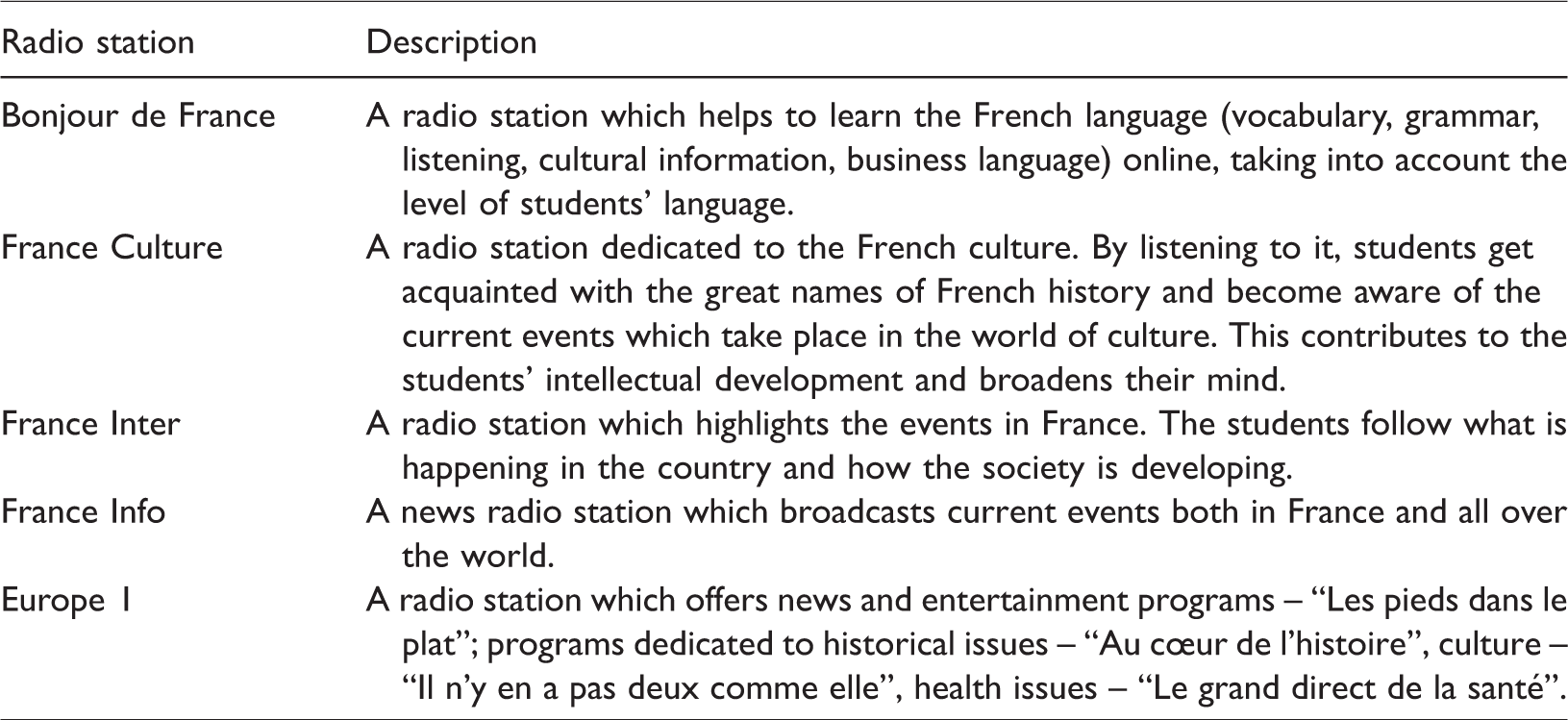
As we may see, there is a wide choice of different French radio stations. It is important that students regularly listen to the French radio, since it encourages not only the development of listening skills but also enriches their vocabulary but has a positive influence on intellectual development.
French newspaper and magazine sites play an important role in applying mass media texts to the learning process. In the learning process they have a bigger number of advantages compared to authentic television and radio texts. Firstly, the news presentation on a newspaper or magazine site sets the necessary conditions to become acquainted with the information and to define one’s priorities in reading. Thanks to its static character, a hypertext in the Francophone virtual network allows to read the information several times in order to reach full comprehension and to work with the language in the text. In the ‘podcast’ section one may read and listen to the pre-recorded entertainment or educational programs. The hypertext allows students to adjust the learning process in accordance with their reading tempo and skills. The visual perception of hypertext helps to memorize the language means used in the text. In general, hypertexts are applicable to the methodic modelling, mostly at the initial level of learning French.
We suppose that the newspaper and magazine sites shown in Table 4 contribute to the effective bilingual learning.
Newspaper and magazine sites.
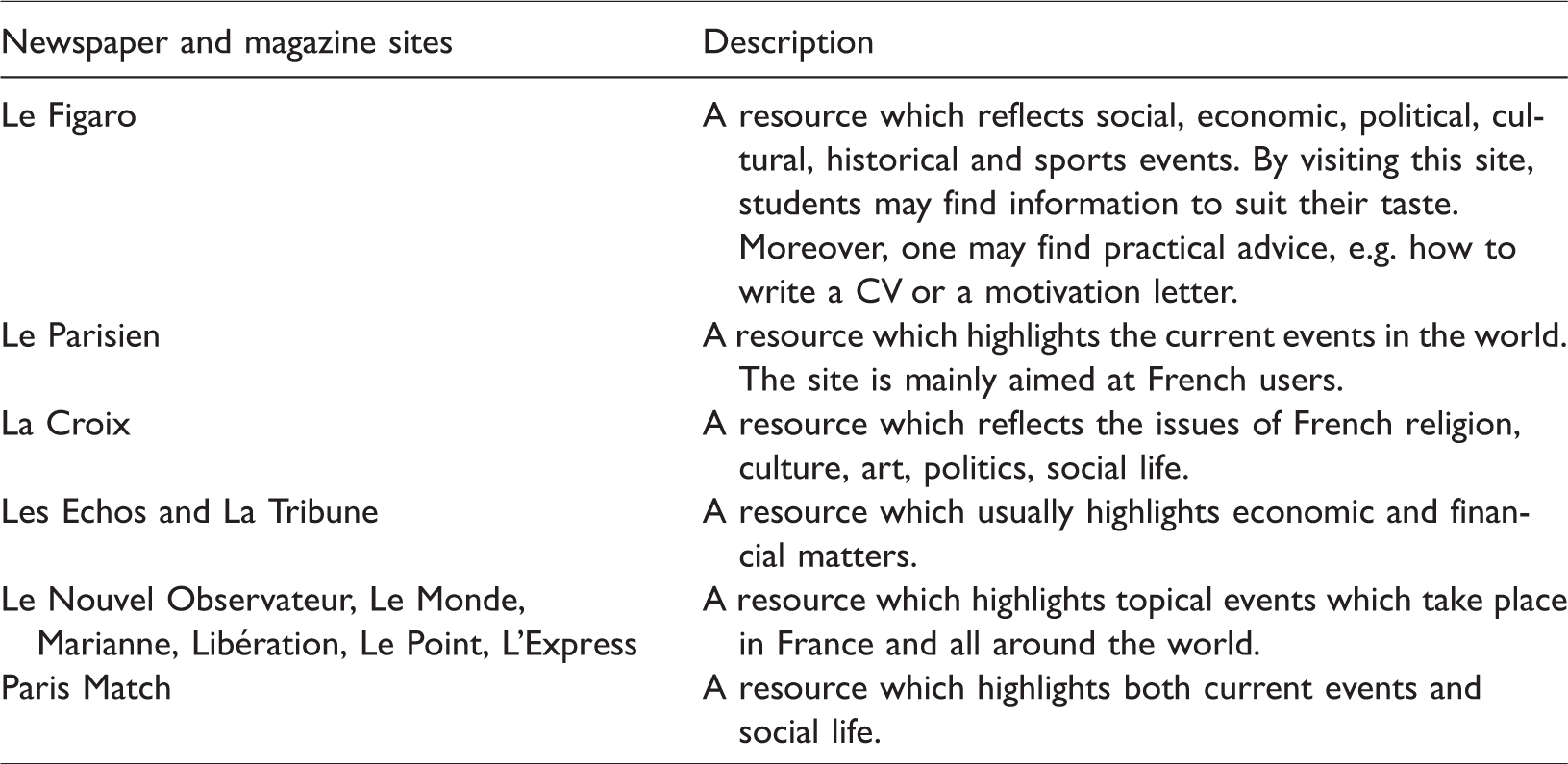
The wide choice of French newspaper and magazine sites allows students to pick the information which is interesting for them.
French printed press sets a classical example of a source of information about events which take place in the country and worldwide in the political, economic, social and cultural spheres. The above-listed newspapers provide authentic and balanced information and are aimed at those readers who wish to get detailed information and are interested in the articles on different topics.
The Internet offers the students a great choice of hypertexts which evoke personal and professional interest. The information related to science, culture, education and economics help the French language teachers to realize the most significant objectives of the profession-oriented education in a linguistic higher education institution.
Below we will consider the examples of using French hypertexts on the different stages of learning the French language in a linguistic higher education institution.
At the initial level of learning French students have different levels of basic language skills and little background knowledge. For this reason, hypertexts, selected according to their complexity, should reflect mostly factual information with little evaluative vocabulary. At the given stage of learning we may use simple news items, headlines, cooking recipes, weather forecasts. The tasks aimed at comprehending the contents of the hypertext, should include true or false statements, multiple choice, wrong order of pieces of text. Oral skills may as well be developed via tasks which involve expressing one’s attitude to a certain problem.
At the middle stage of learning we may use interactive educational methods (work in pairs and groups). “Brainstorming” and co-operative learning develop spontaneous French speech.
The advanced stage is characterized by oral tasks. At the lesson the teacher offers a hypertext for discussion. Students express their opinion and to prove it. Moreover, students choose a hypertext they like to make a presentation. The issues, which are raised in these hypertexts, may become a topic for discussion in class.
To make the work with hypertexts in the Francophone virtual network more productive, it is necessary to develop methods of extracting information. These methods will help to understand the text more quickly.
The organization of the learning process based on the multimedia model will allow: to support the students’ motivation to learn (in general) and to learn French (in particular); to actualize their competences and skills in the Francophone virtual network; to form new competences in the sphere of language communication using cognitive processes for analysis and synthesis of received information and students’ interdisciplinary and life experience.
Conclusion
The ICT means (above all television, radio, online newspapers, magazines and websites) represent an inexhaustible source of information for acquiring communicative and oral bilingual skills. The role of ICT in handling didactic tasks is the following: (1) formation and development of reading skills; (2) formation and development of listening skills; (3) formation and development of skills for monologue and dialogue; (4) vocabulary enrichment; (5) acquirement of cultural knowledge about the country; (6) formation of communicative culture; (7) formation of a stable motivation to learn; (8) formation of cross-cultural competence; (9) the use of educational Francophone network contributes to learning French in the natural language environment; (10) interactive form of vocabulary and grammar tasks; (11) interactive work with the French language taking into account the level of language proficiency.
The use of ICT in the sphere of teaching and learning the French language allows to understand the practical purpose of education (mastering the French language as a means of communication), including such purposes as educational and cultural. The use of ICT contributes to the formation of a socio-cultural competence, expands one’s knowledge of political, economic and social issues as well as culture and art.'
Footnotes
The author(s) declared no potential conflicts of interest with respect to the research, authorship, and/or publication of this article.
Funding
The author(s) received no financial support for the research, authorship, and/or publication of this article.