




Abstract
Today, educational practices are being designed and varied due to advance of millennium generation who tend to use mobile technologies in every aspect of their lives. Accordingly, growing interest towards mobile learning in education brings several opportunities and advantages for English as foreign language teachers and learners. Augmented reality, which is another growing phenomenon on mobile devices, is a technology that incorporates digital information such as images, video, and audio into real-world spaces. As a part of mobile learning, augmented reality technique has potential to facilitate learning through enjoyment over learning tasks, engagement and motivation. Designed in descriptive survey model, this study intended to assess English as a foreign language learners’ subjective experience regarding the implementation of augmented reality-based learning materials in their language classes with a game-based approach in Anadolu University, Turkey. The analysis of the questionnaire items showed that most of the students accepted the activities in augmented learning environment highly motivating and enjoyable, which is common in augmented reality research.
Keywords
Introduction
It is a known fact that ubiquity of Internet access on mobile devices has become a growing phenomenon across the world in recent years. According to global digital statistics in 2017, with 10% annual growth, more than half of the world now uses smartphone and more than half of the world’s web traffic comes from mobile phones with broadband mobile connections (We are social-digital in 2017, 2017). Similarly, International Telecommunication Union’s report for 2016 indicates that 95% of the global population lives in an area that is covered by a mobile-cellular network and Mobile-broadband networks (3G or above) reach 84% of the global population (ITU, 2016). As a matter of course, today educational practices are being designed and varied due to advance of millennium generation who tend to use mobile technologies in every aspect of their lives. Augmented reality (AR), which is another growing phenomenon on mobile devices, is a technology that incorporates digital information such as images, video, and audio into real-world spaces. Besides use of this application in marketing, sport, and entertainment, it has now become more widespread with real opportunities for it to be used for educational purposes. This technology makes it possible to blend virtual environment with reality. Users of this technology have a chance to learn in immersive, computer-generated environments through realistic sensory experiences.
As in many other learning environments, growing interest towards mobile learning (m-learning) in education brings several opportunities and advantages for English as foreign language (EFL) learners who tend to have difficulty in productive skills, particularly speaking. Foreign language learners often lose interest and motivation towards classroom activities due to experiencing similar exercises and learning materials provided either by course book publishers or the language teachers themselves. Even if publishers and language teachers provide students with audio-visual classroom materials, such materials often fail to allow learners to interact with each other, engage in activities, and more importantly, enjoy their learning experiences. When AR-based learning materials are designed with games-based approach, they can offer learners rich, real time, collaborative, and contextual learning experiences. Since learners are likely to perceive such materials as games, their motivation and interest towards learning a foreign language might tend to increase. In their oral productions, they may feel less anxious, but more confident while collaborating with their classmates. As a part of m-learning, AR technique has potential to facilitate learning through enjoyment over learning tasks, engagement, and motivation. AR simulations could provide language learners with intrinsically motivating gameful experiences, challenge, and unexpected delight, which in return might result in crossing the border between formal and informal learning. Designed in descriptive survey model, this study intended to assess EFL learners’ subjective experience regarding the implementation of AR-based learning materials in their English language classes with a game-based approach via Intrinsic Motivation Inventory (IMI) as the data collection tool during 2016–2017 academic year. Two subscales of IMI, which focused on interest/enjoyment and value/usefulness, were used in order to assess participants’ experience related to AR-based learning materials.
Augmented reality
The ubiquity of mobile technology in our daily lives has made universities realize the fact that many students are equipped with smart mobile devices which allow the collection, organization, transfer, storage, and presentation of information using wide range of Internet environments. These mobile technologies have become an increasing part of young generation’s daily activities, which consequently have made their entrance in educational contexts across the world. The advent of this technology is affecting both the delivery and creation of educational content and so it can be used to assist learning in many ways such as production and consumption of information, delivery of instruction, use of external apps in classrooms (Fraga and Flores, 2018). Similarly, the potential of mobile technology for teaching and learning has been emphasized since the 2010 Horizon Report (Johnson et al., 2010) and the latest report points out the significance of mobile technologies in terms of enabling learners to access anywhere (Becker et al., 2017), which attaches importance to the further improvement of digital literacy as an essential 21st century skill. m-Learning, a concept originated from e-learning, describes a type of learning activity that occurs by means of user’s portable communication device (laptop, mobile phone, Wireless Application Protocol, and General Packet Radio Services) without dependence on fixed locations (Laouris and Etokleous, 2005; Peters, 2007). m-Learning integrates flexible learning on the basis of interest and personal need (Hicks and Sinkinson, 2011) and it provides learning experience that is “just in time, just enough and just for me” (Rosenberg, 2001). m-Learning offers great potential to support lifelong learning (Waycott et al., 2005), provide a strong sense of ownership over the learning tasks (Hennessy, 2000), prepare learners for the wide range of subjects and skills necessary for the 21st century (Seifert and Tshuva-Albo, 2014), enhance motivation of both students and teachers (Morgan, 2010), support informal, flexible, and enjoyable learning which strengthens communication, collaboration and learners’ internal motivation (Jones and Issroff, 2007; Jones et al., 2007). As a matter of course, many higher education institutions have integrated m-learning into their programs providing their students with a great number of possibilities to support their formal and informal learning experiences (Ahmed and Parsons, 2013; Jones et al., 2013). In Turkey, the country that was the context for this study, 96.9% of the households own mobile phones according to Turkish Statistics Institution’s report for 2016 (TUİK, 2016). Accordingly, Organization for Economic Cooperation and Development’s report for 2015 (OECD, 2015) indicates that Turkey ranked second in the world for use of high-speed mobile broadband networks via smart phones. The majority of the Internet users in Turkey have access to the Internet through mobile devices and 4.5G services became operational in Turkey in April 2016.
AR is a concept used for a wide range of technology group that superimposes computer-generated materials such as texts, pictures, audio, or video on a user’s view of the real world, thus providing a composite view. According to some researchers, AR is defined with three main features: (a) combination of real and virtual worlds, (b) with real-time interaction, and (c) accurate three-dimensional (3D) registration of virtual and real objects (Azuma, 1997; Kaufmann and Schmalstieg, 2003; Zhou et al., 2008). Similarly, Höllerer et al. (1999) define AR applications as the interactive combination of real and virtual elements in a real context and time. According to Ludwig and Reimann (2005), AR is a human–computer interaction that combines virtual objects with real senses via a video camera. Thanks to advanced features of today’s smart phones with 3G Internet connection, GPS, motion and balance sensors, video cameras and touch screens, all required tracking, displaying, and interacting aspects of AR application features can be combined in one single device. It is possible to enrich a two-dimensional image just by hovering the device over the object to interact with a new audiovisual content. The New Media Consortium’s Horizon Report, which focuses on trends and technology developments that are anticipated to drive educational change, pointed out AR as the highest-rated topic in several previous editions and the report for 2016 brings out fresh perspectives by underlying the significance of this technology in teaching and learning. According to the report, these technologies have potential to prepare learners for the future workplace and pilot findings indicate positive impacts on the classroom as these technologies enhance learning by placing course content in rich contextual setting and fostering peer-to-peer learning (Freeman et al., 2016).
Game-based learning
Game generation of today is highly interested in playing computer or video games. This interest has led educators to embed games into their teaching because good games have become a model of 21st century learning. “The same principles that games use to ‘hook’ gamers can be used to ‘hook’ learners on anything worthwhile” (Gee, 2012: xvii). A review study by Tobias et al. (2014) points out a rapidly growing body of empirical evidence on the effectiveness of using video and computer games to provide instruction. This empirical evidence reveals the fact that people do learn from games. The important point to consider while transferring games into educational settings is to create tasks that have overlapping cognitive process engagements with the games. Studies show that engagement in the game and immersive technologies enhance learning (Barab et al., 2009; Hamari et al., 2016), improving learner motivation, flow state, and satisfaction degree (Hwang et al., 2015). Another review study also reveals that game-based learning presents new opportunities for learners to produce their own materials, share learning experiences, and rehearse skills for the “real-world” (de Freitas, 2006), and it might be effective in facilitating students’ 21st century skill development (Qian and Clark, 2016). Use of mobile games that combine situated and active learning with fun results in higher engagement and significantly more gain of content knowledge compared to regular instruction (Huizenga et al., 2009). Game-based learning should not be considered merely for the purpose of learning content, but also to experience failure and success, learn how to use in-game immediate feedback strategically, and get prepared for problematic contexts in real life. As Barab et al. (2009: 80) points out “By helping students connect virtual accomplishments to real-life scenarios, we lead learners closer to John Dewey’s ideal of learning… when students solve problems in virtual scenarios, they get a taste of the real-world power of academic content”.
AR in education
AR has a wide range of applications in teaching and learning contexts. Çetinkaya and ve Akçay (2013: 2) define the advantages of AR as follows:
In AR applications, use of 3D visual objects draw attention of learners, which increases participation and motivation. AR makes it possible to support teaching of difficult, expensive, or highly complex experiments which are prohibitive in many laboratory situations, yet demonstrating the results is often essential to understand theory. AR enhances student–student and student–teacher collaboration by providing collaborative tasks. AR helps to foster learner’s creativity and imagination. AR can be used for educational entertainment (edutainment) as it increases the sense of reality and promotes interaction with real world. It also provides students with personalized learning. AR can create an individual learning environment that fits various learning styles. AR renovates the learning environment, which in return fosters comprehension and awareness.
Recent research states that the use of AR applications in the educational field has positively affected the learning process (Abdüsselam and Karal, 2012; Bower et al., 2014; Lee, 2012). These applications provide more efficient learning environments for students with low success rates (Cai et al., 2014). Bower et al.’s (2014) detailed literature review on use of AR in educational contexts points out that with its rich media content and simultaneously enriching information on real context, AR can be considered as one of the best examples of situated learning by providing students with the content just in time, just for their need. According to their review, AR applications reduce the cognitive load during learning process. Also, as in one of the case studies in an art school, it is observed that AR helps significantly increase independent thinking, creative, and critical analysis levels of the learners. Another AR literature review analysis which examined 25 different published studies grouped the positive effects of AR applications in 14 different advantage groups and “increase in motivation” ranked top in the list (Diegmann et al., 2015). Some other review studies that compared student learning in AR versus non-AR applications revealed positive impact such as increased content understanding, learning spatial structures, language associations, and long-term retention (Radu, 2012). In their research Dunleavy and Dede (2014) focused how teachers and students describe participating in an AR simulation and as the most significant affordance, they found out AR’s unique ability to create immersive hybrid learning environments, enhancing the development critical thinking, problem solving, and communication skills through interdependent collaborative exercises. AR applications in educational contexts revealed positive results in many other studies such as significantly higher academic achievement in math (Figueiredo, 2015), in astronomy classes (Yen et al., 2013), and among architecture department students (Fonseca et al., 2014), useful and enjoyable classroom experiences (Wojciechowski and Cellary, 2013), significantly higher motivation, self-efficacy and interest level in science classes (Seifert and Tshuva-Albo, 2014), higher concentration and satisfaction levels in visual art classes (Di Serio et al., 2013), higher motivation and participation levels in preschool (Rasalingam et al., 2014), positive attitudes related to practicality, usefulness and effectiveness of AR enriched learning materials in electronic engineering classes (Martín-Gutiérrez et al., 2015), better comprehension, higher interaction levels with content and positive attitudes toward AR application in physics classes (Barma et al., 2015), and increase in collaboration and interest towards the courses among secondary school students (Bressler and Bodzin, 2013).
AR has been studied in foreign language teaching as well. Solak and Cakir (2015) examined the correlation between the use of learning materials that were enriched with AR and learner’s motivation and academic achievement levels among 130 university students. Results showed significant positive correlation between AR experience and academic achievement and motivation levels. It was observed that learning materials enriched with AR increased the motivation levels of students in vocabulary learning. Knowing that EFL learners tend to have difficulty in learning abstract concepts such as prepositions, Hsieh et al. (2014) examined the motivation and acceptance levels of students towards AR enriched learning content. At the end of the application, these contents found to be highly useful and practical. Teaching Material Motivation questionnaire revealed that the subject was supported by these materials and students got high concentration, interest and reliability scores. In another EFL study, learning materials designed by means of AR applications were found to be easy to use, effective, user satisfactory, and highly interactive learning materials that enhance foreign language learning process (Taşkıran et al., 2015). This study intended to seek answers for the following research questions:
Can AR games motivate EFL learners? Is there a difference between interest/enjoyment and value/usefulness subscale scores? The population of this study consisted of 83 students enrolled in an intensive foreign language program as a preparatory class during their first year at higher education.
Methodology
Participants
Among 1590 EFL students at Anadolu University School of Foreign Languages (AUSFL), 83 Turkish students were chosen according to convenience sampling. According to a placement test administered by AUSFL at the beginning of the 2016–2017 academic year, 41 of the students were placed in Intermediate level classes and 42 of them were placed in Lower Intermediate level classes. Their ages varied between 18 and 24 and they were of various departments in the university. The intensive language program they were enrolled at AUSFL follows an integrated skills content-based curriculum for 24 hours each week for 15 weeks. All participants gave informed consent before answering the questionnaire.
Instruments
IMI, designed by Ryan and Deci (2000), was used in this study. The inventory was originated from self-determination theory, which focuses on the relation between social–contextual conditions and self-motivation with healthy psychological development. It is claimed that in learning contexts promoting an interest towards learning and confidence in students’ own capacities, and creating value of education would help learners become intrinsically motivated. IMI is a multidimensional measurement device that intends to assess participants’ subjective experience related to a target activity. The instrument assesses participants’ interest/enjoyment, perceived competence, effort, value/usefulness, felt pressure and tension, and perceived choice while performing a given activity. It includes six subscale scores. The interest/enjoyment subscale is considered the self-report measure of intrinsic motivation. The information regarding the use of the inventory points out that the researchers can make use of the subscales selectively according to their research intentions (Çalışkur and Demirhan, 2013). The reliability and factorial validity of the inventory in Turkish language was evaluated by Çalışkur and Demirhan (2013). Cronbach alpha value that showed internal validity was found to be 0.86. The five-point scale ranged from not at all true (1 point) to definitely true (5 points). In this study, interest/enjoyment and value/usefulness subscales of IMI were used. Each subscale included seven statements. Among total of 14 statements, 2 of them were reverse and calculated accordingly.
Procedure
Four different games that can be applied with AR technology were genuinely designed and applied by the researcher in four different language classrooms that consisted of 84 students during 2016–2017 academic year fall and spring semesters. After the application of all games, the participants were given the IMI. Each game had different learning outcomes for different language skills and areas. Each game was designed by using an AR application (AURASMA). This application allows users to create or view AR experiences by pointing a mobile device at a “trigger” (a photo or object) that has an “aura” (interactive experience featuring an animation, video, or image) attached to it. By means of this application, the teacher created a public account and embedded audio-visual contents in triggering objects that were to be used. Once the users hover their mobile devices over the triggering objects, the aura pops up on their phone’s screen. Learning outcomes, necessary materials, and designs for each game are as follows.
Materials
Game 1 (Messy room)
The main purpose of the game was to place all given objects correctly into a messy room by following the instructions. The classroom was divided into four groups. Each team had a big messy room picture on their table. Huge posters displaying various kinds of objects scattered randomly were stuck on the class walls for each team. In turns, the team members were supposed to use their mobile phones, rush to the poster, hover their device over the objects on the posters, read or listen to the instructions that pop up on their mobile device’s screen related to correct location of the objects in the messy room, rush back to their team members, report the instructions and all together they were supposed to place the objects into their correct location in the messy room picture. The fastest team that placed all the objects on the poster correctly into the messy room became the winner. The learning outcomes of the activity were: practicing prepositions of place, practicing newly learned vocabulary, practicing speaking, listening, and reading.
Game 2 (Let’s go to the movies)
The main purpose of the game was to fill in movies, showtimes, and movie theater’s schedule correctly. The classroom was divided into four groups. Each group had five pages of reading texts on film reviews in which 12 newly learned vocabulary items were embedded. Each team also had a printed schedule with some missing information. The teams were supposed to scan the texts as quickly as possible and notice the newly learned vocabulary items, hover their mobile phones over the words and read or listen to the information that pops up on the screen, transfer that information on the schedule correctly. The fastest team that completed the schedule correctly became the winner. The learning outcomes of the activity were: scanning, recognizing newly learned vocabulary, practicing listening and reading.
Game 3 (Treasure hunt)
The main purpose of the game was to reach the final destination by following the steps correctly. The classroom was divided into two groups (Team Blue and Team Red). The teacher prepared a different route that included 12 steps for each team. Tens of various pictures were stuck on the walls randomly. Only some of those pictures had hidden clues for the next step. The clues consisted of riddles, simple math puzzles, songs, animations, videos, all of which signaled a clue for the each next step to follow. The teams had a specific starting point. Students were supposed to hover their devices over the objects, listen to riddles, read the instructions, watch and solve the puzzles carefully to gather information about the next correct picture to rush for. The fastest team that follows 12 steps correctly to reach the final point became the winner. The learning outcomes of the activity were: recognizing newly learned vocabulary, practicing listening, speaking and reading, recognizing language structures, retaining and transferring knowledge.
Game 4 (Fast reporters)
The main purpose of the game was to report what is heard correctly in order to transcribe a speech to text by dictating. The classroom was divided into four groups. There were photos of two women and two men stuck on a different wall. In turns, each team member had to rush for the photo, hover the mobile phone over it, start listening to the woman or man that came alive on the screen telling about what had happened to them recently. After listening to it for a while, the student had to rush back to his/her team, report and dictate what he/she had just heard to the team members. The fastest team to transcribe the whole speech correctly became the winner. The learning outcomes of the activity were: practicing listening for specific information, practicing reported speech, practicing writing.
Data analysis
Likert-type items fall into the ordinal measurement scale, so descriptive statistics, which include a mode or median for central tendency and frequencies for variability, are recommended for them. On the other hand, Likert scale data, which includes a series of four or more Likert-type items that are combined into a single composite score that represents the character/personality trait, is analyzed at the interval measurement scale. Recommended descriptive statistics for such items include the mean for central tendency and standard deviations for variability (Boone and Boone, 2012). In order to get a general idea about participants’ assessment of the AR-based materials, descriptive statistical analyses including modes and medians for central tendency, and frequencies for variability for all 14 individual questions with five-point Likert response options in IMI were done. Also, for two subscales of IMI, which are interest/enjoyment and value/usefulness, mean scores were calculated for all participants and paired sample t-test was run following normality tests.
Findings
Descriptive statistics were used for the first research question, which looked into the EFL learners’ attitudes towards their experience regarding AR-based learning materials. Eighty-three participants answered the questionnaire, IMI, which was a five-point Likert scale survey with 5.00 as the highest score and 1.00 as the lowest score.
Statistical results can be seen in Table 1. According to descriptive statistics for all Likert-type items, score 5.00, meaning “very true”, was found to be the mode, which was the most frequent score for all questions in the inventory. Question 14 had the highest score with 66.3%. For the lowest score frequency, question number 8 had the highest frequency for score 1.00, meaning not at all true, with 9.6%. In general, scores 4.00, true, and 5.00, very true, were heaped up around the highest percentages. This shows that the participants mostly had positive opinions regarding the AR learning materials. They seemed to enjoy the application and perceive it as a valuable experience for their foreign language learning process. For second research question, which asked if there was a difference between interest/enjoyment and value/usefulness subscale scores, descriptive statistics for Likert-scale data were used.
EFL learners’ IMI results.
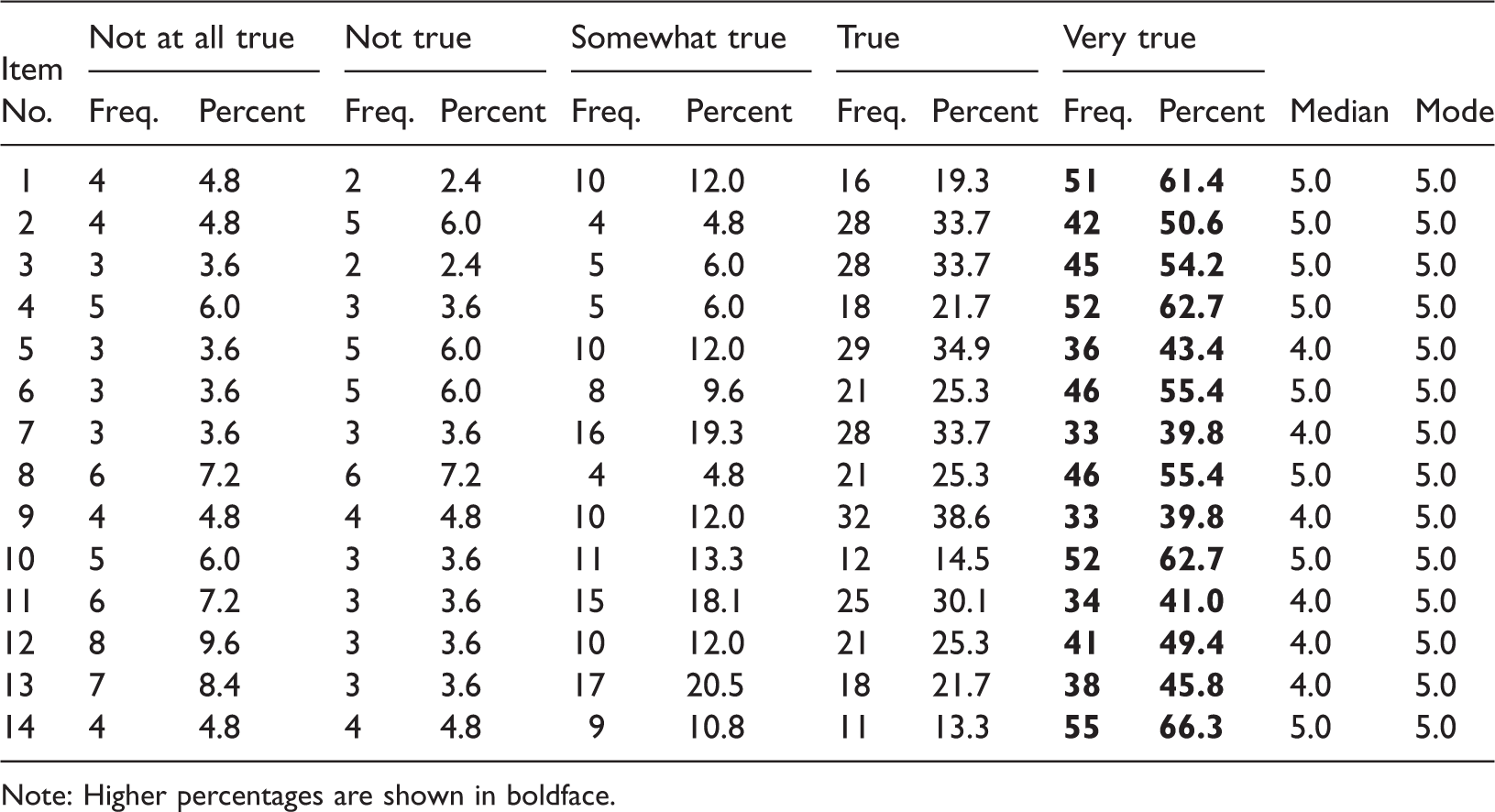
Note: Higher percentages are shown in boldface.
Table 2 shows the mean sores for each item in each subscale. In both subscales, almost all items scored higher than 4.00, except for items 11 and 13 in value/usefulness subscale with a slight drop.
Mean scores of each item in subscales.
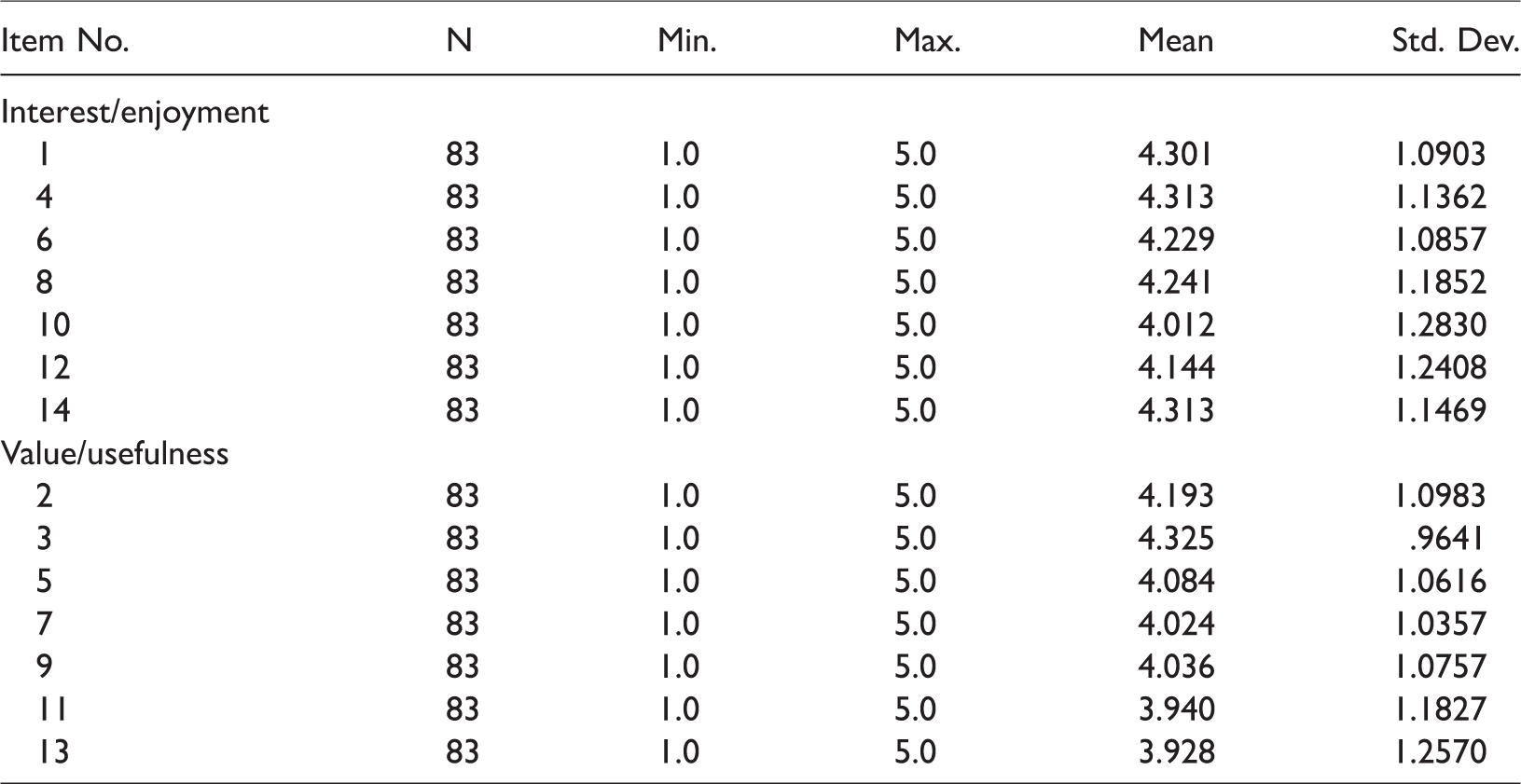
Table 3 shows the mean scores of each subscale. According to results, both subscales scored higher than 4.00. The participants mostly appreciated the application and enjoyed the experience. However, interest/enjoyment subscale had a slightly higher mean score than value/usefulness subscale. Table 3 also shows skewness and kurtosis values of each mean (skewness = –1.6, –1.5, kurtosis = 1.9, 2.1). It can be concluded that the data were normally distributed (George and Mallery, 2010).
Descriptive statistics for subscales.

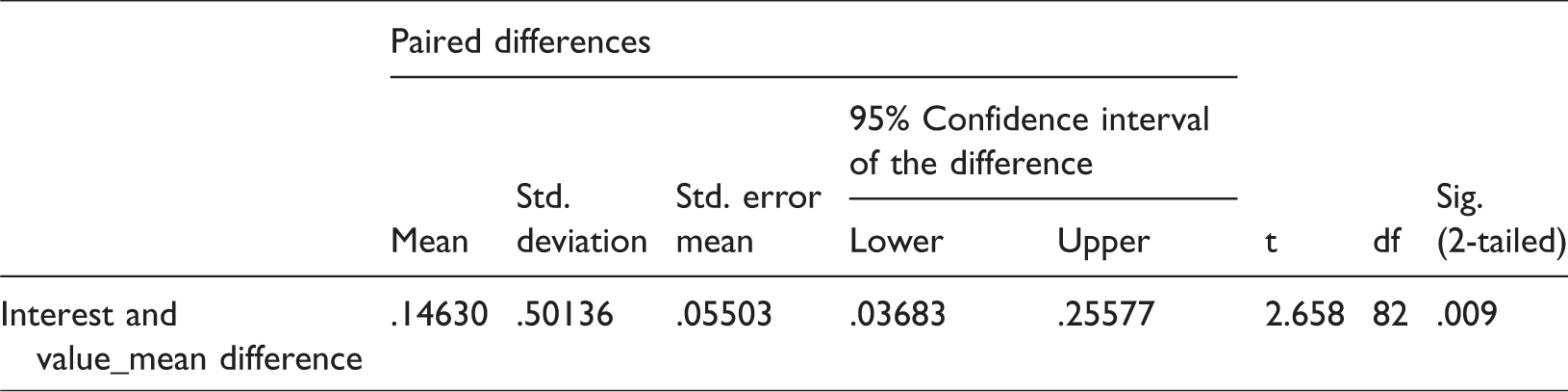
In order to get a clear result about the significance of the difference between mean scores of subscales, the means of each subscale for all participants were calculated and paired sample t-test was run.
Table 4 shows the results of paired sample t-test. In the Paired Samples Statistics Box, the mean difference between interest and value subscale is .14630. The Sig. (2-tailed) value is 0.009. According to results, the difference between two subscales was found to be statistically significant; (t(82)=2.658, p = 0.009). Since descriptive statistics box revealed that interest mean (4.2220) was greater than the value mean (4.0757), it can be concluded that participants found AR games more interesting.
Paired sample t-test for subscale difference.
Discussion and conclusion
This study intended to find out how EFL learners evaluate their experience regarding the implementation of AR-based learning materials in their English language classes with a game-based approach. The findings revealed that almost all participants enjoyed the use of learning materials enriched by AR. The analysis of the questionnaire items showed that most of the students accepted the activities in AR learning environment highly motivating and enjoyable, which is a similar finding in AR research (Dünser et al., 2012; Iwata et al., 2011; Redondo et al., 2013). The participants’ questionnaire scores indicated that the activities drew their attention, and they were interesting. In general the participants accepted that they had a lot of fun while engaging in the activities. This indicates that the AR technology succeeded in providing interest, motivation and joy in English language classrooms. As such activities increase the motivation by arousing interest and joy, foreign language educators might make use of AR applications to change possible negative attitudes of EFL learners towards learning language. Regarding positive affective side of AR applications in this study, it might be concluded that social, affective, and cognitive aspects of AR can be advised to be used for creating a productive environment which will increase students’ success eventually (Yilmaz ZA and Batdi, 2016). Findings of this study might also shed some light on the questions regarding how M-learning can be supported and how AR, a relatively new technology in educational context, can be implemented in language classrooms.
Value/usefulness subscale scores of the study indicated that the students valued the AR-based learning materials for their usefulness and they believed that the activities were beneficial for their language skills. Almost all participants were willing to do the activities again. It can be concluded that the students did not merely have fun while playing those games, but at the same time they reinforced their language skills. These kinds of activities can foster collaboration (Wang et al., 2012) among the students, which in return foster speaking and listening skills as well as retention (Hou et al., 2013) of newly learned vocabulary.
All in all, implementation of AR as an M-learning experience in language classrooms provides language learners with intrinsically motivating gameful experiences, challenge, and joy. These positive outcomes might result in crossing the border between formal and informal learning. AR-based activities trigger attention and increases motivation as M-learning is a phenomenon appreciated by 21st century learners. Foreign language teachers should take initiatives to design similar activities according to the needs of their students and observe strengths and weaknesses of such experiences and design better ones in order to increase motivation and academic achievement in their classes.
Footnotes
Declaration of Conflicting Interests
The author(s) declared no potential conflicts of interest with respect to the research, authorship, and/or publication of this article.
Funding
The author(s) received no financial support for the research, authorship, and/or publication of this article.