



Abstract
The paper reports on the concept, implementation and findings of qualitative research focused on an electronic portfolio. The research aimed to explore the use of an electronic portfolio in the learning process of lower-secondary school pupils in the Czech Republic concerning their career choice. The primary research question was defined as whether we can consider an electronic portfolio as an appropriate learning tool to support pupils’ preparation for their career choice. The research sought to (a) analyse the current process of pupils’ preparation for their career choice; (b) evaluate the appropriateness of an electronic portfolio as a supportive learning tool for career choice based on the experience from last years; (c) evaluate the appropriateness of an electronic portfolio for the pupils’ self-reflection and self-evaluation development and (d) suggest optimum learning scenarios, which could be implemented into learning through educational activities. In the first stage of the action research, the pupils described their preferred occupation and specified formal and informal job requirements using cloud technologies. In the second stage, a teacher assessed pupils’ work with the assistance of an external interviewer. In the third stage, pupils prepared a curriculum vitae and cover letter for an imaginary employer using a professional portfolio. An imaginary recruitment process followed. It was organized by an external interviewer using pupils’ job applications.
Introduction
A pupil portfolio can be generally defined as a collection of outcomes or artefacts ‘documenting and archiving information about a pupil’s work. It is an organized collection of a pupil’s work collected within a certain period of time providing various information about his or her experience and accomplishments’ (Šteflová, 2006). In addition to traditional assessment methods, such as marking or oral assessment, pupil portfolios offer another way of school assessment. Portfolios are also used for evaluation in lifelong education (JISC, 2008), and in addition to a pupil portfolio, we can also work with a teaching portfolio or institutional portfolio (Campbell et al., 2011). In terms of a form, we can consider a pupil portfolio comprising of written, drawn, printed, in other words generally materialized outcomes (a print-based portfolio) and a portfolio containing electronic data, in other words documents (an electronic portfolio (e-portfolio)).
Based on the previously carried out research, there has been seen an upward trend in the use of electronic pupil portfolios in schools and out-of-school activities (Becta, 2009; Fuglík, 2012). This trend may be attributed to a wider use of the electronic form of the portfolio supported by the increasing availability of information and communication technologies (ICTs), a broadband Internet access and improving level of users’ information literacy. George Lorenzo and John C. Ittelson (2005) consider the e-portfolio a ‘digitized collection of demonstrations, resources and achievements that represent the individual and group efforts of individuals and institutions. This collection consists of text, graphic or multimedia elements that are archived on the web or other electronic media’. The authors add that ‘it can serve as a tool for managing and organizing work that has arisen using a variety of applications and a way to track a pupil and discuss his work’. They define the e-portfolio as a ‘personal web collection of works, responses to work and reflections that are used to demonstrate key competences and achievements in different areas and periods of pupil development’.
The theory of pupil portfolios is also worked by Howard Gardner, the author of theory of multiple intelligences, which considers the portfolio to be one of the key means of developing childhood intelligence at an early age. Furthermore, as a way of evaluating educational activities and a possible tool for assessing pupils’ work as well as a criterion for admission to higher educational level (Gardner, 2006). One of the existing forms of portfolio within professional education or generally in terms of education is called professional portfolio. Its use is apparent in a wide range of occupations including teachers (a teaching portfolio), for whom lifelong learning is essential (Campbell et al., 2011). In this connection, we talk about a working and presentation form of a portfolio. A working form is usually built by pupils themselves and it usually covers a certain period of time. A presentation form is the aggregation of the pupils’ best works, with the choice of which a teacher or external authoritative figure may help (Baumgarner, 2009).
Research design
The research aimed to explore the use of an e-portfolio in the learning process of lower-secondary school pupils (ISCED 2) in the Czech Republic concerning their career choice. The research was conducted as action research lasting three months taking place in two 8th grades involving 46 pupils and a school year before there was a pre-research lasting the same amount of time involving 41 pupils. The primary research question was defined as whether we can consider an e-portfolio as an appropriate learning tool to support pupils’ preparation for their career choice.
The course of action research in pedagogy is solved by the conditions of the terrain. Topics of exploration are related to practice. They all work together to diagnose the problem and creating its solutions. In particular, qualitative research methods are applied. To achieve a goal, action research needs to respond flexibly to emerging situations and difficulties, at a same time evolving (Hendl, 2008).
The research sought to (a) analyse the current process of pupils’ preparation for their career choice; (b) evaluate the appropriateness of an e-portfolio as a supportive learning tool for career choice based on the experience from last years; (c) evaluate the appropriateness of an e-portfolio for the pupils’ self-reflection and self-evaluation development and (d) suggest optimum learning scenarios, which could be implemented into learning through educational activities.
The essence of action research is not a method but an activity. The following subsidiary research methods were used: a content analysis method used to collect documents and data, a method of participant unstructured observation realized by the teacher and a structured interview method with open questions held by a teacher along with an external authoritative figure (Hendl, 2008).
Research field
The research was carried out in the school, the catchment area of which is a standard residential district of the capital city. This school comprises both a primary and lower-secondary school involving 1st–9th grade (1st–5th grade ISCED 1 and 6th–9th grade ISCED 2). This school year, 565 pupils attend the school in 25 classes taught by 43 teachers and four teaching assistants. Eighth grades participated in the project. They are part of the lower-secondary school consisting of two classes in each year having 20–26 pupils in one class. The lower-secondary school pupils usually achieve better results in comparative tests carried out during a school year than it is the average in whole Prague and the Czech Republic. Generally, we may conclude that the test results and pupils’ achievements participating in the research correspond to pupils’ relatively high motivation for learning reflecting their personal inclinations and stimulating school environment, as well as family background. At the same time, pupils with special learning needs and specific learning disabilities are part of both classes. Their presence in the class requires the adjustment of learning goals, content and methods.
The mentioned research was conducted within a learning project in Technology lessons, in which the issue of career choice is taught in the fourth quarter in eighth grade according to School Education Programme. A Technology teacher and a researcher took part in the pilot study of the research. The following year, a Technology teacher, who carried out most of the activities with their pupils and was a researcher at the same time, participated in the research. Further on, there were two more teachers from the school cooperating within interdisciplinary links in Civic Education and Financial Literacy, and there was also an external authoritative figure participating in conducting interviews with pupils and evaluating the learning project in its final stages. The role of an external authoritative figure was given to the second researcher. Both researchers then worked on designing the concept of a learning project, on its implementation including data collection and their evaluation.
We chose Mahara (www.mahara.org) tool for the e-portfolio administration. It is a native web application for building and administration of e-portfolios enabling to record the process of pupils’ learning having features of a social network providing room for their mutual communication. Creating and implementing this application into school practice was part of one of the pillars of the current New Zealand curriculum in the field of evaluation and self-evaluation. Mahara is open source software with open source code under the GNU General Public License 3.
For research purposes, we used UMIM.TO (umim.to) web portal run by Charles University in Prague, Faculty of Education. It is based on Mahara version 15.10 application released in October 2015. The application is complemented by a Czech localization (gitlab.com/umim-to/mahara-cs-test/tree/15.10_STABLE) prepared within Department of Information Technology (it.pedf.cuni.cz). The portal aims to offer schools a space for creation, administration and sharing of e-portfolios and enable to work with them to enhance pupils’ development, self-evaluation and self-reflection, to improve the use of portfolios for individual work and group projects and to facilitate mutual communication between pupils, teachers, parents and communication among themselves and schools as well (Fuglík, 2011).
Since the school year 2009/2010, the school, in which the action research was conducted, has been using services available within an educational set of the Google Apps for Education (https://www.google.com/edu/products/productivity-tools/) cloud package. It is a localized file of solutions enabling communication and data sharing within a specific community clearly defined by users consisting of teachers and lower-secondary school pupils. During the learning process, as well as during other educational activities, both teachers and pupils use cloud tools primarily to create, share, publish and showcase the outcomes of activities. During the learning project realized within the research, Google Drive tool proved especially useful, within which pupils used most of the following applications: Documents, Sheets, Slides and Drawings to create date files containing outcomes of pupils’ work. Google Drive, or some of the web publishing tools, e.g. Google Sites, Hangouts, etc. proved to be the most useful for the purposes of sharing and publishing segments of work. The advantage of Disk Google is that it enables to use its shared content in the environment of Mahara application or UMIM.TO portal.
During the research, pupils prepared their imaginary professional portfolio showcasing their results and other related contents using the above-mentioned tools, which they afterwards transformed into a presentation portfolio, with which they would apply for a job at the end of the learning process. In terms of classification of their activities, it was actually a professional portfolio with elements of a presentation portfolio.
Research course
Pilot study
In the school year 2014/2015, the organization scheme of the research was based on the pilot study conducted with a similar research sample comprising 41 pupils in two classes with the same education programme in eighth grade in lower-secondary school. These pupils were preparing for a career choice in accordance with the content of curricular documents in Technology lesson (Figure 1). The basic concept of activities and the time allocated for pilot research were the same as in the subsequent research project. The topics and learning objectives were identical as well. However, pupils used different tools for work. The main difference between the pilot research and the one conducted a year later lay in the fact that during the pilot research pupils created their portfolios using no specific tool for their administration. They collected results in various ways. The outcome of the activities realized within the pilot research was a comprehensive file of materials, but in very different formats and on different storages, or on data drives (e.g. cloud environment Google Drive, One Drive, Drop Box or network computer drive, USB flash drive, etc.). Inconsistent forms of pupils’ outcomes significantly influenced the quality of pupils’ work, both from pupils’ and teachers’ side and an external authoritative figure participating in the educational activities, or evaluation of the results of joint work.
Google Apps for Education (teacher view).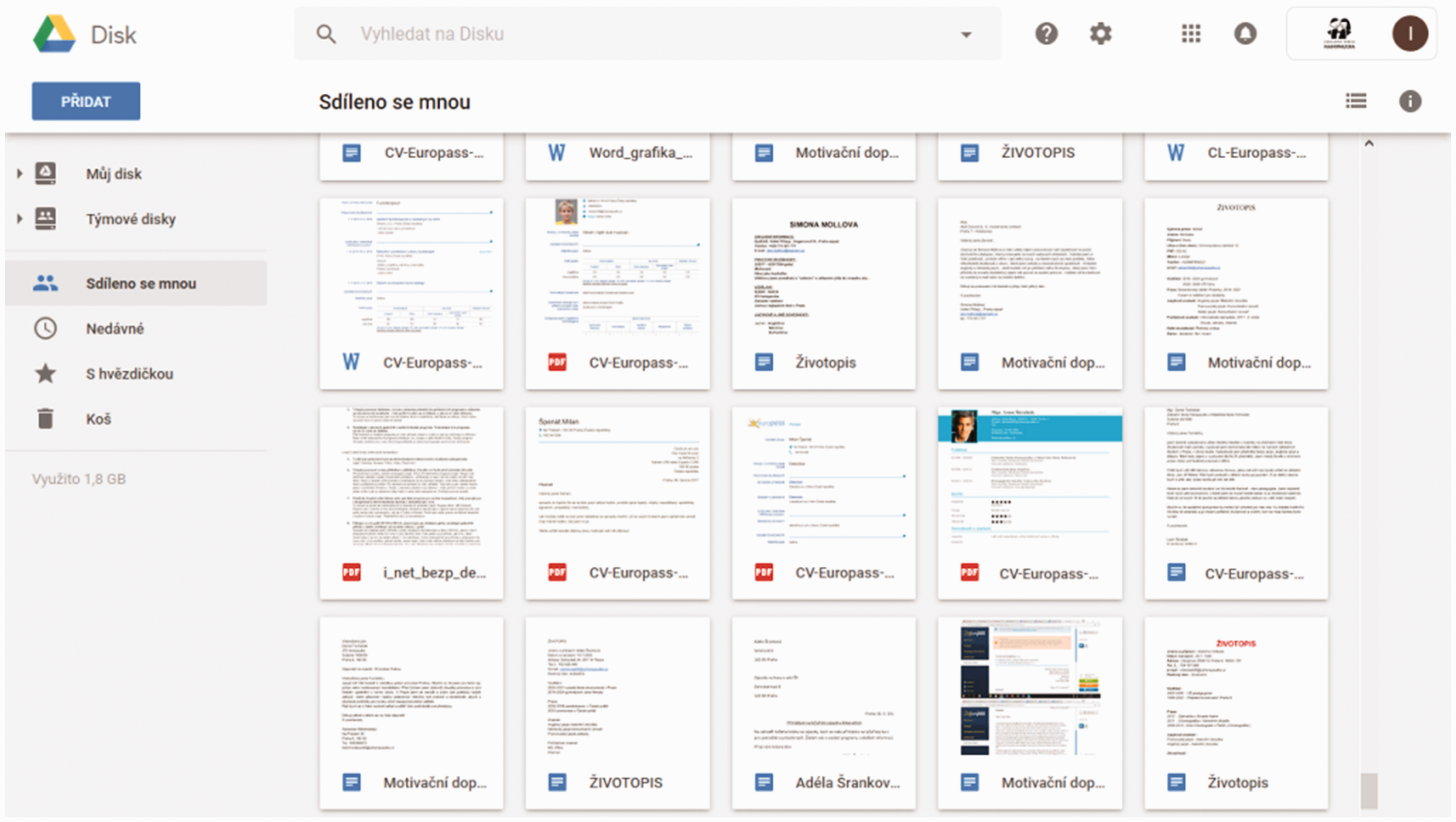
As stated above, the concept of the pilot research corresponded to the existing research. Hence research stages, individual sub-tasks, as well as the primary task were identical for both surveys. The researchers intended to carry out both surveys (the pilot and existing) in the way that they would match as much as possible in the content, time schedule and their findings would be comparable to the greatest possible extent. For this purpose, identical research methods were employed in both surveys, i.e. content analysis of the outcome documents and data, unstructured participant observation and structured interview with open questions. The most significant difference between both surveys was the targeted implementation of Mahara, a tool for the administration of e-portfolios, through UMIM.TO, a specialized installation environment.
Learning project
The concept of the whole learning project contained four interlinked stages based on the pupils’ activities. In the first research stage, pupils prepared the characteristics of their preferred occupation and a specification of formal and informal job requirements under the teacher’s supervision within unstructured participant observation. In the second stage, a teacher with the assistance of the external authoritative figure carried out the evaluation of the pupils’ documents using content analysis. In the third stage, pupils prepared their CV and a letter of motivation for an imaginary employer in the form of a professional portfolio working in e-portfolio environment. An imaginary recruitment process followed. It was organized by an external interviewer using pupils’ job applications in the form of a structured interview with open questions. Based on the results of the recruitment process, the pupils carried out a self-reflection of their submitted work considering selected occupations and outcomes from the imaginary employer using an e-portfolio.
Other activities connected to manuals for various environments (Google Drive and Mahara, or UMIM.TO portal), or transmitting theoretical knowledge from thematic fields of career choice and career preparation complemented the project stages. These supplementary activities played also an important role in the learning project as using an electronic environment is based on having the know-how. Sufficient theoretical background allowed for necessary orientation in the issue and successful task completion. The theoretical part of the learning project interlinked in many points with the content of pupils’ practical tasks so that the tasks helped pupils to understand the issue better and to gain necessary knowledge. In order to transmit the theoretical content, various forms and procedures were used whereas the methods of frontal teaching, group and collaborative learning and theoretical elements of constructivist approach proved most useful.
Universally transferable digital learning objects were used to a great extent in this part of the learning project. They were specifically designed for these purposes and they comply with the principles and requirements provided for their identification. We assumed that digital learning objects meeting the criteria can be repeatedly used with the same effect on ICT means of various types and characteristics (Tocháček, 2015).
Forty-six pupils from two classes took part in the existing learning project in the school year 2015/2016 and one teacher, who participated in all its stages. In the stages focused on the evaluation of pupils’ outcomes within the learning activities, another researcher joined the research in the role of an external interviewer as an imaginary recruitment specialist. Two more teachers from the school participated indirectly in the project by realizing learning activities in other subjects within the targeted interdisciplinary cooperation and cross-cutting topics sharing. These teachers were teachers of Financial Literacy and Civic Science. In their lessons within the interdisciplinary links, they talked about pupils’ career choice and pupils prepared their outcomes.
Pre-conceptual activities thematically focusing on career choice and career preparation were the first stage of the action research in the form of a learning project. Pupils got familiar with basic terms from the field, but they did not get any further information on the topic. The reason for this was to ensure to the greatest possible extent a full unlimited development of pupils’ ideas about the topic and simultaneously to set up conditions stimulating pupils need to search for the necessary information in external resources and this information process. The creation of a comprehensive electronic outcome in any format (a document, presentation, broadsheet, collage, multimedia object) of an appropriate extent was central to pupils’ practical activities, by means of which pupils collected and expressed their ideas about their future career. After completion, this material was shared by a teacher through Google Drive and at the same time pupils could keep it in this environment for a further use and future export to UMIM.TO portal. The material involved a content analysis carried out by researchers with the following items:
Expected area of interest of occupational orientation, or a particular occupation (when indecisive more areas or occupations). Basic characteristics (properties, specification) of the occupation; reasons for the choice of the career or areas of occupational orientation; expected demands on the training for the profession and gaining the employment in the field or area of occupational orientation; assumed formal qualifications (e.g. study programme, certificates, practice, etc.) and informal (e.g. communication skills, personal characteristics, etc.); potential further vocational guidance, professional development; assumed advantages and disadvantages of the occupation or occupational orientation; possibilities for re-training from the occupation or occupational orientation taking advantage of the previous training and practice.
A follow-up activity realized in the first stage of the learning project constituted active individual pupils’ work on creating clear characteristics of the national educational system and labour market taking account of their preferred occupation or area of occupational orientation with teacher’s participant observation using a precisely defined observation scheme. A brief indication of the possibilities for use of educational institutions abroad with regard to permeability of the system, transfer mechanisms and recognition of qualifications within open international labour markets was part of the pupils’ work.
During this individual activity, pupils again generated electronic outcomes having no specific assignment for the form. Teacher’s conditions for the acceptance of the results were the following: pupils had to meet the criteria defined for the content quality and in terms of the form they had to make the outcome available within the shared environment. In order to achieve the goal defined for this part of the project, pupils were to create outcomes so that it was obvious they were able to identify individual parts of the system and they understood the relations between them.
The second activity stage of the learning project consisted of pupils’ writing CVs, letters of motivation and creating e-portfolios. Pupils equipped with sufficient amount of theoretical knowledge and information coming from the introductory activity stage, during which they articulated their ideas of their future occupation and occupational orientation, created their own CVs, letters of motivation and in the teacher’s presence they created comprehensive portfolios. During this stage of the learning project, new electronic outcomes were developed in the form of CVs and letters of motivation; comprehensive files of materials were created when CVs, letters of motivation, earlier created pre-conceptual materials, materials summarizing information on educational systems, but completely new materials as well, such as certificates and outcomes from various previous and existing activities in other subjects and out-of-school activities were combined into one file – an e-portfolio. Pupils’ work on e-portfolios was closely monitored by researches in accordance with prepared observation scheme and outcomes from this stage were subject to an in-depth analysis.
The third activity stage of the learning project concerned an imaginary selection procedure at the prospective employer, or in the HR company, as a structured interview (Figure 2). At this stage, an external interviewer joined the project, a co-author of the research in the role of a human resources specialist, who the pupils had not met so far and who went through and evaluated pupils’ materials stored in the electronic environment and simultaneously in teacher’s presence he or she conducted the imaginary selection interviews with pupils in the form of a structured interview. The assessment of all parts of the professional portfolios and analysis of the imaginary interview were part of the interview.
Mahara UMIM.TO (external interviewer view).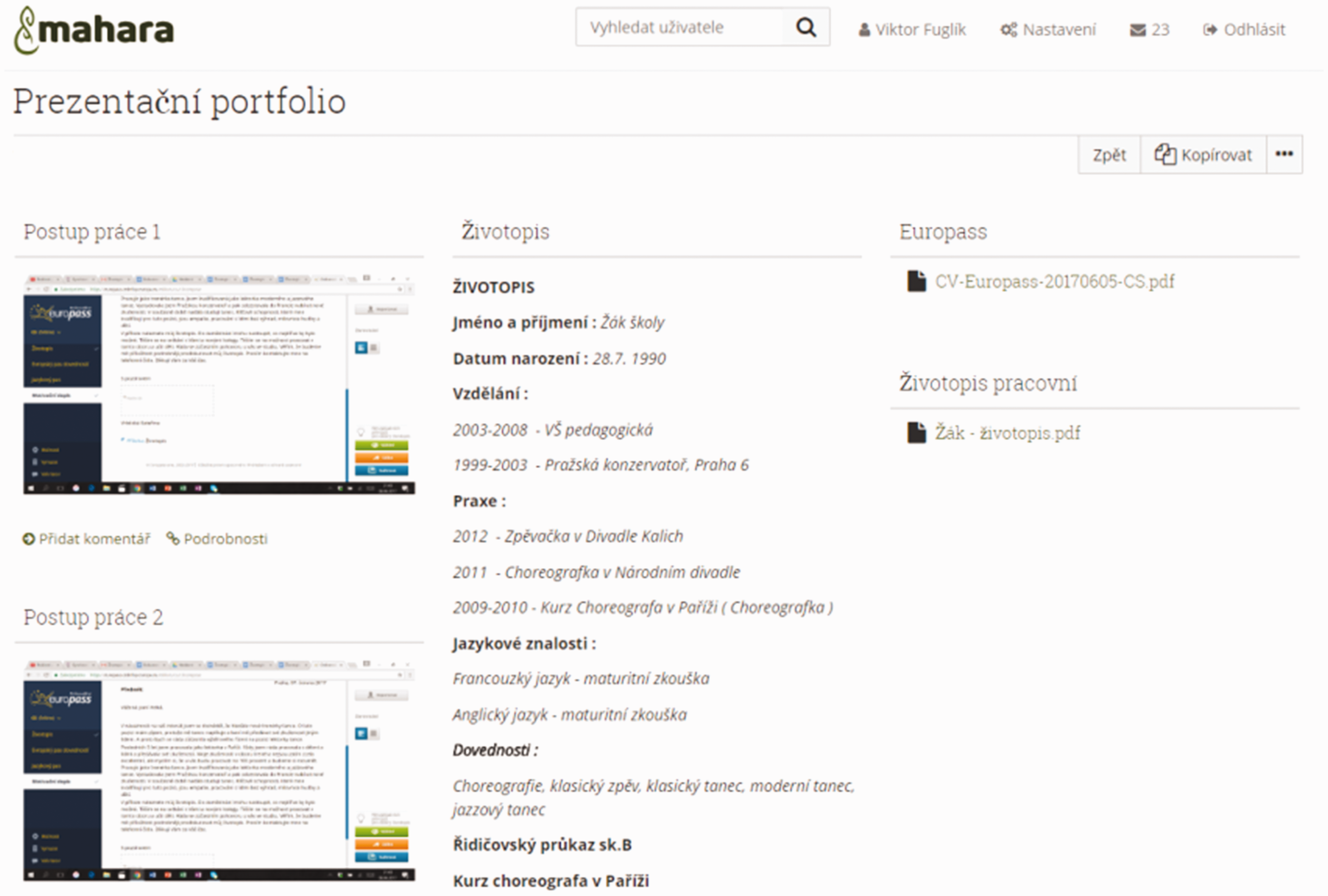
During the final stage of the learning project, which followed up immediately after the third stage, all the participants of the learning project shared and discussed knowledge and experience gained from all the stages of the learning project and they co-participated in the evaluation of the individual phases, including generating general outcomes and recommendations for optimizing procedures for planning a personal study and professional development and career choice. Within the UMIM.TO portal, a group was set up for this purpose. In this group, pupils can share their outcomes and provide feedback to each other.
Results
The research in the form of action research took place within a learning project in primary and lower-secondary school with the use of a content analysis of the school works, participant unstructured observation in class and structured interviews with pupils. After the achievement of the objectives, an analysis of the current pupils’ preparation for their career choice was conducted. The evaluation of an e-portfolio as an appropriate tool to advance learning focused on career choice was conducted based on the past experience, namely the pilot research project. It was also assessed whether an e-portfolio is a powerful tool that develops pupils’ self-reflection and self-evaluation. Finally, learning scenarios used in the educational activities were suggested and verified in their practical implementation.
During the assessment of the results, pupils’ outcomes produced during the stages of the learning project were thoroughly analysed. In the first place, these were the electronic outcomes summarizing pupils’ ideas about their further study, career preparation and career choice. Second, these were materials focused on the description of the educational system taking into account pupils’ preferred study pathway and occupational orientation. The content of the background materials included in pupils’ e-portfolios was thoroughly compared with the content of other outcomes included in the complex of an e-portfolio, primarily with a CV and a letter of motivation. As a basis for an overall evaluation of the study, we carried out observations of pupils’ solving strategies for the assigned tasks and used data recorded by researchers during the interviews with pupils. Simultaneously, we assessed relevant outcomes, as well as pupils’ e-portfolios with the statements made by the pupils during the imaginary selection procedures with an external interviewer.
When observing the results obtained in the previously conducted pilot study, it seems that the comprehensiveness of the pupils’ outcome has a positive influence on meeting the learning objectives. Completing the tasks and preparing materials led to insufficient mastering of the issue in the pilot study. Pupils gained some knowledge and skills in the field, but the level of their knowledge and skills was not sufficient after the learning had been completed. This statement can be supported by particular pupils’ outcomes, which show significant incoherence and content inconsistency, even though this requirement was clearly stated in the instructions and thus expected by the researchers. On the contrary, after the realization of the existing learning project, the analysis of the available materials shows that the outcomes from the pupils’ work from the stages of the learning project are mostly closely interwoven (both content and form). Most pupils managed to create from sub-materials a comprehensive complex of values in the form of a professional portfolio illustrating their ideas about follow-up study, career preparation and career choice. Pupils acquired necessary skills related to the development of an occupation-oriented presentation portfolio as well.
The assessment of the pupils’ activities in the final stage of the learning project provided researchers with valuable information enabling them to assess the significance of an e-portfolio as a self-evaluation and self-reflection tool for pupils. The discussion conducted in both classes and follow-up individual interviews showed that a comprehensive file of materials, i.e. an e-portfolio, is perceived as a valuable material, which can be used for the given purposes. Planned activities leading to the preparation of a professional, or presentation portfolio were evaluated positively by the pupils and almost in all cases the learning objective and overall objective of the learning project were well understood. When comparing the results of the learning project and the pilot study, in which pupils often did not meet the defined learning objectives and the feedback showed they did not understand the purpose of particular steps, we may draw positive conclusions in favour of the future use of e-portfolios when developing pupils’ career preparation.
During the research and within the individual objectives, researchers concluded that an e-portfolio can be considered a useful tool to advance learning. The answer to the primary research question can be, moreover, supported by the fact that an e-portfolio is an effective tool, which, when used for eighth graders’ career preparation, enables a more effective and better achievement of the learning objectives than when the traditional tools are used. The opinion is based on the findings of the research, primarily the comparison of the results of the pilot study and the current learning project.
Discussion
In accordance with the literature cited above are the biggest limits were a short period of time of the research determined by the maximum possible length reserved for the topic in Technology lessons, or Civic Science and Financial Literacy, and the length of lessons for pupils’ practical work. It is also necessary to take into account eighth graders’ abilities and skills in the field of information technologies and the level of their acquisition in primary and lower-secondary school.
We should bear in mind that one of the researchers works also as a teacher in the school, where the research took place. Knowing the environment and pupils’ possibilities for learning or an opportunity to monitor the whole research work could be an advantage. The disadvantages could be an excessive level of personal involvement, mainly in the parts concerning evaluation. To keep a sufficient distance, the teacher–researcher cooperated in such moments with other two colleagues and another researcher in the role of an external authoritative figure, who had no previous links to the school nor pupils and he could thus assess their work, implementation of the research and findings impartially.
Conclusion
The paper reported on the concept, implementation and findings of the qualitative research focused on the issue of career choice in primary and lower-secondary school. It explored lower-secondary school pupils’ development in the learning process using the support of e-portfolio and cloud services in Technology lesson.
Based on the results of the recruitment process, the pupils carried out a self-reflection of their submitted work considering selected occupations and outcomes from the imaginary employer using an e-portfolio. Based on the research findings, we may confirm the presumption of a significant positive impact of using e-portfolios on the pupils’ learning related to their preparation for choosing a career. The e-portfolio environment enables pupils to work with valuable information, which is also important for the development of their self-reflection and self-evaluation skills.
Footnotes
Declaration of Conflicting Interests
The author(s) declared no potential conflicts of interest with respect to the research, authorship, and/or publication of this article.
Funding
The author(s) received no financial support for the research, authorship, and/or publication of this article.