



Abstract
Researchers have recognized the role that microblogging tools play in enhancing the effectiveness of communication and interaction in the classroom. However, few studies have specifically examined how to use microblogging tools to bring educational resources into the classroom to enrich the student learning experience. The exploratory case study examined an instructional activity designed to expand and deepen student learning experience by having undergraduate students subscribe to, read, and share tweets from high-quality Twitter accounts in the field. The findings suggested that students believed that the activity broadened their knowledge on the topics to be learned, helped them see the connections between coursework and real work, and empowered them with a new tool for learning and inquiry.
Introduction
Microblogging has been recognized by researchers as an alternative form of communication to support classroom learning (Ebner et al., 2010; Perifanou, 2009; Kassens-Noor, 2012). In the past few years, researchers have made various efforts to integrate microblogging tools into their instruction in order to enhance the interaction among students and instructors both in and outside of the classroom (Evans, 2015). Few studies, however, have specifically examined how to use microblogging tools to bring valuable resources into the classroom to enrich student learning experience. In this study, we examined an instructional activity that was designed to expand and deepen student learning by having students (a) subscribe to and read tweets from high-quality Twitter accounts created by professionals, and (b) regularly reflect on and share the tweets with their classmates. The study examined learners’ participation in the activity and their perceived effectiveness of the activity, and provided insights on how to better engage students in learning the course content by accessing and using resources available on Twitter.
Microblogging integration in the classroom
Research on microblogging integration has mainly focused on how microblogging tools can be used for organizing class activities and facilitating communications. It is suggested that microblogging integration promotes a sense of community and enhances interaction among students and instructors (Dunlap and Lowenthal, 2009; Ebner and Maurer, 2009; Hennessy et al., 2016), and allows for more open access to information, more consistent communication, and an increase in a sense of shared learning (Bledsoe et al., 2014; Hitchcock and Young, 2016). In addition, the use of microblogging tools helps support individual or collaborative reflection. Studies showed that, with the use of microblogging tools, students were able to develop self-reflective practices (Krutka et al., 2014; Wright, 2010) and extend their thinking about the topics discussed in class (Domizi, 2013). It is evident that properly designed microblogging-based activities may help relieve anxieties (Hennessy et al., 2016), facilitate communication, and lead to improved participation and engagement among students (Antenos-Conforti, 2009; Borau et al., 2009; West et al., 2015).
A few studies examined whether the integration of Twitter in the classroom enhances student learning. Junco et al. (2013, 2011) conducted two experimental studies examining the effectiveness of Twitter integration in large college-level courses. In both experiments, students in the experimental group used Twitter while control group students in the first experiment used Ning, and those in the second experiment did not use any social networking tools at all. In both studies, Twitter was used to support continued class discussions, send class or campus event reminders, connect students with each other and with instructors, form learning groups, and collaborate on projects. The results from both studies suggested that student GPAs of the experimental group were significantly higher than those of the control group. In another study (Kim et al., 2015), the researchers took a different approach and used Twitter as a classroom response system in large lectures. During the lecture, the professor posed surprise quiz questions at unexpected moments, and students were asked to submit their answers using Twitter. Points were awarded on a first-come-first-served basis to a limited number of the students who submitted correct answers so as to improve student concentration during the lecture. The analysis of student exam scores suggested that students who used Twitter learned better than those of the previous year who did not use Twitter but had the same instructor and curriculum.
The microblogging-based learning activities examined in the above studies encouraged the formation of fully closed communities with the participants being students and instructors in a class. The communication occurred among students and instructors, and the content was solely contributed by students and instructors. As a result, the level of resource or expertise sharing was limited to the students and instructors within the class. To date, only limited number of studies reported the benefits of having students tap into the resources available in the larger Twitter community for the purpose of classroom learning. In Rinaldo et al.’s (2011) study, for example, a professor in a consumer behavior course used Twitter to promote social interactions, discussions, and reflections from the students. As students actively interacted with the professors and their peers, some students began following tweets from people outside and shared relevant tweets with the class, leading to a richer experience of resource sharing. In another study, Becker and Bishop (2016) utilized Twitter as a learning tool both in and outside of an eighth grade science classroom. Students were encouraged to tweet at class-specific hashtags, to follow famous science advocates on Twitter, and to broadcast their own experiments to their followers for feedback. The goal was to provide students with opportunities to read the most up-to-date science research, allow those outside of the classroom to view their work, increase the relevancy of science to their everyday lives, and identify “new ways to communicate about science” (p. 12).
Microblogging for professional learning and development
The studies conducted by another group of researchers have proved the value of using microblogging tools to access resources for professional learning and development. Carpenter and Krutka (2014, 2015), after conducting a survey on practicing educators who used Twitter, found that teachers used Twitter to collaborate with other teachers, share or acquire resources, participate in Twitter chats, network, and communicate with parents and students. When exploring teachers’ motivation for using Twitter, they found that some believed that the free personalized learning environments on Twitter offered superior PD opportunities, and others reported that the professional learning communities that they had developed through Twitter helped to serve an important role when they looked for activities or resources for their class (Carpenter and Krutka, 2016). Similarly, when they studied four high school social studies teachers who used Twitter on a consistent basis, Noble et al. (2016) identified a number of benefits of using Twitter for professional learning: First, it gives teachers access to a distributed knowledge network that may not be available in their schools as well as resources that they may not have time to create. Second, it allows teachers to participate in discussions, share their own resources, or mentor other colleagues. Third, the diversity of viewpoints they are exposed to on Twitter makes the teachers frequently reflect upon their own practices and philosophical assumptions about teaching. In another study, Rodesiler and Pace (2015) attempted to identify what secondary English educators who participated in professional development activities online using Twitter, blogs, and some other social networking sites had gained from the experience. Analysis of the data gathered from interviews indicated that these English educators participated in such online activities to: (a) relieve a sense of isolation, (b) establish a social network, (c) inform thinking or shape practice, (d) practice digital writing skills, (e) generate professional opportunities, and (f) enhance the capacity to support students.
Research has also been conducted on the use of Twitter by professionals in the fields other than education, and similar benefits have been found. For example, Mulatiningsih et al. (2013) examined the usages of the microblogging service, Twitter, among library information specialists. A qualitative data analysis of participant interview answers as well as their tweets revealed that the library information specialists used Twitter as a part of their professional practice to connect and build networks with other like-minded individuals and stay informed about current issues within the field. In another study, Roberts et al. (2015) attempted to examine the state of journal clubs delivered via Twitter as a form of continual professional development in the medical field. Journal clubs offer medical professionals opportunities to discover and review research being done by their peers in asynchronous environments, thus reducing the workload on those busy medical professionals. They found that, across the medical profession, there was increased participation in social media usage, specifically, in the form of journal club membership. This increase in participation on social media has also led to an increase in visits to academic journal’s websites.
In sum, research has shown the possibilities of using Twitter for professional learning and development in various fields. The free and open access of many learning resources and communities that exist on Twitter allows the professionals who are interested in learning to be engaged in various educational activities. Online professional development activities supported by Twitter add value to their learning experience by providing opportunities for them to share resources and ideas, get connected with like-minded professionals, and combating isolation, through the processes of which the participants develop their understanding of the field and improve their practices.
The goal of this study is to explore how to make use of resources available on Twitter to enrich the student learning experience of the course content. An instructional activity was specifically designed to achieve this goal by asking students enrolled in an undergraduate online course to regularly read tweets posted by professionals, reflect on them, and share them with their classmates throughout the semester. The research questions are the following:
How did students participate in the instructional activity? How did students perceive the effectiveness of the activity?
Material and methods
Participants and settings
One online undergraduate course in project management was selected for the study because all participants in the class were working adults who dealt with issues related to project management in their everyday lives. It is believed that students in this class would particularly benefit from the experience of getting additional resources from other professionals in the field because they were already engaged in their careers.
Participants were 11 undergraduate students (five males and six females) from this online undergraduate level class in a university in the United States. Age range varied with 55 being the oldest and 21 being the youngest. The majority of the class (63%) fell in the 21–25 age range. Reported Twitter usage prior to the experiment was also varied: Four students (36%) reported using Twitter every day, two students (18%) reported using it once per week, three students (27%) reported using Twitter less than once per month, and two students (18%) reported that they did not use Twitter at all.
Procedures
During the first week of class, the instructor introduced the idea of using Twitter for professional learning in order to help students understand the purpose of the learning activity. Then, the instructor introduced the learning activity, discussed its educational benefits, and made it clear that participation in this activity was voluntary and student performance in this activity would not affect their grades.
Students started with setting up a Twitter account and subscribing to 14 project management Twitter accounts as identified by Walker (2014). It was expected that the information from the 14 accounts could provide the students a diverse range of perspectives without overwhelming them. The list was composed based on the following criteria: (a) The person consistently shared information relevant to the topic of project management, (b) the person tried to engage the readers in conversation, (c) the person had generated at least a few thousand tweets, and (d) the person had a minimum of 2000 followers (Walker, 2014).
From Week 1 to Week 16, students were asked to explore and reflect on the tweets from the subscribed Twitter accounts at least once every week. The instructor set a minimum amount of time of one hour per week for students to read tweets, but did not assign a maximum amount time or a specific number of tweets for each student to explore. This was done purposefully to promote autonomous learning practices that would mirror the ways that professionals use Twitter for professional learning and development. Students were instructed to take notes for any interesting information that they came across; look for connections between the tweets and what they read, discussed, or learned in the class; and reflect on how the information in the tweets were related to their work. During the whole process, students were encouraged but not required to subscribe to additional Twitter accounts, look for new resources, and reach out and get connected with people on Twitter. By the end of Week 4, Week 8, and Week 12, students were asked to share in a discussion forum the tweets that they found particularly valuable and their reflections on those tweets. They were also invited to review and respond to their classmates’ shared tweets and reflections. At the end of Week 16, students completed a survey on their experiences of working on the project.
Data collection and analysis
Data were collected from multiple sources with different methods to provide a comprehensive account of student learning experiences. The three types of data collected were student self-reported Twitter activities, student reflections on shared tweets, and student survey responses.
Students were asked to self-report their Twitter activities because they participated at different times and locations, precisely tracking each individual student’s behaviors would have been difficult. As a result, self-report was utilized to gather qualitative data about how the students participated in this activity throughout the semester despite its validity problems. The self-report was conducted by the end of Week 4, Week 8, and Week 12, where students responded to a list of questions regarding their Twitter activities. The questions asked students to report the time they spent on reading the tweets, what they chose to do during the activity, and whether they noticed any change of behaviors or new behaviors over time.
Student shared tweets and reflections. All the tweets shared by the students were examined to identify the topic. Grounded theory approach, the constant comparative method in particular, was adopted to identify and fine-tune the categories to describe the tweets (Strauss and Corbin, 1998). Two phases of coding were conducted: initial coding and focused coding (Charmaz, 2008). First, the researchers read the tweets one by one, asking what each tweet was about and comparing it to the previous ones to decide whether it should be given a same or a different category. During the process of assessing and categorizing the tweets, the researchers were open to unanticipated categories. Reassessments and revisions were made until further analysis did not provide new information or insights. Once the categories were identified, two raters worked independently coding the tweets to different categories, and the differences were resolved by discussion. The percentage of agreement was 87.3%, and the Cohen’s Kappa was .83. Student reflections on the tweets were also collected and examined to identify what students thought as the values of reading the subscribed tweets. When the list of values was identified, the number of students who mentioned a specific type of value was counted. If one student mentioned a certain type multiple times across several posts, it was still counted as 1. The findings were used to support the analysis of student survey responses. For example, if the survey results suggested a preference on the instructional activity, this finding from student reflections would be used to understand why there was a preference.
At the end of the instructional activity, students completed a survey created to measure their experience in this Twitter-supported instructional activity. The survey is comprised of 13 Likert-scale items, which asked the students to rate their (a) perceived individual learning experience, (b) perceived collaborative learning experience, and (c) motivation. Additionally, there were a few open-ended questions asking students to comment on the overall value of the activity and explain their ratings. Finally, students were asked whether they would be interested in continuing using Twitter when the course was over.
A score ranging from −2 to 2 was given to student rating on each of the 5-scale Likert questions, where −2 indicating “disagree,” −1 “slightly disagree,” 0 “neutral,” 1 “slightly agree,” and 2 “agree.” MANOVA was conducted to test whether the ratings within each category were significantly different from 0. Due to the small number of participants, effect sizes were reported to provide a sense of the magnitude of differences. Student responses to open-ended questions were reviewed to explain their ratings on the Likert-scale questions.
Results
Student self-reported Twitter activities
The majority of students (nine out of 11) reported spending 1–2 hours per week reading through project management-related tweets throughout the semester, and two stopped reading the tweets by the end of the first month. One said that he lost interest because he could not find a lot of articles that interested him (S7), and the other said that what he found on Twitter “has augmented what has been previously laid as a foundation – not as a source for building the foundation,” so he did not consider Twitter as “a primary source of knowledge or training” (S8). Two of the nine students who participated throughout the semester reported that the time they spent on the activity decreased over time despite the fact that they enjoyed reading and learning from the tweets: “Although I found my time dwindling down, the articles that I did read, I found to be very beneficial” (S4); and “when I do spend time reading the tweets, I do enjoy the time I spend …” (S6).
Of the nine students who participated in the activity throughout the semester, six students did not report any noticeable changes in their behaviors throughout the semester. They read the tweets that they subscribed to, particularly those with titles or images that quickly caught their attention, but did not add new accounts to their subscription lists. The other three reported that they started to follow new accounts, either because they wanted to see “some new types of posts or articles” (S2) or they discovered other Twitter accounts that provided “informative and interesting” information (S3). None of the students reached out to other Twitter users to form relationships. Two students noticed that they became more willing to explore new content that they might not feel comfortable doing previously: “I am starting to get more comfortable clicking on random articles that sound interesting and end up liking them” (S2); and “I found I was more willing to click into links that would not have interested me before, and that allowed me to find even more content that I would not have found otherwise” (S9).
Student shared tweets and reflections
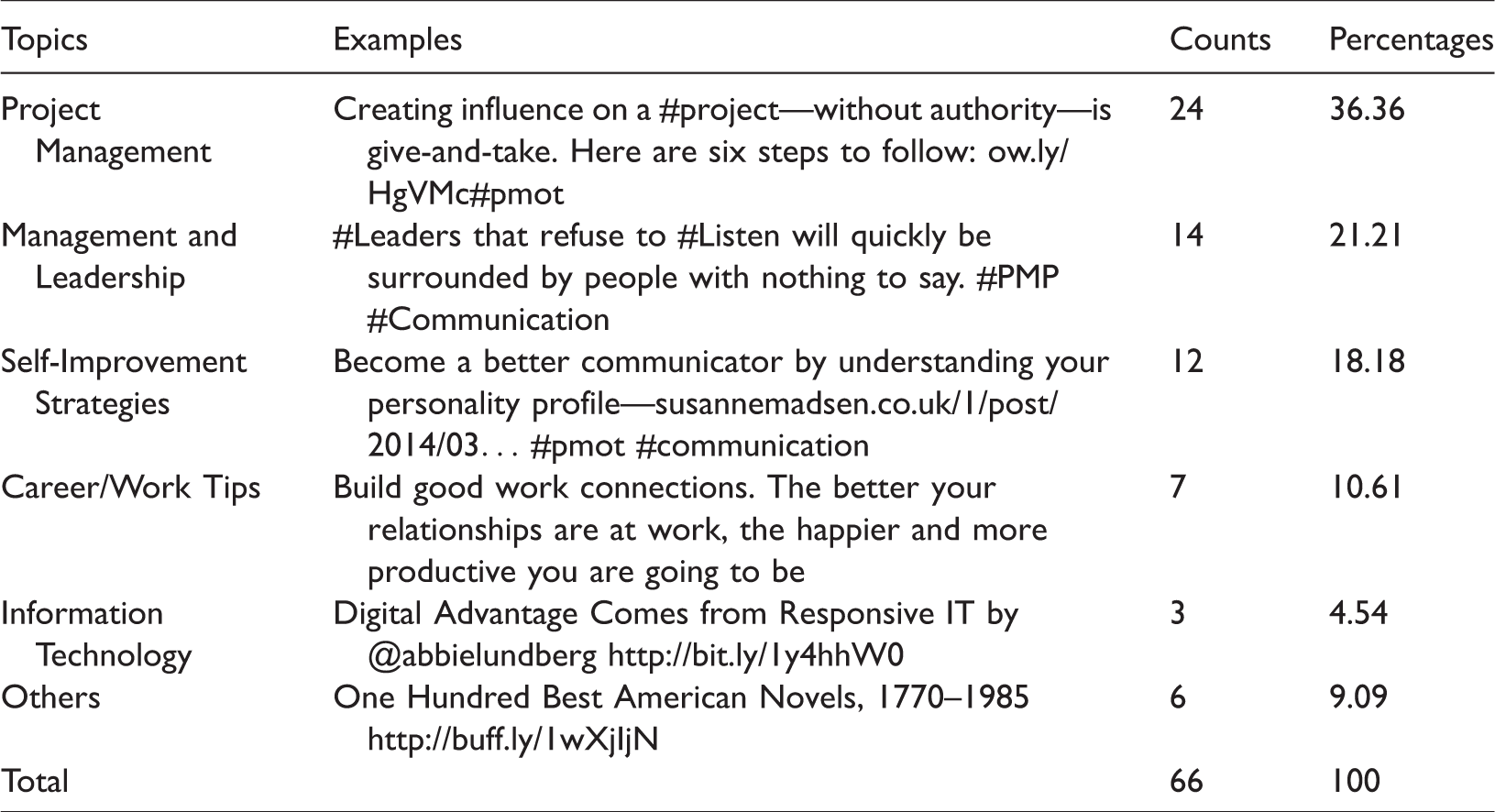
Table 1 presents the number of tweets shared by the students as categorized by topics. The analysis suggested that about one-third of the shared tweets were directly related to project management, and around one-fifth of the shared tweets were about management and leadership, which is partly related to project management. Another one-third of the tweets addressed the topics of self-improvement strategies, career/work tips, and information technology, which were work-related tweets but not directly related to project management. Six tweets were on irrelevant topics, and were thus coded as others.
Numbers and percentages of shared tweets by topics.
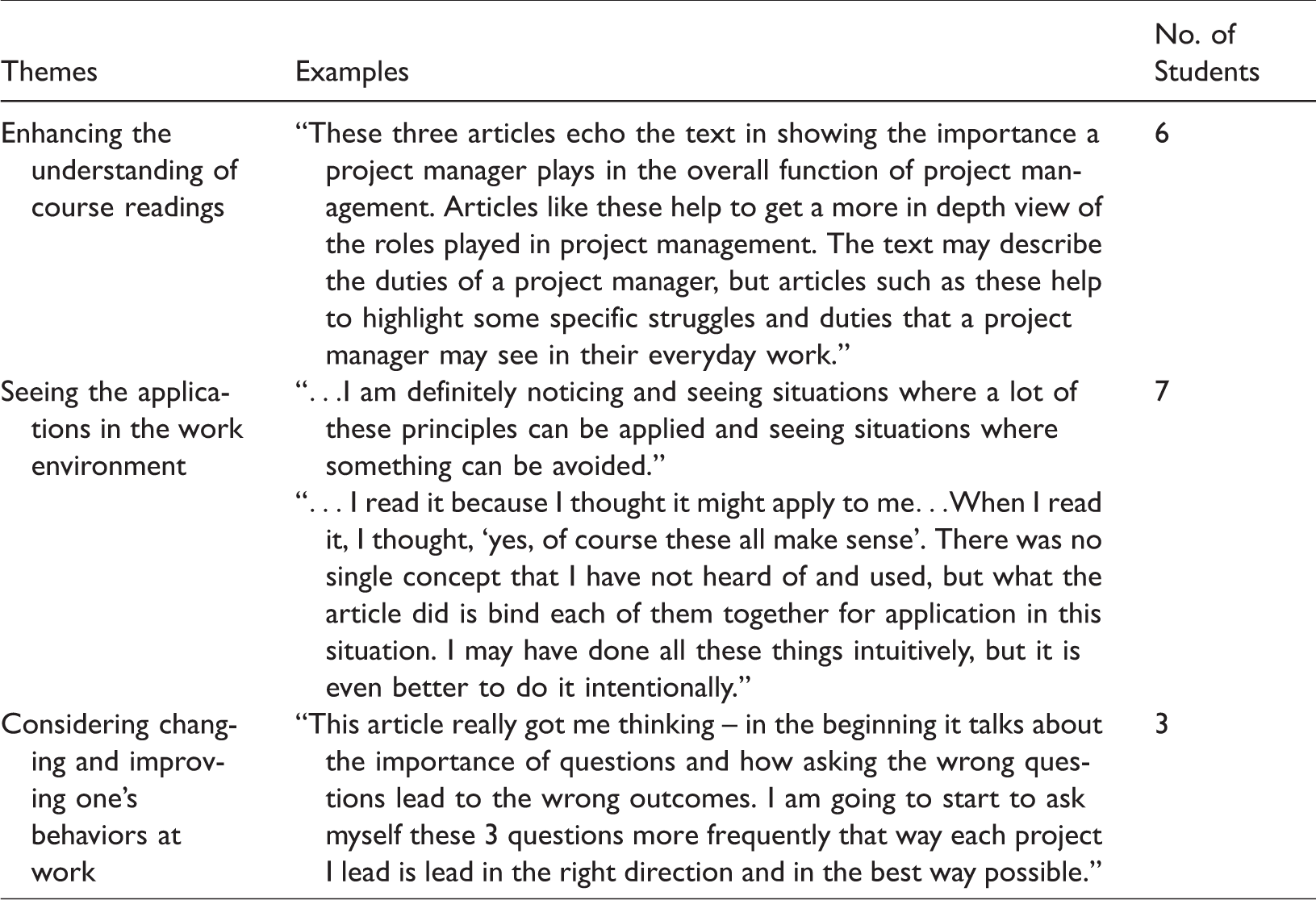
Students wrote about the values of reading the shared tweets. Table 2 shows a list of values mentioned by the students in the reflections and the number of students who mentioned them. Many students shared that some of the tweets that they read enhanced their understanding of the course readings. And students felt that they were able to relate the tweets to what happened in the work environment, where they see how the strategies or principles described in the tweets might apply to everyday work. Three students explicitly expressed that they were going to change their behaviors at work based on what they had read.
Values of the shared tweets identified by students (N = 11).
Student survey results
Table 3 presents the means, standard deviations, medians, and IQRs of student ratings on the survey items within three categories. Though the sample size for this study is small, we decided to run MANOVA to provide a sense of the magnitude of how the means of student ratings were different from 0. The results from the MANOVA test suggested that, in general, students perceived the learning activity had a positive effect on their individual learning (F(4, 7) = 9.32, p < .01,
The means, standard deviations, median, and IQRs of student survey responses (N = 11).
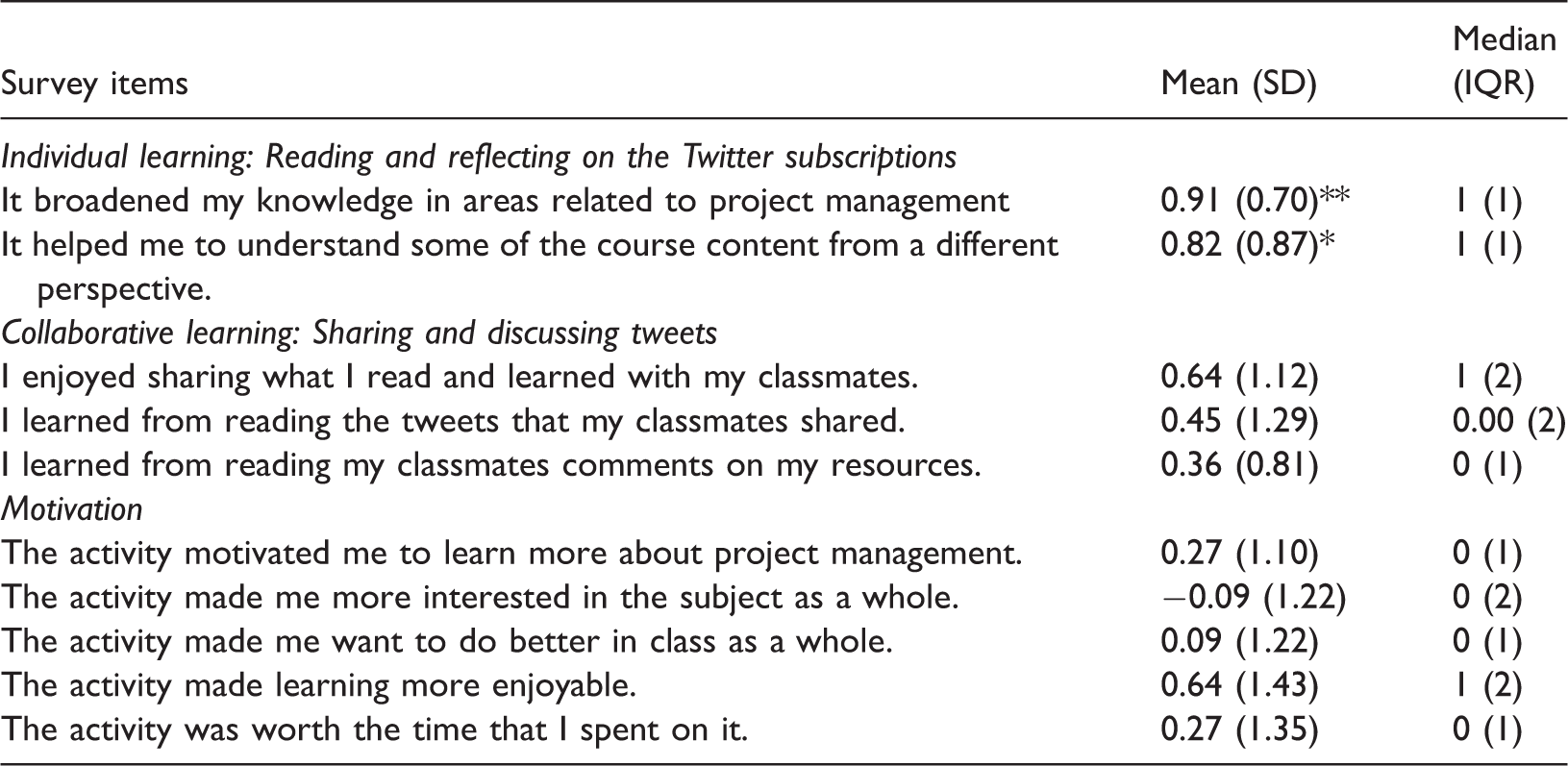
IQR: interquartile range.
*p < .05; **p < .005.
A majority of students felt that it was a valuable activity for learning the topic of project management. They also explained why they thought the activity was valuable. First, three students commented that the activity expanded their knowledge on topics related to project management and sometimes led them to researching other things—“…it helped me get out of my box to read articles I would have never thought about reading” (S2), and “…I expanded my knowledge and in some cases it led me into researching other things as well” (S6). Second, four students expressed that the readings from the Tweets can be a good supplement to course readings because it relates to project management in the real world: The biggest reason that I enjoyed this was because it was able to give a broad sense of the subject, and provide insight on project management aspects that aren’t discussed in the book, but are things that I notice on an average day. (S11) instead of constantly reading a textbook, I love that this was ‘real-time’ articles and things going on that we could read about. In addition, it also allowed me to connect with other project managers and learn more about the field on a personal level. My mind is a little more open to using Twitter for work as a result of this experience… I don’t know why this never dawned on me until now. I think this experience may have helped me realize this fact. (S5)
Students’ opinions on their experiences of sharing and discussing the tweets collaboratively during this activity varied greatly. Those who found the experience positive expressed that they enjoyed reading what their classmates had shared, which also allowed them to learn more about their classmates. But some students did not think it was quite beneficial. According to student comments, the major reason seemed to be the differences in their interests. Two students (S2 and S11) stated that their classmates were interested in different subjects or topics, so their posts did not raise an interest to them—“I only learned a few things while reading the articles posted by my classmates. Majority of them were not interesting to me, so it was hard to relate to them” (S2).
Similarly, students had diverse opinions on how well the learning activity motivated them to learn. One student commented, This project kind of made me want to do better in this class but even more so in my actual job. I tried to use the things I learned from the articles and actually apply it to me and my team. (S6)
Discussion
The study examined an instructional activity that was designed to enrich student classroom learning experiences by making use of resources available on Twitter. To make the experience rewarding, the instructor participated in the activity by (a) discussing the potential benefits of the instructional activity at the beginning of the class, (b) providing a list of high-quality Twitter accounts for students to subscribe to, (c) asking students to be mindful of what they read and take notes of their thoughts, and (d) providing opportunities for students to share and reflect on the tweets. In general, the findings suggested that the instructional activity has its values, but there are still ways to improve the design of the activity to make it more effective.
Students’ self-reported Twitter activities were analyzed for patterns and changes. Though it was hoped that, as they became more familiar with the task, their communication patterns would transform from individualistic to communal and collaborative (Ricoy and Feliz, 2016), only three of them reported that they followed some new accounts, and none of them interacted with other Twitter users. The tweets that students found valuable and shared with others are mainly related to project management or other aspects of work. In their reflections on these tweets, they discussed how these tweets helped them understand course readings, see the applications of what they have learned in the work environment, and improve their behaviors at work. These findings are also echoed by what was found in student survey responses. The majority of the students believed that reading and reflecting on the tweets throughout the semester is beneficial because that the activity broadened their knowledge on the topic of project management, helped them see the connections between coursework and real work, and empowered them with a new tool for learning and inquiry. Previous studies (e.g. Hsu and Ching, 2011) have reported similar findings that information found on Twitter might help student understand course-related content, and students were able to expand their knowledge by utilizing examples and real-world cases they found on Twitter.
Some findings have practical implications for improving the design of the activity in the future. Based on the student comments, two types of students questioned the value of the activity. First, students who considered themselves knowledgeable in the field found the activity not as beneficial. Articles or information shared via tweets are informative, up to date, easy to digest, but may not be extremely rich or in depth (Gao & Li, 2017). Learners who have extensive knowledge in the field may have already had access to a repertoire of quality resources. Information gained from the tweets may not significantly expand their existing knowledge base. This is consistent with the research suggesting experienced learners demonstrated high autonomy toward learning and were more demanding of course content and structure (Rivers, 2001), thus they should be provided with more autonomy to work on open-ended, exploratory tasks during the process of learning (Clark, 2000). Therefore, when designing such activities in the future, the instructor may need to provide opportunities for knowledgeable learners to participate in content creation by contributing resources and sharing their expertise, or promoting Twitter’s capabilities to establish professional relationships. Second, some students who had little prior experience with Twitter were reluctant to use it and found the activity not motivating. Similar findings have been reported by other researchers, where they found that some students who reported negative learning experiences were mostly critical of Twitter, noting that they would not take the time to learn how to use it (Stephens and Gunther, 2016). In our study, one student explicitly mentioned that he was comfortable with using Facebook but not Twitter. It seems that accommodating student technology preferences by providing students with options of a range of tools they could use to complete the activity may be helpful. Providing multiple options will also increase students’ sense of control (Flowerday and Schraw, 2000). In this particular activity, the instructor may identify project management groups on Facebook or online group forums for students to explore as well. Students will then decide whether a particular tool or a combination of multiple tools serves their needs best.
The study is exploratory in nature. Although multiple data sources were reported to provide a comprehensive view of student learning experience, one limitation of the study is the small sample size. Future research should be conducted on a larger sample size to verify the findings in this study. The second limitation is the self-report nature of the survey data. Such data help reveal participants’ attitudes and perceptions but are subjective in nature. In future studies, attempts should be made to incorporate more objective data sources, such as student learning outcomes and evaluation of student discussion posts, into the analysis.
Conclusions
Up till now, the majority of the research on microblogging in classrooms has focused on using it as a communication or activity planning tool to connect students and instructors. One of the greatest potential uses of microblogging for learning—quick and timely resource sharing among a large group of participants (Zhang & Gao, 2014)—has not been fully exploited for classroom learning. This study reported an attempt to make use of the resources available on Twitter to enrich the classroom learning experience. As one of the first few studies on this topic, the findings are encouraging and open up avenues for future research.
The activity in the study was designed to model the way that professionals use Twitter for professional learning and development, where learners took the responsibility to identify tweets that are relevant and meaningful and made free choices on what tweets they would like to read or who to get connected with. Though some learners enjoyed the open-ended approach, others, especially those who are new to Twitter, did not. As Barn (2016) found, the low levels of prior experience with Twitter negatively affected learners’ experience. Future research may explore how to better integrate such Twitter activities into the existing curriculum and make it a part of more structured instructional activities. The integration may help novice users become familiar with using Twitter (or other social media tools) for information seeking and professional learning, and thus be more prepared for independent use of Twitter to access learning resources. According to research, the great value of using Twitter also lies in the professional learning networks enabled by Twitter, which offer teachers supportive and trustworthy friendships, and provide them with the catalyst for changing their teaching practices (Noble et al., 2016). Therefore, future research is needed to identify ways to help learners become more deeply involved in the Twitter community by getting connected with others and establishing professional relationships.
The findings of the study suggested that learners’ experience of using resources available on Twitter for classroom learning could be shaped by a variety of factors, including learners’ prior knowledge on the topic, their experiences with the technology tool used, perceived value of the tasks, and so on. Future research is needed to identify factors that predict learners’ readiness to use Twitter or other social media tools for learning. In one of our ongoing projects, we surveyed over 200 educators on their behaviors and opinions related to educational Twitter use. Using the Structural Equation Model, we attempt to identify the key factors that predict educators’ use of Twitter as a professional learning tool. The findings from the project will help inform the design of such Twitter-related instructional activities. For example, if the findings suggest that learners’ knowledge level affects learners’ intention and behavior of using Twitter for professional learning, there will be a need to explore ways to engage learners with different knowledge levels in such instructional activities.
Footnotes
Ethical approval
All procedures performed in studies involving human participants were in accordance with the ethical standards of the institutional and/or national research committee and with the 1964 Helsinki declaration and its later amendments or comparable ethical standards.
Informed consent
Informed consent was obtained from all individual participants included in the study.
Declaration of Conflicting Interests
The author(s) declared no potential conflicts of interest with respect to the research, authorship, and/or publication of this article.
Funding
The author(s) received no financial support for the research, authorship, and/or publication of this article.
