




Abstract
There is a growing prevalence in the use of digital media for education management and international partnerships; however, research continues to reflect the position that the absence of social interaction is a major barrier to a positive on-line learning experience. In 2007, a paper described the application of PESTE (Political, Economic, Social, Technical and Environmental) factors from Sociology to the employment of e-learning, leading to the proposal of PESTE factors for educational software, and e-learning in particular. This paper recaps the findings of the 2007 paper, and revisits the application of the now trans-national framework for the employment of e-learning, before applying PESTEL (Political, Economic, Social, Technical, Environmental and Legal) factors to e-learning. It then proceeds to consider the influence of the latest innovations: MOOCs (Massive Open Online Courses) and Flipped Learning. Finally, the future of learning technologies is discussed and conclusions drawn, including the 4Es of Tutoring for Value Added Learning.
Introduction
There is a growing prevalence in the use of digital media for education management and international partnerships; however, research by Berge et al. (2002) and Graham and Valsamidis (2006) continues to reflect the position that the absence of social interaction is a major barrier to a positive on-line learning experience. The aim of this paper is primarily to revisit the application of PESTE factors, now PESTEL including Legal factors, to educational software and e-learning, and observe what has happened over the last 10 years, and in addition, to consider the influence of educational innovations such as: MOOCs and Flipped Learning.
Recapping the 2007 paper, much has changed in the 10 years since the paper on PESTE factors (Graham, 2007) was published. The motivation for the original research and the development of a framework for e-learning stemmed back to a report giving the main reason for the failure of the UKeU (United Kingdom eUniversity) as attributable to the lack of research into potential customers’ needs and a “supply-driven approach” (Samuels, 2005: 4–5). In addition, in 2004 Mason (Ryan, 2005) states that:
There is absolutely no evidence that learners are able or willing to do without teachers, no matter how well designed the materials, how extensive the resources or how ‘just in time’ the learning. The fundamental role of the teacher or tutor has not changed but the mode of operation has.
Eliciting a representative week in the calendar of several university lecturers, resulting in a synthesis of common interaction examples that constitute teaching and tutoring (Figure 1). Highly noticeable then was the significant amount of time spent dealing with e-mail. The activities and tutoring skills required are identified from this diary synthesis (Figure 2). The third column was added to suggest the new skills required for e-tutoring. The inference was that e-tutoring required all the same skills as traditional face-to-face (f2f) tutoring, plus some additional skills. Synthesis of common interaction examples that constitute teaching and tutoring in 2007 (Graham, 2007: 43–44). Activities and skills required for tutoring and e-tutoring (Graham, 2007: 44).
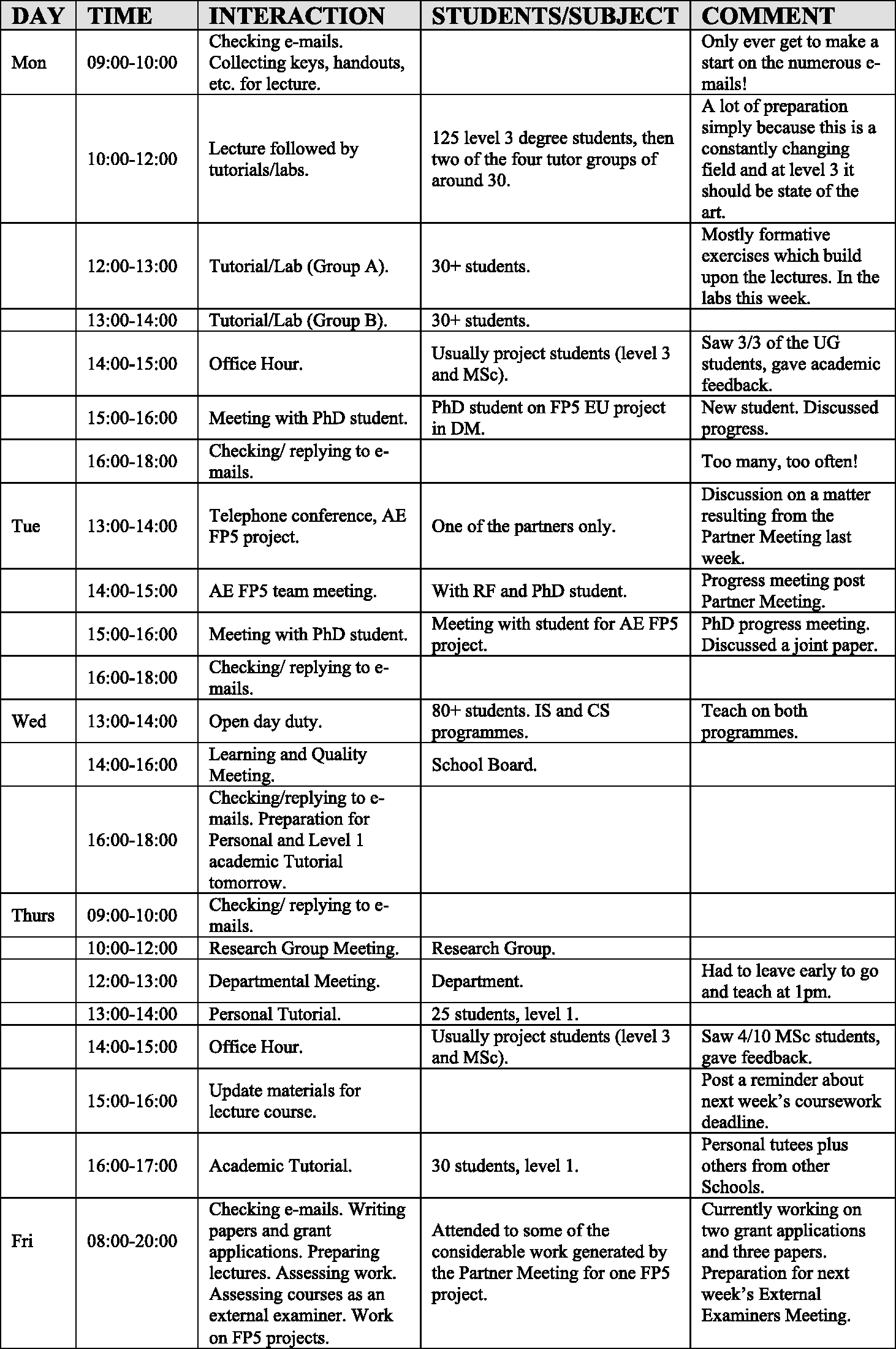
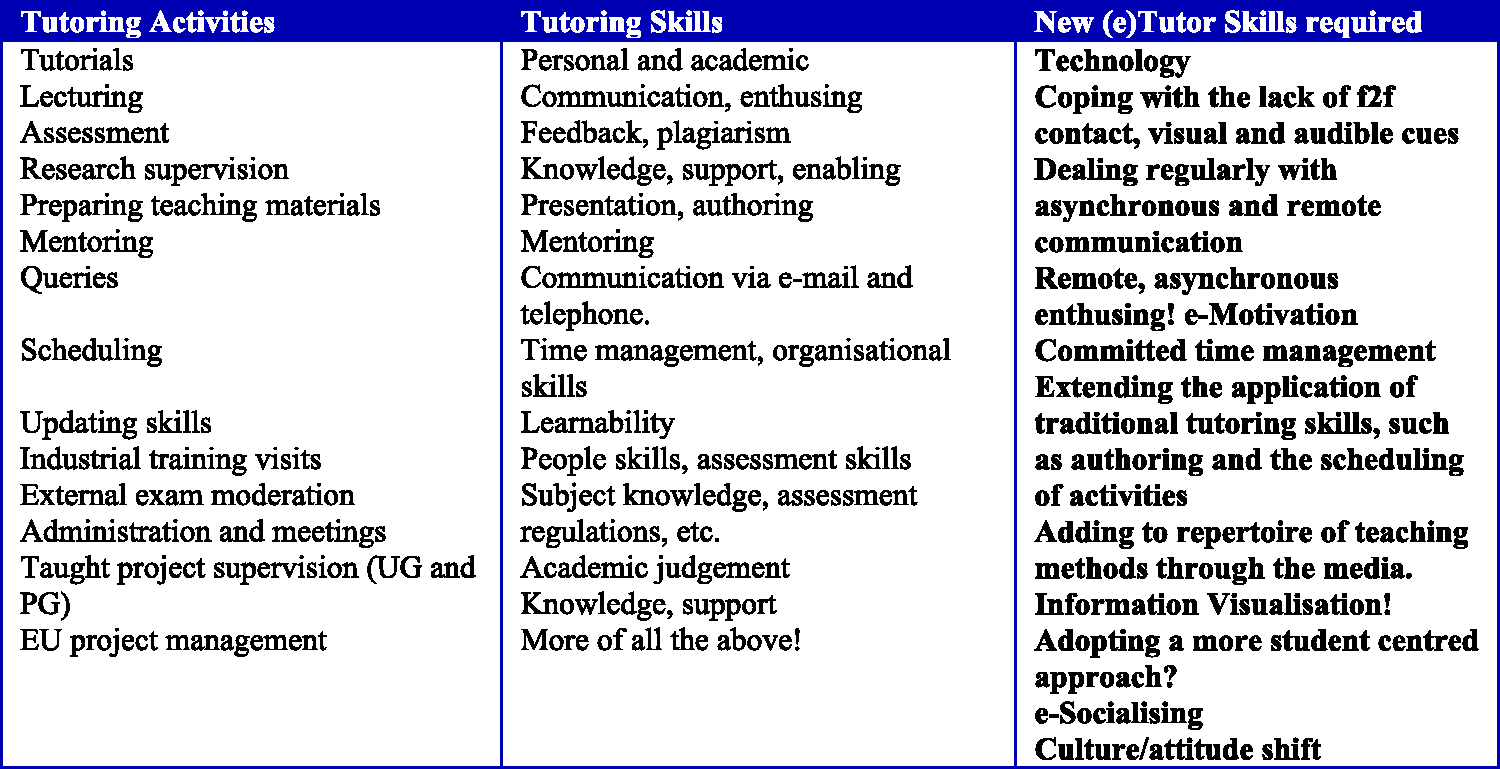
The additional skills were considered to be first technological, and second, skills which dealt with managing mostly remote and often asynchronous communication. The skills were stated to relate directly to perceived problems with Computer-Mediated Communication (CMC), and were equally inherent in Computer-Supported Cooperative Work (CSCW) and Human–Computer Interaction (HCI). CSCW is about groups of users and designing systems to support their group work, understanding the effect of technology (products often called groupware) on group work patterns (Dix et al., 2004; Preece et al., 2002). Groupware can be classified as synchronous or asynchronous, co-located or remote, supporting CMC, and shared applications and artefacts, facilitating meeting and decision support systems. Interaction problems such as the lack of visual and audible cues, gestures, intonation, turn-taking, context, collaboration, group dynamics, etc. have long been recognised by HCI and CSCW practitioners (Maier and Warren, 2000). A further related area is Information Visualisation. Information Visualisation (Shneiderman and Plaisant, 2005: 580) is defined as “the use of interactive visual representations of abstract data to amplify cognition”. Learning is arguably a social activity, and communication is widely accepted as being central to any successful teaching and learning strategy (Sutherland, 1992), and a system will fail even if it fulfils all its functional requirements if it does not address the requirements of the user.
3. The skills identified are then mapped against those suggested by Salmon’s (2004) five-stage model of e-tutoring (Figure 3). A framework for supporting e-tutoring. Maintenance is deemed to be an issue for all stages of the model. STAGE refers to Salmon's (2004) 5 stage model of e-tutoring (Graham, 2007: 45).
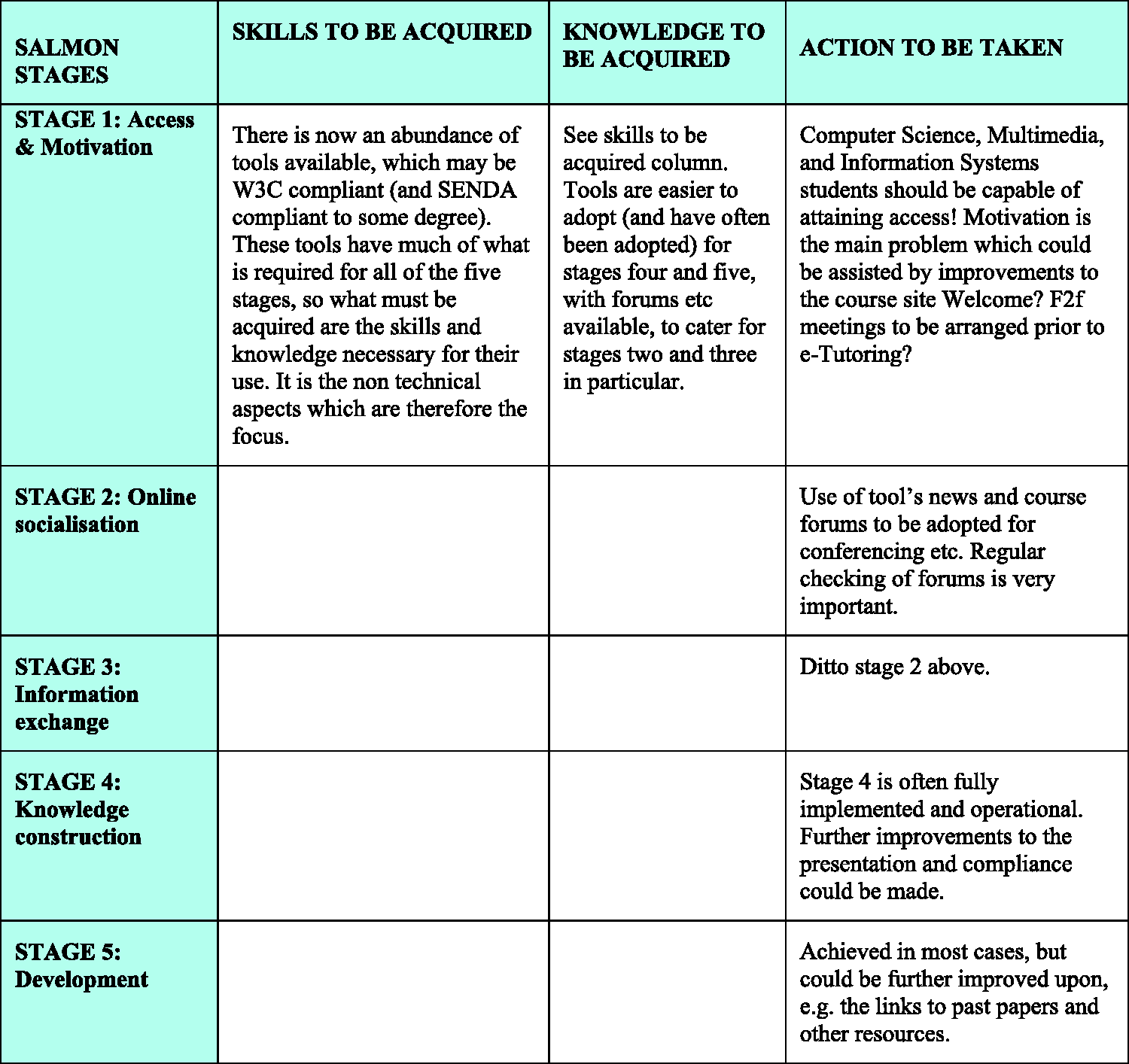
Salmon’s model for e-moderating gives more weight to the social aspects of e-tutoring, adapting to the e-learning environment and the group dynamics (three of the five stages). The last two stages are those concerned with the actual knowledge construction and development. Anecdotally, this emphasis is probably correct and is the main implication for practice. The framework proposed (Figure 3) showed that the human factors associated with stage 1 of Salmon’s model appeared to be paramount to the success or failure of a system. Communication, cultural and social aspects are examples of human factors, and have much in common with the user requirements. Learning was deemed to be achieved by providing appropriate scaffolding, whether for traditional tutoring or e-tutoring. Motivation was replaced by e-motivation, socialising became e-socialising. Fundamentally, the nature of human interaction and the lack of visual and social cues, etc., provided by the technology, was the likely reason for Salmon’s e-tutoring stages 1–3 being more difficult in non f2f situations.
Blended learning is one solution often proposed to resolve many weaknesses of the human requirements provided by systems for e-learning (such as “Motivation” and the lack of “Online Socialisation” as described by Salmon’s (2004) early stages) as implied by the “Action to be taken” column. In 2007, there was a movement towards blended learning, with in-house course management tools invoking a creeping change in teaching practice from traditional tutoring to e-tutoring. Sharpe et al. (2006) suggested that “the term blended learning was attributed in the 1980s to the Open University’s model of blending distance learning with face to face support”. Gulc (2006) later states a definition given by the British Educational Communications and Technology Agency (2015, BECTa), who described blended learning as: ‘a combination of face-to-face and on-line delivery’, which they believe ‘suits a wider range of learning styles’.
An educational formation that integrates elearning techniques including online delivery of materials through web pages, discussion boards and/or email with traditional teaching methods including lectures, in-person discussions, seminars, or tutorials.
The findings suggested that the pros of blended learning appeared to be mostly managerial; for example, a reduction in the amount of printing and photocopying costs and paper. Moderated work was immediately available electronically; indeed, almost everything was available at the click of a mouse. All learning material for each course (schedules, coursework, room bookings, etc.) was on the system, so staff absence could be more easily accommodated. Staff absence was also recorded on the system and news bulletins were provided on Teachmat to inform students of staff absences. Extenuating circumstances and coursework extensions were also dealt with online. Everything was on Teachmat.
Many of the cons were born by the tutors. Although many of the mostly technical requirements of blended learning and the framework were provided for by Teachmat, the human issues were still unresolved. Tutors were expected to be online 24/7. Traditional tutoring was still superior in terms of flexibility and the accommodation of unforeseen circumstances. It was much easier to flick through paper coursework submissions than electronic ones. A “Course Attendance and Uploads Register” for a student on a continually assessed course only showed that a linked file had been uploaded for a course in a given week by the student; it did not give any indication of the file contents (which could be nonsense) or actual attendance. Restrictions were placed on the size of uploaded files. Printing of uploaded coursework was restricted to black and white, which is a weakness for assessing HCI criteria in particular, adding further pressure for tutors to mark online. Students, and especially staff, felt that they were being dictated to by the system. There were issues associated with the ownership of teaching materials, which were more accessible in electronic form. Teachmat had furthered the vast increase in e-administration, with the continuous monitoring of forums, plus the propagation of electronic communication and documents required to be completed for tasks. The management system was becoming unmanageable. Anxiety and resentment within staff and students was being created by this wandering into blended learning. There remained outstanding health and safety, pedagogical, as well as social issues regarding e-tutoring which had yet to be addressed. Finally, everything was on Teachmat.
In the development of the framework, it was suggested that the problems of e-learning were not new, and were as for other forms of interaction and their requirements. Also, that e-learning should heed the lessons learnt from other areas such as HCI and CSCW, in that the problems of e-learning (and associated requirements) were no longer fundamentally technological but human. It was concluded that it was these problems that needed to be addressed in any proposed framework for progress to be made, which might be enabled by greater improvements in communications technology becoming sufficiently sophisticated as to convey subtle cues, etc. Further progress, however, might ultimately necessitate a cultural and social shift in the attitudes of tutors and tutees towards teaching and learning per se.
It was also concluded that the use of blended learning had been an indirect consequence of the in-house technologies then employed. Tools like Teachmat were directing teaching and learning practices towards blended learning. The development of such in-house tools had caused a technology-led proliferation in the employment of blended learning. This sea-change was not a conscious decision by staff and students, which raised questions about the pedagogy behind the systems that were developed. HCI and communications issues remained, as did some technical problems. The major concern was that, although many (but not all) of the technical requirements had been catered for by tools like Teachmat (as demonstrated by the pros, mainly associated with Salmon’s stages 3–5), many important issues, namely those referred to as “human”, had not been addressed (reflected by the cons, mostly associated with Salmon’s stages 1 and 2). There had not been any cultural or social shift in attitudes, however. It was concluded that the successful embodiment of human factors (pedagogical, social, etc.) required most effort for fully “e” or blended learning. Blended learning was not providing a solution; it had yet to accommodate the attainment of Salmon’s motivational or social stages as identified by the development of the framework, and the constant focus on the technology was merely aggravating the situation.
Sociology uses a classification system of PESTE factors: Political (P); Economic (Ec); Social (S); Technical (T), and Environmental (En). Wannemacher’s (2006: 72) institutional incentives (a–f) for e-learning in higher education were reclassified in terms of PESTE factors. It was seen that the normal interpretation of environmental issues was not relevant to e-learning. However, a looser interpretation could classify Environmental as educationally environmental.
Financial Incentives (Ec) Infrastructural and Technical Incentives (T) Accounting and Reducing Workload (Ec) Distinctions Incentive (S/Ec) Competitive Advantage for Universities (Ec) Creating a Climate Conducive to E-teaching (P)
The major concern with the incentives identified by Wannemacher was that pedagogical motives were not evident. This significant absence was also true for the use of blended and e-learning through in-house tools such as Teachmat (Graham and Valsamidis, 2006). The findings of Wannemacher (2006) and Graham (2006) indicated that e-learning was management driven; the pros (as previously given) were mostly for management and, as they originated from the higher echelons of the institution, were likely to be externally politically driven. Haydn (2006) suggested that the e-learning trend then in the UK was highly political, but it was not having pedagogy as the primary motivation for the use of e-learning that raised most unease.
After evaluating the application of e-learning using PESTE factors from Sociology, it was proposed that e-learning should adopt its own PESTE factors, where PESTE stands for Pedagogical, Educational, Social, Technical and (Educationally) Environmental. The order of these PESTE factors for e-learning was significant. Pedagogy should be the overall concern. Pedagogy overlaps with Education. Social factors should also be high on the agenda in accordance with the findings that human issues are paramount, as learning is inherently a social activity, fundamentally founded on the instinct to survive. Equally, the findings suggested that Technology and the Environment should carry less weight.
A deliberate conscious decision was then made to exclude and replace Political and Economic factors, which were credited as the drivers for much of the expansion of e-learning. In practice, economic incentives were suggested as being proven to be a myth, as serious attempts to realise e-learning were experientially at least as expensive as f2f learning.
In the next section, the trans-national framework for e-learning is reapplied and PESTEL (Political, Economic, Social, Technical, Environmental and Legal) factors are reconsidered for 2016. A discussion then follows and looks at the influence of the latest innovations: MOOCs (Massive Open Online Courses) and Flipped Learning. Finally, the future of learning technologies is discussed and conclusions drawn, including the proposal of PESTEL factors for e-learning and the 4Es of Tutoring for Value Added Learning (VAL).
PESTEL factors for e-learning: 2016
The trans-national framework was developed for the application of e-learning technologies in the design of programmes and courses, with stages from determining the feasibility and requirements through to organisational strategies for their adoption. The original framework for e-learning (Graham, 2005) formed stages 1–3 of the trans-national framework. For the trans-national framework, the more cognitively accurate term e-delivery replaced e-learning (Graham, 2009b). The frameworks were aimed at tutors, administrators and senior management, according to the stages involved below.
Trans-national framework for e-learning
The trans-national framework (Graham, 2010) was the culmination of several studies and is in the form of a complete timeline (historical summary) that constitutes a generic framework for e-learning technologies. The nine stages involved are:
1. Creation of a diary “synthesis of common interaction examples that constitute teaching and learning” within the organisation (Figures 1 and 4). 2. Generating from 1. above a list of “activities and skills required for tutoring and e-tutoring” (Figure 2). 3. Mapping the skills required for e-tutoring against Salmon’s (2004) stages in the “Framework for supporting e-tutoring”, determining the “knowledge to be acquired” and the “action to be taken” for the organisation for e-learning within the organisation (Figure 3). 4. If necessary, revisiting activity 3. if blended learning is/becomes prevalent within the organisation. 5. Evaluating e-learning within the organisation in terms of STEP (Social, Technical, Economic, Political) or PESTE (Political, Economic, Social, Technical, Environmental) factors, which may be completely external to the organisation, and yet have significant influence. 6. Take CSCW view of the organisation’s e-learning technologies: (i). Instantiate a Time/Space Matrix. (ii). Apply a Cooperative Work Framework, instantiating the roles of participants and artefacts, identifying where and in what form feedback, control and understanding occur. 7. From the above stages (1–6), determine critical factors and impediments to e-learning for the organisation. 8. Conduct an organisational review of the framework findings. 9. Adopt suitable strategies for employing e-learning within the organisation. Synthesis of common interaction examples that constitute teaching and tutoring in 2016.

The original framework proposed in 2005 (Graham 2005) underlined the fact that many e-learning problems were common interaction problems well known to HCI practitioners. Returning to the HCI roots of the original research: Stage 6 reflects upon the reality that e-learning is just another form of CMC, and so should abide by CSCW approaches and hence fit within a Time/Space matrix and a Cooperative Work Framework. This was found to be the case, and the framework was further revised to incorporate this fact. From the trans-national framework stages 1–6, the critical factors and impediments to e-learning could then be elicited (stage 7).
The findings from stage 7 of the trans-national framework would then be appraised by the organisation (stage 8), and, in the light of the findings, suitable strategies for employing e-learning within the organisation could be adopted (stage 9).
The last point is where the goals of the organisation’s management (the STEP or PESTE factors) would decide the future shape of e-learning within the organisation. The trans-national framework presented is an academic framework based upon empirical evidence, which may be extremely distant from any individual department’s strategic management policy. For example, the adoption of e-learning technologies may be mandatory and deemed to be imperative to the financial survival of the organisation.
The full trans-national framework for e-learning technologies required that each stage should be applied, leading to a set of documents and diagrams that describe and depict the e-learning needs of the organisation, instantiating each of the given figures for each stage. However, blended learning is now commonly employed, and therefore stages 7, 8 and 9 (organisational factors) are a matter of fact; e-learning and suitable strategies are employed by the organisation, and so are deemed to be a part of the organisation’s strategy. Equally, stages 1 to 4 (looking at feasibility and requirements) are again established, but will be revisited here purely for academic reasons of comparison with the 2007 findings. It must also be accepted that STEP/PESTE factors (stage 5) have been evaluated favourably. Stage 5 will also be revisited for reasons of academic consistency, but PESTEL factors will be considered instead. The remaining stage 6 of the framework is normally all that can be applied.
Stages 1 and 2: Tutoring – activities and requirements
Typical tutoring activities for a representative week in the calendar of several university lecturers were again elicited, resulting in a synthesis of common interaction examples that constitute teaching and tutoring in 2016 (Figure 4). The significant amount of time spent dealing with electronic communication (e-mail, forums, etc.) and electronic systems administration (Sharepoint, Banner, Moodle) is still noteworthy. Communication is now through mobile technologies, e.g. smart phones and tablets, and includes social networks, such as Facebook and Twitter. The activities and tutoring skills required were identified from this new diary synthesis and found to be similar to those in 2007. Keys for computer cabinets are no longer collected. All lecture theatre and lab materials are via the university portal which now solely employs Moodle for course delivery. Lecture theatres and labs use virtual office desktop access. Project meetings are conducted via WebEx. Some courses include Podcasts and Webinars. In 2016, only minor differences from 2007 were noted; therefore Figure 2 (stage 2) did not require serious revision. The new skills required for e-tutoring suggested by the third column were unchanged from 2007. Again the inference was that e-tutoring required all the same skills as traditional face-to-face (f2f) tutoring, plus some additional skills. The additional skills are still considered to be technological and administrative, and skills which deal with managing mostly remote and often asynchronous communication.
Stages 3 and 4: Salmon’s 5 stages of e-tutoring in 2016
The mapping of the relationship between the skills identified and those given or suggested by Salmon’s (2004) five-stage model of e-tutoring was again explored. In 2016, mapping activities and skills to be required for e-tutoring on to Salmon’s five-stage model revealed the only difference to be that the tool had changed from Teachmat to Moodle, and the “Action to be taken” column (for stages 3–5) had now been realised. The focus is still on Salmon’s stages and 1 and 2 (non-technical and human). The anecdotal evidence is that a great many colleagues are solving these online (remote and asynchronous) motivational and socialisation issues by increasing the instances of f2f contact.
Blended learning, teachmat and moodle
In 2007, many of the technological requirements necessary to enable e-learning were provided by Teachmat, an in-house tool (Graham, 2006). In 2016, the open-source tool, Moodle, had been adopted and it fulfils the same needs as Teachmat, and is university-wide. Many aspects of the framework in relation to Salmon’s five stages have been attained for most courses using technology-led blended learning, e.g. employing Panopto software. Like Teachmat, Moodle means the end of printed handouts. Links to past papers and other virtual resources are provided. Moodle also handles everything from learning material, assignment uploads, assessment and examinations management, forums, student advice, registration and attendance, curriculum and institutional teaching policies management, lecturer and student handbooks, etc. The learning and teaching style is now unmistakably blended. The level of blended learning is being standardised across courses; several courses employ multi-media course delivery, such as video and pod-casts. All coursework is uploaded online, and online assessment is now the default. All submissions generate automatic electronic receipts. Separately, portable bar code readers read student ID card bar codes to take attendance registers. Forums are available on Moodle to all students and staff at course level. It is still the case that the level of electronic communication with students and other staff has further exploded as a by-product. Fundamentally, more and more elements of the teaching and learning and administration are now electronic. F2f (co-located and synchronous) teaching remains the predominant method employed in the institution for local (co-located) students, but much of the related activities are now remote and asynchronous. Lecturers still give lectures, tutorials and workshops in person, but via Moodle. Moodle is being further exploited for external collaborative institutions, where both teaching and supporting activities are being carried out remotely and asynchronously for example, video. Here, learning is more fully “e” than blended. Any f2f teaching is primarily being done by the local staff at the external institutions.
As in 2007, the pros of the deployment of blended learning still appear to be mostly for management, with an increasing element of micro-management. For example, there is a reduction in the amount of printing and photocopying costs and paper. Moderated work is immediately available electronically, with almost everything available at the click of a mouse (in theory at least). All learning material for each course (schedules, coursework, room bookings, etc.) is on the system so staff absence can be more easily accommodated. Staff absence is also recorded on the system and news bulletins provided on Moodle inform students of the absence of staff. Extenuating circumstances and coursework extensions are also dealt with online. Everything is now on Moodle (or linked systems). Although the role of linked systems is important, only the learning delivery system (Moodle) is considered here for the framework. Replacing the in-house system (Teachmat) with an open-source one (Moodle) has changed little beyond making blended learning a clear and deliberate management choice.
Moodle again provides for many of the mostly technical requirements of blended learning and the framework for e-learning support. The human issues remain unresolved. Tutors are still expected to be online 24/7. Traditional tutoring is still superior in terms of flexibility and the accommodation of unforeseen circumstances. It is still much easier to flick through paper coursework submissions than electronic ones. There are still restrictions on file size (uploads). Any exceptional printing of uploaded coursework is still restricted to black and white (still a weakness for assessing HCI criteria in particular), adding further pressure for tutors to mark online, which is now the default. Students, and especially staff, still feel that are being dictated to by the system. There are still issues associated with the ownership of teaching materials and copyright, now materials are more accessible in electronic form. Moodle has furthered the vast increase in e-administration, with the continuous monitoring of forums, plus the propagation of electronic communication and documents being required to be completed for tasks. The management system is no more manageable, with an increasing number of linked systems. Anxiety and resentment within staff and students is still being created by the use of blended learning. There are still considerable health and safety, pedagogical, as well as social issues regarding e-tutoring which have not been addressed. Students are commenting on the necessity of university attendance when the teaching is online (Ryan, 2015). Finally, everything is on Moodle and an array of linked systems, such as Sharepoint. A major issue is that, although everything is supposedly immediately to hand, in practice, it takes more time to go through electronic screens (often due to HCI issues, such as the lack of intuitive navigation) and to enter feedback via linked systems such as Turnitin and GradeMark. There appears to be an illogical drive to micro-manage and log/automate/make electronic every conceivable task and document; everything from staff appraisals to help desk queries. The workload, systems and management are increasing, not decreasing. Due to the greater number of linked systems, there is an increasingly large element of data duplication and poor systems’ management practice. In addition, (big) data is being generated on an unprecedented scale often leading to the blind use of data analytics without a business case or demonstrated poc (proof of concept). There is also the often ignored matter of what happens when Moodle (or a linked system) goes down. The consequences are normally far from trivial.
PESTEL factors (stage 5)
With the addition of Legal factors, Wannemacher’s (2006) incentives are once more reclassified here, but in terms of PESTEL (Political (P); Economic (Ec); Social (S); Technical (T); Environmental (En), and Legal (L)) factors.
Financial Incentives (Ec) Infrastructural and Technical Incentives (T) Accounting and Reducing Workload (Ec/L) Distinctions Incentive (S/Ec) Competitive Advantage for Universities (Ec) Creating a Climate Conducive to E-teaching (P)
There is little change from the application of PESTE factors, as only a single “L” (Legal) has been added. It is difficult to argue the involvement of “Legal factors” other than for incentive c. Pedagogical motives are still not evident, as was the case for the evaluation of Teachmat (Graham and Valsamidis, 2006). The lack of pedagogical drivers is still apparent for open source tools such as Moodle, contrary to the hype and pedagogical claims linked to VARK (Visual, Audio, Reading, Kinetic) student evaluations (Flemming, 2008). The findings of Wannemacher (2006) and Graham (2006) still indicate that e-learning is management driven; the pros given are mostly managerial. However, rather than externally politically driven, the use of learning technologies is now increasingly likely to be internally politically driven by the institution. In 2007, Haydn (2006) suggested that the e-learning trend in the UK was highly political and externally driven. The internal drivers which exist now are more likely to be due to institutional competition. Using learning technologies to improve pedagogy should always be the primary motivation, but is yet to be realised.
Computer-supported cooperative work and e-learning (stage 6)
Stage 6 requires that a CSCW view of the organisation’s e-learning technologies be taken. This involves the application of the Time/Space matrix, and the use of a Cooperative Work Framework to depict the interaction of elements and attributes of groupware, such as Participants and Artefacts. See Graham (2013b: 47, 49) for examples of the instantiation of stage 6 (i) and (ii).
As stated previously, stages 7–9 have been deemed to be redundant and are not directly relevant to this paper’s objectives.
Discussion
Debates about whether or not digital media and technologies for e-learning should be employed are now forfeit, making all but stage 6 of the trans-national framework for e-learning technologies, in most cases, redundant for universities in the UK. It has been deemed to be a matter of fact that e-learning is now part of the organisational strategy of many universities in the UK. The arguments for and against e-learning have been rendered academic, “with e-learning now high on the agenda of the UK Government and of all educational sectors, it is clear that e-learning is here to stay” Wiles (2007), Senior Adviser LTSN Generic Centre); the genie is well and truly out of bottle. The main concern is that the promotion of e-learning is still politically rather than pedagogically driven (Graham, 2007; Haydn, 2006; Wannemacher, 2006), and the fact that mapping the e-learning strategy to an organisation’s business objectives is strategically the first stage is a strong indictment of this stance (Graham, 2009a).
The absence of social interaction continues to be a major barrier to a positive online learning experience (Graham and Valsamidis, 2006; Berge et al., 2002). Some courses claim to address the problem by the use of asynchronous communication (namely, discussion boards) to facilitate critical interaction between the tutor and learners, between learner and learner, and between learner and content in the course. It has been further claimed that: To accomplish these academic objectives, specific course examples are presented to demonstrate how the use of Virtual Learning Environments (VLEs) can effectively support pedagogical principles by designing learning activities that encourage: active engagement in student learning experiences; sharing their learning with other students; opportunities for student reflection on learning and peer/tutor feedback. (Stair, 2010: 4–5).
Despite the claims of such courses, weaknesses in online delivery (the use of remote and asynchronous communication) are usually addressed by the introduction of more f2f (co-located and synchronous) communication as a solution. As discussed Graham (2007), cmc is no substitute for the richness of human interaction (Benyon et al. 2005: 699). Ubiquitous communications systems cannot compensate for distance as the sheer richness of human communication is not merely verbal, but is in the use of gesture, body posture and so on; all of these elements make up non-verbal communication. For e-learning/e-delivery, the richness of f2f communication is replaced with impoverished cmc. People seem to accommodate the inferiority of cmc to a degree where one or two channels of communication are absent, for example, Australia’s School of the Air (remote but synchronous). Australia has many years of experience with distance learning. Large distances and low population density led naturally to the ‘School of the Air’. This retained the teacher pupil verbal interaction and much of the strict time frame with few of the problems that today’s e-learning environment faces. (Howgate, 2007)
Anecdotal evidence, as well as that from the annual “e Teaching and Learning” workshops (Graham, 2011), implies that Technology Enhanced Learning (TEL) is more successful for postgraduate students and when not purely “e”. The claimed success rate for some university online courses (now recognised to be not purely online) for postgraduate students, alluded to by Stair (2011), could be because postgraduate students are already the ideal independent learners. The successful use of some f2f and/or synchronous interaction is also supported by renowned institutions such as the Open University in the UK, who hold summer workshops and provide synchronous telephone contact with tutors. Australia’s School of the Air is another example, where radio communication, whilst remote, is synchronous.
One major difference between 2016 and 2007 is the existence and prominence of MOOCs (Massive Open Online Courses). A study published by the HEA in 2015 (Bayne and Ross, 2014; Wintrup et al., 2015a, 2015b) showed that “participants can and do experience engaged, high quality learning” through MOOCs (heacademy, 2015: 1). Bayne and Ross (2014) identified 58 MOOCs offered by UK universities. Of these, 18 MOOCs were in Social Science, 13 in Humanities, and 13 in Medical and Veterinary Science, 8 in Natural Sciences and 6 in Computing Sciences. MOOCs in this case run for between 2 and 12 weeks; the majority are six weeks in length. Baynes and Ross (2014: 8) conclude that:
“MOOCs have multiple pedagogic forms and intentions (not just cMOOC/xMOOC binary). MOOC pedagogy is not embedded in MOOC platforms. ‘The teacher’ persists in the MOOC”.
The availability and financial implications of MOOCs may impact on course delivery as the diversity of subjects and courses offered increase. As with Moodle, management should be wary of perceived financial benefits versus the reality. Moodle is open-source; however, institutions often end up paying for consultants to make full use of this “free” software. It would be interesting to discover whether proprietary e-learning software, such as WebCT, actually costs more than Moodle with the additional support costs. Any institution which has moved from proprietary to open-source software is unlikely to make this publicly known (whatever the outcome).
Another recent teaching innovation (buzzword) is “Flipped Learning”, popularised by Bergman and Sams (2012). This classroom-based learning is said to be inverted, because students are introduced to the learning material before class, and the time spent in the classroom is then used to deepen understanding through peer-based discussions and problem solving activities facilitated by teachers. The use of technology is often promoted as a means for “flipping the classroom”. The reality is that good teachers have been “flipping the classroom” for years, mostly without the use of technology. Technology is not a substitute for good teaching or good teachers, and, in fact, technology usually exposes poor teaching competence.
Conclusions
The findings from the 2007 paper still stand; so after evaluating the application of e-learning using PESTEL factors, it is now suggested that e-learning’s PESTEL factors should stand for Pedagogical, Educational, Social, Technical, (Educationally) Environmental and Legal. The order of these PESTEL factors for e-learning is still important. Pedagogy should always be the main concern, overlapping with Education, but Social factors should stay high on the agenda in accordance with the findings; that human issues are still paramount, and learning remains an inherently social activity. Technology and the Environment continue to carry less weight.
Political and Economic factors, which were credited as the external drivers for much of the expansion of e-learning (now mainly internal), are still excluded, and the economic advantages of e-learning over f2f remain questionable. This economic advantage is even more dubious as the common solution to online (fully e-learning) problems is to increase the amount of f2f interaction. From experience, students attend university as much for the social interaction (university life) as for the educational benefits (subject knowledge and learning). The Legal factors are left unaltered as they imply a moral element. Laws should embody ethical and moral principles, and be a part of wider learning.
It was previously suggested that the future of teaching and learning would be Cloud-oriented: “Learning in the Cloud” or “Cloud-based Learning”. The Cloud-based future view of e-learning would be influenced by PESTEL factors. “The Cloud Computing Model, more commonly referred to as simply Cloud Computing or ‘The Cloud’, provides access to ‘clouds’ of shared computing resources such as storage and applications, over a network, usually the Internet” (Graham, 2013a: 7). Chang and Wills (2013: 233–234) describe Education as private Cloud-based, delivered through Education-as-a-Service. MOOCs may be a precursor to public Cloud-based Education-as-a-Service.
Finally, the framework for e-learning focused on the knowledge and skills of tutors in relation to Salmon’s stages of e-tutoring. Perhaps what is missing most from e-learning are the (human) attributes of a good tutor. A small survey was carried out with undergraduate and postgraduate students, asking them to list the four attributes of a good tutor. According to staff and students, common thematic attributes of a good tutor are invariably stated as 4Es, given below:
Expertise – extensive knowledge of the subject area Exposition – the ability to explain (deliver) Enthusiasm – for the subject and teaching it Empathy – with the students and their learning experiences
These are the 4Es of Value Added Learning (VAL). If the ideal human teacher is to be electronically or virtually replicated, then, for most learners who are not in the minority of independent learners, any VLE or its ilk must embody these attributes. The problem is, of course, that these attributes are fundamentally social and human (and therefore intelligent and agile), and require time to be developed. It is questionable if the latter 2Es can ever be embodied by technology. However, there must be at least a fundamental shift from web-enabled database systems to more intuitive knowledge-based systems. Technology Enhanced Learning (TEL) has its place, for instance, exploiting the infinite patience of computers (software), multi-modal delivery (supporting people with impairments), or where distance (remoteness) or time (asynchronicity) is unavoidable. However, just because you can do something (use technology) does not mean you should, especially if the only or major motivation is financial.
It is suggested that if universities and educational institutions are to remain bricks (and mortar) as well as clicks, then there must be some added value to co-located synchronous f2f teaching. This added value, therefore, is the human element, as there is as yet no substitute for a good tutor espousing the 4Es of tutoring for value added learning.
Footnotes
Acknowledgements
The support of the other participants of the CeLTT (Certificate of professional development in eLearning, Teaching and Training) workshops, their contributions to the synthesis and to  are gratefully acknowledged. The assistance and course information provided by Nola Stair at the University of Greenwich is also gratefully acknowledged. Facebook, Linked-In, Moodle, Panopto, Skype, Sharepoint, Twitter and WebEx are all registered trade names.
Declaration of Conflicting Interests
The author(s) declared no potential conflicts of interest with respect to the research, authorship, and/or publication of this article.
Funding
The author(s) received no financial support for the research, authorship, and/or publication of this article.