




Abstract
An ongoing challenge of 21st century learning is ensuring everyone has the requisite skills to participate in a digital, knowledge-based economy. Once an anathema to parents and teachers, digital games are increasingly at the forefront of conversations about ways to address student engagement and provoke challenges to media pedagogies. While advances in game-based learning are already transforming educative practices globally, with tech giants like Microsoft, Apple and Google taking notice and investing in educational game initiatives, there is a concurrent and critically important development that focuses on “game construction” pedagogy as a vehicle for bringing computational literacy to middle and high school students. Founded on Seymour Papert’s constructionist learning model and developed over nearly two decades, there is compelling evidence that game construction can increase confidence and build capacity in science, technology, engineering and mathematics. This project is a research-based challenge to the by now widely questioned but surprisingly persistent presumption that students in today's classrooms are all by default “digitally native” and that those “digitally native” children are learning just by playing digital games. Through a survey of 60+ students at a largely immigrant middle school in Toronto, Canada, we present some important updates on youth’s media and technology competence and its relationship to baseline knowledge of computer programming and performance in a computational literacy game-based curriculum.
Background: In pursuit of “21st century skills”
Concerns surrounding what 21st century learning and skills are required from public education has dominated educational discourse. Despite widespread enthusiasm for “21st century learning,” researchers and policy makers around the globe are still trying to articulate exactly what 21st century learning is (Johnston, 2005; Partnership for 21st Century Skills, n.d.), if the concept has not been abandoned all together, and while public education generally is being criticized for not doing it (Francis, 2012; Lynch, 2003). There is, for example, no specific curriculum regarding what 21st century learning should entail and how that should inform K-12 schooling and curricula (Voogt et al., 2013), although there is widespread agreement that digital games are somewhere in that landscape (Gee, 2005; Salen, 2007; Squire, 2011). Digital games are increasingly at the forefront of conversations about ways to address student disengagement (Gee, 2003; Rieber, 1996; Rupp et al., 2010) and to foster 21st century learning and skills (Barab and Dede, 2007; Steinkuehler, 2008; Squire, 2011). That research concentrates on playing digital games, whether those are commercially made or made especially for education. Less prominent has been research focused on the design and development of games as a means to support critical competencies like creative problem solving, collaboration, and programming skills (Carbonaro et al., 2010; Peppler and Kafai, 2007; Denner and Wenner, 2007; Papert, 1993). Designing and making digital games, as prior work suggests, might well provide an ideal framework for operationalizing 21st century learning: creating digital artifacts entails technical, computational and aesthetic forms of competence whose success depends on bridging between arts and sciences – an intersection increasingly characteristic of the contemporary job market and effective participation in social life.
Given the landscape of enthusiasm for “21st cenutry learning and skills,” or as Voogt et al. (2013) put it “21st century competencies,” it is important to recognize and interogate the surprisingly persistent presumption that students in today's classrooms are all by default “digitally native” (Prensky, 2001) and that those “digitally native” children are learning just by playing digital games (Prensky, 2005). In actuality, “digital nativity” is looking markedly gendered, raced and classed (Bennett and Maton, 2010; de Castell et al., 2008; Jenson et al.,2010) and just being familiar with digital technologies and using them in one’s everyday life does not necessarily translate into skillfully using them for learning (Livingstone, 2008) – for educational purposes, more is entailed. This study recognizes that in the contemporary media landscape, familiarity with digital gameplay can represent for many young people their entry point into acquiring foundational digital skills demanded by a global knowledge economy and builds on that familiar medium as a “gateway” to study the development of critical digital literacies not through digital game play on its own, but through a “production pedagogy” (Thumlert et al., 2015) in which gameplay is integrally co-engaged with the design and development of digital games. As such, one of the aims of this study is to interrogate, in addition to the properties and enactment of digital skills and comptencies, the context of game-based learning – that is, how does general media and technology experience in kids’ lives relate to their ability to participate and benefit from game construction activities in the classroom? This question is inextricably linked to the larger context of STEM instruction, and in that sense, this study will contribute to the research on game design as a “gateway” to STEM that might, moreover, be a way to effectively re-fuse the digital divide when it comes to computational literacy by seeing it and treating it as a new form of “media literacy” (diSessa, 2000; Wing, 2006; Yadav et al., 2014). We set out to explore, beyond simply celebrating the introduction of game construction in the classroom, specific relationships between youth’s media and technology fluency and the myriad of attitude and confidence-related barriers to supporting game making in k-12 schooling.
Computater programming: A 21st century comptency?
Of the many arguments for 21st century competences, it is generally acknowledged that technologies and their role in teaching and learning play a key role (Dede, 2010; Jenkins et al., 2006). Concomittently, there are calls for significant changes to curriculum and assessment practices (Trier, 2003; Voogt et al., 2013). One primary argument for introducing game design and development as part of STEM curriculum planning concerns the need to introduce and familiarize youth from an earlier age to the principles of computation, design thinking and procedural logic. The context for this is a growing acknowledgement among educational researchers, computer scientists and teachers that “computational thinking” and algorithmic logic ought to be considered a kind of “core literacy” that needs to be incorporated into the school curriculum alongside numeracy, textual literacy and scientific thinking (diSessa, 2000; Wing, 2006). A secondary argument for introducing game design in K-12 schooling addresses a key problematic in the implementation of 21st century learnin and comptencies – the restructuring of curriculum. Game design, we argue, could well be one way of supporting the acquisition of what might broadly be referred to as “digital literacie” (Lankshear and Knobel, 2006) and more specifically “computational thinking” (Wing, 2006). In addition, providing this kind of instruction might bridge the significant gap between those who are digitally skilled and those who are not. One of the particularly pertinent underpinnings of contemporary education research into using game construction software in the classroom is addressing the systemic problem of girls’ impoverished representation in computing science and technical fields (Corbett et al., 2010). Such studies aim to deliberately engage girls and other marginalized youth groups in coding activities and counter negative associations and lack of confidence that might hold them back from approaching and benefiting from ongoing computer programming instruction.
More specifically, one of the particularly pertinent considerations of this (and similar) work is addressing the the paucity of women in the technology sector (Corbett et al., 2010; Margolis and Fisher, 2003) and early on, effecting gender-based differences in the way kids approach and benefit from ongoing computer programming instruction (Abbate, 2012). In order to complicate and update narratives of both youth defacto being “digitally competent” and gender differences in technology use and gaming experience, our present work emprirically revisits youth’s media and technology use as it connects to both students’ attitudes and confidence towards computers and programming, as well as to students’ pre and post test scores on a computational literacy assessment tool.
Study design
The study took place in grade 6 classrooms in a very large elementary school in Ontario, Canada, in a neighbourhood heavily populated by transient immigrant communities. We chose to work with grade 6 students because much of the work done previously (see Carbonaro et al., 2010; Denner, Werner and Ortiz, 2012; Werner et al., 2012) suggests that grades 6 and 7 are the point when many students begin to make choices about what courses they will or will not take at the high school level, and this often ends up determining post-graduate specializations. In particular, classroom subjects begin to have a “gender,” making girls especially vulnerable to lagging behind their male peers in technologized and computer-related areas. We worked with the full grade 6 complement in the school (n = 67), replacing their Language Arts curriculum for a period of 1.5 hours over six consecutive days of game design and coding instruction, in addition to a full day of additional curricular programming in a fieldtrip to a local university. In total, the participating students had approximately 15 hours of game development practice using the software Game Maker Studio and of that, approximately 4–5 hours were direct instruction. With small exceptions, students worked in pairs to create their games. In order to determine kids’ media and technology habits, as well as their general attitudes towards computers and programming, we had students complete a media use and computer confidence survey before game design instruction. Students were also asked to fill out a pre-test prior to the study and post-test directly on completion of the study.
Instrucments: Media use survey
The media survey (see Figure 1) was organized around themes of electronic communication and technology use, including patterns of social media use, gaming habits, access and familiarity with different types of computing technology, all rated by frequency of use. Included in the questionnaire were also a set of Likert-scale questions on general confidence with computers and attitudes towards computer programming (Seiter and Foreman, 2013; Hoegh and Moskal, 2009).
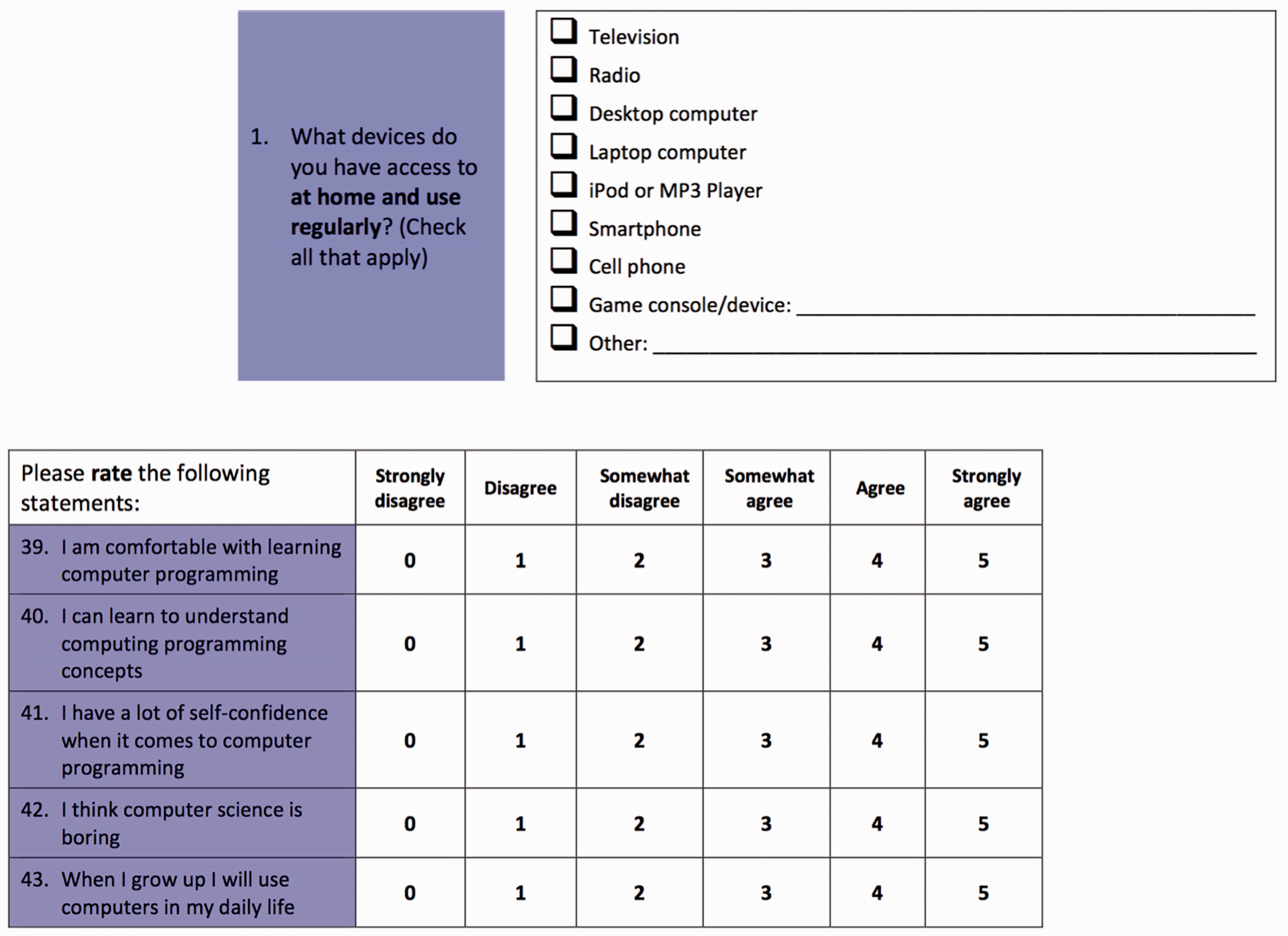
Example of a media use survey question and a computer programming confidence question.
Computational literacy pre/post-test
The pre-test was designed to evaluate students’ existing knowledge of computer science concepts, such as what variables, operations and functions are (see Figure 2). Following the study, a post-test was administered that was identical to the pre-test; however, the questions were given in a different order, to gauge changes in definitional and practical knowledge of computational constructs and syntax.

Two examples of pre/post test computational literacy questions.
Among the questions that we posed at the onset of this study are these: (1) how are media use and technology competence connected to both declarative knowledge and performance in a game-based computer literacy instruction and (2) are there gender differences in attitudes towards and confidence with using computers and computer programming among this student population, and if and how do they influence performance.
Media use results
In this paper, we focus on the media use responses by participants and their intersection with self-reported attitudes and competencies with computers generally and computer programming more specifically. Overall, the classroom-based instructional model seemed to function well for grade 6 students working in pairs, and they were able to create playable games using Game Maker Studio within the timeframe of six classroom sessions + 1 extended university field trip (see Figure 3). Not only did students design and code their games with minimal facilitation but their content knowledge of basic computational terminology, as well as Game Maker domain knowledge improved from an average of 6.7 to an average of 9.3 (out of 16) from the pre to post test. In the following sub-sections we discuss data organized around several critical areas: (1) assumptions of “digital nativity” as related to both playing games and pre-existing computer-based (and computational) knowledge; (2) the relationship between gender, confidence and attitudes towards computer programming instruction and (3) gender differences in computer programming performance in the context of game construction. As part of our analysis, we also developed two child media use “personas” as a model of visualizing youth media literacy practices.
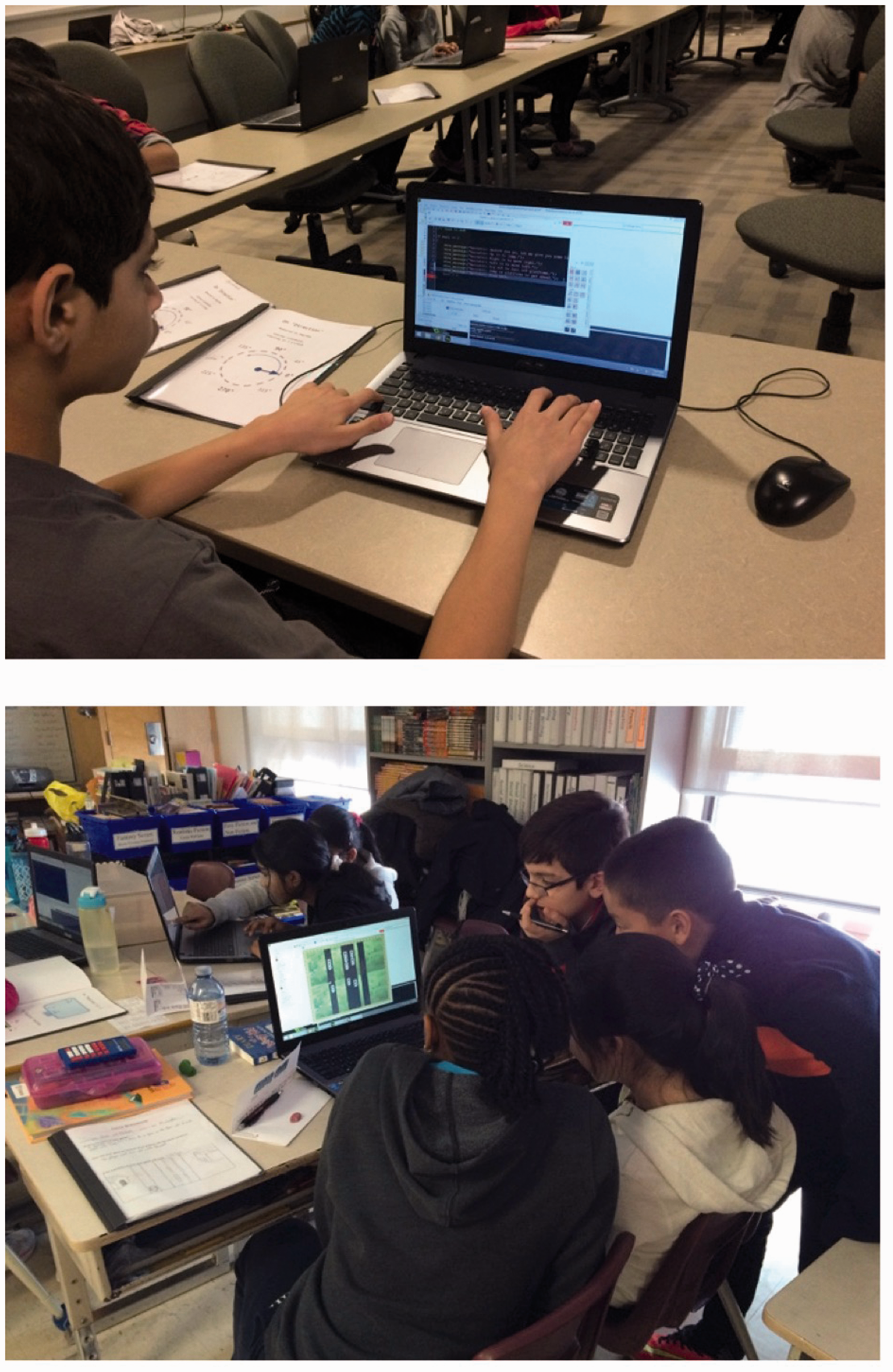
Classroom setup and kids working on game design and game programming.
Similarities and differences: Media and technology use
In terms of general media use, boys and girls are similarly likely to use social media, and almost everyone reported YouTube as one of their top websites/social media sites to visit at home, closely followed by Facebook, Instagram, Gmail and Twitter. Girls were slightly more likely to report that they use online communication tools such as Skype or FaceTime, as well as more likely than boys to frequent the micro-blogging platform Tumblr. In terms of frequency of use, despite the assumption that these students belong to a “screen-based generation,” the most popular mode of communication listed was “face-to-face” followed by phone conversation. The primary means of self-expression that was self-reported was talking, followed by “making” – crafts or media. Overall, there was no significance differences between boys and girls when it came to using different forms of technology at home, with several notable exceptions: boys are more likely to have access to and use high-quality game consoles such as Playstation and Xbox, as well as desktop computers; girls report more often than boys using a laptop and iPad or other tablets, corresponding to their reporting that they play more mobile and casual games. Girls were also more likely to list visit popular educational sites and report playing Wii games. While many girls reported playing games, boys reported that they played games more regularly than girls, and in particular, much more likely to play online multiplayer and high-end console games. Some of these gender differences in access to and use of computers and gaming consoles might well speak to cultural advertising that targets boys as the market for high-end consoles such as XBOX and PlayStation, while establishing a wider audience (that includes girls) for “educational” tools, consoles such as the Wii (which was marketed to families) and the iPad (Note: http://www.edutopia.org/blog/ipad-teaching-learning-apps-ben-johnson) (Rusetski, 2012). This finding is consistent with prior surveys of children’s media use that report gender-based differences in frequency and kind of gameplay (Bertozzi, 2008; Hamlen, 2010). So while general media use, in particular social media, is very similar for both girls and boys, gender gaps still pervade the use of more specialized technology, including games and game consoles.
Confidence and attitudes towards computer use and computer programming
Confidence and attitudes towards Computing Science (CS) has already been linked in a number of studies (Baser, 2013; Carbonaro et al., 2010; Simsek, 2011) to classroom performance, the ability to learn computer programming, as well as the motivation to continue on that educational track. Results in this study suggest that while both boys and girls reported egalitarian attitudes towards computer programming in terms of its appropriateness as a subject and career for both men and women, when it came to personal attitudes towards the opposite sex, boys were much more likely to doubt that “a girl can do well in computer programming,” whereas girls had mixed (and mostly positive) evaluations of boys’ capabilities. This trend unfortunately mirrors self-reported attitudes and confidence with regard to computer skills in general and one’s capacity to learn programming in particular (see Figure 4). For example, girls consistently scored lower in confidence levels than boys, and in particular, they scored significantly lower on confidence in their abilities to troubleshoot computer programs (e.g. I am confident I can fix the computer if it stops working).
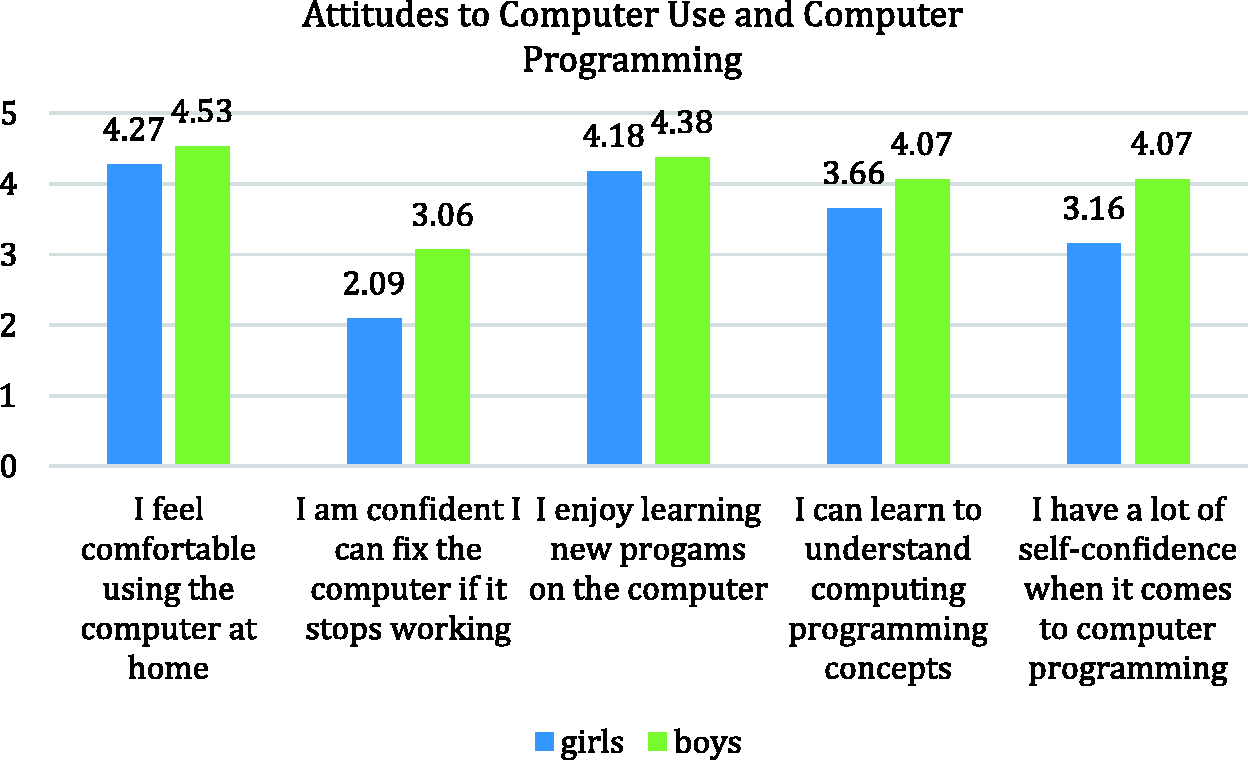
Attitudes to computer use and computer programming by gender.
Neither girls nor boys reported any social stigma for “being good with computers” and on the whole everyone gave positive answers to the idea of studying computer programming at school, being interested in computer programs, pursuing computer science further, and having a future career that includes computer work and coding.
Media competence: Aptitude for computational literacy?
While not stastically significant, girls had a slightly lower average score on the computational literacy pre-test compared to boys, and boys’ post-test scores improved, on average, more than girls’ scores (see Figure 5). This suggests that there are still factors that impact girls’ baseline knowledge of computer-related concepts and computer skills, as well as their ability to benefit from school-based instruction, as evidenced by score improvement. Exposure to and playing games has long been hypothesized as a factor that may give boys an edge in computer programming; however, recent work has dimissed it as a factor that impacts how either girls or boys do in a school-based game construction curriculum (Carbonaro et al., 2010; Denner, Werner and Ortiz, 2012). In the same vein, an ANOVA significance test revealed that device usage at home – whether mobile, media or computer-related – did not correlate to either pre-test score or corresponding score improvement. Interestingly, pre-scores were not correlated with post-score improvement, meaning that students with higher pre-scores did not necessarily improve at a higher rate than those with a lower pre-score.
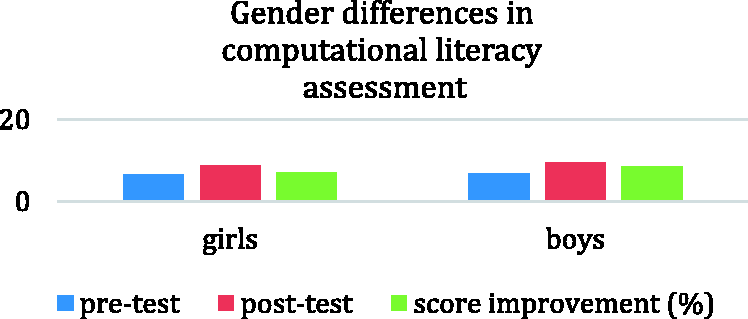
Computational literacy pre and post-test results by gender.
What was significantly correlated with pre-test scores and rate of change on the post-test were a range of “attitudes” and “confidence” questions around computers and computer programming in general. For example, the more comfortable students were using the computer at home, the higher their pre-test score was and the more they improved between the pre- and post-test, meaning they were better able to uptake and apply concepts related to computer programming. Being comfortable with computers also correlated with feeling positive about learning new programs and holding equality attitudes (Both women and men can be good and computer programming and Computer science is an appropriate subject for both women and men). Enjoying learning new computer programs positively predicted overall confidence in computer programming and overall desire to use computer programming in the future. The more they enjoyed learning new programs, the more confident they were about programming and the more they hoped to use programming in the future.
Youth media/technology use personas
In order to further understand and interrogate youth media literacy and its potential relationships to building computational literacy (inside and outside the classroom), we created two media and technology use personas as composites of average reported data in the survey. Traditionally in ethnography, the subject is constructed through a rich personal biography meant to illuminate individual user actions and perspectives within the study’s ecological context. However, given our specific interest in the convergence between digital media literacy, computer use and gameplay experience, we used the media survey data to develop typologies of media and gaming use. The aim was to construct a model that references both the kinds of media devices and game platforms kids use, as well as the frequency and relative prominence of their use. Codifying these typologies was inspired by a design method known as “persona development” (Foth et al., 2011). This method offers a way of working conceptually with a set of “typical” subjects; however, where the ethnographic subject is rich and biographical, the persona contains only details relevant directly to the inquiry at hand, in this case, media and technological competence, communicative patterns and gaming habits.
Each persona flashcard (Figure 6) uses common CMC (computer-mediated communication) icons to represent collective participants’ media and technological use, contexts of exposure to different types of media and gaming experience. Some of the specific content including apps, websites and game titles comes from a qualitative text-entry portion of the survey where students were invited to rank their three favourite social media websites and three favourite games. It is important to note that while the survey responses included additional categories for each participant, the icons displayed in persona are the ones that were used most predominantly by that participant group – in this case deliniated by sex.
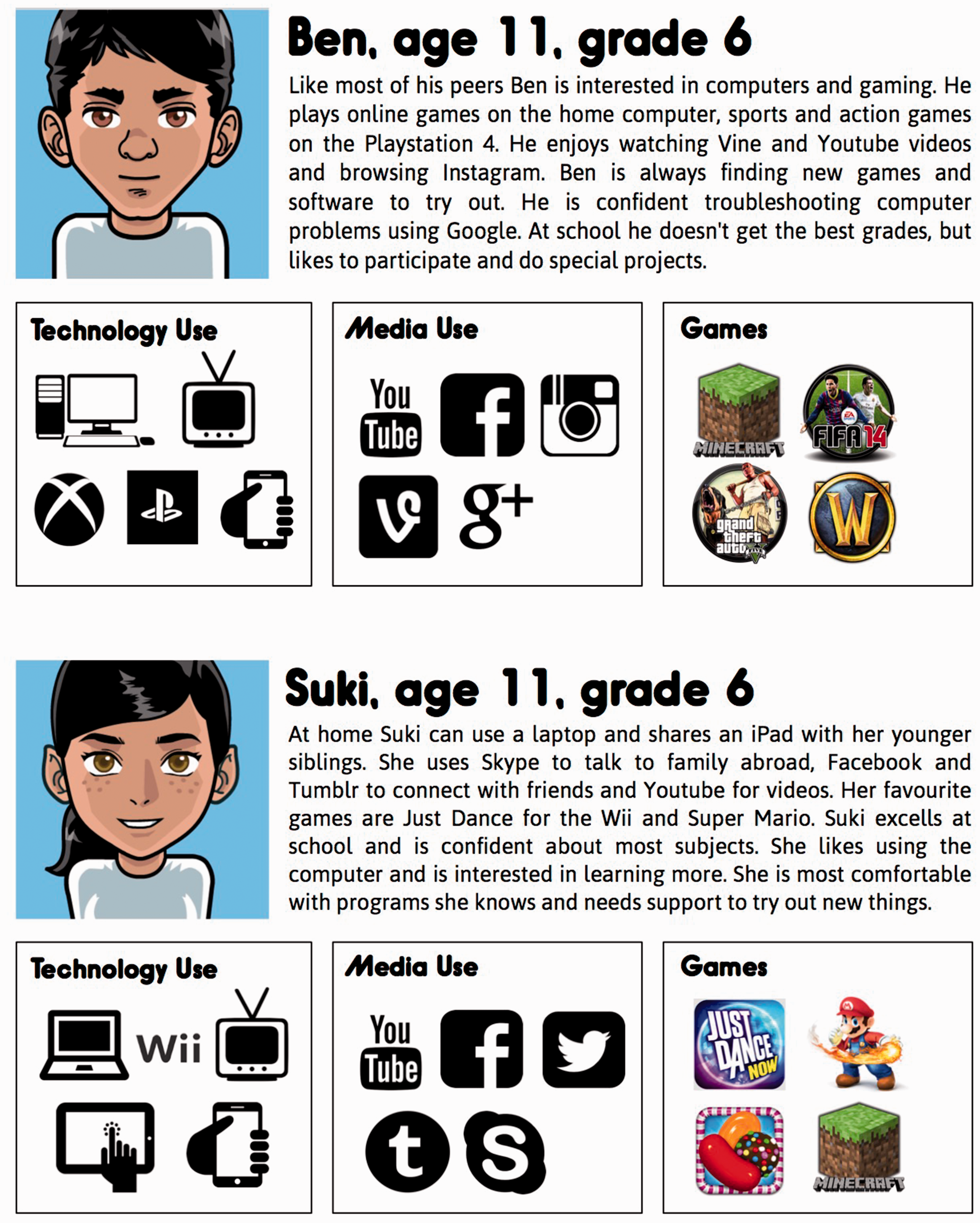
Boy and Girl youth media use personas.
As these short-hand visualizations make visible, boys do have access to more specialized computing and gaming technology, while girls have more access to more versatile mobile platforms that combine gaming with social media browsing and educational applications. This is also reflected in each persona’s respective gaming habits: boys report playing more complex action and strategy games such as Minecraft, Grand Theft Auto or multiplayer online games, as well as “gender”-coded sports games such as FIFA and NHL; girls, on the other hand, tend to play classic RPG games such as Zelda or Mario, as well as movement-based games on the Wii, and puzzle games like Candy Crush on mobile platforms. While not explcit, annectodal data also points to the fact that boys may be more likely to have a computer where they could “try things out,” whereas girls are more likely to be using the family laptop or tablet. What this means is, whereas boys learn by playing at home through having more access and freedom, the school classroom becomes the primary space where girls can “fail in a safe environment.” It makes it that much more important and critical then for schools to offer compuational literacy not only as a core skill and conceptual language but as a way to equalize some of the home-based differences that still persist in the socialization of girls and boys.
What is interesting here in terms of the oft-assumed relationship between “digital nativity or competencies” and aptitude for computer science, is that reported frequent gameplay activity did not correlate with either a high score on the computational knowledge pre-test, or with an overall high confidence about using computers and learning programming. Not playing games (at all) on the other hand seemed to be associated with lower confidence using and learning about computers and lower pre-test scores. Certainly we do not suggest that playing video games is not an important factor in establishing computational literacy; however, it is worth noting that it is attitudes and confidence that significantly correlate with the conditions for building computer programming competence.
Conclusion
This paper presents some of the core findings from a school-based study that made use of a free, commercially available, game design program (Game Maker Studio) to introduce and allow kids to practice applying key computational thinking constructs such as variables, operations, functions and conditionals. We focused here on media use and its interaction with self-reported computer-based and gameplay competencies and skills. Based on our preliminary discussion of the data above, there are three primary conclusions that are worth emphasizing. First, as others have pointed out, claims that today’s students are de facto “digitally native” is not the case for all students nor does it indicate that students have familiarity or even facility with basic computer programming skills and competencies. Second, there are still gender differences in attitudes toward and confidence with computers that in an instructional study such as this can and did affect performance on programming related tasks, not only on the post-test, but also in our many observations of girls during the time we spent with them (as we've observed in previous work – see Jenson and de Castell 2005). In general, they were less willing to participate in public displays of knowledge (like answering questions to the whole group) and were more likely than their male counterparts to “disavow” their skills with speech acts such as: “I always break the computer” and “I am not good at computers”. Such differences in attidues, we show, can and do affect performance in statistically significant ways. Thirdly, in querying the relationship between media and technology use and students’ performance on the computational tests, interestingly, no device usage in itself was significantly correlated with test performance; however, the level of confidence and general attitudes towards computers and programming critically predicted how well kids were going to do on the test as well as the level of their score improvement. Given this and the fact that there remain some salient gender differences in exposure to computer technology and games in the home, the question still remains – where and how do attitudes and confidence concerning computers and programming develop? One suggestion we put forth, supported both by our data and field observations, is that while boys are still able to “learn by doing” at home and are given more individual, unsupervised time for gaming and computer work, girls have access to a variety of devices and platforms, however, with less unsupervised time, less opportunity for gaming and thus less experience “failing in a safe environment.” That makes the classroom the primary venue for girls to receive computational literacy instruction, guidance and opportunity for individual work. Our model of a structured curriculum that combines applied work with direct follow-along instruction is encouraging then precisely for the reason that it provides all students – both boys and girls with an equal footing in building a foundation of computer programming skills and computational literacy. We intend for this model to be replicable in eventually, a school district-wide instructional programme. In conclusion, this preliminary analysis has shown that using a commericallly available game design software that permits a variety of scalable programming actions in the process of coding a game, is not only a viable way of introducing a middle-school demographic to computational literacy but is a salient and promising means for fostering and supporting STEM-related competencies, vocabularies and skills.
Footnotes
Declaration of Conflicting Interests
The author(s) declared no potential conflicts of interest with respect to the research, authorship, and/or publication of this article.
Funding
The author(s) disclosed receipt of the following financial support for the research, authorship, and/or publication of this article: This research was supported by the Social Sciences and Humanities Research Council of Canada.