




Abstract
While elements of Deleuze’s theory, notably the ‘geophilosophical’ concepts of ‘rhizomes’, ‘smoothness’ and ‘striation’ have been applied to educational technologies, his work on time has, to date, been comparatively neglected by educational theorists. This article explores practices and outcomes of educational technology design in terms of Deleuze’s dimensions of time in which habitual practices, trajectories of change and concerns about identities in flux are synthesised into a ‘present-becoming’. The article draws on empirical work carried out during a large, funded research project during which teachers, students, technologists and researchers were able to work together for extended periods in order to explore the potential of emerging ‘semantic web’ and ‘linked data’ technologies and approaches in higher educational settings (Ensemble: Semantic Technologies for the Enhancement of Case Based Learning). Doing learning technology design and development in a way informed by ‘Deleuzian’ syntheses of time involves conversations not just about creating a technology-rich educational utopia or constantly specifying new ‘gadgets’, but the troubling of existing pedagogical practices and the multiplication of perspectives and subjectivities. By going beyond notions of ‘feature sets’, ‘use cases’ and ‘affordances’ it provides a richer conceptual framework that helps us understand why some educational technologies are adopted and abandoned, some are creatively appropriated and used in unexpected ways, and others sink without trace. The article concludes with suggestions as to how current conditions in higher education, rather than constraining the development of educational technologies, might provide opportunities for these broader explorations to be initiated.
Introduction
This paper reflects on the experiences of working with teachers and students in higher education settings in the UK to design and develop new web applications that make use of ideas and techniques associated with the emerging ‘Semantic Web’ and ‘Web of Data’, which reflect a shift in the dominant paradigm of the World Wide Web from one of digital document publishing to that of a ‘global data space’. The initial grand vision of such a ‘future web’ (Berners-Lee et al., 2001) has been tempered in the light of experience as technological and social constraints have become apparent, just as new opportunities have emerged. There has been a change in emphasis in writing on the ‘future web’, with visions of ‘intelligent agents’ working across the World Wide Web on our behalf being eclipsed by discussions of the potential of ‘linked data’ to allow connectivity, communication and transparency (Bizer et al., 2009; Heath and Bizer, 2011).
The paper draws on the experiences of a large research and development project: Ensemble – Semantic Technologies for the Enhancement of Case Based Learning, which was funded by the UK’s Economic and Social Research Council (ESRC) and the Engineering and Physical Sciences Research Council (EPSRC) under the Technology Enhanced Learning Programme from 2008–2011. This explored how both this grand ‘future web’ vision and the practical developments it has engendered might impact upon higher education and professional learning (Carmichael and Jordan, 2012), and how these might support, enhance or transform the practices and discourses of teaching and learning in subjects ranging from pure and applied sciences to performing arts (Martinez-Garcia et al., 2012). A significant outcome of the project was the development of participatory approaches to critique, design, prototyping and evaluation that involved teachers and students working closely with technologists and researchers for an extended period. This was accompanied by exploration of alternative theoretical frameworks, with members of the team drawing on elements of socio-material theories (Tscholl et al., 2011), spatial theory (Edwards et al., 2011) and post-modernism (Carmichael and Tscholl, 2013) in attempts to understand, describe and support the practices of the project, its participants and its partners.
This paper represents a further contribution to this theorisation, and draws on a particular aspect of the work of Gilles Deleuze. While the ‘geophilosophical’ work of Deleuze and Guattari, with its conceptual repertoire of rhizomes, territories, smoothness and striation, has been used in the theorisation of education, and technology-enhanced education in particular (Bayne, 2004; Cole, 2011; Roy, 2003; Semetsky, 2008; St Pierre, 1997), Deleuze’s work on time, particularly as articulated in Difference and Repetition (Deleuze, 2004) has, to date, been much less used in relation to educational practice.
Theorising the Ensemble project and its activities
Working with web technologies, and learning technologies are no exception, often involves participation in a world where, rather than any single grand vision, multiplicity, complexity and contestation are the norms. There are certainly powerful ideas at work (‘connectedness’, ‘openness’, ‘virtuality’ and so on); international standards and frameworks are introduced and implemented with varying degrees of success; and there is rhetoric of ‘grand challenges’ to be addressed. (In fact, the funding programme under which the Ensemble project was funded was framed in these terms, with projects being asked to identify with which challenges or themes identified by the research councils and the British Computer Society they would engage.) But in most cases, what is actually involved are parallel, overlapping projects, initiatives and activities, each evolving on a different timescale, some of which gain adherents and achieve recognition and a level of stability, but many of which are temporary and transient. Crook and Joiner highlight the fact that, while institutional or societal capacity and capability for the take-up of technologies in education are seen as worthwhile, and even crucial, there is “a recurring discomfort that these translations are not more widely taken up – that the education system fails to embrace new technologies with adequate enthusiasm” (Crook and Joiner, 2010: 1). Responding to this, Hall (2011) suggests that this may stem either from projection from the present into an idealised cyber-utopian future, or a focus on a promise of educational technology that clouds, oversimplifies or ignores the realities of complex educational systems and does not adequately acknowledge the need for diversity, multiplicity and acceptance of ‘failure’.
Projects such as Ensemble, while they functioned as elements of a larger programme of research funding and had research ‘settings’ and a defined project timescale, are also better understood as complex, multiple and temporary, with many individual comings-and-goings and evolving relationships. While most of our project reports talk about the ‘six research settings’ within which research and development activities were located (see Martinez-Garcia et al., 2012, for further details), over the 3 years of project funding (2008–2011), relationships were established with teachers and students in 11 different departments as well as learning technology centres, libraries and archives. Some of these endured (and continue to do so) while others did not. Even within different research settings, different patterns of engagement developed: in some, the project team worked primarily with teachers, in others with teachers and students together. In some of these settings, significant technological and pedagogical initiatives were already under way, while in others, engagement in the project catalysed and framed activities (again, see Martinez-Garcia et al., 2012, for further discussion of these variations).
However, as Bayne (2004) has persuasively argued, for all the rhetoric of personalisation and flexibility that accompanies learning technologies, the limitations of institutional virtual learning environments or social media platforms mean that the local, contingent and ‘molecular’ (to borrow a term from Deleuze and Guattari’s geophilosophy) are overcoded, and existing roles, processes and inequalities are enforced and reproduced. This in itself tends to constrain and limit the opportunities for other technologies and the practices that accompany them to emerge: a lesson we were to learn within the Ensemble project, as the potential of new semantic web technologies was sometimes limited by participants’ prior experiences and was measured in terms of the ease with which they could be integrated into existing institutional infrastructures.
While all of these settings were subject to broader organisational developments and reflected policy agendas, concerns about student experience, and increasing interest in the applications of learning technologies, each was also influenced by discipline-specific developments and changes in the nature of the worlds of work to which their programmes were related (some of these issues are discussed by Brooks, 2012; Litherland and Stott, 2012). But each was distinctive, representing particular local responses to these broader contexts, as teacher and students negotiated and adapted practice in response to highly complex, often uncomfortable and contradictory juxtapositions (Gherardi, 2000).
So Ensemble is better thought of not as a singular ‘project’, but as a series of instantiations or repetitions, each shaped by different institutional priorities and micro-politics, the epistemological commitments of participants and the ongoing pedagogical discourses in which they were engaged. These had the potential to enable and constrain patterns of involvement in the project, the nature of the research relationships that emerged and the technological applications that emerged from these processes. While the web applications that were designed and developed have ‘family resemblances’ (either because of the mediating actions of the research team, or relationships between participants, or common pedagogical concerns), this cannot be attributed to simple processes of replication, reproduction or transfer of ‘what works’. They are better thought of as what Deleuze and Guattari describe as territorialisations or differential repetitions within a broader field – UK higher education – which the project team and their technological interventions perturbed, encouraging or enabling particular lines of pedagogical enquiry.
This view locates the activities that were set in motion not as the enactment of expertise by one set group, such as researchers or technology developers, on behalf of ‘less expert’ others such as teachers or students. Instead, they were examples of what Lather describes as a “praxis of not being so sure” that needs to tolerate “discrepancies, repetitions, hesitations, and uncertainties, always beginning again” (Lather, 1998: 491) and refuses “the privileging of containment over excess, thought over affect, structure over speed, linear causality over complexity, and intention over aggregate capacities” (Lather, 1998: 497). While this need to support tentative, discrepant and differential repetitions has been explored in other educational contexts (for example, by Denzin, 2009; Kumashiro, 2002; Roy, 2003), this is less evident in relation to the use of learning technologies, and still less to the processes by which they are designed and developed.
Experimentation through design
Against this background, we needed to find ways of thinking about the processes by which new learning technologies, activities and relationships were envisioned, designed, developed and used. Against a background of technologies and pedagogical practices that were developing rapidly, we needed to look beyond demotic notions of ‘user requirements’ or ‘products’. Instead, we needed to explore the processes by which these, in their multiplicity, came into existence, and which, following Lather (1998), allowed for hesitation, reticence and differential patterns of adoption, and recognised the importance of ‘timeliness’. For some of our participants, the new web technologies we proposed were described as ‘just what they had been waiting for’; for others, it was ‘too early’ to engage; others wanted time to explore and experiment in order to explore what these new technologies offered and how they might align with, support or challenge established pedagogical practice.
When we began to organise participatory design workshops, teachers and students were able to draw on prior experience of using web technologies (including existing web sites, social media and search interfaces) and other software (such as video annotation and editing software), relate them to pedagogical activities, and suggest how new combinations of these might be developed. Through discussion of existing prototypes and involvement in ‘paper prototyping’ activities they were able to generate designs incorporating web content, search interfaces and sequences of activities, reflecting their developing awareness of the potential of semantic web and linked data approaches. Figure 1 shows one such example, generated by a group of undergraduate students of contemporary dance. It is important to stress at this point that while what emerged in some settings could be described as ‘learning designs’ of the kinds described by Koper (2005) or Laurillard (2012), other designs were concerned with access to digital content, supporting case study or assessment, or providing visual interfaces (maps, timelines or concept maps) to enable learners to explore relationships and patterns in the face of complexity.
Students involved in a ‘bricolage’ paper prototyping activity, drawing on existing software to help develop a composite web application design.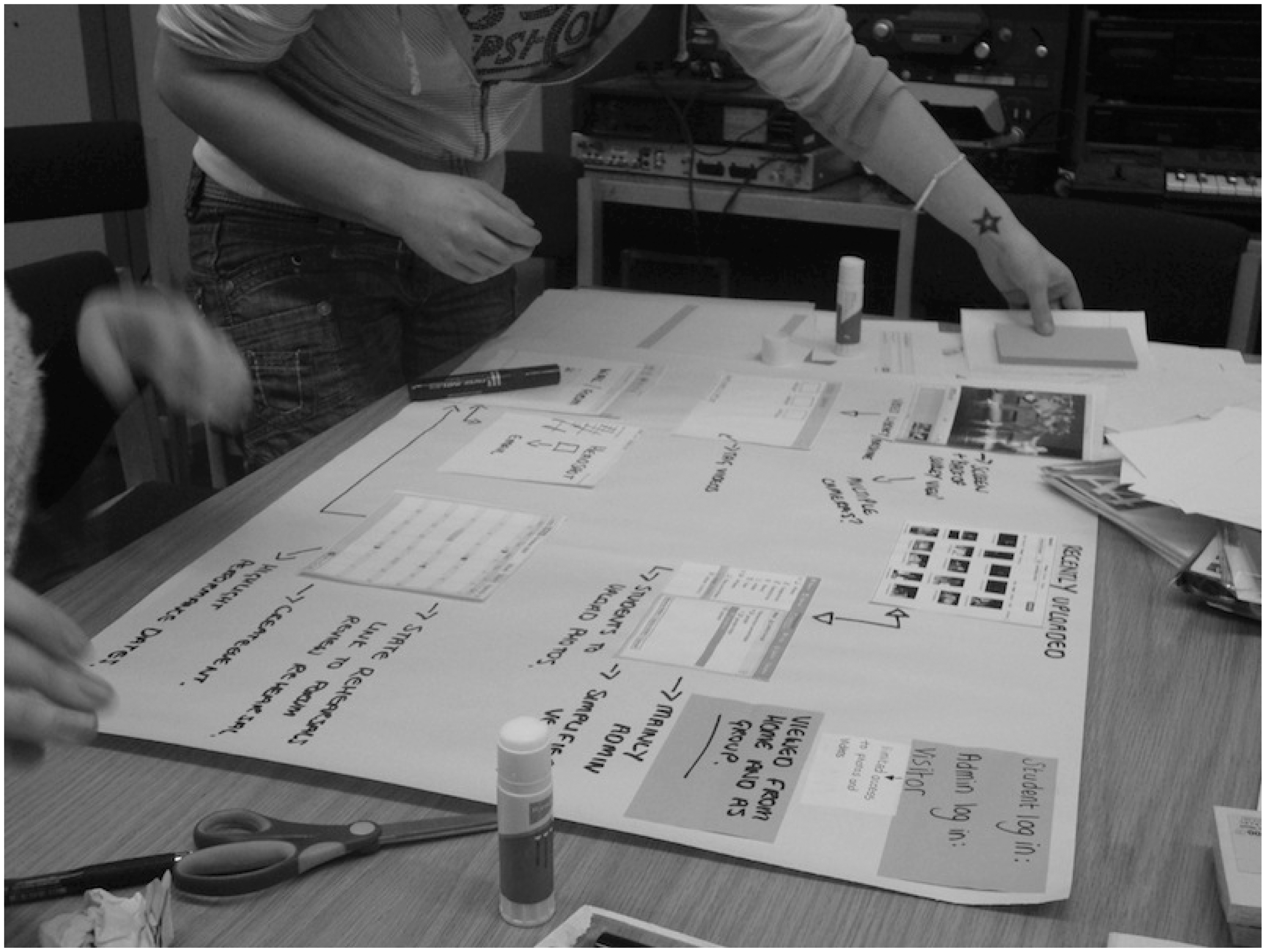
These user designs were initially useful for technologists, for whom they provided guidance as to what web applications they might construct as prototypes before engaging teachers and learners in further discussions. But it rapidly became apparent that these ‘snapshots’ of how learning technologies might function articulated just one aspect or dimension of participants’ experience and intentions. As we continued to work with teachers and students, we became increasingly aware that we were asking them not just to envision learning technologies, but potentially also those of importance in future professional practice, and also, more critically, their possible future selves. This echoes Massumi’s point, made in response to Negroponte’s optimistic technicism, that: a futurological desire … is not just about gadgets. An expressed desire for the future envelops a possible world: a potential space of a particular kind, inhabited by a particular self-form, whose ostensibly goal-oriented activities take on a specific spin. (Massumi, 1995: 4)
Designing for the future of the World Wide Web as it might be experienced by diverse groups of teachers and learners not only ‘now’, but in an uncertain future, demanded a framing that was capable of reflecting these complexities and syntheses. Drawing on prior work on the role of software in design (De Landa, 2002; Massumi, 1995) and inspired by understandings of design from other expansive and creative domains, such as architecture and planning (Ballantyne, 2007; Van Wezemael, 2010; Williams, 2000); urban education (Roy, 2003); and cinema (Boque, 2003; Massumi, 1987), we turned to Deleuze’s ideas about the nature and synthesis of time.
Deleuze, time and design
In Difference and Repetition (2004), Deleuze offers an alternative to conventional notions of temporality and outlines three concepts of time. These are not, however, seen as empirical components of time, but rather as dimensions: different ways of looking at time as a totality (Reynolds, 2004; Williams, 2011). Each dimension is a synthesis, and they are then synthesised in turn into a “present-becoming” (Deleuze and Parnet, 1987): it is only though looking at a particular instance, event or assemblage that it is possible to explore its interrelationships. Williams (2011) presents an elegant example of this in the form of a vignette in which a visit to a cemetery can be understood as a synthesis of historical time, personal narrative, and habitual practices (laying flowers, feeding birds and so on), each with its own ‘scale’ and periodicity.
The first of Deleuze’s concepts of time is the circular recurring time of the habitual, through which subjectivities are created, while the second is a linear time which is realised in narratives and trajectories of memory, development and change, as a series of passing moments (Deleuze, 2004: 70–79). Rather than simply discarding the former as an illusion, Deleuze argues that subjects must engage in an active synthesis of these concepts of time. Following Bergson, he suggests that the sense they make of their past experiences and habits, is brought as ‘blocks of time’ into the present (Deleuze, 2004: 81) and is embodied as ‘action’ that at once exists as present perception and as the contraction of many repetitions of the past into the action of the present (Bollmer, 2011; Williams, 2011). There is, additionally, a third concept of time as ‘imagined future’, which we will address shortly.
The idea of time as a synthesis of the ‘circular’ and ‘linear’ resonates both with the experience of many projects concerned to support emergence, innovation or enhancement, and is reflected in discussions of how these notions are problematic. For example Veletsianos (2010) describes the debate over what constitutes an ‘emerging’ technology, and Bayne (2014) challenges the assumptions underpinning the technological ‘enhancement’ of learning, where the dominant rhetoric is of continuous and linear development. This was also evident across the Ensemble project as a whole and of the specific design and development activities in which we were engaged. On the one hand, there was a concern with understanding existing practice, but on the other, an intention to support and encourage technological and pedagogical innovation. So at the same time that we were trying to abstract and generalise the ‘habitual’ by asking teachers and students to identify established practices, common tasks and ‘workflows’, we also found ourselves seeking to integrate new technological elements into these practices (‘enhancing’ them), or developing entirely new practices. This tension is recognised in design and development approaches which recognise that, rather than there being clear phases of requirements gathering, development, and deployment, design continues through use and that, rather than all of the affordances and opportunities offered by a new technology being immediately evident, an extended and discursive learning process is involved through which these may be surfaced (Boedker and Peterson, 2000).
Gourlay (2014), in a recent paper on students’ use of technologies as ‘temporal practices’, draws on Lemke’s work on ‘boundary objects’ that enable ‘coordination of processes on radically different timescales’ (Lemke, 2000: 142). The designs, such as that illustrated in Figure 1, represent such boundary objects, but there is more at work here than simply issues of scale. What Deleuze’s synthesis brings to this is an understanding that the production of a design, or the identification of a hitherto unrecognised affordance, represents both an articulation of the habitual and, at the same time, a moment in a linear narrative of development or transformation. If the designs that were produced represent ‘boundary objects’, then design activities have the potential to function as ‘boundary practices’ with synthetic and generative potential.
Educational institutions, of course, have their own ‘cycles’ of time as well as linear trajectories of development. The idea that these too represented a synthesis, and sometimes one that created or highlighted tensions, was only too clear to us as we tried to establish when it would be most ‘timely’ to intervene in research settings governed by academic years, module timetables, course review processes, and funding cycles, while also wanting to address strategic plans that were concerned with development of their pedagogical practice and improvement of the learning experiences of student cohorts. Even once we had negotiated ‘timely’ interventions and the most appropriate kinds of participatory design and development activities, the tension between these circular-habitual practices and the linear-innovative was evident.
What emerged in the course of these extended conversations was that the longer-term affordances of the technologies that teachers and students envisaged did indeed, as Massumi suggests, go far beyond the production of ‘gadgets’ (Massumi, 1995: 4). For that matter, it also went beyond either the representation or automation of habitual practices, or the development or enhancement of teaching and learning environments and activities. When we asked teachers and students across settings about the broader and longer-term significance of the technologies that they were helping us to envisage and develop, they raised issues that extended beyond and challenged any simple linear notion of temporality. Teachers did talk about the professional development needs that new technologies would demand, and students, with an eye on their employability post-graduation, were interested in technologies which would give them an edge in the workplace; but they also raised much more wide-ranging issues of identity and becoming. These led us to extend the scope of our investigations and in doing so, bring us to Deleuze’s third dimension of time: that of the imagined future and of ‘return’.
Deleuze invokes Nietzsche’s ‘eternal return’, but rather than being based on a repetition of endless cycles and the ‘return of the same’, he argues for a ‘return of difference’ in which we choose, in which we are selective about what returns, and where there is room for things that may be other than they are in the present (Deleuze, 2004: 91–92). What we experience of the future in the present is an affirmation of what it is that is important to us to intensify: thus this third concept of time is also a synthesis or fold which shapes our experiences of each present moment. In the case of the teachers and students with whom we worked, this third concept of time was reflected less directly in the designs they produced, and more in the discussions and reflections of what they would mean for their established and emergent identities. While the production of designs encouraged participants to bring the past into the present, it was reflection upon these envisionings, designs and prototypes that brought into play this further aspect of a complex and folded temporality. What emerged then were discussions around the challenging question: ‘What will these technologies, and the design decisions that we make in the present, mean for my future-self – not just for future-technology?’
What might be, and what might be lost?
We will now explore further these issues in detail in the context of two of our research settings – undergraduate courses in contemporary dance and environmental education. While the semantic web technologies on which the design and development activities drew were similar, the pedagogical settings, practices and discourses into which they might be introduced were, as might be expected, markedly different. As a result, the web applications that emerged reflect not only different combinations of technologies, but different syntheses of the habitual, the innovative and what, in French-language accounts are described as the ‘identiary’: that is, relating to the formation of complex identities in intersecting global culture (Auzanneau, 2002: 118).
The relationship between the embodied practices of dance and Deleuze’s ideas about repetition have been explored elsewhere (see for example Briginshaw, 2005; Rothfield, 2011), repetitions in dance being recognised as synthetic and productive, rather than reductive, reproductions. In relation to the pedagogical rather than solely choreographic practices of teachers and learners of contemporary dance, what emerged from our design activities, discussions and prototyping was shaped by the particular project in which these participants were involved. Over a period of several years, a programme of ‘telematic dance’ had developed, with teachers and students at Liverpool John Moores University and Temple University, Philadelphia, working together to explore the potential of video-conferencing technologies and other social media to support not only tutoring but actual performances. The telematic dance performances that emerged involved groups of performers in different locations performing for a local audience but also choreographing their performance so that a shared, ‘split-screen’ served as third, virtual performance space (Brooks, 2012; Brooks and Kahlich, 2009).
When we asked a group of undergraduate students to envisage how additional or alternative web technologies might support the kinds of choreographic and pedagogical practices and discourses that were emerging from their experience of the telematic dance programme, they were able to draw on a range of experiences. These reflected not only the telematic dance programme itself, but also a range of communication technologies and social media, some of which they were using alongside those provided by the university. They mentioned using Skype for internet telephony and file sharing; video sharing sites like YouTube as a source of inspiration; Microsoft Messenger for online chat; and Facebook to share images and for adding annotations and ‘tags’ to these. The last of these was alluded to in this short extract, in which one of the students presents design ideas from the paper prototype shown in Figure 1 to the group of teachers, students and researchers: So with the videos you have a link to a video library, an archive … and you have things from the previous years … so you could look and see what worked and what didn’t. You could search [indicates label ‘tag videos’ on poster] duets, solo work, so you tag them when you upload them, as a trio, duet, group work … It’s not like you tag in Facebook, you’re not tagging people, you’re tagging this as a solo, this as a duet. We were thinking only lecturers could upload and delete videos, and students could upload photos, because we’ve got lots of photos like we put on Facebook … You’d have ‘recently uploaded’, like a constant feed to see what had been recently uploaded, it’s another way of accessing the videos too. (Nina, Dance Undergraduate Student)
Aspects of those technologies with which the students were familiar and these repeated learning activities (sometimes already involving technology use) surfaced in the more imaginative and expansive designs that the students had developed. Even then, as our example illustrates, there are already differences: the ‘tagging’ of activities in a video is ‘like’ social tagging in Facebook, and might operate in a similar way, but with different purposes in mind. What emerged from these designs and discussions around these and the subsequent prototypes was a web environment (see Figure 2). which allowed students to upload videos to a shared server (such as YouTube), to ‘tag’ whole videos, segments and incidents, add annotations, and construct reflective narratives in which they were able to draw on and refer to the content of videos (Morris, 2012). This is the trajectory of change that emerged, incorporating and synthesising the established and habitual practices of the teachers and students with whom we worked into a trajectory of change. But this was not a linear process (there were changes of direction, hesitations, moments of confusion) and what emerged was not a simple or singular ‘solution’ to a problem that was well defined from the outset.
Telematic dance – the dance annotator web application.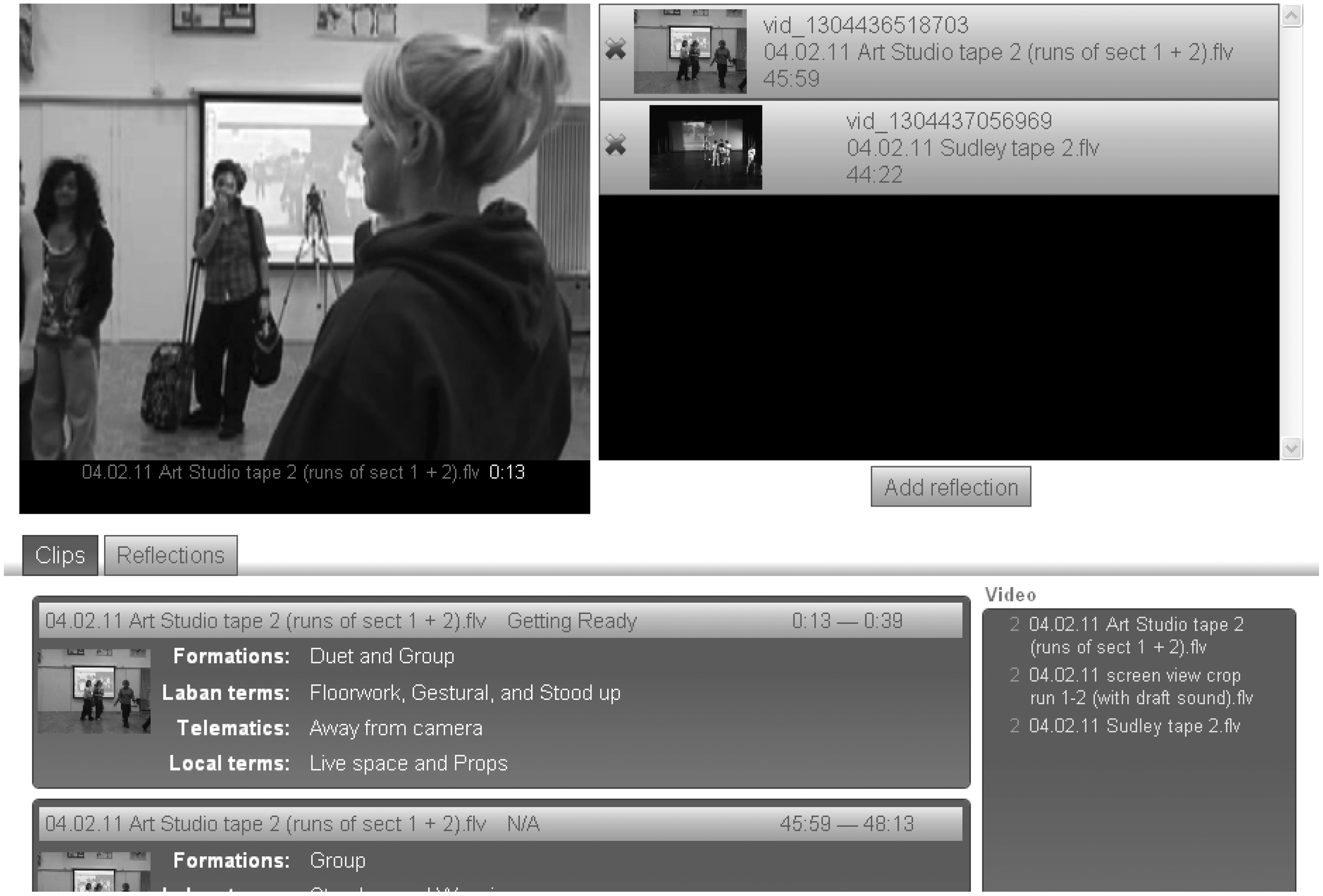
These processes of design and development did not only draw on a composite ‘past’: they also reflected and stimulated thinking about uncertain, imagined futures. These were highlighted in more speculative discussions focused around the designs and prototypes, and in the outcomes of a more structured evaluation exercise conducted by two contemporary dance students themselves. Some characterisations of the future of the project’s work, of telematic dance, and of contemporary dance more broadly were extensions or extrapolations: ‘Imagine if we could have more cameras … how many different groups could take part in a single performance?’ Others took these and asked even more challenging questions, reflecting the potential of archived video to bring newly accessible ‘pasts’ into a synthesised present: ‘We could dance with recordings of previous performances … or with past versions of ourselves!’
But alongside these questions about the future of technologies and the practices that might accompany them were others about the future identities of the becoming-dancers: already the norm within the course was for students to describe themselves not solely as dancers but as ‘dance professionals’ and some of the students described themselves on personal websites a ‘multimedia performers’. The students expressed dissatisfaction with some of the ways in which university requirements demanded that they present evidence of their learning and expertise (dissertations, electronic portfolios, transferable skills audits). In contrast, the technologies that the students began to propose went beyond representing their selves, their work, as the subject of assessment, and became seen as a means by which they might exist as members of heterogeneous assemblages of performances, performers and audiences.
Technological features and functions which had first been introduced as aspects of their prior experience (such as the ability to ‘tag’ and annotate video segments) and which had been the focus of the development process (which enabled them to do this via a web browser as shown in Figure 2), now became a way of rethinking performance itself, as they began to imagine conversations around, alongside and even as part of, their choreographic processes. The processes of design reflected a temporal fold as the space provided for teachers and students allowed them to synthesise reconstructed pasts and imagined futures. The technological elements were important and enabling, but ultimately secondary to deeper concerns about what it means to become and to be a dancer. These students saw their role in broader terms than as contributors to, or users of, some future dance technologies: the synthesis enabled by the boundary practice of design served as a starting point for reflections on their identities as ‘becoming-dancers’, and allowed them to articulate their desire for particular futures.
In contrast, tensions and syntheses between the habitual, the innovative and the identiary were also in evidence in another setting, namely, environmental education. Working with teachers (who for the most part identified themselves as geoscientists, but whose students might be following courses in geography, environmental science or outdoor education), we explored how semantic web technologies could be used to support the development of ‘virtual fieldwork’ activities. These had initially been introduced to support trips to localities, or to allow students unable to participate in fieldwork to gain some experience of them, but these had developed into more extensive online environments in which students could access data collected in the featured localities. Examples included records of climatic data, river flow and levels of suspended sediment that complemented diagrams, maps, photographs and videos. As well as a search interface allowing students to retrieve all data of particular types, from particular localities, or related to particular processes, a new assessment activity was designed in which students were able to draw on relevant data, resources and publications to propose solutions to a realistic problem relating to the location of a new hydroelectric power station in a glacial valley in the Swiss Alps (Litherland and Stott, 2012).
On the surface, this appeared to be a relatively straightforward example of a technological ‘enhancement’ of existing pedagogical practice, which in turn allowed innovations in assessment practice. The habitual practices that characterised the domain (the collection of data, plotting of geospatial information on maps, interpretation of photographic evidence and so on) and a trajectory of technological and pedagogical change seemed at first to be well aligned. These developments were, however, set against a background of broader debate about the nature, purpose and worth of ‘virtual fieldwork’ that in turn belied concerns about the changing nature of environmental science more generally. As Litherland and Stott (2012) report, many educators are wary of using ‘virtual fieldwork’, voicing concerns about failure to perpetuate established traditions of field study skills as well as a loss of the environmental experiences and sensitivities that they have themselves experienced, and which constitute a critical aspect of their personal identities as geoscientists. In this setting, then, the relationship between habitual practice-knowledge, trajectories of innovation and disciplinary identity was less straightforward than first appeared to be the case.
The process of designing web applications for environmental education reflected a much less comfortable synthesis of prior experience and future trajectories than was the case in contemporary dance. This was reflected in the designs that emerged, which juxtaposed data sets and assessment tasks couched in the language of consultancy, expert advice and evidence-based decision making, with photographs of teachers and students engaged in fieldwork activities in the locality. In contrast with our experiences of working with teachers and students of contemporary dance, here there was a sense that the linear trajectories of technological innovation (which our learning technologies represented in microcosm) were contributing to the ‘passing’ of the distinctive practices that contributed to disciplinary and personal identities. While the new opportunities offered by remote sensing and global data sharing were recognised and the need to engage students with new technologies was addressed, there was a sense that, rather than any kind of ‘return’, teachers described themselves as defenders and curators of traditions and habits in the face of inexorable changes over which they had limited control.
What, in purely technical terms, appeared to be very similar affordances of the software to those that had emerged from the design process with the dance students carried different meanings and reflected different temporal syntheses. For example, the ability to review images or videos from previous years (one of the features which had inspired such enthusiasm amongst the dance students) was also important for the environmental science teachers as a means of enabling longitudinal analysis, but also carried with it a sense of wistfulness and a harking back to the fieldwork experiences of former times.
To design as a poet or assassin?
Deleuze and Guattari remind us of an interesting question posed by Virilio and ask how we should dwell, ‘as poets or assassins?’ (Deleuze and Guattari, 2004: 45). In our context, we can ask the question of our practice as designers of learning technologies and of the encounters we design for learners. Rather than using Deleuze’s concepts of time solely as a lens through which to interpret the activities and ideas of teachers and students, a sensitivity to the tensions and syntheses that they engender can help us rethink the practices of design itself, the spaces in which it takes place and the nature of the encounters that are set up within them.
So how might we dwell and design as ‘poets’, articulating aspirations, celebrating difference and making the milieu of thought available, rather than as ‘assassins’, who stifle those aspirations and overcode individual differences, consigning people to a particular trajectory of development, or the fulfilment of predetermined roles in models of pedagogical or professional practice? The ‘poet’ may, of course, not be solely appreciative and supportive, and the identification of lines of flight and trajectories of innovation may challenge the habitual and invite divergences. And the self-perceptions of designers who believe themselves to be ‘poets’ may not correspond with those with whom or for whom their designs and developments are intended. The environmental educators, for example, saw in the trajectories of innovation embodied in the new designs a disregard for, or even a violence towards, their existing practice-knowledge.
But what might educational technology design involve, stimulate and generate if it paid better attention to habits, imaginings and identiary concerns? Based on the experiences of working with the dance and environmental education teachers and students, what does it mean to ‘do’ educational software design in a Deleuzian way?
To privilege the habitual, and to dwell on habitual and established practices risks slipping into a unproblematised reproduction: if the design processes are carried out ‘for’ or ‘on behalf of’ they may lead to learning technologies which reproduce stereotypical views of teachers or students rather than reflecting or engaging with their actual practice. On the other hand, an emphasis on innovation, development and progress risks losing sight of practice-knowledge and the values that accompany it entirely. Pedagogical practice and personal preferences are subordinated to ideal types: ‘digital natives’, ‘twenty-first century learners’ and ‘new professionals’ whose competences are measured in terms of their willingness to align their practice and identity with a hegemonic and linear temporality. This drives what Toscano (2008: 57) calls a ‘bullish discourse of innovation’ as a new kind of production that is simultaneously limited and limiting, and that allows little room for improvisation or the exploration of subjectivities and values. Both of these scenarios place limitations on the extent to which it is possible to recognise and provide space for divergence and circumscribe the role of participating teachers and students, whose voices and concerns may be lost against a drive towards generalisation or abstraction.
Working in the more complex temporal fold informed by a Deleuzian synthesis allows other activities: articulation, consolidation, reconsideration and deviation, and critically, a tolerance of the uncertainties inherent in changing educational settings and technological systems. The focus of design and development activities is broadened and, as we have seen in our vignettes, allows for exploration of social practices based around circulation and repetition, rather than just the (re)production of technological objects: the gaze is shifted from the ‘gadget’ to the discourses and controversies that accompany it in complex social–technological–semiotic assemblages.
A feature of both of the settings described in our vignettes is that activities such as sketching, prototyping, testing and evaluation were opened up to participants as well as designers and software developers. The design space that resulted allowed improvisation rather than a constrained and linear process of innovation or enhancement in which designs were abstracted and rendered into software applications to be offered back to participants now relabelled as an ‘audience’ or as ‘users’. Sensitivity to a Deleuzian synthesis allows not only for multiple technological outcomes but also for multiple becomings to be realised in a way that simplistic and linear notions of enhancement or innovation do not. Most critically, it encourages not only those recognised as designers, developers or technologists, but also teachers and students to ask the question ‘What future do we see in emergent technologies?’, and to allow responses that are multiple, divergent and couched in terms far broader than concerns about current relevance, efficiency or employability. Without this, we would have had little inkling of the creative, improvisational aspirations of the dance students, and still less the wistful regret on the part of environmental educators.
These issues and questions go beyond the design of learning technologies and have a broader relevance across learning environments, although the introduction of new technologies and the opportunities to participate in design often does have a catalytic role. The technological developments that the Ensemble project supported – not only in contemporary dance and environmental education but other settings too – were one aspect of more expansive processes of curriculum-making, in which technologies and pedagogical practices were discursively co-constituted. Just as the dance teachers and students were able to articulate requirements that they wished web technologies to address, so too were their pedagogical and choreographic imaginations stimulated by the new technological assemblages that emerged. Much of what has been presented in relation to temporal synthesis in relation to learning technologies has relevance to the pedagogical practices and discourses of curriculum-making more generally.
The curriculum may, as Daignault (2008) suggests, represent a ‘contract’, but it is fruitful to see this not in terms of representation and reproduction of disciplinary habits, nor a constant drive for timeliness, relevance and innovation, but as a commitment to mutual and supportive investigation of synthesis and multiplicity. Rather than looking for predefined roles or subjectivities, a key pedagogical commitment needs to be the recognition of the micropolitical dimensions of a design site where new subjects – teachers, learners, dancers, environmental scientists, and for that matter technologies – are situated and produced. Rather than subjectivities presupposing identities, they are produced through processes of investigation and individuation, which are always already, Deleuze says, ‘populated’ (Deleuze and Parnet, 1987: 9).
Not only are new technologies being created here, but also new subjectivities, and teachers and technologists ignore this fact at their peril lest they become unknowing assassins! Design of learning technologies, as with any element of the assemblages of learning, has the potential to involve not the achievement of a utopia or the assertion of a particular subjectivity, but the ‘multiplication of perspectives’ which, including opportunities to reflect on the habitual, set changes in motion, and imagine many possible futures based on better understandings of ourselves and others.
Footnotes
Funding

Acknowledgements
The author wishes to acknowledge the contribution and support of the other members of the ‘Ensemble’ project team, particularly Dr Kate Litherland, whose insights are reflected in the section of this paper dealing with environmental education; the teachers and students from the settings described in this article who have given generously of their time; participants at the conference ‘Deleuzian Futures’, held in Tel Aviv, 22–24 May 2011; and to Dr Betti Marenko, who provided valuable feedback on an earlier version of this paper.