




Abstract
This article takes its outset in findings from an ongoing research project investigating the use of digital and multimodal resources in teacher education (TE) in Norway. The material studied is mandatory assignments in different courses in TE, asking how teacher students collaborate through digital media in their production of texts for learning, and how the design of these literacy practices can be influenced through the teachers’ design of the assignments.
In focus group interviews the researchers found that the students preferred organizing collaborative processes through Facebook groups rather than through the university’s learning management system. This created a space between formal and informal learning, often mediated by “power users” performing a curatorial function on behalf of the group. Furthermore, the quality of the processes seemed to depend on how the assignments were designed for different modes and for individual or group work. The tasks that inspired genuine collaborative learning were characterized by a certain complexity in terms of multimodality and technology, or professional knowledge combining academic and practical experience. In other cases tasks to be performed in groups were split between the students, and probably did not add the same value to individual learning. This is discussed as an encounter between the teachers’ design of the assignments and the students’ design of their learning processes. When teacher students tell us how they work with assignments, they at the same time explain how their knowledge is designed through social and textual practices. Reflections on these practices are relevant to developing their awareness of didactic design in their future profession as teachers.
Background and problem statement
New technology is changing students’ learning and collaboration practices. These changes are ongoing, and require flexibility, as no-one can predict exactly how these practices will develop in the future. However, there seems to be an expectation that digital media will facilitate more collaborative learning (Jewitt, 2008; Knobel and Lankshear, 2009). The data discussed in this article has been collected as part of an ongoing research project investigating the use of digital and multimodal resources in teacher education (TE) in Norway after the TE reform in 2010. The overall aim of the project is to explore how digital resources are integrated into study practices in TE, and how students reflect on these practices. In this article we will describe and discuss the nature of these practices today, concentrating on the collaboration among students and the communication between teachers and students through digital media.
The advent of learning management systems (LMS) and Facebook as communication tools both inside and outside education has changed the communication between teachers and students. As the LMS tends to be considered as static (Erdmann, 2013: 3), the dynamics of Facebook and the fact that most students have Facebook accounts (e.g. Institute of Politics, Harvard University, 2011) have inspired some institutions to introduce Facebook as part of the learning environment (e.g. Irwin et al., 2012; Odell et al., 2008). But, as pointed out by Tess (2013), there is a need for more studies about the use of social media in education to be able to say whether it can be used as an important learning tool. Regarding students’ use of Facebook, Lampe et al. (2011: 346) found that “some students are using Facebook to collaborate around classroom activities, which may lead to new forms of classroom interactions.”
In the Norwegian context the most recent survey related to the use of ICT in higher education, the ICT Monitor, was carried out in 2011. Important findings in this survey were that LMS were widely used both among students (95%) and academic staff (90%); however, the function of LMS was mainly to communicate information from the teachers to the students (Ørnes et al., 2011: 103). This could be seen as a practice related to Web 1.0, in contrast to the Web 2.0 practices that the students are involved in for leisure and social activities (Sørensen et al., 2010: 19). When asked about social media, 69% of the students responded that they used this at least monthly in relation to their studies, whilst only 11% of the teachers had invited the students to use social media (Ørnes et al., 2011: 95–96). The survey’s conclusion was that the use of social media is mainly student-initiated and used in communication and for collaboration among students, and not between students and their teachers (Ørnes et al., 2011). As the LMS is mainly used as a one-way channel of information from the teacher to the students, and social media is used to communicate between students, the interaction between teachers and students seems to take place mainly in other spaces, for instance face-to-face and by email.
Preliminary findings in our ongoing research project on the use of digital resources in TE show similar tendencies. By going more in depth into students’ work and practices through focus group interviews, we aim to explore the practices behind the statistics from the ICT Monitor on an individual and group level. These changing practices will be discussed from theoretical perspectives regarding literacy practices in learning as design. The first research question aims at mapping the students’ activities and study practices: How do teacher students in Norway cooperate through digital media in their production of texts for learning? Based on these snapshots of a practice that is constantly changing, the second research question further discusses the implications of these practices for how TE teachers design tasks for their students: To what extent can the students’ collaboration be influenced through the design of mandatory assignments?
Theoretical perspectives
In this project we analyze learning trajectories by exploring students’ work with texts in digital environments. This entails on the one hand that knowledge is mediated by semiotic or textual means, and on the other hand a view of learning coined by Jay Lemke as a “social ecology of learning” (Lemke, 2013: 71). The close connection between semiotic work and learning is underlined by Lemke as well as Gunther Kress: “Learning is the result of a semiotic/conceptual/meaning-making engagement with an aspect of the world” (Kress, 2010: 175). This engagement takes place in a certain context, shaping the activity and the focus of interest. Lemke argues that an integrated view of feeling and meaning is needed to discuss learning, in particular in new media. He advocates an expansion of the notion of how to make meaning in a broader sense, concluding that this must be understood as “embodied, situated, distributed, and heavily culture-specific” (Lemke, 2013: 73).
This is in line with the notion of design as a perspective on literacy, which was first established by The New London Group in their discussion of “a pedagogy of multiliteracies.” Establishing a metalanguage of design connects to “The idea that learning and productivity are the results of the designs (the structures) of complex systems of people, environments, technology, beliefs, and texts” (The New London Group, 1996: 72). In order to emphasize the dynamic character of semiotic work through texts, they propose to understand this process through three elements: “available designs,” “designing,” and “the redesigned” (The New London Group, 1996). The first element charts the resources available for design. The New London Group mentions the affordances of semiotic systems as well as “orders of discourse,” including socially shaped conventions and practices. In our context, we may add the way technology and media shape social interaction. Designing, the second element, involves the work done in transforming and reconfiguring what was available into the resulting Redesigned. This process is framed by cultural patterns of meaning; however, at the same time it is driven by the agency of the learner, and hence connected to the learner’s identity.
The theoretical perspectives framing our investigation are based on such an understanding of literacy development as a matter of design, taken up by Selander and Kress (2010). Analogous with the concept of learning, design can be perceived as directed to structure future actions, based on present knowledge and practice. Kress’ example of the potato peeler can work as an example here: The design of the potato peeler is always more than the design of one object or tool; it is the design of a complex ensemble, of an environment of social relations, of social practices and configurations, of purposes, goals, aims, tasks and affect (Kress, 2010: 136–137).
Sørensen et al. (2010) also employ didactic design as a fundamental concept related to learning. Referring to the Norwegian educationalist Erling Lars Dale, they differentiate didactic designs to the level of practice, planning and theory/reflection. Students and teachers will collectively operate at the levels of practice and planning. In a later work Sørensen and Levinsen (2013) find that the students also took part in reflection, while the theoretical level basically belongs in the teachers’ design activity. The scope of this article will mainly be on Sørensen et al.’s levels of planning and practice. We find Selander and Kress’ (2010) “design for learning” and “design in learning” to be complementary to these concepts, emphasizing the institutional frameworks for planning as well as the social and participatory aspects of learning practices, corresponding to the notion of design elements in The New London Group. We will consider the technological infrastructure including LMS and other software, and course plans including mandatory work assignments, as available design on an institutional level. The teachers’ way of organizing the work in the classroom – in our case focusing on how the mandatory work tasks are organized and presented – is also part of the available design at a situated level. Traditionally, didactics has been seen as the domain of the teachers who perform the planning and facilitate the practices in the classroom; however, learning through digital media opens more space for the students to plan their work and shape their own studying practices (Sørensen et al., 2010: 75). This means that students as well as teachers are active in designing the plans and practices of learning. It is this encounter between the designs of the teachers and those of the students that we want to discuss in this article.
Recalling our problem statement, the employment of digital media, the institutional LMS (in this case Fronter), represents the institutional design for learning, whereas social media such as Facebook, available as an infrastructure for worldwide social networking, represents an available design that the students may or may not include in their study practices. Our investigation will shed light on to what extent the use of Facebook is part of the students’ planning and completion of their mandatory assignments. From the teacher’s point of view, the planning entails the design of these tasks in terms of how they relate to the learning objectives, and whether they are designed for collective or individual work. Here, our investigation will shed light on the extent to which students’ responses to such tasks are guided and shaped by the educator’s design. This directs our interests to the question of agency and how the agency of the teachers is met by the agency of the students within the framework of cultural patterns dominating higher education and media culture respectively.
As mentioned in the introduction, there seems to be a considerable distance between digital practices in the official media of educational institutions and the students’ practices in their private lives. In their discussion of the “Digital disconnect,” Ola Erstad and Julian Sefton-Green claim that digital technology leads to changing behaviors and competences among young people; however, they admit the difficulties of measuring the growth of the “Net Generation” (Erstad and Sefton-Green, 2013: 91). This has led to an expectation that the processes of online life “support qualitatively different notions of collective and collaborative activity, especially those that relate to learning” (Erstad and Sefton-Green, 2013: 90). The relationship between individual and collective agency in learning is another perspective that may shed light on our research questions. We will discuss this in terms of the concept of curatorship, relevant to the learners’ planning and practice of learning trajectories. Curatorship most frequently refers to individual agency for the planning and practice of learning (Potter, 2012). In our analysis, we will raise the question of curating functions seen at the level of the group, where some students seem to enter into the role of curator on behalf of a collaborating group.
The question of curatorship at the group level may be related to what Sørensen et al. describe as “power users.” These are active users of digital media, directing their practice toward exploring new ways of using and combining digital media (Sørensen et al., 2010: 57). The authors point to the role these power users may play in developing a commonly unreleased didactic potential for applying new technologies in the classroom. This will require new ways of thinking about planning and organizing learning processes by the teachers. The challenges from power users connect to the question of bridging the gap between formal and informal processes of learning, as well as to the question of collective and/or individual curatorship. Power users develop their competences mainly outside the educational system, in digital spaces where collaboration and networking is vital to achieve one’s goals. In contrast, the networks and arenas for collaboration in formal education are commonly designed by the teachers. For instance, a qualitative study of ICT-use in higher education, carried out by the Nordic Institute for Studies of Innovation, Research and Education (Tømte and Olsen, 2013), found that students often struggle to extract information from LMS-sources. Therefore, task-oriented Facebook groups 1 serve as a second hand infrastructure where dedicated students (power users) pick up questions and provide crucial study information to their peers. For teachers, such groups might represent an unreleased didactic potential, as well as a limitation regarding access and control. A more thorough investigation in such matters is requested. What we want to explore in our analysis of interview data is primarily how the students relate to these designs, and what potentials we might find in the students’ own design of their study practices.
Method
The research design and methods of this study are based on an understanding that learning in the educational system today is closely connected to communication through texts, including multimodal expressions, and that textual modes as well as the media involved in literacy practices and collaboration play a role in how learning processes are designed. This has led to an interest in the teacher students’ literacy practices, in which we regard basic skills such as reading and writing to be an integral part of digital literacy (Catts and Lau, 2008). 2 These practices were accessed on the one hand from the perspective of the teachers’ designs of mandatory assignments, on the other hand from the perspective of the students through focus group interviews. Since we assume that literacy practices differ across disciplines in TE, courses from the fields of pedagogy and pupil-related skills (PPS), Norwegian, English, and social and natural sciences are included in the research design as a whole. From each course we collect students’ mandatory assignments (written, oral, visual) that to a varying degree involve the use of digital media. 3 The data discussed in this article is taken mainly from the focus group interviews in the first two rounds of data collection, where we asked the students to reflect on their learning process, from searching for resources through collaboration and transformations to the final textual product. The material includes a total of 13 interviews involving 34 students, some of them interviewed twice.
The students were recruited partly through the LMS system, where they gave their consent to the use of their mandatory assignments for research purposes, and partly face-to-face in the classroom, where the subject teachers supported us in obtaining written consent to participation in focus group interviews. The participants were assured anonymity, and were free to withdraw from the study at any point. As some of the members of the research group were also teachers in TE, we made sure that none of them were in contact with their own students, and we assured the students that the data from our study would in no way influence the assessment of their work. The procedures for data collection and handling were reported to and approved by The Data Protection Official for Research in Norway.
Overview of mandatory assignments included in the study. The distinction between 1 and 2 in pedagogy and pupil-related skills (PPS) and Norwegian indicates the two strands educating teachers for years 1–7 and 5–10 respectively.
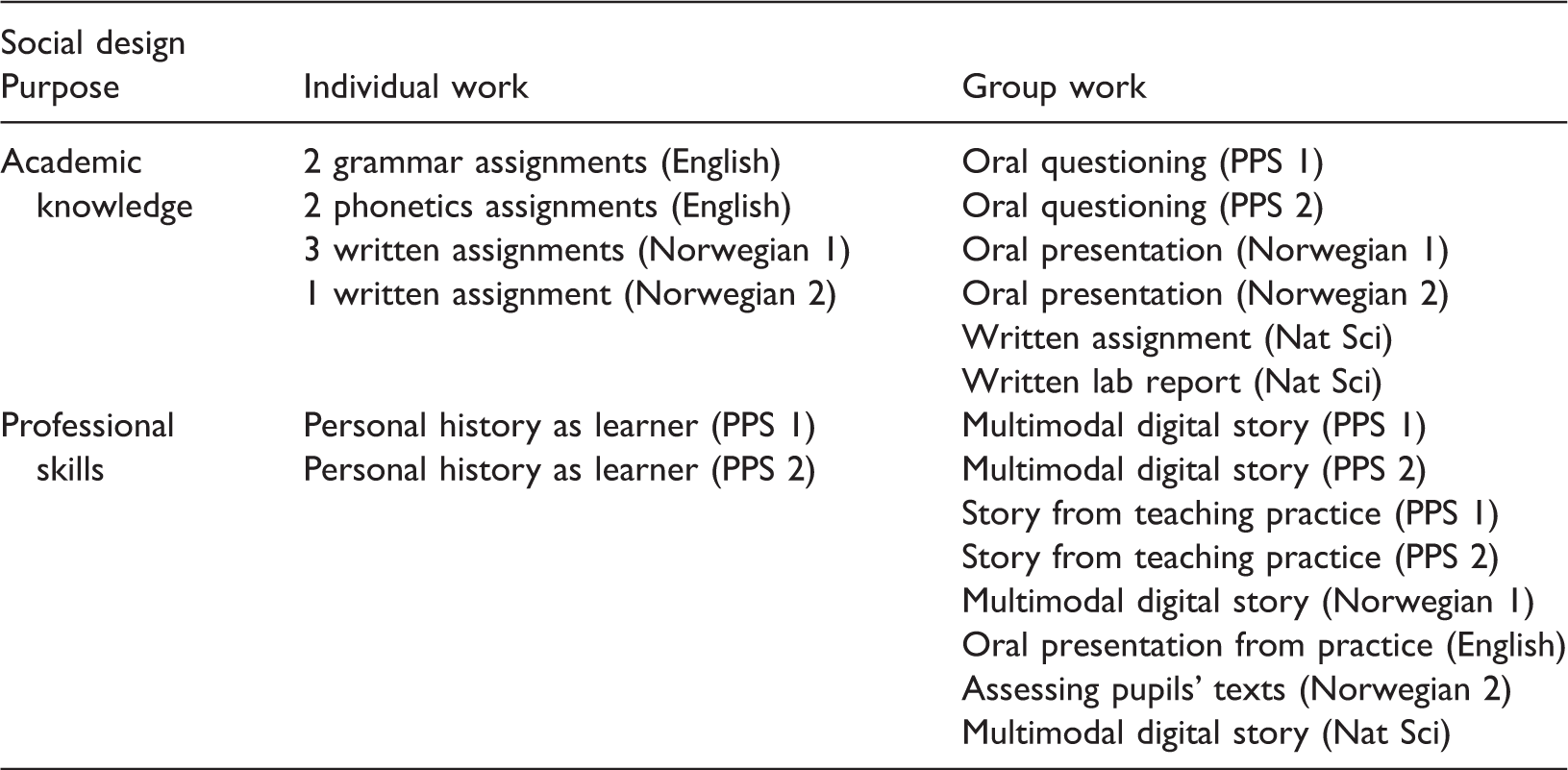
For the focus group interviews, a list of topics was prepared, forming the matrix of discussions that could still take quite different courses in the different groups. The discussion was designed to go through five steps: reflections on (a) the task given; (b) the search for sources and reading in preparation for the task; and (c) the actual work during the production of the text. In addition, the students were asked (d) specifically about how they reworked and adapted the source material in designing their own text, including collaboration and use of media; and (e) to reflect on the qualities and the learning outcomes from the whole process.
Focus group interviews are commonly used to clarify processes that are embedded in a social context. David Buckingham (1993: 45–46) underlines the social nature of the discussion as relevant to exploring the use and interpretation of media, since such processes themselves are so deeply embedded in the social and cultural context. Our interest in communities of literacy practices and how they collaborate in learning is the main reason for talking to the learners in focus groups. 4 In addition, the focus groups were our only opportunity for gaining insight in the students’ activity in social media, since teachers (and researchers) were excluded from these groups.
Findings
Cooperation through digital media
Our first research question was directed at gaining a better understanding of the processes taking place when teacher students design texts as part of their learning process, and the role that digital media play in this process. In our focus group interviews, as a common pattern across groups and course topics, we find that the students use both the university’s LMS Fronter and Facebook to organize their study practices, and they seem to use them for distinctively different functions. When asked what they use Fronter for, they emphasize the system’s function as a reliable archive. They go to Fronter to check their timetable, to find relevant messages from teachers concerning lessons and assignments, and to access texts and links posted by their teachers. The other main function that Fronter serves is that of a mailbox, where their mandatory assignment work is posted to be assessed and commented on by the teachers. This pattern, where the traditional functions of bulletin board, library and mailbox are digitalized without making radical changes in communication patterns between teachers and students, is well known from previous reports (i.e. Ørnes et al., 2011). The archive function, the most important attribute of the LMS, also attracts the most criticism from students; they find that the structure is messy, there are too many folders, and finding the path to a specific document requires too much clicking around.
This discontent with the available design of the institutionalized LMS seems to lead the students to unforeseen practices. While some of the students claimed to visit Fronter once or twice every day, the majority of the students who had established relatively stable practices for their study reported a different practice. They would rather rely on the Facebook group that the students themselves had established for their course to keep them updated on messages originally posted in Fronter. They told us about a practice where one or some of the students in the group entered a kind of curator role, posting messages on Facebook whenever there was something new in the Fronter room requiring their attention. This practice had not yet been established in the groups interviewed during the first month of their studies. The main reasons the more experienced students gave for this practice was that they were more or less constantly connected to Facebook, receiving reminders on their mobile phone whenever something new was posted. They also claimed that the Facebook group gave them a better overview of who had actually received the messages and who was actively taking part in the communication. This made Facebook more suited to exchanging practical information around the study situation, including messages between the students about being late for a planned meeting or being absent due to illness. In this way, the Facebook group became the main arena for connecting socially in the study situation, and as we shall see below, this extends to academic connections in the next instance.
While Fronter leads to a practice of one-way communication from teachers to students, Facebook represents the students’ most readily available design for interacting digitally in social networks. Almost all the students, including the newcomers, worked together through Facebook groups. The only notable exception was a group of fourth year students on a natural science course. They were familiar with this practice, but decided not to use Facebook groups since their course was a full-time course where they met face-to-face every day. Hence, they did not see any need for communicating through Facebook within the group. This was also given as a reason for not seeing the need for chatting with their teacher through the Fronter system; they claimed it was easier to simply knock on the office door, or send an email. For collaboration they used Google Docs, turning to a more specialized tool for sharing documents digitally. All the other students told us about a network of closed Facebook groups at several levels; one group for all the TE students starting the same year, one group for the seminar groups (“classes”) and an indefinite number of smaller groups created to solve specific tasks, such as mandatory assignments, as explained by one student from the second semester Norwegian course: S2F: We use Facebook for groups. That has been very useful. And it has been increasing through the year, actually; you have one group for maths, one for class A and one for class B. And then we post information that comes out in Fronter, for instance, and people put questions to each other and so on. Many students use Facebook actively for that, and so do I.
5
S13F: Making a group is a matter of course. You just establish a group. S14M: So you end up having a lot of groups! S16F: … there we used Facebook in the same way as we do here, in groups. We had a group that we used very actively during the exams, when we had our home exam. We wrote to each other and sent over documents continuously, like: “What do you think?” “Read some of this.” So then we really cooperated like a big group. A big group handing in five answers, sort of.
This combination of the academic, the social and the personal seems to be important for the function of the Facebook groups. Through their practices, the students differentiate the functionalities of Fronter and Facebook in a complementary way. Most of the students we spoke to had not realized that Fronter also contains dialogical functions such as a discussion forum and chat. Only one of the groups told us about a teacher initializing a dialogue among the students in Fronter – and reported that the initiative had limited success. The students seem to prefer Facebook for the practices already established on this platform. Whether this is because Facebook functions better in this respect, because of habit, or because Facebook provides a platform for planning and practicing collaborative learning processes outside the control of the teachers are questions we will return to in the discussion below. Another question is how the role of the curator mediating between Fronter and Facebook is established, and how this influences individual and collective curatorship and learners’ identity.
Working together and/or separately
As mentioned in the methods section, the assignments the students work with are varied and require very different processes of individual work and collaboration (see Table 1). These assignments are designed by the teachers within the framework of the course plans, and should be related to the pre-defined learning objectives. In this section, we will present findings that shed light on how the design work of the teachers meets the students’ designs in their learning processes.
The most striking difference in how the assignments are designed is that some are to be carried out individually, others in groups. This is to a great extent combined with differences in how the work should be presented; academic writing is commonly designed to be done individually, while oral presentations are always performed in groups or pairs. There may be practical reasons for this, or this design may be connected to the particular aims of the assignments, as we shall discuss below. However, we find that the processes the students go through when working on the assignments are not always in line with the teachers’ design. We find group tasks where the students mostly work separately, each with their own parts, and other cases where the students cooperate on solving individual assignments.
The typical way of preparing for an oral group presentation is that the group meets – in person or virtually on Facebook – and determines the main points that should be included and how the work will be distributed among the members of the group. Most often, this overview is made as a PowerPoint presentation, providing a tool for organizing knowledge in the form of bullet points. Subsequently, the work is done individually until the group meets again to prepare for the presentation. What was designed to be collaborative learning from the teacher’s point of view may end up as a kind of serial individual work within the group. Whether this leads to added value in learning depends on the cooperation along the way and in the final stages of editing the parts into a whole. Some groups report that they communicate on Facebook during their work on the separate parts, adjusting the presentation, others do not. When the work is finalized, some of the groups work together in the process, ensuring that all the members of the group share the collected work. But in many instances, the group members only know their own part – hence it is difficult to see any added value from the group as a whole.
This may be the reason why some of the students when reflecting on their practice in the focus group interviews claim that they learn more from individual assignments than from collaboration in groups: S7F: I think that perhaps I have learnt more from the written work, because then you cover a big theme yourself, while in those oral presentations you tend to split the work.
In our material we also find examples of assignments that lead to more collaborative practices. One is the production of digital texts, the other is individual analysis and writing organized as a group process. Producing a multimodal text for digital distribution was one of the mandatory assignments for the students on the Norwegian 1 course. The formats made available to the students through instructions and available software were digital storytelling, audio drama, animation film and production of material for a digital smart board. These are formats that are usually produced as teamwork, combining a series of competences such as providing verbal text, images, sounds and music, and editing all of these together. These tasks were mainly carried out as a genuinely collaborative process in the groups, even though the final editing was often left to one person who had the competence and/or the tools to do so.
The most interesting processes of collaboration, according to the students, appeared when individual assignments were designed as group processes by the teacher. A case in point is the assignment preparing the students on the Norwegian 2 course for assessing pupils’ texts. The students were given authentic written works produced by schoolchildren, and the task was to perform a syntactic analysis and produce a written response to the pupils. Hence this assignment combined academic knowledge with practical classroom work, and the students had a clear sense that this was “for real:” “It is really important when this is given back to the pupils that we are good models, with correct spelling, paying attention to how we start sentences and so on” (S7F). This is the task where the students are most positive to learning from the group. “We were sitting around a table and working independently, but still with each other” (S4F). The students seemed aware that they were practicing a skill that could be developed through experience, and this made sharing meaningful: S5F: Working in groups gave me more than doing this on my own, since I had never done it before […] After discussions in the group we could add maybe 20 more comments. S2F: This assignment on morphology, where you write about how to write, that was new to me. So that was useful, and I believe I can also make use of it for my exams. […] Interviewer: When you think about working as a teacher in school, do you think there are some tasks that you have learnt more from than others, for you to become a good teacher – a good Norwegian teacher? S2F: I think the digital task was good. That was somehow different, something it is very good to know about.
In summary, our findings show discrepancies between the planning and practices of teachers and students. This entails the use of digital communication as well as the literacy practices shaping the way the students learn through texts. In organizing their study processes, the students seem to seamlessly blend practices from in and out of university, keeping the informal collaboration on Facebook out of sight of the teacher. Hence, the teachers do not have full access to how the students adjust and redesign the planned design of the mandatory tasks.
Discussion
Our findings reveal practices that are not fully accounted for in reports monitoring the use of digital media in higher education. The use of the institutional LMS, in ways mainly limited to Web 1.0 practices, is only one side of the coin. The complementary practice developed in Facebook groups adopts collaborative processes and dialogical participation that carry potentials for added values in learning. This situation creates a sharp divide between the practices available to the teachers in their designs for learning, and those available to the students, who seem to be blending the formal practices of Fronter with the informal practices of Facebook. Discussing challenges for the digital learner in the formal school system, Erstad and Sefton-Green (2013) call for better connections between digital practices in and out of school. This may be understood in terms of the standardization that is an integral part of formal schooling, and is becoming even more evident through modern educational policies: “As a system, education is very much about standardizing learning, yet the informal media experiences of young people are more about individual interests and the collective processes of creation and collaboration” (Erstad and Sefton-Green, 2013: 95).
That Facebook could be used as a tool both in teaching and in learning is stated by The Education Foundation in their recently published Facebook Guide for Educators (2013). The Guide (2013: 5) points out that Facebook could be used both in formal learning, where the teachers create groups, share ideas, hold debates and so on, and in informal learning, where the students themselves create groups, offer informal support to friends, etc. The Guide also sees the potential of Facebook to inspire young people in “Making, creating and curating their own content and learning” (2013: 4). Thus far, our investigation on TE shows that such potentials, including Facebook in formal learning activities, are not fully utilized. A divide between formal and informal learning is upheld, but this divide runs between the LMS as the teachers’ available designs, and the students’ design for learning, blending formal and informal processes in their uses of Fronter and Facebook. While the teachers are limited to the LMS used as a one-way channel for standardized on-campus activities, the students expand their design with informal networking, self-organization, and collaboration on Facebook.
Hence, our data indicates that there is some kind of functional specialization between the LMS, preferred as an archive system among students, and Facebook, preferred as a platform for communication and cooperation between students. Technologically, both systems offer related functionality and our student respondents seem to be more or less aware of these overlapping functions. However, we find that the students’ comments on the use of Facebook first and foremost explain their choice as a matter of convenience. The students employ Facebook because it is readily available, they are already familiar with the relevant tools, and “everyone” is on Facebook all the time, in any case. Our interviewees seem more reluctant to comment on why they prefer to collaborate in a space where their teachers are not included. Their claim that the communication would be more formal in case the teachers entered the group may be only part of the answer. This is where an expanded notion of learning along the lines described by Jay Lemke (2013, see the theory section) may add to our understanding. Seeing learning as meaning-making entails interdependence of meanings, actions and feelings. It involves the participants’ feelings for one another, feelings about tools and artifacts, about topics and ideas. Lemke underlines that what happens also depends on memories and habits, on “past experiences and imagined futures” (Lemke, 2013: 74). The present divide has consequences for how teachers’ designs for learning can relate to the students’ practices. The teachers are deprived of insight into important learning practices designed by the students. One way of bridging the gap may be to create experiences of fruitful collaboration where feelings, interests and identity are taken seriously as part of the meaning-making processes of learning.
On the other hand, the students enter into interesting positions as curators of their own learning (Potter and Banaji, 2012), and in some cases also take on a role as curator for the whole group in their use of social media. One may ask about the significance of this collective curating function. In some cases it seems to be limited to posting teachers’ messages in Facebook’s live feed, functioning as a loudspeaker relaying the one-way communication from the teacher. In other cases the communication may go both ways, communicating questions from the students’ dialogues on Facebook back to the teachers. At this point a dimension of selection and evaluation enters into the curating function. On another level, the social curating function is performed when task-oriented Facebook groups are established and managed, creating an interplay between formal and informal study practices. This is where the teachers’ level of planning mandatory assignments meets with the social dynamics of Facebook at the students’ level of practice. The second part of this discussion will direct attention to this phenomenon.
As mentioned in the findings section, the students work in different ways to respond to the mandatory assignments designed by the teachers in TE. In some cases, the students’ design practices differ from the teacher’s design and planning, in particular in extended collaboration on individual assignments and minimized collaboration on group assignments. When the teacher designs an individual assignment, she would expect independent student work on an individual basis. The typical example in our material is academic writing designed as an individual assignment. It may seem that the writing of longer texts and the process of reflection through writing are tasks where the students prefer to work alone, and the only collaboration mentioned is the exchange of general comments to make sure that they have fully understood the assignment. Academic writing is the most traditional task in higher education, and here the teacher’s design and the students’ design seem to correlate. One of the reasons for this practice may be that students see a strong connection between the aims of this type of assignment and the final exam. In order to be able to pass the exam, it is important to study and learn what is considered the central academic content of the course. We only rarely find evidence that students read each other’s academic texts as peers, providing feedback on structure and content. In an academic context, it is common to have peer review on writing, but it is not an established practice in lower levels of higher education. As the students in our project are preparing to become teachers, it could also be a way of practicing how to give feedback on written texts as a teacher to students.
In our findings we also refer to individual assignments solved in collaboration, what we could call “collaborative individual work.” This type of collaboration is found in assignments with closed questions where the answers can be easily compared, as in grammar and mathematics: S9M: But when it is like this here where the point is to find the right answer, with this kind of assignment it is natural to collaborate to find the answers. S11F: I really think I learn more working with others because then they can explain things in a different way than (…) the teacher or the books.
When looking at assignments designed as group work by the teacher, our findings point to two kinds of student practices: “serial individual work within the group” and “genuinely collaborative processes.” As mentioned previously, oral presentations are always designed as group work by the teachers, and the students respond to the task by dividing it into smaller parts. The digital communication concerning these tasks mainly consists of practical questions, and these may be discussed in a group on Facebook. This is also where the group shares their PowerPoint presentation, mainly in order to add the relevant slides for each member of the group. This is a good example of a task designed for collaboration from the teacher’s point of view, where the students respond with a different design. One reason for this may be that the purpose of the group task is not clear to the students. If they experience that the important issue is to participate in the presentation, placing less emphasis on the content, the pragmatic choice may be to invest a minimum of effort. The practice with oral presentations in groups seems to be shaped by PowerPoint software, allowing the students to split the task between the group members in a kind of “serial group work.” It is important to discuss whether this practice has been established as a result of convenience both in the teachers’ and the students’ designs. If the students do not see the relation to the final exam or other learning outcomes, they may not see any reason to make an effort to work with all parts of a presentation. On the other hand, if the aim of the teacher’s design is not just to see the whole group through the task, but to accomplish collaborative learning within the group, the design of the task should include some elements that cannot possibly be split up in smaller parts.
What the students practice as “genuinely collaborative processes” seems to be the type of task where all members of the group have to collaborate to fulfill the assignment. We find this kind of collaboration in the work with digital storytelling, where the software facilitates collaborative work. In order to solve this task, one of the groups reported that they booked a group room on campus for two days, and stayed together until the task was accomplished. In this case we see that the technological complexities of the assignment define the need to work together in a real collaborative process. The other case is in the work with assessing pupils’ writing, where we find complexity in the professional knowledge required to fulfill the assignment. This includes linguistic knowledge as well as experience with pupils’ texts and how to communicate advice in a pedagogical way.
Conclusion
In this article we have uncovered that students employ digital media in a mix of standardized platforms for learning management and practices established in their informal use of social media. The functional specialization between formal and informal arenas for communication seem to be available only in the students’ design of their learning processes, while the teachers are restricted (or restrict themselves) to the institutional system, and also often to a limited set of functions. This creates an imbalance in the dialogue between the teachers’ and the students’ designs for learning, where the teachers’ planning is sometimes met with alternative practices on the part of the students. The students’ blending of educational practices with more informal social interaction in social media opens up a potential for new processes of curating learning, both on an individual and a collective level.
However, these practices of collaboration through digital media do not necessarily lead to more advanced learning processes. Digital technology may be used to minimize the work for each group member, or to collaborate to solve complex tasks, depending on how the assignments are designed by the teachers and practiced by the students. The teachers need insight into how the students practice digital collaboration in order to design tasks that offer real challenges demanding active participation.
Funding
This research was funded by «The Ugland gift», a private-public funding scheme within the Research Council of Norway, managed by the University of Agder.