



Abstract
Sandalwood is an important endemic tree in India. The oil in sandalwood, particularly in the heartwood, is the primary reason for its economic and cultural importance. However, the oil content of heartwood varies greatly between species and even within species. Furthermore, oil concentration varies greatly depending on position where sample is taken. In the present study, we report variations in oil content in a piece of heartwood of a single tree at specified positions both radially and longitudinally from core heartwood to the periphery and from lower side of butt-root to upper side. Further variation in α-santalol and β-santalol content of oil were also estimated. The variation in oil content was found to be in the range of 0.6–5.67% while the total santalol content ranged from 66.7% to 79.5%. This study is aimed towards analysing the variations in santalol content and oil yield across different axes of tree.
Introduction
The East Indian Sandalwood species (Santalum album L.) is a tropical woody plant of Santalaceae family growing up to a height of 12–15 m1–4 and known to thrive under a wide range of environmental conditions. Sandalwood accumulates essential oil in the centre of heartwood in 30 years old matured trees5,6 and is highly valued for the fragrant heartwood and oil, which are used in perfumes, aromatherapy, cosmetics, medicine,7–11 and in skin cancer prevention. 12 Sandalwood trees within their geographical habitat face significant concerns from overharvesting and illegal felling due to rising demand for sandalwood lumber and essential oils. Santalum album is classified as vulnerable under criterion A2de by the IUCN Red List. 4 Declining population of sandalwood is partly attributed to poor selection, as well as infection with sandalwood spike illnesses. 13 With green felling prohibited in forested areas of India and a dire need for sustainable forest management, also private plantations are becoming country's primary source of sandalwood. Moreover, plantation may suffice the expected demand of sandalwood and its products until 2040, and tree breeders and plantation managers are attempting to enhance sandalwood yield on private lands. 5 The high economic importance of the species highlights the need to scale up cultivation and also necessitates quick assessment of the species’ oil content. 14
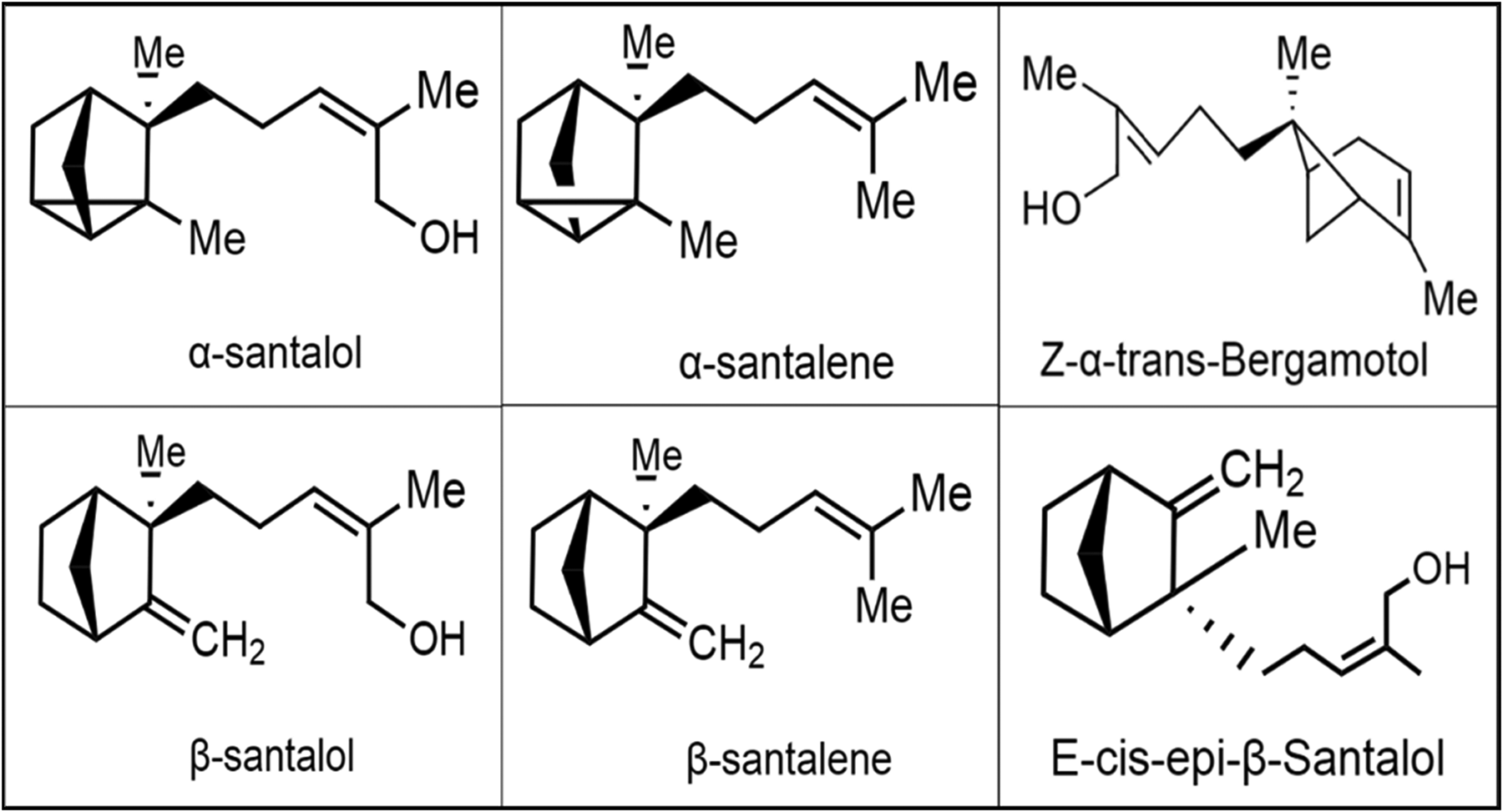
Santalols, which are sesquiterpenoid alcohols, account for the major constituents (Figure 1) of the oil obtained from sandalwood and are responsible for the sweet pleasant aroma of sandalwood.5,15,16 Several standards are thereby formulated to maintain the standards of the sandalwood oil namely Indian standard for S. album (IS: 329-2004), International standard for S. album (ISO 3518: 2022), and standard for Australian sandalwood S. spicatum (ISO 22769: 2009) which are defined based on the specified levels of santalols and bergamotols to be present in the oils. However, the quality and chemical nature of the essential oils are highly varied and depend on the host species, 17 geographical location, climatic and soil conditions, and most importantly the age of the tree, thereby the characteristics of the volatiles also are varied. 5
Solvent extraction of core samples at room temperature generally gives higher oil yield due to the presence of waxes, lignans, and other lipophilic materials and can be an economic approach for oil estimation.15,18,19 Several investigations have been conducted to document variations in oil content and composition of the oil of the species. Doran et al. 20 and Xiaojin et al. 21 evaluated heartwood oil yield in S. yasi and S. album and reported varied oil content ranging from 0.64% to 1.78%. Subasinghe et al., 22 reported higher range of oil content, i.e., up to 6.36% in S. album in Sri Lanka. Other researchers made assessment of α-santalol and β-santalol levels in S. album, S. spicatum, S. yasi, and S. austrocaledonicum.21,23,24 The content and composition of oil from the central and transition zones of the sandalwood disc, 25 analysis of growth and oil composition, 21 and solvent extractable volatile profiling 26 from the heartwood of the East Indian sandalwood tree are also evaluated to characterise the species. However, to the best of the authors’ knowledge, no studies have been done on the variation of oil content and chemical composition in terms of α-santalol, and β-santalol content at particular locations as it moves from the core to the periphery. The sandalwood tree's root and butt-root is predicted to have the largest oil content, and as the height of the tree increases, that is, as one moves towards the upper part of the tree, the percentage of oil drops. The study was done in order to assess the differences in oil yield and santalol content at particular places.
Materials and methodology
Material procurement and extraction
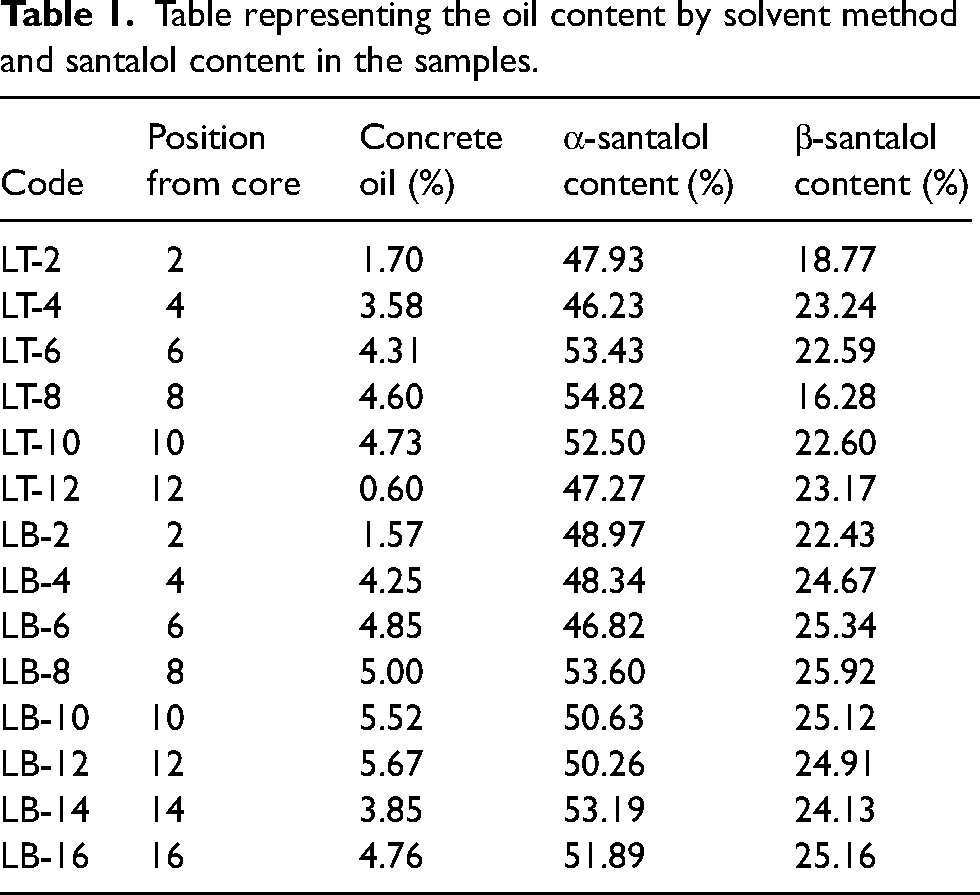
A log of Santalum album L. was obtained from Institute of Wood Science and Technology, Bangalore, India from the location 13°0′48.3768″N and 77°34′13.7928″E. Two separate discs of 2.54 cm thickness were made from the piece of log; one just above the butt-root level and another disc was prepared at a length of 30 cm above the butt-root level. The centre of the heartwood was marked and pointers were placed at regular intervals of 2 cm (LB-2 for 2 cm away from the core at buttroot level and LT-2 for 2 cm away from the core at higher level and so on) till the end of the disc. Table 1 represents the markings done and the codes assigned.
Table representing the oil content by solvent method and santalol content in the samples.
Authentic Certified Reference Materials (CRMs) of α-santalol and β-santalol with 80% purity and N-hexane HPLC, were acquired from Merck Specialties Pvt. Ltd and HiMedia Laboratories Pvt. Ltd, respectively. Powdered sandalwood was extracted using Hexane HPLC grade via ultra-sonication technique
5
with slight modifications. One gram of samples was taken in test tube and to it 30 ml of Hexane was added to the sample. The test tubes were then kept in ultrasonic bath (IKA make) and amplitude was set at 100% for 15 min at 45 °C. The solution was then filtered into previously weighed round bottom flask and the step was repeated thrice. The filtrate obtained in the round bottom flask was then evaporated in rotavapor (Buchi R3). The oil yield percentage (wt/wt) was computed using equation (1).
Gas-liquid chromatography (GLC)
The GLC equipment (NUCON 5765) was equipped with 2 m 10% DEGS on CH4 (HP) 80–100 mesh. The carrier gas was nitrogen at a flow rate of 15 mL/min and 1 μl injections (split-less) were made manually. The starting oven temperature was set to 100 °C for 2 min. The GC oven temperature program was as follows: 100–240 °C, ramping at 4 °C for 5 min followed by a hold at 120 °C for 1 min, then ramping at 10 °C for 3 min followed by a hold at 150 °C for 20 min. The third ramping of temperature was made at 2 °C for 5 min followed by a hold at 160 °C for 10 min and then finally ramping at 5 °C for 4 min followed by a hold at 180 °C for 8 min. The injector temperature was maintained at 220 °C and the transfer line was held at 220 °C. The detection was performed by FID and the detector temperature was maintained at 240 °C. The overall run time was fixed at 60 min. The presence of α-santalol and β-santalol was determined from the TIC obtained from the GLC analysis. The % of the santalols was described as the percentage of the peak area for each peak in the chromatogram.
Authentic Certified Reference Materials (CRMs) of α-santalol and β-santalol with 80% purity were used as certified reference material to which the retention time of α-santalol and β-santalol of samples were matched. The compound is commercially available and is also the main fragrance compound in the standing trees, thus making it suitable for analysing the concentration of the santalols in the tree.
Statistical analysis
Linear regression was developed and coefficient of determination, that is, square of correlation coefficients (r2) was estimated to determine the equation fit of the data. Using SPSS 26 software, means, standard errors, and significance of the linear regression. The graphs were prepared using Microsoft Excel.
Results and discussion
There was a significant difference of oil yield when sampling was done at lower butt-root level and 30 cm above it. The heartwood and oil content both reduce as one moves up the height of the tree and thus sampling at two various positions gives an overall idea of the variation of the oil yield. This was also observed in our case and has been represented in Figure 2. The oil content varied from 0.60% (wt/ wt) to 4.73% (wt/ wt) in different positions of the disc obtained from the higher level while the oil content varied from 1.57% (wt/ wt) to 5.67% (wt/ wt) in different positions of the butt-root area.
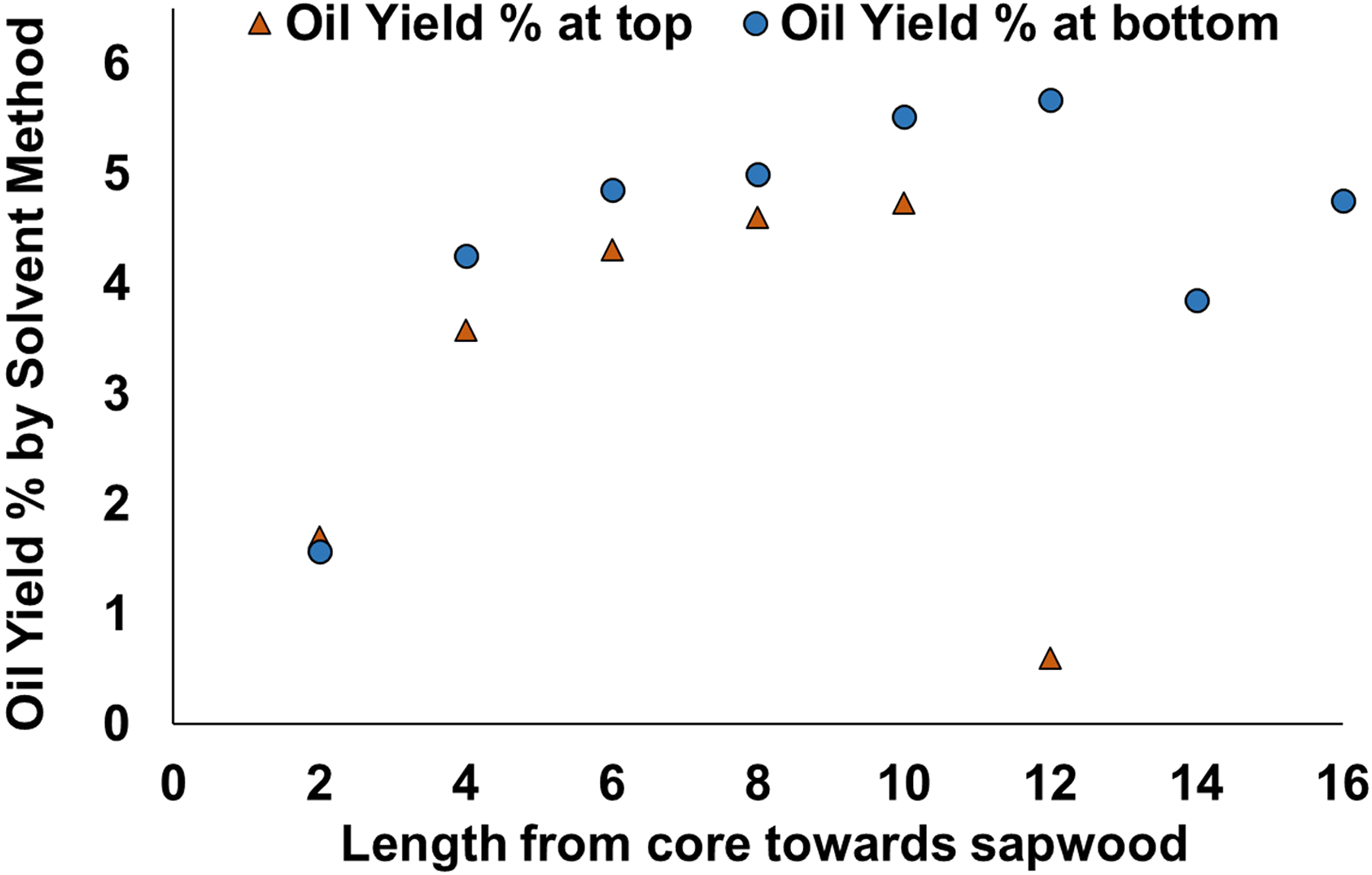
Variation in oil yield (in %) between top portion and bottom portion of the tree.
The GLC-FID spectrum was used to determine the area % of the santalols and to quantify the santalol composition. The standard CRM obtained from Sigma Aldrich was injected under similar conditions and run time. The retention time obtained was matched with the retention time of the samples and thereafter the contents were quantified. The peak for α-santalol originated at ∼31 min while the β-santalol peak originated at ∼39 min. The internal standards were critical in marking the compounds of our interest and quantify the same.
The present study was focused on the changes α-santalol, and β-santalol content, at specific position from core towards periphery and from butt-root to its upper portion. α-santalol, and β-santalol were identified and quantified for every sample. There was a relative proportional change in α-santalol and β-santalol content of the oil both at butt-root and its upper side. The β-santalol content was found to be higher in case of bottom portion of the log than the upper side. However, in some cases, the α-santalols were found to be more in the upper side of the log than in the root level as shown in Figure 3. While the α-santalol ranged from 46.23% to 54.82% (area %) while β-santalol ranged from 16.28% to 25.92% (area %) with an average of 50.42% (± SE 2.74) and 23.16% (± SE 2.59), respectively. The α-santalol was found to be higher than β-santalol at every sampling position as seen in previous reporting 27 but a major change was observed between composition of β-santalols at butt-root level and at its higher level. Table 1 represents compiled table having oil percentage obtained and the santalol content in selected positions.
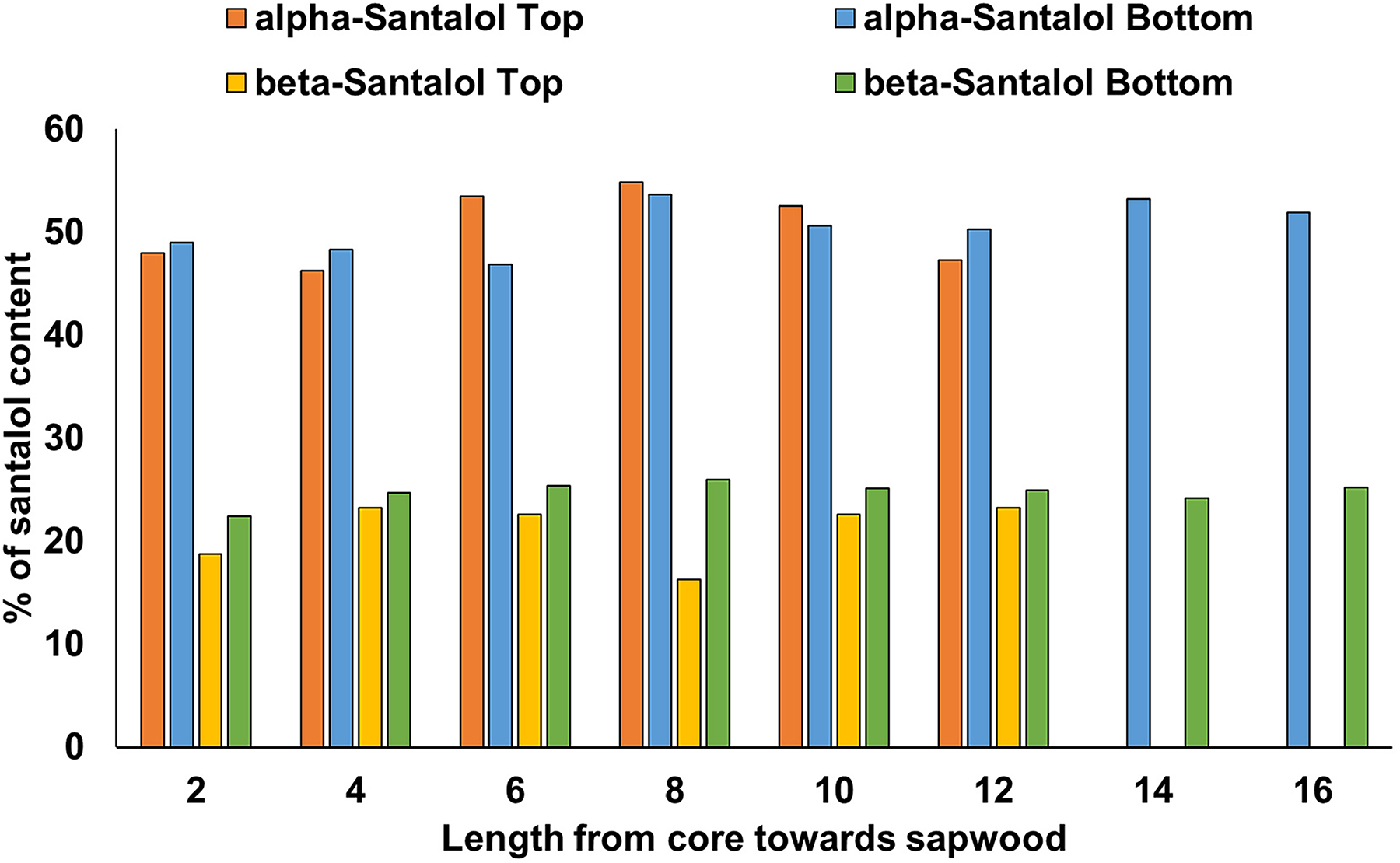
Bar chart for α-santalol content (in %) and β-santalol content (in %) of top and bottom portion of sandalwood.
The oil content and chemical composition of a tree vary significantly not only with the position of the tree from where the sample is taken, but also with the oil extraction technique, geographical location, and the taxonomic origin of the plant. 5 The chemical composition analysis by GLC gave us more detailed and informative analysis of the core sample extracts. The total santalols present in the oil, mainly α-santalol, and β-santalol, yielded a correlation of r2 = 0.4214, n = 14 with the hexane extract percentage (concrete oil percentage) of every sample. Though the r2 value of the obtained equation was not high, from Figure 4 we can say that with an increase in oil yield by solvent extraction technique there is an increase in total santalol content.
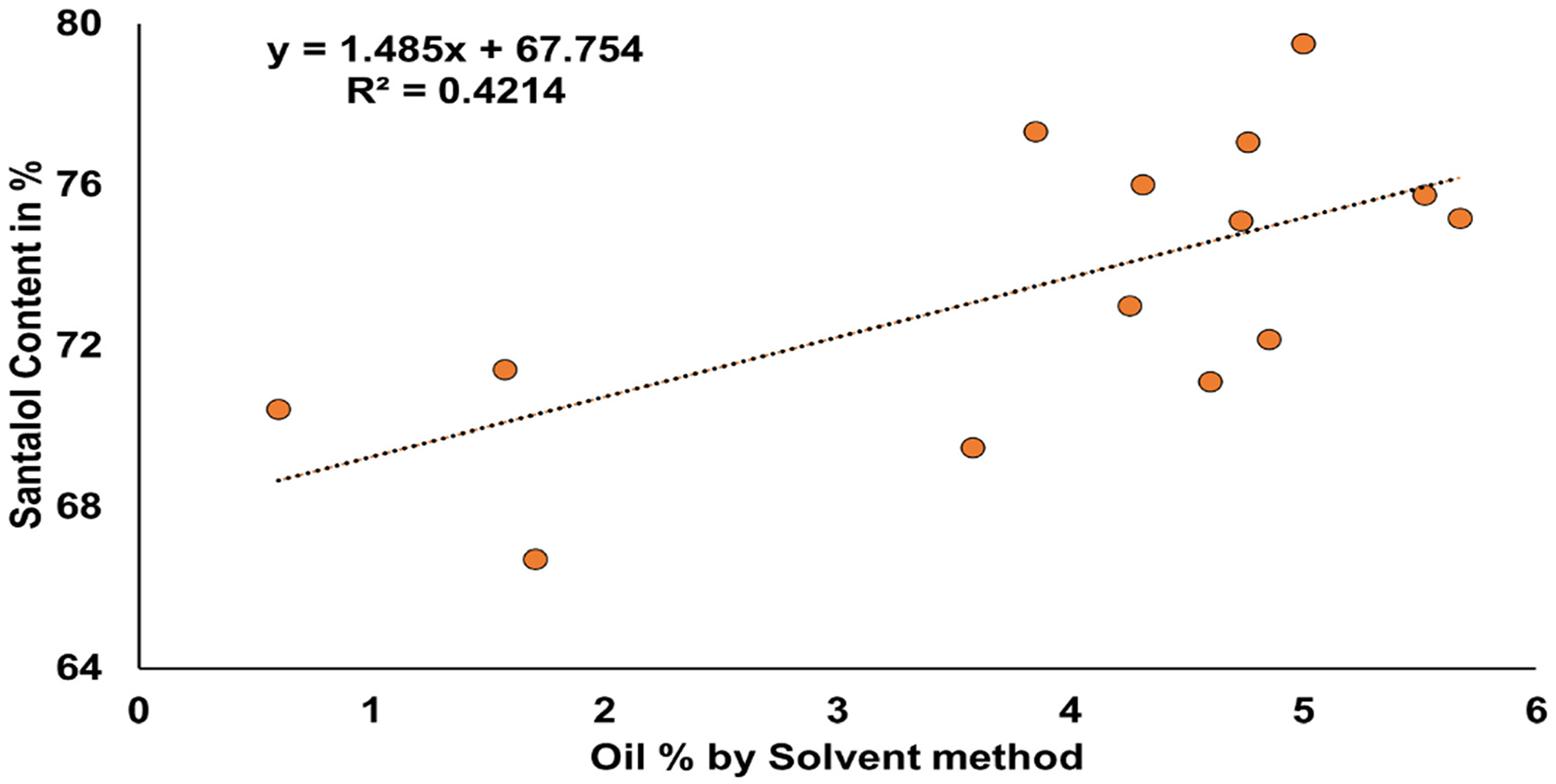
Scatter plot between total santalol content (α-santalol and β-santalol) and oil yield (in %) by solvent method.
Chemical compositional changes of the oil with height have been reported earlier in Santalum spicatum R. Br. 28 and by Jones et al., 19 on Santalum album L. to estimate to α-santalyl, and β-santalyl compounds. The study was done on the overall core obtained at 100 and 30 cm above the ground level. However, the study was focused on the compositional variation between santalols and santalenes in general. This study was focused on the changes α-santalol, and β-santalol content in particular. As suggested by Jones et al., 19 α-santalyl compounds are formed at the initial stages of growth and the ageing of the cells promotes the formation of the β-santalyl compounds. Jones et al. 19 described a comparable study where they studied the variation in santalols with the santalenes. The study inferred that santalene formations were favoured at initial stages of heartwood formation while santalols are formed only after cell maturation. This may be due to the oxidation of the selective compounds by various oxidative enzymes. 19
Sandalwood is a valuable resource, and it is important to ensure that it is used in a sustainable way. This study would help in selecting high oil-yielding parts from the whole log and also produce oil having higher santalol content. The other low oil-yielding parts of the wood can be used for other purposes like in religious yajnas. This can help in boosting economic returns for the farmers. Moreover, the sapwood portion can cut out separately and sold to incense industries for production of incense sticks or dhoops. This would benefit end users by ensuring that they are getting a high-quality product that meets their expectations.
Conclusion
The result obtained demonstrates that there is significant difference in oil content percentage from core towards the periphery of the heartwood. Moreover, there is difference in the santalol content of the oil when the samples are taken from different positions of the sandalwood tree. This would help us in better understanding about the oil and santalols content in the sandalwood tree for estimating the economic value. Thus, segregation of the heartwood and sapwood portion would ensure higher quality of oil and thus, higher economic values.
Footnotes
Acknowledgements
The authors thank the Director, Institute of Wood Science and Technology, Bengaluru, India for the encouragement and support.
Declaration of conflicting interests
The authors declared no potential conflicts of interest with respect to the research, authorship, and/or publication of this article.
Funding
We gratefully acknowledge the financial support provided by the National Authority CAMPA, Ministry of Environment, Forests & Climate Change, Govt. of India to the Indian Council of Forestry Research & Education (ICFRE), Dehradun for the project titled “Conservation, Improvement, Management and Promotion of Sandalwood (Santalum album Linn.) cultivation in India” under the scheme “Strengthening Forestry Research for Ecological Sustainability and Productivity Enhancement.”