




Abstract

Objectives
Topical honey has been suggested to be effective in the treatment of eczema but there are no clinical trials as a single agent. One study reported use of honey, beeswax and olive oil mixture alone and in combination with topical steroids, and suggested that this mixture may be effective for the treatment of atopic dermatitis and psoriasis. 1 We report a pilot study of the acceptability and feasibility of topical medical-grade Kanuka honey for the treatment of eczema.
Design
An open-label single-blind randomized controlled trial was conducted. Participants applied medical-grade honey to a representative lesion on one side and aqueous cream BP to the other, every night for 2 weeks. Lesions were covered with a dry non-adherent dressing overnight. Choice of side was randomized by coin toss.
Setting
Two primary care practices in Tauranga, New Zealand.
Participants
There were 15 adult participants with a doctor’s diagnosis of eczema involving the limbs, with bilateral lesions to allow comparison between treatments. Exclusion criteria were any corticosteroid use, requirement for antibiotic treatment or allergy to honey.
Main outcome measures
Primary outcome measure was the lesion component of the validated SCORing Atopic Dermatitis measure, 2,3 assessed by a second investigator blinded to treatment allocation. Secondary outcome measures were Three Item Severity (TIS) score 3 measured by the blinded investigator, unblinded measures were participant rated itch severity and acceptability of honey therapy, both measured by visual analogue score. The study was approved by the Multi-Region Ethics Committee of New Zealand (NZ), MEC-11-12-098, and written informed consent was obtained from all participants. One sample t-tests were used to estimate the difference between sides administered honey or control. An exact binomial method was used to calculate the confidence interval for the proportion of those with an adverse event. The sample size of 15 was chosen on the basis of variance estimation rather than to detect clinically important differences.
Results
Comparison of 2 weeks' treatment with honey versus aqueous cream in eczema.
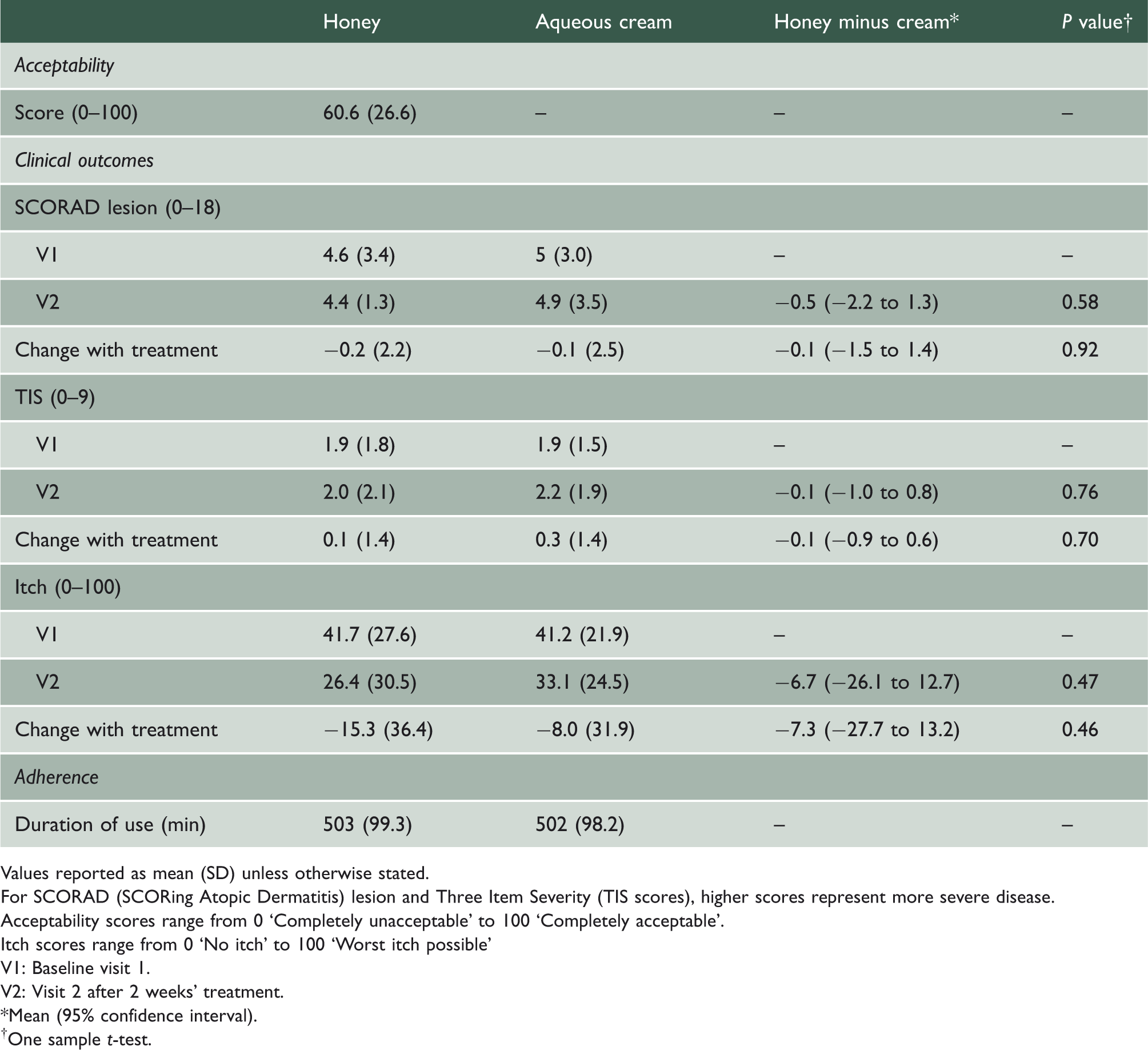
Values reported as mean (SD) unless otherwise stated.
For SCORAD (SCORing Atopic Dermatitis) lesion and Three Item Severity (TIS scores), higher scores represent more severe disease.
Acceptability scores range from 0 ‘Completely unacceptable’ to 100 ‘Completely acceptable’.
Itch scores range from 0 ‘No itch’ to 100 ‘Worst itch possible’
V1: Baseline visit 1.
V2: Visit 2 after 2 weeks’ treatment.
Mean (95% confidence interval).
One sample t-test.
Conclusions
In this pilot single-blind randomized controlled trial of topical medical-grade Kanuka honey for the treatment of eczema, Kanuka honey treatment was found to be feasible with moderate acceptability. There was no evidence of efficacy above that of the aqueous cream control. Aqueous cream is not recommended as a treatment in eczema and represents a negative control. 4 Important limitations of this study are the small sample size, which means that we cannot rule out a small but clinically important response to topical honey, and incomplete blinding due to the physical characteristics of honey.
Topical application of medical-grade Kanuka honey does not appear to be effective in the management of eczema.