



Abstract

DECLARATIONS
None declared
None declared
Written informed consent for publication of the article has been obtained from the patient.
RSM
All authors have made substantial contributions to the following: (1) the conception and design of the study, or acquisition of data, or analysis and interpretation of data, (2) drafting the article or revising it critically for important intellectual content, (3) final approval of the version to be submitted.
Benjamin Stubbs
We review a case of AA battery ingestion as a mode of deliberate self-harm and examine the current guidelines available.
Introduction
Ingestion of multiple large AA batteries is a highly unusual and rare mode of deliberate self-harm (DSH) with potential for serious complications. We describe a patient who presented with this problem, his subsequent management and a review of the current guidelines and literature available.
Case report
A 54-year-old man was admitted through the emergency department following the ingestion of five AA batteries three days prior to admission. He had a history of personality disorder and had previously swallowed batteries and other foreign bodies on five separate occasions. On one of these occasions he had suffered bowel obstruction as a consequence of battery ingestion, and had required a laparotomy to remove them. On this presentation, he reported swallowing the batteries and had not yet passed any of the batteries per rectum.
He complained of some diffuse abdominal discomfort but did not have any clinical features of bowel obstruction or perforation. He was passing flatus and had no nausea or vomiting. On examination, his abdomen was soft to palpation. He was admitted and kept under observation. An abdominal radiograph taken in the emergency department confirmed the presence of five cylindrical radio-opaque objects in his small bowel with no features of obstruction or suggestion of damage to their structural integrity (Figures 1 and 2).

Plain abdominal radiograph demonstrating three AA cells in the small bowel and two AA cells which have transited to the large bowel. All the battery casings appear to be undamaged and intact and there appears to be no signs of bowel dilation or perforation
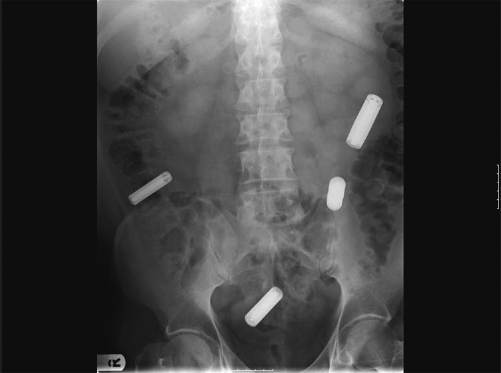
This plain abdominal radiograph demonstrates transit of the AA cells with two AA cells in the small bowel, one in the ascending colon and one in the rectum. The patient reports having passed one of the cells per rectum
Serial abdominal radiographs were taken to track the batteries’ progression along the gut and by day 5 they appeared to have transited to the large bowel. The patient was reviewed by the psychiatric team and was assessed to be fit for discharge with follow-up from community mental health services once he had passed all batteries per rectum. He was discharged home and reviewed in the surgical outpatient clinic several days later with no long-lasting morbidity associated with the episode.
Discussion
The literature commonly reports children inadvertently swallowing small button (coin) batteries. 1 The deliberate ingestion of multiple large AA batteries by an adult is an unusual presentation of deliberate self-harm due to the size and difficulty of swallowing these batteries. Other reports have shown that this can occur as a result of personality disorder leading to deliberate self-harm, or attention-seeking behaviour, as may be seen in prison inmates.1–3
The latest guidelines from the American Society for Gastrointestinal Endoscopy give a concise overview of the management of battery ingestion. Ingestion of cylindrical batteries with any signs of airway compromise, oesophageal obstruction or perforation are an indication for emergency endoscopy, preferably with conscious sedation if appropriate. 4 Equally, emergency endoscopy is also indicated if there is any suspicion of damage to the battery casing from biting or chewing.4, 5 Guidelines from Betalli et al. 6 indicate that if there is no compromise to the structural integrity of the battery, then they can be treated as simple foreign bodies. Complications such as liquefaction necrosis of the gastrointestinal tract lumen or transmission of electrical current locally are both rare phenomena in cylindrical batteries and are more common in disc battery ingestion.4, 6 Observation of the stable patient, who should be kept nil by mouth, is advised with serial radiographs taken every three days to monitor progression of the foreign bodies.4, 6 Endoscopic removal should be reserved for foreign bodies remaining in the stomach for longer than 48 hours. 6 In addition, emetic agents are not indicated but gastrointestinal lavage may have some benefit to aid and expedite passage of the battery. 4
Obstruction from the battery is most likely in the oesophagus, stomach or small bowel, particularly at the ileocaecal valve. 5 If any signs of obstruction, perforation or peritonitis develop distal to the stomach, or if endoscopic removal has failed, the patient should be referred for prompt surgical review; these are indications for urgent laparotomy for surgical removal of the foreign bodies.5, 7
In addition, distal foreign bodies that have any clinical signs of leakage or display no movement within a 48 hour period should also warrant urgent surgical evaluation and may require subsequent laparotomy.4, 7
AA cells typically contain a mixture of toxic heavy metals including mercury, lithium, zinc and nickel that can cause severe damage to the gastrointestinal tract due to their corrosive nature, with mercury oxide batteries most likely to degrade and fragment. 5 Case reports from psychiatric patients biting or damaging the battery casing prior to ingestion show that this increases the risk of heavy metal toxicity or gastrointestinal ulceration, and usually require laparotomy to remove the foreign body. 7 If damage is suspected the National Poisons Information Service (NPIS) should be consulted using their online facility – TOXBASE (http://www.toxbase.org/) – which will guide management according to battery type as per its chemical constituents.
Nevertheless, in batteries maintaining their integrity biochemical assays for heavy metals are not required routinely and cases can be managed conservatively if progressing along the gastrointestinal tract.4, 6
Summary
The reporting of battery ingestion is increasing and with it our understanding of its unique effects on the gastrointestinal tract. In patients presenting with battery ingestion a detailed history and prompt imaging are essential to establish the nature, number and location of foreign bodies. From the literature, management is dependent on the status of the patient and any concerns should be discussed urgently with referral to an experienced gastroenterologist or general surgeon depending on the level of the foreign body.
Footnotes
Acknowledgements
None