



Abstract

© Dennis Brack / DanitaDelimont.com / Alamy Stock Photo
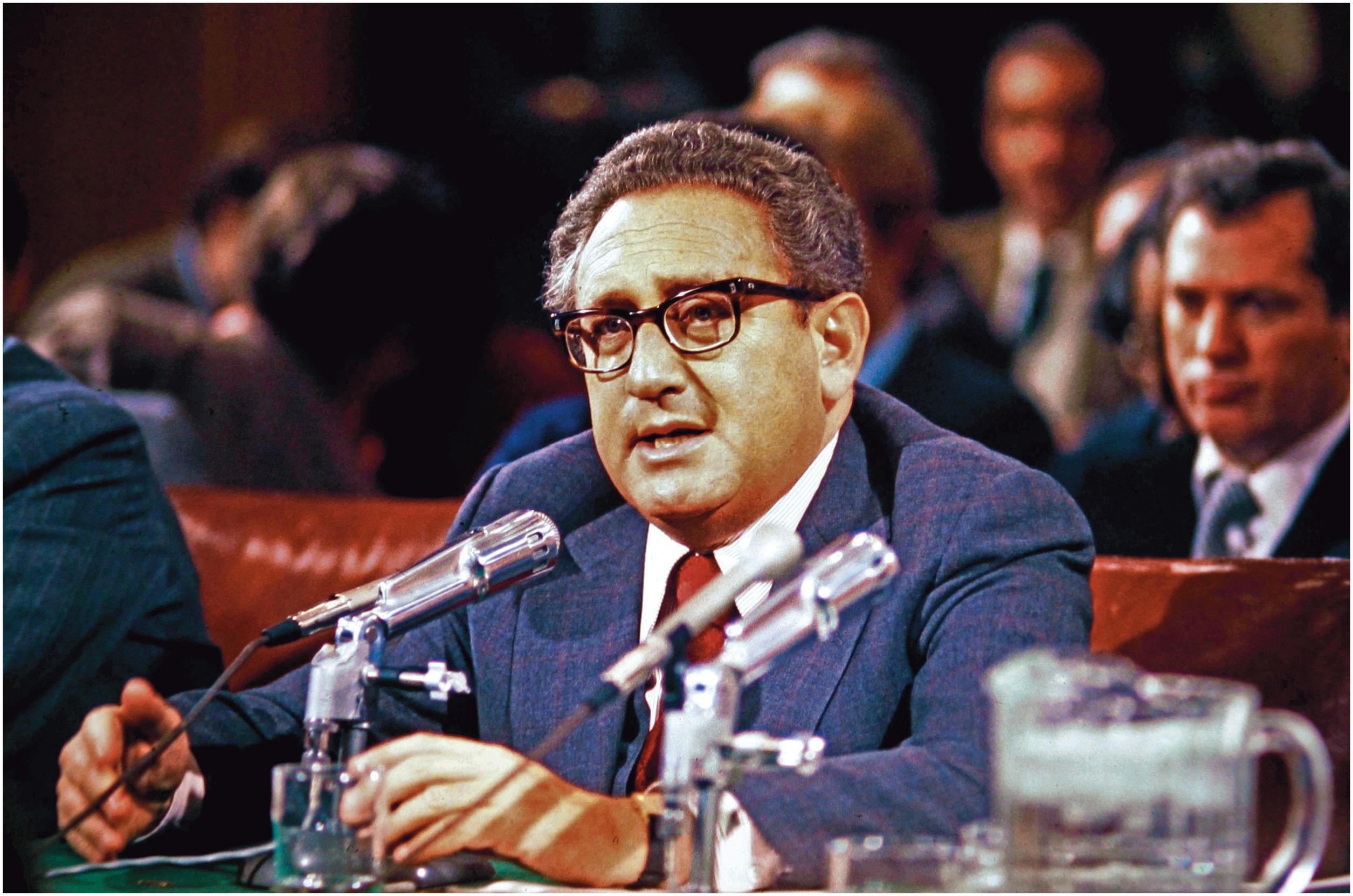
Henry Kissinger, it finally transpires, was mortal after all. He died in November 2023, at the age of 100. In life, Kissinger transcended politics to become an ‘international man of history’, negotiating with presidents and prime ministers by day and dating starlets at night as the ‘secret swinger’. He ingratiated himself with the rich and the powerful, and was subsequently courted by the mighty and the power-hungry. He served as National Security Advisor and US Secretary of State, hit an imagined home run at Yankee Stadium in a TV commercial, was awarded the Nobel Peace Prize, hounded by the critic Christopher Hitchens, lauded by the historian Niall Ferguson, appeared in The Simpsons, and was referenced in The Sopranos.
In death, as in life, Kissinger continues to divide opinion, attracting both praise and damnation in equal measure, having outlived his mentors, his benefactors, his contemporaries, and his adversaries. Justifiably concerned with protecting his image, his legacy, and perhaps his liberty, Kissinger jealously guarded access to his papers ensuring that only now may a true rendering of his remarkable life and contentious career begin to take shape.
In the time since his passing, numerous articles have appeared, from the fawning to the contemptuous. Few, however, have addressed his contribution to the Madman Theory, a strategy of deterrence, most closely associated with Richard Nixon, in which a leader portrays themselves as irrational and unpredictable to convince their enemies to avoid conflict with them. Four decades after Kissinger’s departure from power, and with the potential for a second Trump administration, the significance of the Madman Theory in US grand strategy and its projection of irrationality and threat of overwhelming force is deserving of scrutiny once more.
Kissinger’s strategic contribution to the intellectual development of the Madman Theory centred on his research into a viable role for tactical nuclear weapons in a limited war scenario. This endeavour culminated in the publication of his breakthrough book, Nuclear Weapons and Foreign Policy, which eventually catapulted him from the classrooms of Harvard to the corridors of power in Washington, DC.
An academic madness
Kissinger’s strategic contribution to the intellectual development of the Madman Theory centred on his research into a viable role for tactical nuclear weapons in a limited war scenario. This endeavour culminated in the publication of his breakthrough book, Nuclear Weapons and Foreign Policy, which eventually catapulted him from the classrooms of Harvard to the corridors of power in Washington, DC. Kissinger lamented that President Eisenhower’s policy of ‘massive retaliation’, amounted to an ‘all-or-nothing’ approach that ensured either capitulation or a full-scale nuclear assault in response to Soviet aggression. This, coupled with Secretary of State John Foster Dulles’ favoured form of deterrence, known as ‘brinkmanship’, risked being revealed as a bluff if Soviet military manoeuvres failed to provoke an adequate US military response. Kissinger feared that the risks involved in this strategy would grow with time; as Soviet nuclear forces increased, so the list of global locations whose defence was considered important enough to risk the destruction of New York and other major American cities would rapidly diminish.
The concept of ‘limited nuclear war’ that Kissinger proposed proved to be his intellectual contribution to the Madman Theory. He believed that the widespread fear of an all-out thermonuclear war, and the ensuing disintegration of civil society, should be utilised to guarantee the limits of war and diplomacy. The key to making this an effective strategy, Kissinger believed, lay in the ability to distinguish between types of nuclear weapons and to ascribe differing roles for their potential usage. Drawing such a distinction between tactical nuclear weapons, as opposed to strategic missiles capable of far greater range and strength, enabled Kissinger to make a nuanced call for the use of nuclear weapons in regional conflicts. This was driven, in part, by the inability to leverage the US nuclear superiority in recent conflicts, including Korea, and by the growing public concerns over the use of such weapons. To this end, Kissinger recommended reconstituting the structure of the Joint Chiefs of Staff by separating US forces into ‘strategic’ and ‘tactical’ divisions that he argued would better reflect the strategic challenges facing the United States at the height of the Cold War.
Kissinger was not alone in his research into new Cold War strategies at Harvard. His exploration of limited nuclear war coincided with the game theorist Thomas Schelling’s work on the ‘strategy of irrationality’ and with his colleague Daniel Ellsberg’s exploration of the ‘political uses of madness. All three sought to discern ways to ensure that seemingly irrational behaviour could influence and benefit US grand strategy, and while their terminology differed, their focus remained consistent. Their theoretical research projects, however, were not necessarily intended as a course of action to be implemented by the White House. Indeed, their work was intended more as a warning than a recommendation.
What Schelling, Ellsberg, and Kissinger sought to do that was profound was to rationalise an irrational approach to policy at a time when new approaches were being actively encouraged, and when a new generation of politicians and policymakers were assuming positions of authority in Washington, DC. Kissinger, however, was not content to focus on an academic career. Having consulted with the Kennedy and Johnson administrations, he was appointed Special Advisor to the President for national security affairs by Richard Nixon following his election in 1968, bringing the Madman Theory to the heart of the US national security architecture at the height of the Vietnam War.
Strategic madness
Kissinger had been absent from Nixon’s 1968 campaign, working for Governor Nelson Rockefeller. Nixon, however, had his own rationale for an embrace of the Madman Theory. He believed that the secret threat of nuclear war, known as ‘the Dulles Ploy; had led to the end of the Korean conflict during his time as Vice President in the Eisenhower administration. Nixon’s perception of the Madman Theory, however, ultimately went beyond his own experience under Eisenhower, transcending the intellectual concepts that had been developed at Harvard in the 1950s. He did so by projecting an impression of an unbalanced leader capable of resorting to extreme violence in the name of virulent anti-Communism. Working together, Nixon and Kissinger forged a unique partnership as they implemented a new grand strategy to address the post-Vietnam War era, circumventing Defence Secretary Melvin Laird and dealing directly with the Joint Chiefs of Staff to implement the Madman Theory in Southeast Asia.
Nixon and Kissinger made a deliberate effort to introduce an irrational dimension to US grand strategy by widening operations into the neighbouring states of Cambodia and Laos in defiance of anticipated moves to wind down operations in Vietnam and Indochina. In a series of actions that were deliberately kept from Congress and the American people, Operation Menu instigated the systematic bombing and military incursions into Cambodia, which had maintained its neutrality in the conflict. The ferocity of the bombings was compounded by its lack of a legal basis, which eventually imperilled the Nixon presidency. As Kissinger reflected, the military usefulness of Operation Menu was secondary to the psychological principle of ‘keeping the enemy guessing,, a key element of the Madman Theory.
Launched concurrently with Operation Menu, the US Air Force initiated Operation Raindance, targeting 345 sites in Laos. The clandestine nature of the US role ensured that the mission was fraught with subterfuge, secrecy, and deniability on all sides. Kissinger conceded in April 1973 that the Laotian strategy ‘may look irrational’, but that the United States ‘must do something out of proportion to punch them’. Whatever madness was implemented in Cambodia and Laos, however, was merely a side-show to the application of irrational violence that was employed across the border in Vietnam.
Under the auspices of Operation Duck Hook, Kissinger and Nixon considered plans to mine Haiphong Harbour, bomb dikes, use nuclear weapons, and intimidate Soviet officials. As revealed in recordings, memoranda, and official documentation, discussions regarding the potential use of nuclear weapons in Vietnam began during the transition and continued throughout Nixon’s first year in office. These plans were designed to confound the enemy and contribute to a sense of irrationality regarding the application of US grand strategy in Vietnam. Although never implemented, Operation Duck Hook was indicative of the mindset at work in the Nixon White House as early as 1969. Kissinger later conceded that the ability to devastate an enemy had proved far more complicated to translate into a credible threat than either he or Nixon had imagined.
Operation Duck Hook coincided with another example of Kissinger and Nixon’s use of the Madman Theory: the 1969 Nuclear Alert, designed to convince Moscow that the US would launch a nuclear strike on the USSR if it failed to intervene to end the Vietnam War. Eighteen fully laden, nuclear armed aircraft were kept in a holding pattern at their fail-safe position for three days awaiting a ‘go order’ from the White House. In keeping with the philosophical nature of the Madman Theory, none of this was communicated directly to the Kremlin, since to have done so would have undermined any claim to irrationality on the part of the American President. It was merely hoped that Brezhnev understood what Nixon was up to, raising the serious risk that the Soviet air defence might have believed that the United States was really preparing to launch a first-strike initiative to destroy the USSR. The operation, however, ended without incident.
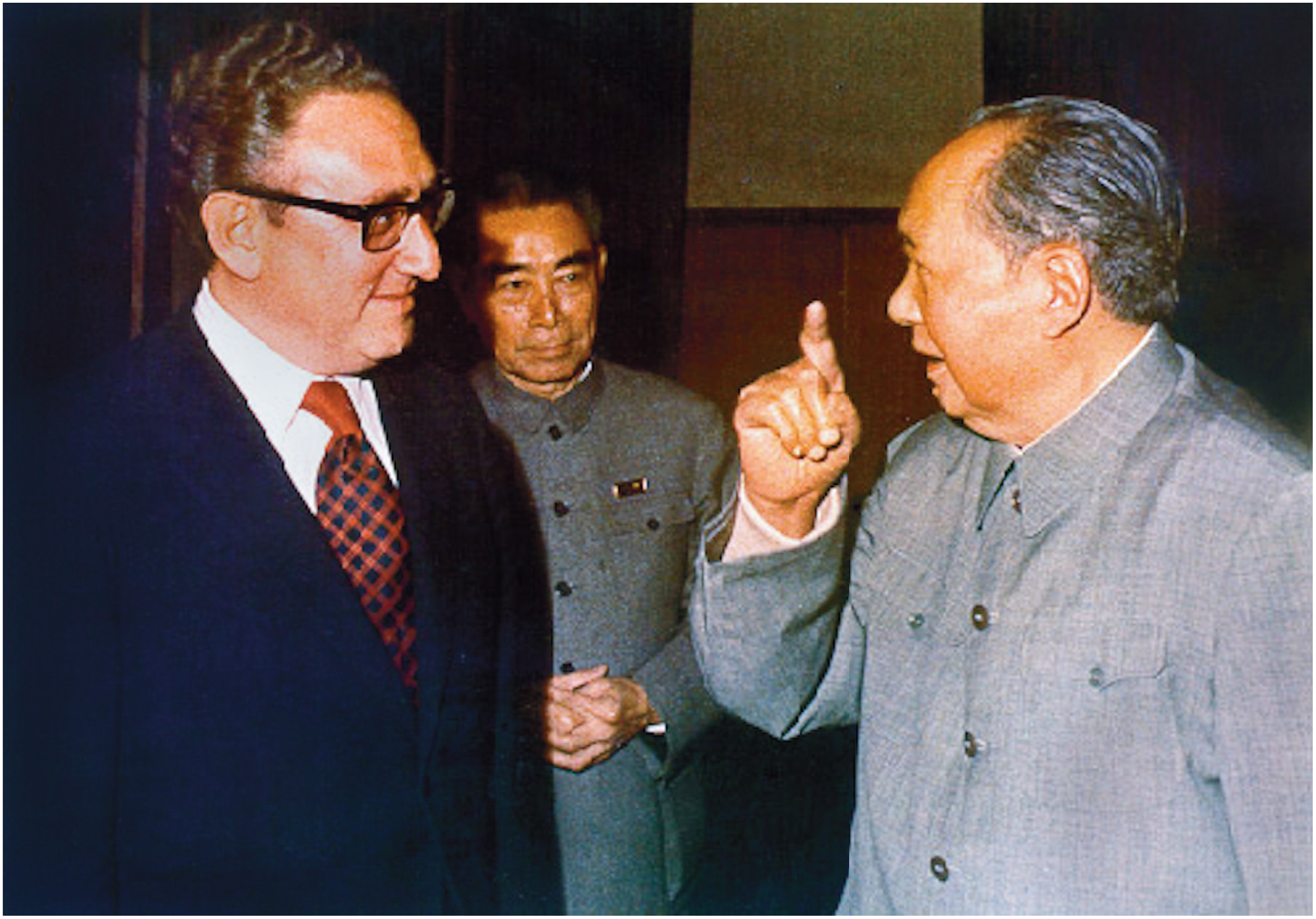
The Madman Theory was designed to convince the governments in both Hanoi and Moscow that Nixon was capable of anything, including the violation of international accords and the bombing of neutral nation states, actions that could clearly be viewed as war crimes. The extent to which both Nixon and Kissinger were cognisant of their actions is evident from recorded conversations and official memoranda.
An April 1971 conversation regarding negotiations with the North Vietnamese diplomat, Xuan Thuy, revealed Kissinger’s recommendation to use ‘the Dulles ploy’, and further implications that Nixon might use nuclear weapons. The following year, a memorandum from Nixon dated 9 May, 1972, reminded Kissinger that he had often discussed the need to establish the impression in the enemy’s mind that the President was absolutely determined to end the war and would take whatever steps were necessary to accomplish this. Nixon insisted that the time to do so had arrived.
The transcripts of this conversation, along with the release of the memorandum, as well as other examples, undermine any claims of presidential detachment from the Madman Theory, implicating both Nixon and Kissinger in its formulation and implementation. They appear to offer conclusive evidence of the extent to which Nixon and Kissinger, together, sought to implement the Madman Theory as US grand strategy during their time in office.
While the various elements of the US initiative in Southeast Asia were designed to directly impact the conduct of the war on the ground, the larger goal was to convince the Kremlin of Nixon’s irrational intent. In April 1972, Nixon ordered Kissinger to utilise the Madman Theory in his dealings with the Soviet leadership, revealing his darkest intentions for Vietnam: ‘I’m going to destroy the goddamn country, believe me, I mean destroy it if necessary,’ Nixon declared, adding that this included using ‘even the nuclear weapon if necessary. Lest there be any doubt, Nixon insisted that the United States would ‘bomb the living bejeezus out of North Vietnam and then if anybody interferes, we will threaten the nuclear weapon’. This conversation encapsulated the Madman Theory approach adopted by Nixon and was an indication of Kissinger’s determination to see just how far politically meaningful threats could be taken to ensure that an adversary took the threat of limited nuclear war seriously.
A mad legacy
A long-standing debate has raged regarding the origins of Nixon’s foreign policy beliefs in general, and specifically regarding the Madman Theory. The debate centres around the impact of Kissinger on Nixon’s strategic vision, with some suggesting that the President was overly beholden to his National Security Adviser for tactical opinions. The attempt to discern an accurate historical record has not been aided by the nature of the Nixon/Kissinger relationship, which was defined by tensions in office and by petty jealousies in later years as they contradicted themselves to define their legacies.
Clearly, both men brought their own experiences and expertise to their roles in the White House. While Kissinger based his embrace of the Madman Theory on his own research and that of his colleagues at Harvard, Nixon based his view on his experience as Vice President under Eisenhower. The Madman Theory evolved during Nixon’s first term as events occurred to necessitate changes to its application. Despite having a career upon which to build a credible threat, however, Nixon’s utilisation of the Madman Theory failed to persuade the Communist forces that his irrational language and implementation of seemingly irrational actions would result in the deployment of the American nuclear arsenal. Try as he might, the world believed that Nixon remained a rational individual. Despite this, the Madman Theory remained one in a series of tactics employed by Nixon and Kissinger that eventually secured detente with the Soviet Union, an historic opening to China, and a peace deal in Vietnam, as they sought to confuse and confound America’s opponents and instigate a new US grand strategy for the post-Vietnam era.
Four decades after Nixon and Kissinger departed the White House, the Trump administration implied that it had emulated their approach to grand strategy as it threatened North Korea with ‘Fire and Fury.’ With Donald Trump’s potential return to the presidency, the Madman Theory may yet emerge as the once and future US grand strategy, further perpetuating Henry Kissinger’s contested legacy.
Footnotes
James D. Boys is author of Clinton’s War on Terror: Redefining US Security Strategy, 1993-2001 (Lynne Rienner, 2018). He is a Visiting Scholar at the Fletcher School’s Center for Strategic Studies at Tufts University, where he is working on his fourth book.