



Abstract

© Roberto Monaldo / Alamy Stock Photo

With the populist radical right widely expected to win major victories in June’s European Parliament elections,
Few political terms are as ubiquitous as ‘populism. Mass media, journalists, and pundits have been increasingly fond of talking about ‘populism. This is particularly the case in Europe, where so-called populist parties are widely predicted to perform strongly in June’s European Parliament elections. For this reason, it is important to explore how these parties have performed in the past elections. But first we need to consider what we mean – and don’t mean – by ‘populism.
Varieties of populism
While the academic literature on populism contains numerous approaches, the ‘ideational approach’ has become prevalent in recent years. This approach views populism as a set of ideas characterised by a Manichean and irreconcilable conflict between the ‘pure people’ (people-centrism) and the ‘corrupt elite’ (anti-elitism). From this perspective, the ultimate purpose of politics is respecting and glorifying the principle of ‘popular sovereignty’ (general will), whatever the cost.
According to the ideational approach, populism is first and foremost a moral approach to politics, which separates the good (the pure people) from the evil (the corrupt elites). Unlike full ideologies such as communism, fascism, or liberalism which -at least in theory – aim to provide answers to all the major political and societal issues, populism is better understood as a thin-centred ideology, meaning that, in isolation, it possesses only a limited capacity to interpret reality. In fact, populism typically does not exist alone: instead, it usually interacts with other ideologies or ideas, which are essential to develop a more comprehensive political project.
Given its peculiar nature, populism has been described as ‘chameleonic’ (Taggart 2004: 275). Rather than a single ‘populism’ it would be more accurate to speak of’varieties of populism’: each different populist variety emphasises, essentially, the ongoing struggle of the people against elite antagonism but does so in different ways. There is a tendency in public debate to interpret populism as a synonym for right-wing populism. However, the reality is more complex. Right-wing populism is itself a wide category that includes different forms, such as the national-conservative populists and neoliberal populism, and, in particular, ‘the populist radical right’ (PRR).
The PRR is now widespread in Europe. This brand of populism is grounded in an ideological mix consisting of nativism, authoritarianism, and populism (Mudde 2007). Nativism is the most important ideological feature of the PRR, and essentially it points to the preference for the natives in virtually any aspect of social, political, and economic life, while non-natives are perceived to be a threat. Authoritarianism, on the other hand, primarily refers to an emphasis on traditional authority and values, including the support for a law-and-order agenda. Despite common perceptions of the populist radical right as predominantly ‘populist, populism is the least important of the three core features of PRR parties’ ideology. Similarly, for the two other main variants of right-wing populism -national-conservative populism and neoliberal populism – populism is arguably the least important aspect of their ideological position.
On the opposite side of the political spectrum, left-wing populism is characterised by an egalitarian and inclusive approach to the definition of who belongs to ‘the people, and typically criticises capitalism. Another major populist variety is ‘valence populism, which points to actors emphasising topics such as anti-corruption appeals, democratic reformism, and political transparency. Finally, recent years have seen the resurgence of agrarian populism in Europe, most notably in the Netherlands, which points to the antagonism between the (good) rural peasants and the (evil) rural elites.
Four decades of the populist radical right in Europe
1979-1989
In the first decade of European Parliament elections (1979-1989), the populist phenomenon was clearly marginal. In the first EP election the only populist party obtaining at least 1 per cent of the votes was the neoliberal populist Progress Party in Denmark. However, during the 1980s Europe’s political landscape became populated with three main groups of populist actors: PRR parties, other right-wing (i.e. non-PRR parties, such as neoliberal and national conservative populists), and left-wing populists.
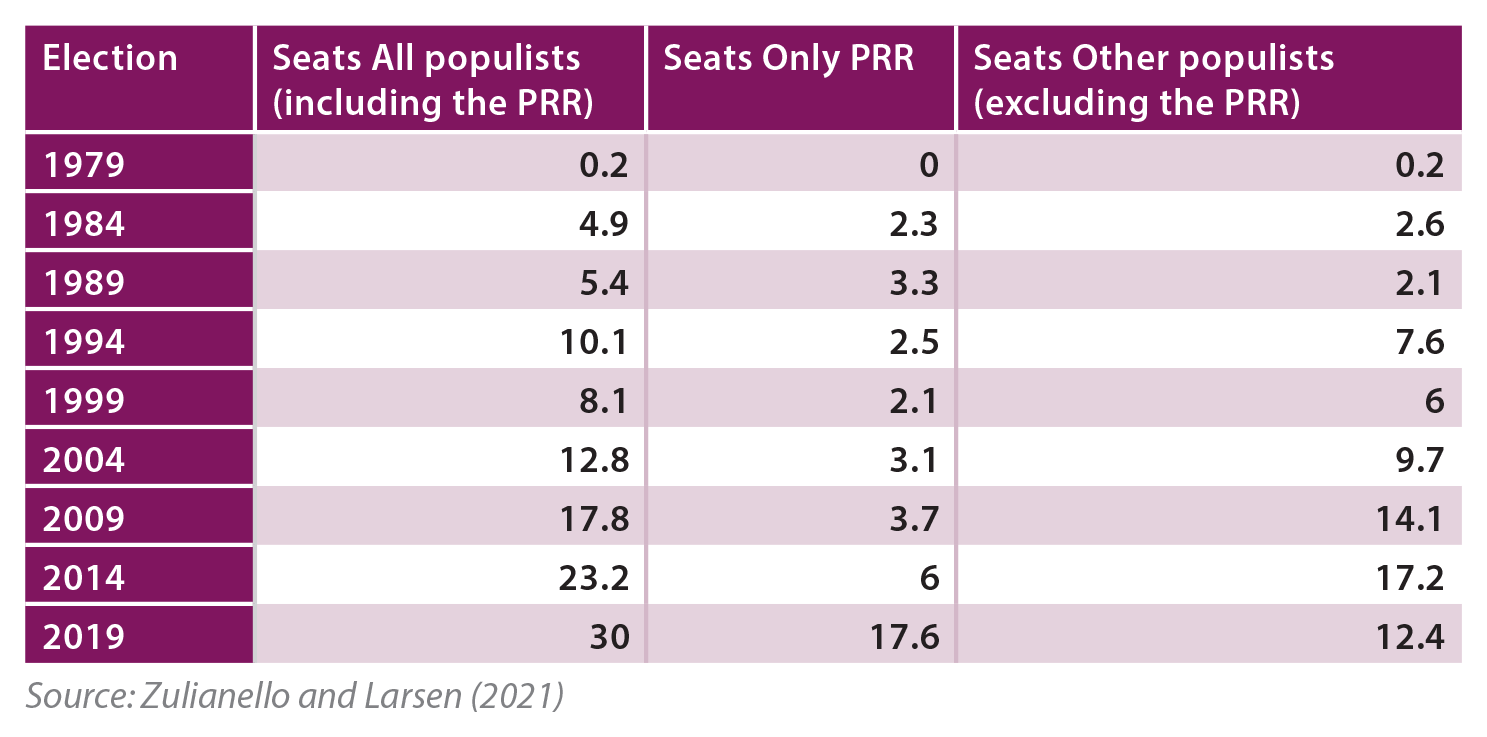
The combined percentage of seats for all populists in EP elections grew from 0.2 per cent in 1979 to 4.9 per cent in 1984 and 5.4 per cent in 1989, while the proportion of seats obtained by the PRR progressively grew, from none in 1979, to 2.3 per cent 1984 and 3.3 per cent in 1989, with PPR parties gaining seats in Belgium, France and Germany. Among the top-performer PRR parties in electoral terms in this period we find the French Front National (11 per cent and 10.5 per cent of the votes in 1984 and 1989, respectively), the German Republicans (7.1 per cent in 1989) and the Flemish Blok (4.1 per cent in 1989). The number of countries in which at least one PRR party obtained 1 per cent of the votes grew from none in 1979, to three in 1984 and five in 1989.
1994-1999
Throughout the 1990s, the first signs of the growing strength of populist parties became evident, as they obtained 10.1 per cent of EP Parliament seats in 1994 and 8.1 per cent in 1999. This growth was primarily due to the performance of other right-wing populist parties (i.e. non-PRR), most notably neoliberal populists like Forza Italia (30.6 per cent of votes in 1994 and 25.2 per cent in 1999) and, to a lesser extent, the United Kingdom Independence Party (7 per cent of the votes in 1999). The legislative strength of PRR parties in the EP, instead, remained in line with that of the previous decade: 2.5 per cent in 1994 and 2.1 per cent in 1999.
Again, the strongest performers in electoral terms were the French FN and the Flemish Blok, but these PRR parties were now joined by the Austrian Freedom Party (who won 23.4 per cent of the vote in 1999). Nevertheless, during the 1990s, the number of countries where a PRR party obtained at least 1 per cent of the vote remained unchanged from 1989, at five.
2004-2009
The EP elections held in the first decade of the millennium began a new phase for European populism and coincided with the addition of the new member states in Central and Eastern Europe. Populist parties secured 12.8 per cent of the seats in 2004 and 17.8 per cent in 2009, a considerable growth in comparison to the previous decade.
Similarly to the 1990s, the growth was primarily due to the performance of non-PRR right-wing populist parties, which remained stronger in terms of seats in the EP than the other populist varieties, including the PRR. Among the other particularly successful right-wing populists were two parties that at the time qualified as national-conservative populists: the Hungarian Fidesz (47.4 per cent of the votes in 2004 and 56.4 per cent in 2009) and the Polish Law and Justice (27.4 per cent of the votes in 2009).
Populist Radical Right Support by EU Country
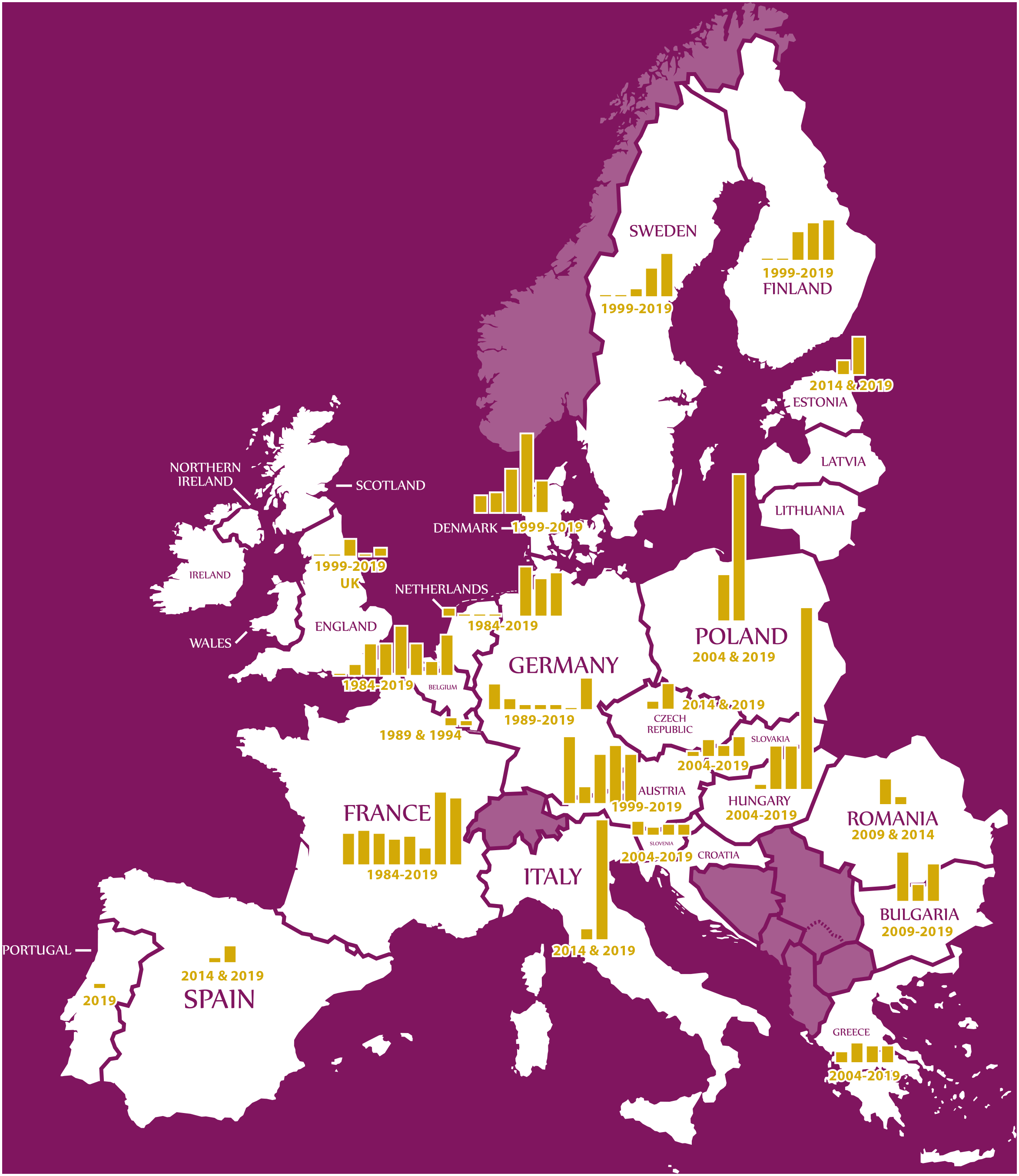
The legislative strength of the PRR in the EP slightly increased in comparison to the previous decade, achieving a total of 3.1 per cent of the seats in 2004 and 3.7 per cent in 2009. For the first time PRR parties won EP seats in Bulgaria, Finland, Greece, Hungary, Poland, Romania, the Netherlands, Slovakia, and the United Kingdom. Among the best performing parties within the PRR were, again, the Flemish Blok as well as the short-lived League of Polish Families (15.9 per cent in 2004), the Danish People’s Party (15.3 per cent in 2009) and Jobbik in Hungary (14.8 per cent in 2009). The first signs of a proliferation of the PRR were becoming visible too: individual PRR parties obtained at least 1 per cent of the votes in 13 countries, and, more importantly, the countries where the aggregate support for these parties exceeded 10 per cent in at least one election rose from three in the previous decade to eight (Austria, Belgium, Bulgaria, Denmark, France, Hungary, the Netherlands, Poland).
2014-2019
The 2010s saw a considerable growth in the proportion of seats obtained by populist parties in the EP Parliament, growing to 23.2 per cent in 2014 and to 30 per cent in 2019. This decade can be appropriately defined as that of an explosion of the PRR, which secured 6 per cent of the seats in 2014 and 17.6 per cent in 2019.
In 2019, for the first time, the PRR was more represented in the EP than the other non-PRR right-wing populists, winning its first seats in the EP in Czechia, Estonia, Italy, Spain and Sweden. Interestingly, part of the rise of PRR is due to the transformation of previously national-conservative parties into PRR themselves, such as Fidesz in Hungary and the Polish Law and Justice or the previously regionalist populist League which became a fully-fledged PRR and state-wide party under Matteo Salvini (34.3 per cent in 2019).
During this decade of EP elections, the vast majority of EU member states had at least one PRR party that obtained 1 per cent of the vote or more, with the exception of Croatia, Cyprus, Ireland, Latvia, Lithuania, Luxembourg, Malta. Most notably, PRR parties won sweeping victories across the Old Continent: in Hungary the combined support for the PRR was 58.9 per cent, in Poland 49.1 per cent and in Italy 40.7 per cent. In addition, the PRR obtained more than a fifth of the vote at least in one of the elections in Austria, Denmark and France, more than 10 per cent in Belgium, Bulgaria, Estonia, Finland, Germany, the Netherlands and Sweden, and more than 5 per cent in Czechia, Greece, Slovakia and Spain. In the meantime, while the PRR proliferated across Europe and substantially increased its electoral support, the other populist varieties, such as left-wing and valence populism remained concentrated in a limited number of countries.
What to expect from the 2024 elections?
Opinion polls suggest that June’s European Parliament elections are likely to lead to yet another growth in the strength of the PRR at the EU level. According to various polls, the PRR has a realistic chance of being the most popular party in Austria, Belgium, France, Hungary, Italy, the Netherlands, Poland and Slovenia. The PRR is also likely to experience major breakthroughs in countries such as Germany and Sweden, as well as in some countries where it was previously very weak or non-existent, such as Portugal or Romania. While in some countries the PRR is expected to decline in comparison to 2019, such as Bulgaria or Denmark, the broad picture seems to be one of further expansion of the PRR in the EP.
The expected increase in seats held by the PRR in the European Parliament will doubtless change the shape of legislature. While PRR parties do not sit in a single EP grouping, many of them span across two main groups: Identity and Democracy (ID) and the European Conservatives and Reformists (ECR). ID includes, among others, the Italian League, the French National Rally, Alternative for Germany and the Austrian Freedom Party. This grouping is expected to grow from the 73 seats it obtained in 2019 to 93 in 2024, according to the data provided by Europe Elects (https://europeelects.eu/). The ECR, which includes parties such as the Polish Law and Justice, Brothers of Italy, the Spanish Vox and the Sweden Democrats, is projected to grow from 62 to 81. Nevertheless, it is hard to envisage the ECR and ID developing a consistent and solid alliance in the next EP as the former would probably have greater incentives to get closer to the European People’s Party (EPP). Power relations and political interactions within the next EP could also be changed by Fidesz’s stated intention to join the ECR after the election. The presence of Orban’s party in the grouping will give the ECR more seats – and more influence – but also highlights the growing transnational reach of PRR parties.
Conclusion
The PRR has been a consistent feature of European Parliament elections in some countries since the 1980s, but these parties have experienced a major growth and diffusion in recent elections. While other varieties of populism are present only in specific national contexts, the PRR today exists in most EU countries. In other words, when we speak about a populist surge in the EP elections, we are actually talking about a PRR surge. Indeed in a number of EU states there are now competing PRR parties, such as in France, Italy and Slovakia.
While the PRR has long been seen as a novel political force, these parties are now well-established and are, increasingly, well-integrated into the mainstream of national party politics. Although some exceptions still exist – such as Germany or Portugal -PRR parties are now accepted as legitimate players in the coalition game and/or potential governing partners in most EU countries. As June’s EP elections look set to demonstrate, the populist radical right is no longer a fringe concern, and its political relevance is unlikely to disappear any time soon.
Footnotes
Mattia Zulianello is an Assistant Professor of Political Science at the Department of Political and Social Sciences of the University of Trieste, Italy.