



Abstract
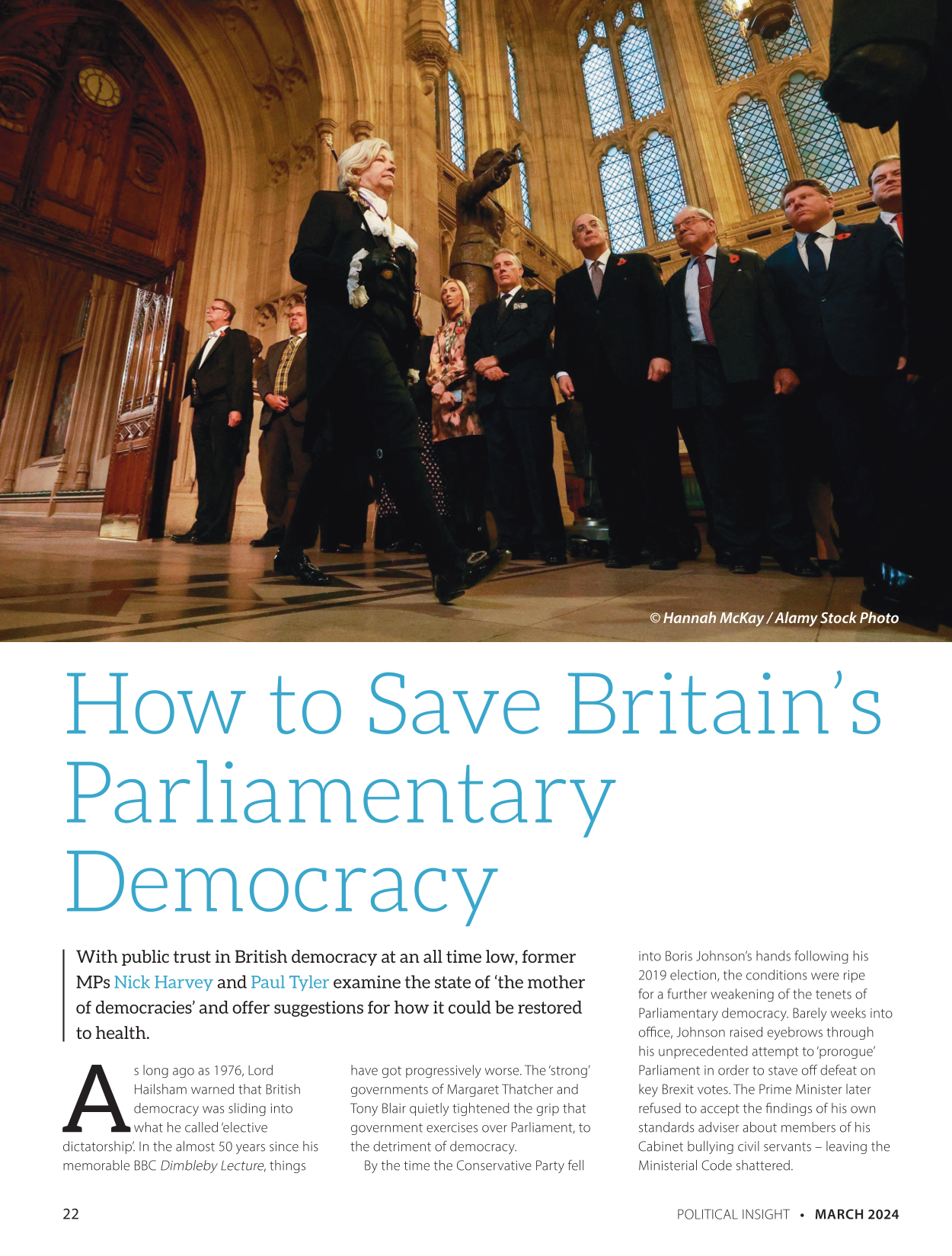
© Hannah McKay / Alamy Stock Photo
With public trust in British democracy at an all time low, former MPs
As long ago as 1976, Lord Hailsham warned that British democracy was sliding into what he called ‘elective dictatorship’. In the almost 50 years since his memorable BBC Dimbleby Lecture, things have got progressively worse. The ‘strong’ governments of Margaret Thatcher and Tony Blair quietly tightened the grip that government exercises over Parliament, to the detriment of democracy.
By the time the Conservative Party fell into Boris Johnson’s hands following his 2019 election, the conditions were ripe for a further weakening of the tenets of Parliamentary democracy. Barely weeks into office, Johnson raised eyebrows through his unprecedented attempt to ‘prorogue’ Parliament in order to stave off defeat on key Brexit votes. The Prime Minister later refused to accept the findings of his own standards adviser about members of his Cabinet bullying civil servants – leaving the Ministerial Code shattered.
Johnson’s litany of abuses did not end there. In three years, his Number Ten forced at least six very prominent civil servants out of office for ideological reasons: they were not deemed to be ‘fellow-travellers’. He attempted government by ‘order’ on a scale which would have made even Henry VIII (its original practitioner) blush, making lavish use of the Royal Prerogative – ancient powers which enable Prime Ministers to declare war, sign treaties, dissolve Parliament and choose election dates.
Johnson was eventually forced out of office after a lengthy parliamentary investigation found that he had lied repeatedly to Parliament about Downing Street parties during the Covid lockdown. But the weakened democracy that allowed Johnson so much power remains. With British politics now ‘on sale to the highest bidder’, fundamental change is needed to safeguard and stabilise our body politic.
Political finance
Nowhere is the democratic malady more acute than in political finance. Effective journalism has always ‘followed the money. Since the 2019 election, rules on political funding have weakened the integrity of our democracy. The government has unilaterally increased the limit on national party election campaign expenditure from around £20 million to almost £35 million. There was no cross-party consensus, no debate, and no need for this.
While Select Committees and bodies such as the Committee on Standards in Public Life have repeatedly called for a tightening of the rules on political donations, the current government have relaxed our political finance regime. Anyone who has ever been on a UK electoral register here – however long ago – can now both vote in elections and make political donations, with minimal authentication. The traditional ‘no taxation without representation’ has been turned on its head.
Take the case of ‘unincorporated associations’. Some £14 million is believed to have come into British politics since 2015 through these often-opaque vehicles -escaping official publication and scrutiny, not least during the 2016 EU referendum campaign. The influence of ‘dark money’ has been largely overlooked by mainstream media – but its threatened scale and potential foreign origin in the next general election is a new threat entirely.
British democracy has been through an extended nervous breakdown in recent years. Parliament has twice gone ‘missing in action’ – failing entirely to protect the national interest during either the Brexit debates or the pandemic and its lockdowns.
In a British political context, £35 million seems a fortune. In other settings, it is small change. Wealthy individuals around the globe indulge enthusiasm for English football’s Premier League by buying our clubs for vast sums. They will spend £35 million in a single transaction, buying an extra player to provide cover at some key position, without even planning to pick him regularly unless another player suffers long-term injury. If these foreign billionaires have a hobby for politics rather than football, our democracy is up for sale very cheaply – they could buy up all our political parties for less than one top striker’s transfer fee.
So, what will the Conservatives – or indeed any other party – do with this money? Here we must look at the 2022 Elections Act. In 2018, a Supreme Court Judgment relating to South Thanet constituency reaffirmed that responsibility for election expenditure falls on the local agent. After that judgment found against the Conservatives, the Electoral Commission spelt out that campaign expenditure by national parties in a constituency must be accounted and declared as expenses by their candidate (within the set limits) ‘even if the items provided have not been authorised by the candidate, or the candidate’s agent’.
In the Elections Act 2022, ministers turned this on its head. A candidate and their agent can now claim ignorance of the expenditure by their national party in supporting their campaign. Parties can effectively spend whatever they need to win a seat. So, in the 150 or so marginal seats that will decide the next general election, the parties can spend millions of pounds targeting voters with unsolicited mail shots, social media messaging and call-centre contacts, far outweighing constituency limits of under £20,000 for a candidate.
Does all this matter? In Britain we do not have a presidential system. We elect individual MPs in constituencies, who in turn indicate in the House of Commons their collective ‘confidence’ in a ministerial team. That is parliamentary democracy. It follows that the integrity of constituency election campaigns is vital for the whole of our democratic system. But if a large proportion of MPs owe their electoral success to the massive investment in their campaigns from their party HQ, that gives the central party machine vast power over them.
Post-election renewal?
British democracy has been through an extended nervous breakdown in recent years. Parliament has twice gone ‘missing in action’ – failing entirely to protect the national interest during either the Brexit debates or the pandemic and its lockdowns.
But, with a general election in the offing, there is also now the possibility of renewal and recovery.
So, how should an incoming government address this quagmire? One thing that is sorely needed is constitutional rehabilitation. Put simply, in a proudly proclaimed ‘parliamentary democracy’ the executive is accountable to the legislature, and not the other way round. This crucial aspect of political reform receives too little comment or study but is crucial to any post-election renewal in British politics. There are several areas where this constitutional rehabilitation is needed:
Election law
Britain’s election law is largely contained in two acts: the Representation of the People Act (RPA) 1983 and Political Parties, Elections and Referendums Act (PPERA) 2000. This cumbersome, complicated legislation needs to be consolidated, simplified, and updated in one Act. The Electoral Commission must be given total independence with sole power to make election regulations. The new Act should allocate all campaigning resources deployed in any seat towards the spending limit in that seat – which would level the playing field – and we should remove voter ID requirements at polling stations to ensure the widest participation in voting.

Government changes
When Britain’s government changes there is currently no requirement for Parliament’s approval. We suggest a Commons vote to approve the appointment of a Prime Minister, Cabinet and government. Parliament should set its own post-election timetable for convening, appointing its Speaker and Select Committees, and promulgating its own standing orders. There should be Select Committee confirmatory hearings for Cabinet posts, and only after all these preliminary steps – spanning perhaps a month or six weeks – should Parliament consider the new legislative programme in a King’s Speech. The incumbent PM and government should routinely stay on as caretaker until the new one is confirmed.
Parliamentary time
The allocation of parliamentary time for debate and discussion is a key lever in any democracy. But in the Westminster system, the sitting government controls how parliamentary time is allocated. This must change. The Commons itself and not the government should allocate parliamentary time. Government should have a set proportion of parliamentary time (e.g. a half, or two-thirds) with Private Members’ Bills and non-government business having more time than currently – including bills, motions, committee reports and petitions. All resolutions of our sovereign Parliament should be binding on government. Parliament should set its own sitting hours, weeks, and schedule. Parliament should summon ministers, not meet at the convenience of ministers.
Parliamentary committees
Parliamentary committees should have greater powers: Select Committee findings, if endorsed by resolution of the Commons, should be binding on government. Chairs and members of committees should be directly elected by secret ballot of MPs – not fixed by whips (party managers).
Parliamentary committees should have greater powers: Select Committee findings, if endorsed by resolution of the Commons, should be binding on government.
Secondary legislation and Royal Prerogative
On secondary legislation, Parliament should prohibit Henry VIII clauses (making law by ‘public notice’). The Ponsonby Rule should be restated, enabling Parliament to supervise all significant UK international obligations and treaties.
Royal Prerogative powers should be rationalised and codified and made fit for the 21st century, with a binding principle that a PM wishing to use Prerogative powers must first secure a two-thirds majority in a Commons vote – including for any early dissolution or prorogation. Government should secure parliamentary approval when committing the Armed Services to significant military deployment, beforehand where practicable and swiftly thereafter where not. We must remove the anomaly of one political team leader (the Prime Minister) being effectively equipped with a ‘whistle to end the match at a time of their choosing’ by having the power to pick the date for a general election.
Civil service
Britain’s impartial Civil Service has long been respected globally, but a review of its practical working involving all levels of the service is needed. Only the Cabinet Secretary and not political figures should be able to remove a Permanent Secretary from a department – and only on performance or disciplinary grounds, which can be tested in law. We must clarify that the role of politically appointed Special Advisers (SpAds) is to advise ministers, with no power to instruct or direct civil servants.
House of Lords
Our democracy desperately needs a reformed and elected second chamber. The widely-backed 2012 House of Lords Reform Bill is the obvious starting template for change, and we should adopt its proposed largely or wholly elected second chamber of around 450 members, elected by proportional representation in multi-member regional (English) and national (Scotland, Wales and Northern Ireland) constituencies. If we elect a third of the members every four or five years, MPs will always have a more powerful recent mandate, avoiding open conflict. Non-renewable 12 or 15-year terms would give a longer outlook, and more independence from parties.
Standards in public life
There is one area of our democracy that is particularly ripe for reform. Standards in public life have been drastically eroded in recent years, with British politics racked by a succession of scandals. The Committee on Standards in Public Life was created in 1996 to address dwindling confidence in the ethical standards of Parliament, the Civil Service and public governance. Over the years its advice has consistently been well-argued, logical and democratically unchallenged. It has, however, been ignored and opposed by successive governments.
Meanwhile the Electoral Commission, set up with similar intentions in 2000, has also had limited government support. The Johnson government ignored its advice and even attempted to constrain its efforts to achieve greater fairness, by imposing a politically dominated committee to oversee it. The Commission’s warning of potential bias in the ways new ID card requirements for voting were implemented, was just one of several impartial recommendations that didn’t suit ministers.
There are, however, ways to reverse this decline in standards in British public life. An obvious starting point would be to enact the Committee on Standards in Public Life’s 2021 report Upholding Standards in Public Life, and to appoint strong independent regulators. We should also enact the principles of the Committee’s 2011 report Political Party Finance, which recommended limits on donations, reduced expenditure limits and a modest increase in the existing level of state funding.
The ethics regime for government ministers is also badly in need of reform. The Ministerial Code needs statutory underpinning, enshrining the Seven Nolan Principles of Public Life, with a Commissioner for Ministerial Standards having complete independence and powers to investigate ministers’ conduct, with clear penalties applicable to ministers and an explicit assumption that a breach of the Code means they depart.
Democracy matters
Commentators and politicians often decry critical political and constitutional issues as having no public salience: they are not ‘doorstep issues’ in an election year. Of course, they don’t feature in immediate day-to-day concerns like the cost-of-living crisis, the strains in the NHS, energy costs or even climate change and the Brexit fallout.
However, looking ahead, an incoming government this year will not inherit the benign economic legacy Tony Blair did from John Major in 1997. It will be challenging and, while a new regime may endeavour to reverse the worst effects on living standards and public services, the political tide could turn swiftly. The exaggerated impact of our outdated ‘First-Past-The-Post’ electoral system could threaten a swing to an ultra-right-wing opposition on a minority vote in 2029.
If Labour should win the election but then ignore urgent political reforms, which even their grassroots and trade unions now see as necessary, that new government might not only prove very temporary, but could go down in history as an unprecedented disaster. That is an avoidable fate, so long as they recognise that national renewal must include long-overdue political reform alongside their economic, social, environmental, and international agendas.
Footnotes
Nick Harvey was a Liberal Democrat MP for North Devon from 1992 to 2015 and Minister of State for Defence in the 2010 Coalition. Paul Tyler was a Liberal Democrat MP for Bodmin in 1974 and North Cornwall from 1992 to 2005, and a working peer from 2005 until 2021. Their book ‘Can Parliament take back control? – Britain’s Elective Dictatorship in the Johnson aftermath’ is out now.