



Abstract
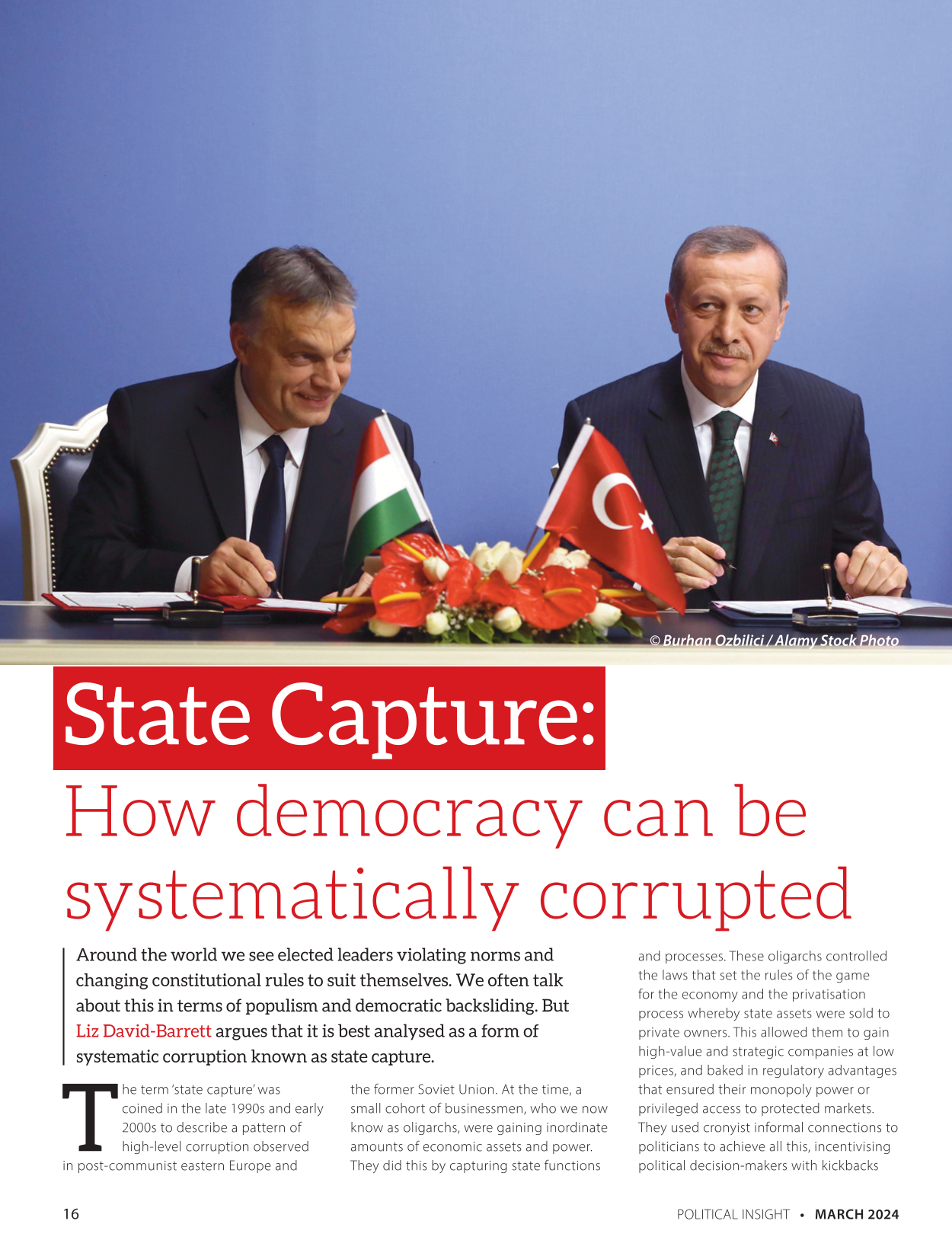
© Burhan Ozbilici / Alamy Stock Photo

Around the world we see elected leaders violating norms and changing constitutional rules to suit themselves. We often talk about this in terms of populism and democratic backsliding. But
The term ‘state capture’ was coined in the late 1990s and early 2000s to describe a pattern of high-level corruption observed in post-communist eastern Europe and the former Soviet Union. At the time, a small cohort of businessmen, who we now know as oligarchs, were gaining inordinate amounts of economic assets and power. They did this by capturing state functions and processes. These oligarchs controlled the laws that set the rules of the game for the economy and the privatisation process whereby state assets were sold to private owners. This allowed them to gain high-value and strategic companies at low prices, and baked in regulatory advantages that ensured their monopoly power or privileged access to protected markets. They used cronyist informal connections to politicians to achieve all this, incentivising political decision-makers with kickbacks or promising future political support or campaign finance.
…state capture has morphed into a new variant, whereby political leaders, often democratically elected in the first instance, abuse their legitimate access to formal power to administer processes or distribute resources in ways that expand their control over core state functions for their own private gain.
Understanding state capture
Hellman and Kaufmann (2000) pointed out a crucial way in which this ‘state capture’ was different from administrative or petty corruption. Administrative corruption, the kind that ordinary people came across in everyday life where public officials asked for bribes before granting access to services or to get around red tape, involved improperly influencing the way that public policy was implemented. But state capture involved improper influence much earlier in the policymaking cycle, by shaping the formation of public policy. This was and remains a much more efficient way of corrupting the system, because it skews the rules of the game in ways that privilege the captor group and bake in their advantage.
The pattern was seen elsewhere in post-communist Europe and Central Asia and was expected to die out as democratisation progressed. But instead, state capture has morphed into a new variant, whereby political leaders, often democratically elected in the first instance, abuse their legitimate access to formal power to administer processes or distribute resources in ways that expand their control over core state functions for their own private gain. Think Viktor Orban in Hungary, Recep Tayyip Erdogan in Turkey, Jair Bolsonaro in Brazil, Narendra Modi in India, Boris Johnson in the United Kingdom, Donald Trump in the United States. They often operate within the letter of the law or constitution, but their actions breach norms about good governance and undermine democratic checks on their power, making it much harder to hold them to account. Seen as individual acts, each step may be legal and defensible, but in aggregate they constitute state capture – a consolidation of control over multiple arms of the state, which violates norms, undermines the purpose of institutions, and serves narrow private interests at the expense of the public interest.
This politics-led form of capture has been given different names by different scholars, including ‘elite state capture’ or ‘incumbent capture’ (Grzymala-Busse, 2008), ‘party state capture’ (Innes, 2014), and ‘executive takeovers’ (Svolik, 2019). Many analyse it in terms of ‘democratic backsliding’, a term which raises the alarm about how it shifts countries towards autocracy and authoritarianism. But using the language of corruption allows us to focus on the private gains that not only accrue to the captors but also motivate their behaviour in the first place. These gains can include consolidating their hold on power such that it is difficult to remove them from office, securing impunity in the face of criminal charges, and personally enriching themselves and their networks. State capture is worth calling out because it changes the power balance in countries into the long-term, creating national security vulnerabilities and exacerbating inequality, as well as undermining democracy.
Political capture
Today’s political perpetrators of state capture are even more ambitious than the original oligarchs. They do not just influence the formation of policy but also seek to control its implementation by using patronage powers to appoint allies to key decision-making roles that allocate budgets or give out contracts, making it easier to siphon off funds. And they take many steps to ensure that their increasing hold on power is not challenged, by disabling or undermining checks and balances. This can be achieved through wielding powers of patronage over regulators and making it difficult for institutions with an accountability mandate to operate, closing down civic space and abusing state power to retaliate against critics. These modern forms of politics-led state capture involve three pillars: (1) the original one, highlighted by Hellman and Kaufmann in 2000, of influencing the formation of policy (2) a second pillar, which involves controlling the implementation of policy from the top, and (3) a third pillar of capture, disabling the institutions that have powers and responsibilities to hold the executive to account.
Hungary’s descent under Prime Minister Viktor Orban since 2010 is an archetypal case of political capture. His party, Fidesz, won the 2010 elections with a two-thirds majority. His allies argue that this gave him a democratic mandate to undertake constitutional reform, but the scale of the changes on which his government embarked, centralising and consolidating the government’s power and weakening checks on his power, violated a host of democratic norms.
Looking at the first pillar of state capture, changing the rules of the game, Orban moved immediately to restrict the jurisdiction of the constitutional court. He pushed through changes to numerous laws without proper parliamentary scrutiny and appointed an ally as Chief Prosecutor. In the second pillar, implementation, he used patronage powers to appoint allies to key bureaucratic roles, gaining political influence over the allocation of an extensive share of public procurement contracts. Finally, to disable the accountability institutions that make up the third pillar, he changed the way judges were appointed and replaced incumbent officeholders with allies. He restructured the media regulator and appointed another ally to head it, and shifted state advertising contracts away from outlets critical of the government. He then clamped down on civic space, making it near-impossible for watchdog civil society organisations to operate. Orban’s new Sovereignty Protection Office is empowered to investigate financial records and demand documents and data from any organisation or body operating in Hungary, including civil society groups, media organisations, and political parties. With a special focus on election periods, the office can impose harsh penalties on organisations allegedly subject to foreign interference.
Orban talks about this as an ideological project, proudly claiming himself to be an ‘illiberal democrat’ and busily making friends with authoritarian leaders around the world. Domestically, he uses nationalist and populist rhetoric to create a narrative about how he is protecting Hungarians from various hostile outsiders although the main enemy moves with the times – sometimes migrants, the European Union, George Soros, LGBTQ+ communities, or media and civil society groups seeking to impose ‘unnatural’ liberal values on the Hungarian people. He keeps winning elections, but with virtually no free media left and electoral reforms providing advantages for the incumbents, the fragmented opposition has failed to put up a real challenge.
Zuma’s South Africa
South Africa under President Jacob Zuma (2009-18) is another case. Zuma extensively used and traded his patronage power, allowing business partners the Gupta brothers to shape his Cabinet as well as appointments to key state agencies. In this way they were able to influence policy decisions to benefit their companies and gain privileged access to state contracts. Zuma focused major efforts on weakening potential checks on the corrupt activity which he was orchestrating and facilitating. He crippled the South Africa Revenue Service (SARS), previously known as a rather efficient and effective tax collection body, through a systematic effort to reduce its powers and strip its capacity. He abolished the Scorpions, a highly esteemed law enforcement unit, and replaced them with a weaker substitute. And at electricity provider, Eskom, contracts were consistently awarded to well-connected companies that provided substandard coal at inflated prices. Over the years, corruption at Eskom eroded the electricity generation capacity to such an extent that blackouts of several hours are now daily events in South Africa.
To further disable accountability institutions, the Guptas launched a television channel and newspaper that served as propaganda outlets for the Zuma regime. They also hired UK public relations firm Bell Pottinger to launder their reputation. And Zuma used the language of Black Empowerment as a cover for corruption, claiming that his political appointments and interference in the allocation of contracts was driven by considerations of redressing past injustice. But ultimately, a strong independent judiciary and a thriving media and civil society helped to expose state capture in South Africa and led to Zuma’s fall.
State capture is also going transnational, where one government seeks to capture the state of another country. When Russian and Chinese state-owned enterprises or sovereign wealth funds invest in other countries with ‘corrosive capital’ – deals that lack transparency, accountability and market orientation – they secure control of parts of other people’s states, including critical infrastructure. This can give one country huge power over the recipient economy, able to turn off supplies and halt economic activity. Such investors often compete unfairly or run down local production capacity by under-investing or stripping assets. Hostile governments also use corrupt practices to interfere with political competition, through disinformation campaigns, interference in elections or buying support from influential individuals.
State capture in Britain?
Mature democracies are not immune from all this. Trump’s efforts to derail democracy are well known. Indeed, he has said that he will be a dictator only on ‘day one’ if elected again in November. Under Boris Johnson’s leadership, the UK also showed signs of state capture, particularly in his aversion to being scrutinised or held to account. His decision to prorogue Parliament in 2019, later declared unlawful by the Supreme Court, sought to curb Parliament’s role in scrutinising Brexit policy. This was particularly blatant, but more broadly we have seen government reduce Parliament’s opportunities for scrutiny through excessive use of skeleton bills and delegated legislation. His government also undermined a number of regulatory bodies, including the Electoral Commission, which polices campaign finance, and the ethics watchdogs that monitor the conflicts of interest of ministers and MPs. Johnson blatantly disregarded the decisions of bodies supposed to regulate conduct in public office. He ignored the independent adviser on ministerial interests when it found that Priti Patel had breached the Ministerial Code, disregarded the House of Lords Appointments Commission when it recommended against conferring a peerage on Tory donor Peter Cruddas, and when Owen Paterson, one of his own MPs, was to be disciplined by Parliament for engaging in paid advocacy, his government blocked the process and sought to overturn the whole system for regulating parliamentary misconduct. Johnson himself repeatedly failed to declare hospitality, gifts, and interests, breaching the Code of Conduct for MPs in nine different ways in 2018 alone.
Trump’s efforts to derail democracy are well known. Indeed, he has said that he will be a dictator only on ‘day one’ if elected again in November. Under Boris Johnson’s leadership, the UK also showed signs of state capture, particularly in his aversion to being scrutinised or held to account.
Was any of this systematically aimed at achieving private or partisan gain? Certainly, the setting up of a ‘VIP lane’ for Covid contracts was an extraordinary deviation from good practice. It allowed ministers to recommend their friends for admission into an exclusive channel where, the National Audit Office later found, companies were ten times more likely to win contracts. In the Greensill affair, David Cameron, a former Prime Minister, sought to use his insider status to lobby for a company that was paying him a hefty fee. Far from this discrediting him, he has since been appointed as Foreign Secretary under Prime Minister Rishi Sunak. We see repeatedly that party donations buy honours and peerages, and that London continues to welcome dirty money from abroad.
© 2020 Images / Alamy Stock Photo

It is not easy to roll back state capture once it has happened. Once institutions have been stuffed with stooges or stripped of their capacity to act professionally, reversing that is difficult without succumbing to the temptation to install loyal allies. Donald Tusk in Poland is grappling with this problem, as Cyril Ramaphosa has in South Africa and as Keir Starmer should be as he plans for potentially taking office in the United Kingdom. Building back after state capture must involve building more plural institutions that distribute power more broadly and allow for the executive to be challenged. In a world of political polarisation and populism, that is a tall order indeed.
Footnotes
Liz David-Barrett is Professor of Governance and Integrity and Director of the Centre for the Study of Corruption at the University of Sussex.