



Abstract
© Jim West / Alamy Stock Photo
Introduction
In recent years, debates about reforms of the voting age – from 18 to 16 years of age – have been gearing up in many democracies around the world. Campaigns for a lowering of the voting age have emerged in more than 25 countries, with proposals in Ireland, Canada, and Australia gaining substantial traction. Most recently, Germany and Belgium pledged to enfranchise 16- and 17-year-olds for European elections and in New Zealand a bill to include young people in local elections is currently passing through the parliamentary stages.
The voting age for Scottish elections was lowered in 2015, with Wales following suit five years later. But there has been little movement on demands for 16- and 17-year-olds to be allowed to vote in UK elections. Westminster has not always been so slow to change. Britain was the first country to lower the voting age from 21 to 18 in 1969, leading a wave of reforms of the voting age in democracies around the world.
Debates about a further lowering of the voting age for UK elections have so far often focused on normative questions: what it means to be a voter and when young people achieve important milestones of adulthood. While debates on these questions are difficult to settle, much can be learnt about how voting age reforms affect young people’s political engagement and relationship with democracy from countries that have already lowered the minimum voting age.
Evidence from countries with lower voting ages
An increasing number of countries have reformed the voting age. To date, 16- and 17-year-olds are allowed to vote in all elections in seven countries – Austria, Argentina, Brazil, Cuba, Ecuador, Malta and Nicaragua. Furthermore, in nine countries under 18s are allowed to vote in some, but not all elections – for example in municipal elections in Estonia and Israel, or certain cities or regions of Germany, Switzerland and the United States. These democratic experiences from around the world provide important empirical evidence to assess outcomes of voting at age 16.
Voting age reform and the role of the left
In most cases of voting age reform, centre-left and left-leaning political parties or governments played a pivotal role in reducing the minimum voting age. In Latin America, left and centre-left actors advocated for the inclusion of voting rights for under-18-year-olds as part of new or overhauled constitutions. Also in Austria, Germany and Wales, social democratic parties were among the first to propose a lowering of the voting age to 16. Several countries have seen bottom-up campaigns by youth movements and other social groups to mobilise demand for young people’s political inclusion and political participation, such as in Brazil and New Zealand. In these countries, too, it was left and centre-left parties which ultimately incorporated and advanced these demands.
Interestingly, evidence shows that these political parties did not always benefit electorally from voting age reform. While today young people tend to vote more often for progressive, green and left-leaning political parties, this is not a foregone conclusion of left-led voting age reforms. After the reforms of the franchise in Brazil and Ecuador, young voters, on average, placed themselves further to the right than older generations on the left-right scale. In Austria, too, many young voters supported centre-right and right-wing parties in the most recent federal election, in 2019, and young Austrians appear to be more polarised than older voters. In Argentina, in the 2023 presidential elections, young voters overwhelmingly supported far-right candidate and elected President, Javier Milei.
Instead of an attempt at political gains, the lowering of the voting age to 16 is often associated with the commitments left and centre-left political parties make to expand democracy and enfranchise under-represented groups, including young people, women and minorities. In Latin American countries, the lowering of the voting age was part of broader constitutional reforms and democratisation efforts. Similarly, in Wales and Germany, efforts to lower the voting age to 16 were part and parcel of electoral reform agendas that also included changes in the number of seats in parliament, and, in the case of Wales, the enfranchisement of foreign nationals.
Increasing the participation of young voters
Most campaigns to lower the voting age argue that they want to increase the democratic engagement and inclusion of young people. This is, in part, a response to the perceived impact of previous measures that lowered the voting age: in 2004, political scientist Mark Franklin argued that the lowering of the voting age to 18 in the 1960s and 70s contributed to the decline in voter turnout that has been observed in established democracies since. Granting voting rights to young people in a highly transitory phase of their lives – where many leave secondary education, move out of the parental home, go to university, or take on their first job – according to Franklin, contributed to lower turnout among younger compared to older cohorts of voters.
The lowering of the voting age to 16, then, offers the opportunity to revise those unintended effects on turnout. Younger people who are in full-time education and often still live at home, would make for better, more engaged first-time voters, Franklin argues. Research indeed consistently shows that, when allowed to vote, 16- and 17-year-olds turn out at higher rates than young people who were enfranchised at age 18 or older.
Mixed evidence on long-term democratic outcomes and political inequalities
To date it is unclear, however, how long-lasting and pervasive the effect of the lowering of the voting age to 16 really is. Evidence on the extent to which voting at an earlier age can start a lifelong pattern of political engagement is mixed so far. In Latin America and Austria, turnout and attitudes to democracy among young people who were first allowed to vote at age 16 have been positively and lastingly affected. In Scotland, seven years after the first lowering of the voting age, turnout levels of those with the right to vote at age 16 and 17 remained higher than among those enfranchised at age 18, but young people’s engagement with political issues outside of elections has returned to pre-reform levels.
Scholars have also raised concerns about inequalities within cohorts of new and younger voters. Because at age 16 or 17 most young people still live in the parental home, their electoral participation is largely impacted by the political interest and voting habits of parents and other family members. Evidence from Wales illustrates how parents affect many aspects of the journeys to political participation of 16- and 17-year-olds, from helping them register to vote to encouraging and accompanying them to the polling station.
Even though schools – another environment 16- and 17-year-olds spend a lot of time in – can play a role in compensating for the lack of parental guidance, there is so much variation in the provision of civic education across schools that these further inequalities. Educational tracks, for example, have been found to mediate the impact schools have on young people’s political interest and electoral turnout in Germany and England, with young people following academic tracks much more likely to turn out to vote than young people in vocational education. Additionally, in the UK, the kind of political education young people receive even in the same type of school remains a postcode lottery.
What matters is the how – not the if
With more democracies around the world lowering the voting age to 16, we are starting to understand that the ways and circumstances in which voting age reform is delivered matter in respect of what such reforms can deliver. Reforms that have shown the most pervasive and long-lasting changes in political attitudes and democratic behaviour all lowered the voting age nationwide and for all elections, for example in Austria, Brazil, Argentina, and Ecuador.
Research in countries that have seen the implementation of voting rights for 16- and 17-year-olds in some, but not all elections (such as in Germany, Scotland or Wales) or where young people were only allowed to vote in trials (e.g. in Norway and Belgium) finds mixed evidence about the democratic benefits. In such cases of partial reform, young people who are allowed to vote tend to be acutely aware of their partial or temporary enfranchisement – the fact that they are allowed to vote in some, but not all elections – and the imbalance this brings.
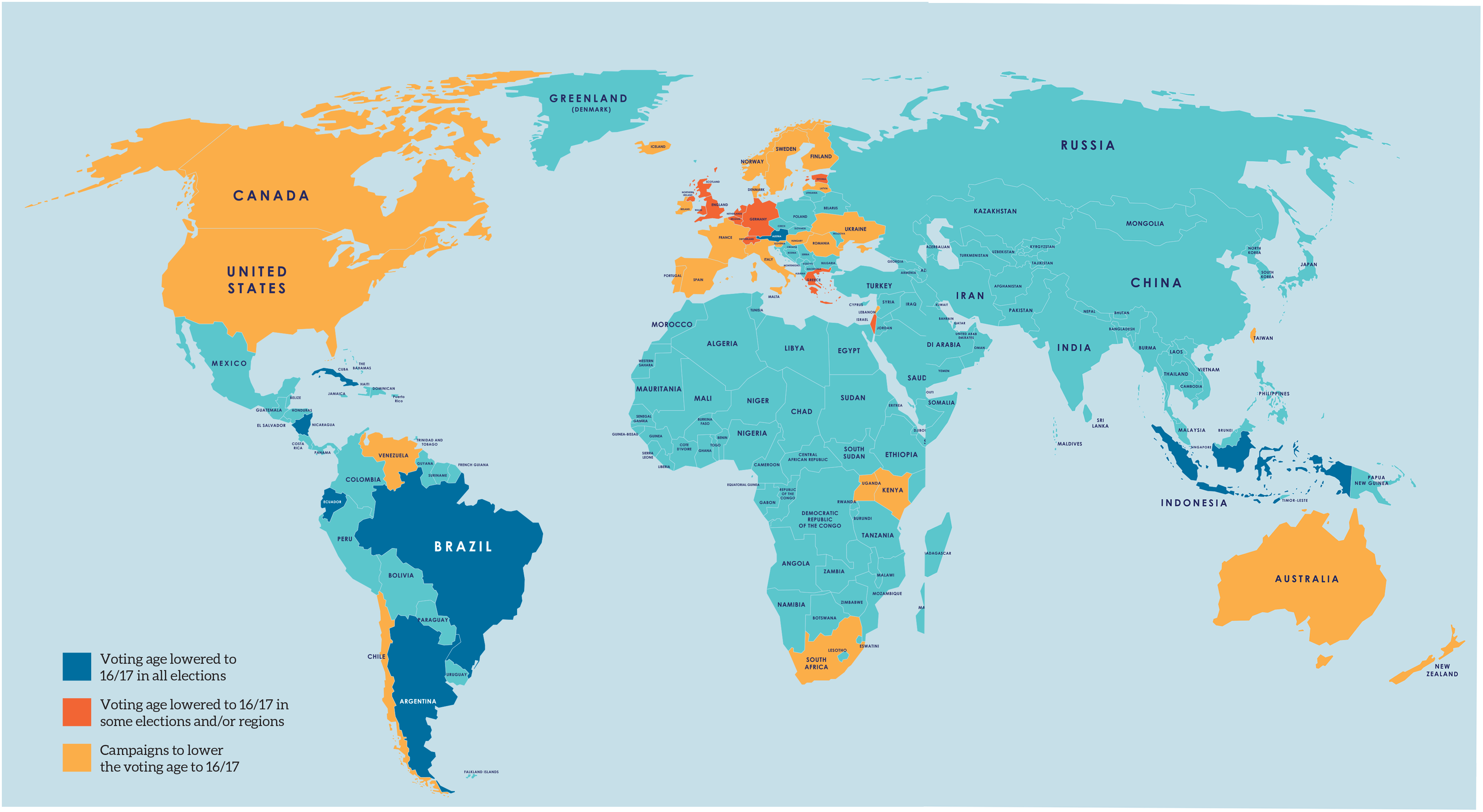
Countries that have lowered the minimum voting age to 16 for most elections (blue), some elections or in some regions (red), or that have active campaigns (yellow)
Furthermore, the specifics of how young people are included in the electorate and what they must do to be able to vote matter. A range of countries that have lowered the voting age to 16 – Argentina, Brazil, Belgium, and Ecuador – also have compulsory voting, though none of them so far choose to enforce voting as a legal duty until young people turn 18. Germany enrols first-time voters automatically based on population records, while in Belgium, 16- and 17-year-olds must specifically request the right to vote for the 2024 European Parliament elections. Similarly in Scotland and Wales, young first-timers must register to vote.
Votes at 16 has also caused administrative headaches in devolved parts of the UK. As data on under-18s is subject to child protection constraints, electoral administration officers have had to create workarounds to ensure 16- and 17-year-olds are on electoral rolls. These solutions are imperfect and add additional barriers to voting for young people. The first election that saw 16- and 17-year-olds voting in Wales revealed big differences in the rates of young people who were registered to vote compared to older voters. Learning from this experience, the Welsh government proposed to introduce automatic voter registration for future Welsh elections.
Lastly, but perhaps most importantly, reforms of the voting age that have delivered the most positive and equal outcomes for young people so far came with distinct and countrywide measures of civic education. In Austria, the lowering of the voting age to 16 was introduced alongside a broad reform of civic education. In Estonia, where civic education has a special role because of tensions between Russian-language and non-Russian schools, a binding guideline for political discussions in schools was developed. There is ample evidence of a link between measures of civic education and young people’s political participation and engagement, although existing research so far does not allow us to establish a clear causal relationship.
An opportunity for policy learning
Variations in voting age reforms offer valuable opportunities for empirical research and policy learning. With more countries around the world deciding to lower the voting age to 16, valuable lessons can be drawn from what matters for young citizens’ democratic engagement from comparing voting age reforms, the specifics of their implementation, and their outcomes in democracies around the world.
Evidence shows that what is important for young people’s longer-term political engagement is not just the reform of the minimum voting age as such, but how reforms are implemented and embedded in a range of measures that increase engagement with political issues and democracy. Considering the lack of representation of younger British voters on issues such as climate or housing policy, much can be learnt about ways to further include young people in decision-making from countries that have undergone minimum voting age reforms.
Footnotes
Constanza Sanhueza Petrarca is a Lecturer in Comparative Politics at the Australian National University. Christine Huebner is a Lecturer in Quantitative Social Sciences at the University of Sheffield. Together they lead the Comparative Project on Voting Age Reform (C-VAR).