



Abstract

© James Street / Alamy Stock Photo

The Liberal Democrats have suffered in UK general elections since the coalition years. Could the party be on course for a comeback this time around?
British politics has reset after the disruptions of Covid and the Russian invasion of Ukraine. The Conservatives who looked impervious after their landslide victory of the ‘Get Brexit Done’ election of 2019, seem to have squandered their dominance thanks to mismanagement of the pandemic and the post-pandemic economy, and an unparalleled taste for chaos and controversy. The only issue that seems to unite Tory MPs is the near certainty of impending electoral defeat.
Labour under Keir Starmer has benefited most from the anti-Conservative turn. The party has tried to look like the government-in-waiting without gaining significant approval from the public for being anything other than not the Tories. Meanwhile, the Scottish National Party lost leaders in Edinburgh and Westminster, the Greens fight the next election without their only MP, Caroline Lucas, and Plaid Cymru will continue to run interference on the plans of the main parties in Wales. The Eurosceptic mantle may have passed from the United Kingdom Independence Party to Reform but coverage of that party tends to focus on the residual political ambition of Nigel Farage and the impact that a splinter right party will have on the Conservatives.
Which brings us to the Liberal Democrats: a decade ago the party was still in government but about to suffer traumatic defeat at the hands of its erstwhile coalition partner. With British politics turned upside down in recent years, could the Liberal Democrats be poised for an electoral comeback? Have they finally laid to rest the ghost of entering a coalition with the Conservatives in 2010, and of the polarising pain of the Brexit referendum of 2016? After the false dawn of success in the 2019 local and European elections and a general election campaign in December that taunted the electorate with the prospect of Jo Swinson as Prime Minister revoking Britain’s withdrawal from the EU, is it possible that the Liberal Democrats will be rehabilitated? Could the 2024 election be the party’s redemption song?
Recent fortunes
Since becoming Liberal Democrat leader in 2020, Sir Ed Davey has overseen a modest, but significant, revival in party fortunes. Liberal Democrats have defeated Conservatives in by-elections in Chesham and Amersham and North Shropshire (both in 2021), Tiverton and Honiton (2022) and Somerton and Frome (2023). Each victory was accompanied by a memorable photo-stunt aimed at the Conservatives: Davey knocking down a blue brick wall; bursting a blue balloon; opening a blue door; and holding a cardboard match to a cut-out blue circus cannon emblazoned with the slogan ‘get these clowns out of No 10!.
Each photo-op led to speculation that the Liberal Democrats could be ‘back; especially if they concoct an anti-Conservative election pact with Labour. To launch the 2023 local election campaign Davey literally drove a tractor through a ‘blue wall’ of hay-bales. The Liberal Democrats now have over 400 new councillors and gained control of an extra 12 councils, winning nearly one-fifth of the English vote. Davey and his party closed 2023 in good spirits. However, a political storm was imminent and the Liberal Democrats were reminded that they couldn’t control the weather.
In the gap between Christmas and New Year, the ITV dramatisation of the Fujitsu-Horizon scandal, Mr. Bates vs the Post Office, became a surprise festive blockbuster. The scandal was long standing (stretching back to the turn of the century). Investigative journalism from Computer Weekly, Private Eye, Panorama, the Daily Mail, BBC Surrey and BBC Wales, failed to make the story resonate over the years but it took the ITV mini-series to trigger widespread outrage over the prosecution and conviction of 900 sub-postmasters for theft, fraud and false accounting, after a malfunctioning IT system blamed them for missing funds, and cut through into popular discourse.
The government line – that compensation procedures were complex and largely outside its control – was reversed before the Downing Street Christmas tree was taken down. By 17 January, Prime Minister Sunak told the Commons that those wrongly convicted would be ‘swiftly exonerated and compensated’ and emergency legislation would rectify historical miscarriages of justice.
While it was hard to pinpoint a political figure to blame for the scandal, the spotlight found the Postal Affairs Minister from 2010-12 – Ed Davey. Despite not being depicted in the TV drama, and being succeeded in office by three fellow Liberal Democrats (Norman Lamb, Jo Swinson – twice – and Jenny Willott), the mud stuck to him alone. Davey’s apparent willingness to back the Post Office over their employees became the hot issue. Several media commentators pointed out that as party leader Davey habitually ordered the resignation of leading figures caught up in public wrong-doings and now demanded he follow suit.
Davey responded by saying that he too had been lied to by the Post Office and was even defended by the real-life leader of the postmasters, Alan Bates, who said that Davey was far from the only politician ‘to have been given a really bum steer by their officials and by the Post Office. Nevertheless, the incident was a stark reminder that the Liberal Democrats’ record during the coalition years might still haunt them. Davey’s reaction to the attention was not nimble. He missed the first Prime Minister’s Questions of 2024 due to family childcare commitments but his absence was gleefully noted by several Conservative MPs. By 13 January The Guardian had reported that although Liberal Democrat fortunes were unaffected, Davey’s reputation suffered. His personal net approval ratings – the difference between those who felt he was doing well or badly as leader, fell from -4 per cent to -13 per cent. The fallout from Davey’s entanglement as collateral damage in the Horizon scandal was a reminder that agency plays an important role in political outcomes for the Liberal Democrats.
Post-coalition reality
After getting the coalition so wrong the party underperformed and was hampered by a series of avoidable errors under Tim Farron, Sir Vince Cable and Jo Swinson. Vince Cable’s interregnum as leader saw a party veering between existential crisis (the threat of being sidelined by a Labour breakaway party) and euphoric expectations as the party best placed to benefit from resistance to Brexit. Under Swinson in 2019 the party fell short after a dismal and hubristic presidential-style campaign (and massively underestimated the extent to which Swinson’s own record in the coalition would be used against her by opponents). The number of Liberal Democrat MPs actually fell and Swinson herself lost her own seat (again) to the SNP.
Consequently, Davey should recognise that as a third party in Britain’s system the Liberal Democrats do not control their own destiny and continue to be assessed via their relative position to others. Davey does have some room for manoeuvre however. An ineffective and discredited Conservative Party has enabled him to appeal to both one-nation Conservatives horrified at the capture of their party by the Eurosceptic right, and to transactional Tories who only voted Conservative because they trusted the party to deliver economically. Meanwhile, Labour’s super-caution can also benefit Davey in crucial constituency battles. A rehabilitated, but non-magnetic Labour is good for the Liberal Democrats – electors are less likely to avoid the Liberal Democrats for fear of causing a socialist victory than in 2019, but are also unlikely to be pulled directly to supporting Labour in seats where the Liberal Democrats might be the non-Conservative force. This seems a golden opportunity for the Liberal Democrats to pose as both a credible alternative to the Conservatives and a bulwark against a Labour landslide.
The electoral challenge
The new electoral boundaries for the next general election offer opportunities for the Liberal Democrats but structural challenges persist. In the key battles against the Conservatives, the Liberal Democrats are second in 85 seats. This includes Westmoreland and Lonsdale currently held by Farron, which under the new boundaries, has a Conservative 2019 notional majority of just under ten percentage points, and Chesham and Amersham which the party won in a by-election in June 2021. More than 80 per cent of these seats are located in the South East, London and the South West. As Jennings (2024) notes, individuals in these Conservative-Liberal Democrat battleground seats are more likely to have voted Remain in the EU referendum, have mortgages or own homes outright and possess university degrees, than those where the Conservatives are fighting Labour. In a nutshell this is the Conservatives’ defensive conundrum – having to appeal simultaneously to different electorates against a backdrop of public discontent. It is a major headache given that many of the south England commuter belt seats – from the home counties of Surrey, Hertfordshire, Buckinghamshire and even stretching to Oxfordshire and Cambridgeshire – are subject to socio-demographic churn which in the wake of Brexit seems to be turning against the Conservatives in favour of the Liberal Democrats (and Labour). With pundits and media commentators claiming these so-called ‘Blue Wall’ seats are under threat, it is exactly these openings that the resurgent Liberal Democrats are seeking to exploit.
Yet historically the Liberal Democrats have to be a credible electoral vehicle in the constituency contest to take full advantage. As Figure 1 shows, the Liberal Democrats are more than 20 percentage points behind in 62 of the 85 seats where they are placed second to the Conservatives. Only 12 of these seats are marginal (where the Liberal Democrats are fewer than ten points behind the Conservatives) of which six are ultra-marginal (the party is fewer than five percentage points behind). A further eleven seats can be classified as fairly safe (between 10-20 points behind the Conservative incumbent). The rest appear longshots, with the Conservatives having a notional buffer of 40 percentage points or more against the Liberal Democrats in one-fifth of these constituencies.
Despite the common Blue Wall narrative, closer inspection suggests that it is unlikely to propel the party to 2010 levels of representation. According to our classification of the 23 seats where the Liberal Democrats are notionally up to 20 points behind the Conservatives, only eight are Blue Wall of which three are either ultra-marginal or marginal (see both Figure 1 and Table 1). Put simply, the Liberal Democrats need to overturn large Conservative majorities to make significant headway in the Blue Wall. While this cannot be entirely discounted – there may be seats like Stratford-upon-Avon for instance where the standing of the Conservative incumbent could generate large scale tactical voting in favour the Liberal Democrats -many of these seats with similar changing demographics are long-term party projects. As such, progress for the Liberal Democrats in 2024 might be limited to winning in places where they have previously done well.
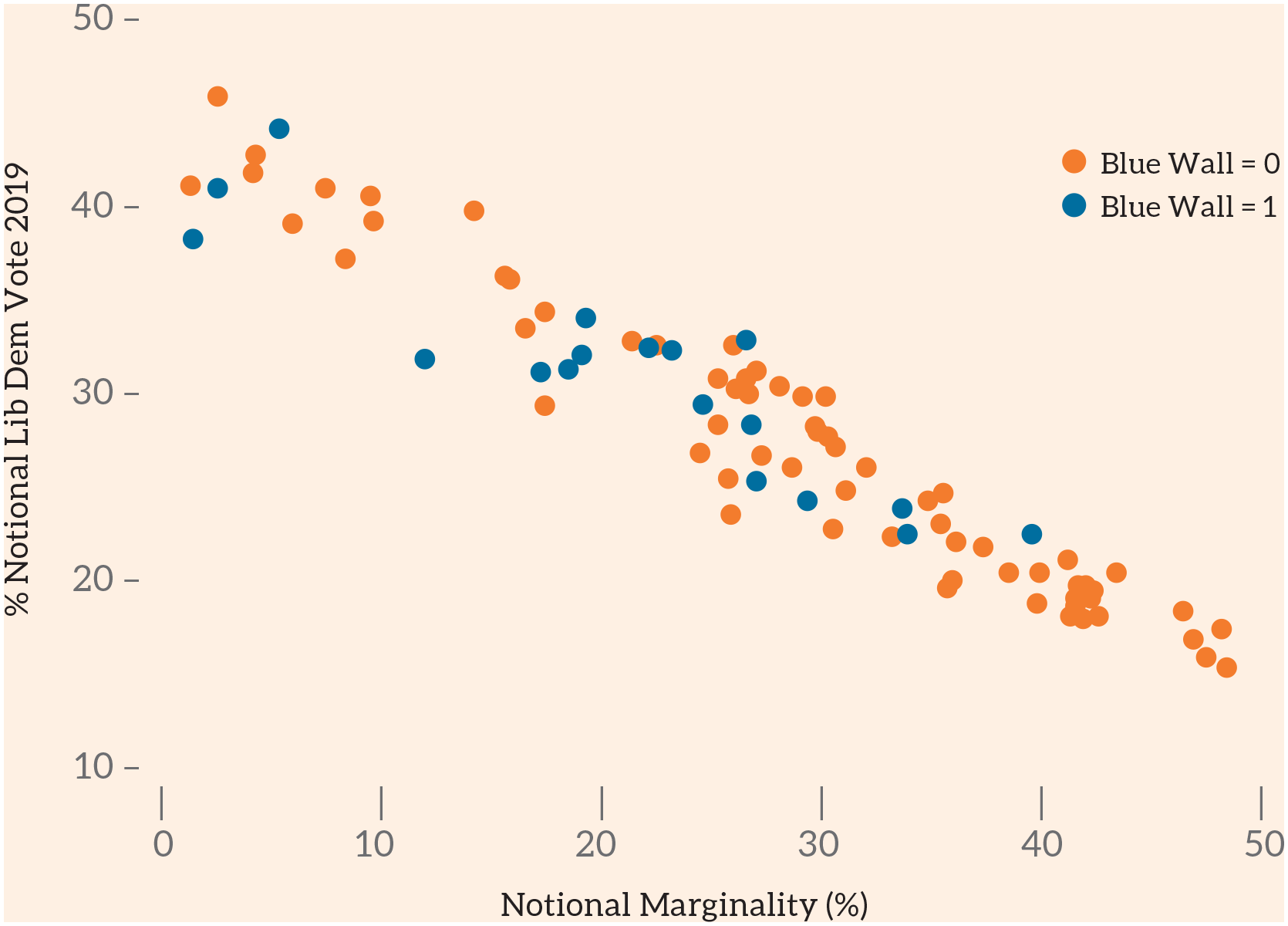
2019 Notional Liberal Democrat Vote by Notional Marginality: Conservative-Liberal Democrat Battlegrounds only
Classification of 2019 seats where Liberal Democrats are second by marginality to the Conservatives (notional 2019 ultra-marginal, marginal and fairly safe only; Blue Wall seats in
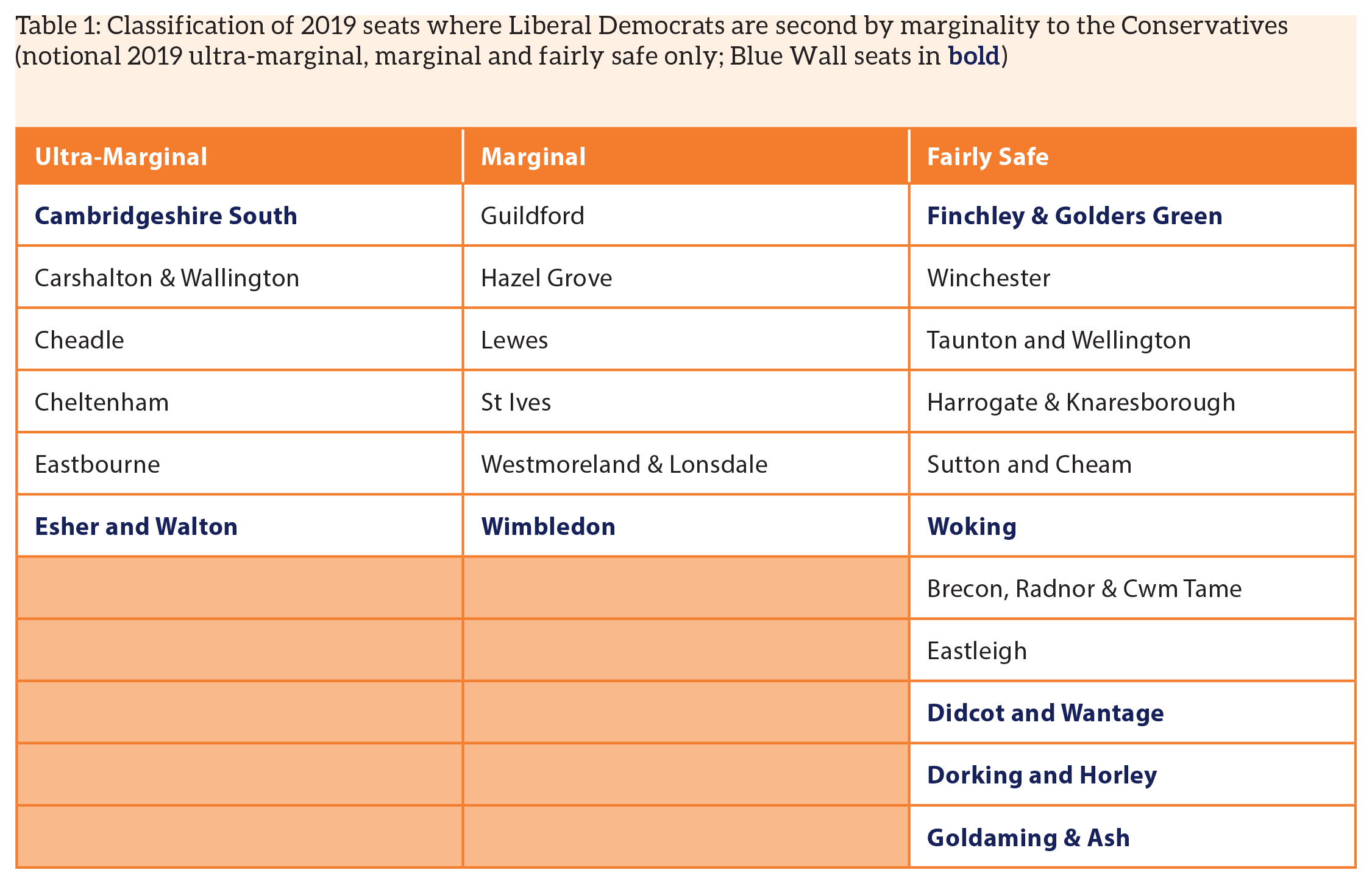
Nearly two-fifths of the 85 seats where the party is notionally second to the Conservatives have previously been held by the Liberal Democrats – including all the non-Blue Wall seats in Table 1 (where the party is 20 points or less behind the Conservative incumbent). Yet the party faces structural barriers even where it used to be strong. Since the 2015 Liberal Democrat collapse, the party has struggled to recover support in ‘traditional’ liberal, non-conformist areas – only Cheltenham of the 15 non-Blue Wall seats above can be considered a ‘traditional’ stronghold; while Eastbourne was won famously in the 1990 by-election (and again in the 2010 and 2017 General Elections) it fell to the Conservatives in every other contest. Regaining many of these seats seems unlikely in the short-term as they either have large Conservative (or SNP) majorities or the Liberal Democrats have struggled to remain in second place and therefore lack electoral credibility. The changing geography of the Liberal Democrat vote makes advance more likely in ‘breakthrough’ seats (those won in 1997) as these are the types of places where the party have steadily regained ground post-2015. This is borne out in Table 1 where ten of 15 non-Blue Wall seats are classified as ‘breakthrough’ seats. Yet even then, only four of these are notionally marginal while the remainder, save for Eastbourne in 2010, were first won under the leadership of Charles Kennedy (Cheadle, Guildford, Westmoreland & Lonsdale).
Prospects for renewal?
In summary, any post-2015 Liberal Democrat recovery has been uneven and sporadic; regaining support in some of the places of previous strength but remaining uncompetitive in others. Structural shortcomings – lack of electoral credibility and organisational weaknesses on the ground where the party is a distance from the Conservative incumbent – is likely to place a ceiling on just how many seats the party can realistically win against the Conservatives in 2024.
These then are likely to be the basic guidelines for Liberal Democrat success or failure in 2024. The party’s parameters are not set by them but by their relationship with other parties. If the Conservative Party are discredited and the Labour Party’s appeal sufficiently transactional rather than positive, the Liberal Democrats could gain more ground than might otherwise be expected. Nevertheless, rapid and extreme changes in the electoral weather system are possible. Even when the Liberal Democrats can reasonably hope that many Labour supporters will have forgiven them for their coalition record, or that those in former Brexit heartlands might return to traditional patterns of liberal voting in large numbers – redemption may depend on factors outside their control.
For the Liberal Democrats, 2024 presents an opportunity for renewal by rethinking their long-term political strategy and identity, and embracing a socially liberal agenda which breaks from the recent past. Expressing a clear direction of travel and generating distinctiveness in core policy areas could allow them to connect with the voters needed to make them a political force again. The 2019 election proved that even when the Liberal Democrats recovered relevance they still found it hard to be popular. How the party defines and positions itself in 2024 could dictate its viability and long-term future.
Footnotes
David Cutts is Professor of Political Science at the University of Birmingham. Andrew Russell is Professor of Politics at the University of Liverpool. Josh Townsley is a Visiting Fellow at LSE Data Science Institute. They are the authors of The Liberal Democrats: From Hope to Despair to Where?