




Abstract
Self-face representation refers to an internal image of one's own face that does not necessarily match its physical properties. A previous study showed that remembered facial features located centrally or on the right side, such as the nose and right eye, tend to shift rightward. However, this rightward bias may result from using the right index finger to report locations. The present study examined whether the bias would occur when participants used the left index finger, following Mora et al.'s procedure in which participants, with their eyes closed, pointed to locations on a transparent acrylic board as if the designated facial features were projected in parallel in front of the board. Twenty-eight participants pointed to designated facial features using either their right or left index finger. The reported locations were recorded digitally and compared with the actual feature locations. When using the right finger, a rightward bias appeared for all central and right-side facial features. When using the left finger, all left-side facial features shifted leftward, indicating a leftward bias. Importantly, the rightward bias remained for all right-side facial features. These results suggest that the bias reflects both a general tendency toward rightward shifting and an artifact related to the side of the reporting finger.
Keywords
How to Cite Article
Chikamura, K., Yoshida, W., Tsurumi, S., & Kawahara, J. (2026). Rightward shift of self-face representation. i-Perception, 17(2), 1-15. https://doi.org/10.1177/20416695261444892
Introduction
Perceptions of self do not necessarily correspond to objective reality. Individuals often interpret their own behavior in a self-favorable way (Kruger & Dunning, 1999; Shepperd et al., 2008; Zell et al., 2020). Such misperception extends beyond behavioral domains and includes evaluations of physical appearance. For example, people tend to regard their own appearance more positively than objective assessments might warrant (Epley & Whitchurch, 2008). When renewing a driver's license, individuals may perceive their facial image in the identification photograph to be awkward or unflattering. Similar discomfort may occur upon viewing candid snapshots from a recent social gathering. These examples suggest that the actual appearance of the face, as recorded in everyday photographs, often diverges from the self-face representations stored in long-term memory. This self-face representation can be conceptualized as a modified internal image of one's face that departs from its objective physical properties.
Such deviation has been examined using various techniques (e.g., perceptual adaptation, Suchow et al., 2024; composite faces, Lee et al., 2022a; eye fixation, Lee et al., 2022b; Malaspina et al., 2018; visual search, Ishibashi et al., 2007) to demonstrate the properties of self-face representation. For example, studies using chimeric faces illustrated an inconsistency between self-face representation and reality (e.g., Brady et al., 2005). Specifically, participants identified a chimeric face created from the left half of a photograph of their own face as more representative of their remembered self than their full, unaltered face. This discrepancy has been investigated extensively with regard to left–right bias (e.g., Brady et al., 2004, 2005; Zhou et al., 2014) and this bias has been shown to occur.
Another dimension of inconsistency concerns size distortion of facial features. For example, individuals tend to perceive their own face as wider and shorter than its actual proportions (D'Amour & Harris, 2017; Fuentes et al., 2013). These size distortions have been measured using several procedures. In one method, participants were asked to judge which of two sequentially presented images, an edited version of their own face or the unedited original, more closely matched their perception of their own face (D'Amour & Harris, 2017). In another method, participants were asked to the locations of designated their facial features on a computer screen (Fuentes et al., 2013). Regarding individual features (Felisberti & Musholt, 2014), the nose is typically remembered as smaller, while the eyes appear enlarged when self-representations are compared with partially edited probe images. In this paradigm, participants chose which of two simultaneously presented images that edited or unedited version of their face more closely matched or more favorable their perception of their own face (Felisberti & Musholt, 2014). Notably, this distortion correlates negatively with self-esteem: individuals with low self-esteem demonstrate greater memory distortion than those with high self-esteem.
The procedure that contrasted participants’ own faces with partially edited images of differing sizes highlighted the inconsistencies between memory and reality (Felisberti & Musholt, 2014). However, the observed interaction between self-esteem and memory distortion suggests that self-face representation, as measured by this method, may be influenced by various factors, including social norms and expectations. To address this concern, a more egocentric approach that directly measures facial memory representation, independent of external probes, would be preferable.
Researchers (Longo & Haggard, 2010; Mora et al., 2018) developed such a paradigm to fulfill this purpose (see Figure 1). Specifically, participants were instructed to indicate the locations of eleven facial features using their index finger on a transparent acrylic board positioned vertically in front of them, with their eyes closed. The results revealed two major findings. First, the self-face representation was horizontally elongated similar to the known horizontal expansion in tactile distance judgment for multiple body parts, such as the hands (Longo, 2017, 2022; Longo & Golubova, 2017; Longo & Holmes, 2020; Longo & Morcom, 2016; Stone et al., 2018) although the mechanisms underlying this similarity of horizontal expansion in body image and tactile sensation are unclear. Second and more relevant to the present study, the indicated positions for the right side (e.g., right eye) and central facial features (e.g., nose tip) were shifted rightward, suggesting a directional distortion in self-face representation. Longo and Holmes (2020) also found a similar rightward bias.

Materials and equipment for measuring self-face representation. The figure illustrates that participants used their right index finger.
However, this rightward bias may have been attributable to the use of the right index finger to indicate location. That is, using the left index finger might produce a leftward bias in self-face representation. Because Mora et al. (2018) used only the right hand for this task, it remains unclear whether the direction of distortion (rightward or leftward) in self-face representation depends on the side of the reporting hand.
In the present study, we examined whether the rightward bias occurred when participants reported facial features using their left index finger. We replicated the procedure used by Mora et al. (2018), with the modification of having participants use either their right or left index fingers in separate experimental blocks. If the rightward bias is specific to the use of the right index finger, it should decrease or disappear in the left-finger condition. Alternatively, if the rightward bias merely reflects spatial mislocalization of self-face representation due to the side of the reporting finger, a mirror-reversed effect would occur. That is, leftward bias might occur when using the left index finger. Conversely if the bias reflects a general property of self-face representation, the rightward bias should manifest regardless of the reporting finger used.
Transparency and Openness
The present study was pre-planned and registered (https://aspredicted.org/gvb9-t4gp.pdf). The data that support the study findings are available at https://osf.io/e5npb.
Method
Participants
Twenty-nine right-handed participants (M = 19.71 years, SD = 2.35; 15 females, 14 males; age records available for 24 participants, as the ages of 5 participants were not recorded due to a technical error) participated in the experiment. They were undergraduate and graduate students at Hokkaido University; 14 participants were first assigned to the right finger condition followed by the left finger condition. The remaining 14 participants were assigned to the left finger condition first followed by the right finger condition. Data from one participant was excluded because a photograph was not obtained. With resulting participants of N = 28, we were able to detect significant differences of r = 0.5 with power 1-beta = 0.8 (alpha = 0.05, two-tailed). No participant reported motor disability in hand arm control on either side. All participants gave informed consent before the experiment and were remunerated afterward. This research project was approved by the research ethics committee of Center for Experimental Research in Social Sciences, Hokkaido University.
Materials
An acrylic board (70 cm high × 80 cm wide × 3 mm thick) was placed perpendicularly in front of the participant, as shown in Figure 1. A chin rest was positioned at the edge of the desk between the participant and the acrylic board. It was securely fixed to the desk, with the distance between the tip of the participant's nose and the acrylic board set at 1 cm.
Under the right finger condition, the distance between the right edge of the acrylic board and the chin rest was 17 cm, while under the left finger condition, the distance between the left edge of the acrylic board and the chin rest was also 17 cm. A Canon EOS KissX7 camera (recording pixels, 18 M, 5184 × 3456) was mounted on a tripod positioned 90 cm from the acrylic board. An L-shaped ruler was placed on the left side of the acrylic board from the participants’ perspective to aid conversion from pixels to centimeters for analysis.
Procedure
Before the experiment began, a round sticker (8 mm in diameter; KOKUYO Tack Title) was placed on the nails of each participant's right and left index fingers. Participants were instructed to point to 11 designated positions on a facial illustration as the experimenter read them aloud to ensure that they understood the designated positions correctly (Figure 2).

Locations of the 11 facial features.
Participants rested their chins on the chin rest and were prohibited from talking, moving their faces, or touching their own faces during the experiment.
In the first condition, participants imagined their faces as being projected in parallel in front of the acrylic board. In each trial, they were instructed to indicate the 11 designated features with the designated index finger. The order of the features was randomized by a computer, and participants reported them in the order specified by the experimenter. A trial consisting of 11 reports of different positions was repeated 6 times, resulting in a total of 66 pictures (11 positions × 6 trials). In the second condition, participants used the index finger of the hand that was not used in the first condition to indicate positions in the same manner for another six trials. Finally, to record the actual 11 positions on each participant's face, a stationary image was taken when the participant was not pointing. The entire experiment took about 30 minutes per participant to complete.
Results
Horizontal Mislocalization of Self-Face Representation
Figure 3 presents the shift distances along the X-axis, for the right- and left finger conditions, respectively. Positive values indicate a rightward shift, that is, the reported locations of right features, such as the inner and outer corner of right eye and right nasal ala, were shifted rightward relative to their actual locations. Negative values reflect a leftward shift. One-sample t-tests were used to assess whether the mean shift distance for each facial feature differed significantly from zero.
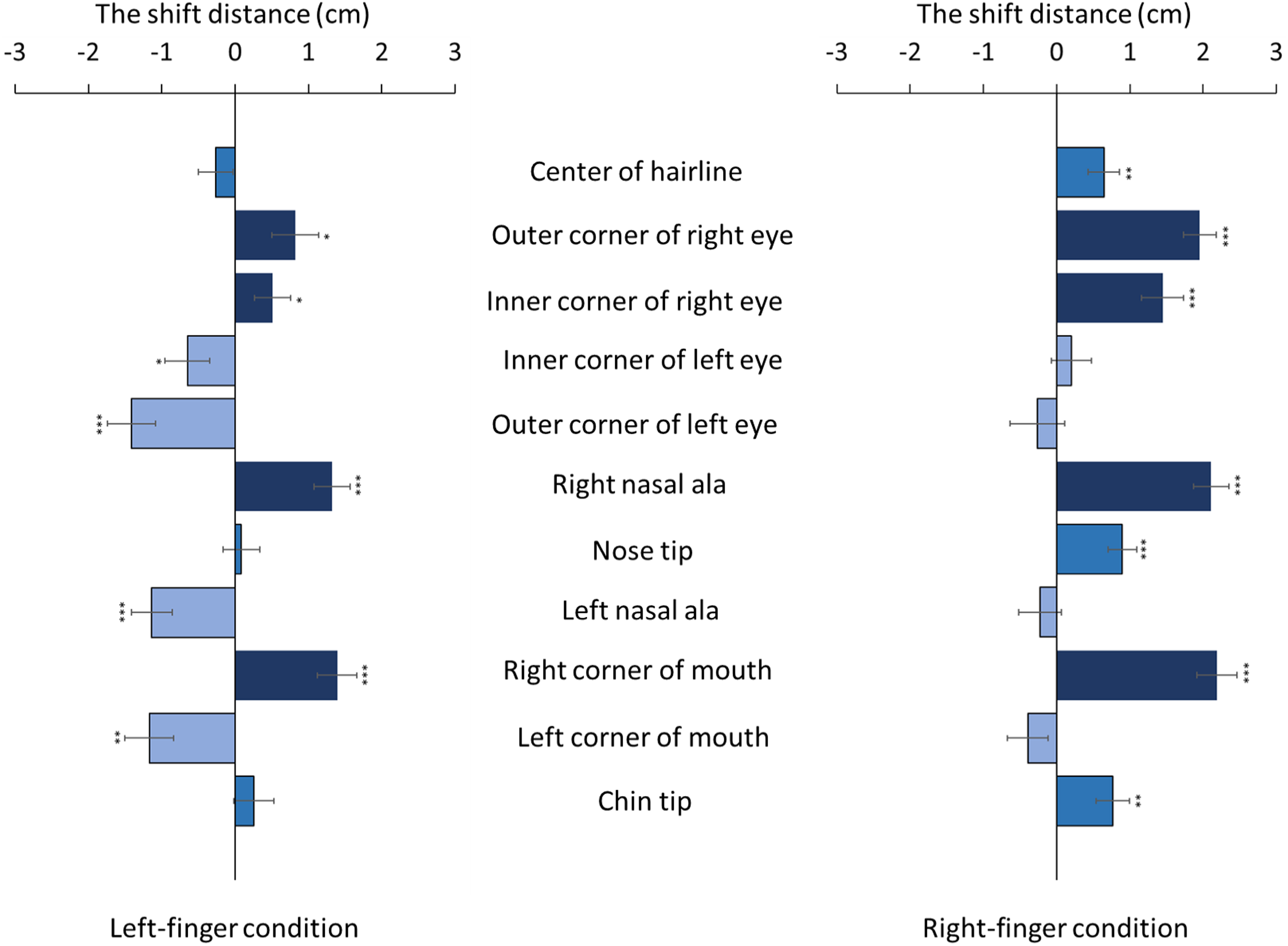
The shift distance (centimeters) along the X-axis in the right-finger condition(right figure) and in the left-finger condition(left figure). A positive value means rightward shift and a negative value means leftward shift. The error bars represent standard error. *p < .05, **p < .01, ***p < .001.
Under the right finger condition, the reported locations of the right facial features were significantly shifted rightward. Specifically, self-face representations of the outer and inner corners of the right eye, right nasal ala, and right side of the mouth shifted rightward (Outer corner of right eye: t(27) = 8.760, p < .001, r = .860; Inner
corner of right eye: t(27) = 5.049, p < .001, r = .697; Right nasal ala: t(27) = 8.685, p < .001, r = .858; and Right corner of mouth: t(27) = 8.016, p < .001, r = .839).
The reported locations of the central facial features also significantly shifted rightward. Specifically, self-face representations of the center of the hairline, nose tip, and chin tip shifted rightward (Center of hairline: t(27) = 3.026, p = .005, r = .503; Nose tip: t(27) = 4.534, p < .001, r = .657; Chin tip: t(27) = 3.337, p = .002, r = .540). In comparison, no such shift was found in the reported locations of the left facial features (Inner corner of left eye: t(27) = 0.733, p = .470, r = .140; Outer corner of left eye: t(27) = –0.706, p = .486, r = .135; Left nasal ala: t(27) = –0.787, p = .438, r = .150, Left corner of mouth: t(27) = –1.432, p = .164, r = .266).
Under the left finger condition, the reported locations of the right facial features significantly shifted rightward. Specifically, the self-face representations of the outer and inner corners of the right eye, right nasal ala, and the right corner of mouth shifted rightward (Outer corner of right eye: t(27) = 2.582, p = .016, r = .445; Inner corner of right eye: t(27) = 2.101, p = .045, r = .375; Right nasal ala: t(27) = 5.434, p < .001, r = .723; Right corner of mouth: t(27) = 5.177, p < .001, r = .706). In comparison, the reported locations of the left facial features were significantly shifted leftward (Inner corner of left eye: t(27) = –2.134, p = .042, r = .380; Outer corner of left eye: t(27) = –4.287, p < .001, r = .636; Left nasal ala: t(27) = –4.092, p < .001, r = .619; Left corner of mouth: t(27) = –3.515, p = .002, r = .560). Notably, no such shift was found for the reported locations of the central facial features (Center of hairline: t(27) = –1.111, p = .276, r = .209; Nose tip: t(27) = 0.334, p = .741, r = .064; Chin tip: t(27) = 0.929, p = .361, r = .176).
These results indicate a rightward bias in the self-face representation of right facial features, such that these features shifted rightward regardless of the side of the reporting finger. The present results are consistent with the results of Mora et al. (2018). Specifically, they found that self-face representation of all facial features except the left eye shifted rightward. In the present study, self-face representation of all right facial features significantly shifted rightward. Moreover, it is a novel finding that this pattern of the results was found in both the right- and left-finger conditions. In contrast, the direction of shifts in the self-face representation of central and left facial features depended on the side of reporting finger. Self-face representation of central facial features shifted rightward only when participants used their right finger, whereas self-face representation of left facial features shifted leftward only when they used their left finger.
To highlight the effect of the side of reporting finger, we compared the average shifts combining the reported X-axis values from the right-finger and left-finger condition to 0 as an additional analysis. Figure 4 presents the shift distances along the X-axis combining the right- and left-finger conditions. The reported locations of the all right facial features significantly shifted rightward (Outer corner of right eye: t(27) = 7.134, p < .001, r = .808; Inner corner of right eye: t(27) = 5.833, p < .001, r = .747; Right nasal ala: t(27) = 10.141, p < .001, r = .890; Right corner of mouth: t(27) = 9.458, p < .001, r = .876). The reported locations of the two central facial features except center of hairline significantly shifted rightward (Nose tip: t(27) = 3.149, p = .004, r = .518; Chin tip: t(27) = 2.969, p = .006, r = .496), whereas center of hairline was not significant (t(27) = 1.034, p = .311, r = .195). The reported locations of left facial features, except inner corner of left eye, significantly shifted leftward (Outer corner of left eye: t(27) = –2.856, p = .008, r = .482; Left nasal ala: t(27) = –3.365, p = .002, r = .544; Left corner of mouth: t(27) = –3.719, p < .001, r = .582), but inner corner of left eye was not significant (Inner corner of left eye: t(27) = –0.943, p = .354, r = .179).

The shift distance (centimeters) along the X-axis for the combined right-finger and left-finger conditions. A positive value means rightward shift and a negative value means leftward shift. The error bars represent standard error. **p < .01, ***p < .001.
The results indicated three major findings. First, the self-face representation of right facial features was mislocalized rightward (i.e., showed a rightward bias). Similarly, the self-face representation of central facial features was also mislocalized rightward, although the self-face representation of center of hairline did not show such bias. Second, the self-face representation of left facial features, except for inner corner of left eye, was mislocalized leftward. Finally, and most interestingly, the results were not mirror-reversed in terms that switching from the right to left finger did not produce a symmetric pattern in the results. Rather, the results show strong rightward bias. The magnitudes of the mislocalization of the self-face representation on the side of the reporting finger were greater when participants used their right finger than when they used the left finger. For example, the shifted magnitudes of the right nasal ala and right corner of mouth are greater than those of the left nasal ala and left corner of mouth. Moreover, the reported locations of the central facial features shifted rightward when participants used their right finger, whereas no such shift was found when they used their left finger. To support these visual inspections, we conducted an analysis of variance on the horizontal mislocalization (i.e., shift distance along X-axis), which confirmed this pattern. This analysis was part of the comparison of the magnitude of the vertical vs. horizontal mislocalization in the right- and left-finger conditions. See details in section “Comparing the Magnitude of Mislocalization in the Right and Left Finger Conditions for Horizontal and Vertical Directions.”
Vertical Mislocalization of Self-Face Representation
The aim of the present study is to examine horizontal mislocalization of the self-face representation using right and left fingers. Nonetheless, vertical mislocalization in self-face representation would also be worth examining in the present context. Figures 5 presents the vertical shift distances for the right- and left-finger conditions, respectively. Positive values indicate an upward shift, that is, the reported locations of facial features were shifted upward relative to their actual locations. Negative values reflect a downward shift. One-sample t-tests were used to assess whether the mean shift distance for each facial feature differed significantly from zero.

The shift distance (centimeters) along the Y-axis in the right-finger condition(right figure) and in the left-finger condition(left figure). A negative value means downward shift. The error bars represent standard error. *p < .05, **p < .01, ***p < .001.
Under the right-finger condition, the reported locations of all facial features significantly shifted downward (Center of hairline: t(27) = −10.725, p < .001, r = .900; Outer corner of right eye: t(27) = −5.229, p < .001, r = .709; Inner corner of right eye: t(27) = −5.717, p < .001, r = .740; Inner corner of left eye: t(27) = −5.979, p < .001, r = .755; Outer corner of left eye: t(27) = −7.687, p < .001, r = .828; Right nasal ala: t(27) = −5.654, p < .001, r = .736; Nose tip: t(27) = -3.528, p = .002, r = .562; Left nasal ala: t(27) = -5.433, p < .001, r = .723; Right corner of mouth: t(27) = -5.305, p < .001, r = .714; Left corner of mouth: t(27) = -5.900, p < .001, r = .750; Chin tip: t(27) = -2.107, p = .045, r = .376). Under the left-finger condition, the reported locations of all facial features also significantly shifted downward (Center of hairline: t(27) = -8.613, p < .001, r = .856; Outer corner of right eye: t(27) = -5.598, p < .001, r = .733; Inner corner of right eye: t(27) = -5.254, p < .001, r = .711; Inner corner of left eye: t(27) = -5.095, p < .001, r = .700; Outer corner of left eye: t(27) = -4.884, p < .001, r = .685; Right nasal ala: t(27) = -5.550, p < .001, r = .730; Nose tip: t(27) = -4.188, p < .001, r = .627; Left nasal ala: t(27) = -5.035, p < .001, r = .696; Right corner of mouth: t(27) = -6.701, p < .001, r = .790; Left corner of mouth: t(27) = -6.037, p < .001, r = .758; Chin tip: t(27) = -3.966, p < .001, r = .607).
The self-face representation of all facial features shifted downward when participants used their right finger for reporting. This result replicates the findings of a previous study (Mora et al., 2018) and extends them by showing that the downward mislocalization occurred regardless of the reporting fingers. Furthermore, the present results suggest that the vertical mislocalization of self-face representation was not modulated by the side of the reporting finger and instead reflects a general tendency toward a downward shift.
Comparing the Magnitude of Mislocalization in the Right and Left Finger Conditions for Horizontal and Vertical Directions
A two-way repeated-measures ANOVA was conducted to compare the magnitude of mislocalization in the reported locations of facial features between the right- and left-finger conditions across horizontal and vertical directions. The factors included were the side of reporting finger (2 levels, right finger and left finger) and facial feature (11 levels, e.g., Center of hairline, Outer corner of right eye) both as within-participant factors.
For the horizontal mislocalization, the two-way repeated measure ANOVA revealed a significant main effect of the side of reporting finger (F (1,27) = 6.686, p = .015,
For the vertical mislocalization, a similar two-way repeated measure ANOVA revealed a significant main effect of facial feature (F (2.858,77.154) = 15.862, p < .001,
Figures 6 and 7 present visualizations of the average shift distance (in centimeters) along the X- and Y-axes for the right- and left-finger conditions separately, as well as the combined shift distance along the X- and Y-across both conditions, respectively.

Visualization of the averaged shift distance (centimeters) along the X- and Y-axes in the right-finger condition (right figure), in the left-finger condition (left figure). The central figure illustrates the original position.

Visualization of the averaged shift distance (centimeters) along the X- and Y-axes, combining the right- and left-finger conditions. The left figure illustrates the original position, and the right figure illustrates the combined shift distance from both conditions.
Face Lengths
It is worthwhile to report the vertical mislocalization of self-face representation, although this analysis was not originally planned. To assess whether participants over- or underestimated the lengths of their self-face, three pairs of measurement were calculated: (a) overall face length (from center of hairline to chin tip), (b) top-half length (from center of hairline to nose tip), and (c) bottom-half length (from nose tip to chin tip). Each pair was expressed as a ratio of the represented size divided by the actual size. These ratio values were subtracted from 100 and submitted to one-sample t-tests, after Mora et al. (2018). Accordingly, negative values indicate underestimation, whereas positive values indicate overestimation.
The overall face length was significantly underestimated relative to the actual size for both right finger (t(27) = -5.397, p < .001, r = .720) and left finger (t(27) = -5.038, p < .001, r = .696) conditions. The top-half face length was also significantly underestimated relative to the actual size for both reporting finger conditions (right finger condition: t(27) = -7.334, p < .001, r = .816; left finger condition: t(27) = -5.056, p < .001, r = .697). However, no such underestimation occurred for the bottom-half face length (right finger condition: t(27) = 0.082, p = .935, r = .016; left finger condition: t(27) = -1.479, p = .151, r = .274). These results were generally consistent with those of a previous study (Mora et al., 2018). While the overall length size was not significantly underestimated in that study, both the overall and the top half face length were underestimated in the present study. These results suggest that the length (overall and top half) of self-face representation is not accurate and reflects a general tendency toward underestimation, regardless of the reporting fingers.
Face Widths
Although this analysis was not planned, we report it for completeness after Mora et al. (2018). To assess whether participants under- or overestimate the size of five facial features (Right eye ; from outer corner of right eye to inner corner of right eye, Left eye; from inner corner of left eye to outer corner of left eye, Between eyes; from inner corner of right eye to inner corner of left eye; Nose; from right nasal ala to left nasal ala, Mouth; from right corner of mouth to left corner of mouth), we calculated their widths in centimeters separately for each reporting finger condition. A two-way repeated measures ANOVA was conducted with two within-participant factors: condition (3 levels: actual size, self-face representation size reported by the right finger, and that reported by the left finger) and facial feature (5 levels: Right eye, Left eye, Between eyes, Nose and Mouth).
The ANOVA revealed significant main effects of condition (F (2,54) = 76.602, p < .001,
These patterns of results replicated previous findings obtained with nearly identical procedures (Longo & Holmes, 2020; Mora et al., 2018). Moreover, they were consistent with studies that used slightly different procedures (D'Amour & Harris, 2017; Fuentes et al., 2013). Taken together, these findings suggest that the self-face representation size reflects a general tendency toward overestimating face width and underestimating face length.
Discussion
The purpose of the present study examined whether self-face representation is influenced by the finger used to report the perceived location of facial features when participants blindly pointed to them. Specifically, we examined whether rightward bias occurred when using the left index finger, such that self-face representation would still be mislocalized rightward when participants reported facial features using the right index finger. The results were consistent with this prediction. When facial features were reported using the right index finger, the perceived locations of central and right-side features shifted rightward, replicating the findings of Mora et al. (2018). Notably, when features were reported using the left index finger, the perceived locations of left-side features shifted leftward. More importantly, the rightward bias persisted when participants reported using their left index finger, as the reported locations of right-side features still shifted rightward. No spatial bias was observed for the reported locations of central facial features.
The results for vertical mislocalization in self-face representation were also consistent with those reported by Mora et al. (2018). The downward bias, where facial features in the self-face representation were perceived as shifted downward, was observed for all facial features in both right- and left-hand conditions. These findings indicate that the side of reporting finger did not affect vertical self-face representation and that the downward shift reflects a general perceptual tendency.
Moreover, as additional analyses indicated, the results were not mirror-reversed with respect to the side of the indicating finger. Rather, the spatial shifts observed when using the right index finger were greater than those observed when using the left index finger. Combined, these results suggest that the rightward bias found in the present study, and possibly in Mora et al. (2018), reflects two critical components: a spatial shift due to the side of the reporting finger, and a general tendency toward rightward bias in self-face representation. This general tendency was evident as a consistent rightward shift for central facial features when using the right index finger, which likely reflects the additive effect of both the finger-dependent spatial shift and the general rightward bias. The absence of such a shift when using the left index finger suggests that the spatial shift due to the reporting finger was counteracted by the general rightward bias in self-face representation.
However, the present data cannot identify the mechanism(s) underlying the rightward bias in self-face representation, which could be related to the side of the dominant hand. This uncertainty arises because we recruited only right-handed participants, although it is a limitation of the present study that we identified the handedness by participants’ self-reports. Beyond this limitation, a speculative mechanism for the rightward bias could involve structural asymmetries of the cerebral cortex, such that left–right differences in somatosensory homuncular size may correspond to distortion in self-body representation (McCormack, 2014; Mora et al., 2018, 2021). However, Sha et al. (2021) recently reported asymmetries in cortical thickness (e.g., in the postcentral gyrus), with the left hemisphere tending to be thicker than the right regardless of handedness. This asymmetry in postcentral gyrus thickness was weaker in left-handed participants. Therefore, the rightward bias in self-face representation could be stronger in right-handed participants than in left-handed participants. Notably, the authors of a study of self-body representation reported results consistent with this speculation (Hach & Schütz-Bosbach, 2010). In their experiment, participants pointed at locations on a wall that concealed their body (except for the face) using a laser pointer to indicate the positions of hidden body parts, such as the right and left ends of the shoulders, waist, and hips. The results indicate that self-body representation was shifted rightward, and this rightward bias was greater in right-handed participants than in left-handed participants. To determine whether handedness is similarly related to the rightward bias in self-face representation, future research should include left-handed participants.
We can draw several implications from the present study. First, using both hands would provide a more precise estimation of one's self-body representation when employing a pointing procedure (Hach & Schütz-Bosbach, 2010; Longo & Holmes, 2020; Mora et al., 2018, 2021) as adopted in the present study. Averaging estimated self-body representations would mitigate or cancel out rightward bias by using the data obtained from right- and left-hand reports. Second, mixed-handed participants may show a reduced rightward bias in self-face representation. As noted above, the present study recruited only right-handed participants, and including left-handed participants is an important direction for future research. It would also be informative to measure self-face representation of mixed-handed participants, although identifying such participants can be challenging (Nicholls et al., 2013; see also Papadatou-Pastou et al., 2020). Short-term dexterity training of the left hand may also alter the right bias. Finally, the current procedure may be useful for examining the malleability of self-face representation. For example, introducing priming tasks to sensitize left facial features, such as moving the left eyebrows, winking with the left eye, immediately before the measurement may counteract the rightward mislocalization observed in the present study.
Conclusion
In conclusion, consistent with the findings of Mora et al. (2018), we observed a rightward bias in self-face representation for all central and right-side features when participants used their right index finger. Conversely, when using the left index finger, a leftward bias emerged for all left-side features. Notably, the rightward bias remained for right-side features even when using the left index finger. These results suggest that mislocalization in self-face representation may reflect both a general rightward shift and an artifact related to the side of the reporting finger.
Footnotes
Acknowledgments
Part of this research will be presented at the 2025 Psychonomic Society Annual Meeting.

Ethical Approval
This research project was approved by the research ethics committee of Center for Experimental Research in Social Sciences, Hokkaido University.
Author Contribution(s)
Funding
The author(s) disclosed receipt of the following financial support for the research, authorship, and/or publication of this article: This research was supported by a Japan Society for the Promotion of Science grant 25K00892 to JK.
Declaration of Conflicting Interests
The author(s) declared no potential conflicts of interest with respect to the research, authorship, and/or publication of this article.