



Abstract
The slimming effect of striped clothing has long been a research topic in the field of visual perception. Some studies have supported the Helmholtz illusion, which suggests that clothing with horizontal lines makes a person appear thinner than clothing with vertical lines. However, other studies argued that these experiments lacked ecological validity, as it seemed unlikely that stimuli with vertical and horizontal stripes were present concurrently. Therefore, perceptual anchoring should be incorporated into the experimental procedure. While previous studies used only pencil stripes as the research object, this study employed both pencil and equidistant stripes, introducing five different stripe spacing types. This study conducted three comparisons regarding the perception of body image in striped clothing using a survey (n = 214): Experiment 1 identified the horizontal style that appears the slimmest; Experiment 2 identified the vertical style that appears the slimmest; Experiment 3 compared the effects of horizontal and vertical stripes across five garment styles on body image perception, including which style makes the body look slimmer, enhances the figure more effectively, and is more visually appealing. The results show that the horizontally pencil-striped dress (1 × 2 h in our nomenclature) is perceived as the slimmest. Second, while a pencil stripe pattern may make the body appear slimmer when oriented horizontally, an equidistant stripe pattern may do this when oriented vertically instead (1 × 1 v from back). Third, there are slight differences between the perceptions of males and females.
Keywords
How to cite this article
Chen, T-Y., & Peng, L-H. (2026). The influence of striped clothing on visual body perception: A study on pattern spacing design. i-Perception, 17(2), 1–13. https://doi.org/10.1177/20416695261441454
Introduction
The visual perception of clothing is related to the visual closure of the body shape. When geometric line patterns are applied to fabric, they contribute to the overall visual experience of clothing (Marian, 2004). Sarah et al. (2016) found that horizontal and vertical pattern designs on clothing held high potential value in the fashion industry at that time. Since most people want to appear taller and slimmer, fabric patterns can significantly affect the perceived overall appearance of clothing. However, when two-dimensional lines are applied to three-dimensional forms, they may produce different visual impressions and cause optical illusions. Ashida et al. (2013) suggested that although applying line patterns to clothing appears simple, it is a complex phenomenon involving visual perception, optical illusions, and visual stimuli. For example, a strong hysteresis effect was observed in the sequence of observing fat and thin figures, and different research approaches yielded varying results (Yuki & Kentaro, 2022; Swami & Harris, 2012; Ashida et al., 2013).
Thompson and Mikellidou's (2009, 2011) research supports the theory of Helmholtz's illusion, which suggests that clothing with horizontal stripes makes one appear thinner than clothing with vertical stripes. However, Swami and Harris (2012) argued that Thompson's stimuli, comprising vertical and horizontal lines, were presented concurrently in their experiments, which may not occur in real-world settings (p. 1243). However, it is known that twins often share similar body and facial shapes. In this case, it is possible that vertical and horizontal stripes are worn and compared at the same time. More importantly, striped clothing has continued to be popular, and for consumers, wearing striped clothing can enhance their body image, which is a key factor influencing its continued popularity. Specifically, relevant research has not addressed the correlation between stripes and body image, instead assuming the final body image perception is based only on thinness and tallness. This is because the concept of Helmholtz's illusion refers only to the thinning and heightening effect.
Body image is a subjective picture of an individual's physical appearance. It is a combination of representations of physical appearance and attitude toward the body, particularly in terms of size, shape, and esthetics (Azuji et al., 2025; Yahaya et al., 2021; Neagu, 2015; Savi-Çakar & Savi-Karayol, 2015; Tylka & Wood-Barcalow, 2015a). It reflects how an individual considers or imagines their body and how they believe it appears to others (Johnson & Wardle, 2005). Generally, it involves an evaluation of the body, including both physical appearance and psychological aspects. It also includes subjective cognition, comprising both negative and positive feelings. Furthermore, it is influenced by individual, environmental, and cultural factors (Tylka & Wood-Barcalow, 2015b; Stice & Shaw, 2002).
Differences in experimental stimuli may also influence research outcomes. Thompson and Mikellidou (2011), based on the study by Cornelissen et al. (2009), used half-body mannequins wearing horizontal and vertical striped clothing in their experiment. People judge body size by focusing their gaze on the stomach, with the scanning area limited to the upper body. However, Swami and Harris (2012) argued that the appearance of clothing on a half-body mannequin may not accurately represent its appearance on a real human body. In everyday life, the human body is perceived as a whole, including the head and feet, rather than as a partial figure.
The relationship between clothing style and body shape also affects visual perception. Thompson and Mikellidou (2011) indicated that when thin individuals wear sleeveless pencil lines, horizontal stripes would make them appear taller and slimmer. Helmholtz claimed that ladies’ frocks with horizontal stripes make the figure appear taller (Helmholtz, 1867; Thompson, 2008). However, when the line pattern is used on a dress with sleeves, visual perception differs. The clothing style used in the study of Swami and Harris (2012) featured three-quarter length sleeves. Two of the dresses were white, with 1-cm navy-blue stripes spaced 2 cm apart, running either horizontally or vertically from the neckline to the hem. However, the experimental results showed that when the confederate wore horizontal stripes, she was perceived as having a significantly larger body size than when she wore either vertical stripes or no stripes.
Our previous study (Chen & Peng, 2017) conducted a similar research design, inviting four female models with different body shapes (tall, short, thin, and fat, defined by BMI) to wear short-sleeved and loose-fitting dresses. The models wore clothing featuring one-centimeter stripes at equal intervals, along with sleeves and either vertical or horizontal lines. The experimental results showed that the respondents mostly agreed that all four models with vertical stripes enhanced their body shapes more effectively. Unlike studies that used pencil stripes and fitted dresses, we used equidistant stripes and loose dresses. Based on the above, the present study hypothesizes that when the model wears fitted striped clothing, the pencil and horizontal stripes appear the most slimming. Moreover, the present study examined the five stripe spacing types, including the pencil and equidistant types.
The experimental procedure is divided into three comparison methods. Experiment 1 excludes vertical stripes and compares the slimming effect of horizontal-striped clothing styles alone. Experiment 2 excludes horizontal stripes and compares the slimming effect of vertical-striped clothing styles alone. Experiment 3 includes all five spacing types and compares horizontal and vertical striped clothing to determine which appears slimmer, flatter the figure more effectively, and is perceived as more visually appealing.
Method
Respondents
The respondents were 241 undergraduates from a university in Chiayi, Taiwan. All respondents were of Asian descent.
Stimuli and Materials
Confederate and Clothing
Ethical approval for the study was obtained from the Center for Taiwan Academic Research Ethics Education. The confederate was informed of the study procedures and signed an informed consent form prior to the experiment. Before data collection, a female confederate (height = 161 cm, weight = 54 kg, Body Mass Index = 20.8 kg/m2) was selected from a pool of women who volunteered for the study. The official classification defines the normal BMI range for females as 18.5 ≦ BMI < 24, and the average waist circumference as <80 cm. Based on average values, standard deviations of height and weight, and average BMI for females in Taiwan (Taiwan ILOSH (Institute of Labor on Occupational Safety and Health, Ministry of Labor, Taiwan), 2016), the model in this study represents the medium-to-high body type among Taiwanese women. In this experimental setup, the confederate wore a slim-fitting stretch polyester dress with a scoop neck and short sleeves. The sampled dresses were white with black stripes spaced at 1, 2, or 5 cm apart, running either horizontally or vertically from the neckline to the hem. Five striped spacing types were created and are denoted as follows. 1 × 1 : 1 cm black stripe followed by 1 cm white stripe 1 × 2 : 1 cm black stripe followed by 2 cm white stripe 1 × 5 : 1 cm black stripe followed by 5 cm white stripe 2 × 2 : 2 cm black stripe followed by 2 cm white stripe 5 × 5 : 5 cm black stripe followed by 5 cm white stripe
Combining the sapcing and the orientation, a clothing style is denoted as 1 × 1 h (or 1 × 1 v). Letter “h” indicates horizontal, and “v” is vertical. Spacing types 1 × 1, 2 × 2, and 5 × 5 were classified as equidistant stripes where the spacing is uniform. Spacing types 1 × 2 and 1 × 5 were classified as pencil stripes, where the spacing between lines is often wider than the lines themselves.
Photographing Conditions
The model stood in a fixed position while being photographed. A Sony Xperia mobile phone was positioned 260 cm away from the model and mounted on a tripod at a height of 150 cm. Only front and back standing images of the model were taken for comparison during the administration of the questionnaire. All images were 300 dpi. The absolute size was 720 × 960 pixels. Respondents observed the model image through a computer screen. The height of images was 25.5 cm. The distance between images and observers was approximately 45–60 cm. The visual angle was approximately 24°–32°.
Procedure
Respondents who agreed to participate in the study were invited to attend a classroom session at a specified time. Respondents was presented with a screening survey, consisting of two-page, paper-and-pencil questionnaire. The first side of the questionnaire form included demographic items (including sex, age, and occupation). The second side of the questionnaire was divided into three sections corresponding to the experimental procedures. The first section involved comparing the horizontal stripes (Figure 1), the second section focused on comparing the vertical stripes (Figure 2), and the third section involved comparing both horizontal and vertical stripes (Figure 3). The respondents observed the images displayed on the slides and evaluated their perceptions of the model's body image. The sample questionnaire items are presented in Table 1. Answers are all in nominal scale.

Slide image for the first section (horizontal stripes).

Slide image of the second section (vertical stripes).
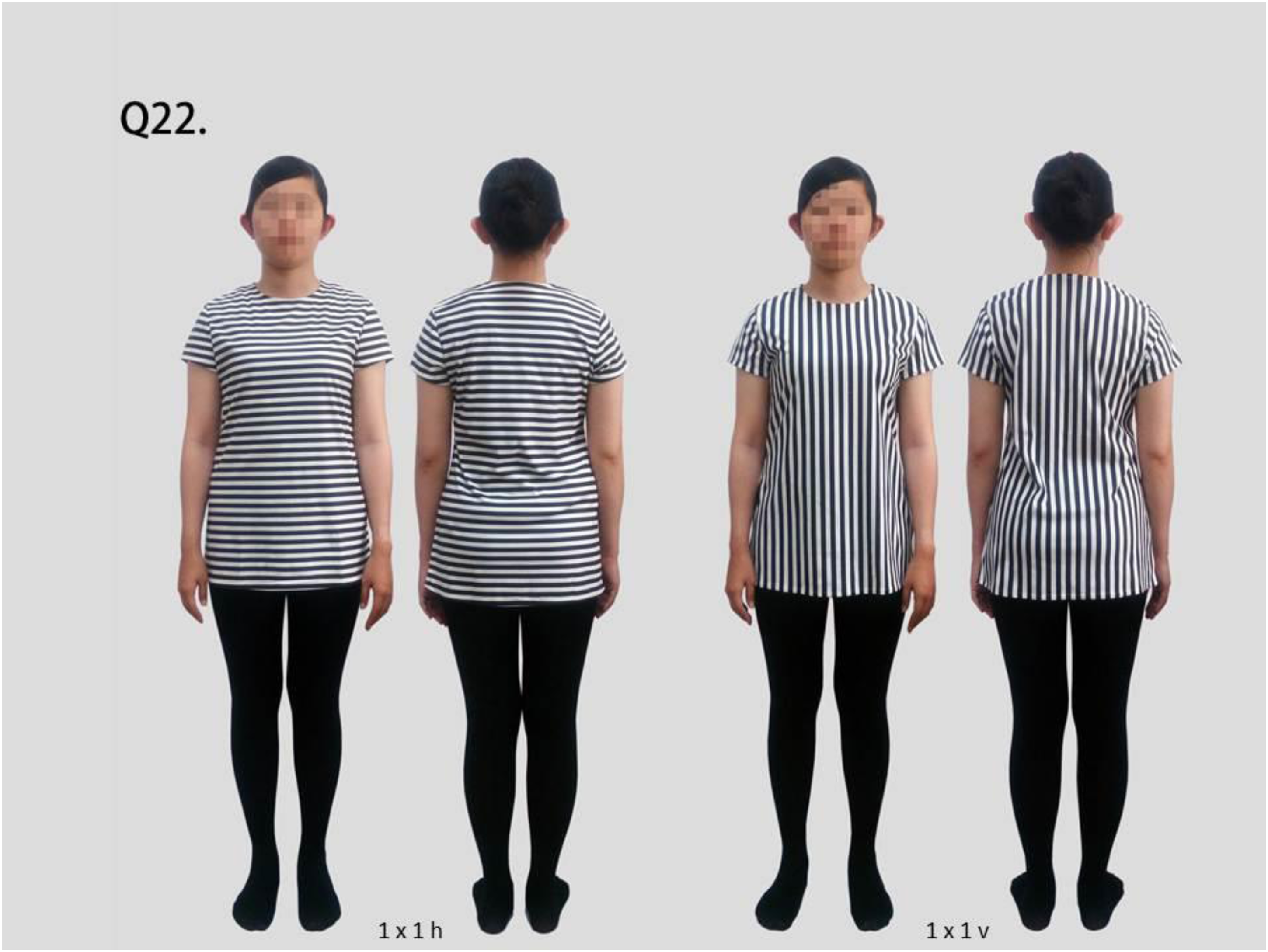
Slide image of the third section (comparisons of horizontal and vertical stripes).
Sample questionnaire items.

Experiment 1: Horizontal Stripes
Regarding pencil stripes, Thompson and Mikellidou (2011) suggested that horizontal stripes appear slimmer, while Swami and Harris (2012) found that when the confederate wore horizontal stripes, she was perceived as having a significantly larger size than when she wore either vertical stripes or no stripes. This study aims to determine whether the slimming effect of equidistant stripes is the same as that of pencil stripes. Therefore, in the absence of vertical stripes, it is assumed that one of the five horizontal stripes will make the model appear the slimmest. In this section of the slides, the model images are arranged side by side for comparison, from slim to wide. Style 1 × 1 h serves as the basic design for all stripe styles and is included in both pencil stripes and equidistant stripe categories. The pencil stripes (1 × 1 h, 1 × 2 h, and 1 × 5 h) are compared first, followed by the equidistant stripes (1 × 1 h, 2 × 2 h, and 5 × 5 h), and lastly, all five horizontal stripes together. This arrangement enables respondents to clearly perceive and compare the differences among all the stripe spacing types in a logical order.
Experiment 2: Vertical Stripes
This section is a continuation of the first part. In the absence of horizontal stripes, it is assumed that one of the five vertical stripes make the model appear the slimmest. The arrangement remains the same as in the first part, except that the vertical stripes are used instead of horizontal stripes. The comparison method also remains the same, with side-by-side presentation. In Experiments 1 and 2, the independent variables include stripe types (pencil, equidistant, and both types), stripe directions (horizontal and vertical), and the model's views (front and back). The dependent variables are the stripe spacing types (1 × 1, 1 × 2, 1 × 5, 2 × 2, and 5 × 5).
Results
The results of the questionnaire are presented as percentages. Experiments 1 and 2 were analyzed using goodness-of-fit tests. The null hypothesis of test 1 is provided below as an example.
H0: There is no significant difference in slimming effects among 1 × 1 h, 1 × 2 h, and 1 × 5 h.
(The ratio of 1 × 1 h, 1 × 2 h, and 1 × 5 h is 1:1:1).
We conducted six and six tests for Experiments 1 and 2, respectively. Every six consecutive tests are related and should be adjusted through multiple testing corrections. We implemented the Bonferroni–Holm method to perform the multiple testing corrections, as addressed in Holm (1979). Let us assume H0(1), …, H0(6), then denote 6 related null hypotheses with p-values, p(1), …, p(6), sorted from smallest to largest. The Bonferroni–Holm method is briefly presented in Table 2. Beginning with the top test, once an upper null hypothesis is not rejected, its following null hypotheses are all not rejected. An illustrative example is presented in Table 6 under Results. The critical value (
Testing strategy of the Bonferroni–Holm method.

The test results for Experiments 1 and 2 are provided in Table 3. The p-values indicate that the 12 null hypotheses should be all rejected.
Test results for Experiment 1 (horizontal stripes) and Experiment 2 (vertical stripes).
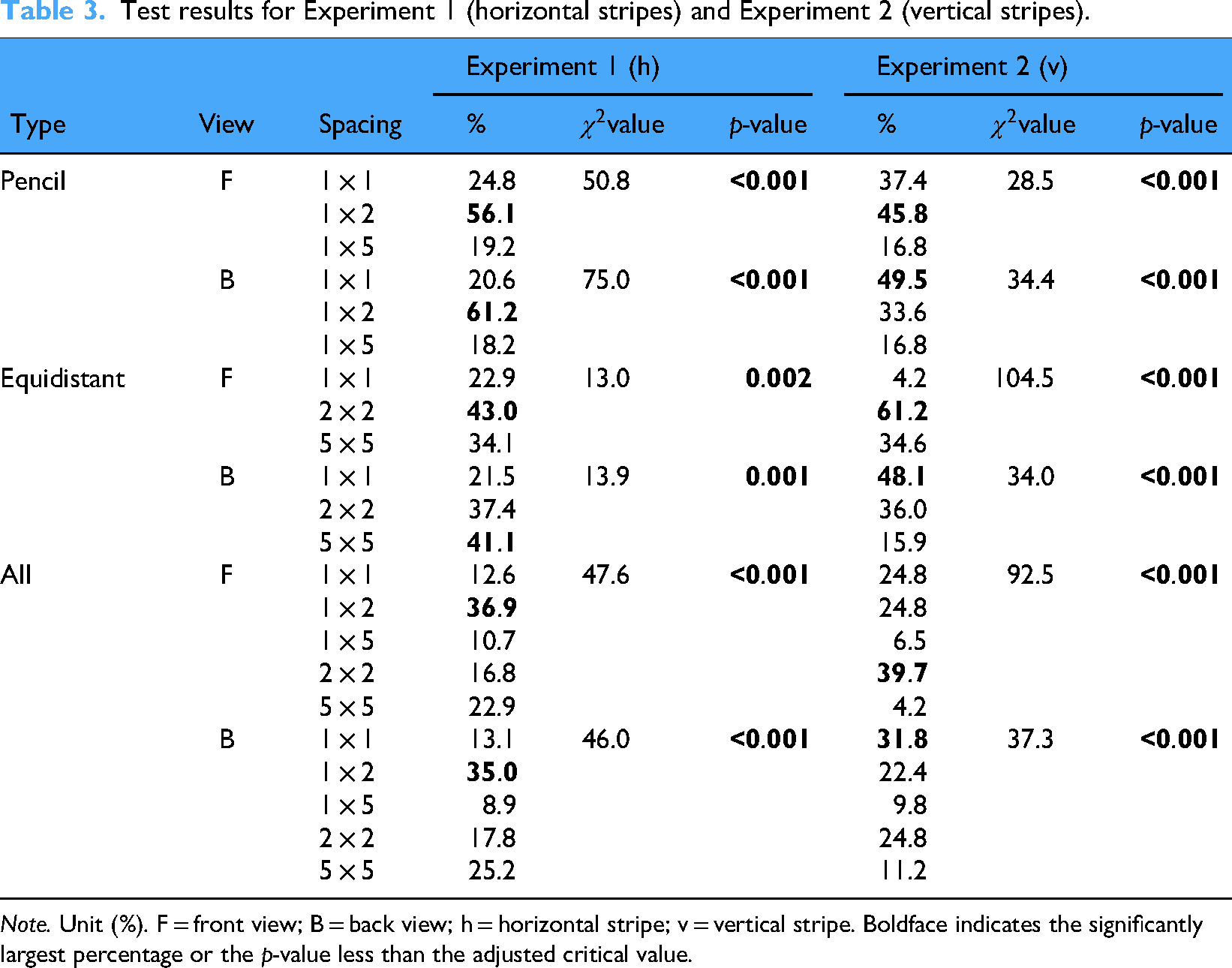
Note. Unit (%). F = front view; B = back view; h = horizontal stripe; v = vertical stripe. Boldface indicates the significantly largest percentage or the p-value less than the adjusted critical value.
The results of Experiment 1 indicate that the respondents generally perceived pencil stripe 1 × 2 h as having the most slimming effect, with 56.1% support in the front view. In contrast, 1 × 5 h received the least support, with only 4.2% (front view) and 9.8% (back view) of the votes. This suggests that a wider stripe spacing does not enhance the slimming effect among pencil stripes.
In Experiment 2, which examined the slimming effect of vertical stripes, the respondents tended to favor 1 × 1v as the most slimming. Contrary to expectations, neither pencil nor equidistant vertical stripes consistently appeared slimmer. When observing the back view, respondents most frequently selected 1 × 1 v as the slimmest (49.5% among the three pencil types, 48.1% among the three equidistant types, and 31.8% among all five spacing types). However, for the front view, 2 × 2 v was most supported (39.7% among all five spacing types and 61.2% among the three equidistant types). These results suggest inconsistencies in the perceived slimming effects of vertical stripes, particularly for pencil types.
Experiment 3: Comparison of Horizontal and Vertical Stripes
Previous studies by Thompson and Mikellidou (2011) and Swami and Harris (2012) employed pencil stripes but differed in experimental stimuli (sleeve length and “mannequin or real human”) and procedures, which led to significantly different results. Drawing on Helmholtz's illusion as applied to clothing, Experiment 3 compares the body perception effects of horizontal and vertical stripes. The assumption is that one stripe direction and one stripe type may make the model appear slimmer, more shapely, and esthetically improved. In this experiment, in addition to the side-by-side comparison on the same page, this study included an interchanging images comparison on separate pages. The two pages are presented in the order of horizontal stripes first and vertical stripes second, with the sight line positions remaining consistent (center and slightly below the slide). The respondents were instructed to control the image viewing speed using the keyboard's up and down keys, and no limit was placed on the number of viewings. They were asked to compare the direction of the stripes in the image based on their memory impressions to determine whether the horizontal stripes on the first page or the vertical stripes on the second page produce a better body image effect.
This experimental procedure engages the respondents’ short-term memory and simulates a real-world situation in which the same person would not wear horizontal or vertical stripes simultaneously. The images of the model wearing only vertical stripes or only horizontal stripes were either separated or displayed side by side to examine the respondents’ perception of the model's body image. The five striped spacing types were compared in two different directions (horizontal and vertical). The independent variables included the stripe spacing type, the model's view (front or back), and the image comparison method (side-by-side or interchanging pages). The dimensions of body image perception include appearing slimmer, enhancing one's figure, and improving overall appearance. The dependent variables are the stripe directions (horizontal and vertical).
Results
Experiment 3 was also analyzed through goodness-of-fit tests. The null hypothesis of test 13 is provided below as an example.
H0: There is no significant difference in the slimming effet between 1 × 1 h and 1 × 1v.
(The ratio of 1 × 1 h and 1 × 1v is 1:1).
A total of 30 tests were conducted. Every six consecutive tests are also related and should be adjusted based on the Bonferroni–Holm corrections.
The percentages of stripe orientation are presented in Table 4. The chi-square values and p-values are summarized in Table 5. The Bonferroni–Holm's stepdown procedure for tests 13 to 18 are provided in Table 6. Most p-values are statistically significant.
Percentages for Experiment 3 (comparing horizontal and vertical stripes).

Note. Unit (%). Dir. = direction; OA = overall (front and back views). Boldface indicates the significantly largest percentage.
The Chi-Square values and p values for Experiment 3 (comparing horizontal and vertical stripes).

Note. Boldface indicates the p-value less than the adjusted critical value.
The Bonferroni-Holm's stepdown procedure for tests 13 to 18 (1 × 1).

Note. Boldface indicates the p-value less than the adjusted critical value.
When the respondents viewed and compared the horizontal and vertical stripes using both side-by-side and interchanging methods, their feedback became more detailed. The results regarding perceptions exhibit some differences between male and female respondents. Therefore, to examine the corelation between gender and the body image perception, 30 tests of independence were conducted. The null hypothesis of test 43 is stated below as an example.
H0: Gender does not affect the perception when respondents choose whether 1 × 1 h or 1 × 1v makes the body image look slimmer by the interchanging comparison.
A total of 30 tests were conducted. Every six consecutive tests are related and should be adjusted based on Bonferroni–Holm corrections. However, only seven null hypotheses are rejected. The seven significant test results for gender influences are provided in Table 7.
The seven significant test results regarding gender influences.

Note. Boldface indicates the significantly largest percentage or the p-value less than the adjusted critical value.
The findings for each spacing type are detailed as follows:
Compared to 1 × 1 h, 1 × 1 v was perceived as more slimming, particularly in the side-by-side comparison (back 75.2%, and overall 61.7%). It was perceived as enhancing the figure more effectively (62.1%), as shown in Table 4. Compared to 1 × 2 v, 1 × 2 h received higher support for the slimming effect, enhancing the figure, and being visually appealing. Compared to 1 × 5 v, 1 × 5 h received higher support across all body image perceptions. However, there was a divergence between genders. Regarding the front view (interchanging), 51.9% of male respondents believed that the vertical stripe looks slimmer, while 71.9% of female respondents tended to support the horizontal pattern (Table 7). This finding indicates that female were more inclined to support the perception that the horizontal stripe makes the model look slimmer. In 2 × 2 v, the results of Experiments 1, 2, and 3 differed. Respondents found it challenging to determine which stripe direction appears slimmer, enhances the body figure more effectively, and is more visually appealing. Compared to 5 × 5 v, the respondents tended to support 5 × 5 h; they perceived the horizontal stripe to look slimmer (69.2%), enhance the body figure more effectively (72%), and appear more visually appealing (82.2%). Regarding the front view (interchanging), front view (side-by-side), back view, and overall view, horizontal stripes received support at the rates of 68.7%, 64.5%, 70.1%, and 69.2%, respectively. Further analysis of gender influences revealed that female support rates are higher than male's. For example, the support rate for male was 53.3% and for female was 73.8% (front, interchanging, as shown in Table 7.
Discussion
This study found that the slimming effect of pencil stripe 1 × 2 h received the highest support. This aligns with the finding of Thompson and Mikellidou (2009, 2011) that horizontal stripes better reflect three-dimensional characteristics. Whether in a sleeved or sleeveless women's dress, it is generally agreed that horizontal pencil stripes can make the wearer appear slimmer. However, as the stripe spacing increases, the horizontal stripes become visually dispersed, causing the Helmholtz illusion to disappear, and the slimming effect diminishes, along with the reduced three-dimensionality of the body, as seen with style 1 × 5 h. Therefore, not all horizontal pencil stripes can make the wearer look slimmer.
Additionally, when only the vertical stripes were compared, the respondents had difficulty distinguishing the slimming effect. For example, the slimming effect was inconsistent when viewed from the front and back of the model. From the front, 2 × 2 v received the highest support for slimming. From the back, 1 × 1 v appeared the slimmest. This finding is consistent with Thompson and Mikellidou (2009) that the apparent depth in a human body is best revealed by horizontal, rather than vertical lines.
Based on the Helmholtz illusion theory, horizontal-vertical comparisons of the five stripe styles were repeated. This study found that the pencil stripe style, characterized by horizontal stripes, makes the figure appear slimmer. However, the equidistant stripe (1 × 1 and 2 × 2) featuring vertical stripes, can also make the figure look slimmer. Therefore, “only horizontal stripes make you look slimmer” Is rather inconclusive Instead, the slimming effect of striped clothing is influenced by the stripe directions (horizontal or vertical), stripe type (pencil or equidistant), and stripe spacing (thin or wide).
As Swami and Harris (2012) noted that vertical and horizontal stripes are unlikely to occur in real-world settings, this study employed two comparison methods in the horizontal-vertical comparison experiment: image interchanging and side-by-side comparison. The results indicate there is no cognitive difference between the two methods, only a difference in degree. For example, both comparisons of 1 × 2 h supported for slimming effect, with 69.2% (interchanging) and 66.8% (side-by-side). One possible explanation is that the respondents had already decided on their answers, so it was not easy for them to change their minds even if they were compared in a different way in the next question.
Regarding gender influences, women were more inclined to support style 1 × 5 h made the model look slimmer. While women supported that style 5 × 5 h had better body image perception effects, men could not tell (Table 7). These research findings can help designers to select suitable patterns by developing stripe spacing and to design clothing while understanding the principles of visual design. Women not only prefer 1 × 2 h stripes but may also be willing to try bold designs such as 5 × 5 h stripes.
Recommendations
In Experiment 3, the body image perception of 2 × 2 stripes is not significant when comparing horizontal and vertical lines. However, the study finds that 2 × 2 is more eye-catching than 1 × 1 is. Notably, 2 × 2 h may be suitable for pregnant women; when worn during pregnancy, this striped clothing may conceal the growing belly while briefly attracting people's attention, increasing the wearers’ safety. Future research should explore 2 × 2 black and white horizontal stripes in maternity wear design, which may be safer than solid-colored clothing.
Footnotes
Acknowledgments
The research would not have been possible without the gracious help and support of Dr.Ying-Yen Chen, who kindly shared his knowledge about statistics. I would also like to thank the action editor and reviewers for the insightful suggestions that were essential for the successful completion of my paper.

Author Contribution(s)
Funding
The authors received no financial support for the research, authorship, and/or publication of this article.
Declaration of Conflicting Interests
The authors declared no potential conflicts of interest with respect to the research, authorship, and/or publication of this article.