




Abstract
Emotion perception of the target face within an emotional crowd is influenced by the intensity of surrounding emotional faces. The present study investigated whether participants perceived the target face's emotional intensity as more aligned with the crowd's emotional intensity (i.e., assimilation effect of facial emotion perception in an emotional crowd). Participants estimated the emotional intensity of the target face within a crowd consisting of multiple emotional faces (angry/happy crowd in Experiment 1 and Experiment 3; angry/happy/fearful crowd in Experiment 2). Results across the first two experiments established a consistent assimilation effect: when embedded within a low-intensity angry or fearful crowd, negative target faces were perceived as less intense than their objective baseline. After accounting for potential confounds related to facial morphological features, Experiment 3 replicated these findings, confirming the stability of this perceptual bias. Notably, this assimilation effect was valence-specific, appearing consistently for negative emotions but failing to emerge for happy faces. Additionally, we found that individuals with a higher level of depression tended to underestimate the happy intensity of the happy face within a happy crowd. Across three experiments, the present study revealed that the negative face's emotional intensity perception within a negative crowd exhibited an assimilation effect.
Keywords
How to Cite this Article
Cai, J., & Wang, Y. (2026). Negative emotion alignment: The assimilation effect of facial emotion perception in a negative emotional crowd. i–Perception, 17(2), 1–18. https://doi.org/10.1177/20416695261435451
Introduction
Consider a scenario where you notice your child amidst a group of children, where the surroundings exude happiness, while your child does not seem particularly cheerful. How is your child's emotional intensity perceived in such a context? This everyday intuition highlights a fundamental question in social perception: how the collective emotional climate of a crowd modulates our judgment of a single target face.
A crowd comprises numerous individuals. When perceiving these individuals simultaneously, observers tend to integrate information across the set to form a singular statistical representation reflecting collective attributes—a process known as ensemble encoding (Alvarez, 2011; Whitney & Yamanashi Leib, 2018). Ensemble encoding enables the rapid extraction of features from numerous similar objects without the necessity for detailed processing of each object's features, aiding in swiftly perceiving the overall characteristics of the emotional crowd (Elias et al., 2017; Liu et al., 2023). How, then, does the statistical representation of the emotional crowd influence the target face's facial emotion perception? Two potential patterns emerge based on distinct processing models. One possibility is that individuals employ contrastive processing (i.e., contrast effect; Burns et al., 2021), using the crowd's average intensity as a reference point. Under this model, if a target face exhibits higher emotional intensity than the crowd average, it is perceived as even more intense than its objective baseline; conversely, if the target face displays lower intensity than the crowd, it is perceived as less intense. Another possibility is that individuals employ a hierarchical processing (i.e., assimilation effect; Brady & Alvarez, 2011; Burns et al., 2021; Walker & Vul, 2014), allowing individuals to perceive the target face's emotional intensity more closely with the statistical representation of the crowd's emotional intensity. In this case, if the crowd's intensity exceeds that of the target, the target is perceived as more intense; if the crowd's intensity is lower, the target is perceived as less intense. There is reason to believe that perceiving the target face's emotional intensity in an emotional crowd is likely to comply with the hierarchical processing rather than the contrastive processing. Hence, the emotional intensity deviation between the target face and the crowd might drive these perceptual biases: in high-intensity crowds, higher emotional intensity deviation is more likely to be associated with the overestimation of emotional intensity of the target face, while in low-intensity crowds, it may lead to underestimation.
Previous research on facial emotion perception has revealed that individuals with high levels of depression or trait anxiety tend to allocate less attention toward positive emotional stimuli while exhibiting an increased attentional bias toward negative emotional stimuli (e.g., Krause et al., 2021; Yoon & Zinbarg, 2008). However, it remains unclear whether individuals with a high level of depression or social anxiety also display a diminished bias toward positive faces within a positive crowd, or an augmented bias toward negative faces within a negative crowd. Accordingly, we hypothesized that individuals with higher levels of social anxiety, depression, or trait anxiety might attenuate the emotional intensity perception of the positive face in a positive crowd or amplify the emotional intensity perception of the negative face in a negative crowd.
The current research was designed to explore whether individuals’ perception of the emotional intensity of a target face within an emotional crowd complies with hierarchical processing (assimilation effect) or contrastive processing (contrast effect). We tested two hypotheses. First, we predicted that the perceived intensity of the target face aligned more closely with the crowd's emotional intensity, exhibiting an assimilation effect. Second, we hypothesized that individuals with higher levels of social anxiety, depression, or trait anxiety would be more likely to underestimate the target face's positive intensity within a positive crowd and overestimate the face's negative intensity within a negative crowd.
To test these hypotheses, we employed a facial emotion evaluation task in which participants first viewed a central target face surrounded by multiple emotional faces and subsequently were demanded to estimate the target's emotional intensity by adjusting a morphed face's intensity.
Experiment 1 examined how the valence of the emotional crowd (anger crowd vs. happiness crowd) influenced the emotional intensity perception of the target face, providing a preliminary test of the two processing models (contrastive processing vs. hierarchical processing). Experiment 2 introduced an additional negative category (fearful crowd) to further test the assimilation effect for the target face's emotional intensity perception in the negative emotional crowd. Experiment 3 manipulated a size judgement task as a control condition, to clarify whether the observed effect was specific to facial emotion perception rather than physical feature perception. Finally, we performed a pooled analysis across all three experiments to explore whether participants’ trait depression levels would affect their facial perception of the target face within an emotional crowd.
Experiment 1
The aim of Experiment 1 was to investigate the influence of crowd emotion on the facial emotion perception, and to explore whether the emotion perception of the target face within an emotional crowd follows contrastive processing or hierarchical processing.
Method
Participants
As no direct reference effect size was available in existing literature, we determined the required sample size by conducting a simulated power analysis using the initial data from 10 participants. Specifically, we compared models with and without interaction terms using the R package simr (Green et al., 2016). The results indicated that a sample size of 40 would provide 95% power to detect the predicted effects (see Supplemental Figure S1). Consequently, we recruited a total of 40 Chinese college students (34 women; Mage = 21.25 ± 1.86), and incorporated data from all participants into the subsequent analysis. Participants were financially compensated for their participation. The present study was approved by the Human Research Protection Committee at East China Normal University, and the research was carried out according to the guidelines in the Declaration of Helsinki.
Materials
Stimuli
Emotional faces were selected from the Karolinska Directed Emotional Faces database (KDEF; Lundqvist et al., 1998). Although the actors in the KDEF database were Caucasian, its validity has been verified in numerous studies on Asian participants (Liu et al., 2023; Ying, 2022; Ying & Xu, 2017). To ensure uniform emotional intensity across stimuli, a preliminary experiment was conducted. First, 58 male faces (29 happy faces and 29 angry faces) were selected from the KDEF database and standardized for luminance and size. Image saturation was minimized, and luminance was further equalized using the SHINE toolbox (Willenbockel et al., 2010). Subsequently, 30 participants (15 women, Mage = 21.07 ± 1.26) were recruited to rate the emotional intensity and attractiveness of these emotional faces on a 7-point Likert scale (1 = not at all, 7 = extremely). Finally, we selected 10 angry faces with non-significant differences on angry intensity, 10 happy faces with nonsignificant differences on happy intensity, while attempting to minimize attractiveness differences among faces of the same emotion type (see Supplemental Table S1).
To quantitatively manipulate the emotional face's emotional intensity, we generated a sequence of emotional face sets using face morphing software (InterFace; Kramer et al., 2016), ranging from neutral to angry or happy expressions (see Figure 1c). Each emotional face comprised 51 images with emotional intensity levels ranging from 0% (completely neutral) to 100% (completely happy or completely angry) in 2% increments. All stimuli were presented on a 27-inch AOC 27B1H monitor (spatial resolution 1920 × 1080, refresh rate 60 Hz) at a viewing distance of 60 cm. Individual faces and the entire crowd subtended visual angles of 5.61° × 8.01° and 23.81° × 23.73°, respectively. The experimental program was implemented in MATLAB (Release R2019a; The Math Works, Natick, MA) via Psychtoolbox (Brainard, 1997).
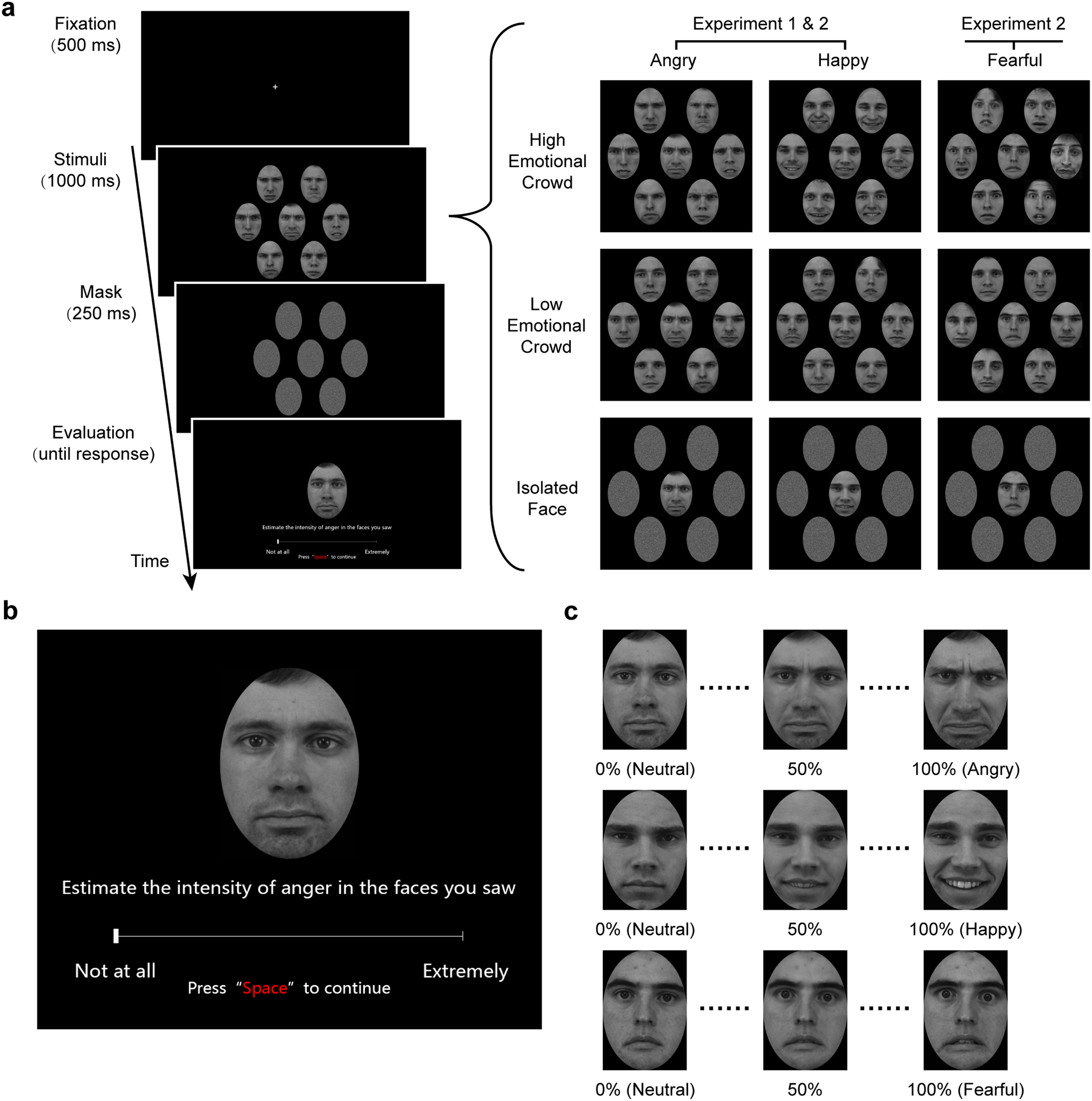
(a) Experimental procedure and experimental stimuli of Experiment 1 and Experiment 2. Participants were instructed to focus solely on the central target face and evaluate its emotional intensity in a subsequent phase. (b) The adjustable test face in the evaluation phase. (c) A sample of three face sets from the neutral-to-angry scale, the neutral-to-happy scale, and the neutral-to-fearful scale, ranging from 0% to 100%.
Questionnaires
Following the behavioral task, participants’ social anxiety, depression, and trait anxiety were assessed. Social anxiety was measured using the revised Chinese version of the Social Interaction Anxiety Scale (SIAS; Mattick & Clarke, 1998), comprising 19 items on a 5-point scale, with higher scores being associated with a higher level of social anxiety. Depression was measured by the revised Chinese version of Beck Depression Inventory Second Edition (BDI-II; Beck et al., 1961; Wang et al., 1999), which consisted of 21 items on a 4-point scale, where higher scores reflect a higher level of depression. Trait anxiety was measured by the revised Chinese version of Spielberger's State-Trait Anxiety Inventory (STAI-T; Spielberger et al., 1971; Wang et al., 1999), which comprised 20 items rated on a 4-point scale, with higher scores indicating a higher level of trait anxiety. All three scales exhibited good internal consistency in Experiment 1 (SIAS: α = .90; BDI-II: α = .84; and STAI-T: α = .85).
Procedure
We employed a 3 × 2 × 6 within-subjects design, manipulating crowd emotional intensity (high emotional intensity [all context faces with emotional intensity = 90%] vs. low emotional intensity [all context faces with emotional intensity = 10%] vs. no emotional intensity [i.e., an isolated-face condition with the context faces replaced by masks]), emotional type (anger vs. happiness), and the target face's emotional intensity (10% vs. 26% vs. 42% vs. 58% vs. 74% vs. 90%).
In each trial, participants viewed a stimulus array for 1000 ms, consisting of one central target face surrounded by six identity-distinct context faces. In the high emotional intensity condition, all context faces were set to 90% intensity; in the low emotional intensity condition, they were set to 10%. Target face and context faces shared the same emotional category. Participants were instructed to focus solely on the central target face and evaluate its emotional intensity in a subsequent phase. To enhance comparability and mitigate identity-related response bias, the same target identity was presented across all three crowd conditions.
Following the stimulus presentation, a set of elliptical masks appeared at each face location for 250 ms to suppress visual afterimages. Finally, participants evaluated the emotional intensity of the target face by adjusting a test face on the screen. The adjustable test face would be the previously appeared neutral target face with a default emotional intensity of 0% (see Figure 1b). Participants could adjust the emotional intensity of the face on the screen by pressing the “left” and “right” keyboard keys until they perceived it matched the emotional intensity of the target face. The evaluation phase had no time limit. After completing their evaluation, participants pressed the “space” key to advance to the next trial. The emotion evaluation task comprised 180 trials, with a break provided after every 90 trials. After completing the emotion evaluation task, participants proceeded to the questionnaires.
Data Analysis Plan
To measure the impact of emotional intensity deviation between the target face and the emotional crowd on the facial emotion perception, we introduced a new independent variable named emotional intensity deviation (EID).
The independent variable of EID, EID = |the intensity of crowd emotion – the emotional intensity of the target face|. For example, in a certain trial, if the crowd emotional intensity was low (10%) and the target face's emotional intensity was 42%, then the EID for that trial would be 32%. A higher EID value indicated a larger difference between the target face's emotional intensity and the crowd emotional intensity, while a smaller EID value indicated a lesser difference. Specifically, an EID of 0 indicated that the target's intensity was congruent with the crowd's intensity. Using this approach, we delineated six levels of emotional intensity deviation: 0%, 16%, 32%, 48%, 64%, and 80%.
To provide a more intuitive visualization of the impact of crowd emotion on facial emotion perception, we introduced a new dependent variable named emotion evaluation difference (EED).
The dependent variable of EED, EED = the emotional intensity evaluation of the target face in the high/low crowd condition – the emotional intensity evaluation of the target face in an isolated-face condition. A higher EED value indicated that the emotional intensity evaluation for the target face in the crowd condition exceeded that in the isolated-face condition, while a lower EED value indicated the emotional evaluation for the target face in the crowd condition was lower than that in the isolated-face condition. The emotion evaluation in the isolated-face condition served as the baseline, resulting in the independent variable of crowd emotional intensity containing only two levels, high emotional intensity and low emotional intensity, without the isolated-face condition.
If there was an assimilation effect for the target face's intensity perception in emotional crowds, we expected that there was a significant interaction between EID and crowd emotional intensity on EED. Specifically, in the low emotional crowd, the higher EID (the target face's intensity was higher than the crowd's intensity) was associated with a smaller EED; the target face's intensity was rated by participants as lower than it was (the isolated-face condition), that is, the assimilation effect. And in the high emotional crowd, the higher EID was associated with a higher EED, that is, the target face of higher intensity was rated by participants as higher intensity than it was.
In contrast, if there was a contrast effect for the target face's intensity perception in emotional crowds. We expected there were these patterns: In the low emotional crowd, the higher EID (the target face's intensity was higher than the crowd's intensity) was associated with a larger EED, that is, in the low emotional crowd, if the target face's intensity was lower, participants rated the target face's intensity as higher that it actually was (the isolated-face condition). And in the high emotional crowd, the higher EID was associated with a smaller EED; that is, in the high emotional crowd, if the target face's intensity was higher, participants rated the target face's intensity as lower than it was.
Data were analyzed using linear mixed-effects models (LMMs) to examine the predictive effects of crowd emotional intensity, EID, and emotional type on the EED. Participant and face identity were included as random effects. Analyses were conducted in R 4.2.2 (R Core Team, 2017, Vienna, Austria). We excluded data with response times <200 ms (Schurgin et al., 2020), which accounted for 0.13% of the total data.
Given that the sample size plan for the present study was developed mainly for crowd emotion affecting facial emotion perception, which may not be sufficient for individual variables, we consolidated the results from three experiments into a comprehensive analysis in a later section (see the Mini Meta-Analysis section). Detailed results for individual variables in each experiment would be presented in the Supplemental Material (S2 to S4).
Results
The linear mixed model revealed a nonsignificant three-way interaction effect, b = 0.04, SE = 0.04, 95% CI = [−0.04, 0.12], t (4,746) = 0.96, p = .338. Among the two-way interaction terms, only the crowd emotional intensity × EID interaction was significant, b = −0.07, SE = 0.03, 95% CI = [−0.13, −0.02], t(4,747) = −2.63, p = .009, R2 = .024. Further simple effects tests indicated that it was significant in the low emotional crowd, suggesting that a higher EID was associated with a smaller EED, b = −0.04, SE = 0.02, 95% CI = [−0.08, −0.00], t(2,352) = −2.13, p = .033. However, there was no significant main effect of EID in the high emotional crowd, b = 0.03, SE = 0.02, 95% CI = [−0.01, 0.07], t(2,352) = 1.59, p = .111. These results suggested that perceived the target face's emotional intensity aligned more closely with the crowd emotional intensity, indicating the assimilation effect in the low emotional crowd.
We also analyzed the effects of crowd emotional intensity and EID on EED in the happy and angry crowds, respectively. These results revealed a significant interaction effect of crowd emotional intensity × EID in the angry crowd, b = −0.07, SE = 0.03, 95% CI = [−0.14, −0.01], t(2,355) = −2.44, p = .015, R2 = .029. Simple effects tests indicated that it was significant in the low emotional crowd, suggesting that a higher EID was associated with a smaller EED, b = −0.04, SE = 0.02, 95% CI = [−0.09, −0.00], t(2,354) = −1.99, p = .047. There was no significant main effect of EID in the high emotional crowd, b = 0.03, SE = 0.02, 95% CI = [−0.01, 0.07], t(2,354) = 1.46, p = .144 (see Figure 2a). However, in the happy crowd, we did not observe a significant interaction effect between crowd emotional intensity and EID, b = −0.04, SE = 0.03, 95% CI = [−0.09, 0.01], t(2,351) = −1.39, p = .164 (see Figure 2b). These results suggested that the assimilation effect was absent in the happy crowd.

Results of Experiment 1, Experiment 2, and Experiment 3. (a–g) Mean emotion evaluation differences (EEDs) are shown for different emotional intensity deviation (EID) and different emotional intensity of the crowd. (h) Mean size evaluation difference is shown for different size deviations and different shape sets in Experiment 3. Error bars represent standard errors. EID = |the intensity of emotional crowd minus the emotional intensity of the target face|. EED = the emotional intensity evaluation of the target face in the crowd condition (high or low) minus the emotional intensity evaluation of the target face in the isolated-face condition. A higher EED value indicated that the emotional intensity evaluation for the target face in the crowd condition exceeded that in the isolated-face condition, and a lower EED indicated the emotional intensity evaluation for the target face in the crowd condition was lower than that in the isolated-face condition.
Discussion
Experiment 1 revealed that the assimilation effect appeared within the angry crowd but was absent within the happy crowd, suggesting that this assimilation effect may be related to the emotional type of the crowd. Crucially, the magnitude of the assimilation effect increased with a higher EID between the target face and the crowd. However, it remains unclear whether this assimilation effect only occurs in the angry crowd. To investigate this, Experiment 2 aimed to replicate the results of Experiment 1 and to explore whether there was an assimilation effect for the target face's fear intensity perception within the fear crowd would.
Experiment 2
Experiment 2 introduced the fear crowd, a negative emotion akin to anger and associated with threat signals (Adams et al., 2006), with the aim of replicating the results of Experiment 1 and exploring whether the assimilation effect for the target face's facial perception would also occur in the fearful crowd.
Method
Participants
Consistent with the sample size in Experiment 1, Experiment 2 recruited 40 Chinese college students (30 women, Mage = 22.75 ± 2.01) and incorporated data from all participants into the subsequent analysis. Participants were financially compensated for their participation.
Materials
The stimuli of happy and angry faces, as well as the questionnaires, were consistent with those used in Experiment 1 (SIAS: α = .90; BDI-II: α = .87; and STAI-T: α = .88). Fearful faces were similarly screened and generated using the procedures from Experiment 1. We recruited 30 participants (19 women, Mage = 24.67 ± 6.85) to evaluate the emotional intensity and attractiveness (1 = not at all, 7 = extremely) of 29 faces. Finally, based on the evaluations provided by 30 participants, 10 fearful faces were selected such that no significant differences were observed in either emotional intensity or facial attractiveness among the stimuli (see Supplemental Table S2).
Procedure and Data Analysis Plan
The experimental design and analytical approach mirrored Experiment 1, utilizing LMMs to examine the effects of crowd emotional intensity, EID, and emotional type (anger vs. fear vs. happiness) on EED. Given that Experiment 2 involved three levels of emotional types, happiness was set as the reference level during dummy coding. The facial emotion evaluation task in Experiment 2 was consisted of 270 trials with a break after every 90 trials. We excluded data with response times < 0.2 s, which accounted for 0.04% of the total data.
Results
A linear mixed model revealed a significant three-way interaction effect involving emotional type (anger–happiness) × crowd emotional intensity × (EID), b = −0.17, SE = 0.08, 95% CI = [−0.32, −0.03], t(7,144) = −2.31, p = .021, R2 = .014; as well as emotional type (fear−happiness) × crowd emotional intensity × EID, b = −0.16, SE = 0.08, 95% CI = [−0.31, −0.01], t(7145) = −2.10, p = .036, R2 = .014.
We then analyzed the effects of crowd emotional intensity and EID on the emotion evaluation difference in three emotional crowds, respectively. The results revealed a significant interaction effect of crowd emotional intensity × EID in the fearful crowd, b = −0.12, SE = 0.05, 95% CI = [−0.22, −0.01], t(2,356) = −2.19, p = .029, R2 = .042 (see Figure 2e). Simple effects tests indicated that the main effect of EID was not significant, neither in the low emotional crowd (b = −0.05, SE = 0.04, 95% CI = [−0.13, 0.02], t(2,353) = −1.45, p = .147) nor in the high emotional crowd (b = 0.06, SE = 0.04, 95% CI = [−0.14, 0.14], t(2,353) = 1.66, p = .098). A significant interaction effect of crowd emotional intensity × EID was observed in the angry crowd, b = −0.12, SE = 0.05, 95% CI = [−0.24, −0.02], t(2,356) = −2.40, p = .016, R2 = .017 (see Figure 2c). Simple effects tests indicated that in the low emotional crowd condition, a higher EID was associated with a smaller EED, b = −0.08, SE = 0.04, 95% CI = [−0.16, −0.01], t(2,354) = −2.16, p = .031. There was no significant main effect of EID in the high emotional crowd, b = 0.05, SE = 0.04, 95% CI = [−0.03, 0.12], t(2,354) = 1.24, p = .215. In the happy crowd, there was no significant interaction effect observed between crowd emotional intensity and EID, b = 0.05, SE = 0.05, 95% CI = [−0.06, 0.15], t(2,353) = 0.90, p = .368 (see Figure 2d). These results suggested there was an assimilation effect for the target face's intensity perception in the negative emotional crowd (angry and fearful crowd). However, this effect remained undetected in the happy crowd condition.
Discussion
Experiment 2 found a similar assimilation effect in the fearful crowd, suggesting that individuals adopt hierarchical processing when perceiving the emotional intensity of a target face within a negative emotional crowd. However, a critical alternative explanation remains: perceptual biases might be driven by physical features rather than emotional meaning (Ekman, 1992). For instance, individuals could perceive the emotional intensity of a happy face through observing how the size of the mouth opened (Freitas-Magalhães, 2018). Therefore, the assimilation effect observed in Experiment 1 and Experiment 2 might be confounded by the perception of structural facial properties. Experiment 3 aimed to test the assimilation effect for the target face's emotional intensity perception in the negative emotional crowds, which was rooted in facial emotional intensity perception, rather than physical feature perception.
Experiment 3
In Experiment 3, we further controlled the morphological features of crowd faces and introduced a new task, the shape size evaluation task. In this task, participants were required to judge the size of a target shape, a process related to the Ebbinghaus illusion (Doherty et al., 2010). Specifically, the size evaluation of the smaller target shape in the larger shape sets tended to be underestimated, while the size evaluation of the larger target shape in the smaller shape sets tended to be overestimated. This pattern reflects a contrast effect distinct from that of the target face's emotional intensity perception in the emotional crowd (assimilation effect). By comparing the assimilation effect in emotion perception with the expected contrast effect in size perception, we sought to determine whether our previous findings were specific to social-emotional information.
Method
Participants
Following the same recruitment criteria, 40 Chinese college students (31 women, Mage = 21.88 ± 1.81) participated. All data were retained for analysis. Participants were financially compensated for their participation.
Materials
The questionnaires remained consistent with those used in Experiment 1 (SIAS: α = .93; BDI-II: α = .86; and STAI-T: α = .89). Ten emotional faces (five angry faces and five happy faces) were selected from the emotional faces of Experiment 1, with the critical adjustment that each actor now provided both angry and happy expressions to ensure identity-level control. To establish comparability between the shape size evaluation task and the facial emotion evaluation task, we used MATLAB to generate six gray shapes (circle [5.61° × 5.61°] vs. ellipse [5.61° × 8.01°] vs. square [3.97° × 3.97°] vs. circle frame [5.61° × 5.61°] vs. ellipse frame [5.61° × 8.01°] vs. square frame [3.97° × 3.97°]; see Supplemental Figure S5). For each shape, we created an additional set of 50 variations, systematically decreasing in size, varying from 0% (scaling 10%) to 100% (scaling 100%) of the original dimensions.
Procedure and Data Analysis Plan
In Experiment 3, the identities of the crowd faces were no longer distinct from that of the target face; instead, all faces shared the same identity and differed only in emotional intensity. Nonetheless, such a presentation might oversimplify the processing of crowd faces, potentially leading participants to perceive the emotional expressions of the crowd as those of an isolated face. To address this issue, we permitted the emotional intensity of each face to fluctuate within specific limits while maintaining a consistent average emotional intensity across the crowd. In the high-intensity condition, the average emotional intensity of the six faces was set at 90%, with individual intensities ranging from 80% to 100%. In the low-intensity condition, the average emotional intensity of the six faces was set at 10%, with individual intensities ranging from 0% to 20% (see Figure 3a). The facial emotion evaluation task consisted of 180 trials.
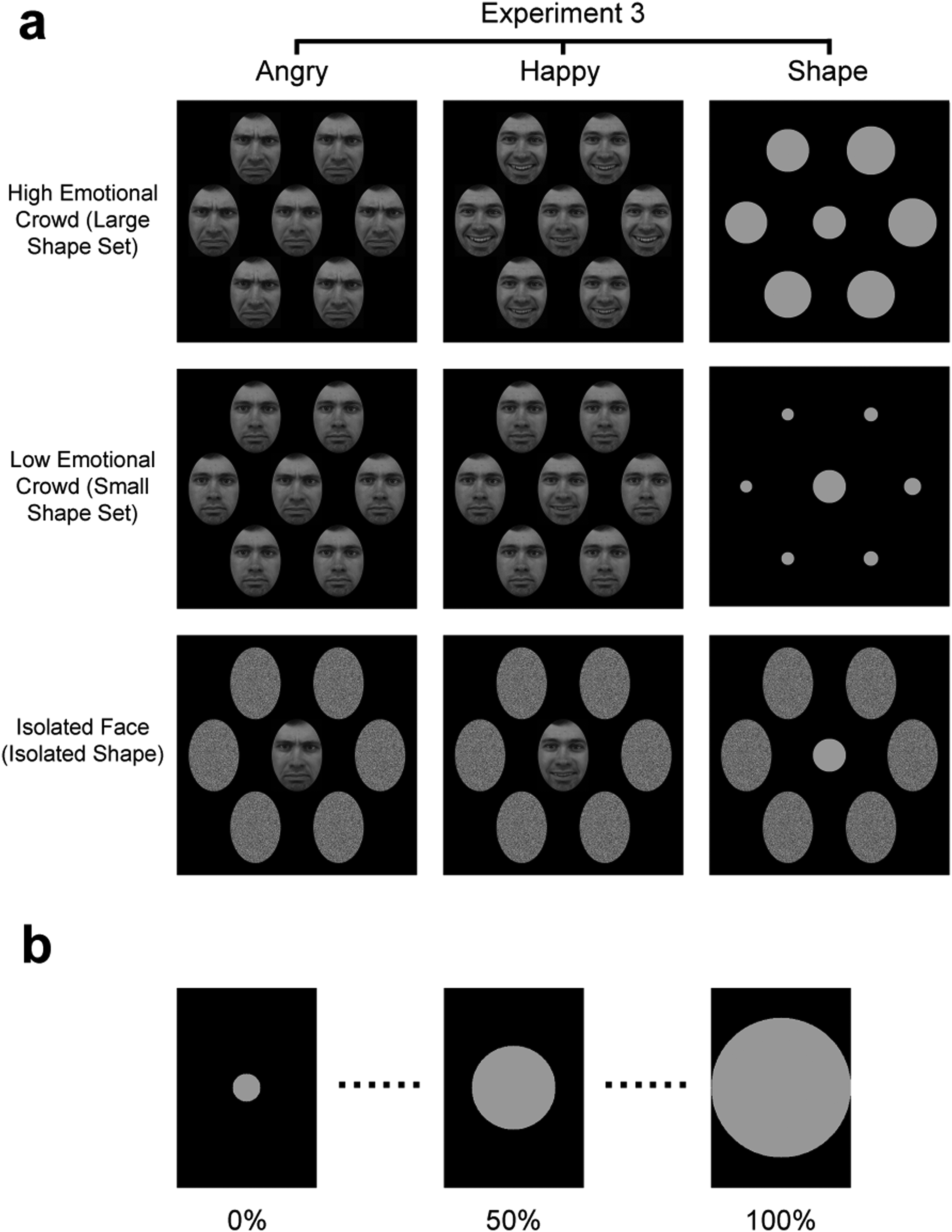
Sample of materials in Experiment 3. (a) A sample of different intensities of the emotional crowd and shape set size in Experiment 3. (b) A sample of shape sets from the small-to-large scale that were used in Experiment 3, ranging from 0% to 100%.
In Experiment 3, we set a shape size evaluation task, manipulating shape size (large shape set [average size = 90%] vs. small shape set [average size = 10%] vs. isolated-shape [the surrounding shapes replaced by masks]) and the target shape's size (10% vs. 26% vs. 42% vs. 58% vs. 74% vs. 90%). The shape size evaluation task closely mirrored the emotion evaluation task adopted in Experiment 1 and Experiment 2. Participants were instructed to pay attention to the central target shape and evaluate its size in a subsequent phase. In each trial, all shapes were identical in form and differed only in size. Similar to the emotion evaluation task, the size of each shape was allowed to vary within a predefined range while maintaining a constant mean size for the surrounding shapes. In the large shape set condition, the average size of the six surrounding shapes was 90%, with individual sizes ranging from 80% to 100%. In the small shape set condition, the average size was 10%, with individual sizes ranging from 0% to 20% (see Figure 3b). The shape size evaluation task consisted of 108 trials.
The order of the facial emotional intensity evaluation task and the shape size evaluation task was counterbalanced across participants. Trials with response times shorter than 200 ms were excluded from the analysis, accounting for 0.04% of the data in the facial emotion evaluation task and 0.04% of the data in the shape size evaluation task.
Results
A linear mixed model analysis revealed a significant three-way interaction effect involving emotional type × crowd emotional intensity × EID, b = −0.13, SE = 0.03, 95% CI = [0.06, 0.19], t(4,750) = 3.75, p < .001, R2 = .015. We then analyzed the effects of crowd emotional intensity and EID on EED in the happy and angry crowd conditions, respectively. The results revealed a significant interaction effect of crowd emotional intensity × EID in the angry crowd, b = −0.10, SE = 0.03, 95% CI = [−0.15, −0.05], t(2,356) = −3.80, p < .001, R2 = .020. Simple effects tests indicated that in the low emotional crowd condition, suggesting that a higher EID was associated with a smaller EED, b = −0.04, SE = 0.02, 95% CI = [−0.08, −0.01], t(2,356) = −2.24, p = .026. In the high emotional crowd condition, a higher EID was associated with a higher difference in participants’ emotion evaluation, b = 0.06, SE = 0.02, 95% CI = [0.02, 0.09], t(2,356) = 3.14, p = .002 (see Figure 2f). However, in the happy crowd condition, we did not observe a significant interaction effect between crowd emotional intensity and EID, b = 0.03, SE = 0.02, 95% CI = [−0.01, 0.07], t(2,355) = 1.24, p = .214 (see Figure 2g). These results suggested that the assimilation effect was present in the angry crowd condition but absent in the happy crowd condition.
Next, we conducted a linear mixed model with shape set size (large vs. small), size deviation as independent variables, size evaluation difference as dependent variable, and shape types and participants as random variables. The results revealed a significant interaction effect involving shape set size × size deviation, b = −0.10, SE = 0.02, 95% CI = [0.07, 0.13], t(2,834) = −5.71, p < .001, R2 = .077. Simple effects tests indicated that greater size deviation was associated with a higher size evaluation difference, b = 0.08, SE = 0.01, 95% CI = [0.06, 0.10], t(2,834) = 6.51, p < .001. There was no significant main effect of size deviation in the large shape set, b = −0.02, SE = 0.01, 95% CI = [−0.04, 0.00], t(2,834) = −1.57, p = .117 (see Figure 2h). These results suggested that there was a contrast effect for the shape size perception in a shape set.
Discussion
Experiment 3 further controlled for facial morphological features and successfully replicated the findings of Experiment 1. Specifically, in the low-intensity angry crowd, a higher EID corresponded to a tendency to underestimate the target face's intensity; in the high-intensity angry crowd, this deviation corresponded to a tendency to overestimate the intensity. These results indicated an assimilation effect for facial emotion perception in the angry crowd. However, this assimilation effect was again not observed in the happy crowd condition. Additionally, the results of Experiment 3 confirmed that the sizes of the surrounding shapes influence the size perception of the target shape, exhibiting a contrast effect distinct rather than an assimilation effect. These results indicated that individuals tended to employ a hierarchical processing for facial emotional intensity perception within a negative crowd, while employing a contrastive processing for shape size perception within a shape set. This implied that in the process of perceiving facial emotion intensity, the formation of abstract emotional concepts holds more significance than the perception of specific facial morphology (Brooks et al., 2019).
Mini Meta-Analysis
Across three experiments, the present study did not reveal a significant effect of the happy crowd on the perceived emotional intensity of happy target faces. Additionally, the main effect of EID within high-intensity crowd conditions exhibited some inconsistency across three experiments. Specifically, the findings regarding individual differences (social anxiety, depression, and trait anxiety) and their interactions with emotion types were not entirely uniform, potentially owing to insufficient power in the individual experiments.
Given the similarity of tasks and consistent measurement methods for the dependent variable across these three experiments, we merged the samples into one large dataset for a pooled analysis (i.e., a mini meta-analysis). Since the fear crowd condition was only investigated in Experiment 2, it was excluded from this integrated analysis.
The effect of emotional type (anger vs. happiness), crowd emotional intensity, and EID on the EED
We conducted a linear mixed model with emotional type (anger vs. happiness), crowd emotional intensity (low vs. high), EID as independent variables, and EED as the dependent variable. The results revealed a significant three-way interaction effect involving emotional type × crowd emotional intensity × EID, b = 0.11, SE = 0.03, 95% CI = [0.05, 0.17], t(14,260) = 3.59, p < .001, R2 = .008.
Further analysis revealed a significant interaction effect of crowd emotional intensity × EID in the angry crowd, b = −0.10, SE = 0.02, 95% CI = [−0.14, −0.06], t(7,072) = −4.47, p < .001, R2 = .017. Simple effects tests indicated that a higher EID was associated with a smaller EED in the low emotional crowd condition, b = −0.06, SE = 0.02, 95% CI = [−0.09, −0.02], t(7,068) = −3.47, p = .001. It was significant in the high emotional crowd condition, suggesting that a higher EID was associated with a higher EED, b = 0.05, SE = 0.02, 95% CI = [0.01, 0.08], t(7,068) = 2.85, p = .004 (see Figure 4a). However, in the happy crowd condition, we did not observe a significant a two-way interaction effect between crowd emotional intensity and EID, b = 0.01, SE = 0.02, 95% CI = [−0.03, 0.05], t(7,066) = 0.49, p = .628 (see Figure 4b). These results further confirmed the stability of the assimilation effect for the target face's facial emotion perception in the angry crowd condition.

Results of mini-meta analysis. (a, b) Mean emotion evaluation difference (EED) was shown for different emotional intensity deviation (EID) and different crowd emotional intensities. (c) EED for the angry and the happy crowd condition as a function of individual variables. Error bars and gray areas represent standard errors. EID = |the intensity of crowd emotion – the emotional intensity evaluation of the target face. EED = the emotional intensity evaluation of the target face in crowd condition (high intensity or low intensity) – the emotional intensity evaluation of the target face in the isolated-face condition.
The effect of individual difference (social anxiety, depression, and trait anxiety) and emotional type (anger vs. happiness) on the EED
We employed a linear mixed model with individual variables (social anxiety, depression, and trait anxiety) and emotional type (anger vs. happiness) as independent variables, EED as the dependent variable. The results showed that the interaction effect of social anxiety × emotional type was significant, b = −1.50, SE = 0.64, 95% CI = [−2.73, −0.24], t(13,184) = −2.35, p = .019, R2 = .007 (see Figure 4c). The interaction effect of trait anxiety × emotion type was significant, b = −2.27, SE = 1.01, 95% CI = [−4.23, −0.29], t(14,261) = −2.26, p = .024, R2 = .007 (see Figure 4c). However, the results of simple effect analyses for these two-way interactions (social anxiety × emotion type; trait anxiety × emotion type) did not yield significant.
The two-way interaction effect of depression × emotional type was significant, b = 4.67, SE = 1.33, 95% CI = [−7.28, −2.06], t(14,268) = −3.51, p < .001, R2 = .007 (see Figure 4c). Simple slope tests revealed significant effects of emotions for both low and high level of depression: participants with low level of depression were more likely to evaluate the happy target face as higher emotional intensity in the happy crowd condition than for the angry target face in the angry crowd condition (b = −1.37, SE = 0.63, 95% CI = [−2.62, −0.13], t(980) = −2.17, p = .031). On the other hand, participants with high depression level were more likely to estimate lower emotional intensity for the happy target face in the happy crowd condition than for the angry target face in the angry crowd condition (b = 1.58, SE = 0.64, 95% CI = [0.32, 2.84], t(723) = −2.47, p = .014). Additionally, in the angry crowd condition, the main effect of depression was not significant, b = 1.36, SE = 1.00, 95% CI = [−0.61, 3.33], t(377) = 1.36, p = .176. However, the main effect of depression was significant in the happy crowd condition, showing that higher depression level was associated with lower EID, b = −3.32, SE = 1.00, 95% CI = [−5.29, −1.34], t(378) = −3.31, p = .001.
These findings suggested that individual trait variables (social anxiety, depression, and trait anxiety) impacted the perception of target faces within emotional crowds, trait depression exerted a more pronounced effect. Specifically, individuals with a high level of depression tended to underestimate the happy intensity of the target face in the happy crowd compared, while simultaneously overestimating the angry intensity of target faces in angry crowds.
General Discussion
The present study employed three experiments to examine how the emotional intensity of a crowd modulates the perception of a target face. Our findings revealed that the perceived emotional intensity of a negative face aligns closely with the surrounding negative context (angry crowd in Experiments 1 to 3; fearful crowd in Experiment 2), manifesting as an assimilation effect. Specifically, in high-intensity crowds, a greater emotional deviation predicted an overestimation of the target's intensity, whereas in low-intensity contexts, it predicted underestimation. This pattern suggests that the perception of negative facial expressions within a group follows a hierarchical processing model rather than a contrastive one.
Prior research has identified phenomena such as emotional contagion from crowds to individuals, which aligns with the assimilation effect observed in the current study (Lee et al., 2022; Qureshi et al., 2024; Zhang et al., 2020). A pivotal question remains: why does the perception of negative faces within a crowd elicit assimilation rather than contrast? One possible explanation was that the complexity of perceptual object changes affects our visual processing mode. In our shape size evaluation task, participants only need to pay attention to changes in shape size, while in the facial emotion evaluation task, participants need to notice more changes in the entire facial morphology, including in eyebrows, mouth, eyes, and other local features. Such structural complexity might steer participants towards hierarchical processing for extensive and intricate morphological changes, while an isolated feature change in a shape might incline them towards contrastive processing. Some research found that for facial attractiveness, which also involves similarly complex morphological changes, there exists a contrast effect when perceiving the attractiveness of a target face within a crowd, meaning target faces in a low attractiveness crowd are more likely to be perceived as attractive than those in a high attractiveness crowd (Burns et al., 2021; Ying et al., 2019).
Another possible explanation revolves around the inherent characteristics of the perceptual object, contributing to the observed processing differences. Negative facial emotions not only reflect the attribute of emotional face's emotional intensity but also serve as a threat signal (Adams et al., 2006). Such negative faces with threat implications might affect visual perceptual processing. For instance, Givon-Benjio and Okon-Singer (2022) found that individuals with spider phobia exhibited an increased attentional focus on the global features of spider-related stimuli compared to those with snake phobia or the control group, suggesting that individuals facing threatening negative stimuli might lean towards adopting hierarchical processing (Alvarez, 2011; Givon-Benjio & Okon-Singer, 2022). Moreover, the experience of individuals expressing emotions through facial expressions in social settings might influence facial emotion perception within a crowd. Research has shown that emotional expressions within a crowd lead to continuous transmission and reception of emotions through interpersonal interactions, resulting in interpersonal emotion convergence or emotional contagion (Parkinson, 2020). This phenomenon of emotional contagion might prompt observers to perceive the target face and its context as a unified whole. Conversely, the size of a geometric shape is a purely physical attribute lacking social significance, thereby favoring a contrastive judgment. This functional perspective also clarifies why facial attractiveness—a cue central to mate selection—often elicits a contrast effect (Ying et al., 2019). Mate selection requires the differentiation of individuals to identify the most desirable partner, necessitating a contrastive rather than an assimilative strategy.
Across three experiments, the assimilation effect for the target face's facial emotional intensity perception in emotional crowd only occurred in angry and fearful crowd but remained absent in happy contexts. These results suggested that compared to positive emotional crowds, negative emotional crowds, which carried more threaten-related information, have a greater impact on the intensity perception of negative facial emotions within a negative crowd. This aligns with evidence that individuals have greater perceptual bias towards negative crowds than positive crowds (Goldenberg et al., 2021; Mihalache et al., 2021). Goldenberg et al. (2021) discovered that the amplification effect of individuals perceiving the intensity of the negative crowd was larger than that of perceiving the intensity of the positive crowd; Mihalache et al. (2021) found that when identifying whether the emotional crowd was happy or angry, people were more inclined to perceive the emotional crowd as an angry crowd. The reason might be the differential processing stages of discrete emotions affecting the ensemble encoding of the emotional crowd. Early processing occurs for negative threatening faces, while processing for happy faces happens later (Calvo & Beltran, 2013; Luo et al., 2010). However, the ensemble encoding of emotional crowd occurred early, even before the configuration processing of an isolated face takes place (Liu et al., 2023; Whitney & Yamanashi Leib, 2018). This suggested that negative emotions might have an advantage in ensemble perception, leading to larger amplification effects and perceptual bias. These results should be interpreted with caution, as further support from future studies is required.
Additionally, we found that individuals with high levels of depression tended to underestimate the positive intensity of target faces within a happy crowd. While those with lower depression scores evaluated positive faces as significantly more intense than angry ones, individuals with high depression scores exhibited the opposite pattern, rating positive faces as significantly less intense. A recent study also revealed that socially excluded participants overestimated the mean emotions for disgusted crowd faces compared to socially included participants (Geng et al., 2025). The present study extended previous findings by demonstrating that depression weakened positive facial emotion perception within a positive emotional crowd and suggesting an amplification effect for negative facial emotion perception in a negative emotional crowd. Such valence-specific distortions provide a novel perceptual framework for understanding the social withdrawal and avoidance behaviors characteristic of clinical and subclinical depression.
The present study has some limitations. Firstly, we found the assimilation effect for the angry target face in the angry crowd only in the meta-analysis, likely due to small sample size in individual experiments. Future studies should increase sample sizes to test the assimilation effect for the negatve target face in a negative crowd. Secondly, while we identified the impact of the emotional intensity of the negative crowd on the negative target face's emotional intensity perception, we did not delve deeper into the underlying mechanisms. This absence of exploration leaves us with insufficient empirical evidence to support our interpretation of the negative results observed in the happy crowd. Future research could employ the event-related potentials (ERPs) technique to reveal the characteristics and mechanisms of this effect in perceptual processing (Calvo & Beltran, 2013; Liu et al., 2023). Thirdly, our stimuli consisted solely of Caucasian male faces to avoid confounds related to gender and ethnic proportions in ensemble encoding. However, this may limit the
Conclusion
In three experiments, the present study demonstrated that participants perceived the emotional intensity of the negative target face aligned more closely with the emotional intensity of the crowd in the negative crowd (assimilation effect). Furthermore, individual differences in depressive traits significantly modulate this bias, specifically by attenuating the perception of positive affect within happy crowds. These findings provide new insights into how it contributes to social avoidance behavior among depressed individuals.
Transparency and Openness
We report how we determined our sample size, all data exclusions, all manipulations, and all measures in the study. All data, analysis code, and research materials are available from the corresponding author upon reasonable request. Data analysis was conducted using R (Version 4.2.2). All methodological procedures and analysis pipelines were established prior to data collection to ensure the integrity of the findings.
Supplemental Material
sj-doc-1-ipe-10.1177_20416695261435451 - Supplemental material for Negative emotion alignment: The assimilation effect of facial emotion perception in a negative emotional crowd
Supplemental material, sj-doc-1-ipe-10.1177_20416695261435451 for Negative emotion alignment: The assimilation effect of facial emotion perception in a negative emotional crowd by Jiaotao Cai and Yanmei Wang in i-Perception
Footnotes
Author Contribution(s)
Declaration of Conflicting Interests
The authors declared no potential conflicts of interest with respect to the research, authorship, and/or publication of this article.
Funding
The authors disclosed receipt of the following financial support for the research, authorship, and/or publication of this article: This work was supported by the Open Fund of Key Laboratory of Philosophy and Social Science of Anhui Province on Adolescent Mental Health and Crisis Intelligence Intervention (SYS2024A03), the STI 2030—Brain Science and Brain-like Intelligence Technology - National Science and Technology Major Projects (2021ZD0200500), the Fundamental Research Funds for the Central Universities.

Supplemental Material
Supplemental material for this article is available online.
References
Supplementary Material
Please find the following supplemental material available below.
For Open Access articles published under a Creative Commons License, all supplemental material carries the same license as the article it is associated with.
For non-Open Access articles published, all supplemental material carries a non-exclusive license, and permission requests for re-use of supplemental material or any part of supplemental material shall be sent directly to the copyright owner as specified in the copyright notice associated with the article.
