




Abstract
Patrick Hughes’ "Reverspectives" typically have a three-dimensional structure consisting of protruding, truncated pyramids but they appear to recede into the distance because of the perspective images on the sides of the pyramids. More recently, PH has created "Solid Hollows" which have a receding (hollow) three-dimensional structure but they appear to protrude. In this paper, we have attempted to describe both the similarities and differences between "Reverspectives" and "Solid Hollows". We conclude that perspective is not a mere "secondary cue" (Helmholtz, 1910) in the perception of Reverspectives but instead perspective dominates over binocular disparity when the viewing distances are greater than 50–100 cm. For "Solid Hollows", perspective also plays a role in the (perceived) reversed depth, as does the visual system's inherent bias for seeing objects as convex.
How to cite this article
Rogers, B., & Hughes, P. (2026). “Solid Hollows” and “Reverspectives”: Similarities and differences. i-Perception, 17(2), 1–12. https://doi.org/10.1177/20416695261434802
Background
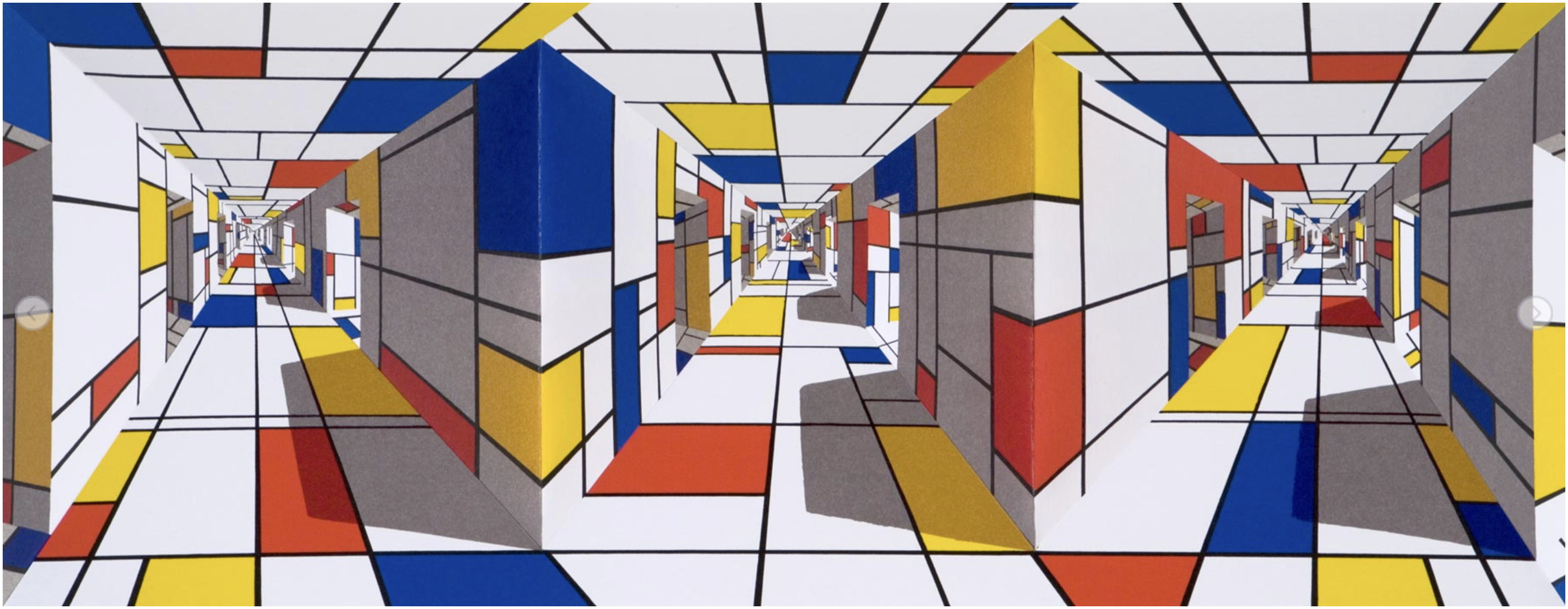
One of us (PH) is most well-known for his “Reverspective” artworks (Figure 1) in which the protruding physical structure is seen as receding when viewed from 100 cm or more away from the artwork (Hughes, 2018). In contrast, the physical structure of his more recent works - “Solid Hollows” - is receding but is seen as protruding towards the viewer. PH's first “Solid Hollow” was a pair of hollow dice (Figure 2) which is seen as convex (like a normal die) when viewed from 50 cm or more away. PH's dice were first displayed at the Kunsthalle Messmer gallery near Freiburg in Germany in 2022 and 2 months later at the Illusion Night during the 44th ECVP (European Conference on Visual Perception) in Nijmegen in the Netherlands. Over the past three years, PH has created a series of more complex “Solid Hollows” 1 , all of which share similar characteristics - a hollow, receding form (physically) that is seen as protruding (Figure 3).

(a) A frontal view of Patrick Hughes’ “Venice Vista”. The physical structure consists of three protruding truncated pyramids. (b) Seen from the side, the same Reverspective reveals the actual 3-D structure of the artwork.

(a) Patrick Hughes’ Hollow Dice. (b) Seen from the side, the same Hollow Die reveals the actual concave structure of the dice.

Patrick Hughes’ Solid Hollow: “Vincent's chair”.
Why do we see both Reverspectives and Solid Hollows as 3-D structures with a depth that is in the opposite direction to their physical shape? In the case of Reverspectives, it is generally accepted that the perspective information provided by the images of the receding ground plane and buildings in a Reverspective such as “Venice Vista” (Figure 1) overrides the binocular disparity information created by the contours of the physical structure (Papathomas, 2002; Rogers & Gyani, 2010; Rogers & Hughes, 2023; Rogers et al., 2024). This explanation is consistent with fact that viewers perceive the reversed structure at large viewing distances (when the disparities are small), while viewers perceive the structure as protruding at close viewing distances when the disparities are large. We have also noticed that Reverspectives that are based on real-world scenes (such as “Venice Vista” in Figure 1) are more likely to be seen as reversed in depth compared with those based on more abstract perspective images such as PH's “Purism” (Figure 4).
Patrick Hughes’ “Purism”.
Overall, it should not surprise us that the perspective information provided by a Reverspective is a more powerful source of 3-D information than binocular disparities when that Reverspective is viewed from beyond the viewer's personal space. Artists, for example, have long appreciated the power of perspective in their flat paintings. Moreover, many paintings typically face the same contradiction as a Reverspective: i.e., there is perspective information within the painting that contradicts the flatness 2 (uniform disparities) of the canvas on which the scene is painted.
Solid Hollows
Does this explanation of Patrick Hughes’ Reverspectives also apply to his Solid Hollows? In both cases, the binocular disparities created by the actual physical structures are ignored or overridden when the viewing distance is greater than ∼70 cm. And in both cases, the perceived depth of the 3-D structure is opposite in direction to the physical structure. However, the information that is responsible for the perceived depth in Reverspectives and Solid Hollows is quite different. In Reverspectives, the dominant source of contradictory information is perspective but bounding contours of the dice in PH's Hollow Dice provide only minimal (false) perspective, as can be seen in Figure 2b. (N.B. geometry tells us that objects that subtend a small visual angle create little or no perspective). Unlike Hollow Dice, Reverspectives such as “Venice Vista” (Figure 1), subtend a much larger visual angle (from a similar viewing distance) and the sides of the buildings and the width of the water surface have been given a very large amount of perspective, as can be seen in Figure 1a (a 3:1 size ratio). Hence, given that there is minimal (false) perspective in Hollow Dice, why do we see the reversed depth? We suggest that there must be a bias in the human perceptual system for seeing objects as convex rather than concave.
The convexity bias has been used to explain the well known hollow face illusion. Figure 5 is a photograph of a hollow mask of Beethoven. Figure 5 is only a flat picture but when viewing an actual hollow mask from a distance, observers see the mask as a protruding, convex structure, helped by the fact that there is only (weak) disparity information in the smooth contours of its true concave structure (Bülthoff & Mallot, 1988; Rogers & Hughes, 2023). BR's former Ph.D. supervisor, Richard Gregory (1980), suggested that we see the hollow mask as convex because we have had a lifetime of viewing normal convex faces and hence the “perceptual hypothesis” of a hollow face is very unlikely. Hill and Bruce (1993) have suggested an alternative explanation - that the bias towards seeing convexity in hollow masks is due to the fact that there are more convex objects in the world compared with concave objects. This statistical bias that has always been present throughout our evolution. The experimental evidence to support Hill and Bruce's suggestion is provided by the fact that the convexity bias also applies to other hollow objects such as their “hollow potatoes”, which are also seen as convex (Hill & Bruce, 1994). One could make the stronger claim that all objects necessarily have a bounding contour which defines the object as being ‘in front’ with respect to the background. Objects might have a 3-D structure that includes a concave region (like a cup or glass seen from above) but the object itself stands between the observer and the background and, as a consequence, it occludes that background.

A hollow mask of Beethoven that is seen as concave.
If there is a bias in seeing “objects” as convex then it is not surprising that Patrick Hughes’ Hollow Dice are seen as convex. Our conclusion is that the convexity bias, together with the limited perspective information, is sufficient to overrule the limited disparity information in the Hollow Dice.
Does the same logic apply to PHs’ “Vincent's chair” (Figure 3) and his delightful “Mountain Holiday” (Figure 6)? Both of these Solid Hollows subtend larger angular sizes than the Hollow Dice (when viewed from the same distance) and they both provide enhanced (false) perspective information. This can be seen in the photo of “Mountain Holiday” (Figure 6a). As a consequence, PH's Solid Hollows typically provide sufficient perspective information to specify the opposite depth to the actual 3-D structure, just like Reverspectives. In addition, the ‘objectness’ (convexity bias) of this Solid Hollow provides additional information to bias our perception in favour of seeing it as a convex structure.

(a) A frontal view of Patrick Hughes’ “Mountain Holiday”.
One of PH's recent Solid Hollows, “The Rule of Seven” (Figure 7), provides some important evidence about the roles and strength of these two factors (perspective and convexity bias). Unlike the Hollow Dice shown in Figures 2a and b (which have false (convergent) perspective), each of the faces in the seven cuboid structures in “The Rule of Seven” has parallel sides. Hence, from an observer's viewpoint, the receding faces of each of the cuboids provide a small amount of correct, divergent perspective which signals that each of the seven objects is concave. (This can be seen in the slight divergence of physically “parallel” contours of the cuboids in Figure 7). But this is not what we perceive. We see “The Rule of Seven” artwork as a series of protruding cuboids. This provides clear evidence for role of a convexity bias in the human visual system. However, we have also observed that the “flipping point” (when the perception flips from convex to concave as the observer approaches the artwork) is typically around 2–3 m from the artwork - i.e., at a greater distance than the “flipping point” for a typical Solid Hollow. This suggests that the small amount of divergent perspective shown in “The Rule of Seven” can overrule the convexity bias when the observer reaches a distance of 2–3 m from the artwork.

Patrick Hughes’ “the Rule of Seven”.
There is one additional feature of PH's Solid Hollows that is worth mentioning. Because both the Hollow Dice and the Solid Hollows have concave (hollow) physical shapes, the bounding, outer contours of these artworks are necessarily at some distance in front of the background (see Figure 2b and 6b). As a result, those bounding contours provide a convergent (or crossed) disparity (with respect to the background) so that those contours are seen to be located well in front of the background - i.e., a Hollow Die or Solid Hollow becomes an “object” that lies in front of the background. However, within the bounding contour, the combination of the false perspective and the convexity bias is sufficient to override the uncrossed disparities of the enclosed area of the artwork.
The Role of Observer Movement in Solid Hollows and Reverspectives
For most observers, the perception of the reversed depth in a Solid Hollow or a Reverspective is striking enough but an even more impressive percept and a greater sense of depth is created when the observer moves from side-to-side (or up-and-down). When the observer moves from side-to-side, the 3-D structure of a Reverspective appears to rotate around a vertical axis in the same direction as observer's movements: i.e., when the observer moves from left to right, the 3-D structure appears to rotate in an anticlockwise direction (as seen from above) and vice versa during observer movements to the left - in other words, the structure “follows” the observer's movements (Figure 8c). In addition to the vivid “following motion”, most observers report that the 3-D structure appears to have significantly more depth, compared with that seen by a stationary observer.

(a) A plan view of the eye of a monocular observer moving from left-to-right while viewing a protruding truncated pyramid (as in a Reverspective). (b) The parallax transformation created by that observer's movement is equivalent to a clockwise rotation of the truncated pyramid with respect to the observer's line-of-sight. (c) The same parallax transformation is also created when the observer moves left-to-right while seeing a depth-inverted truncated pyramid (as a result of the perspective information on the sides of the pyramid), such that it appears to rotate in the same direction with respect to the observer's line-of-sight - i.e., counter-clockwise.
What is the explanation? In 2010, Rogers and Gyani suggested that the motion parallax created by the side-to-side movements of the observer when viewing the reversed 3-D structure of a Reverspective is consistent with the rotation of the scene in the same direction with respect to the observer's line of sight (Figure 8c) but see Papathomas (2017). Geometrically, the extent of the rotation should be double the angle of rotation with respect to the observer's line of sight (Figure 8c), and this is what many observers report.
Rogers and Gyani (2010) also suggested that the appearance of “following” motion (with respect to the observer's line of sight) when an observer moves from side-to-side while viewing a hollow mask is also consistent with the observer's perception of rotation of the mask in the same direction and double the amount of rotation, with respect to the observer's line of sight (Figure 9c).

(a) A plan view of the eye of a monocular observer moving from left-to-right while viewing a hollow mask (Figure 5). (b) The parallax transformation created by the observer's movement is equivalent to a clockwise rotation of the face with respect to the observer's line-of-sight. (c) The same parallax transformation is also created when the observer moves left-to-right while viewing a depth-inverted hollow mask (i.e., when it is perceived to be convex) that rotates in the same counter-clockwise direction with respect to the observer's line-of-sight and with double the angle of rotation, in accordance with the geometry.
We think that a similar explanation can account for the apparent rotation of PH's Hollow Dice and Solid Hollows when the observer moves from side-to-side. As a consequence, we have found yet another similarity between Reverspectives and Solid Hollows. While the physical structures of Reverspectives and Solid Hollows are different - the first a protruding structure and the second a concave structure - the perception of both reversed depth and the “following motion” is common to both (Figures 8c and 9c).
We now have an explanation of why we perceive the “following” rotation of Solid Hollows and Reverspectives but we have neglected an important consequence of the motion parallax. As mentioned previously, the majority of observers report that the perceived depth in both Solid Hollows and Reverspectives is substantially enhanced when they move their heads from side-to-side (Rogers & Hughes, 2023). However, this should not surprise us given that the perceived depth from motion parallax alone can be comparable in magnitude to that produced by binocular disparities (Rogers, 2016; Rogers & Graham, 1979).
Observer-Produced and Object-Produced Motion Parallax
So far, we have only considered the motion parallax that is created by the side-to-side movements of the observer - i.e., “observer-produced” parallax (Rogers, 1993; Rogers & Graham, 1979). But motion parallax is also created when a 3-D object translates along a straight line path across the observer's line-of sight - i.e., “object-produced” motion parallax. Geometrically, the parallax transformation created is the same in both cases and this is evident when a Reverspective or Solid Hollow is translated along a straight-line path in front of a stationary observer. Most observers report seeing the appearance of reversed depth in both cases. Whilst the optic flow (motion parallax) might be the same in both cases, there is an important difference: in “observer-produced” parallax, the optic flow is created by the observer's own movements, which can be sensed both proprioceptively and from the vestibular system. (Note that this is also true for the parallax created by the 3-D structure of natural scenes).
It might be assumed that the addition of proprioceptive and vestibular information enhances the perception of the 3-D structure and layout of objects in the world, but is this the case? As far as we are aware, there is no experimental evidence to answer this question either way. On theoretical grounds, it could be argued that because similar optic flow is created in both self-motion and stationary-observer situations, this is what the visual system has evolved to rely on. For example, similar optic flow is created when we are translated through the world by a car or train - situations which produce no (relevant) proprioceptive information and minimal vestibular information when the car or train moves at constant speed. But this does not preclude the possibility that the additional proprioceptive and vestibular information might enhance the observer's perception of depth.
‘Virtual’ Reverspectives and ‘Virtual’ Solid Hollows
The majority of earlier studies of Reverspectives have used the technique of asking observers to walk towards a Reverspective from a distance of several meters (when they see the 3-D structure as reversed in depth), until they reach the point when the perceived depth “flips” to that of the actual, physical structure (Papathomas, 2002; Rogers & Gyani, 2010; Rogers & Hughes, 2023). The “flipping point” (Gregory, 2005) is typically at a distance of between 50 and 100 cm. However, the results of experiments that use this technique are open to a number of different interpretations. As the observer nears a Reverspective, the disparity differences between the tops of the pyramids and the background increase and therefore make it more likely that the observer will see the shape of the actual 3-D structure. But at the same time, the angular size of a Reverspective also increases. Does size matter? In those previous studies of Reverspectives, these factors are confounded.
To address this issue, we have created “Virtual Reverspectives” in which each of the different factors can be manipulated independently. To do this, we asked observers to view the stereoscopic images presented on either a 3-D TV screen with polarising glasses or projected onto a non-depolarising screen and viewed with polarising glasses (Rogers et al., 2024). Unlike a conventional Reverspective, the disparities presented in a “Virtual Reverspective” can be varied in both magnitude and in sign. There is a second advantage of using “Virtual Reverspectives” for experimental studies - there is no such thing as the “real” or “physical” depth. Instead, there is merely depth specified by disparities (on the one hand) and depth specified by perspective (on the other).
Finally, there is one surprising effect for which we have no satisfactory explanation. Consider the situation in which the disparities in a Reverspective are increased to the point when the observer reports sees the “flipped” disparity-specified 3-D structure (i.e., the depth is no longer reversed). We have noted that, if the observer is asked to move her/his head from side-to-side at this particular distance, most observers report that the perception “flips” back to seeing a 3-D structure with reversed depth. Moreover, the reversed depth is also accompanied by “following motion” (with respect to the observer's line-of-sight).
Conclusions
From PH's point-of-view, both Reverspectives and Solid Hollows are intriguing and beautiful artworks that have been admired and enjoyed by artists and non-artists alike. From BJR's point-of-view, Reverspectives and Solid Hollows have provided vision scientists with a valuable tool to investigate the role and contribution of different sources of 3-D information. In the nineteenth century, von Helmholtz (1910) suggested that binocular disparities and convergence of the eyes were “primary cues” for 3-D vision, whereas perspective and the other “pictorial” cues were regarded as “secondary”. Even today, many people still assume that having two eyes and binocular vision is essential for perceiving the 3-D world. In contrast, both Reverspectives and Solid Hollows clearly show the importance of perspective, and the more limited importance of binocular disparities in the perception of scenes that lie beyond the observer's personal space. However, von Helmholtz (1910) was correct in identifying the importance of motion parallax as a source of 3-D information. In the 3rd volume of his “Treatise on Physiological Optics” (pp. 295–296) (written over 150 years ago), he wrote: “Suppose, for instance, that a person is standing still in a thick woods, where it is impossible for him to distinguish, except vaguely and roughly, in the mass of foliage and branches all around him what belongs to one tree and what to another …. But the moment he begins to move forward, everything disentangles itself, and immediately he gets an apperception of the material contents of the woods and their relations to each other in space, just as if he were looking at a good stereoscopic view of it.”
Footnotes

Author Contribution(s)
Funding
The authors received no financial support for the research, authorship, and/or publication of this article.
Declaration of Conflicting Interests
The authors declared no potential conflicts of interest with respect to the research, authorship, and/or publication of this article.