



Abstract
At sunset, your shadow can be more than 10 times longer than your own height. This long shadow may appear to have a disproportionally small head and long legs, but the disproportion is not in the physical shape of the shadow. The head looks tapered because it is far away and is viewed from a fixed position. But unlike any other long object, our own shadows seem to fascinate us. We discuss the reasons behind this unique phenomenon.
Keywords
How to Cite this Article
Kaneko, S., & Anstis, S. (2026). Me and my shadow: Elongated sunset shadows disrupt size constancy. i–Perception, 17(0), 1–4. https://doi.org/10.1177/20416695261418499
Your shadow at sunset can be really long—it will be elongated vertically to 1, 5, or 10 times your body height when the sun is respectively 45°, 11. 3°, or 5.7° above the horizon (Casati & Cavanagh, 2019). You may notice that the shadows of your own feet and legs look large while the shadow of your head looks absurdly small (Figure 1A). Is this because your shadow really is physically tapered, being wide at your feet and narrow at your head and shoulders?

(A) A photographer's elongated shadow. From this person's perspective, the shadow appears to have disproportionally large and long legs and a small head. (B) A view from the head end. Now the head looks much larger than the feet. (C) Because the sun is infinitely far away, the light rays that cast the shadow are all parallel and only stretches the figure lengthwise without distortions.
Figure 1 gives the answer. Figure 1A shows the photographer's own elongated shadow, in which the head looks much smaller than the feet. However, when viewed from the head end the same shadow looks very different with an enormous head and tiny feet (Figure 1B). Furthermore, geometry tells us that the projections of the feet and head are the same size. Since the sun is at optical (near-)infinity, the proportions of the body are perfectly preserved, and this proportionate shadow would be seen correctly by a bird that flew directly overhead (Figure 1C). The apparently tiny head is a perspective effect: the retinal image of the head's shadow is small because it is far away. But it is mistakenly interpreted as a small object instead of as a faraway object.
We are not the first to observe the interesting distortions of shadows. Artists have long studied shadows (McCouat, 2023), and mountaineers have noted the distorted shadows sometimes cast by mountains. Livingston and Lynch (1979) showed that all mountain peaks, whatever their actual shapes, cast triangular shadows to an observer at the summit when the sun is low. The apparent pointiness of mountain shadows was closely analogous to the apparent convergence of long straight railroad tracks. These striking effects were purely geometrical, with no perceptual effects involved. In the same way, the retinal image of the head in our own long shadow becomes smaller and pointy owing to geometrical perspective. One might expect that size constancy should compensate for such distortion. But size perception is notoriously sensitive to context; Norman et al. (2022) showed that young and old people are extremely good at judging the size of objects in the presence of strong perspective cues, but their performance was very poor in complete darkness. Our elongated shadows probably give intermediate perspective cues so that size constancy is imperfect and head size is underestimated because of its small retinal image.
Thus, the effect of perspective is certainly not restricted to our shadows. The end of a long corridor looks narrower, or a long shadow of a tall tree looks tapered too. Yet we do not generally assume that the end of the corridor is physically narrower, or the tree is tapered. Still, most observers naïvely believe that our own long shadows are actually tapered as they lie on the ground. We asked undergraduate students (N = 104) to indicate a long shadow's shape seen from directly overhead (Figure 2A). They responded by ticking along a scale (Figure 2B) that showed three sample shadows with different tapers (ratio of head to feet sizes were; left: 33.3%, midpoint: 100%, right: 300%). Most students (N = 79, 76%) chose the left-hand side of the scale, which suggest that most believe that a sunset shadow really is physically tapered. The median taper of the responses was 56.1%.
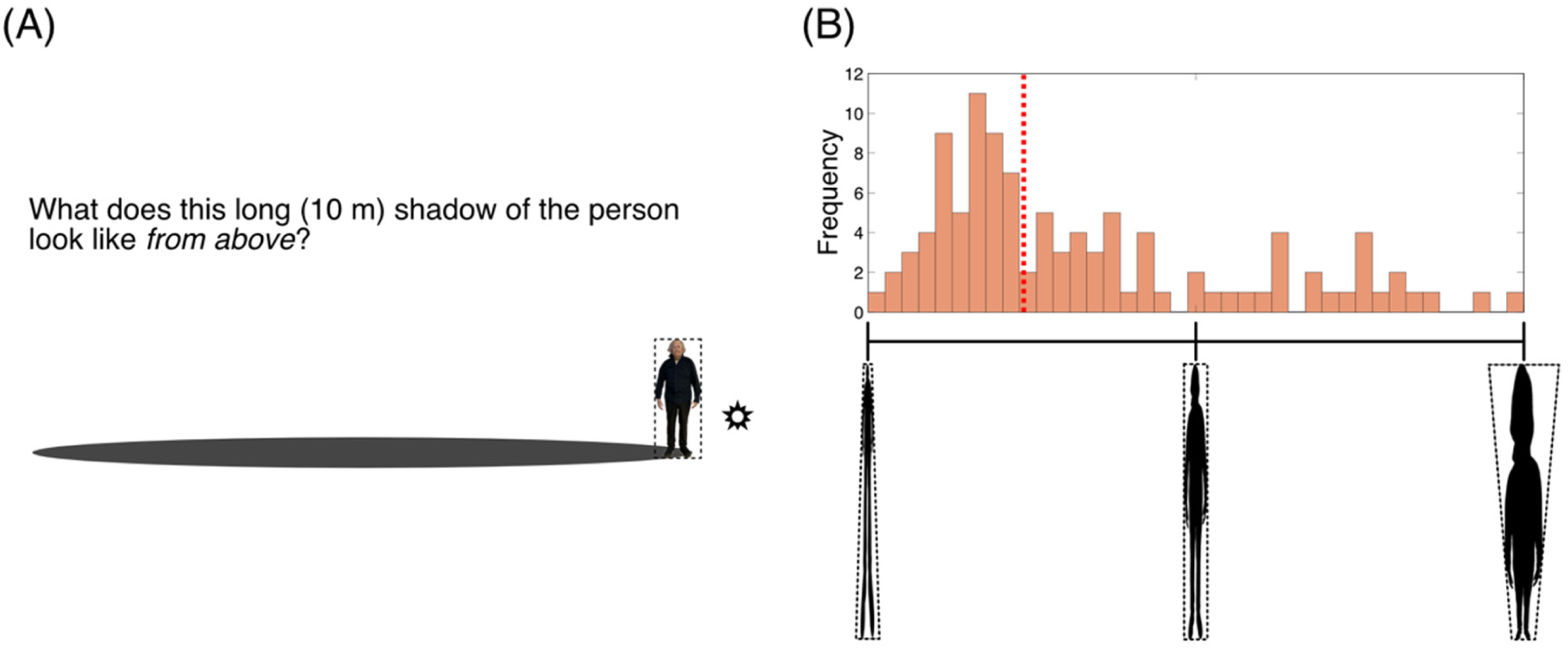
(A) Observers were asked to mentally visualize an elongated shadow of a person seen from above. (B) Histogram of their responses (N = 104); the dotted line represents the median, showing that the majority believed that the shadow really does have a tiny head.
We demonstrated this phenomenon at the 2025 Vision Sciences Society meeting, by means of an artificial replica of a person's elongated shadow. We prepared a vastly elongated photograph of one of the authors (SA) printed on a long roll of paper. This photo was of the normal width of a person but was ∼11 m long, which stretched the height by a factor of ∼6.1. Its contour was also traced on to a long roll of black vinyl to create an artificial shadow. We laid out both of these out on the floor (Figure 3). Observers stood at both the feet-end and the head-end of both “shadows” to examine their shape and size, and most observed that changing their viewpoint strikingly altered their perception.
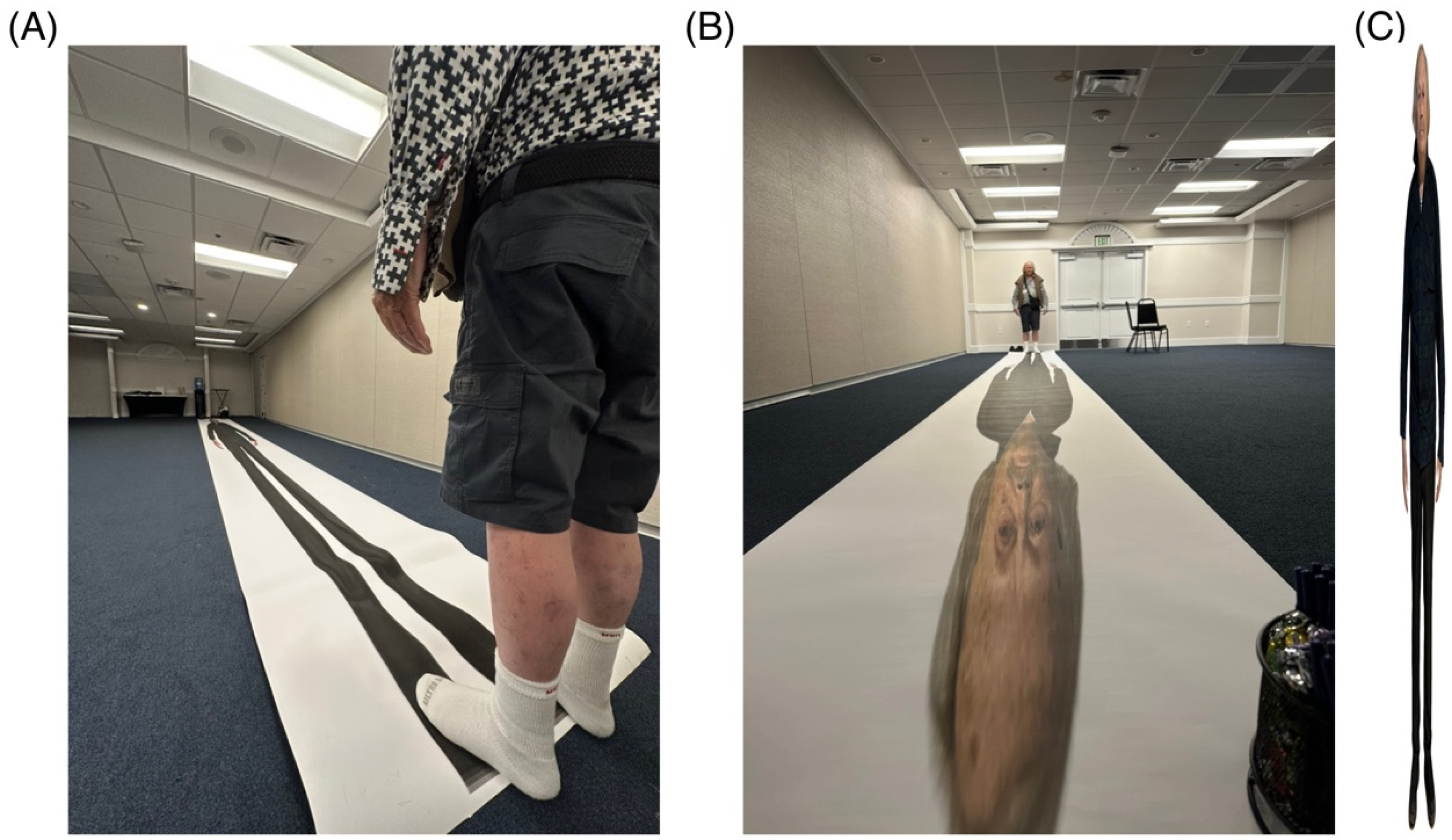
SA viewing the elongated photograph of himself. (A) The photograph is stretched vertically without any change in its proportion. (B) The same photograph from the head end. (C) The actual stretched photograph used in this demonstration.
If we know and understand the effect of perspective, why does our own shadow still appear so distorted? It seems to break shape and size constancy, more than any other long and narrow objects in life. The shadow of a rectangular wooden plank the same height as a person might also look tapered, but we would find this less fascinating.
We suggest two reasons for this. One, we blindly believe that we know our own body shape, both visually and proprioceptively (de Vignemont et al., 2021). The long and distorted shape of our own body on the ground betrays our firm and concrete expectation so much that we fail to discount the effect of perspective. Two, unlike any other perspective-distorted retinal image, our own shadow can only be seen from a particular fixed position, and we can never walk around it to see its “true” shape and size. The lack of experience may explain the loss of such constancy.
The unexpected failure of constancy demonstrates how little we understand our own visual abilities.
Footnotes
Acknowledgments
We thank Brian Rogers, who first called our attention to the visual properties of sunset shadows.

Author Contribution(s)
Funding
The authors disclosed receipt of the following financial support for the research, authorship, and/or publication of this article: This work was supported by the Japan Society for the Promotion of Science (Grant No. 23H00078).
Declaration of Conflicting Interests
The authors declared no potential conflicts of interest with respect to the research, authorship, and/or publication of this article.