




Abstract
The color-dependent Fraser–Wilcox illusion is an illusion in which still images appear to move, and it has been reported that the direction of the illusory motion reverses depending on the illuminance level. Furthermore, preliminary observations suggest that the color temperature of the illumination also affects this reversal phenomenon of the illusion. In the present study, in addition to illuminance, we investigated how the color temperature affects the illusory motion using two types of the color-dependent Fraser–Wilcox illusions: the red-purple type and the red-blue type. The direction and intensity of the illusory motion were rated at illuminance levels of 10, 20, 40, 80, 160, 320, 640, and 1280 lx under color temperature conditions of 3000 K and 6700 K. The results showed that the illusory motion in one direction predominated under high color temperature conditions, while the illusory motion in the opposite direction predominated under low color temperature conditions. Consistent with the previous study, we also observed that the motion occurred in the former direction under brighter conditions and in the latter direction under darker conditions. Although the red-purple type was on average more dominant than the red-blue type in the former direction of motion, both types showed the same switching of illusory motion direction under high and low illumination conditions.
Keywords
How to cite this article
How to cite this article
Nishikawa, M., & Kitaoka, A. (2026). The effects of color temperature and illuminance on the color-dependent Fraser–Wilcox illusion. i-Perception, 17(1), 1–15. https://doi.org/10.1177/20416695251412759
Introduction
The study of visual illusions has provided unique insights into the complexity of visual processing mechanisms and offered potential clues for understanding them. One particularly fascinating area is the study of illusions where stationary objects appear to move, among which the Fraser–Wilcox illusion demonstrates several intriguing phenomena. Stationary disks containing repeated luminance gradients appear to rotate spontaneously (Figure 1; Fraser & Wilcox, 1979). A notable characteristic of this illusion is that the perceived direction of rotation varies among observers. Some observers perceive rotation from dark to light regions along the luminance gradient, while others perceive rotation in the opposite direction. However, subsequent studies were unable to replicate this perceptual bistability (Faubert & Herbert, 1999; Naor-Raz & Sekuler, 2000), and consequently focused their investigations on the predominant illusory rotation from dark to light regions.

Fraser–Wilcox illusion created by the author based on the original figure from Fraser and Wilcox (1979, Figure 1). According to Fraser and Wilcox (1979), some observers saw the disk rotate clockwise while others saw it rotate counterclockwise.
The issue of perceptual bistability was resolved by Kitaoka and Ashida (2003), who demonstrated that the Fraser–Wilcox illusion comprises two distinct motion components that cancel each other. The first component generates illusory motion from dark to light regions, while the second induces motion in the opposite direction, from light to dark regions. When the two illusory components are aligned in the same direction, the resultant motion perception is more pronounced (Figure 2(a)) compared to the original configuration (Figure 2(b)).

(a) Kitaoka–Ashida's enhanced version of the Fraser–Wilcox illusion. The disk appears to rotate clockwise. (b) The sawtooth-luminance-profile arrangement of the Fraser–Wilcox illusion. The disk may appear to rotate clockwise or counterclockwise. (Reproduced from Kitaoka, 2014.)
The direction and magnitude of the original Fraser–Wilcox illusion as well as Kitaoka-Ashida's enhanced one are determined by luminance. However, the illusion can be enhanced by the use of colors, as demonstrated in the “Rotating Snakes” illusion (Figure 3; Kitaoka, 2003, 2017; Kuriki et al., 2008; Murakami et al., 2006; Otero-Millan et al., 2012; Uesaki et al., 2024). Furthermore, different chromatic variants have been documented, in which color is indispensable to create illusions (Kitaoka, 2014; Kitaoka & Yanaka, 2013). These variants are termed the color-dependent Fraser–Wilcox illusion (Figures 4 and 5). Figure 6 shows Kitaoka's (2012) classification of the Fraser–Wilcox illusion including the color-dependent Fraser–Wilcox illusion, along with his proposed basic figures for them. Accordingly, this paper adopts a broad definition of the “Fraser–Wilcox illusion,” encompassing not only the original type but also variants such as the “Rotating Snakes” and the color-dependent type.

An illusion work Rotating Snakes created by Kitaoka (2003). Each disk appears to rotate clockwise or counterclockwise. The direction of illusory motion is from black to blue, white, yellow, back to black.

The color-dependent Fraser–Wilcox illusion, the red-purple type. Each disk appears to rotate clockwise in bright conditions: that is, the direction of illusory motion is from dark purple (1) to purple (2), light purple (3), red (4), back to dark purple (1). On the other hand, each disk appears to rotate counterclockwise in dark conditions: that is, the direction of illusory motion is from dark purple (1) to red (4), light purple (3), purple (2), back to dark purple (1). The described RGB values are the parameters for the four main colors in this stimulus. These colors were empirically determined by the second author to maximize the illusion effect. Please note that readers will likely view this image on a display rather than in print. In such cases, the illusion under bright conditions is expected to be visible. To observe the illusion under dark conditions on a display, it is recommended to use a 16- or 32-degree neutral density filter. (Reproduced from Kitaoka, 2014.)
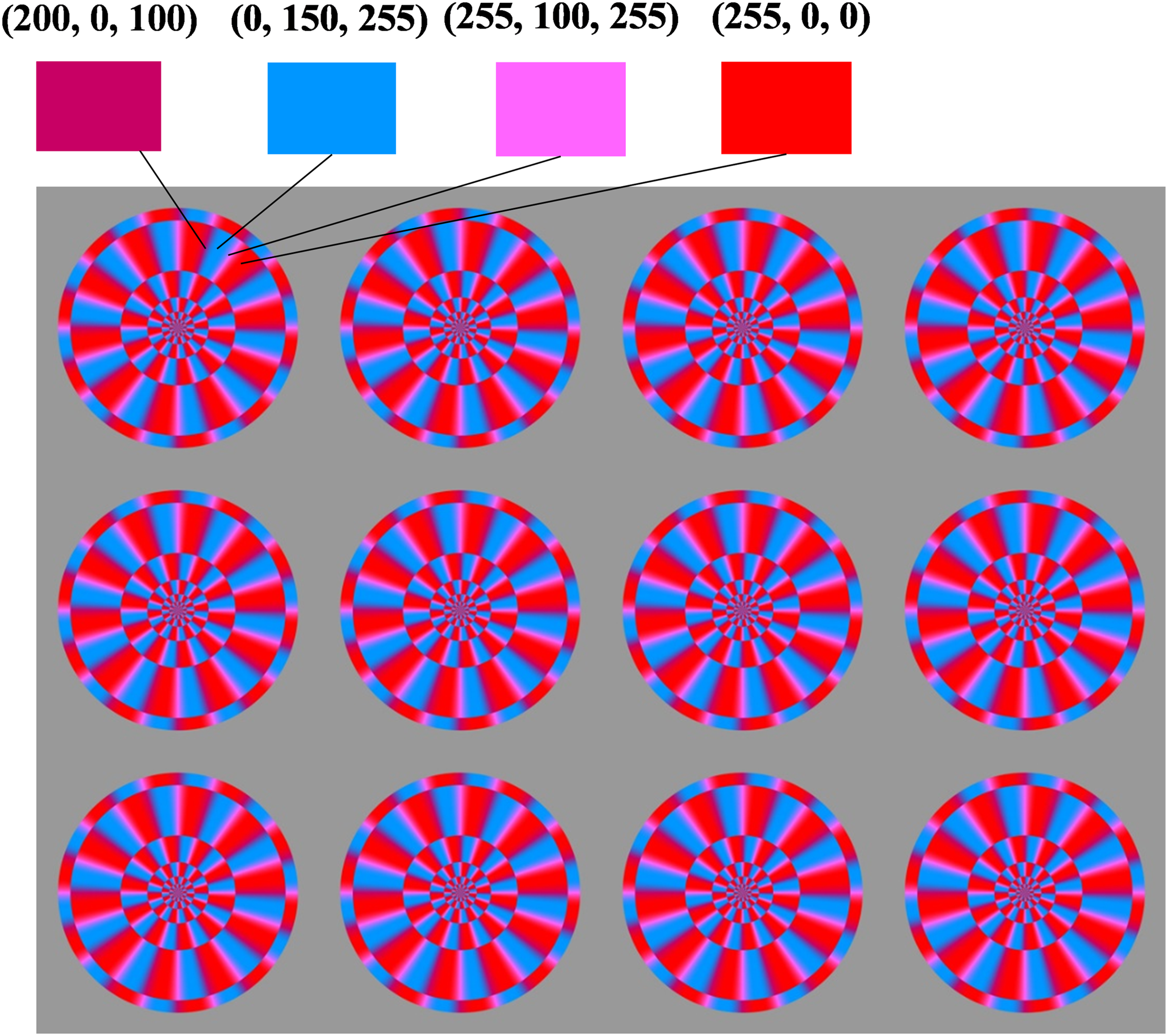
The color-dependent Fraser–Wilcox illusion, the red-blue type. Each disk appears to rotate clockwise in bright conditions, whereas each disk appears to rotate counterclockwise in dark conditions. The described RGB values are the parameters for the four main colors in this stimulus. These colors were empirically determined by the second author to maximize the illusion effect. Please note that readers will likely view this image on a display rather than in print. In such cases, the illusion under bright conditions is expected to be visible. To observe the illusion under dark conditions on a display, it is recommended to use a 16- or 32-degree neutral density filter. (Reproduced from Kitaoka, 2014.)

A classification of the Fraser–Wilcox illusion group. This classification was first presented in Kitaoka (2012), in which the color-dependent type was labeled Type V. This image is the current version revised in 2013, which was distributed as a handout of Kitaoka and Yanaka (2013) in ECVP2013.
What is notable about the color-dependent Fraser–Wilcox illusion is that many people have been reported to perceive the pattern as moving in one direction under bright illumination and in the opposite direction under dark illumination (Kitaoka, 2014; Kitaoka & Yanaka, 2013). The optimal condition for inducing these illusions is that a spatial arrangement of long-wavelength and short-wavelength color regions that flank the darker or brighter strips, as shown in Figure 7. Figure 7(a) is an image made up of long- and short-wavelength color regions flanking a thin strip that is darker than the two regions, and Figure 7(b) is an image made up of long- and short-wavelength color regions flanking a thin strip that is brighter than the two regions. In bright conditions the darkest strip in Figure 7(a) appears to move in the direction from the long-wavelength region to the short-wavelength one, while the brightest strip in Figure 7(b) appears to move in the direction from the short-wavelength region to the long-wavelength one. In dark conditions the directions of illusory motion are just the reversals. In Figure 4, the long-wavelength color region is red (4), the short-wavelength one is purple (2), the darkest strip is dark purple (1), and the brightest strip is light purple (3). All disks are arranged with their patterns oriented in the same direction, and are designed to appear to rotate clockwise under bright conditions and counterclockwise under dark conditions.

Diagram of supposed elements of the color-dependent Fraser–Wilcox illusion. (a) An image made up of long- and short-wavelength color regions flanking a thin strip that is darker than the two regions. (b) An image made up of long- and short-wavelength color regions flanking a thin strip that is brighter than the two regions. In bright conditions the darkest strip in (a) appears to move in the direction from the long-wavelength region to the short-wavelength one, while the brightest strip in (b) appears to move in the direction from the short-wavelength region to the long-wavelength one. In dark conditions the directions of illusory motion are just the reversals. (Reproduced from Kitaoka, 2014.)
Kitaoka (2014) set up both bright and dark lighting conditions during several lectures and classes, asking attendees to evaluate their perception of the color-dependent Fraser–Wilcox illusion. At those times, the data were not obtained in a laboratory setting where lighting conditions were strictly controlled. Furthermore, Kitaoka (2019) suggested that the color temperature of illumination also affects the direction of rotation. At that time, the study included only three participants. In the present study, we conducted observations of the illusion under controlled experimental conditions with the aim of investigating how color temperature, in addition to illuminance, affects the illusion. We employed two variants of the color-dependent Fraser–Wilcox illusion as stimulus figures: the red-purple type (Figure 4) and the red-blue type (Figure 5), which were identical to those used in the previous studies. Based on previous reports and observations, it is expected that the disks will appear to rotate clockwise under high illuminance and high color temperature conditions, while counterclockwise illusory motion will be predominant under low illuminance and low color temperature conditions.
Methods
Participants
Ten adults (five females and five males; mean age: 24.6 years; age range: 19–57 years) participated in the study in accordance with the ethical standards stated in the Declaration of Helsinki. Nine participants were undergraduate or graduate psychology students, and one male was a professor of psychology. Both authors participated. They were recruited from Ritsumeikan University. No one reported a color vision deficiency.
Stimuli and Apparatus
The stimuli were two different images of the color-dependent Fraser–Wilcox illusion: the red-purple image (Figure 4) and the red-blue image (Figure 5). These two images were printed on an A3-sized sheet of paper using a printer (PX-5V, EPSON). Participants observed the stimuli in a dark room where the color temperature and illuminance could be controlled (Figure 8). The color temperature conditions were 3000 K and 6700 K, and the illuminance conditions were 10 lx, 20 lx, 40 lx, 80 lx, 160 lx, 320 lx, 640 lx, and 1280 lx. The light sources were 3000 K fluorescent lamps (FL20SS·EL/18M, Panasonic) and 6700 K fluorescent lamps (FL20SS·EX-D/18M, Panasonic). The illumination adjusted using a dimmer (NQ21535Z, Panasonic).

The dark room used in the study.
Procedure
The sessions at 3000 K and 6700 K were conducted separately. For each color temperature condition, trials were performed to increase the illuminance from 10 lx to 1280 lx and to decrease it from 1280 lx to 10 lx. Firstly, participants sat in the chair in the dark room and adapted to each lighting condition for 3 minutes. Secondly, they were instructed not to close their eyes or fall asleep during the adaptation period, but they were allowed to look anywhere in the dark room. After adaptation, participants observed the two illusion images and rated the perceived illusory rotation for each condition according to Table 1. The viewing distance was approximately 50 cm. Participants were given a 5-minute break between the sessions of 3000 K and 6700 K, and the order of sessions was counterbalanced across participants.
Rating scales of illusory rotation.

Results
The results are presented graphically in Figure 9. With respect to color temperature, the disk tended to appear to rotate clockwise under high color temperature conditions and counterclockwise under low color temperature conditions. With respect to illuminance, the disk tended to appear to rotate clockwise under brighter conditions and counterclockwise under darker conditions. With respect to figure type, the red-purple (RP) type exhibited stronger clockwise illusory rotation compared to the red-blue (RB) type. These results were confirmed by a three-way analysis of variance (ANOVA) with color temperature (2) × illuminance (8) × figure type (2). The analysis revealed significant main effects of color temperature (F (1, 9) = 5.257, p = .048, partial η2 = .369), illuminance (F (7, 63) = 28.072, p < .001, partial η2 = .757), and figure type (F (1, 9) = 8.622, p = .017, partial η2 = .489). The two-way interactions between color temperature and illuminance or between color temperature and figure type were not significant (color temperature and illuminance: F (7, 63) = 0.807, p = .585, partial η2 = .082; color temperature and figure type: F (1, 9) = 0.000, p = 1.000, partial η2 = .000). But the interaction between illuminance and figure type was significant (F (7, 63) = 4.119, p < .001, partial η2 = .314), and while there was no significant difference in scores between 10 lx and 20 lx, the red-purple type showed higher scores in the range of 40–1280 lx. That is, both figure types commonly showed higher scores with clockwise dominance as illuminance increased, and the difference was only to the extent that the red-purple type showed a faster increase in scores than the red-blue type. The three-way interaction was not significant (F (7, 63) = 1.135, p = .353, partial η2 = .112).

Results of the direction and strength of motion illusions based on variations in color temperature, illuminance, and figure type. RP indicates the red-purple type of figure, and RB indicates the red-blue type. As a result, disks tended to appear to rotate clockwise under high color temperature conditions or under bright conditions, whereas they tended to appear to rotate counterclockwise under low color temperature conditions or under dark conditions. As a reference for readers observing these images on a display, we measured the luminance of the images on our laboratory display in a bright room (approximately 1000 lx on the desk), and the results were as follows. The average luminance of the disk of Figure 4 (RP) was approximately 47 cd/m2 on a LCD display (EIZO FlexScan EV2785), and the disk of Figure 5 (RB) was 49 cd/m2. These values corresponded to a brightness level approximately midway between the luminance levels of the disks under the 640 lx and 1280 lx conditions for both color temperature settings. Specifically, at 640 lx, the average luminance of the disk of Figure 4 was approximately 36 cd/m2, and that of the disk of Figure 5 was 37 cd/m2 under both color temperature conditions. At 1280 lx, the average luminance of the disk of Figure 4 was approximately 60 cd/m2, and that of the disk of Figure 5 was 60 cd/m2 under both color temperature conditions.
Regarding the boundary where illusory reversal occurs between clockwise and counterclockwise perception, it was around 320 lx under 3000 K illumination and around 80 lx under 6700 K illumination for the red-purple type. On the other hand, for the red-blue type, it was around 450 lx under 3000 K illumination and around 200 lx under 6700 K illumination.
Discussion
In the present study, we investigated the effects of color temperature and illuminance of lighting on the color-dependent Fraser–Wilcox illusion through a controlled experiment. Results showed that the color temperature affected the perceived rotation direction of the disks shown in Figures 4 and 5: the disks predominantly rotated clockwise under high color temperature conditions and counterclockwise under low color temperature conditions. Consistent with Kitaoka (2014), the disks appeared to rotate clockwise under high illuminance conditions and counterclockwise under low illuminance conditions. With respect to figure type, the clockwise rotation was more pronounced in the red-purple figures compared to the red-blue figures. While previous studies (Kitaoka, 2014, 2019) suggested the illuminance and color temperature effects on rotation direction through observational findings, our study provided quantitative evidence confirming these effects.
Although the present study demonstrated that the color temperature and illuminance of lighting when viewing the illusion bring about dramatic changes in the rotation of the illusion, other factors that affect rotation have also been reported. For instance, in related Fraser–Wilcox illusions including the Rotating Snakes illusion, the rotational motion is more pronounced in peripheral vision compared to central vision (Faubert & Herbert, 1999; Fraser & Wilcox, 1979; Hisakata & Murakami, 2008; Kitaoka & Ashida, 2003; Naor-Raz & Sekuler, 2000). Moreover, in the color-dependent Fraser–Wilcox illusion, shaking the image enhances the rotational effect (Yanaka & Hilano, 2011). This phenomenon is unique to the color-dependent Fraser–Wilcox illusions and is not observed in other Fraser–Wilcox illusions. Yanaka (2015) analyzed the patterns of the color-dependent Fraser–Wilcox illusion and proposed the hypothesis that this motion illusion depends on the difference in response speed among the three cones.
Factors contributing to the Fraser–Wilcox illusion, aside from the color-dependent type, include eye movements, pupil dilation, or luminance contrast (Backus & Oruç, 2005; Conway et al., 2005; Faubert & Herbert, 1999; Fermüller et al., 2010; Mather & Cavanagh, 2025; Murakami et al., 2006; Otero-Millan et al., 2012). Regarding eye movements, Murakami et al. (2006) examined fixational eye movements and found a positive correlation between fixation instability and the strength of illusory motion. Since we did not measure eye movements in this study, the effect on the color-dependent Fraser–Wilcox illusion remains unknown. Regarding pupil dilation, Mather and Cavanagh (2025) demonstrated that changes in pupil diameter induce illusions and that pupil dilation duration strongly correlates with the duration of perceived illusions. Since pupil diameter was not measured in our study, its effects remain unclear. They used the color-dependent Fraser–Wilcox illusion image (the one shown in Figure 4) as one of their stimuli. However, since they conducted their research using bright stimuli, it would be interesting to know whether the same effect occurs with the illusion under dark conditions. Regarding luminance contrast, Faubert and Herbert (1999) proposed that luminance information travels through the visual system at different latencies, with lighter information being processed faster than darker information, resulting in potential motion signals. Similarly, Conway et al. (2005) proposed that motion information arises from differential processing speeds in the visual system, where regions of high contrast relative to mean luminance are processed more rapidly than those of low contrast, rather than from the mere presence of bright areas. Although the stimuli used in this study were not isoluminant, the differences in luminance and contrast were relatively small, making it unlikely that these factors were the primary contributors.
Among potentially related phenomena, we consider reversed phi movement to be particularly relevant to our findings. Reversed phi movement refers to an illusory motion perceived in the direction opposite to the spatial displacement of an object (Anstis, 1970; Anstis & Rogers, 1975; Kitaoka, 2006). An example of reversed phi movement is shown in Movie 1 (Kitaoka, 2006, animation 1). In Movie 1, there are four rectangles, each flanked by thin lines that are either dark or light. When the luminance of the rectangles decreases and that of the background increases accordingly, the upper two appear to converge while the lower two appear to diverge. On the other hand, when the luminance of the rectangles increases and that of the background decreases accordingly, the upper two appear to diverge while the lower two appear to converge. In sum, the direction of apparent motion is from the dark flank toward the neighboring part that is darkening, or from the light flank toward the neighboring part that is brightening. Reversed phi movement is named for the phenomenon where movement appears to occur in the opposite direction of the target's positional shift. This illusion can also be characterized as a form of motion perception induced by changes in luminance. Figure 10 illustrates this phenomenon. Upward-pointing arrows indicate an increase in luminance in each region, while downward-pointing arrows indicate a decrease in luminance in each region. Right-pointing or left-pointing arrows indicate the direction of the apparent motion. As shown in Figure 10, in Figure 10(a), the regions flanking the dark strip, and in Figure 10(b), the regions flanking the bright strip, alternately become brighter or darker, thereby producing the motion illusion. The color-dependent Fraser–Wilcox illusion is also composed of dark strips, bright strips, and the regions flanking them, and the spatial configuration of the current illusion is similar to that of reversed phi movement. Changes in illumination, particularly those arising from blinking-induced variations in retinal illuminance, may trigger luminance fluctuations. These fluctuations can generate reversed phi movement in the illusion figure, manifesting as the color-dependent Fraser–Wilcox illusion.

Perceived motion in reversed phi movement. Upward-pointing arrows indicate an increase in luminance in each region, while downward-pointing arrows indicate a decrease in luminance in each region. Right-pointing or left-pointing arrows indicate the direction of the apparent motion.
Several phenomena unique to chromatic colors have been documented. First, the Abney effect is a phenomenon in which the hue of color stimuli changes with saturation (Abney, 1909). For example, when monochromatic light of unique blue around 475 nm is gradually mixed with white light while maintaining constant luminosity, the hue gradually becomes more reddish, changing to light purple or pink. Given that the Abney effect manifests as changes in hue, establishing a direct relationship with the current illusion presents considerable challenges. Second, the Bezold–Brücke hue-shift refers to the change in hue perception that occurs when luminance varies (Boynton & Gordon, 1965; Purdy, 1931, 1937). For wavelengths longer than around 510 nm, hue shifts toward yellow with increasing luminance, while for wavelengths shorter than around 510 nm, hue shifts toward blue with increasing luminance. Since the Bezold–Brücke hue-shift similarly manifests as changes in hue perception, its contribution to the present illusion is likely minimal. Third, the Helmholtz–Kohlrausch effect is a phenomenon in which colors with higher saturation appear brighter than colors with lower saturation at equal luminance levels (Kohlrausch, 1935). If the phenomenon of highly saturated colors appearing brighter due to this effect can be interpreted as an increase in perceived luminance, it may partially account for the present illusion. Fourth, the Helson–Judd effect is a phenomenon in which achromatic color samples appear colored depending on background lightness when observed after sufficient adaptation to highly saturated chromatic illumination (Helson, 1938; Judd, 1940). Specifically, samples with higher lightness than the background appear to take on the same hue as the illuminant, while samples with lower lightness than the background appear to take on the complementary color of the illuminant. However, since the Helson–Judd effect manifests as changes in hue, it is considered to be unrelated to this illusion. Fifth, the Hunt effect is a phenomenon in which the saturation of chromatic colors appears to increase when illuminance is increased under the same illuminant (Hunt, 1952, 1953). Although the Hunt effect might have occurred in this study due to increased illuminance, its relationship to the current illusion is difficult to establish. Sixth, the Liebmann effect refers to the melting or blurring of borders that occurs when viewing images composed of different hues at isoluminance (Liebmann, 1927). Since the present study did not employ isoluminant stimuli, the Liebmann effect is unlikely to be involved in this illusion. Seventh, the Stevens effect is a phenomenon in which black appears blacker and white appears whiter as illuminance increases when achromatic color samples are observed under white illumination (Jameson & Hurvich, 1961; Stevens, 1961). Since the Stevens effect manifests as perceptual changes in blackness and whiteness—specifically changes in lightness rather than luminance—its relationship to the current illusion is difficult to establish. In sum, if any known effect is involved in this illusion, it would likely be one that influences perceived luminance or luminance contrast. The Helmholtz–Kohlrausch effect may be the only plausible candidate among the phenomena discussed above.
Regarding the limitations and challenges of the present study, although the reversal phenomenon due to illumination and color represents a highly novel finding, much remains unknown about its relationship to previous research. As factors involved in the rotational motion of the Fraser–Wilcox illusion, eye movements, pupil dilation, and luminance contrast have been studied, and some studies have discussed individual differences such as age and genetic factors (Billino et al., 2009; Fraser & Wilcox, 1979; Kitaoka, 2017; Matsushita, 2015). The rotational motion in the Fraser–Wilcox illusion appears to involve multiple factors, warranting further detailed investigation of its relationships with previous findings. Our results provide potential insights into the mechanisms underlying illusory rotational motion and the complexity of visual processing.
Footnotes

Ethical Approval and Informed Consent Statements
The study was conducted in accordance with the ethical standards stated in the Declaration of Helsinki. Participants gave written informed consent. This study did not require ethics review according to the guidelines of the affiliated institution.
Author Contribution(s)
Funding
The authors disclosed receipt of the following financial support for the research, authorship, and/or publication of this article: This work was supported by Japan Society for the Promotion of Science (Grant-in-Aid for Scientific Research, 21H04426, A.K.).
Declaration of Conflicting Interests
The authors declared no potential conflicts of interest with respect to the research, authorship, and/or publication of this article.