



Abstract
Olfactory function plays a vital role in daily life but tends to decline with age, affecting health and wellbeing. While previous studies suggest a link between physical activities and olfactory function in older adults, the relationship between cognitive activity and olfactory function remains unclear, as do the combined effects of both activities. This cross-sectional study examined associations between physical and cognitive activity and three domains of olfaction (identification, sensitivity, and memory) in 583 community-dwelling older adults. Both types of activity were positively associated with overall olfactory performance. Physical activity exhibited the strongest link with olfaction identification, while cognitive activity was more closely related to olfaction memory. Furthermore, participants engaging in moderate-to-high levels of both activities achieved the best overall olfactory scores. These findings suggest that a combined lifestyle of physical exertion and cognitive engagement may help preserve olfactory function in aging, with implications for autonomy, safety, and quality of life.
How to cite this article
Wang, B., Tao, T., & Guo, W. (2025). Associations between physical and cognitive activities and olfactory function in older adults. i–Perception, 16(6), 1–12. https://doi.org/10.1177/20416695251399118
Introduction
Olfactory function typically declines with age, often without being noticed (Kondo et al., 2020; Olofsson et al., 2021). This deterioration can lead to safety and health risks in daily life, for instance, forgetting food cooking on the stove or failing to detect the smell of smoke. Importantly, olfactory decline is considered an early marker of neurodegenerative processes (Dan et al., 2021; Fatuzzo et al., 2023). Emerging evidence suggests that an active lifestyle may help preserve olfactory function in later life, providing a promising direction for intervention (Delgado-Lima et al., 2023; Sollai & Crnjar, 2023). Among lifestyle factors, physical activity has been consistently associated with better olfactory performance in older adults. Large-scale population studies have shown that higher weekly activity levels are linked to better olfactory ability (Shrestha et al., 2023). Moreover, longitudinal findings indicate that regular physical activity, such as exercising at least once per week, is associated with a reduced 10-year risk of olfactory impairment, with increased frequency further lowering this risk (Schubert et al., 2013).
Beyond physical activity, cognitive engagement may also play a role in maintaining olfactory function. Studies suggest that maintaining both physical and cognitive activity throughout midlife and older adulthood supports healthy aging (Livingston et al., 2020). Although evidence directly linking cognitive activity to olfactory function is limited, some findings are suggestive. For example, an 8-year longitudinal study identified cognitive activity as a predictor of both olfactory and cognitive decline (Dintica et al., 2021). Furthermore, cognitive behavioral interventions have been associated with a reduced risk of olfactory dysfunction (Reid et al., 2017). Despite growing interest in this area, few studies have directly examined how cognitive activity relates to olfactory function in older adults, particularly when considering multiple dimensions of olfaction such as identification, sensitivity, and memory. Specifically, olfactory identification refers to the ability to correctly recognize and name odors (e.g., smelling an orange and identifying it as “orange”), olfactory sensitivity reflects the minimum concentration of an odor that can be reliably detected (e.g., noticing the faint smell of perfume in a room), and olfactory memory denotes the ability to remember and later recognize previously encountered odors (e.g., recalling the smell of coffee from a past experience) (Jiang et al., 2025; Nie et al., 2023; Peng et al., 2025). Most existing research has relied on single-dimensional olfactory assessments, limiting our understanding of how lifestyle factors might differentially affect various olfactory processes. In addition, little is known about how the combination of physical and cognitive activities may jointly predict olfactory function.
To address these gaps, the present study investigates the associations between physical and cognitive activities and multiple aspects of olfactory function in a large sample of older adults. Specifically, we examine how different levels and combinations of these activities relate to olfactory identification, sensitivity, and memory. We hypothesize that both physical and cognitive activities will be positively associated with olfactory function, and that individuals engaging in higher levels of both activities will exhibit superior performance across olfactory dimensions.
Methods
Participants
This study initially recruited 629 individuals aged 60 and above from Jiangsu Province, China. Individuals were excluded if they (a) reported chronic nasal or respiratory disorders, (b) had current cold-like symptoms that could impair olfaction, (c) had a diagnosed mental illness, or (d) worked in occupations requiring heightened olfactory acuity (e.g., perfumers and sommeliers). After screening, 583 participants remained for analysis (M = 69.51 years, SD = 6.08; 50.6% female). All procedures complied with the Declaration of Helsinki, and written informed consent was obtained prior to testing. All assessments of physical and cognitive activities were administered directly by the authors.
Measures
Olfactory Function
Olfaction was assessed with a validated kit (Hanwang Technology Co., Ltd., China) comprising three subtests: olfactory identification, olfactory sensitivity, and olfactory memory. The olfactory identification section contains 8 scent bottles (8 trials), each filled with a different scent solution. For each trial, participants selected the correct odor from four choices, with a maximum score of 64 points. The olfactory sensitivity section consists of 4 scent bottles (4 trials), each containing a very low concentration of scent solution. In each trial, participants sniffed the bottle and then selected the correct odor from four options presented on the screen, with a maximum score of 20 points. The olfactory memory section consisted of four scent solutions (4 trials, labeled A–D). Participants sniffed each solution in sequence, spending up to one minute on each scent, and were instructed to memorize them as carefully as possible. After a 30s interval, they were presented with four bottles (labeled 1–4) and asked to identify which of the previously presented A–D scents each bottle matched, yielding a maximum of 16 points. Odors were delivered in bottles positioned 1 to 2 cm in front of the participant's nose, with a 30s interval between trials to minimize fatigue. A total of 13 different scents were used in the assessments. Specifically, the olfactory identification task included 8 scents (milk, red bean, star anise, vinegar, pineapple, mint, garlic, and durian); the olfactory sensitivity task included 4 scents (longan, lemon, corn, and Hami melon); and the olfactory memory task included 1 new scent and 3 previously presented scents (milk, vinegar, cola, and star anise). To increase task difficulty and minimize guesswork, several additional odor options (e.g., watermelon, soy sauce, orange, and grape) were included as distractors in the multiple-choice selection. The total score for the three sections is used to assess overall olfactory function. Scores are calculated automatically by the accompanying software, with higher scores indicating better olfactory function. The test employed odor items that are familiar and easily recognizable to the Chinese population, thereby enhancing its ecological validity and measurement accuracy. In addition, it directly assesses three olfactory domains: olfactory identification, olfactory sensitivity, and olfactory memory. This is different from the Sniffin’ Sticks and the University of Pennsylvania Smell Identification Test (UPSIT), which primarily focus on olfactory identification (Doty et al., 1984; Hummel et al., 1997).
Physical Activity
Physical activity was measured and calculated using the short version of the International Physical Activity Questionnaire (Craig et al., 2003), a widely recognized tool that includes questions about the types, duration, and frequency of physical activities performed in the past 7 days. The physical activity score used in our analyses was calculated by combining three intensity levels of activity. For each activity type, the score was computed as the product of the corresponding MET value, weekly frequency (days/week), and duration per day (minutes/day). Specifically, the MET values used were 3.3 for moderate walking, 4.0 for moderate strenuous activities, and 8.0 for strenuous activities. High physical activity was defined by the following criteria: engaging in strenuous activity on at least 3 days, a total METs expenditure greater than 1500 METs, and a cumulative energy expenditure of over 3000 METs across all three activities. Moderate physical activity was defined by the following criteria: engaging in strenuous activity on at least 3 days, with each session lasting at least 20 min, or a combination of moderate strenuous activity days and walking days totaling more than 5 days, with a total energy expenditure of more than 600 METs across all three activities. Low physical activity was defined as any situation not meeting the criteria for moderate or high physical activity.
Cognitive Activity
Cognitive engagement was quantified with the Verghese Cognitive Activity Scale, a clinically validated instrument exhibiting strong test–retest reliability (Lee, 2014; Verghese et al., 2003). The scale asks participants how often they engage in six mentally stimulating pursuits: reading newspapers or books, creative writing; solving crossword puzzles, playing board or card games, taking part in organized discussion groups and playing a musical instrument. Reported frequencies are weighted as seven points for daily participation, four for several times a week, one for once a week, and zero for less than weekly involvement. Summing the six items produces a composite score between 0 and 42. Consistent with published cut-offs, scores below 8 indicate low cognitive activity, 8 to 11 moderate activity, and 12 or higher high activity.
Statistical Analysis
SPSS 27.0 was used for data analysis. Pearson correlation was employed to assess the degree of association between variables. Analysis of variance (ANOVA) was then applied to compare olfactory function across participants with varying levels of physical and cognitive activity. Pairwise comparisons were performed using the Bonferroni correction, and a significance level of p < .05 was set for statistical results.
To visualize and assess the relationships between variables, the qgraph package in R was used for network analysis, utilizing the EBICglasso function (Epskamp et al., 2012). The network visualization illustrates the relationships between nodes (representing study variables) and edges (showing regularized partial correlations between variables). The expected influence centrality index was applied to evaluate the significance of each variable in the network, calculating centrality by summing the weighted values of direct connections between each variable and others (Robinaugh et al., 2016).
To assess the accuracy and stability of the network, the bootnet package in R was used (Epskamp et al., 2018), with 1,000 bootstrap samples to determine 95% confidence intervals for edge weights. If the confidence intervals for different edge weights show minimal overlap, it indicates higher estimation accuracy. Stability of node centrality indices was assessed through subset bootstrap, where a critical stability coefficient above 0.75 suggests good stability, and a value above 0.5 indicates acceptable stability (Ju et al., 2025).
Results
Descriptive Statistics
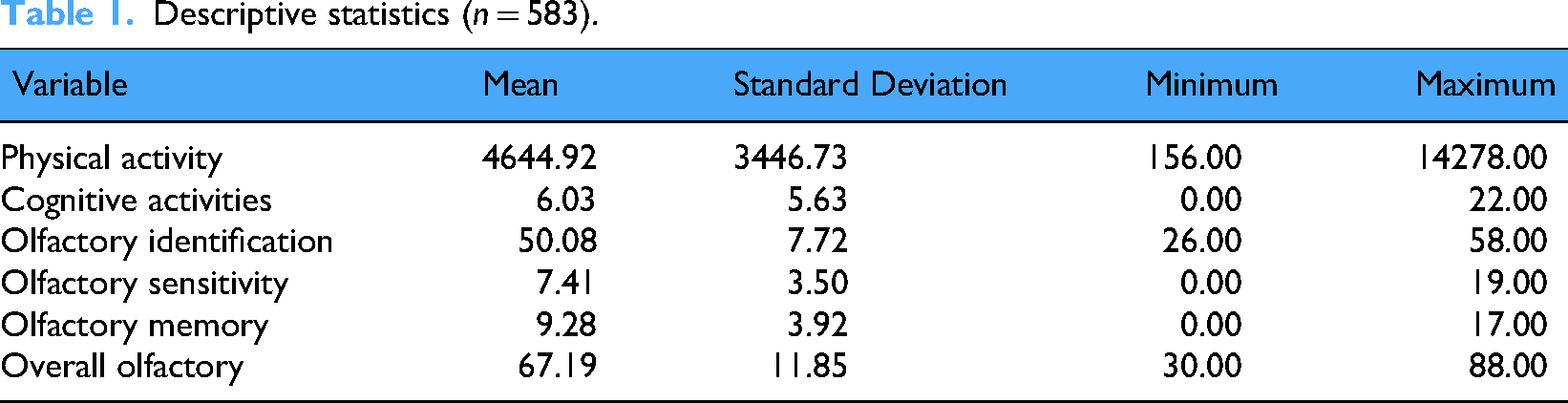
Among the 583 older adult participants included in the final analysis, the average age was 69.51 ± 6.08 years. The sample consisted of 295 females (50.60%) and 288 males (49.40%). Regarding physical activity, 332 participants were classified as high physical activity, 169 as moderate physical activity, and 82 as low physical activity. In terms of cognitive activity, 401 participants were classified as low cognitive activity, 78 as moderate cognitive activity, and 104 as high cognitive activity. Descriptive statistics for physical activity, cognitive activity, and olfactory function are presented in Table 1.
Descriptive statistics (n = 583).
Correlation Analysis
Pearson correlations were calculated for the variables, as shown in Table 2. The physical activity, cognitive activities, and olfactory function of older adults are positively correlated with each other (p < .001). Physical activity is strongly correlated with overall olfactory function (r = 0.62) and olfactory identification (r = 0.63), while cognitive activities are most strongly correlated with olfactory memory (r = 0.67, see also in Supplemental Figures S1–S2). These results suggest that different types of activities may be associated with various aspects of olfactory function to varying degrees.
Correlations between physical activity and olfactory test scores.

***The correlation is significant at the 0.001 level (2 tails).
Network Analysis
To further explore the relationships and structure among different variables, network analysis was employed. The structural connections between the variables are illustrated in the network visualization (Figure 1). Each node represents a variable, while the edges show the relationships between them. Positive relationships are represented by red solid lines. The strength of these relationships is reflected in the edge thickness, with thicker edges signifying stronger connections between the nodes.
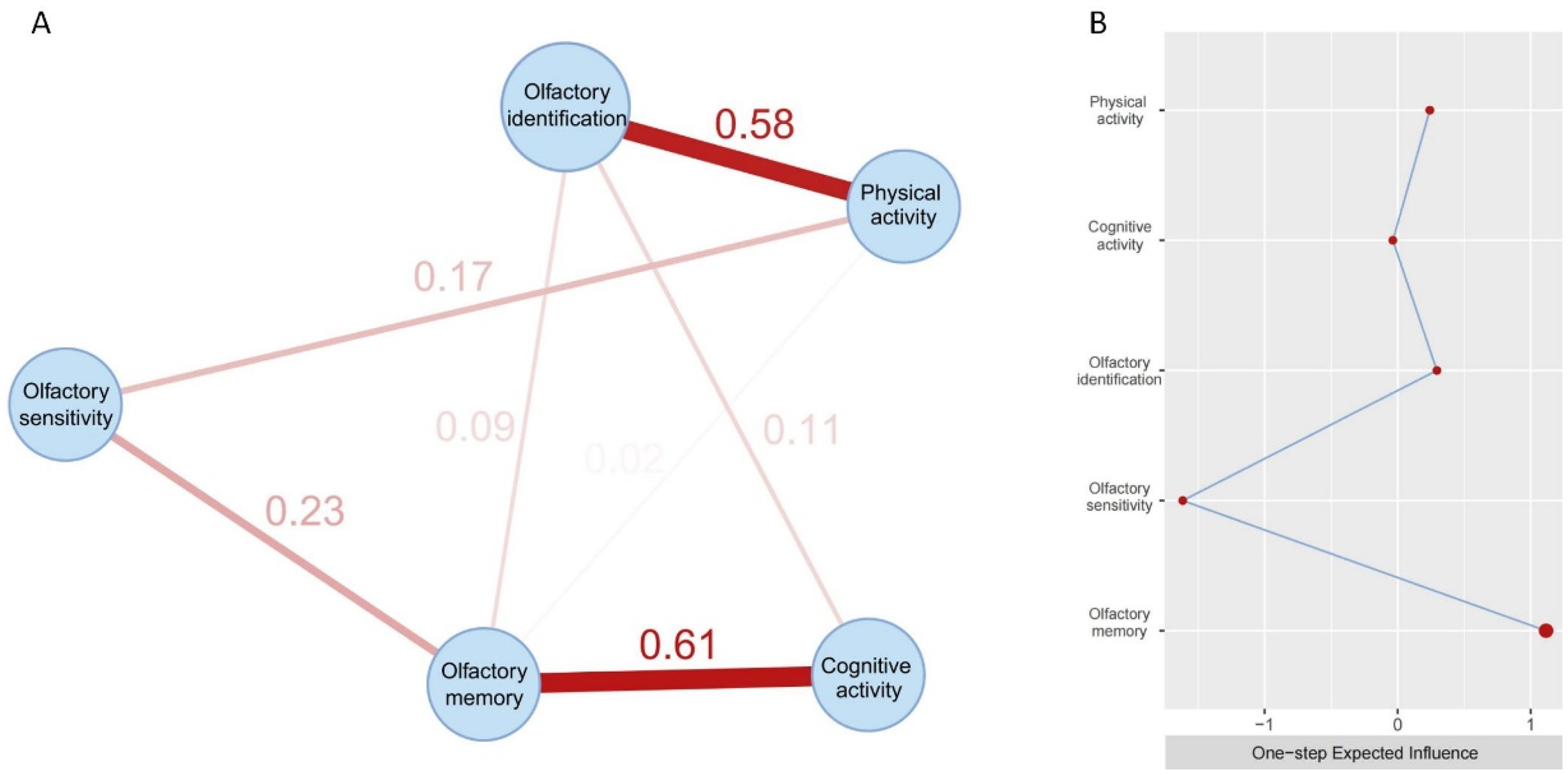
Network model of the study variables. (A) Regularized partial-correlation network; red edges indicate positive associations (edge width reflects association strength). (B) Node centrality expressed as expected influences.
Physical and cognitive activities and the different components of olfactory function exhibit varying degrees of positive connections (Figure 1A). The connection between physical activity and olfactory identification, as well as between cognitive activity and olfactory memory, is the strongest, even after controlling for other variables. Centrality measures for the correlation network reveal that olfactory memory has the highest expected influence, highlighting its central role in the network (Figure 1B).
The 95% bootstrap confidence intervals for most of the edges were narrow (Supplemental Figure S4), and several of the strongest edges did not overlap with others, suggesting that the edge estimates in the concurrent networks are stable. Additionally, the stability of the expected influence centrality in the network was high, with coefficients nearing 0.75 (Supplemental Figure S5).
Physical activity and olfactory identification, as well as cognitive activity and olfactory memory, show a strong relationship. These results further confirm the hypothesis derived from the correlation analysis and strengthen the supporting evidence. However, the combined effects of physical and cognitive activities, particularly their association with different components of olfactory function, remain unclear.
Differential Testing of Activity Levels
To examine the differences in olfactory function and its components across physical and cognitive activities, as well as the interaction between these activities, a two-way analysis of variance (ANOVA) was conducted with cognitive activity (low, moderate, and high) and physical activity (low, moderate, and high) as factors. The results revealed significant main effects for cognitive activity on overall olfactory function, F(2, 574) = 218.38, p < .001, ηp² = 0.43, with high cognitive activity being significantly better than moderate cognitive activity (p < .01), and moderate cognitive activity being significantly better than low cognitive activity (p < .001). A significant main effect for physical activity was also found, F(2, 574) = 107.80, p < .001, ηp² = 0.27, with high physical activity being significantly better than moderate physical activity (p < .001), and moderate physical activity being significantly better than low physical activity (p < .001). The interaction effect was significant, F(4, 574) = 43.63, p < .001, ηp² = 0.23. Simple effects analysis showed that, at low cognitive activity, high physical activity outperformed moderate physical activity (p < .001), and moderate physical activity outperformed low physical activity (p < .001). At moderate and/or high cognitive activity levels, only high physical activity outperformed low physical activity (p < .05).
For olfactory identification, the main effect of cognitive activity was significant, F(2, 574) = 228.32, p < .001, ηp² = 0.44, with high cognitive activity being significantly better than moderate cognitive activity (p < .001), and moderate cognitive activity being significantly better than low cognitive activity (p < .001). The main effect of physical activity was also significant, F(2, 574) = 232.73, p < .001, ηp² = 0.45, with high physical activity being significantly better than moderate physical activity (p < .001), and moderate physical activity being significantly better than low physical activity (p < .001). The interaction effect was significant, F(4, 574) = 125.54, p < .001, ηp² = 0.47. Simple effects analysis revealed that, at low cognitive activity, high physical activity outperformed moderate physical activity (p < .001), and moderate physical activity outperformed low physical activity (p < .001). At moderate cognitive activity levels, high physical activity outperformed low physical activity (p < .001).
In olfactory sensitivity, the main effect of cognitive activity was significant, F(2, 574) = 6.99, p < .01, ηp² = 0.02, with high cognitive activity being significantly better than low cognitive activity (p < .01). The main effect of physical activity was significant, F(2, 574) = 5.03, p < .05, ηp² = 0.02, with high physical activity being significantly better than low physical activity (p < .05). The interaction effect was nonsignificant, F(4, 574) = 0.27, p = .89, ηp² = 0.002.
For olfactory memory, the main effect of cognitive activity was significant, F(2, 574) = 173.41, p < .01, ηp² = 0.38, with high and/or moderate cognitive activity being significantly better than low cognitive activity (p < .001). The main effect of physical activity was nonsignificant, F(2, 574) = 2.27, p = .10, ηp² = 0.01, and the interaction effect was also nonsignificant, F(4, 574) = 0.46, p = .76, ηp² = 0.003. The results of all pairwise comparisons and simple effects analysis from the two-way ANOVA are presented in Supplemental Tables S16–S20.
Additionally, to examine the differences in olfactory function and its components under different combinations of physical and cognitive activities, a one-way ANOVA was conducted with group as the single factor, which included nine levels corresponding to all combinations of cognitive activity and physical activity. The results of the one-way ANOVA are shown in Supplemental Result S1, Figure S6 and Tables S21–S24 (Figure 2).

Mean scores (± SE) for (A) olfactory identification, (B) olfactory sensitivity, (C) olfactory memory, and (D) overall olfactory function performance across the nine cognitive-by-physical activity profiles. Light blue bars represent low cognitive activity, medium blue bars represent moderate cognitive activity, and dark blue bars represent high cognitive activity.
Discussion
The present cross-sectional study examined whether habitual physical and cognitive activities are linked to three facets of olfactory functioning (identification, sensitivity, and memory) in community dwelling older adults. Consistent with our pre-registered hypothesis, more active lifestyles were broadly associated with better olfactory performance. Physical activity showed its strongest association with olfaction identification, whereas cognitive activity was most closely tied to olfaction memory. Older adults who engaged in moderate-to-high levels of both activities demonstrated the best overall olfactory scores, highlighting the potential of combined engagement for preserving chemosensory health.
These findings extend prior work that has primarily focused on olfaction identification tests (Schubert et al., 2013; Sollai & Crnjar, 2023) by incorporating sensitivity and memory measures. Although network regularization reduced many intercorrelations, the link between physical activity and identification remained robust, suggesting a particularly stable association. Our results also provide scarce direct evidence for a relationship between cognitive activity and olfaction. In line with indirect reports (Dintica et al., 2021; Reid et al., 2017), cognitive engagement correlated most strongly with olfaction memory and occupied a central position in the network structure, implying that mnemonic processes may mediate broader cognition-olfaction associations.
Additionally, this study demonstrated the interaction effect of cognitive and physical activity on overall olfactory function and olfactory identification. Physical and cognitive activities were categorized into low, moderate, and high levels, with older adults classified into nine different daily activity states (Craig et al., 2003; Lee, 2014; Verghese et al., 2003). At low cognitive activity levels, older adults with high and/or moderate physical activity showed better olfactory performance than those with low physical activity. However, at moderate or high cognitive activity levels, olfactory function was higher overall, with no significant differences across the different levels of physical activity. This study also revealed the dose–response relationship and synergistic effects of physical and cognitive activities (Supplemental Figure S6 and Tables S21–S24). Across the spectrum of olfactory outcomes, older adults with low levels of both activity types performed worst. Increasing either physical or cognitive activity partially mitigated this decline, with consistent trends observed across individual measures. For olfaction identification, performance improved progressively with higher physical activity, particularly among individuals with low-to-moderate cognitive activity levels. In contrast, olfaction memory displayed a more pronounced dependence on cognitive activity, with moderate-to-high cognitive engagement yielding superior outcomes—an effect mirrored in both correlation and network analyses. Together, these results indicate that maintaining at least moderate engagement in both physical and cognitive domains confers additive benefits for olfactory health in later life.
From a theoretical perspective, these findings align with frameworks of neuroplasticity and cognitive reserve, which posit that sustained engagement in physically and cognitively demanding activities promotes structural and functional brain adaptations (Cespón et al., 2018; Fernandes et al., 2020; Hötting & Röder, 2013; Mukhtar & Iftikhar, 2025). Physical activity has been shown to enhance cerebrovascular health, neurogenesis, and synaptic plasticity, particularly in regions implicated in sensory integration and memory processing, such as the hippocampus and orbitofrontal cortex (Aghjayan et al., 2021; Bliss et al., 2021; Zalouli et al., 2023). Cognitive activity, in turn, may strengthen neural networks supporting attentional control and episodic memory, which are critical for odor encoding and retrieval (Galliot et al., 2013; Saive et al., 2014; Wollesen et al., 2020; Zamarreño et al., 2024). The observed synergy between physical and cognitive engagement suggests that these domains may exert complementary effects on the olfactory system, possibly by converging on shared neural substrates or by facilitating compensatory mechanisms in the ageing brain. This perspective situates olfactory preservation within broader models of healthy ageing, underscoring its potential role as both an indicator and a beneficiary of lifestyle-driven neural resilience.
Despite these strengths, several limitations merit consideration. The cross-sectional design precludes causal inference, and future longitudinal or randomized controlled studies are needed to establish temporal directionality. The sample's cultural homogeneity limits generalizability, underscoring the value of multisite or cross-national research that can account for contextual factors and control for potential confounders such as comorbidities, medication use, and environmental exposures. Moreover, although cognitive activity was more closely related to olfaction memory, this association may reflect a generalized effect of cognitive engagement on memory rather than a specific influence on odor-related memory. The relatively low correlations observed among the three olfactory subsets, despite their strong associations with overall olfactory function, further suggest that these components may capture distinct but complementary dimensions of olfaction. However, the possibility of measurement noise or limited reliability cannot be fully excluded, which may have attenuated the observed intercorrelations. In addition, integrating neuroimaging or electrophysiological measures could help elucidate the neural mechanisms through which lifestyle activities contribute to olfactory preservation, potentially clarifying the interplay between sensory, cognitive, and motor systems in ageing.
In conclusion, regular engagement in moderate-to-vigorous physical activity alongside frequent participation in cognitively stimulating pursuits appears to support multiple components of olfactory function in later life. Encouraging the adoption of such combined lifestyle patterns may offer a practical and accessible strategy for safeguarding sensory health, with potential downstream benefits for cognition, social functioning, and overall quality of life in ageing populations.
Supplemental Material
sj-pdf-1-ipe-10.1177_20416695251399118 - Supplemental material for Associations between physical and cognitive activities and olfactory function in older adults
Supplemental material, sj-pdf-1-ipe-10.1177_20416695251399118 for Associations between physical and cognitive activities and olfactory function in older adults by Biye Wang, Tao Tao and Wei Guo in i-Perception
Supplemental Material
sj-xlsx-2-ipe-10.1177_20416695251399118 - Supplemental material for Associations between physical and cognitive activities and olfactory function in older adults
Supplemental material, sj-xlsx-2-ipe-10.1177_20416695251399118 for Associations between physical and cognitive activities and olfactory function in older adults by Biye Wang, Tao Tao and Wei Guo in i-Perception
Footnotes
Acknowledgments
The authors are grateful to all the participants in the study.

Ethical Approval and Informed Consent Statements
This study was approved by the Ethics Committee of Yangzhou University (No.YXYLL-2024-020) and carried out in compliance with the approved guidelines. All procedures complied with the Declaration of Helsinki, and written informed consent was obtained prior to testing.
Author Contribution(s)
Funding
The authors disclosed receipt of the following financial support for the research, authorship, and/or publication of this article: This research was funded by the Project of Social Science Foundation of Jiangsu Province, grant number 25TYB002.
Declaration of Conflicting Interests
The authors declared no potential conflicts of interest with respect to the research, authorship, and/or publication of this article.
Data Availability Statement
Supplemental Material
Supplemental material for this article is available online.
References
Supplementary Material
Please find the following supplemental material available below.
For Open Access articles published under a Creative Commons License, all supplemental material carries the same license as the article it is associated with.
For non-Open Access articles published, all supplemental material carries a non-exclusive license, and permission requests for re-use of supplemental material or any part of supplemental material shall be sent directly to the copyright owner as specified in the copyright notice associated with the article.
