



Abstract
The rise of social media has raised concerns about its addictive potential and impairments in mental health and cognitive functions, including distortions in time processing. Emerging evidence suggests social media addicts tend to misestimate the amount of time spent using social media, hinting at possible problems with their cognitive time-processing. This study aimed to investigate the impact of social media addiction on basic time perception using controlled experimental paradigms. Forty participants scoring ≥24 on the Bergen Social Media Addiction Scale with ≥5 hr daily usage were recruited, alongside 40 controls. After excluding individuals craving, fear of missing out for social media, or test anxiety during experiment, final samples included 36 addicts and 37 controls. Time reproduction (motor timing) and bisection (perceptual timing) tasks were administered, distinguishing subsecond (<1 s) and suprasecond (>1 s) intervals. Tasks used neutral gray stimuli to avoid social media cues and included pretask rest to control physiological arousal. Social media addicts exhibited significant deficits in suprasecond bisection task, demonstrated by lower subjective equality points (1,430.69 vs. 1,549.32 ms) and higher Weber ratios (0.41 vs. 0.29), indicating both time overestimation and reduced time sensitivity. No significant group differences were observed in reproduction tasks or in subsecond bisection task. These findings establish that social media addiction selectively impairs suprasecond perceptual timing, characterized by overestimation and diminished sensitivity. These findings establish a novel cognitive deficit linked to addictive social media use, with potential clinical implications for intervention strategies targeting distorted time processing.
This is a visual representation of the abstract.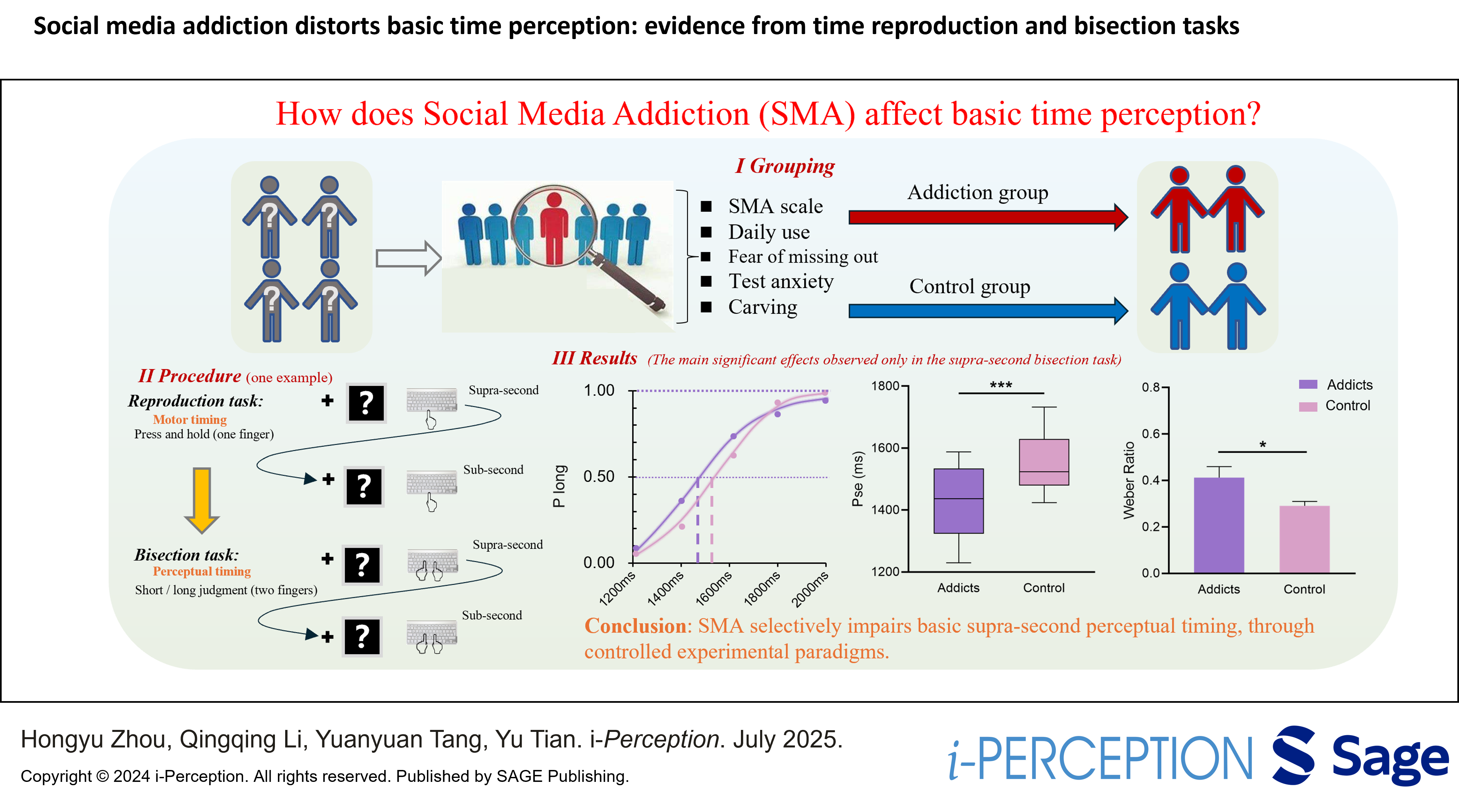
How to cite this article
Zhou, H., Li, Q., Tang, Y., Tian, Y. (2025). Selective suprasecond timing deficit in social media addicts: Bisection task reveals overestimation and impaired sensitivity without subsecond effects. i-Perception, 16(6), 1–12. https://doi.org/10.1177/20416695251391634
Introduction
With the proliferation of social media (SM), its addictive potential has emerged as a critical public health concern, impacting mental health and cognitive functioning—particularly time processing. Defined as “maladaptive use characterized by excessive preoccupation, loss of control, and functional impairment” (Schou Andreassen & Pallesen, 2014), SM addiction now affects millions worldwide. DataReportal (Kemp, 2024) estimates humanity collectively spent over 500 million years on SM by 2024, underscoring the scale of engagement. A striking phenomenon observed in addicts is that, users frequently report discrepancies between subjective and objective time, misestimating their SM usage duration, reflecting potential distortions in time perception.
Recent research has begun to unravel the link between SM addiction and time misestimation. Time perception, defined as the subjective judgment of event duration or interevent intervals (Block, 2014), is critical for adaptive behavior. Studies show SM addicts overestimate durations of primed activities (e.g., short videos vs. reading; Yang et al., 2024) and exhibit persistent abnormalities even after abstinence (Turel & Cavagnaro, 2019). However, these investigations primarily focus on retrospective duration estimation of extended intervals (e.g., hours of usage). Equally important is the ability to accurately perceive time in the present moment—a capacity essential for time management and behavioral regulation.
Emerging work explores SM-related stimuli effects on short-term time perception. For instance, SM cues induce time overestimation in time bisection tasks (Gonidis & Sharma, 2017), and network-related words lengthen perceived duration compared to neutral stimuli (Peng et al., 2017). These deficits are often attributed to impaired attentional control (Marciano & Camerini, 2022; Wittmann & Paulus, 2008; Wu & Tian, 2024). Critically, however, no study has systematically examined general time perception in SM addicts without explicit SM cues. This gap limits understanding of whether addiction itself, independent of contextual stimuli, alters time processing.
Time processing further differentiates into motor timing (reproduction of durations via motor responses) and perceptual timing (judgment of duration as shorter/longer). Motor timing relies on “stopwatch-like” memory traces (Wiener et al., 2010), typically measured via time reproduction tasks, while perceptual timing involves comparative judgments (e.g., time bisection tasks; Zhang et al., 2019). Prior SM addiction research conflates these constructs, overlooking critical methodological distinctions. Additionally, time duration variability (subsecond vs. suprasecond) remains underexplored (Zhang et al., 2021). Suprasecond intervals (>1 s) depend heavily on cognitive control and attentional resources (Cui et al., 2023; Grondin, 2010; Hayashi et al., 2014; Mioni et al., 2013), with neuroimaging evidence highlighting distinct neural substrates: subcortical regions dominate subsecond processing, whereas suprasecond intervals engage cortical networks (supplementary motor area [SMA], parietal/prefrontal cortex [PFC]; Mioni et al., 2020; Mondok & Wiener, 2023; Nani et al., 2019).
In summary, prior research has significantly advanced our understanding of how SM addiction may influence time perception, particularly through cue-dependent paradigms and self-report measures. These studies have consistently highlighted time overestimation in addicted individuals, underscoring the role of attentional biases and contextual cues. Building on this foundation, the present study seeks to extend this line of inquiry by addressing three interrelated gaps: (1) the lack of cue-independent assessments of time perception in SM addicts, (2) the absence of systematic comparisons between motor and perceptual timing mechanisms, and (3) the limited investigation into duration-specific effects (subsecond vs. suprasecond intervals). By integrating time reproduction and bisection tasks with rigorous participant screening, this study aims to provide a more comprehensive characterization of time perception deficits in SM addiction.
Specifically, we conducted two cue-independent timing experiments in a single session to dissociate motor from perceptual timing and to contrast subsecond with suprasecond intervals. In the time reproduction task, time perception was indexed by accuracy and precision, making this paradigm well-suited to assess motor timing with minimal decision demands. In the temporal bisection task, time perception was indexed by the perceived midpoint and sensitivity, isolating perceptual/comparative timing while minimizing motor requirements. Hypotheses: H1: Under cue-free conditions, individuals with SM addiction will exhibit a bias in basic time perception. H2: Consistent with a graded rather than all-or-nothing pattern, the bias will be present in both production (motor) and perceptual/comparative timing, but will be relatively stronger for perceptual timing. H3: The bias will occur for both subsecond and suprasecond intervals and will be more pronounced at suprasecond durations. Findings will clarify whether such deficits represent a general cognitive vulnerability or are specific to certain time processing demands, thereby informing targeted intervention strategies. Findings will clarify whether such deficits represent a general cognitive vulnerability or are specific to certain time processing demands, thereby informing targeted intervention strategies.
Methods
Participants
This study recruited a total of 80 participants, comprising 40 individuals who met the inclusion criteria for SM addiction and 40 healthy control group. Participants in both groups were recruited via an online cohort and social media platforms using neutral, uniform wording; group assignment was determined postrecruitment by prespecified screening criteria. After applying exclusion criteria related to craving for SM, fear of missing out and test anxiety during the experiment, the final sample consisted of 36 participants in the addicted group and 37 in the control group.
The addicted group included 36 individuals (19 females) aged between 18 and 29 years (M ± SD = 21.55 ± 2.87). The control group consisted of 37 individuals (19 females) aged between 18 and 28 years (M ± SD = 21.16 ± 2.62). There were no significant differences between the two groups in terms of sex or age (p > .05). All participants had normal or corrected-to-normal vision and self-reported no history of psychiatric disorders. Prior to the experiment, participants were fully informed about the experimental procedures, and written informed consent was obtained.
Addiction Screening Criteria
To determine eligibility for the study, the primary inclusion criteria were established for each group. For the addicted group, participants first needed to score 24 or higher on the Bergen Social Media Addiction Scale (BSMAS), a 6-item self-report measure that demonstrated strong internal consistency in this study (Cronbach's α = .867). Higher scores on this scale indicate a greater degree of addiction, with a cut-off of 24 validated for clinical relevance.
Additionally, device-based screen time is the secondary inclusion criteria, and statistics confirmed that these participants used SM for at least 5 hr a day over the past seven days, ensuring that their behavior aligned with their self-reported addiction. For the control group, participants were required to score 12 or lower on the BSMAS, indicating a minimal risk of addiction. They also needed to have used SM for less than 4 hr a day over the past seven days, as confirmed by device-based screen time statistics. We derived daily social media duration from iOS Screen Time and Android Digital Wellbeing, combining the system “Social” category with a whitelist of platforms characterized by core social-interactive affordances—that is, apps whose primary use involves user-to-user interaction, public or semipublic sharing, commenting, and community features (e.g., Facebook, Instagram, Xiaohongshu, Weibo). The rationale behind using this dual-assessment approach was that while the BSMAS provides valuable subjective insights into addiction tendencies, the 5+ hr a day usage threshold offers an objective behavioral verification. This multimethod approach helps reduce reliance on self-report biases and enhances the diagnostic rigor of the study.
To isolate the effects of SM addiction from other confounding psychological factors, participants were assessed using the Depression, Anxiety, and Stress Scale-21 as an inclusion criterion, where a score within the normal range (i.e., not exceeding the clinical thresholds: more than 10 on the depression subscale, more than 7 on the anxiety subscale, or more than 14 on the stress subscale) was required for inclusion.
Additionally, exclusion criteria also included self-reporting which measured after the experiment: (1) a score of more than 2 on a 9-point Likert scale (where 1 indicates no craving at all and 9 indicates extreme craving) for SM craving during the experiment; (2) a score of more than 2 on a 9-point Likert scale for fear of missing out related to SM information; and (3) a score of more than 2 on a 9-point Likert scale for test anxiety induced by the experiment itself. Previous research has revealed that transient affect can bias time perception (Choi et al., 2021; Gable et al., 2022). To preserve sample representativeness—and, by extension, the generalizability of our findings—we excluded sessions marked by acute craving or other short-lived states. These exclusion criteria ensured that any observed group differences were a reflection of SM addiction rather than acute craving, fear of missing out, or test anxiety.
Detailed information about the final group composition and prescreening scores is provided in Table 1.
Descriptive Statistics (M ± SD).

Note. BSMAS = Bergen Social Media Addiction Scale; DASS-21 = Depression, anxiety, and stress scale-21; M = mean; SD = standard deviation, the same below.
*p < .05, **p < .01, ***p < .001.
Task Procedure
The experimental protocol was meticulously structured to assess the impact of SM addiction on time perception while controlling for baseline physiological and psychological states. Prior to task administration, participants engaged in a 15-min rest period in a dimly lit, sound-attenuated room. They were seated comfortably in an ergonomic chair, instructed to remain awake, minimize movement, and avoid external distractions (e.g., phone use). This rest period served to stabilize autonomic arousal and reduce carryover effects from daily activities, ensuring baseline physiological coherence for subsequent time processing measures.
The core experimental tasks, administered via E-Prime 3.0 software (Psychology Software Tools Inc., Sharpsburg, PA), were designed to evaluate motor and perceptual timing across subsecond (<1 s) and suprasecond (>1 s) intervals. All stimuli were displayed on a 24-in. monitor (1,920 × 1,080 resolution, 60 Hz refresh rate) against a dark background. Participants completed the tasks individually in the same quiet room. Task order (time reproduction vs. bisection) was randomized across participants to mitigate order effects, and each task was preceded by a practice block to ensure task comprehension. No SM-related cues were included in the stimuli to avoid confounding influences.
The time reproduction task evaluated motor timing by requiring participants to reproduce subsecond (<1 s) and suprasecond (>1 s) intervals. In the subsecond reproduction task, each trial began with a fixation cross (300–500 ms), followed by a gray square (8 × 8 cm2, 50% luminance) presented for one of five standard durations (i.e., the first gray-square duration to be reproduced): 300, 400, 500, 600, or 700 ms. After a blank interval (400–600 ms), a question mark prompted participants to reproduce the standard duration by pressing and holding the spacebar, with feedback provided by redisplaying the gray square during the key press. The key press terminated upon release, and the intertrial interval varied randomly between 600 and 800 ms (Figure 1(a)). Each standard duration was repeated 40 times, divided into five blocks of eight trials each (200 trials total), with rest breaks provided between blocks. The suprasecond reproduction task followed an identical procedure, except that the standard durations were extended to 1,200, 1,400, 1,600, 1,800, or 2,000 ms.

(a) Schematic depictions of the subsecond time reproduction task. (b) Schematic depictions of the subsecond time bisection task.
The time bisection task assessed perceptual timing by requiring participants to discriminate between two time intervals, again distinguishing subsecond and suprasecond conditions. In the subsecond bisection task, each trial began with a fixation cross (300–500 ms), followed by a standard gray square (500 ms). After a blank interval (400–600 ms), a comparison square was presented for one of five durations: 300, 400, 500, 600, or 700 ms. After a 400 ms blank, a question mark prompted participants to judge whether the comparison duration was “longer” or “shorter” than the standard by pressing “F” or “J” (counterbalanced across participants). The intertrial interval varied randomly between 600 and 800 ms (Figure 1(b)), and each comparison duration was repeated 40 times, divided into five blocks of eight trials each (200 trials total). The suprasecond bisection task mirrored this procedure, except that the standard duration was 1,600 ms, and the comparison durations were 1,200, 1,400, 1,600, 1,800, or 2,000 ms.
Upon task completion, participants underwent three postexperimental assessments: self-reported SM craving, fear of missing out, and test anxiety during the experiment.
Statistics
The time reproduction task was analyzed using two dependent variables to assess motor timing accuracy and variability. First, absolute error (AE) was calculated as the absolute difference between the reproduced duration and the standard duration, divided by the standard duration. Higher AE values indicated poorer time accuracy. The equation is as follows:

Second, relative error (RE) was computed to assess the directionality of timing errors. Positive RE values reflected overestimation, while negative values reflected underestimation. The equation is as follows:

Coefficient of variation (CV) was derived by dividing the SD of reproduced durations by the mean reproduced duration for each condition. Higher CV values reflected greater time variability. The equation is as follows:

The time bisection task was analyzed by fitting psychometric functions to the proportion of “long” responses for each comparison duration to derive two key metrics (Figure 3(a) and (d)): the point of subjective equality (PSE) and the Weber ratio (WR). The PSE was defined as the comparison duration at which the proportion of “long” responses equaled 0.5, indicating the perceived duration equivalent to the standard. A smaller PSE reflected time overestimation, while a larger PSE reflected underestimation. The WR was calculated as the difference limen (DL, the half-height interval width of the psychometric function) divided by the PSE: WR = DL/PSE. The DL was derived from the standard deviation (σ) of the fitted Gaussian cumulative distribution function: y = 0.5 × [1 + erf((x − μ)/(σ × √2))], where y is the proportion of “long” responses, erf is the error function, x is the comparison duration, μ is the PSE, and σ is the standard deviation. A smaller WR indicated higher time sensitivity.
Group comparisons (SM addicts vs. controls) were conducted using F-tests for AE, RE, and CV; independent-samples t-tests for PSE and WR. Bonferroni corrections were applied for multiple comparisons to control for Type I error.
Ethics
This study was conducted in accordance with the Declaration of Helsinki and approved by the Institutional Review Board (IRB) of the local university. All participants provided written informed consent after being fully informed of the study's purpose, procedures, and their rights to withdraw at any time without penalty. Confidentiality was ensured by anonymizing all data, and participants were debriefed upon completion.
Results
Motor Timing Analysis
Subsecond Motor Timing
The analysis of subsecond motor timing was conducted using a 2 (group: addiction vs. healthy) × 5 (duration: 300/400/500/600/700 ms) mixed-design analysis of variance for each of the dependent variables: AE, RE, and CV. For AE, the analysis revealed no significant main effect of group, F(1, 71) = 0.349, p > .05, indicating that SM addiction did not significantly affect the magnitude of deviation from the target time in subsecond intervals. Additionally, there was no significant interaction between group and duration, F(4, 284) = 0.195, p > .05, but a significant main effect of duration was observed, F(4, 284) = 91.923, p < .001, ηp2 = 0.564, and posthoc analysis showed that the AEs significantly increased with the standard duration, ps < .001, suggesting that duration's effect on motor timing was consistent in addicted and healthy groups, while participants’ timing accuracy varied with interval duration (Figure 2(a)). For RE, no significant main effect of group was found, F(1, 71) = 0.657, p > .05, indicating that the directionality of timing errors did not differ significantly between the addicted and healthy groups in subsecond intervals. There was also no significant interaction between group and duration, F(4, 284) = 0.146, p > .05. A significant main effect of duration was present, F(4, 284) = 204.234, p < .001, ηp2 = 0.742, and posthoc analysis showed that the REs significantly increased with the standard duration, ps < .001, demonstrating that the consistency of motor timing performance varied with duration (Figure 2(b)). For CV, the results showed no significant main effect of group, F(1, 71) = 0.301, p > .05, suggesting that the variability of motor timing performance did not differ significantly between the two groups in subsecond intervals. There was no significant interaction between group and duration, F(4, 284) = 0.582, p > .05. A significant main effect of duration was observed, F(4, 284) = 38.728, p < .001, ηp2 = 0.353, and posthoc analysis showed that the CVs significantly increased with the standard duration, ps < .001, indicating that the consistency of motor timing performance varied with duration (Figure 2(c)).

(a–c) Absolute error (AE), relative error (RE), and coefficient of variation (CV) for the subsecond time reproduction task comparing addicts and control groups. (d–f) Same metrics for the suprasecond time reproduction task. Error bars represent m±SEM.
Suprasecond Motor Timing
The analysis of suprasecond motor timing followed a similar 2 (group: addiction vs. healthy) × 5 (duration: 1,200/1,400/1,600/1,800/2,000 ms) mixed-design analysis of variance. For AE, no significant main effect of group was found, F(1, 71) = 0.021, p > .05, indicating that SM addiction did not significantly affect the magnitude of deviation from the target time in suprasecond intervals. Additionally, there was no significant interaction between group and duration, F(4, 284) = 2.208, p > .05, but a significant main effect of duration was observed, F(4, 284) = 16.469, p < .001, ηp2 = 0.188, posthoc analysis showed that the AEs significantly increased with the standard duration, ps < .001, suggesting that participants’ timing accuracy varied significantly with the duration of the intervals (Figure 2(d)). For RE, the analysis revealed no significant main effect of group, F(1, 71) = 2.219, p > .05, indicating that the directionality of timing errors did not differ significantly between the addicted and healthy groups in suprasecond intervals. There was also no significant interaction between group and duration, F(4, 284) = 0.93, p > .05, but a significant main effect of duration was present, F(4, 284) = 73.368, p < .001, ηp2 = 0.508, posthoc analysis showed that the REs significantly increased with the standard duration, ps < .001, demonstrating that the consistency of motor timing performance varied with duration (Figure 2(e)). For CV, no significant main effect of group was found, F(1, 71) = 0.524, p > .05, suggesting that the variability of motor timing performance did not differ significantly between the two groups in suprasecond intervals. There was no significant interaction between group and duration, F(4, 284) = 0.826, p > .05. A significant main effect of duration was observed, F(4, 284) = 9.973, p < .001, ηp2 = 0.123, posthoc analysis showed that the CVs significantly increased with the standard duration, ps < .001, indicating that the consistency of motor timing performance varied with duration (Figure 2(f)).
Taken together, these results imply that SM addiction has no discernible impact on motor timing across both subsecond and suprasecond intervals, and the effect of duration on motor timing is consistent across both groups.
Perceptual Timing Analysis
Subsecond Perceptual Timing
For subsecond perceptual timing, independent-samples t-tests were conducted to compare the PSE and WR between the addicted and healthy groups. The t-test revealed no significant differences in PSE, t(71) = −0.236, p > .05 (Figure 3(b)), or WR, t(71) = 0.337, p > .05 (Figure 3(c)), between the two groups, suggesting that SM addiction does not affect perceptual timing abilities within the subsecond range.

(a) Behavioral psychometric curves. P long represents the probability that participant responded “long” on trials for each stimulus duration. (b) Point of subjective equality (PSE). The box represents the interquartile range (IQR), the horizontal line inside the box denotes the median, and the whiskers indicate the minimum and maximum values in each group. (c) Weber ratio (WR) for the subsecond time bisection task comparing addicts and control groups. (d–f) Same metrics for the suprasecond time bisection task. Bars represent m±SEM. Statistical significance: *p < .05, ***p < .001.
Suprasecond Perceptual Timing
Textual values are M ± SD (PSE in ms; WR unitless). In the suprasecond bisection task, the t-test yielded significant differences. The PSE of the addicted group (1,430.693 ± 106.907 ms) was significantly lower than that of the healthy group (1,549.322 ± 90.158 ms), t(71) = −5.130, p < .001, Cohen's d = 1.207 (Figure 3(e)), indicating that the addicted group tended to overestimate the duration of suprasecond intervals compared to the healthy group. Furthermore, the WR of the addicted group (0.434 ± 0.326) was significantly larger than that of the healthy group (0.273 ± 0.093), t(71) = 2.391, p = .019, Cohen's d = 0.562 (Figure 3(f)), suggesting that the addicted group had reduced time sensitivity, meaning they were less precise in discriminating between different suprasecond time intervals.
Overall, these results indicate that SM addiction may specifically impair perceptual timing abilities in the suprasecond range, leading to less accurate and less sensitive time judgments.
Discussion
The present study systematically investigated the impact of SM addiction on basic time perception using controlled experimental paradigms, addressing critical gaps in prior research. While previous findings highlighted time distortions in SM addicts during extended intervals (i.e., retrospective usage episodes on the order of ∼15–60 min or longer) or cue-dependent tasks (Gonidis & Sharma, 2017; Yang et al., 2024), in line with our hypotheses our study uniquely demonstrated that these deficits persist even in the absence of SM stimuli. More specifically, the alteration extends specifically to perceptual timing at suprasecond intervals. This selective impairment—observed through increased time overestimation and reduced time sensitivity in suprasecond bisection tasks—provides novel insights into the cognitive mechanisms underpinning addictive SM use.
Departing from our expectations, our results revealed a striking dissociation between motor and perceptual timing processes. While SM addiction did not affect participants’ ability to reproduce durations via motor responses (time reproduction tasks), it significantly impaired their capacity to judge and discriminate suprasecond intervals. This pattern suggests that the core deficit lies in cognitive processes involved in time judgment rather than motor execution. The resilience of motor timing aligns with theories emphasizing its reliance on implicit “stopwatch-like” memory traces (Wiener et al., 2010), which appear unaffected by addictive behaviors. In contrast, perceptual timing deficits in the suprasecond range highlight sensitivity to disruptions in attentional control and cognitive monitoring—processes critical for judging elapsed time but not required for motor reproduction tasks.
Though different from our expectations, the observed overestimation of suprasecond durations (lower PSE) and reduced time sensitivity (higher WR) in addicts align with attentional theories of time perception (Liu et al., 2024; Zhang et al., 2024). Wittmann and Paulus (2008) propose that time overestimation arises when attentional resources are diverted to internal states rather than external stimuli. SM addicts may allocate excessive attention to monitoring time passage during abstinence, paradoxically distorting their time judgments. This mechanism is supported by our exclusion of participants reporting acute craving, suggesting the deficits reflect trait-level cognitive alterations rather than state-dependent arousal (a design choice to minimize state effects rather than proof of trait causality). Neuroimaging evidence further implicates cortical networks in suprasecond timing, particularly the SMA and PFC (Mioni et al., 2020; Nani et al., 2019), which may be compromised by chronic SM use through altered dopamine signaling or structural plasticity.
The duration-specific nature of these deficits—absent in subsecond conditions—underscores the neurocognitive distinction between time processing mechanisms. Subsecond intervals likely rely on subcortical circuits (e.g., cerebellum) less implicated in addictive behaviors, while suprasecond timing engages cortical networks vulnerable to addiction-related disruptions (Wiener et al., 2010). These findings challenge prior assumptions that SM-related cues are necessary for time distortions, establishing that addictive use itself alters fundamental aspects of time cognition.
These results carry important theoretical and clinical implications. First, the dissociation between motor and perceptual timing deficits underscores the need to distinguish between these processes in addiction research, as they may reflect distinct neural pathways affected by addictive behaviors. Second, the duration-specific nature of perceptual timing deficits highlights the vulnerability of suprasecond processing to addiction-related disruptions, potentially contributing to maladaptive behaviors such as prolonged SM engagement. Clinically, these findings suggest that interventions targeting time cognition—such as cognitive training programs focusing on time estimation—may help mitigate distortions in time perception.
Several limitations warrant consideration. First, our adult sample precludes generalization to adolescents, whose developing attentional systems may confer greater vulnerability to SM-related timing distortions (Marciano & Camerini, 2022). Although longitudinal work has linked social media use to mental health, attention, and neurodevelopment in adolescents and young adults, longitudinal studies that directly follow basic time perception outcomes remain scarce and are needed. Second, while we controlled for stress, anxiety, and depression, residual confounding from subclinical symptoms cannot be fully excluded. Third, the cross-sectional design limits causal inferences; future studies should employ pre–post addiction interventions to assess time processing changes. Finally, neuroimaging could clarify whether addiction-related alterations in SMA/PFC activity mediate the observed perceptual timing deficits.
Conclusion
This study demonstrates that SM addiction selectively impairs basic suprasecond perceptual timing, through controlled experimental paradigms. We found that addicts exhibit significant overestimation of durations and reduced time sensitivity in suprasecond bisection tasks, while motor timing and subsecond perceptual timing remain unaffected. This dissociation underscores that the deficit lies in cognitive judgment processes rather than motor execution or subsecond timing mechanisms, which rely on distinct neural pathways. Unlike prior research focusing on extended intervals or cue-dependent tasks, our findings reveal a trait-level cognitive alteration in addicts, suggesting that addictive use itself distorts fundamental time cognition. These results highlight the specificity of suprasecond perceptual timing deficits in SM addiction, offering novel insights into its neurocognitive basis and pointing to potential targets for interventions addressing distorted time processing.
Footnotes

Ethical Considerations
This study was conducted in accordance with the Declaration of Helsinki and approved by the Institutional Review Board (IRB) of Sichuan Normal University (IRB No. SCNU-2410311). All participants provided written informed consent after being fully informed of the study's purpose, procedures, and their rights to withdraw at any time without penalty. Confidentiality was ensured by anonymizing all data, and participants were debriefed upon completion.
Author Contribution(s)
Funding
The authors disclosed receipt of the following financial support for the research, authorship, and/or publication of this article: This work was supported by the Key Laboratory of Adolescent Cyberpsychology and Behavior, Ministry of Education (Grant No. CCNUCYPSYLAB2324B05), and the Sichuan Provincial Natural Science Foundation (Grant No. 2025ZNSFSC1020).
Declaration of Conflicting Interests
The authors declared no potential conflicts of interest with respect to the research, authorship, and/or publication of this article.
Data Availability Statement
Raw experimental data are available upon a reasonable request.