



Abstract
This study investigates how the method used by participants to assess the beauty of pictures influences their preference for the compositional rules of symmetry, balance, and proximity. The hypothesis that production methods (actively arranging picture elements) prompt a local perspective, favoring proximity, while evaluation tasks (rating precomposed pictures) elicit a global perspective, favoring symmetry and balance, was tested in two experiments. Experiment 1 demonstrated that (positional) symmetry was preferred over balance, and balance over proximity, when participants rated precomposed pictures. Experiment 2, employing a production method with movable elements, showed a frequent use of proximity, yet also a tendency toward (positional) symmetry. The combined results indicate that assessment methods substantially impact the preferred composition rules.
How to cite this article
Hübner, R. (2025). Preference for symmetry, balance, or proximity in picture aesthetics depends on the method of evaluation. i–Perception, 16(6), 1–20. https://doi.org/10.1177/20416695251381548
Introduction
The aesthetic appreciation of pictures has been linked to various composition rules such as harmony, balance, symmetry, or Rule of Thirds (Amirshahi et al., 2014; Arnheim, 1982; Kandinsky, 1926/1979/1979; Ross, 1907). Bilateral symmetry, for instance, has often a positive effect on aesthetic preferences (e.g., Pecchinenda et al., 2014), although there are also examples where symmetry has negative effects, such as in landscape images (Bertamini et al., 2019). Furthermore, the effect of symmetry is occasionally contingent upon the method of preference measurement, specifically whether it is explicit or implicit (Roccato et al., 2024; Weichselbaum et al., 2018). Finally, there are interindividual differences in the preference for symmetry, which are related, for example, to the expertise of the evaluators. When making explicit assessments, experts usually prefer asymmetrical compositions (Gartus et al., 2020; Leder et al., 2018).
However, despite its positive effects, the symmetry rule in the strict sense is overly restrictive. A related but more flexible principle is perceptual balance, variously termed “aesthetic symmetry” (Pierce, 1894) or “dynamic symmetry” (Locher & Nodine, 1987). Perceptual balance can have different meanings. It can be defined as some kind of equilibrium, but also as some kind of stability (Fillinger & Hübner, 2020). Depending on the type of image, one concept or the other may be more relevant (Hübner & Fillinger, 2019). However, perceptual balance conceptualized as equilibrium is more common and prominent. This type of balance is usually understood as an analogy to mechanics, in which the visual elements in a picture have a “perceptual weight.” A balanced composition is achieved when these weights are in equilibrium across the picture (Locher, 2014). Accordingly, determining the perceptual weights of the elements in a picture is crucial. A basic approach is to assign greater weight to darker and larger elements. This can be formalized using gray-value integration (McManus et al., 2011), where element weight is calculated by summing pixel gray values. This method has been used to develop quantitative balance measures, such as the Deviation of the Center of “Mass” (DCM) score (Hübner & Fillinger, 2016; Wilson & Chatterjee, 2005). The DCM score measures the deviation of a picture's center of mass from its geometric center, with smaller deviations indicating greater balance, a concept tracing back to Ross (1907). If people create or prefer a picture that is unbalanced in this sense, that is, its center of mass deviates from the geometric center, it remains unclear whether they do not value balance much or are unable to determine the center of mass of a picture. It has been demonstrated that the latter is not always an easy task (Friedenberg & Liby, 2002; Liby & Friedenberg, 2010).
Early experimental investigations into perceptual balance, conducted in Hugo Münsterberg's lab at Harvard, primarily focused on horizontal balance. Pierce (1894), for example, showed participants a variable object moving back and forth on a black square rubber board toward a fixed object. When asked, “When do you like the moving line best?” (p. 488), participants had to indicate the corresponding position. Pierce observed that some participants aligned the movable object according to mechanical balance. Later, Ethel Puffer, also working in Münsterberg's lab, refined this methodology by using a rectangular board with a fixed element at varying distances from the center and a horizontally movable element (Puffer, 1903). Participants adjusted the movable element to create aesthetically pleasing compositions.
Surprisingly, Puffer's findings did not strongly support mechanical balance. Instead, participants often produced what I will call “positional symmetry.” They placed the variable element in a symmetrical position opposite to the fixed one, even when the two elements had a different size (perceptual weight). Consequently, the compositions were neither mechanically balanced nor strictly symmetric in a formal sense.
Puffer also observed that some participants placed the elements very close together, what she called “closeness.” In the present article, I will prefer to use the term “proximity” for this principle. Proximity is a well-known grouping principle from Gestalt psychology, which states that elements close to one another are perceived as a group (Wagemans et al., 2012). Artists and designers usually apply it to establish visual relationships and structure within a picture.
Hübner and Thömmes (2019) replicated Puffer's experiments in an online study with a larger participant sample. Although participants completed adjustments significantly faster than in the original study (on average in 5 s instead of 6 min), their results mirror Puffer's: mechanical balance was rarely used. Instead, positional symmetry and, notably, proximity were frequently observed, even when resulting in unbalanced compositions. Some participants relied solely on proximity.
Given that balanced compositions are often preferred (e.g., Hübner & Fillinger, 2016, 2019; Locher et al., 1996; Thömmes & Hübner, 2018; Wilson & Chatterjee, 2005), the predominance of proximity in the studies by Puffer (1903) and Hübner and Thömmes (2019) raised the question of how the difference between the preferences can be explained. Hübner and Thömmes proposed that the production-based method, where participants actively manipulate elements, fosters a local perspective favoring proximity. Conversely, evaluation tasks, where participants judge precomposed pictures, encourage a global perspective favoring balance and positional symmetry. It is known from categorization tasks that the spatial focus of attention can be deliberately enlarged or reduced depending on the requirements of a task (Hübner, 2014; Hübner & Volberg, 2005; Navon, 1977). Similar observations have been made in the field of construction tasks. Drawing, for example, requires a local focus of attention (Chamberlain et al., 2013; Chamberlain & Wagemans, 2015). In light of these results, it is reasonable to assume that the production methods considered here induce a local focus of attention that limits the area within a picture to be evaluated in terms of aesthetics. This might explain why, in this case, compositions with proximal elements are preferred, compared to a situation with a global focus of attention, which leads to an evaluation of the entire picture, probably using different criteria.
The present study aimed to determine whether the production method indeed drives the preference for proximity. Two experiments were conducted. In the first, participants rated the aesthetic appeal of pictures where elements were positioned according to specific rules, including proximity. If simply viewing pictures evokes a global perspective, the influence of proximity on beauty ratings should be diminished compared to positional symmetry and balance. This hypothesis was supported.
However, the results of Experiment 1 did not answer the question of whether the frequent realization of proximity in the studies of Puffer (1903) and Hübner and Thömmes (2019) was attributable to the production method as such or to the specific restriction that only one element was movable while the other was fixed. It is conceivable that fixing one element is crucial for inducing a local perspective. Therefore, a second experiment was conducted using the same method as in Hübner and Thömmes (2019), with the difference that both elements were now movable.
Experiment 1
This experiment aimed to determine the extent to which the composition rules observed in Puffer (1903) and in Hübner and Thömmes (2019) were influenced by the production method employed. Using the same elements and element pairs as in these prior studies (see Figure 1 for examples), and maintaining the original fixed element positions, stimulus pictures were composed in which the previously movable element was positioned to achieve balance, positional symmetry, or proximity (see Figure 2 for examples). The participants were asked to evaluate the aesthetic appeal of these pictures.

Example stimuli showing the eight element pairs in balanced compositions.

Example stimuli (long-short element pair only) of the three rules: balance, positional symmetry, and proximity.
If the results of Puffer and of Hübner and Thömmes were primarily attributable to the production method, the observed strong preference for compositions with proximal elements observed in these studies should not be present in this experiment. As far as the evaluation of balance and positional symmetry is concerned, both should be equally possible from a global perspective. However, since balance played virtually no role in Hübner and Thömmes’ study, in contrast to positional symmetry, it was also hypothesized for this experiment that positionally symmetric pictures would be rated as more aesthetic than balanced ones. Nevertheless, for differently balanced pictures, it seemed reasonable to assume that those with higher balance would also be evaluated more positively. These hypotheses were tested across appropriate subsets of the stimuli.
Method
Participants
Forty-one participants (mean age 23, SD = 5; 10 males), all with an academic background, were recruited via an online system (ORSEE; Greiner, 2015) for participation in the online experiment. All participants received a 3 € voucher as an incentive. Because this study involved no medical interventions, posed no risk of harm or stress to participants, and was entirely noninvasive, ethical approval was not required, consistent with the University of Konstanz's policies. However, the experiment was conducted in accordance with the ethical guidelines of the University of Konstanz and the Declaration of Helsinki (1964) and its later amendments. Participants were informed of their right to quit the study at any time without reprisal and their informed consent was obtained by check-marking a box before the actual experiment started.
Stimuli
As in Hübner and Thömmes (2019) we used five different element types: A short vertical line (80 pixels), a long vertical line (160 pixels), a double line (two lines of 80 pixels, 10 pixels apart), an oblique line (80 pixels) pointing in at 45°, and an oblique line (80 pixels) pointing out at 45°. The oblique lines were pointed at the upper end. All lines had a width of 10 pixels. The short and long lines were combined with each of the other, except that of its own type, which resulted in eight basic pairs: long-short (LS), short-long (SL), double-short (DS), double-long (DL), oblique-in-short (OIS), oblique-in-long (OIL), oblique-out-short (OOS), and oblique-out-long (OOL). Example stimuli composed of these pairs can be seen in Figure 1. A further variable was position. That is, the left element in each of these pairs was located 40, 80, 120, 160, or 200 pixels to the left from the center along the horizontal axis, where horizontal distance to the center of the image was measured from the center point of the respective element. The position of the corresponding right element depended on the applied composition rule: balance, positional symmetry, or proximity. Balanced pictures were created by placing the right element at such a distance that the picture was balanced according to the mechanical metaphor, that is, the center of mass was in the center of the picture. Positionally symmetric pictures were constructed by placing the right element at the same distance from the center as the left element. Since the elements in each pair had a different shape and/or size, the positionally symmetric pictures were not symmetric in a strict sense. Finally, in proximity pictures, the right element had a small distance (10 pixels) to the left element (see Figure 2 for examples).
In total we had 8 element pairs × 5 position conditions × 3 composition rules, which resulted in 120 pictures. However, for LS and DS pairs with a distance of 160 and 200 pixels of the left element from the center, the right element in the balanced condition was outside the picture. Accordingly, we discarded these four pictures, which reduced the stimulus set to 116 pictures. Moreover, some of the pictures were identical. The five DL pictures were identical for the rules balance and positional symmetry. Accordingly, they were presented only once, which further reduced the set to 111 pictures. Finally, pictures with OIS and OOS elements were also identical for the rules balance and positional symmetry. However, the corresponding 10 pictures were kept for each rule condition. All stimuli can be seen in the supplement to this article.
Thus, there were 25 unique positionally symmetric pictures, 21 unique balanced pictures, five positionally symmetric and balanced DL pictures, 10 positionally symmetric and balanced OIS pictures, 10 positionally symmetric and balanced OOS pictures, and 40 proximity pictures. Together, they sum up to a set of 111 pictures.
The stimulus area had an extension of 480 × 320 pixels and was framed by a dark gray border (30 pixels). The pictures were presented at the center of the display on a light blue background. Stimulus presentation and response registration were controlled by SoSci Survey (Leiner, 2016). For the stimuli, the DCM scores were computed as an objective balance measure in the same way as in Hübner and Fillinger (2016). They ranged from 0.50 to 63.7 (M = 15.1, SD = 18.4), where the smaller the value the higher the balance.
Procedure
The online experiment began with an instruction that informed the participants about the task. Participants then rated how much they liked the randomly presented stimuli by clicking on a visual analog scale, internally represented by numbers from 1 to 100, whose starting point and end point were visually labeled “I do not like it” and “I like it,” respectively. After each response, the next stimulus was displayed. The entire rating process for the 111 pictures took approximately 10 min.
Results
The ratings ranged from 16.3 to 62.9. The mean rating was 39.9 (SD = 15.3). As expected, there was no substantial difference between the mean ratings of the two identical versions (positionally symmetric and balanced) of the OIS (27.4 vs. 27.71) and OOS (25.9 vs. 25.8) pairs. Therefore, the corresponding data were pooled.
Rule and Pair
First, the ratings of the 21 unique balanced pictures and those of the corresponding pictures for the other two rule conditions were considered. This approach ensured that comparable combinations of element pairs and distances were considered for all conditions (only five element pairs, see below). With this restricted selection, we computed an ANOVA for repeated measures with the variables rule (balance, positional symmetry, and proximity), and pair (LS, SL, DS, OIL, and OOL).
The analysis revealed significant main effects of rule, F(2, 80) = 5.21, p < .01, η2 = .12, and pair, F(4, 160) = 43.7, p < .001, η2 = .52. The interaction was not significant, F(8, 320) = 1.71, p = .096, η2 = .04. Concerning rule, positional symmetry was liked most (47. 2), followed by balance (44.2), and proximity (42.0) ones. Planned pairwise comparisons (paired t-tests) revealed that the ratings for positional symmetry were significantly higher than those for balance and proximity (p < .001). Moreover, balance was rated significantly higher than proximity (p < .05). Concerning the variable pair, pictures with an oblique element were less liked than those without such an element (DS: 24.6, LS: 22.9, SL: 22.3, OIL: 17.8, OOL: 17.6).
Rule, Pair, and Position
In a next step, position was added as variable but rule was restricted to positional symmetry and proximity, since some stimuli (LS and DS with position 160 and 200) could not be constructed for the balance rule. Accordingly, an ANOVA with the variables rule (positional symmetry, and proximity), pair (DL, DS, LS, SL, OIL, OIS, OOL, and OOS), and position (40, 80, 120, 160, and 200) was computed. As can be seen in Table 1, all main effects were significant. Concerning the variable rule, positional symmetry was liked more than proximity (43.5 vs. 38.3). The variable pair was also significant (DL: 55.8, DS: 54.8, LS: 56.3, SL: 56.6, OIL: 26.9, OIS: 25.6, OOL: 27.3, OOS: 24.0), indicating again that pictures without an oblique element were liked more than those with an oblique element (55.9 vs. 25.9). However, rule interacted with pair. As can be seen in Figure 3, this is due to the fact that the positional symmetry advantage was larger for pictures without an oblique element (59.7 vs. 52.0) compared to pictures with such an element (27.3 vs. 24.6).

Mean Beauty Ratings for Positionally Symmetric and Proximity Pictures as a Function of the Different Pairs of Elements. The Error Bars Indicate the Respective Standard Errors.
Result of one of the overall ANOVAs.

Note. Significance codes *p < .05, **p < .01, ***p < .001.
There was also an interaction between rule and position. As can be seen in Figure 4, the position of the left element had an effect only for proximity pictures. Rating decreased from 42.3 to 35.3 with an increasing eccentricity.

Mean beauty ratings for positionally symmetric and proximity pictures in dependence of the different positions of the left element.
Multiple Regression
Although a negative oblique effect was already apparent in the ANOVAs, a picture-level analysis was additionally conducted for further clarification. Moreover, given the varying interpretations of the position variable across different element pairs, a general analysis of the balance effect should be performed. To achieve these objectives, a multiple regression analysis was computed to predict the aesthetic ratings of each picture using the DCM score and a dummy variable representing the presence of an oblique element. The regression was highly significant, F(2,108) = 1490, p < .001, R2 = .965. Moreover, each of the predictor variables had a significant effect (see Table 2). As can be seen again in Figure 5, oblique elements had a large negative effect on beauty. Moreover, the effect of balance was mainly driven by proximity, because the balance of the corresponding pictures varied over a relatively large range.
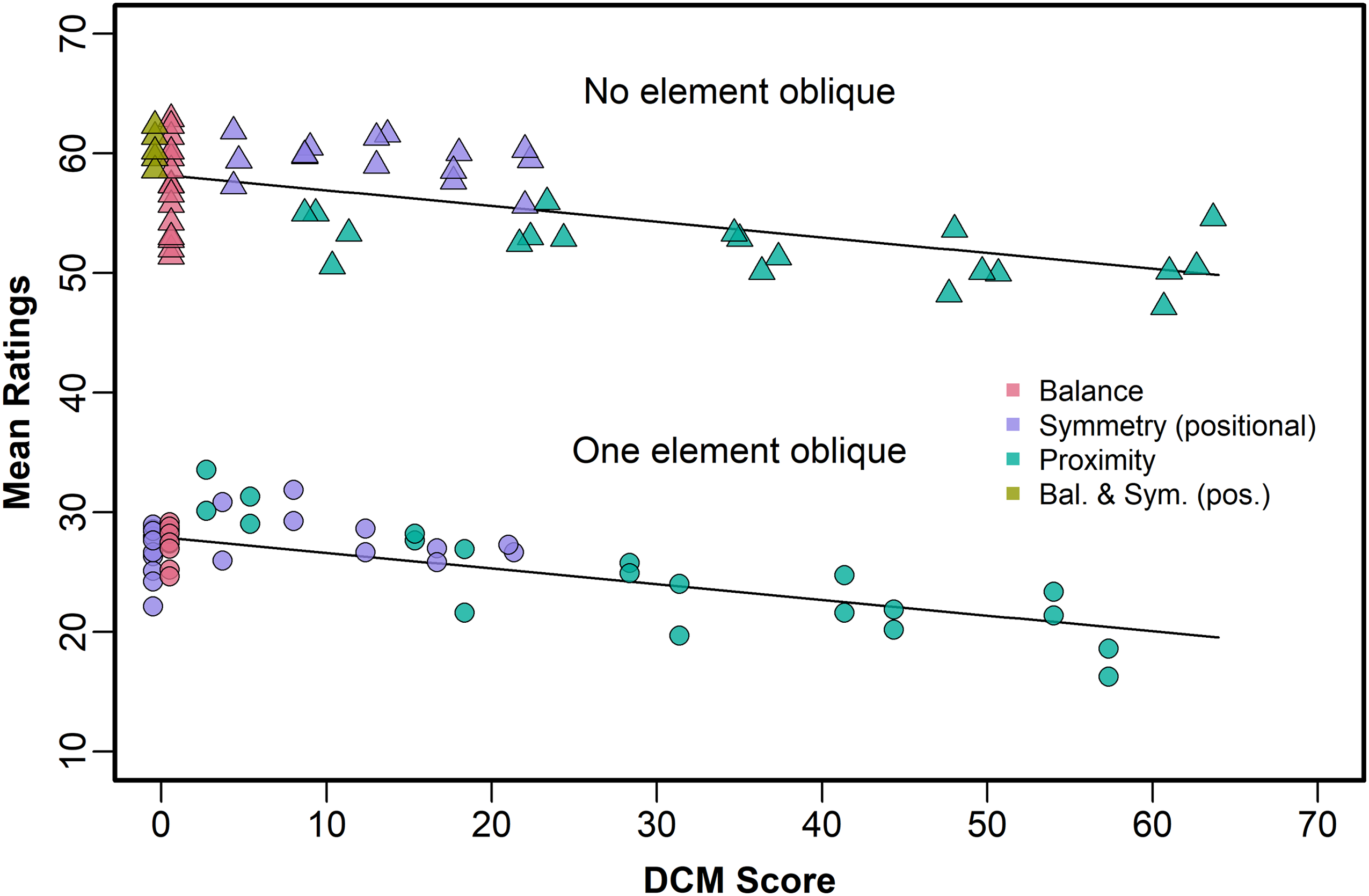
Relation between the DCM scores, obliqueness, and the mean liking ratings in Experiment 1.
Results of multiple regression analysis with liking ratings as dependent variable.

Note. DCM = Deviation of the Center of Mass.
Discussion
Instead of employing a production method, as in Puffer (1903) and in Hübner and Thömmes (2019), this experiment utilized a precomposed set of pictures, systematically constructed according to specific composition rules. Participants rated these pictures based on their aesthetic appeal. The effects of individual rules were then analyzed by comparing rating differences across appropriate picture sets. Initial analyses revealed that positionally symmetric pictures were preferred over balanced pictures, and balanced pictures over proximity pictures. Additionally, a strong negative oblique effect was observed, with pictures containing oblique elements receiving the lowest ratings.
Further analysis, excluding balance but incorporating the left element's eccentricity, demonstrates that the positive effect of positional symmetry was significantly reduced for pictures with an oblique element. A significant interaction between rule and position was also found. As expected, eccentricity did not influence ratings for positionally symmetric pictures but negatively impacted proximity pictures, as increasing eccentricity resulted in greater imbalance and, consequently, reduced liking. This effect is evident in Figure 4, but also in Figure 5, where the mean ratings of all pictures are shown as a function of DCM score.
A comprehensive multiple regression analysis revealed that DCM score and the presence of an oblique element accounted for nearly 97% of the rating variance. Notably, the oblique effect contributed substantially to this variance (Figure 5).
The finding that positionally symmetric pictures were preferred over balanced pictures aligns with the results of the study by Hübner and Thömmes (2019). However, the lower preference for proximity pictures contrasts with their study, where proximity was frequently employed. This discrepancy supports the hypothesis that production methods induce a local perspective, focusing on element configuration, whereas evaluation tasks promote a global perspective, considering overall picture features. Consequently, factors like empty space and imbalance exert a stronger negative influence in evaluation tasks. Furthermore, the production method appears to influence the valuation perspective beyond merely determining the application of compositional rules.
It is important to acknowledge that the prevalence of proximity in Puffer (1903) and in Hübner and Thömmes (2019) may not solely stem from the production method itself, but also from specific constraints, particularly the fixation of one element. For instance, with high left-element eccentricity, positional symmetry and balance necessitate large interelement distances, potentially disrupting perceived configuration. In such cases, a local perspective might prioritize proximity to create a cohesive element arrangement.
To examine whether the fixation of one element in prior production methods induced a local perspective favoring proximity, a second experiment was conducted with both elements movable. If element fixation indeed had the hypothesized effect, this effect should then be absent.
Experiment 2
Experiment 1 indicated that the findings of Puffer (1903) and of Hübner and Thömmes (2019), particularly the frequent use of proximity, were partially attributable to their experimental procedure. However, the precise influence of the production method versus the constraint of a fixed element remained unclear. To address this, a second experiment was conducted. It replicated Hübner and Thömmes’ (2019) Experiment 2, with the key modification that both elements were movable. This procedural change allowed for the assessment of the effect of fixing one element on compositional choices.
Method
Participants
Thirty participants (mean age 27.2, SD = 8.75; 12 males), mostly students of the University of Konstanz, were recruited in the same way as in Experiment 1. For participation, they received a voucher worth €2. The experiment was performed in accordance with the same ethical standards as Experiment 1.
Stimuli
The same five element types and their combination were used to construct the initial stimuli as in the previous experiment. Additionally, the relative side of the elements of the basic stimuli was also reversed. Thus, in all, there were 16 stimuli. However, because reversing doubled the number of LS and SL pairs, there were actually only 14 unique pairs (plus two copies of LS and SL, respectively). Because we used the method of production, the elements were randomly located in the stimulus area of 600 × 400 pixels, which was horizontally centered on a light blue screen and surrounded by a gray frame (see Figure 6). Both elements were movable with the restriction that they could not cross each other.

Image of the screen in Experiment 2.
Procedure
The program for the online experiment was written in JavaScript. Participants were asked to use a notebook or desktop computer and instructed how to scale their browser window (full-screen mode) so that all relevant elements were optimally visible. The actual experiment started with a short instruction that informed about the task and continued by requiring the participants to work through a block of trials showing the 16 stimuli in a randomized order.
Participants’ task was to move the two elements with the computer mouse (via drag and drop) to positions that produced the most beautiful picture. Each element could be moved horizontally anywhere between the position of the other element and the opposite gray frame with a minimum distance of 2 pixels to the other element and the frame, respectively. The initial positions were chosen randomly. There was no time limit. The participants could end a trial and forward to the next one by pressing a NEXT-button. However, this was possible only after they had moved both elements at least once. Altogether, the experiment lasted about 8 min.
Results
Distributions
All participants completed the online experiment. The compositions created by all participants for the various pairs of elements were superimposed and are shown in the corresponding panels in Figure 7. Since the result for each pair and its reversed version was quite similar, only that of the eight basic pairs are shown. As can be seen, in most cases the elements are widely distributed across the picture area. However, they are not distributed evenly, but cluster at certain positions. In the lower part of each panel the corresponding Poisson intensity distributions (Baddeley et al., 2016) of the positions are shown for the left and right elements, respectively.
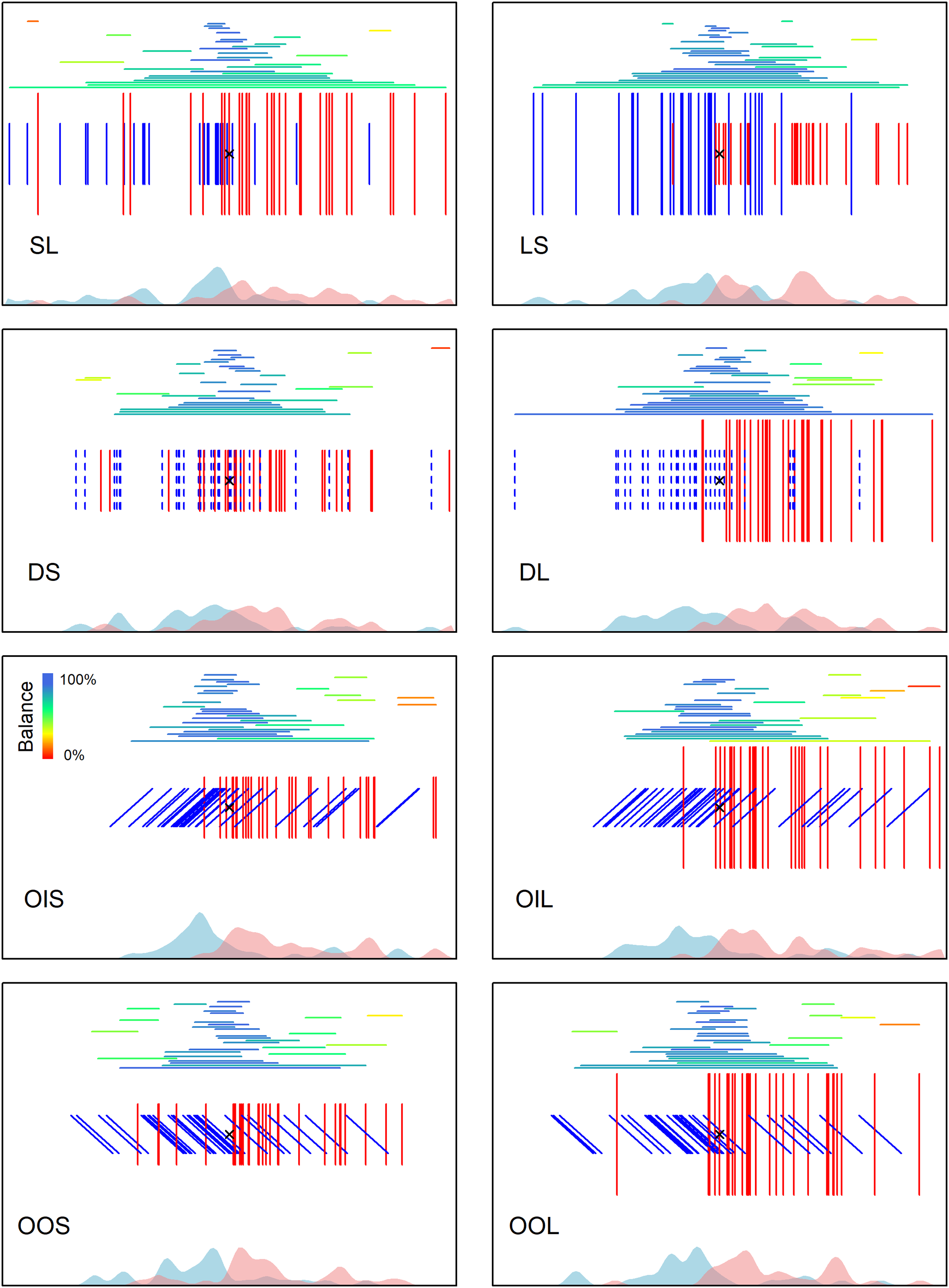
This figure shows the element pairs and their positions produced by the participants in the eight basic stimulus conditions in Experiment 2.
The horizontal lines in the upper part of the panels indicate which two element positions belong together, that is, were produced by one person, respectively. They are ordered according to their length, and their color indicates the balance (DCM) of the corresponding picture. As can be seen, the distances between the elements in a pair were relatively short. Moreover, most lines of these pairs were positioned around the center. In this case they were more balanced (more blueish) than laterally positioned element pairs (more reddish). Many participants applied the positional symmetry rule, that is, they placed the elements in bilaterally symmetrical locations with respect to the picture's central axis. As a result, when the elements had a different perceptual weight (e.g., SL or DS), then the balance of the compositions decreased with an increasing eccentricity. Positioning elements close to each other and on each side of the picture's central axis was particularly frequent for DS and OIS pairs.
SL and LS pairs were treated differently. For LS the long line was mostly located left near the center. The positions of the long line cluster near the center. However, there was also a cluster near the middle of the right side, which indicates balance. Interestingly, for SL such a balance was not the case.
To better see how the distance between the elements is distributed, that is, to what extent proximity was produced, the data in Figure 8 are plotted in such a way that the left elements are shown at a common fixed position, and the right elements at positions corresponding to their original distance. It is obvious that proximity played an important role and occurred at positions near the center as well as at more lateralized ones. The extent of proximity, however, also depended on the pair type. It occurred frequently for double-short pairs but also when one element was oblique. The only condition where the nearest peak of the red distribution is not higher than the next peak is the LS pair.

This figure shows the results of the first eight stimulus conditions in Experiment 2.
Overall, visual inspection of the data suggests that proximity and positional symmetry strongly influenced picture composition. In contrast, balance appeared to play a less prominent role, with the exception of the LS condition. To provide a more rigorous analysis, quantitative measures reflecting the various compositional rules were calculated.
Measures
The DCM scores were used to quantify balance, with a mean of 19.4 (SD 3.05) for the composed pictures. Figure 9 presents the distribution of these balance scores as a percentage histogram. Positional symmetry was quantified using a similar method to DCM, but excluding element weight differences. Consequently, lower values indicate higher symmetry. The mean positional symmetry score across all pictures was 17.4 (SD 3.03). Figure 9 also displays the percentage histogram of the corresponding scores. Proximity was measured as the center-to-center distance between elements, with an average of 107 pixels (SD 22.2). Figure 9 includes the corresponding histogram for this proximity measure.

Percentage histograms of the different scores of the composed pictures in Experiment 2.
The histograms in Figure 9 indicate that most compositions exhibit good balance and, to an even greater extent, positional symmetry. However, due to minor weight differences between some elements, a significant correlation was observed between mean balance and mean positional symmetry for unequal-weight pairs (r = .869, p < .01, n = 10). To assess whether participants prioritized balance or positional symmetry, a paired t-test was conducted on these unequal-weight pairs. Perfect positional symmetry would result in a mean score of zero, while the corresponding mean balance score would be higher. Conversely, perfect balance would yield the opposite pattern. The data revealed a mean balance score of 20.4 (SD 12.4) and a mean positional symmetry score of 17.1 (SD 13.3). This difference was statistically significant (t(29) = 3.97, p < .001), suggesting a preference for positional symmetry over balance.
Both balance and positional symmetry were found to be related to interelement distance. As becomes evident by inspecting the histogram, increasing distance correlated with higher positional symmetry (r = −.633, p < .01). The relationship between distance and balance differed. For positionally symmetric unequal-weight pairs, balance tended to decrease with increasing distance, although this trend was not statistically significant (r = −.291, p = .415). These results support the hypothesis that positional symmetry was favored over balance in most compositions.
Crucial to the objective of this experiment is that the majority of compositions exhibit elements within 20% of the available width (see the histogram of distances in Figure 9), demonstrating the substantial influence of proximity as a compositional rule.
Individual Differences
Individual differences in preferred composition rules were also examined. Preference for positional symmetry allows for a wide range of interelement distances, whereas preference for balance imposes constraints on this distance. Figure 10 illustrates this variability across participants. Specifically, participants who favored proximity (i.e., smaller interelement distances) exhibited greater variability in positional symmetry preferences. Conversely, those who placed elements far apart tended to create more positionally symmetrical compositions. Overall, the data reveal that positional symmetry was favored across the entire range of realized interelement distances.

The relation between the mean distance produced by the participants and the corresponding mean positional symmetry.
Discussion
Experiment 2 sought to determine whether the findings of Puffer (1903) and of Hübner and Thömmes (2019) were influenced by the production method, specifically the constraint of a fixed element. The aim was to distinguish between the effects of the production method itself and the constraint of fixing an element, particularly at extreme positions, which might increase the preference for proximity at the expense of balance and positional symmetry. To this end, the production procedure used by Hübner and Thömmes (2019) was applied, with the critical modification that both elements were movable.
The results demonstrate that participants frequently utilized proximity, as evidenced by the relatively short interelement distances in most compositions. However, quantitative analyses also revealed that most compositions were well-balanced and, to a greater extent, positionally symmetrical. Statistical analyses further indicated a preference for positional symmetry over balance.
Individual differences were observed, with some participants favoring proximity and others positional symmetry. Thus, both proximity and positional symmetry emerged as significant compositional rules, albeit with varying application across individuals.
Together, the results of Experiment 2 suggest that while the fixed-element constraint may contribute to the prevalence of proximity, the production method itself also plays a significant role, likely by inducing a local perspective.
General Discussion
The primary goal of this study was to investigate which of the visual composition principles—symmetry, balance, or proximity—is preferred for pictorial beauty and how the method used to assess this preference (rating vs. production) influences the outcome. Specifically, in line with Gestalt psychology and results showing that the spatial focus of attention can be deliberately controlled in size depending on the requirements of a task (Chamberlain & Wagemans, 2015; Hübner, 2014; Hübner & Volberg, 2005; Navon, 1977), it aimed to test the hypothesis that the production method might induce a local focus, favoring proximity, compared to the rating method which might encourage a global focus, favoring symmetry and balance.
One of the earliest studies investigating balance used a production method where one element was fixed, and another could be moved to create a pleasing composition (Puffer, 1903). It found that participants often applied the proximity principle, that is, placing elements close together, even if this resulted in unbalanced pictures. This result has recently been replicated (Hübner & Thömmes, 2019), but contradicts findings from studies where participants rated precomposed pictures, which often showed a preference for balance and symmetry (e.g., Hübner & Fillinger, 2016; Locher et al., 1996; Wilson & Chatterjee, 2005).
To investigate the origin of this contradiction, Experiment 1 was conducted to test if the frequent use of proximity in the early production tasks was specific to that method. To make the experiment comparable to the previous experiments, the same picture elements were used. However, instead of having the participants compose the pictures, they were precomposed by systematically varying the principles of balance, and proximity. Symmetry in the strict sense could not be achieved because the elements differed in each picture. Therefore, positional symmetry was used instead, that is, the different elements were placed in symmetrical positions.
It was hypothesized that if participants rated precomposed pictures in terms of beauty, they would adopt a global focus of attention, resulting in a lower preference for proximity compared to production tasks. To test this hypothesis, participants had to evaluate pictures that had been designed using the elements and rules employed in previous studies (Hübner & Thömmes, 2019; Puffer, 1903). The results show that the participants liked positionally symmetric pictures most, followed by balanced pictures, and liked proximity pictures least. The ratings for proximity pictures decreased as the elements became more eccentric (further from the center), presumably, because of their increasing imbalance. An analysis also showed a strong negative effect for pictures containing an oblique element. The finding that proximity was least liked is at odd with the results from corresponding production studies and supports the hypothesis that the assessment method impacts preference, with rating methods potentially promoting a global perspective where overall balance and positional symmetry are more valued.
While the results of Experiment 1 confirmed that the production method influenced preferences, it remained unclear if this was due to the act of production itself or the specific constraint in earlier studies due to a fixed element. Fixing an element, especially one far from the center, might encourage to adopt a local perspective and to apply proximity to create a pleasing configuration rather than achieving overall balance or positional symmetry, which would place elements far apart. Such an idea has already been proposed by Puffer (1903).
To test the effects of a fixed element, Experiment 2 used a similar production task as Hübner and Thömmes (2019), but allowed participants to move both elements freely, aiming to isolate the effect of the fixed-element constraint. As a result, even when both elements were movable, participants frequently placed them relatively close together, indicating proximity remained an important composition strategy. However, quantitative analysis showed that many compositions were also well-balanced and even more were positionally symmetric. A direct comparison indicated a significant preference for creating positionally symmetric compositions over balanced ones. Individual differences were also observed, with some participants prioritizing proximity and others positional symmetry.
The two experiments highlight a significant discrepancy based on the assessment method used. In essence, the preference for positional symmetry, balance, or proximity in picture composition is not absolute but depends significantly on how beauty is assessed. Production tasks encourage a focus on element arrangement (favoring proximity), while rating tasks favor a holistic assessment (prioritizing positional symmetry and balance).
Limitations and Further Direction
Despite delivering interesting and significant findings, our study has several limitations. For instance, the range and variety of stimuli were limited due to our exclusive use of line segments. Furthermore, the elements within an image were different, making it impossible to create perfectly symmetrical compositions. Additionally, participants could only move the elements horizontally. These limitations arose because our study closely followed the early work of Puffer (1903) and its replication by Hübner and Thömmes (2019). Accordingly, while our results demonstrate that the production method used influences preferred design principles compared to a rating method, it remains an open question to what extent our findings can be generalized to other more complex and realistic production methods.
There are several studies that have used more complex production methods. Locher et al. (1998, 2001), for example, conducted studies on balance that used not only highly varied element types but also different frame shapes (rectangular, round). The elements could be physically placed anywhere within the frame. Under these conditions, not only the elements themselves but also perceptual effects created by the frame come into play, such as a strong “gravitational” pull toward the image center and its diagonals (Arnheim, 1982; Hübner, 2022). An interesting question is whether these more complex production conditions also lead to a local focus, resulting in a more frequent application of the proximity rule. Future studies could compare compositions produced by participants using these more complex methods with those formally generated based on specific design principles. It would be informative to see how they differ and how differently they are aesthetically judged. This would reveal whether the same preference differences between production and evaluation emerge as in this study.
Individual differences in the production of compositions, which were only briefly considered in the present study, are also worth investigating more thoroughly in future research. It is known that certain groups of people differ in their preference for specific design principles. This holds true, for example, between laypeople and artists (Letsch & Hayn-Leichsenring, 2020; Mutter & Hübner, 2024). In the study by Letsch and Hayn-Leichsenring (2020), laypersons and artists created abstract compositions. The researches then calculated not only a range of low-level image features, such as the Fourier slope, but also the adherence to the Rule of Thirds, which is now easily possible with readily available software (Redies et al., 2025). They found systematic differences between artists and laypeople. Unfortunately, no other rules, such as balance or symmetry, were considered. This should not be overlooked in future studies.
Supplemental Material
sj-pdf-1-ipe-10.1177_20416695251381548 - Supplemental material for Preference for symmetry, balance, or proximity in picture aesthetics depends on the method of evaluation
Supplemental material, sj-pdf-1-ipe-10.1177_20416695251381548 for Preference for symmetry, balance, or proximity in picture aesthetics depends on the method of evaluation by Ronald Hübner in i-Perception
Footnotes
Acknowledgments
I thank Martin Fillinger for the collection and preliminary analysis of the assessment data in Experiment 1.

Ethical Standard
This study, carried out on human participants, followed the ethical guidelines set by the institutional research committee, and complied with the 1964 Helsinki Declaration and its subsequent amendments or other equivalent ethical standards.
Informed Consent
Informed consent was obtained from all individual participants involved in the study.
Author Contribution(s)
Funding
The author received no financial support for the research, authorship, and/or publication of this article.
Declaration of Conflicting Interests
The author declared no potential conflicts of interest with respect to the research, authorship, and/or publication of this article.
Data Availability Statement
Supplemental material
Supplemental material for this article is available online.
References
Supplementary Material
Please find the following supplemental material available below.
For Open Access articles published under a Creative Commons License, all supplemental material carries the same license as the article it is associated with.
For non-Open Access articles published, all supplemental material carries a non-exclusive license, and permission requests for re-use of supplemental material or any part of supplemental material shall be sent directly to the copyright owner as specified in the copyright notice associated with the article.
