



Abstract
Numerous studies have explored the mechanisms of heading estimation from optic flow and ensemble coding in other features, yet none have examined ensemble coding's role in heading estimation. This study addressed this gap through two experiments. Participants sequentially viewed three (experiment 1) or five/seven (experiment 2) optic flow-simulated headings, then reported specific directions. Results revealed that individual heading accuracy declined with increasing numbers, while estimates closely matched ensemble representations, demonstrating ensemble coding in heading estimation. Notably, ensemble coding accuracy remained unaffected by heading quantity, indicating its capacity-free nature—unlike capacity-limited individual heading processing. The discovered summary statistics of motion may help us to better understand the navigation in complex environments (e.g., how pedestrians/drivers judge their self-motion directions), which could potentially contribute to real-world implications.
How to cite this article
Sun, Q., Ying, H., & Sun, Q. (2025). Self-motion direction estimate from optic flow is a result of capacity-free and implicit ensemble coding. i-Perception, 16(5), 1-12. https://doi.org/10.1177/20416695251377199
Introduction
To accurately estimate our self-motion direction (i.e., heading), our visual and cognitive systems use various visual and nonvisual information (Angelaki et al., 2009; Chen et al., 2013; Fetsch et al., 2010; Schindler & Bartels, 2018). Among them, it has been demonstrated that observers can accurately estimate their translational heading directions from optic flow (Gibson, 1950)—a dynamic light-motion pattern projected on an observer's retina when one is moving in the world (Burlingham & Heeger, 2020; Crowell & Banks, 1993; Layton & Fajen, 2016; Maus & Layton, 2022; Sun et al., 2024a, 2024b; Warren & Hannon, 1988; Warren et al., 1988) and systematically show a bias toward the straight-ahead direction, which is known as center bias (e.g., D’Avossa & Kersten, 1996; Sun et al., 2024a, 2024b; Xu et al., 2022). Additionally, recent studies have demonstrated that heading perception from optic flow also involves different cognitive abilities, such as attention (Sun et al., 2024b) and working memory (Sun et al., 2023).
However, the above studies on heading perception present only one optic flow pattern per trial, requiring participants to report a single heading direction. This approach examines memory for isolated events, unlike real-world scenarios. For example, when a traffic officer asks “Which direction were you heading?”, we may report either our immediate direction or an average of recent headings—a distinction current literature fails to address (Figure 1).
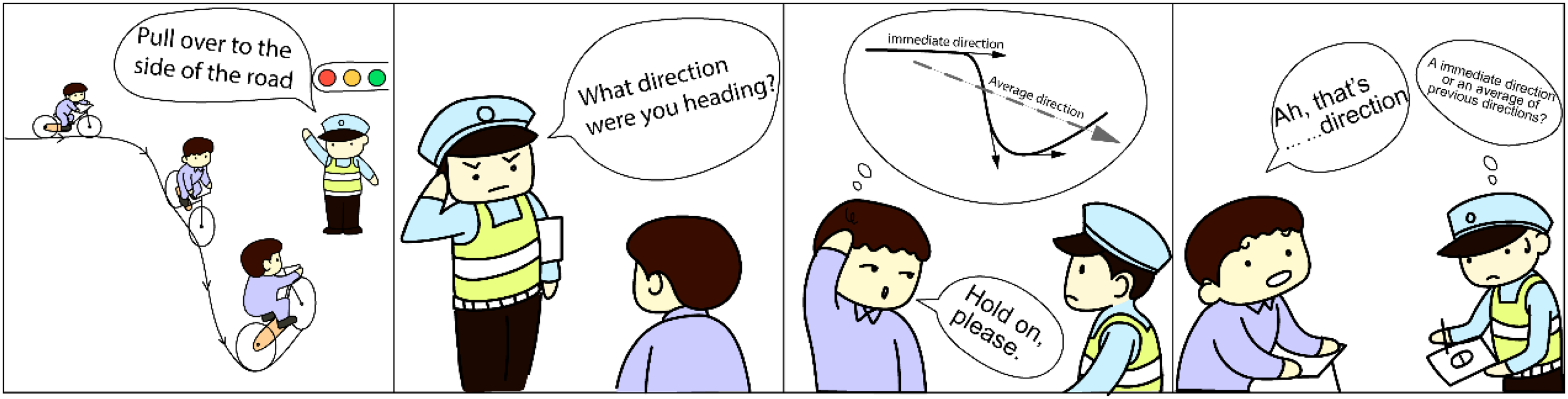
Schematic depiction of a traffic violation interaction between law enforcement and a cyclist.
Capacity-limited working memory (Oberauer et al., 2016) and efficient coding principles (Attneave, 1954) suggest that remembering individual headings is cognitively costly. Instead, observers likely compute an average—consistent with ensemble coding, where people efficiently extract summary statistics from multiple items (Whitney & Leib, 2018). This effect generalizes across features like orientation (Utochkin et al., 2024), motion direction (Sweeny et al., 2013), and facial traits (Haberman & Whitney, 2009). Moreover, such phenomenon does not only occur at perception of simultaneously presented stimuli, but also at sequentially presented ones (e.g., Haberman et al., 2009; Ying et al., 2020). Notably, Sweeny et al. (2013) demonstrated ensemble coding for object motion, raising the question: does it also apply to self-motion direction (heading) estimation?
Ensemble coding is often considered a capacity-free process that bypasses visual system limitations (Alvarez, 2011; Epstein & Emmanouil, 2017; Fitousi, 2025). For example, mean size estimation remains accurate regardless of set size (Attarha et al., 2014), though basic attentional resources are still required (Alvarez & Franconeri, 2007; Huang, 2015). However, representing multiple ensembles may be a limited-capacity process (Fitousi, 2025) and result in degraded individual item precision (Haberman & Whitney, 2007). This raises critical questions for heading estimation: While optic flow integration relies on component motion trajectories (Warren et al., 1988), recent work shows attention and working memory constrain individual heading judgments (Sun et al., 2023, 2024a, 2024b). If ensemble coding operates in multiheading contexts, does it remain capacity-free? And is it truly independent of individual heading processing?
In summary, the current study investigated whether heading estimation from optic flow involves capacity-free ensemble coding through two experiments adapting Khayat & Hochstein's (2018) paradigm. Participants sequentially viewed three to seven optic flow patterns before reporting specific nth headings, with results showing three key findings: (1) serial position effects (enhanced accuracy for first/last headings), (2) systematic bias toward the mean heading direction indicating ensemble coding, and (3) invariant ensemble accuracy across set sizes, demonstrating its capacity-free nature. These findings establish that heading estimation automatically integrates multiple flows into summary representations independent of working memory constraints, revealing a fundamental mechanism for efficient navigation in complex environments.
Experiment 1
Methods
Participants
Eighteen participants (11 females, seven males; 19–25 years old) were enrolled from Zhejiang Normal University. All were naïve to the experimental purpose and with normal or corrected-to-normal vision. The sample size was determined according to the previous studies (e.g., Warren et al., 1988; Sun et al., 2024a, 2024b). The Scientific and Ethical Review Committee in the School of Psychology of Zhejiang Normal University approved the experiment.
Stimuli and Apparatus
The current study presented three sequential optic flow patterns (Figure 2A) per trial (112°H × 80°V), simulating observer translation through a three-dimensional (3D) dot-cloud (200 dots, 0.28° diameter, 22.5 cd/cm2 luminance) at 1.5 m/s speed with depth ranging from 0.2–5 m. Each flow pattern's heading direction was randomly selected from seven possible angles (0°, ± 10°, ± 20°, ± 30°), where negative/positive values indicated left/right deviations from screen center (0°).
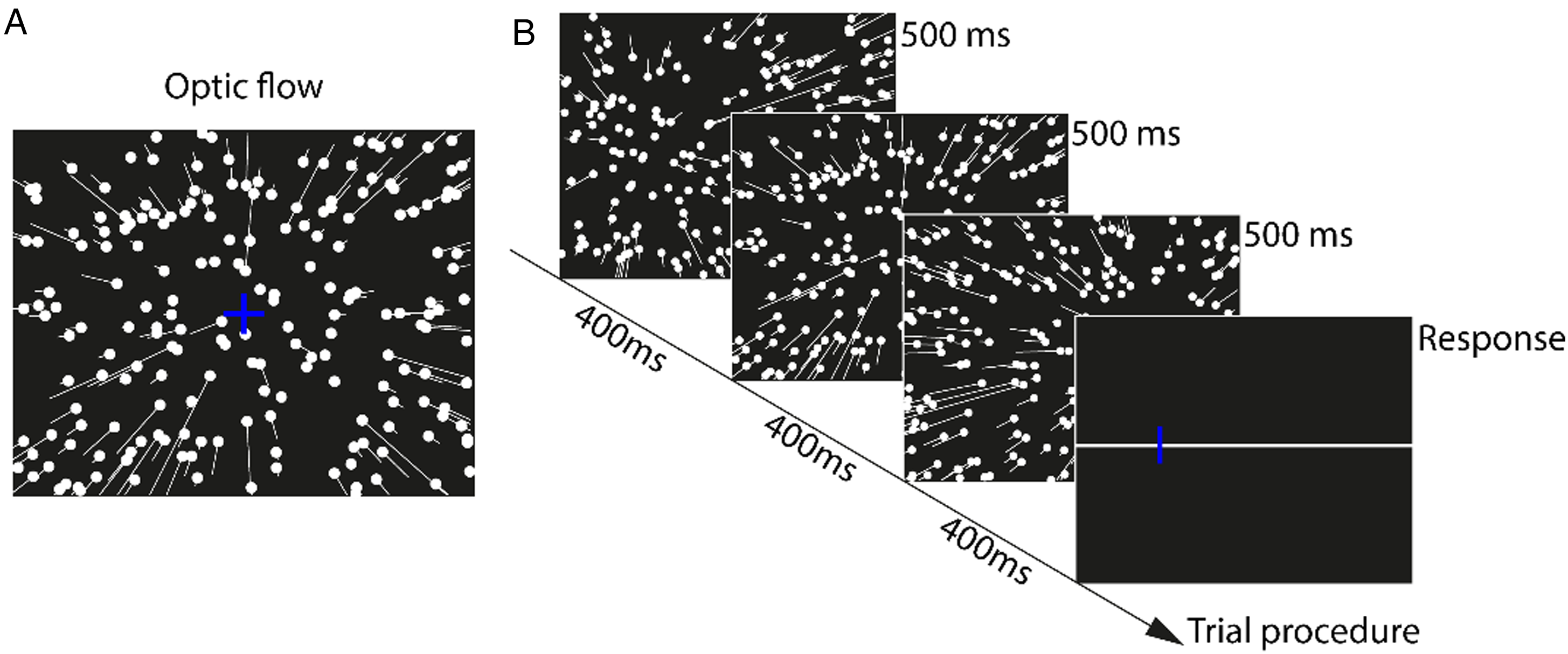
(A) Schematic representation of experimental visual stimuli simulating observer translation through a 3D dot-cloud. Dots represent initial positions (frame 1), while white lines (not visible during experiments) indicate subsequent motion trajectories. (B) Illustration of a trial produce consisting of three optic flow displays.
The visual stimuli were generated using MATLAB (Psychophysics Toolbox 3) and displayed on a 27-inch Dell monitor (2560 × 1440 resolution, 59.8 × 33.6 cm, 60 Hz refresh rate) driven by an NVIDIA GeForce GTX 1660Ti graphics card.
Procedure
Participants were seated in a light-exclude room with their heads stabilized using a chin-rest, maintaining strict head–body alignment with the display center. They viewed the stimuli monocularly (right eye) at a fixed 20cm distance to minimize binocular disparity conflicts while preserving simulated motion parallax cues. Throughout the experiment, participants maintained central fixation and refrained from any head or body movements.
As shown in Figure 2B, each trial consisted of three sequentially presented 500ms optic flow patterns, each followed by a 400ms blank interval. Following the final blank, a central cue number (n = 1, 2, or 3) indicated which of the three headings participants should recall. Simultaneously, a 112° horizontal line appeared with a randomly positioned blue vertical bar, which participants adjusted to match the cued heading direction before confirming their response via mouse click.
Heading directions were randomly selected from seven possible angles (0°, ± 10°, ± 20°, ± 30°) across 270 experimental trials. Prior to testing, participants completed 10 practice trials (excluded from analysis) to familiarize themselves with the procedure. The entire session lasted approximately 20 min.
Data Analysis
We recorded the heading estimate of each trial. To examine whether participants could accurately retrieve and discriminate the target heading directions, we fitted the heading estimates (


If participants could remember and discriminate the target heading direction, then
Moreover, given that previous studies have demonstrated that the heading estimates are systematically compressed toward the straight-ahead direction (0°), indicating a center bias (e.g., Sun et al., 2023, 2024a, 2024b), it can be expected that
Aside from the question above, we also examined whether participants represented the presented headings by ensemble encoding/averaging (i.e., ensembled heading). If true, what weights were assigned to the different headings? To address these questions, we conducted two types of multifactors linear regression, given by:


In equations (3.1) and (3.2), we assumed that participants first create an ensemble heading by assigning weights (
Three key findings would support ensemble coding in heading estimation: (1) superior performance of functions (3.1)/(3.2) over function (1) would demonstrate ensemble representation; (2) better fit of function (3.2) versus (3.1) would indicate differential weighting of headings in ensemble formation; and (3) statistically significant weights for individual headings would confirm their incorporation into the ensemble representation.
Results and Summary
Our analysis employed two linear regression models to assess heading discrimination accuracy: function (1) modeled estimates against target headings, while function (2) used previously presented nth headings. As shown in Figure 3A, the significantly steeper slopes for target headings (
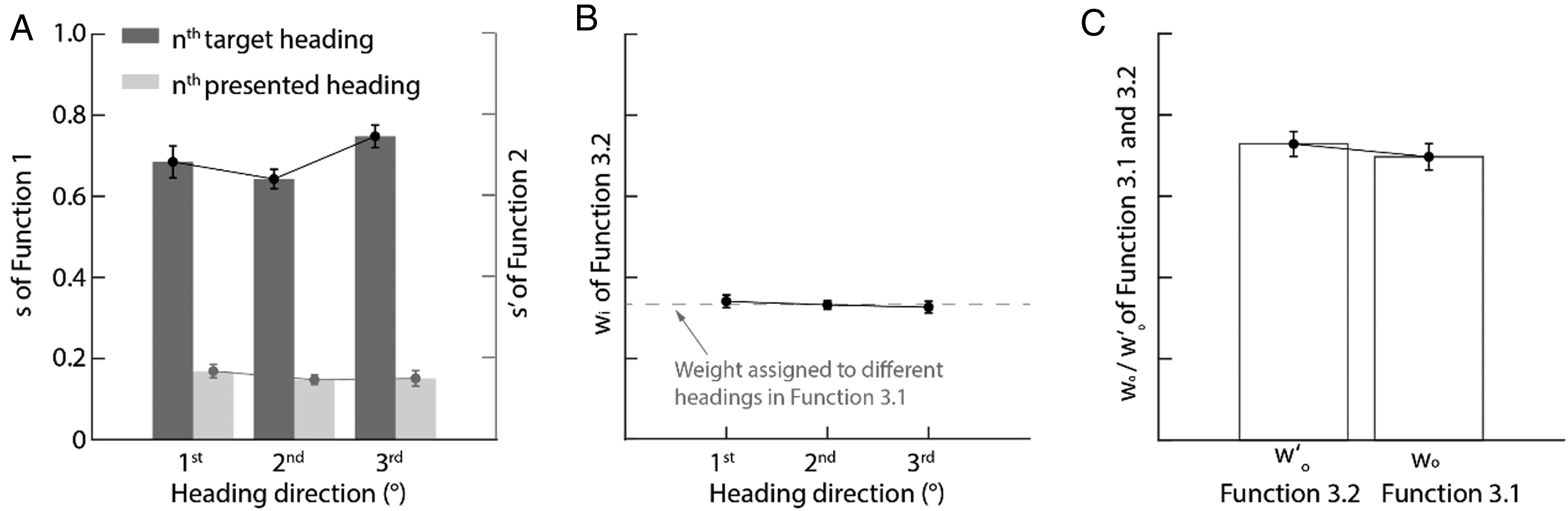
Experiment 1 results. (A) Direction-tuning slopes (
In addition, as shown in Figure 3A, the slope
Moreover, the slope analysis revealed a distinct serial position effect: the third target heading showed the steepest slope (
Next, to investigate ensemble encoding, we analyzed the weighting (
Importantly, further comparisons revealed a complex pattern: while ensemble weights (
Experiment 2
The results of experiment 1 are open to one question: whether participants reported the first/last heading or an ensemble heading. To address this concern, in experiment 2, we recruited 18 participants to complete two blocks of trials. One block comprised trials with five optic flow patterns, while the other block consisted of trials with seven optic flow patterns. Previous studies in Visual Working Memory indicates that the memory capacity is limited (Baddeley, 2012), which motivated us to compare the performance with a wider range of item numbers. Here, the heading directions were randomly selected from seven possible angles (0°, ± 10°, ± 20°, ± 30°), allowing for the repetition of the same heading within a single trial. Note that, a block design, as opposed to a randomized presentation, was employed to mitigate participant fatigue. All other parameters, procedures, and methods remained consistent with experiment 1.
Figure 4A and D plots the slopes (
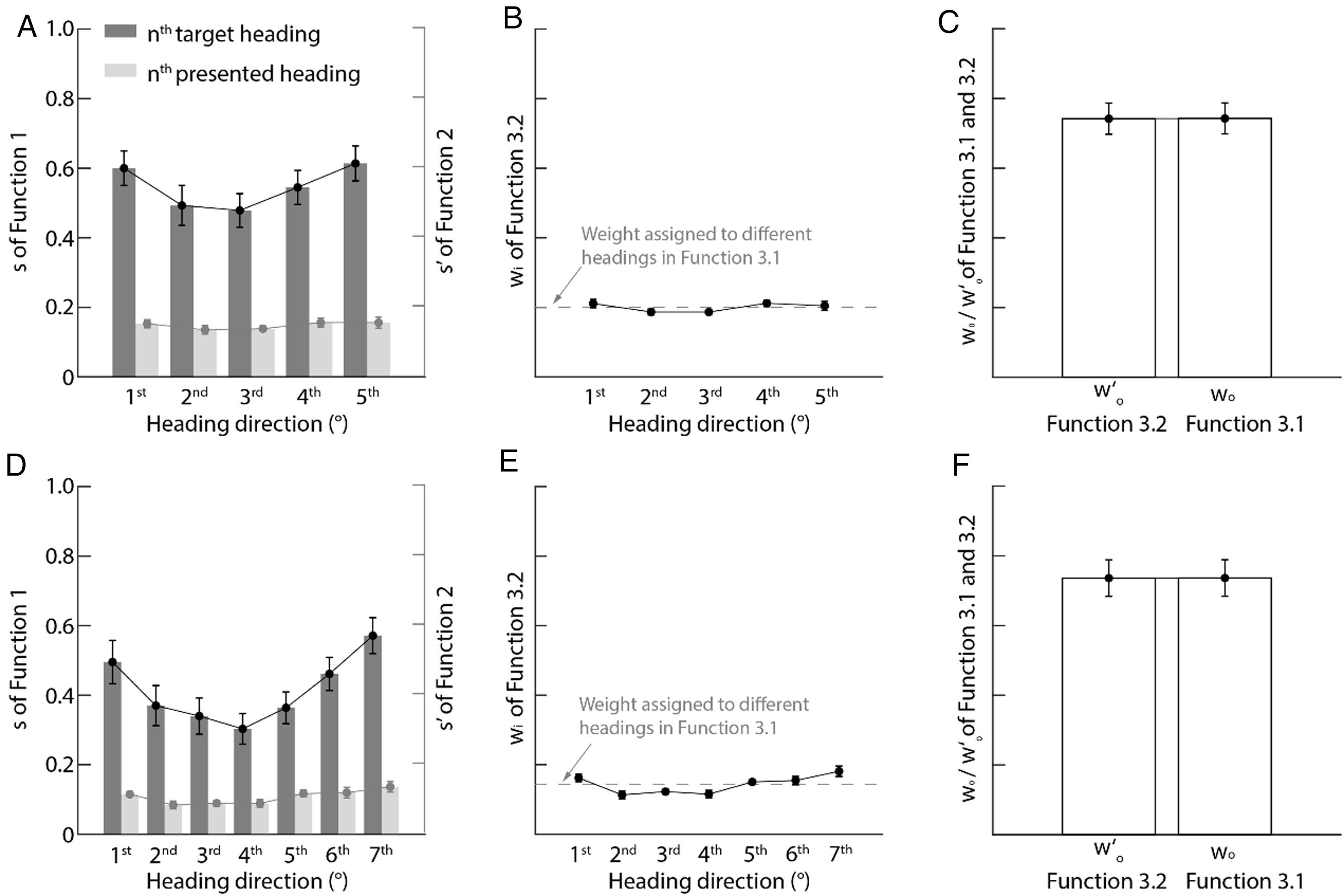
Experiment 2 results. (A) Direction-dependent slopes (
Meanwhile, the weight patterns (
Table 1 compares the goodness-of-fit metrics (Deviance, AIC-Akaike Information Criterion, BIC-Bayesian Information Criterion, R2) for functions (3.1) and (3.2) across experiments. The nearly identical performance of both functions indicates that additional parameters in function (3.2) did not significantly improve variance explanation. This supports a uniform weighting strategy (
Results of functions 3.1 and 3.2 in Experiments 1 and 2.

The numbers in each cell indicate the mean index averaged across all participants and the corresponding standard error.
Moreover, an independent samples t-test showed that
General Discussion
Two experiments examined the existence of ensemble coding in optic flow heading estimation. Results revealed both primacy (Anderson & Barrios, 1961) and recency effects (Broadbent & Broadbent, 1981), with estimates most closely matching the average heading sequence, which may suggest ensemble encoding in heading estimation from optic flow. This indicates a bias toward ensemble averages when recalling specific headings.
This study may provide the first empirical evidence for ensemble coding in optic-flow heading estimation. Departing from static single-flow paradigms (Crowell & Banks, 1993; Sun et al., 2023, 2024a; Warren et al., 1988), our dynamic sequential design reveals observers equally integrate multiple headings into ensemble representations (models 3.1–3.2). Critically, this suggests recalled headings reflect averaged rather than instantaneous directions—a fundamental navigation mechanism.
Meanwhile, the findings also hinted the existence of implicit ensemble coding in heading estimation. Despite explicit instructions to recall individual headings (no averaging required), estimates were consistently driven by the ensemble mean. This task-behavior dissociation reveals automatic computation of summary statistics, even when task-irrelevant, supporting ensemble coding as a fundamental perceptual mechanism (Alvarez, 2011; Haberman et al., 2009; Whitney & Leib, 2018).
Additionally, ensemble coding accuracy remained stable across varying numbers of flow patterns, supporting the notion of its cognitive load independence (i.e., capacity-free; Alvarez, 2011; Epstein & Emmanouil, 2017; Fitousi, 2025). Both experiments confirmed that grand averaging—a proxy for ensemble representation—faithfully captured individual optic flows. This aligns with domain-general ensemble coding robustness (e.g., Haberman & Whitney, 2009), including Attarha et al.'s (2014) demonstration of capacity-unconstrained coding. Even under information overload (5 vs. 7 flows), performance was comparable, reinforcing ensemble coding's automatic, capacity-free nature—a consensus across studies (Alvarez, 2011; Whitney & Leib, 2018).
These results contrast with working memory's role in individual heading estimation. As optic flow patterns increased, we observed declining accuracy for individual headings—consistent with working memory limitations. While Sun et al. (2023) indirectly implicated working memory through Electroencephalogram decoding of heading representations, our paradigm directly engaged working memory by requiring explicit recall of multiple headings. This behavioral finding partly supports Sun et al.'s (2023) neural findings and, crucially, suggests optic flow heading estimation as a cognitive process (Sun et al., 2023, 2024a) rather than purely information-driven computation (Royden & Hildreth, 1999).
Moreover, the current study indicates that ensemble coding coexists with individual heading estimation, though biasing individual representations (Brady & Alvarez, 2011; Corbett, 2017; Utochkin & Brady, 2020)—indicating preserved (but influenced) feature processing. This contrasts with studies showing exclusive ensemble perception (e.g., emotion judgments; Alvarez, 2011; Haberman & Whitney, 2007; Whitney & Leib, 2018), highlighting a stimulus-dependent duality in visual processing. Future work should examine key moderators (e.g., stimulus dynamics and task demands) to resolve this theoretical divergence.
It is important to note that the ensemble-coding interpretation was derived based on a “winner-takes-all” assumption: specifically, that either
Our current findings not only advance theoretical understanding in cognitive neuroscience but also carry practical implications such as traffic accident investigations. Our findings reflected that the visual system relies on a temporally averaged representation (integrating previous perceptual history) rather than instantaneous recording for a complex motion scenario. The current study, together with myriads of previous studies (Alvarez, 2011; Epstein & Emmanouil, 2017; Fitousi, 2025), suggested that such ensemble coding is almost automatic and capacity-unconstrainted. Thus, these findings suggesting that witness statements about travel directions may inherently incorporate this systematic bias without conscious recognition (Figure 1). Consequently, traffic authorities should account for this physiological constraint by applying temporal calibration to directional reports and maintaining appropriate flexibility in evidence evaluation during liability determination, thereby enhancing both the scientific validity and fairness of accident assessments.
In summary, this study shows that optic-flow heading estimation involves capacity-unconstrained ensemble coding operating automatically and implicitly. Crucially, while individual heading estimation remains limited by perceptual/cognitive constraints, ensemble coding better reflects natural navigation behaviors. As the first to integrate optic-flow processing with ensemble coding theory, this work provides a framework for investigating multisensory heading integration (visual/vestibular/proprioceptive) in ecological contexts.
Footnotes
Acknowledgements
The authors would like to thank Xiao-Yan Zhang (master student in our lab) for collecting the data.

Ethics Approval
This study was approved by the Scientific and Ethical Review Committee in the Department of Psychology of Zhejiang Normal University.
Consent to Participate
Informed consent was obtained from all individual participants included in the study.
Consent for Publication
Not applicable.
Author Contribution(s)
Funding
The authors disclosed receipt of the following financial support for the research, authorship, and/or publication of this article: This study was supported by National Natural Science Foundation of China, China (No. 32200842) to Qi Sun.
Declaration of Conflicting Interests
The authors declared no potential conflicts of interest with respect to the research, authorship, and/or publication of this article.
Availability of Data and Materials
Code Availability
The scripts for experimental program and data analysis can be available on request.