




Abstract
In Hwang and Peli (2014), few errors occurred in computing the angular disparities. The direction of peripheral depth distortion (the angular disparity differences between what it is in real-world 3D viewing and S3D viewing) is reversed when the computational errors were corrected, making the perception of the peripheral depth to be expanded, not compressed. This reply points to the error and provides the corrected figures. Correcting these errors does not affect the general conclusion that S3D viewed on single screen display induces peripheral depth distortion which may be a cause of visually induced motion sickness.
There were computational errors in generating Figures 9 and 10 of the Hwang and Peli (2014) paper. The corrected figures are presented later as Figures 1 and 2, respectively. The computation of the angular disparity (AD) and the explanation of the computational error are presented in Appendix.
This figure should replace the Figure 9 of the Hwang and Peli (2014) paper. The effect of gaze shifts on AD as a function of eccentricity while the viewer’s head remains centered. The ADs of all nine objects are shown for each gaze (fixation) position. In the first two rows (panels a to f), legend symbols distinguish gaze position, not objects rows, with all nine objects per gaze having the same symbol. Panels (a), (b), and (c) show the ADs with S3D viewing, each with three gaze positions overlaid (for fixations on the objects in first row, second row, and third row, respectively). Panels (d) to (f) show the corresponding ADs during natural viewing. Panels (g) to (i) plot the arithmetic difference between the S3D and natural ADs as a function of VE, with symbols representing gazed objects, O1 to O9. The amount of the depth distortion is largely independent of aiming distance (vergence angle), but is substantial at larger VEs. This figure should replace the first row of the Figure 10 of the Hwang and Peli (2014) paper. Distribution of ADs and virtual locations of objects viewing in S3D when the eyes’ position has shifted (a) −0.2 m, (b) 0.0 m, and (c) 0.2 m from the center while fixating on the center object (O5).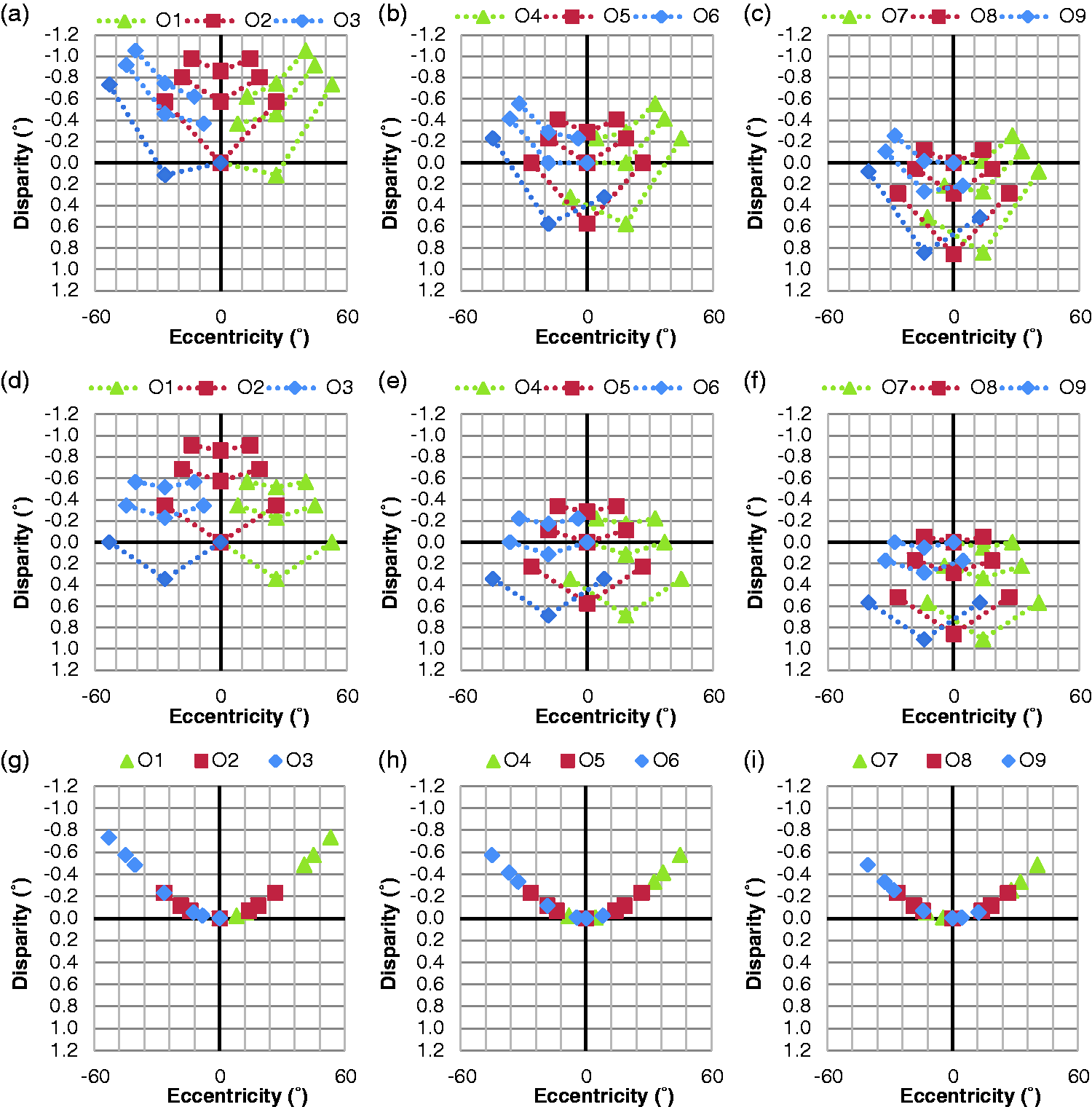

These errors resulted in incorrect depiction of the perceptual depth distortion from viewer’s perspective, where the disparity differences between the real-world 3D viewing and S3D viewing should be increased in negative (uncrossed) direction (as shown in Figure 1(g) to (i)), instead of positive (crossed) direction (as shown in Figure 9 (g) to (i) of the paper), as the eccentricity is increased.
This corrected depiction indicates a depth expansion (not compression) in the viewer’s peripheral field, which makes any motion in depth in the peripheral area to be perceived slower than it should be.
The same errors also affected a few panels in Figure 10 of the Hwang and Peli (2014) paper, which illustrated the effect of viewer’s lateral head position shift in S3D viewing. Although the magnitude of distortion was changed in the corrected disparity structure depicted (Figure 2), the main point of the paper, the perception of world rotation following the viewer’s head position shift, is still well supported. Note that the viewer’s impression of the world rotation mentioned in the Hwang and Peli (2014) paper, in fact, is a sheering of the 3D scene in depth direction.
Although the direction of peripheral depth distortion has been reversed and the amount of the distortion caused by viewer’s lateral head shift have been corrected, these changes are not affecting the general conclusion of the paper, that the peripheral depth distortion and viewer’s position shift while viewing S3D may induce non-rigidity of the depicted world, and it may be a likely source of the visually induced motion sickness.
Footnotes
Declaration of Conflicting Interests
The author(s) declared no potential conflicts of interest with respect to the research, authorship, and/or publication of this article.
Funding
The author(s) disclosed receipt of the following financial support for the research, authorship, and/or publication of this article: This study was supported in part by a Faculty Research Awards from Google Inc. to Dr. Peli and by the Joint PhD Program from China Scholarship Council (No. 201606230159).
Author Biography