



Abstract
Over the past three decades, scholars have found that organizational change often results in high levels of psychological uncertainty about change as well as enhancing job insecurity. Research also has identified these variables as predictors of employee wellbeing during change. Despite this, researchers have not developed an integrative model of the antecedents and consequences of the different types of change-related uncertainty and insecurity that may emerge during change. In this conceptual paper, we draw on the conservation of resources theory to develop such an integrative model. We identify change event characteristics (i.e., change content, change processes, and the internal change context) as antecedents of different types of change-related uncertainty, which influence different types of insecurity, and ultimately influence multiple dimensions of employee wellbeing. We identify employees’ personal characteristics (i.e., demographic and individual dispositions) as moderators of relationships between change event characteristics and different types of change-related uncertainty and employee insecurity, which in turn influence wellbeing. We discuss the implications of this model for research and practice when managing change.
Plain Language Summary Title
THE IMPACT OF PERSONAL AND CHANGE EVENT CHARACTERISTICS ON EMPLOYEE WELLBEING VIA UNCERTAINTY AND INSECURITY
Plain Language Summary: In this conceptual paper, we offer a more nuanced understanding of the impact of personal and change characteristics on employee wellbeing. In doing so, we pay attention to how these characteristics influence different aspects of change-related uncertainty, insecurity, and wellbeing. Our work provides information to managers about which and how dimensions of employee wellbeing are influenced by change, which is critical to understand where to invest resources, training, and support to maximize support for employees to maintain their wellbeing.
Keywords
Organizational change involves planned activities that are implemented to enable the transformation of a company to a desired future state (Oreg & Berson, 2019; Stouten et al., 2018). However, implementing change often negatively affects employees’ health and wellbeing (Kalyal et al., 2010; Lingmont & Alexiou, 2020; Sverke & Hellgren, 2002). Seminal reviews exploring relationships between the occurrence of organizational change and employee outcomes (e.g., Armenakis & Bedeian, 1999; Choi, 2011; Oreg et al., 2011; Rafferty et al., 2013) have identified two categories of antecedents of employee responses to change including change event characteristics and personal characteristics. Change event characteristics refer to features of a change event that are salient to employees. In their review of organizational change research in the 1990s, Armenakis and Bedeian (1999) identified three key categories of change event characteristics including the content of change, the context of change, and change processes. Personal characteristics refer to the demographic factors and personality characteristics of individuals that shape responses to change (see Fugate & Kinicki, 2008; Gonzalez et al., 2023; Iverson, 1996).
We focus on change-related uncertainty and employee insecurity as psychological mediators in our model. Psychological uncertainty about change has been defined as an individual's state of doubt regarding the outcomes or consequences of a proposed change (DiFonzo & Bordia, 1998; Milliken, 1987). In addition, we build on our review of insecurity literature (e.g., Brondino et al., 2020; Hellgren et al., 1999; Roll et al., 2023; Spurk et al., 2022) to define global insecurity as the perceived threats to an individual's job, career, and/or occupation that emerge from experiencing change. Our model identifies three types of change-related uncertainty and three types of insecurity as mediators of relationships between change event characteristics of multiple dimensions of employee wellbeing (see Figure 1 below). We use conservation of resources (COR) theory (Hobfoll, 1989) as the theoretical foundation when considering how change event characteristic variables influence change-related uncertainty and insecurity, which in turn influence employee wellbeing. We also use COR theory to explain the moderating roles of personal characteristics on the relationships between change event characteristics and outcomes.
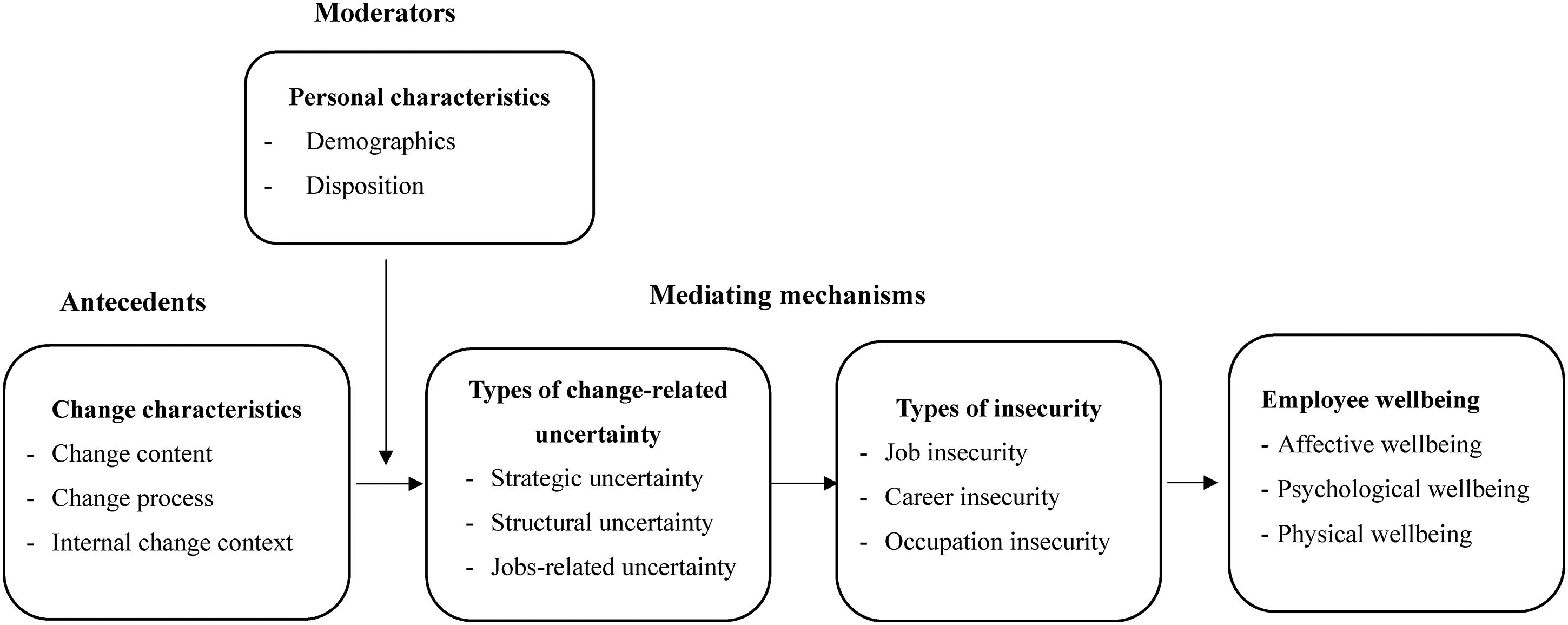
A model of how personal characteristics and change event characteristics influence employee wellbeing.
We make several contributions to change research. First, there is a lack of research that examines the interaction between personal and change event characteristics in predicting employee wellbeing via uncertainty and insecurity. We acknowledge existing empirical studies that examine the interaction between personal and change characteristics on person-environment fit (e.g., Caldwell et al., 2004) and commitment to change (e.g., Herold et al., 2007). Yet, those studies do not consider change-related uncertainty and insecurity, which are key psychological responses that emerge in response to change (Rafferty & Griffin, 2006; Sverke & Hellgren, 2002). We draw on conservation of resources (COR) theory (e.g., Hobfoll et al., 2018; ten Brummelhuis & Bakker, 2012), to identify personal characteristics as valuable resources enabling employees to better cope with the impacts of change. As such, we expect that personal characteristics will moderate the influence of change event characteristics on change-related uncertainty and employee insecurity, which then influence employee wellbeing. It is important to examine the interplay between personal characteristics and change event characteristics to determine if the impact of change on change-related uncertainty, insecurity, and wellbeing differs across individuals who possess different demographic characteristics and/or dispositions.
The second contribution of our model concerns the psychological mechanisms linking organizational change and employee wellbeing. While scholars suggest that implementing change is positively associated with psychological uncertainty about change (e.g., Rafferty & Griffin, 2006; Schweiger & DeNisi, 1991) and job insecurity (e.g., Ashford et al., 1989; Nikolova et al., 2023; Sverke & Hellgren, 2002), there has been a lack of attention devoted to distinguishing between different types of change-related uncertainty and types of insecurity that employees experience during change. As such, we suggest that there is considerable conceptual confusion concerning the distinctions between the types of uncertainty and types of insecurity in the literature, which we seek to address. We theoretically identify several types of change-related uncertainty and types of insecurity and consider the distinctiveness of these constructs. In addition, simultaneous consideration of different types of change-related uncertainty and types of insecurity will allow us to consider the causal order of these constructs. We argue that change-related uncertainty predicts insecurity.
The third contribution of our model is that we broaden the conceptualization of employee wellbeing examined (e.g., Neves et al., 2018). To date, research has predominantly focused on examining one or two dimensions of employee wellbeing (e.g., Neves et al., 2018). However, employee wellbeing is multidimensional (Grant et al., 2007; Inceoglu et al., 2018; Lomas et al., 2019), extending beyond the work domain to include general wellbeing as well as health (Page & Vella-Brodrick, 2009). Thus, current change research misses an opportunity to examine the broader implications of organizational change for employees’ health and wellbeing inside and outside of work. We conceptualize employee wellbeing as a multi-dimensional concept that encompasses the dimensions of affective wellbeing, psychological wellbeing, and physical wellbeing in the context of job-specific (e.g., work wellbeing) and context free (e.g., life wellbeing) wellbeing (Danna & Griffin, 1999; Ryff & Singer, 2008; Warr, 1994).
Practically, our research will enable organizations to assess how they can better implement change to enhance the likelihood of success. Our model encourages scholars and human resource (HR) and change agents to pay more attention to change event characteristics and how these characteristics influence employees’ psychological responses during change. Additionally, our model emphasizes that not all employees experience organizational change in the same way. That is, some employees will be more likely to interpret change more positively than others as they possess relevant resources that enable them to respond more positively to change, which will have benefits for employee wellbeing.
Overarching Theory
The central tenet of COR theory is that individuals seek to gain, retain, and protect the resources that they value (Hobfoll, 1989). Resources refer to anything that is perceived as helpful for individuals to achieve their goals such as energy (e.g., time, money, knowledge), objects (e.g., working equipment), conditions (e.g., tenure, employment), personal characteristics (e.g., skills, personality), social relations and supports, management resources (e.g., self-esteem, sense of control, emotional intelligence, power, status), and role and decision autonomy (Halbesleben et al., 2014; ten Brummelhuis & Bakker, 2012). An important principle of COR theory - primacy of resource loss – outlines that “it is psychologically more harmful for individuals to lose resources than it is helpful for them to gain the resources that they lost” (Halbesleben et al., 2014, p. 1335). That is, the perceived threat or loss of resources is disproportionally more salient when predicting individuals’ wellbeing than resource gain (Halbesleben et al., 2014; Hobfoll et al., 2018). COR theory also suggests that those who have greater resources are less likely to be vulnerable to resource loss and more likely to be able to position themselves for resource gains.
We draw on the COR model to consider the relationship between change event characteristics and employee wellbeing (Figure 1). We argue that change event characteristics including the content of change, the internal change context, and change processes result in different types of change-related uncertainty and thereby influence the threat of resource loss as captured by different types of insecurity, which in turn influences employee wellbeing. In contrast, some change event characteristics may alleviate change-related uncertainty and therefore conserve against resource loss, which will enhance wellbeing. We suggest, for instance, that a favorable change management process, whereby managers provide timely, accurate, and high-quality information about change, will reduce employee uncertainty about the strategic issues related to the change (e.g., vision, future directions) (Bordia et al., 2004a). By doing so, a favorable change management process will reduce perceived threats of an individual losing their job and/or valued social relationships, which will in turn translate into greater wellbeing. Further, we argue that the impact of change event characteristics on employee change-related uncertainty, which then influences insecurity which in turn results in wellbeing will depend on available personal resources including demographic characteristics and individual dispositions.
It should be noted that we focus on the moderation of personal characteristics in the path between change event characteristics and change-related uncertainty (Figure 1). This focus is motivated by the first contribution outlined in the introduction, which suggests that there is a lack of research that examines the interaction between personal and change event characteristics in predicting employee wellbeing via uncertainty and insecurity. In this respect, given the scope of our paper, we do not focus on theorizing about the interaction(s) between personal characteristics and change-related uncertainty on insecurity, or the interaction(s) between personal characteristics and insecurity on employee wellbeing.
In the following sections, we first provide an overview of the change-related uncertainty concepts and insecurity concepts examined in this research and then we consider how these concepts are related. We then discuss our conceptualization of employee wellbeing. Finally, we elaborate on the influence of different change and personal characteristics on different types of change-related uncertainty, insecurity, and wellbeing.
Change-Related Uncertainty and Insecurity
Change-Related Uncertainty
A long tradition of research has identified psychological uncertainty about change as a critical outcome of organizational change (Allen et al., 2007; Bordia et al., 2004a, 2004b; Cullen et al., 2014; DiFonzo & Bordia, 1998; Katsaros & Tsirikas, 2022; Rafferty & Griffin, 2006; Rodell & Colquitt, 2009). One prominent definition of psychological uncertainty about change is that it encompasses an individual's state of doubt regarding the outcomes or consequences of a proposed organizational change(s) (DiFonzo & Bordia, 1998; Milliken, 1987). According to Nelson et al. (1995), “one of the most frequently cited concomitants of extensive organizational change among employees has been heightened perceptions of uncertainty” (p. 59). Organizational change events such as downsizing, mergers and acquisitions, reengineering, restructuring, and new technology typically result in a high level of change-related uncertainty (Allen et al., 2007; Bordia et al., 2004a; Schweiger & DeNisi, 1991). Bordia et al. (2004a) and Allen et al. (2007) identified three types of change-related uncertainty that employees experience during organizational change, including strategic, structural or implementation uncertainty, and jobs-related uncertainty. Strategic uncertainty refers to the extent that employees report doubt about the reasons, vision, and future direction of the proposed organizational change. In contrast, structural or implementation uncertainty captures an employee's inability to predict how the organizational change will impact key aspects of the organization such as structure, culture, and the function(s) of work units (e.g., Allen et al., 2007; Bordia et al., 2004a; Kramer et al., 2004). Jobs-related uncertainty captures an employee's inability to predict the impact of organizational change on job security, workload, job roles, and promotion opportunities (Allen et al., 2007; Bordia et al., 2004a) as well as whether employees possess the required skills and training to handle new tasks and responsibilities (Olsen & Stensaker, 2014; Schweiger & DeNisi, 1991). According to Allen and colleagues, jobs-related uncertainty is the most prevalent type of uncertainty that employees experience during change. In this paper, we consider the three types of change-related uncertainty as key mediators in our model.
Insecurity
Unlike psychological uncertainty about change, which is often discussed as a global concept, we observe that limited research has examined a global insecurity concept. Instead, researchers have devoted effort to examining more specific insecurity concepts (see Table 1). Scholars have focused on job insecurity and argued that organizational change events create a heightened level of job insecurity (e.g., Ashford et al., 1989; De Witte, 1999; Greenhalgh & Rosenblatt, 1984; Lee et al., 2018; Shoss, 2017; Sverke & Hellgren, 2002). We identify two common conceptualizations of job insecurity, namely, quantitative and qualitative job insecurity. Quantitative job insecurity refers to the extent to which an individual perceives threats to their current job or employment (Heaney et al., 1994; Hellgren et al., 1999). Qualitative job insecurity refers to the extent to which an individual perceives or anticipates threats to important aspects or features of their current job (Hellgren et al., 1999; Shoss, 2017; Van den Broeck et al., 2014). For instance, in their measure of qualitative job insecurity, Brondino et al. (2020) assess threats to the content of work (e.g., “I feel insecure about the future content of my job”), work conditions (e.g., “chances are my workload will increase in the future”), employment opportunities (e.g., “I am insecure about my chances of promotion”), and social relationships (e.g., “I am not sure which colleagues I will be soon cooperating with”, “I worry I might get another supervisor in the future”).
Sample Definitions of Change-Related Uncertainty and Insecurity Concepts.
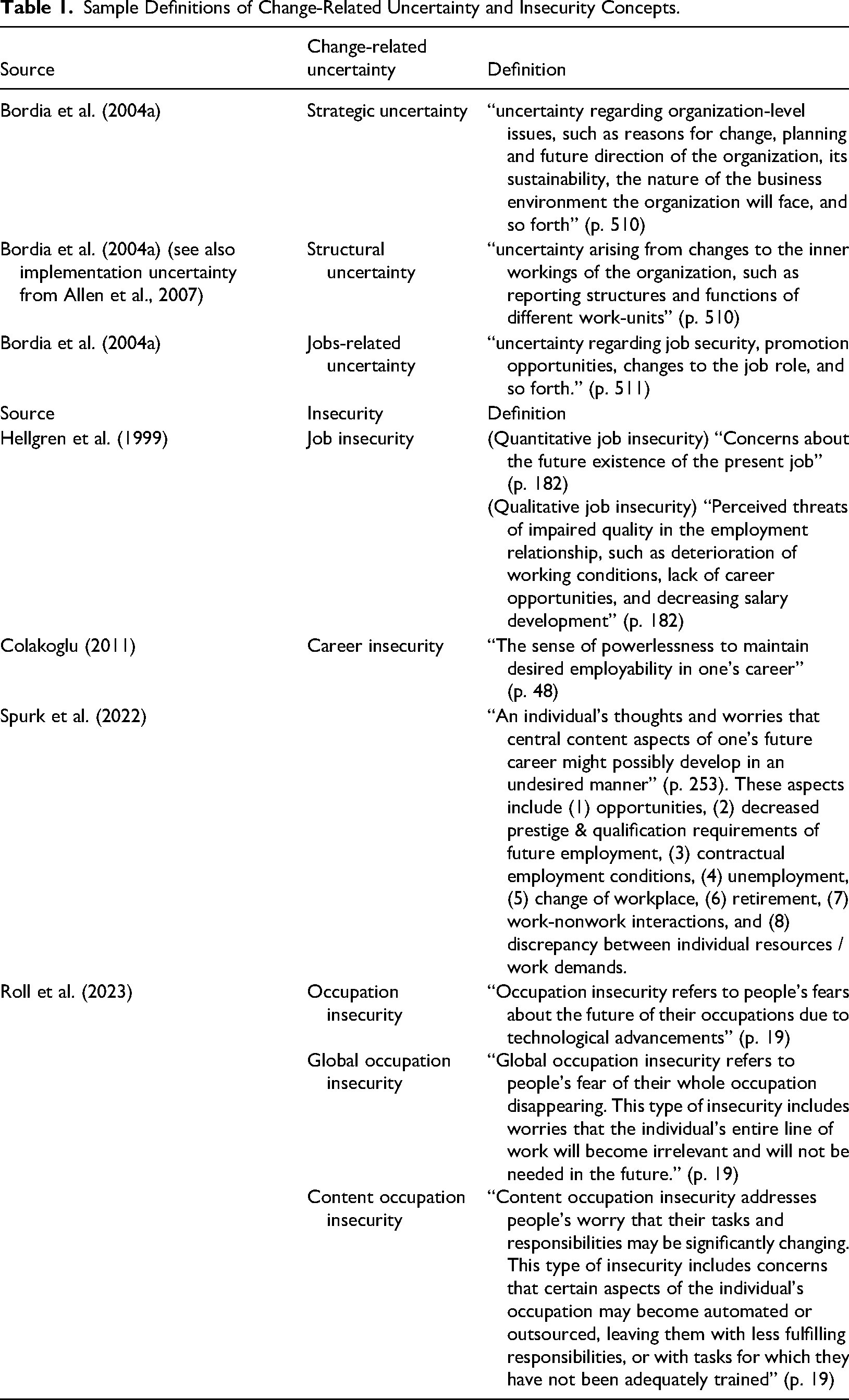
Scholars also have discussed career insecurity, which refers to “the sense of powerlessness to maintain desired employability in one's career” (Colakoglu, 2011, p. 48). Spurk et al. (2022) define career insecurity as “an individual's thoughts and worries that central content aspects of one's future career might possibly develop in an undesired manner” (p. 253). This latter definition conceptualizes career insecurity as a multidimensional construct that captures eight threats including to career opportunities, prestige and qualification requirements of future employment, contractual employment conditions, unemployment at any point in one's future career, change of workplace, retirement, work-nonwork interactions, and discrepancy between individual resources and work demands (see Spurk et al., 2022). Moreover, Spurk and colleagues discuss distinctions between career insecurity and job insecurity. While job insecurity focuses on insecurities related to the current job and its aspects in a specific organization (see also Lee et al., 2018), career insecurity is concerned with one's career prospects and opportunities that are not necessarily constrained within a single organization. In addition, job insecurity focuses on short-term and near-future insecurities whereas career insecurity captures short-term, mid-term, and long-term worries and thoughts (Spurk et al., 2022).
Recent research has introduced the occupation insecurity concept (Roll et al., 2023) (see also De Cuyper et al., 2023). An occupation refers to a profession that employees have been trained in and covers jobs with similar characteristics that define one's role in society (Roll et al., 2023). Roll et al. argue that as organizations implement automation in response to environmental changes such as COVID-19 and/or technological advancements, employees are increasingly likely to report that some professions may disappear (Roll et al., 2023). The authors discuss two conceptualizations of occupation insecurity including global and content occupation insecurity. Global occupation insecurity refers to the perceived threats that one's occupation might disappear such that employee's entire line of work will become irrelevant or not needed in the future. In contrast, content occupation insecurity is concerned with the perceived threats that one's tasks and responsibilities in the occupation might subject to significant changes (Roll et al., 2023). Accordingly, these occupation insecurity concepts capture the perceived threats that are beyond one's job in a specific organization as well as distinct from the threats related to aspects of one's future career. Indeed, Roll and colleagues obtained empirical support for the distinction between occupation insecurity and job and career insecurity.
We note that in the insecurity literature, some scholars identify uncertainty as a defining characteristic of insecurity (De Witte, 1999, 2024; Lee et al., 2018; Roll et al., 2023; Shoss, 2017; Shoss et al., 2018). Particularly, job insecurity has been defined as involving uncertainty about a future loss of job or job features (De Witte, 2024; Vander Elst & De Witte, 2024). For instance, De Witte (1999) claimed that “job insecurity also implies uncertainty about the future: For the person concerned it is uncertain whether he/she will be able to continue to work, or whether he/she will be made redundant” (p. 156). With respect to career insecurity, Spurk et al. (2022) suggest that this insecurity concept involves uncertainty about the future of one's career, which the authors argued “not knowing exactly what the future will bring and associated thoughts and worries are at the core of career insecurity” (p. 256). When Roll et al. (2023) discuss occupation insecurity, they suggest that this concept also involves employee uncertainty about the future of their occupation or profession.
In this paper, however, we propose that there are distinctions between the three types of change-related uncertainty and insecurity. Specifically, although job, career, and occupation insecurity involve the aforementioned uncertainty elements, we argue that these insecurity concepts assess separate conceptual domains in comparison to the three types of change-related uncertainty (Allen et al., 2007; Bordia et al., 2004a). The three types of change-related uncertainty focus on employees’ doubts about issues related to the proposed organizational change such as the reasons, vision, and future directions of the change (i.e., strategic uncertainty), how the proposed change will impact key aspects of the organization including its culture and structure (i.e., structural uncertainty), and how the proposed change will impact various jobs (e.g., in terms of workload, job roles, promotion) (i.e., jobs-related uncertainty) (Allen et al., 2007; Bordia et al., 2004a). In this respect, these types of change-related uncertainty are concerned with the extent to which an individual is uncertain about aspects of the proposed organizational change and its implications. Meanwhile, the insecurity literature focuses on insecurity due to an individual's job, career, and occupation. That is, definitions of these insecurity concepts relate to an individual's
Types of change-related uncertainty including strategic, structural / implementation, and jobs-related uncertainty about change are distinct from job, career, and occupation insecurity.
We consider the three types of change-related uncertainty - strategic, structural, and jobs-related uncertainty as antecedents of job, career, and occupation insecurity. We expect that employees’ doubts about the vision and future directions of the organizational change, and about implementation issues related to the change and its implications on jobs, are likely to result in a sense of threat to an individual's job, career, and occupation. Thus, we offer the following propositions: Types of change-related uncertainty including strategic, structural or implementation, and jobs-related uncertainty about change are positively associated with job, career, and occupation insecurity.
Employee Wellbeing
Researchers have established that employee wellbeing encompasses multiple dimensions. Warr (1987, 1994) suggests that when examining job specific and context free wellbeing, an employee's wellbeing may be described in terms of pleasure and arousal dimensions. Within the two-dimensional framework, three principal axes of measurement are considered (Daniels & Guppy, 1994; Lucas et al., 1996; Warr, 1987, 1999): (a) displeasure to pleasure, (b) anxiety to contentment, and (c) depression to enthusiasm. According to Warr (1990), pleasure has been assessed by job (i.e., job-specific) or life (i.e., context-free) satisfaction. Additionally, Warr (1990) developed measures of anxiety – comfort (e.g., tense, uneasy, worried, calm, contented, and relaxed) and depression – enthusiasm (e.g., depressed, gloomy, miserable, cheerful, enthusiastic, and optimistic) axes of affective wellbeing. However, we observe that War's (1987, 1994) model is limited to the hedonic dimension (e.g., positive emotions and the absence of negative emotions), only focusing on affective wellbeing, and predominantly focuses on the emotional aspects of an employee's life. We identify that there are two other dimensions of employee wellbeing: (1) eudaimonic (e.g., psychological wellbeing) and (2) physical (i.e., sleep quality, eating/substance abuse) (e.g., Danna & Griffin, 1999; Inceoglu et al., 2018; Ryan & Deci, 2001)
Danna and Griffin (1999) proposed that employee health and wellbeing comprise life (non-work) satisfactions (e.g., life satisfaction and happiness), work (job related) satisfactions (e.g., job satisfaction, job attachment, satisfaction with pay, coworkers), mental/psychological health, and physical/physiological health (e.g., illness, somatic symptoms of stress, agitation symptoms, eating/substance abuse). The psychological dimension focuses predominantly on health and associated psychological indicators of health. We broaden the consideration of psychological wellbeing by drawing on Ryff and Keyes (1995) model which identifies autonomy, environmental mastery, personal growth, self-acceptance, purpose in life, and positive relations with others as critical elements of psychological wellbeing. Ryff and Singer (2008) define high and low conditions in each of the six elements of psychological wellbeing. For instance, with respect to self-acceptance, the authors suggest that an individual who has a low score in this element “feels dissatisfied with self; is disappointed with what has occurred in past life; is troubled about certain personal qualities; wishes to be different than what he or she is” (p. 25).
Danna and Griffin (1999) also outline the important role of physical wellbeing, or “bodily health and functioning” (see Grant et al., 2007, p. 53). Guest (2017) argues that physical wellbeing captures physiological indicators of health and illness including positive indicators (e.g., vigor) and negative indicators (e.g., exhaustion and stress). Inceoglu et al. (2018) suggest that in addition to subjective measures, physiological measures should be used. While there is a body of evidence indicating that physical wellbeing is an important dimension of an employee's wellbeing (Grant et al., 2007; Inceoglu et al., 2018; McKee-Ryan et al., 2005), little research has studied physical wellbeing (Inceoglu et al., 2018).
In this study, we conceptualize employee wellbeing in a way that extends the work of Warr (1987) and Danna and Griffin (1999). Our conceptualization of wellbeing encompasses three dimensions of employee wellbeing including affective wellbeing (e.g., displeasure-pleasure, anxiety-comfort, and depression to enthusiasm), psychological wellbeing (e.g., personal growth, environmental mastery, self-acceptance, purpose in life, autonomy, and positive relations with others), and physical wellbeing (e.g., sleep quality, illnesses, somatic symptoms of stress, agitation symptoms, and eating/substance abuse).
Drawing on COR theory and the primacy of resource loss, we formulate the relationships between different types of change-related uncertainty and employee wellbeing via types of insecurity. We first expect that the different types of insecurity are likely to influence employee wellbeing. More specifically, during change implementation, the extent to which employees experience threats of losing valuable resources such as continuing important aspects of their job, career, and occupation are likely to translate into lower affective, psychological, and physical wellbeing. We offer the following proposition: Job, career, and occupation insecurity are negatively (or positively) associated with positive (or negative) indicators of affective, psychological, and physical wellbeing.
In addition, we expect that the different types of insecurity will mediate the relationships between types of change-related uncertainty and wellbeing. We argue that the uncertainty that employees experience from change in terms of its vision, strategy, future direction, and implementation issues, as well as its implications on jobs will influence their affective, psychological, and physical wellbeing via greater threats of losing valuable resources related to employees’ job, career, and occupation.
Job, career, and occupation insecurity will mediate relationships between strategic, structural, and jobs-related uncertainty and indicators of affective, psychological, and physical wellbeing.
The Influence of Personal and Change Event Characteristics
In this section, we draw on COR theory to develop propositions concerning the influence change event characteristics on change-related uncertainty, insecurity, and wellbeing. We also consider how personal characteristics moderate the influence of change event characteristics on these employee outcomes (Figure 1). In the following, we first discuss our choice of personal and change event characteristics in our model.
The Choice of Model Variables
We rely on existing reviews (e.g., Armenakis & Bedeian, 1999; Choi, 2011; Oreg et al., 2011; Rafferty et al., 2013; Stouten et al., 2018) and meta-analysis papers (e.g., Gonzalez et al., 2023; Peng et al., 2020) to identify change event characteristics and personal characteristics as two broad categories of factors that explain employees’ responses to change. These papers were published in high-ranking management and change journals including the Journal of Management, Human Resource Management, Personnel Psychology, and Journal of Applied Behavioral Science. Most of these papers involve a systematic literature search of empirical studies identifying variables that are associated with employee responses to change such as change readiness, resistance to change, and commitment to change as well as work and health outcomes during the context of change.
We identify three key change event characteristics including the content of change, change management processes, and the internal change context (Armenakis & Bedeian, 1999). Moreover, we identify, drawing on the work of Oreg et al. (2011) and Gonzalez et al. (2023), two broad categories of personal characteristics that have been studied as predictors of employee's response to change including personality or dispositional factors (e.g., positive self-concept and risk tolerance) and demographics (Table 2). We use these broad categories to model the influence of change event characteristics on different types of change-related uncertainty, insecurity, and wellbeing, and how personal characteristics can moderate such influence of change event characteristics on these types of employee outcomes (Figure 1).
Change Event and Personal Characteristics.
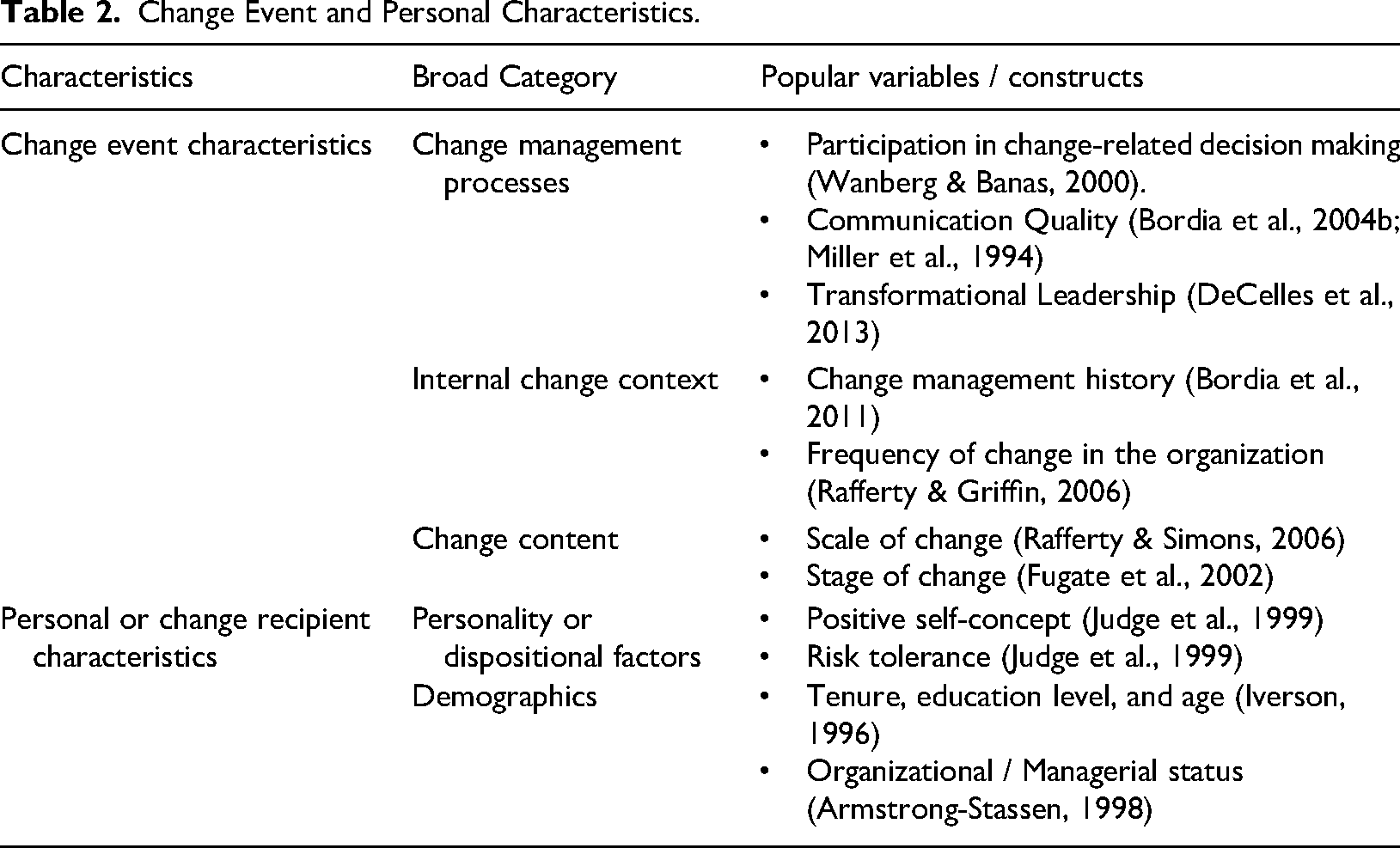
It should be noted that our purpose is not to discuss all possible variables that belong to these broad categories of change event characteristics and personal characteristics. Instead, we rely on the aforementioned reviews and meta-analysis papers to identify the variables that have been frequently considered that explain employee change responses as well as wellbeing outcomes (see Table 2). We use these variables to illustrate how change event characteristics and personal characteristics jointly explain the types of change-related uncertainty, insecurity, and consequently wellbeing.
Change Event Characteristics – The Antecedents
Change Content
Researchers have focused on the content or the “what” of change as a key change event characteristic. Theorists have considered the content of change by examining the degree or the scale of change that is experienced. This is typically operationalized as the extent to which a change is experienced as transformational versus incremental (Rafferty & Simons, 2006). A second aspect of the content of change that has been considered is the stage of the change. Isabella (1990) found that managers’ interpretations of change evolved through four stages including anticipation, confirmation, culmination, and aftermath. Each stage of change was associated with a distinct constructed reality and interpretive task.
When considering the degree of change, research reveals that large scale or transformational changes modify key aspects of an organization's system including values, strategy, and structure (Levy, 1986). Empirical research reveals that transformational changes are associated with high levels of change-related uncertainty and employee insecurity, which translates into unfavorable employee responses to change (Belschak et al., 2020; Bordia et al., 2004a; Schweiger & DeNisi, 1991; Schweiger & Weber, 1992). In comparison to those who experienced transformational change, Rafferty and Simons (2006) found that individuals who experienced smaller-scale changes tended to have higher change readiness. In addition, Caldwell et al. (2004) reported that the extent of changes in work processes, procedures, and routines was a moderator of the relationship between change fairness and person-organization fit such that this relationship was stronger and more positive when the degree of change was low rather than high.
Research on the stage of change indicates that employees’ reactions to organizational change vary over time across different stages of change (e.g., Fugate et al., 2002; Nguyen, 2022; Schweiger & DeNisi, 1991). For instance, Fugate et al. (2002) study indicated that employee coping with change (i.e., negative appraisal, perceived control, and wishful thinking) varied during four stages of a merger, namely, anticipatory, initial change, final change, and aftershock stages. In their field experiment of merger communication, Schweiger and DeNisi (1991) found that employee job satisfaction, uncertainty about change, and perceptions of their organization's trustworthiness, honesty, and caring varied over time such that those constructs became more negative in the later stages of a merger if employees received no or little communication about a merger.
We propose that there is an indirect relationship between the content of change and employee wellbeing via different types of change-related uncertainty and types of insecurity. With respect to the scale of change, we expect that transformational changes make it difficult for individuals to predict the implications of those changes (Rafferty & Griffin, 2006; Rafferty & Simons, 2006). We expect that large-scale changes are associated with more questions, concerns, and confusion related to those changes and thus induce higher levels of the three types of change-related uncertainty, which will contribute to anticipated and actual loss of resources, enhancing insecurity (Belschak et al., 2020; Bordia et al., 2004a; Schweiger & DeNisi, 1991), which then negatively affects employee wellbeing.
Regarding the stage of change, previous research (e.g., Allen et al., 2007; Fugate et al., 2002) suggests that high change-related uncertainty, and insecurity are likely to occur at the onset of change. At this stage of change, employees do not have sufficient information to assess the change in terms of what is the vision for the change, what implementation of change will involve, and what change means for jobs and related aspects (Schumacher et al., 2016). Uncertainties about these change-related issues are then likely to translate into experienced threats concerning an individual's job roles, career advancement opportunities, and occupations. These insecurities are then likely to be negatively associated with an employee's affective, psychological, and physical wellbeing. In contrast, in the later stage of change, we suggest that employees are likely to have accumulated knowledge about the change from supervisors and co-workers (see Lewis, 1999). Thus, at the later stages of change, an individual's change-related uncertainties and insecurities tend to be lower than in the early stages of change. In this respect, we offer the following proposition regarding the relationship between the content of change and employee wellbeing: Transformational change and change that is at an earlier stage are positively associated with strategic, structural, and jobs-related uncertainty, and, therefore, will be positively associated with job, career, and occupation insecurity, which in turn will be negatively associated with positive indicators of affective, psychological, and physical wellbeing.
Change Management Processes
Decades of research have focused on the specific actions undertaken by managers or leaders when implementing an organizational change (Armenakis & Bedeian, 1999). Reviews of the change literature (e.g., Choi, 2011; Oreg et al., 2011; Rafferty et al., 2013) show that scholars have frequently considered communication about change, participation in change decision making, and transformational leadership as key change processes. With respect to communication about change, numerous studies examine relationships between the quality of change communication and employee responses to change (Allen et al., 2007; Bordia et al., 2004b; Petrou et al., 2018; Wanberg & Banas, 2000). Communication quality refers to the extent to which communication about change is timely, useful, and accurate (Miller et al., 1994). Employees who report high quality communication about change tend to have more favorable responses to change including greater commitment to change (Hill et al., 2012; Rafferty & Restubog, 2010), openness to change (Wanberg & Banas, 2000), and readiness for change (McKay et al., 2013). Participation refers to the extent employees are encouraged to have input into decisions about a change event (Wanberg & Banas, 2000). Armenakis et al. (1993) argued that participation in change-related decision-making provides employees with opportunities to discover management's expectations and enhance their understanding of change. Scholars have identified participation as a key predictor of favorable employee responses to change (Bartunek et al., 2006; Fournier et al., 2021; Fuchs & Prouska, 2014; Wanberg & Banas, 2000).
Many scholars also identify transformational leadership as a type of effective change leadership that influences employee responses to organizational change (see Peng et al., 2020). Research suggests that transformational leaders facilitate favorable employee responses to change because they convey a sense of optimism about change, encourage followers to understand that change is necessary, challenge existing approaches, and guide followers through adapting to change (Bommer et al., 2005; Carter et al., 2013; DeCelles et al., 2013; Oreg & Berson, 2011). In addition, transformational leaders assist in reframing change from a harmful or threatening event into an opportunity (Kim et al., 2021).
In this paper, we argue that positive change management processes are negatively associated with the different types of change-related uncertainty, which are in turn negatively associated with the different types of insecurity and in turn positively associated with employee wellbeing. A positive change management process provides employees with timely, accurate, and useful change-related information, opportunities to discover and make decisions about change, and motivation, guidance and support from leaders (Armenakis et al., 1993; DeCelles et al., 2013; Miller et al., 1994). Accordingly, such a process encourages positive interpretations of the change vision and change implementation and is likely to be negatively associated with negative impacts of change on jobs, thereby conserving against the potential loss of valuable resources like employment, tenure, and career opportunities and thereby result in enhanced different types of wellbeing. Alternatively, when change processes are poor (e.g., low quality change communication and limited participation for example), individuals are likely to possess restricted knowledge regarding change, which Bordia et al. (2004a) argue lays the groundwork for extensive rumors related to the change process and its expected outcomes. This tendency to amplify the potential adverse elements of the change frequently fosters uncertainty related to the change, which in turn will enhance insecurity, which then results in poorer wellbeing. Thus, we offer the following proposition: A positive change management process will be negatively associated with strategic, structural, and jobs-related uncertainty, which will be negatively associated with job, career, and occupation insecurity, which in turn will be positively associated with positive indicators of affective, psychological, and physical wellbeing.
Internal Change Context
The internal change context captures those salient aspects of a change situation that influence the meaning of change (Johns, 2006). Aspect of the internal change context that have been identified include individuals’ perceptions of their organization's change history (Bordia et al., 2011; Rafferty & Restubog, 2010; Vardaman et al., 2023) and the frequency with which change takes place in the organization (Carter et al., 2013; Rafferty & Griffin, 2006; Rafferty & Jimmieson, 2017). According to Vardaman et al. (2023), employees tend to “build a cumulative profile of their history with organizational change that influences the way they respond to change initiatives” (p. 4). Rafferty and Restubog (2010) found that those who perceived that their organization had a poor change management history tended to report lower levels of commitment to change in comparison to those who perceived their organization had a more successful change history. Another important aspect of the internal change context that influences employee responses to change is employees’ subjective perception of the frequency with which change occurs in their workplace (Rafferty & Griffin, 2006). An environment where change occurs very frequently creates a sense that the organization is turbulent and constantly changing (Rafferty & Jimmieson, 2017), which reduces employee comfort due to the removal of work routines (Carter et al., 2013).
Empirical studies have documented evidence of the link between frequency and history of change and psychological and wellbeing outcomes. Rafferty and colleagues suggest that an internal change context where individuals report frequent organizational change and/or an unsuccessful history of change will result in high levels of uncertainty about change (Rafferty & Griffin, 2006; Rafferty & Restubog, 2017). Rafferty and Griffin (2006) found that the frequency of change was indirectly negatively related to job satisfaction and turnover intentions through uncertainty about change. Similarly, Bordia et al. (2011) found that a poor change history significantly reduced trust in the organization, which was negatively related with job satisfaction and intention to stay.
Building on previous research, we expect that the internal change context influences the types of change-related uncertainty including strategic, structural, and jobs-related uncertainty, which in turn influences the types of insecurity, and ultimately employee wellbeing. Aspects of the internal change context provide employees with information and cues to learn about the strategic, implementation, and jobs-related issues of change and thereby whether employees report that change is likely to result in resource loss (or gain). We expect that a poor internal change context that is characterized by frequent change and an unsuccessful change history will be positively associated with strategic, structural, and jobs-related uncertainty about change, creating a sense that resources are threatened and, therefore, elevating all types of insecurity, and thereby negatively influencing employee wellbeing. Thus, we offer the following proposition regarding the link between internal change contexts and employee wellbeing: A poor change context is positively associated with strategic, structural, and jobs-related uncertainty, and, therefore, will be positively associated with job, career, and occupation insecurity, which in turn will be negatively associated with positive indicators of affective, psychological, and physical wellbeing.
Employee Personal Characteristics – The Moderators
The personal characteristics of employees play a major role in shaping their responses to change (Gonzalez et al., 2023; Vakola et al., 2013). Personal characteristics are important because they influence the ways in which individuals make sense of a change event and thereby shape their reactions to the event (Bartunek et al., 2006; Oreg et al., 2011). Drawing on literature reviews (Choi, 2011; Oreg et al., 2011; Rafferty et al., 2013) and meta-analyses (Gonzalez et al., 2023), we observe that scholars have frequently examined the impact of a range of personal characteristics including demographic factors and individual dispositions.
Employees’ demographic characteristics have been found to be associated with employee responses to change (e.g., Iverson, 1996). However, many studies have identified employee demographic variables as control variables rather than variables of interest (Oreg et al., 2011; Vakola et al., 2013). One exception is work by Iverson (1996), who considered substantive relationships between employee age, tenure, and education and attitudes toward organizational change. This author argued that older employees are more likely to resist change because these employees tend to be unwilling to change their habits, behaviors, and/or opinions. Tenure was also said to be important in predicting change responses because individuals who have less time in the organization will have fewer ‘preconceived notions’ about how things should be done and have less established routines than longer tenured employees.
In addition, drawing from Iverson's (1996) work, we suggest that educational level may also predict employees’ responses to change. Employees with a higher educational level are likely to have greater resources (i.e., skills and knowledge) that will allow them to more easily meet the new challenges of their job induced by the change and thus are less likely to report change-related uncertainty or insecurity. In addition to age, tenure, and education, we identify from Oreg et al.'s (2011) literature review, that organizational and managerial status are demographic factors that shape employee perceptions of organizational change processes and innovation. For instance, Armstrong-Stassen (1998) documented significant differences across individuals with different organizational statuses in their responses to downsizing. This author found that in such downsizing context, technicians reported greater procedural injustice than clerical employees and the first-level supervisors and that the supervisors had greater control over decisions regarding the future of their jobs than the employees and technicians. Overall, we argue that some demographic characteristics provide individuals with resources that enable them to cope with the impact of change and thereby these individuals will experience less change-related uncertainty and insecurity. We focus on employee age, tenure, education, and organizational status as moderators of relationships in Figure 1.
Individual dispositional characteristics refer to “stable tendencies in patterns of response across a wide variety of situations” (Griffin, 2001, p. 1143). We follow previous research (e.g., Judge et al., 1999; Vakola et al., 2013) to classify individual dispositions into two factors that influence employees’ change responses. The first dispositional factor we identify is positive self-concept¸ which captures “one's perception of self-worth, of self-control, and of perceptions of one's ability to be successful in a given environment” (Gonzalez et al., 2023, p. 835). Positive self-concept was first identified and examined by Judge et al. (1999), who discussed this as a broad construct that encompasses locus of control, self-efficacy, self-esteem, and positive affectivity. The second dispositional factor we consider is risk tolerance, which has been defined as “an individual's latent ability to deal with uncertainty, novel situations, and risk” (Gonzalez et al., 2023, p. 834). Judge and colleagues considered risk tolerance to be a broad concept that subsumes openness to experience, tolerance for ambiguity, and risk aversion. While risk tolerance has been found to be significantly associated with change responses, these relationships tend to be is weaker than those of positive self-concept in several change responses and work attitude outcomes (see Gonzalez et al., 2023).
We consider employee personal characteristics including demographic characteristics and dispositions as individual resources (Hobfoll et al., 2018) that can either strengthen or weaken the indirect relationships between change event characteristics and employee wellbeing. We build on the premise that certain change event characteristics will be positively related to the types of change-related uncertainty and threats of losing personal resources pertaining to employees’ jobs, careers, and occupations. Individuals who possess certain resources due to their demographic characteristics or individual dispositional characteristics are less vulnerable to these types of change-related uncertainty and the perceived threats and will therefore experience a reduced impact of change on their wellbeing. In contrast, employees who lack relevant resources for use in responding to change-related uncertainty and the resource threats during change are less likely to cope well with change, and therefore will experience poorer wellbeing.
We identify employees’ demographic characteristics as moderators of the indirect relationships between change event characteristics and employee wellbeing via different types of change-related uncertainty and types of insecurity. We expect that the demographic characteristics we focus on moderate the relationships between change event characteristics and wellbeing in two ways. First, age, education, tenure, and organizational / managerial status may provide explicit resources (e.g., time, energy, skills, power) that help individuals handle organizational change effectively. For instance, compared to individuals with low status, those with high organizational or managerial status are more likely to be (or closer to) the ones who initiate change and thus tend to have more information about the proposed change in terms of its vision, implementation, and jobs-related issues. In this respect, we expect that higher status would weaken the negative impact of poor change event characteristics on strategic, structural, and jobs-related uncertainty, which in turn influence insecurity and consequently wellbeing. Moreover, those individuals with a high educational level are likely to possess the skills and knowledge needed for tackling the new demands and challenges brought by change implementations (Iverson, 1996). We expect that these individuals are likely to experience a less negative impact of poor change event characteristics on change-related uncertainty, insecurity, and wellbeing. In addition, we suggest that in comparison to older workers, younger workers tend to have more time and physical energy to cope with the impact of poor change event characteristics on their wellbeing. We suggest that those employees with greater available time and energy resources may go the “extra mile” to learn about organizational change, reducing types of change-related uncertainty and, therefore, types of insecurity. Thus, we expect a younger age may reduce the negative impact of change event characteristics such as poor communication and leadership on change-related uncertainty, insecurity, and consequently wellbeing.
Second, some demographic characteristics may encourage employees to see change more negatively and thus develop heightened levels of change-related uncertainty, which in turn will be positively associated with insecurity and therefore will be negatively associated with wellbeing. We suggest that older employees and/or those with a longer tenure may experience a stronger negative impact of poor change event characteristics on their psychological responses and ultimately on wellbeing. Iverson's (1996) research suggested that these employees may be more unwilling to change their habits and tend to have a preconceived notion of how things should be done in the organization. Hence, older employees and/or those with longer tenure are more likely to doubt the proposed change and thereby view change as unfavorable, stressful, and even risky for the organization and themselves. In sum, we offer the following moderated mediation proposition: Change recipients’ demographic characteristics (including age, tenure, education, and organizational / managerial status) will moderate the indirect relationship between change event characteristics and employee wellbeing via different types of change-related uncertainty and types of insecurity. Specifically, for younger and less tenured employees or those with a higher educational level and status, the negative impact of poorer change event characteristics on strategic, structural, jobs-related uncertainty, and on job, career, and occupation insecurity will be reduced, resulting in smaller negative relationships between poorer change event characteristics and positive indicators of affective, psychological, and physical wellbeing.
In addition, we argue that employee positive self-concept moderates the indirect relationships between change event characteristics and employee wellbeing via different types of change-related uncertainty and types of insecurity. Individuals who possess a positive self-concept tend to evaluate and make positive inferences about themselves (Judge et al., 1998). Individuals who possess a high level of self-efficacy, self-esteem, positive affectivity, and psychological capital, have resources that allow them to positively engage in difficult, novel, and unpredictable situations (Judge et al., 1999; Nguyen et al., 2022; ten Brummelhuis & Bakker, 2012). We argue that while experiencing change, individuals who are high in positive self-concept, are more likely to be optimistic in their understanding of change as well as confident in their ability to successfully handle new tasks and/or adjustments resulting from the change. That is, individuals high in positive self-concept are less likely to be uncertain about the proposed organizational change and thus perceive fewer threats to their job, career, and occupation as induced by change. Thus, we propose the following moderated mediation proposition: Positive self-concept will moderate the indirect relationships between change event characteristics and employee wellbeing through the different types of change-related uncertainty and types of insecurity such that for those employees with high positive self-concept, the negative impact of poorer change event characteristics on strategic, structural, jobs-related uncertainty, and on job, career, and occupation insecurity will be reduced, resulting in smaller negative relationships between poorer change event characteristics and positive indicators of affective, psychological, and physical wellbeing.
We also expect risk tolerance to moderate the indirect relationships between change event characteristics and employee wellbeing via different types of change-related uncertainty and types of insecurity. Risk tolerance subsumes an employee's degree of openness to experience, risk taking, and tolerance for ambiguity, dispositional resistance to change, and need for growth (Gonzalez et al., 2023). Previous research has suggested that risk tolerance enhances the likelihood that individuals will see ambiguous and uncertain situations as desirable (see tolerance for ambiguity, Budner, 1962) and less stressful, and as a result, these individuals are less likely to withdraw from such situations (Judge et al., 1999). We expect that those individuals who have a high level of risk tolerance are more likely to view the proposed organizational change as more desirable and less stressful and, therefore, will engage in actions to learn more about the change and thereby reduce different types of change-related uncertainty. As such, these individuals will experience lower levels of perceived threats captured by their job, career, and occupation insecurity, which will positively influence employee wellbeing. We offer the following moderated mediation proposition: Risk tolerance will moderate the indirect relationship between change event characteristics and employee wellbeing via different types of change-related uncertainty and types of insecurity such that for those employees with high risk tolerance, the negative impact of poorer change event characteristics on strategic, structural, jobs-related uncertainty, and on job, career, and occupation insecurity will be reduced, resulting in smaller negative relationships between poorer change event characteristics and positive indicators of affective, psychological, and physical wellbeing.
Discussion and Implications
General Discussion
This conceptual paper seeks to advance understanding of the impact of change event and personal characteristics on different types of change-related uncertainty and types of insecurity, which then influence wellbeing. Building on COR theory, we suggest that change event characteristics - which encompass the content of change, the change management processes, and the internal change context - either deplete or help employees conserve against resource loss during change. As such, we argue change event characteristics influence different types of change-related uncertainty, which influences types of insecurity, and consequently influences indicators of affective, psychological, and physical wellbeing. Our model (i.e., propositions 1 through 6) enhances understanding of the mechanisms through which organizational change event characteristics affect employee insecurity and wellbeing (Kalyal et al., 2010; Lingmont & Alexiou, 2020; Rafferty & Griffin, 2006; Sverke & Hellgren, 2002). We identify the types of change-related uncertainty as underlying mechanisms explaining how specific characteristics of a change event can induce employee job, career, and occupation insecurity, which influence aspects of their wellbeing. Moreover, while previous research has remained inconclusive about the direction of causality between change-related uncertainty and insecurity (e.g., Li & Griffin, 2022; Priyadarshi & Premchandran, 2022), we argue that types of change-related uncertainty that encompass strategic, structural, and jobs-related uncertainty influence an individual's job, career, and occupation insecurity. We encourage future research to further theorize and empirically examine the relationships between specific types of change-related uncertainty, insecurity, and wellbeing. Such an examination contributes to unravel the unique mechanisms through which different change event characteristics influence wellbeing.
Drawing on COR, we also argue that the magnitude and direction of the indirect relationships between change event characteristics and wellbeing depends on employees’ demographic characteristics and individual difference characteristics, including positive self-concept and risk tolerance. We suggest that employee demographic characteristics of age, tenure, educational level, and managerial status reflect critical resources that enable employees to view change more positively and assist in using resources appropriately to cope with change. Some demographic characteristics provide individuals with more resources in the form of time, energy, skills, power, and/or social network that help them in understanding change and determine how they should react to it. In addition, we build on the work of ten Brummelhuis and Bakker (2012) who developed a typology of resources to suggest that individual dispositions belong to the category of key or management resources that “facilitate the selection, alteration, and implementation of other resources” (p. 4). Consider an example from Hobfoll's (2002) work. He argued that individuals with self-efficacy “might be more capable of selecting, altering, and implementing their other resources to meet stressful demands” (Hobfoll, 2002, p. 308). In this respect, our model suggests that certain dispositions enable employees to use other resources to make sense of change as well as influence identification of potential threats. For instance, we expect that risk tolerant individuals are more likely to devote their time and energy to learn about the proposed change (rather than finding ways to avoid it), and as a result experience less change-related uncertainty and identify fewer resource threats, which positively influences wellbeing. Overall, the moderation roles of personal characteristics in our model (i.e., propositions 7 through 9) contribute to developing a more accurate explanation of employee responses to organizational change via integration two important lines of change response research: change event (e.g., Rafferty & Griffin, 2006; Schweiger & DeNisi, 1991) and personal characteristics (e.g., Fugate & Kinicki, 2008; Gonzalez et al., 2023; Iverson, 1996). The model guides research to further explain why the impact of change on change-related uncertainty, insecurity, and wellbeing differs across individuals who possess different demographic characteristics and/or dispositions.
When identifying variables to include in our model, we rely on existing reviews (e.g., Armenakis & Bedeian, 1999; Choi, 2011; Oreg et al., 2011; Rafferty et al., 2013) and meta-analysis papers (e.g., Gonzalez et al., 2023) to identify variables (see Table 2) that have been frequently examined by scholars. As we previously noted, we use these variables to illustrate how change event characteristics and personal characteristics jointly explain the types of change-related uncertainty, insecurity, and consequently wellbeing. In doing so, we acknowledge a limitation that there are many other variables from those reviews that we do not consider such as organizational change justice, supportive environment, trust, perceived meaningfulness and appropriateness of the proposed change, and other demographic and personality trait variables (see Choi, 2011; Oreg et al., 2011). For example, we argue that organizational change justice might better serve as an outcome of change processes like communication and participation, rather than as a measure of the change process itself (Chawla & Kelloway, 2004; Georgalis et al., 2014; Kernan & Hanges, 2002). Georgalis et al. (2014) documented evidence that justice mediated the relationship between change management processes including participation and communication and employee responses to change.
In addition, although a supportive environment and organizational trust have been found to be positively associated with employee change outcomes (Oreg et al., 2011), these two variables represent the general internal context of the organization which is not the focus of our paper. We instead focus on the internal change context that captures the aspects of a change situation (e.g., change management history, and frequency of changes in organization) that influence the meaning of change. Compared to the general internal context, the internal change context is likely to better represent salient characteristics of organizational change that employees (first) look at to make sense of a proposed change and develop their responses to change. Nevertheless, we suggest that future research might examine these variables, identified from existing literature reviews in the change field, as additional factors that could enrich our proposed model (Figure 1). Moreover, noting much change response research being conducted over the past decade, we recommend future research to conduct an updated systematic literature review that captures possible variables under the categories of change processes, change context, and content.
Implications for Organizational Change Research
Our framework suggests several directions for future research. First, we propose that empirical examination of our model necessitates development and validation of measurement scales that can adequately assess each type of change-related uncertainty, insecurity, and wellbeing. As we note in our proposition 1a and 1b, we encourage future research to empirically test the distinction and relationship between different types (i.e., strategic, implementation, jobs-related) of change-related uncertainty and types (i.e., job, career, occupation) of insecurity. Additionally, scholars might extend our model and propositions by considering if the types of change-related uncertainty also result in non-work aspects of insecurity such as threats to individual employee's social relations outside work settings.
Second, our model requires that researchers examine all aspects of change-related uncertainty and aspects of insecurity in a single study (Nguyen et al., in press) so that they can uncover novel insights into the psychological mechanisms linking change event characteristics with different dimensions of employee wellbeing. With respect to the three categories of change event characteristics, we expect that they are likely to have distinct impacts on the types of change-related uncertainty, insecurity, and wellbeing. For instance, positive change management processes like communication and participation influence change-related uncertainty, and insecurity by providing employees with change-related information, opportunities to make decisions about change, and social support (Armenakis et al., 1993; Lewis, 1999; Miller et al., 1994). A positive change process that involves high levels of transformational leadership is likely to reduce the types of change-related uncertainty and types of insecurity and ultimately improve wellbeing as leader actions help employees reframe the change situation as an opportunity, convey a sense of optimism about change, as well as guide employees through their adaptation of change (DeCelles et al., 2013; Oreg & Berson, 2011). In contrast, the internal change context provides employees with signals and cues that they use to make sense of the change and its implications. The content of change also has a distinct impact on employees’ experience of change-related uncertainty, insecurity, and ultimately, wellbeing. For example, large-scale changes result in many more questions, concerns, and confusion, aggravating change-related uncertainty, and enhancing fear of resource losses broadly, which in turn reduces wellbeing.
Additionally, we expect that variables in each category of change event characteristic (see Table 2) are also likely to have different influences on change-related uncertainty that in turn explain their insecurity and wellbeing. For instance, in the change process category, we identify the work of Bordia et al. (2004a) who found that participation in decision making was negatively associated with uncertainty about the structural / implementation and jobs-related issues, whereas management communication quality was negatively associated with strategic uncertainty. This work implies that change communication and participation are likely to influence insecurity and wellbeing differently in the sense that communication largely addresses employee uncertainty about the strategic aspects of the change whereas participation tackles uncertainty about implementation issues and the implications of change on employees’ jobs. Overall, we encourage future research and meta-analysis studies to further investigate the distinct roles of change processes, the internal change context, and change content on employee wellbeing via shaping different types of change-related uncertainty and types of insecurity. Doing so is important to explore which category of change event characteristics is most salient to employee psychological responses and wellbeing.
Third, we call for research that examines demographics as a substantive factor of interest rather than a control variable when studying change. Viewing demographics via a COR lens, we suggest that factors such as age, tenure, education, and organizational / managerial status offer insights into the extent to which an individual possesses time, energy, skills, power, and/or social network to cope with change. With this focus, similar to the prominent upper echelon theory (Hambrick, 2007; Hambrick & Mason, 1984), our work promotes the substantive consideration of demographic variables.
Fourth, as we have discussed, the link between organizational change and employee wellbeing has been already established (Sverke & Hellgren, 2002). However, while there may be limited agreement among researchers and practitioners about the exact dimensions of employee wellbeing, there is agreement that employee wellbeing is multidimensional. Much of the existing research examining organizational change, change management, and employee wellbeing is limited by focussing on one or two of the wellbeing dimensions, predominantly focussing on an employee's sense of work wellbeing. We have argued that different wellbeing dimensions need to be examined simultaneously to gain insight into the interactions and interrelationships. We argue that it is also worthwhile for future research to examine how organizational change event characteristics influence each of the wellbeing dimensions, and whether they have a greater impact on affective, psychological, or physical wellbeing.
Finally, our research provides insight to managers about how change event characteristics influence employee wellbeing. Such insight is important to understand where to invest resources, training, and support to maximize support for employees to maintain their wellbeing. Based on our model, we suggest certain change event characteristics will be more detrimental in terms of change-related uncertainty and the insecurity experienced, with the negative wellbeing outcomes likely to extend beyond the workplace. In closing, we call for more nuanced research on how change event characteristics influence employee wellbeing. It is critical to ensure that we understand the personal experience, health, and wellbeing of employees, who are critical to the successful implementation of organizational change efforts.
Footnotes
Funding
The authors received no financial support for the research, authorship, and/or publication of this article.
