




Abstract
The requirement for a theory contribution in empirical papers causes consternation among some and confusion among many. We address this issue by articulating alternative approaches to theory that include formal modeling, paradigm elaboration, problem solving, and theory emergence from observations. Knowledge about these different approaches will, we believe, help ameliorate disagreement and incomprehension across the research tribes that dominate social science and business school research. Each approach requires different assumptions about truth and the representation of reality. We outline each approach, provide examples, and a short critique. We suggest that what may seem mundane to the critical realist may be eye-opening to the pragmatist who directs attention to practitioners. For the scholar immersed within the walls of a paradigm, a set of stylized facts may challenge and inspire. The secret to innovative theory contributions is to synthesize ideas from the different tribes to use within your own focused research program.
The organization studies field continues to agonize over what theory is or isn’t (Sutton & Staw, 1995), worries that we are drowning in unnecessary theory profusion (Hambrick, 2007), but also argues that research is stymied in the absence of new theory (Davis, 2010). The number of articles discussing the theory crisis continues to multiply (see the discussion in Cronin et al., 2021) as do potential solutions to the crisis (Haveman et al., 2021). Running through much of the consternation around the role of theory in our research is the persistent demand from top journals that articles provide a theory contribution, a demand that seems detached from any clear sense as to what this contribution consists of (Hambrick, 2007). Efforts to explain the theory contribution conundrum tend to involve the mechanics of model construction (e.g., Whetten, 1989), including sets of exercises that provide the tools for this construction (e.g., Thatcher & Fisher, 2022), and exhortations to provide both originality and usefulness (Corley & Gioia, 2011).
What is often missing from these helpful guides is acknowledgement of the diversity of theoretical contributions that are possible within different approaches to social science. This diversity represents a challenge to understanding given that research training tends to be narrowly based within a single tradition rather than spanning across multiple traditions. As commenters have observed concerning work that might be expected to engage across related areas, “the fields of innovation and entrepreneurship run in parallel, with little interaction occurring between the two” (Shepherd & Patzelt, 2017, p. 103). Others have pointed to the separate worlds of those trained in quantitative and qualitative methods (e.g., Jackson, 2015). However, this persistence of isolated knowledge clusters also represents a potential resource for innovative theory given that new ideas are synthesized by those who broker across different knowledge communities (Burt, 2004).
Theoretical contributions, that are often sparked by knowledge from different communities of practice, can come in many different forms. These include new constructs such as absorptive capacity (Cohen & Levinthal, 1990) and architectural innovation (Henderson & Clark, 1990). These also include new hypotheses from existing theory, such as density dependence within the organizational ecology paradigm (Carroll & Hannan, 1989). Theory contribution can consist of two existing theories put together to forge a new approach to an outstanding problem, such as the merging of institutional theory and resource dependence to address puzzles concerning the diffusion of innovation (Tolbert & Zucker, 1983). A theory contribution can consist of the modification of existing theory (e.g., Burt, 2007). And theory contribution is also achieved through a new theoretical model of an outstanding organizational problem that has hitherto been neglected, such as the question of growing inequality in relation to the relative demise of internal labor markets in large manufacturing companies (Cobb & Stevens, 2017).
Theory contributions tend to be understood and validated within distinctive research traditions. What are the different tribes roaming the fields of social science? There are at least four different mainstream perspectives on theory that derive from radically different philosophies of science (see Figure 1). Some researchers (echoing empiricist thought) want theory to derive from facts: “we need research directed toward uncovering empirical regularities, otherwise known as ‘stylized facts’. Only then are we in a position to build theory that in turn can serve as the basis for more refined tests and extensions” (Helfat, 2007, p. 185). From this perspective, a theory contribution consists of the emergence of a generalizable finding from the aggregation of empirical data. A second position (strong paradigm advocacy) calls for consensus concerning research goals and methods so that the normal science of puzzle solving can proceed (Pfeffer, 1993). According to this set of researchers, theory contributions involve paradigm continuity, elaboration, or extension (Qiu et al., 2012). A third position (echoing instrumentalist thought) embraces pragmatism and calls for theory to be problem driven. An influential articulation of this view proposes that theory contributions consist of solutions to current and future problems affecting managers (Corley & Gioia, 2011). A fourth perspective (echoing realist thought) tries to uncover the relations between entities that comprise reality, the entities themselves typically being beyond our perceptions. From this perspective, “things and events (including organizations, institutions and societies) exist independently of knowing subjects, and are likely to affect the behavior of people and groups whether they conceive of these things or not” (Ackroyd, 2012, p. 231). Theory contributions consist of causal explanations that penetrate behind the surface of experiences and perceptions to reveal the true relations that constitute reality (Ackroyd & Fleetwood, 2000). Critical realism is a distinctive representative of this perspective.
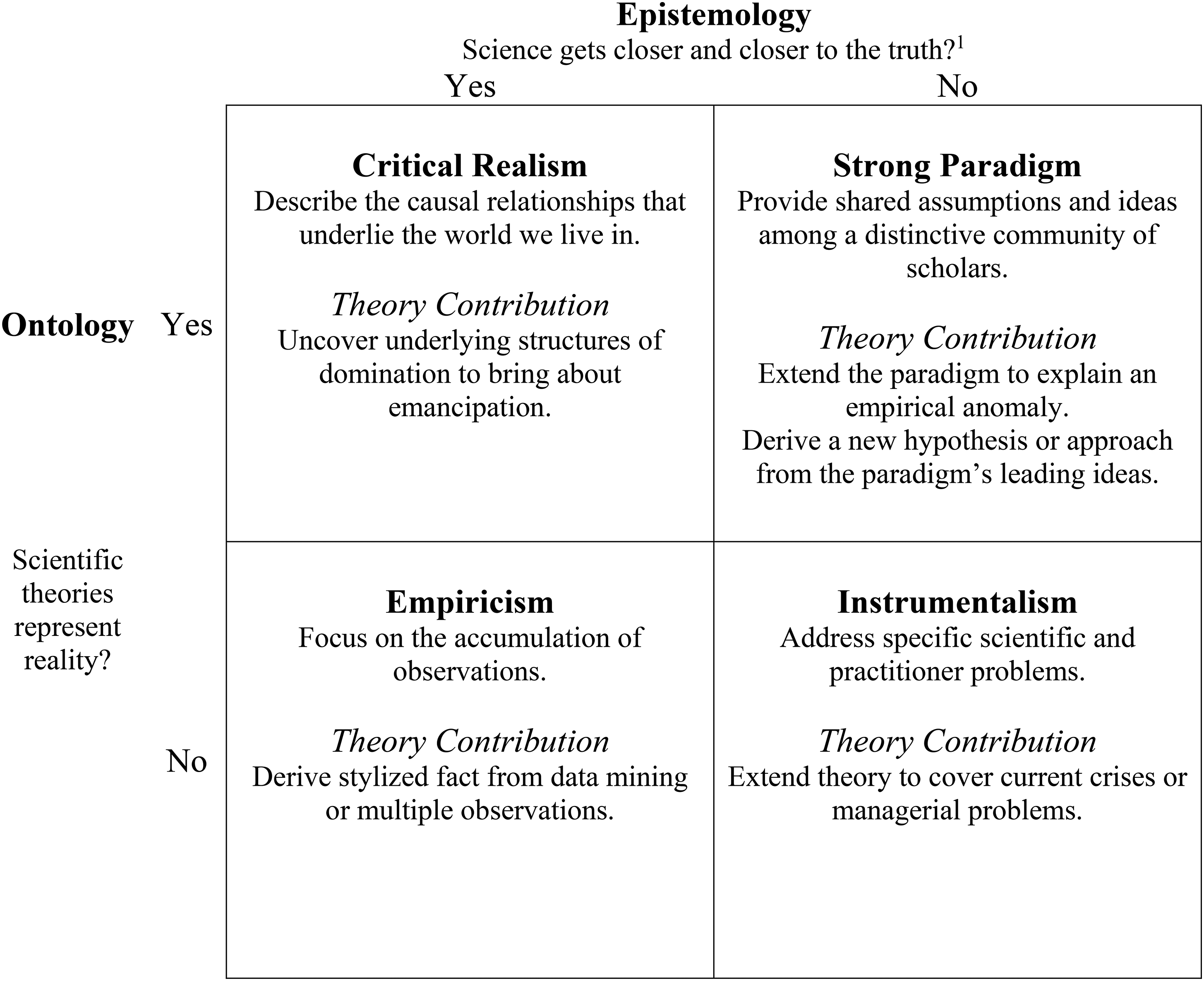
Theory contributions from different philosophical perspectives.
That these radically different perspectives survive and thrive in approaches to organizational research helps explain why there is often disagreement and downright incomprehension across groups of researchers. Scholars trained in a particular set of assumptions and methods can be baffled by research that proceeds from quite different assumptions and methods. For example, researchers from the “just the facts” school of thought sometimes dismiss other approaches as non-scientific, whereas researchers from the pragmatism school of thought sometimes dismiss non-problem-solving research as ivory tower irrelevance. The question as to whether any particular piece of social science provides a theory contribution is often contested territory. Our goal in this paper is to explicate four ways of doing science that, between them, capture much of the work in our field. Each approach proceeds from coherent and long-standing positions in the philosophy of science and provides the opportunity for theory contribution. We endeavor to open our field to a multiplicity of theory contributions by situating them within philosophical approaches to scientific work. By drawing connections between philosophical orientations and potential contributions, we hope to provide clarity concerning theory and to embolden researchers to acquaint themselves with the different scientific tribes with a view to borrowing and synthesizing knowledge across boundaries. It is from such synthesis that particularly novel theoretical contributions can be made. For each distinctive perspective, we offer a short critique. No one scientific perspective dominates the generation of new ideas.
Empiricism: Just give me the facts
A familiar and often-repeated demand from researchers is the opportunity to write and publish papers that just present the facts about interesting phenomena. We hear from operations management that, “There is nothing in science…that insists on theory…Rather, doing science is about ‘observation, measurement, and experiment’” (Schmenner, 2015, p. 1237). If there is to be theory at all, in this view, it is only in the sense of empirical generalizations emerging from reflection upon the current stock of facts. Thus, a strategy researcher writes that, “we need research directed toward uncovering empirical regularities…Only then are we in a position to build theory” (Helfat, 2007, p. 185). According to the advocates of this process, the accumulation of theory-free facts allows generalizable patterns to become apparent and contribute to emergent theory.
This empiricist-first perspective derives from a historical tradition according to which there is no reality outside of human experience. Theory derivation is possible only from observations accessible by human perception. Truth is represented by the reliability of empirical observation. Logical empiricists such as Ernst Mach asserted that science should deal only with phenomena that could be observed, that science should be restricted to the “description of facts” (Wolters, 2000, p. 253). This tradition persisted into the twentieth century through the efforts of logical positivists and their followers such as Ayer (1936) who championed a rigorous empiricist criterion of meaning and dismissed as nonsense theoretical statements that were empirically unverifiable.
If we take empiricism seriously, then it follows that a theoretical statement is more credible the closer it is to a verified set of empirical observations. Two well-known approaches to research align with this perspective despite appearing different on the surface.
The first is the large-scale, inductive hunt for patterns in huge data sets. From this viewpoint, “the organizational sciences need a shock to the system: the advent of big data analytics in organizations provides just such a shock” (McAbee et al., 2017, p. 277). Authors proclaim, “the end of theory” and speculate that the avalanche of big data renders the scientific method obsolete (Anderson, 2008). An example of big data inductive research is the controversial analysis of 58,466 Facebook pages that revealed a range of outcomes about posters including their sexual orientation (Kosinski et al., 2013). Big data is typically publicly available data that can be mined to uncover aspects of individuals’ lives that they thought were hidden from view.
The second empiricist approach seeks to reduce scientific theory to individual experience (e.g., Carnap, 1928). This approach is surprisingly influential in organization theory in the work, for example, of the Carnegie School, where the question of why organizations exist reduces to postulates concerning the bounded rationality of individuals (March & Simon, 1958). More recently, the micro foundations movement seeks to ground macro level theory in micro level phenomena, a process described as endeavoring “to unpack collective concepts to understand how individual-level factors impact organizations, and [how] the interaction of individuals leads to emergent, collective, and organization-level outcomes and performance” (Felin et al., 2015, p. 576). An ambitious variant of this reductionist approach is the use of brain imaging to explain the formation of social relationships (e.g., Hyon et al., 2020).
What are some criticisms of this perspective? Philosophers of science largely dismiss efforts to tie theory to the accumulation of facts despite this perspective showing resilience in organization studies (e.g., Helfat, 2003). The observations that constitute “facts” are already theory-laden in the sense that these observations require implicit theory to be recognized as relevant (Hanson, 1958). And without explicit theory that opens up new lines of enquiry, collections of facts are unlikely to be influential. As the Nobel prize winning economist, Ronald Coase, noted with respect to early institutional economists, “John R. Commons, Wesley Mitchell, and those associated with them were men of great intellectual stature, but they were anti-theoretical, and without a theory to bind together their collection of facts, they had very little that they were able to pass on” (Coase, 1998, p. 72). The philosophical barrier to these institutional theorists’ influence on economics is summarized in the adage that there are no facts outside of theory. Scientists do not start with blank pages on which they record observations. Rather, scientists interpret phenomena according to theoretical frameworks already in place. The extent to which facts are already embedded in a variety of different implicit theories limits the extent to which new theory is likely to emerge from factual aggregation. Randomly accumulated data are, as Coase (1988, p. 230) critically observed, nothing but “a mass of descriptive material, waiting for a theory, or a fire.” The establishment of a new theoretical community requires strenuous effort as the paradigm perspective reminds us.
Strong paradigm advocacy: Let's get on the same page
Perhaps no theory perspective divides opinion as much as the paradigm view. According to this view, the field of organizational studies has fragmented into incommensurable approaches that stymie researchers’ ability to rival the work of more prestigious and influential fields such as economics (Pfeffer, 1993). Strong paradigm advocates blame the persistence of multiple, fragmented paradigms for the failure of theoretical integration (Donaldson, 1998) and see little value in letting a thousand flowers bloom (Pfeffer, 1995). Disagreements over the value of paradigmatic unity continue with no end in sight (Decker, 2016). Our interests do not lie in joining this debate; instead, we consider what a theory contribution looks like from the strong paradigm emphasis on the normal science of puzzle solving within firmly established parameters.
First, what is a paradigm? A paradigmatic community of scholars tends to “see things, process stimuli, in much the same ways” (Kuhn, 1994, p. 193). Scholars within a paradigm share a “disciplinary matrix,” a common theoretical, methodological, and evaluative framework that prioritizes problems needing investigation. Within the paradigm, there is an energizing unity of belief among people who share fundamental assumptions concerning the nature of reality and the practice of research. The establishment of a research paradigm represents, for many researchers, a resounding triumph of collective endeavor that facilitates “normal science” without the distractions of theoretical and methodological disputes.
An example from the organizational studies field is organizational ecology, an influential collective research effort, widely considered an exemplar of paradigmatic research even by its critics (e.g., Pinto, 2005; Young, 1988). The two foundational articles that forged this approach to the birth and death of organizations put forward assumptions, theorems, methods, boundary conditions, and specialized language (Hannan & Freeman, 1977, 1984). Subsequent work tended to adhere to this “disciplinary matrix” and to exploit the inherent empirical potential already implicit in the foundational documents.
Strong paradigm perspectives tend to assume that there is a real world independent of individual experience. Paradigmatic theories attempt to describe the contours of this reality drawing upon the consensus surrounding assumptions, methods, and phenomena. However, according to the paradigm view, we are unlikely to converge towards objective truth through paradigmatic research (Kilduff et al., 2011). The paradigm itself limits the extent to which researchers can extend their vision beyond the paradigmatic boundary. Because researchers are embedded in terms of methods, communities, and topics, they are unable to step outside of their preconceptions and examine their theories from a neutral standpoint. This is because theoretical terms and factual evidence are defined within each paradigm and, according to Kuhn, cannot be evaluated outside of the paradigm's structure of understanding. Paradigms are, in this sense, incommensurable.
The limitations of the Kuhnian view are seldom discussed in organizational research. Partly this is due to the brilliance of Thomas Kuhn's writing in comparison to the overly difficult texts of his philosophical contemporaries. But what are some drawbacks of paradigmatic research? The pursuit of paradigmatic, ideological unanimity that restricts normal science to puzzle solving is one of the limitations of Kuhn's normative approach. According to Kuhn's critics, scientific progress requires competition between research approaches rather than the creation of mutually unintelligible paradigms (Archer, 1996, pp. 232–238). Lakatos (1970) reconciled the Kuhnian emphasis on doctrinaire adhesion to puzzle solving and Popper's (1959) emphasis on competition and open debate by recasting paradigms as competing research programs. These programs incorporate “hard core” quasi-metaphysical leading ideas from which researchers derive “protective belt” subsidiary theories. For example, the social network perspective within organizational science comprises a set of overlapping hard-core ideas typically denominated as: primacy of relations, ubiquity of embeddedness, social utility of connections, and structural patterning of social life (Kilduff et al., 2006). From these core ideas researchers have put forward a series of new (protective belt) theories including social capital theory (Coleman, 1990), dissemination of innovation through structural equivalence (Burt, 1987), structural hole theory (Burt, 1992), and tertius iungens brokerage theory (Obstfeld, 2005). These all represent major contributions to theory.
Researchers can modify or even abandon protective belt theories given new empirical findings without damaging the core ideas of the research program or its forward momentum. For example, structural hole theory was modified to restrict its scope to benefits derived from brokerage across the individual's direct contacts (Burt, 2007). However, within a paradigm or a research program, researchers seldom subject core assumptions and leading ideas to modification given that substantial change indicates a degenerating research program. Critics claim that folk psychology, an approach that builds theory around familiar concepts such as beliefs and desires, is an example of a degenerating program (Churchland, 2002).
Instrumentalism: Theory that solves problems
Is a particular theory a true depiction of reality? Or is it false? These questions arouse little interest for instrumentalist scholars for whom the goal of science is to solve problems (e.g., Laudan, 1977). From this perspective, research traditions are flexible entities within which leading ideas, assumptions, and rival theories can all develop. Progress over time consists of increases in problem solving rather than greater verisimilitude. The aim is to produce reliable knowledge rather than knowledge that takes us closer to truth about the world (Laudan, 1990). The goal of theory is to facilitate the solving of practical problems (Van de Ven, 1989).
A completely different set of researchers see their work as attempting to solve problems afflicting managers, using language that these managers themselves recognize and approve of so as to avoid the situation of theoretical understanding diverging from the practical understanding of the subjects of the research (Gioia, 2022). The emphasis within this instrumentalist program of research is to understand rather than to predict. Models capture the sensemaking of individuals in particular organizational settings with no claims made concerning the generalizability of these models across contexts. Theoretical contributions must provide value to practicing managers (Corley & Gioia, 2011). This sensemaking perspective criticizes organizational scholarship because it produces knowledge “intended mainly for other academic knowledge producers” and because it overemphasizes scientific importance (Corley & Gioia, 2011, p. 20). Relevance to practice is the preeminent dimension of a theoretical contribution.
A criticism of this sensemaking approach might be that it tends to provide grounded, emergent models designed to spur further research toward establishing predictive validity (e.g., Gioia & Thomas, 1996; Toegel et al., 2013). Despite the commitment to provide tools for managers to use, the models themselves incorporate academic jargon such as “information processing structure” (Gioia & Thomas, 1996, p. 393), of interest to researchers rather than managers. The vast majority of citations to these sensemaking articles are from leading research journals rather than from practitioner outlets. Utility is the hallmark of pragmatic, instrumentalist research, but this usefulness tends to be directed at fellow scientists rather than practitioners.
In sum, instrumentalist approaches facilitate diverse contributions to theory that include models to improve predictive validity and narratives of subjective experience that, in capturing the experiences of practitioners, provide useful knowledge for the understanding of complex processes.
Realism: Capture the hidden aspects of reality
Realists agree that scientific theories should provide true descriptions of the world. The catch is that the real world tends to lie beyond our observational powers (Chalmers, 1999, p. 226). Thus, realism differs radically from the foundationalism of “just the facts and nothing more” – although some realists accept that theoretical terms, such as utility function or intelligence quotient, refer to actual entities (Psillos, 1999, p. 11). Realist approaches to science also disagree with the instrumentalist emphasis on the supreme importance of problem solving irrespective of truth or cumulative knowledge (Kilduff et al., 2011). This is because realists value depictions of the real world and the progressive approach to the truth about this world.
The development of structural realism reconciled two apparently contradictory arguments concerning scientific justification. According to the no-miracles argument, it would be “a coincidence on a near cosmic scale” if a particular theory made many correct empirical predictions while being wrong about the underlying causal structure of reality (Worrall, 1989, p. 101). The opposing argument is that science is a graveyard of once-fashionable false theories, so there is no reason to believe in the truth of current theories (Laudan, 1981). Structural realism, however, contends that current theories that make successful predictions provide approximately true depictions of underlying causal structures. New theories are likely to retain structural content from the old theories, by, for example, interpreting the entities in the causal models differently; or by retaining the old model as a limiting case within a more expansive model (Worrall, 1989). There is no need for the kind of scientific revolution described by Kuhn (1994) in which a new ideological regime replaces the old with no transfer of knowledge. The shift from the ether theory of light to the electromagnetic theory of light required no abandonment of the series of equations that constituted the underlying causal model. However, the interpretation of the elements in the model changed. The transition from Newton's laws to those of Einstein involved the retention of Newton's equations for specifically limiting cases (Psilos, 1995, p. 18).
Organizational studies’ realists tend to favor critical realism rather than the mathematical realism characteristic of theoretical physics. Critical realism is much written about (e.g., Archer et al., 1998) but is seldom used in empirical research concerning organizations or management. Critical realism focuses on the relatively enduring structures of relations that stratify human societies. These power relations affect actual events and processes in the world as experienced by human beings (Fairclough, 2005). The underlying structures are themselves unobservable but detectable through ethnographic or historical research. A theory contribution, therefore, from a critical realist perspective consists of exposing the causal nature of power and thereby emancipating people from its force. Social network research, though not ethnographic or historical, sometimes aspires to provide this kind of theory contribution through exposure of the network constraints that restrict people's autonomy (Kilduff & Tsai, 2003). Theory contributions can also consist of challenges to power structures in industry and government through the exposure of taken-for-granted ways of thinking and doing. However, overall, the critical realist approach to theory contribution in organizational studies is large in its promises but small in its instantiation in empirical research, perhaps due to the difficulty of studying undetectable systems of relationships.
Spanning the divides
The above discussion depicts the tribal nature of social science, with each tribe holding fast to its customs and preconceptions. Techniques, methods, and insights developed within borders tend to become tacit knowledge, understood by tribal members but obscure to outsiders. This sticky knowledge (Hayek, 1945) is hard to transfer across groups even within a single organization (Szulanski, 1996). But specialized knowledge communities also represent an opportunity for scholars to venture beyond their own domains to gain conjectures from ideas circulating elsewhere. Scientific theories are human inventions that are “based more upon a scientist's intuition than upon pre-existing empirical data” (Karl Popper quoted in Horgan, 2018). To jolt our intuitions and imaginations into new directions, it may be helpful to encounter the practices and beliefs of scientific tribes other than our own.
Wandering among the knowledge tribes may, of course, result in little more than dilettantism, a scraping together of poorly understood scraps to satisfy the reiterated university demand for cross-disciplinary research. Spanning across divides, if it is to eventuate in the generation of new research, requires some immersion in the different knowledge groups, a deep acquaintance with the systems that each tribe takes for granted (Lévi-Strauss, 1966) and a willingness to inhabit the liminal zones where the assumptions and understandings of the different research tribes collide (Pinar, 2001).
What might this look like in practice? Several research streams (e.g., Burt, 2004; Obstfeld, 2005; Vedres & Stark, 2010) identify the brokerage process (Halevy et al., 2019) as vital to the synthesis of knowledge from knowledge clusters. Brokers connect across different knowledge communities, bringing ideas from one silo to another, thereby facilitating syntheses that represent new contributions to theory and research. For example, the enormously influential theory of weak ties (Granovetter, 1973) combines ideas from the balance theoretic ideas of Fritz Heider (1958) and unrelated research on small worlds (Milgram, 1967) to propose how psychological pressures on individuals affect the resilience of cohesive communities.
Complex knowledge circulates among specialists whose technical language makes this knowledge obscure to outsiders. Some people, however, traverse the knowledge landscape. These brokers have long been lauded for their contributions to knowledge exchange. Georg Simmel described the stranger who belongs to the group but who imports qualities into it that could not have stemmed from the group itself (Simmel, 1950, pp. 402–408). To be connected across groups is to be at risk of gaining new and timely ideas. Structural hole theory focuses on the knowledge brokers who discern the holes in social structure and span across them, taking insights from one group and translating these insights for use by other groups (Burt, 1992), synthesizing knowledge and thereby spurring creativity (Burt, 2004). Similarly, structural fold research focuses on multiple insiders, people whose membership of two or more cliques allows them to transfer ideas and resources across otherwise closed boundaries (Vedres & Stark, 2010).
To summarize, spanning across divides can facilitate timely knowledge development and creativity; and can also benefit the community of knowledge groups that otherwise are unable to learn from each other. The synthesis of knowledge across tribal territories can help individuals realize new theory contributions that they otherwise might not discern. Researchers who attend talks outside of their specialties, who read in adjacent research areas, and who collaborate across knowledge divides are likely to find themselves generating the new theories that drive science forward.
Discussion
The tribes that dominate the knowledge-production within social science and within business schools pursue their research programs without much mutual influence across their borders. It is seldom that the formal modeler learns anything from the critical realist. It is because of the specialized nature of knowledge production that the articulation of theory contribution looms large in our major journals. Facts do not speak for themselves. The theory-laden nature of empirical data has to be made apparent if knowledge in our journals is to circulate within wider circles than the tribe from which it has been issued.
To quote Albert Einstein, “It is the theory which decides what we can observe” (Heisenberg, 1971, p. 63). Or, as Karl Popper noted, “We approach everything in the light of a preconceived theory” (Popper, 1970, p. 52). Clarifying the theory contribution is particularly necessary in fields such as management that incorporate multiple research traditions. Without a defined theory contribution, the empirical results themselves may be uninformative in a field in which different disciplines, including economics, psychology, sociology, and political science, compete. For research to speak to the different constituencies that constitute our heterogenous community of scholars, the articulation of the theory contribution is essential to communicate the relevance of the research.
Cutting across the different approaches to scientific research that we have sketched in this article are two quite different framings of any theoretical contribution (Hollenbeck, 2008). Researchers can position their research contribution as creating consensus in a topic area where there is a clear lack of agreement, thereby opening up new areas of research and contributing to the establishment of an emergent paradigm, research program, or research tradition (e.g., Tolbert & Zucker, 1983). Alternatively, researchers can question a current taken-for-granted consensus, claim that what has long been thought of as true is actually false, and articulate a new program of research (e.g., Burt, 1987). In either case, researchers will have to tell people what it is that they didn’t know before and explain why this new research direction is important both for researchers and, if at all possible, for organizational members as well. Both approaches have the advantage of signaling for the field to go in a new direction, driven either by a new consensus or by the overthrow of an outmoded consensus.
The overall message of this article is that the contemporary absence of clarity concerning what constitutes a scientific contribution (Ziman, 1996) can be ameliorated if researchers trained in different taken-for-granted approaches to theoretical contribution recognize the multiplicity of ways in which scientific knowledge progresses. Self-reflection concerning the different approaches to theory and science outlined in this article can open new ways of thinking and doing (Kleindorfer et al., 1998). Science involves providing true descriptions of the world (Psillos, 1999), but also involves using these descriptions as useful models without lending credibility to their truth or falsehood (Horwich, 1991). Evidence for new causal patterns can emerge from the accumulation of observations through a process of induction (Chalmers, 1999) and these new relationships between theoretical terms are likely to be particularly seized upon if they address outstanding puzzles within a paradigmatic community of scholars (Kuhn, 1994). The challenge for researchers is to appreciate the variety of valid approaches to scientific inquiry used by other social scientists, and also to incorporate these approaches into their own toolbox of research and theory development.
Footnotes
Funding
The authors received no financial support for the research, authorship, and/or publication of this article.
