




Abstract
Individuals often attempt to influence the affective states of others in the workplace. Such interpersonal affect regulation (IAR) occurs across social settings that are characterized by distinct roles and relationships between actors and targets. However, it is unclear whether and how IAR processes and outcomes differ across settings as pertinent research has developed in separate organizational literatures with different research traditions that have thus far not been compared or integrated. In addition, despite the social nature of IAR, the types of relationships between the actor engaging in IAR and the target of IAR have rarely been considered in prior research. Here, we present an integrative framework to establish why and how social roles at work shape motivation, strategies, and affective outcomes of IAR across three core actor-target configurations in organizations. Specifically, we theorize how internal-vertical, internal-horizontal, and external social role configurations influence IAR. We provide integrative insights into the nature and implications of IAR in organizations and generate a comprehensive agenda for future research on IAR.
People often try to influence the emotions of others at work. This is called interpersonal affect regulation (IAR) and happens in different social settings where people have different roles and relationships with each other. However, information about IAR is spread across different areas of research and needs to be brought together. Also, even though IAR involves social interactions, previous research has not looked at the different types of relationships between the person who is trying to change someone else's emotions and the person whose emotions they are trying to change. To address these issues, we have created a framework that explains how the different roles people have at work affect their motivation, strategies, and emotional outcomes when engaging in IAR. This framework looks at three types of relationships between people at work: when the person trying to influence emotions is in a higher or lower position in the organization (internal-vertical), when they are in the same position (internal-horizontal), or when they are outside the organization (external). Our framework provides a comprehensive understanding of IAR in organizations and identifies areas where more research is needed.
Affect in organizations is pervasive (Barsade & Gibson, 2007; Brief & Weiss, 2002; Elfenbein, 2007). The social and professional challenges that organizational members face daily—interacting with colleagues, customers, and clients, completing projects, dealing with stressful situations, and navigating hierarchies in the organization—can trigger strong positive or negative emotional reactions in employees (Weiss & Cropanzano, 1996). The growing recognition of the importance of emotional factors at work has led to an “affective revolution” in organization science (Barsade et al., 2003). A fast-growing body of research attests to the numerous ways in which employees’ affective states impact a wide range of important individual and organizational outcomes, such as work performance, well-being, and turnover (Barsade & Gibson, 2007; Brief & Weiss, 2002; Elfenbein, 2007; Van Kleef et al., 2012).
Given the pervasiveness of affective influences in organizations, understanding how individuals manage affect in the workplace is important. Most research to date has focused on intraindividual affect regulation, i.e., on how individuals regulate their own affective experiences (Brief & Weiss, 2002; Elfenbein, 2007; Grandey & Melloy, 2017). Despite the many social interactions that individuals navigate at work, relatively little is known about how people may attempt to regulate the affective states of others in professional contexts (e.g., co-workers, subordinates, customers). The limited research on such interpersonal affect regulation (IAR) in the extant literature is dispersed across different sets of organizational literatures (e.g., leadership, teams, negotiation, customer service), which stands in the way of an integrative understanding of IAR processes and outcomes. Moreover, despite the social nature of IAR, due to the fragmentation of the extant literature, the relationship between the actor engaging in IAR and the target of IAR, as well as the social roles, motivations, strategies, and affective outcomes associated with IAR, has rarely been considered.
This paper presents an integrative framework that details how the relationships between actors and targets shape IAR processes and outcomes, including actors’ motives for engaging in IAR, the different kinds of IAR strategies used by actors, and the effectiveness of these strategies. With this framework, we make three core contributions. First, although IAR is “social” at its core, given that it happens in interactions between individuals (Reeck et al., 2016; Zaki & Williams, 2013), existing research has not systematically considered how social roles and relationships influence IAR in organizations. We build on dispersed insights of IAR across different literatures within the organization sciences to provide insights into how IAR varies across social roles. By introducing and disentangling the roles of actors and targets within IAR processes, we contribute to the literature by identifying three core social role configurations of actors and targets in organizations (see Figure 1). The first configuration, internal vertical IAR, situates IAR in actor-target configurations that occur between organizational members that occupy clearly distinct roles in the organizational hierarchy (e.g., between leaders and followers). The second configuration, internal horizontal IAR, describes IAR that occurs between individuals on a similar hierarchical level in the organization (e.g., between team members). The third configuration, external IAR, encompasses IAR across organizational boundaries, capturing interactions between organizational members in their role as representatives of the organization and stakeholders outside the organization (e.g., between employees and customers). Incorporating these social role configurations in a unifying model of IAR in organizations provides an organizing framework for analyzing how motives, strategies, and affective outcomes of IAR are shaped by distinct actor-target configurations.
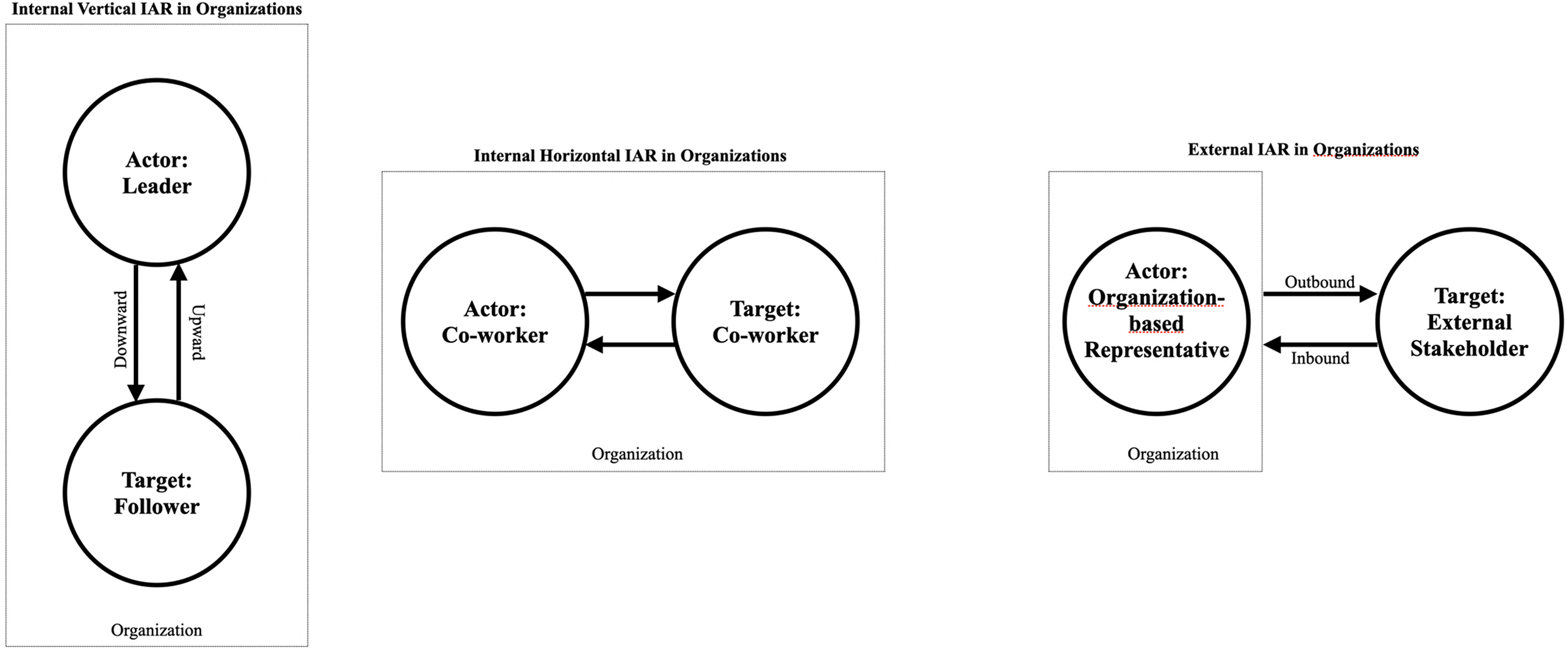
Three social role configurations for studying IAR in organizations.
Second, we theoretically integrate insights from different organizational perspectives that are grounded in different research traditions to develop a unified conceptual framework of how social role configurations shape why (i.e., motives), how (i.e., strategies), and with what effects (i.e., affective outcomes) individuals in organizations engage in IAR. There is currently a lack of systematic insights and theory regarding how social roles influence IAR, particularly in organizational contexts. Our aim is to develop a theoretical framework that helps to predict the occurrence and consequences of IAR within organizations. In doing so, we coalesce findings from divergent literatures (e.g., leadership, teams, negotiation, and customer service) grounded in different research traditions. Incorporating these social role configurations in which IAR processes occur within our integrative framework fosters theory development on IAR in organizations more widely. This enables us to identify patterns of relationships between motives, strategies, and affective outcomes of IAR in different actor-target configurations.
Third, we articulate how our framework can serve as a foundation for future research that systematically builds upon the insights of prior work. Building on our unique insights from different social role configurations of IAR, our framework advances a goal-regulatory perspective of IAR that accounts for purposeful IAR that individuals engage in at work. Doing so enables research to enhance and refine commonly proposed emotion regulation strategies (e.g., Gross, 1998; Little et al., 2012; Williams, 2007) and to better understand why individuals may be driven to choose to engage in different IAR strategies. Thus, our research agenda provides a starting point for new research into IAR that takes into account how the wider organizational context impinges on IAR motives and strategies.
Our paper is structured as follows. First, we provide an overview of existing perspectives on IAR that help us identify three predominant actor-target configurations of IAR in organizations. Next, we develop a theoretical framework of IAR in organizations by drawing on evidence from disparate organizational literatures to provide insights into patterns of relationships between motives (why individuals engage in IAR), the different strategies individuals use to regulate others’ affect (how individuals engage in IAR), and what the affective outcome is (what type of affect is evoked in targets). Our integrative framework synthesizes insights across different actor-target configurations, enabling us to provide testable propositions about how specific actor-target configurations impact IAR. Finally, we use the emerging insights from our conceptual framework to advance an agenda for future research on IAR in organizations.
Perspectives of interpersonal affect regulation across social roles
Given that many workplaces are inherently social as they involve frequent interactions with other people, work life is a notable trigger of affect (Van Kleef et al., 2012; Weiss & Cropanzano, 1996). However, employees are often constrained in their affective experiences and expressions by implicit or explicit expectations or norms imposed by the organization, managers, customers, or other stakeholders (Ekman & Friesen, 1969; Goffman, 1963; Hochschild, 1983; Thoits, 1990). Individuals, therefore, feel compelled not only to regulate their own feelings and expressions at work (intrapersonal affect regulation) often in ways to conform to normative expectations concerning affective experience and expression (Brief & Weiss, 2002; Elfenbein, 2007; Grandey & Melloy, 2017), but also to influence the feelings of others at work (interpersonal affect regulation).
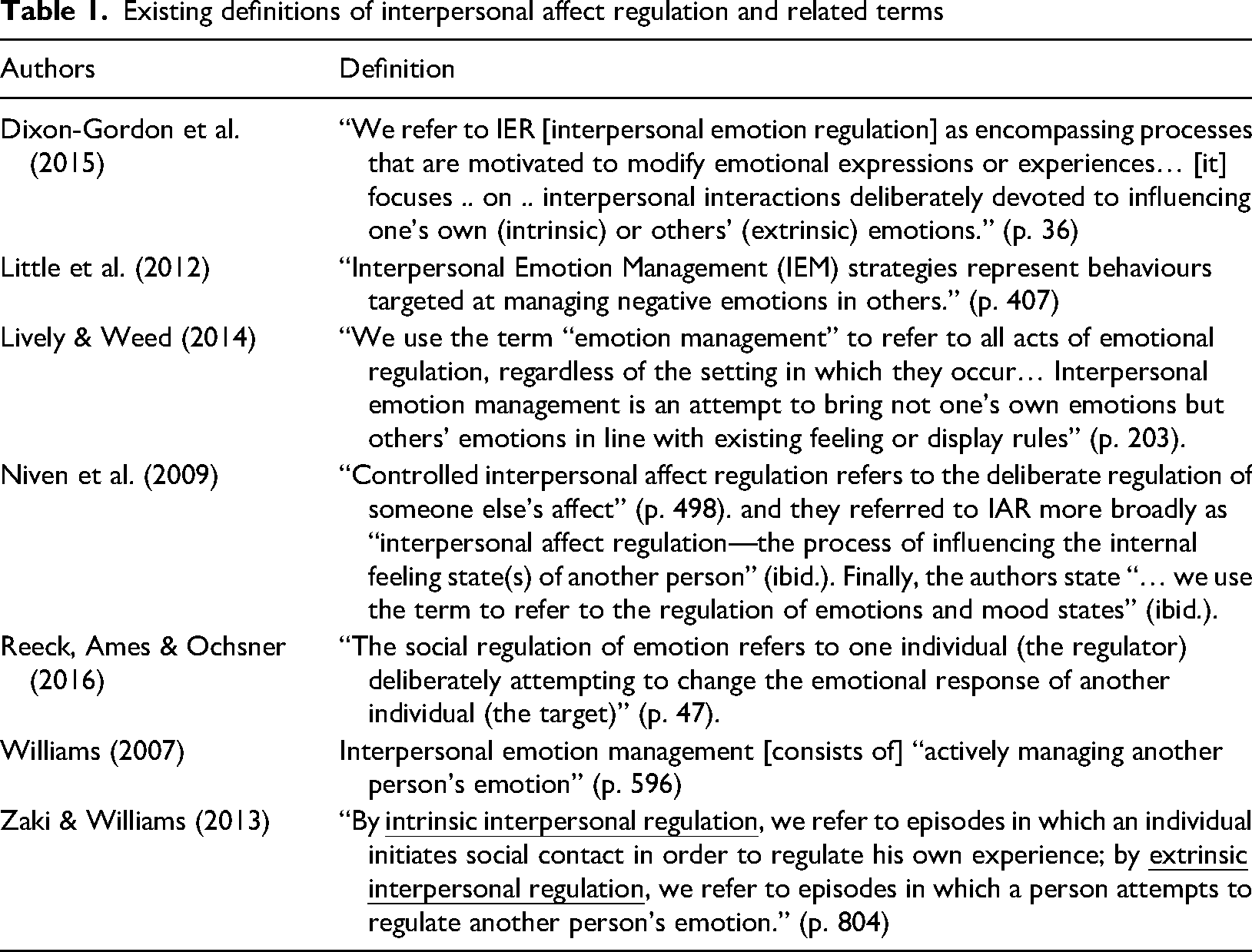
In line with existing definitions of IAR (for an overview, see Table 1), we define IAR, as it pertains to organizational life, as actions (including emotional, cognitive, and behavioral efforts) by (an) actor(s) aimed at influencing the feelings of one or more other individuals they interact with in the work context. Previous research has predominantly assumed that employees are motivated to adhere to organizational norms in expressing affect at work that is conducive to organizational goals (Grandey, 2000; Hochschild, 1983; Rafaeli & Sutton, 1991), implying individuals’ interests and goals are generally aligned with each other to collectively pursue the attainment of organizational goals (Groth et al., 2019). In turn, we propose that IAR in the workplace is goal-oriented and that organizational members are often motivated to influence others’ affect to obtain valued goals (see also Troth et al., 2017, for a review). This approach conceives of IAR as driven by individual motives in a given situation (Tamir & Millgram, 2017). For instance, leaders may have the motive of helping to improve followers’ performance (Niven, 2016), which translates to the goal of selecting strategies to improve followers’ enthusiasm and excitement, for example, through communication (Ashkanasy & Humphrey, 2011; Humphrey, 2002; Pescosolido, 2002). Similarly, employees may be driven to increase customer feelings of happiness, to help increase sales for the organization (Groth et al., 2019). Given the complex nature of goals as well as evidence for their automaticity (see Bargh & Ferguson, 2000), our goal-driven approach to IAR encompasses both intentional and automatic IAR, as well as the possibility for more deliberate IAR strategies to become automated and habituated over time (Bargh, 2014; Niven et al., 2009).
Existing definitions of interpersonal affect regulation and related terms
The questions of why and how individuals choose to regulate others’ affect in organizations have been studied in different, largely separated organizational literatures. Attempts to integrate this literature have largely ignored the dynamics of the social roles of the person instigating IAR (i.e., the actor) and the individuals it is intended to affect (i.e., the target(s) of IAR), which has resulted in divergent conclusions and limited integration of results. However, the social roles of actors and targets involved in IAR are critical. Individuals in workplaces are characterized by the distinct social roles they play, which are often embedded in a broader structure of team members, leaders, subordinates, and external stakeholders. Thus, it is surprising that the relationship between actors and targets in IAR process remains largely unaddressed. Although previous conceptual work has advanced insights into the motives behind IAR strategies (Niven, 2016), we lack systematic insights and theory into how social roles shape IAR, including the outcomes of IAR in organizations. As we argue, theory building is needed to predict when and why IAR takes place in organizations and with what consequences. Thus, our paper advances IAR research by explicitly focusing on the social roles in which IAR occurs in organizations. Highlighting distinct actor-target configurations across organizational roles provides a unique perspective of how these roles and individuals’ motives shape different IAR strategies and their effectiveness in organizations.
An integrative framework of social role configurations in IAR at work
Our framework of how social roles shape IAR aims to provide insights into when, how, and with what implications IAR takes place in different types of organizational settings (see Figure 2). Building on and expanding Niven's (2016) work on motives for IAR, we propose how distinct social role configurations shape how actors choose to engage in IAR in organizations, including the implications for targets. Social roles are “a socially defined pattern of behavior that is expected of a person who occupies a certain social position or belongs to a particular social category” (Bosak, 2018). Organizational role theory defines roles as a collection of obligations, entitlements, expectations, and norms that an individual must assume and execute. It is founded on the notion that individuals exhibit behaviors contingent on contextual factors, such as their social status and other relevant factors (Kahn et al., 1964). Thus, social roles within organizations consist of normative expectations that define social structures and their corresponding roles or behaviors in interactions with others at the workplace (Katz & Kahn, 1978). Effective role behaviors are essential for effective functioning in a particular role. Individual behavior in social contexts, tasks, and responsibilities in work groups and organizations is often organized into social roles, and individuals are constrained by the scripts, norms, and expectations of their roles (Turner, 2002). We propose that social role configurations in which IAR is embedded shape target affect by driving distinct motives and strategies for actors to engage in IAR in these contexts.
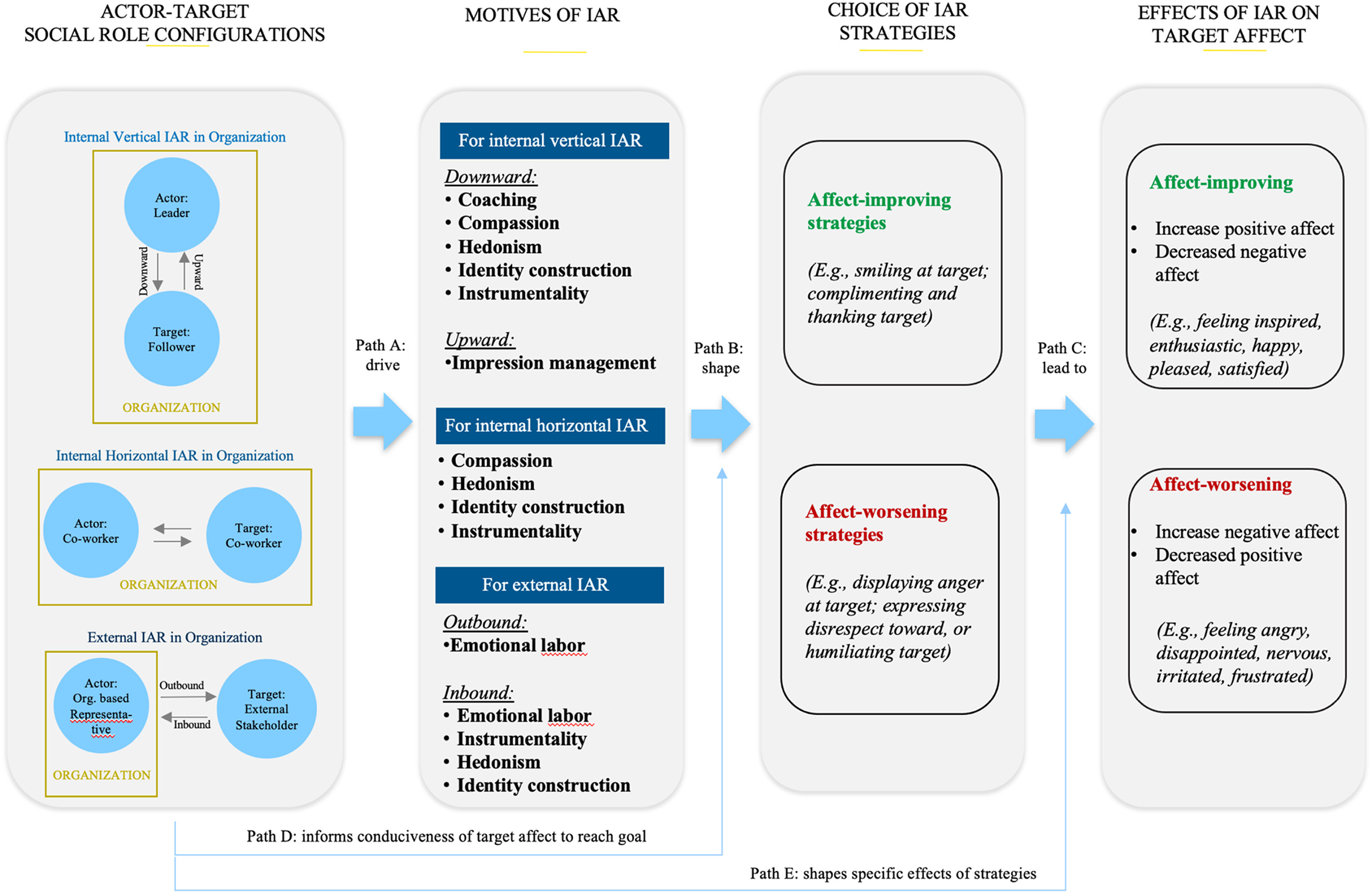
Integrative model of interpersonal affect regulation in organizations.
Evidence suggests an overarching distinction between IAR strategies that focus on improving (e.g., aiming to make a target experience more excitement, happiness, or comfort) versus worsening others’ affect (e.g., aiming to make a target feel more anxious, angry, or sad; Niven et al., 2009). We draw from examples of both affect-improving as well as affect-worsening affect regulation to illustrate the implications of each of the proposed social role configurations for IAR in organizations. Our integrative framework is based on evidence from the distinct social roles contained within the extant literature, which we derived through a detailed review of the literature. (Please see the appendix for a detailed description of how we analyzed the existing literature.) Tables 2–4 show a comprehensive overview of existing research for the vertical, horizontal, and external social role configurations, respectively. These tables contain all studies included in our review and list (inferred) motives, strategies, and affective outcomes, along with a summary of key findings.
Evidence on interpersonal affect regulation from a vertical IAR perspective (focusing on higher versus lower ranks)

Note. Evidence is sorted by affect-improving vs. worsening strategies, as well as by motives of IAR. Note that some research investigated both improvement as well as worsening effects of similar strategies– these are listed in the sub-heading of ‘affect improving vs. worsening’. ↑ = increases in intensity of feelings; ↓ reductions in intensity of feelings.
Evidence on interpersonal affect regulation from a horizontal IAR perspective (focusing on individuals at similar ranks)

Evidence on interpersonal affect regulation from an external perspective (focusing on internal vs. external organizational members)

Note. Evidence is sorted by affect-improving vs. worsening strategies, as well as by motives of IAR. Note that some research investigated both improvement as well as worsening effects of similar strategies– these are listed in the sub-heading of ‘affect improving vs. worsening’. ↑ = increases in intensity of feelings; ↓ reductions in intensity of feelings.
We inductively draw from and integrate organizational literature across different domains to commence theory building by identifying three overarching social role configurations in which IAR takes place at work. First, the internal vertical social role configuration is characterized by interactions between actors and targets with social roles from different levels of the organization's hierarchy. IAR in this configuration includes actions by leaders (downward) or subordinates (upward) to influence one another's affect at work. Second, the internal horizontal social role configuration is characterized by interactions between actors and targets that have comparable roles with similar hierarchical positions, such as team members. IAR in this configuration entails actions taken by team members to regulate each others’ affective states. Within both the vertical and horizontal social role configurations, actors and targets typically work with one another on an ongoing basis and toward a shared goal. Third, the external social role configuration is characterized by interactions between organizational members and external stakeholders, such as interactions of employees with customers, which are often transactional and transient in nature, with limited opportunities for repeated interactions (Czepiel, 1990; Gutek et al., 1999). IAR in this configuration involves actions taken by organization members to influence the affective states of individuals outside of the organization (outbound) or actions taken by external stakeholders to influence the affective states of employees (inbound). As part of our framework, we establish each social role configuration of IAR in organizations and propose how these role configurations differentially influence the why, how, and what of IAR in organizations.
The internal vertical social role configuration of IAR in organizations
We define the internal vertical social role configuration of IAR as one that occurs between an actor and target whose relationship is characterized by salient differences in hierarchical roles. This configuration allows for downward (e.g., from leader to subordinates) or upward (e.g., from subordinates to leader) attempts at IAR. Downward IAR typically involves actions by leaders aiming to influence followers to achieve a shared organizational goal (Yukl, 2006). Roles of leaders that are functional to achieving organizational goals include task- and relational-oriented aspects (Hemphill & Coons, 1957; Stogdill, 1963), including clarifying objectives and coordinating follower actions, as well as showing concern for followers’ well-being. They also include change-oriented aspects such as developing a vision for change (DeRue et al., 2011; Yukl et al., 2002). We propose that these core aspects of leadership roles (i.e., to provide structure in their tasks, support their well-being at work, and inspire followers toward change at work) make IAR aimed at improving target affect (i.e., facilitating the experience of positive affect and/or decreasing the experience of negative affect of followers) particularly relevant in this social role configuration.
Evidence for affect-improving IAR in this social role configuration is largely rooted in positive leadership theories and perspectives, such as transformational (Bass, 1985; 1998), charismatic (Conger & Kanungo, 1998; Gardner & Avolio, 1998), and authentic leadership (Walumbwa et al., 2008). Transformational and charismatic leaders tend to be aware of their emotional impact on followers (Ashkanasy & Tse, 2000; Connelly et al., 2002; Erez et al., 2008). Such leaders use their own positive affect to deliberately shape and improve followers’ affect to motivate their subordinates (Bass & Avolio, 1994; Dubinsky et al., 1995). For example, transformational leaders use positive emotions when communicating a vision to elicit positive responses from their subordinates (Lewis, 2000). These leaders also use their own affect to influence their employees by arousing similar feelings in their followers (Conger & Kanungo, 1998). Indeed, Berson and colleagues (2001, p. 54) argue that leaders use “transformational influence to excite followers to work towards long-term ideals and strategic objectives.” Similarly, authentic leaders often purposely express their own feelings to influence their followers (Avolio et al., 2004). In turn, subordinates relate to their leaders’ feelings because leaders hold power in influencing resources and interactions (Sy et al., 2005). As a result, leaders’ emotional expressions can have a considerable impact on followers’ affective states (Van Knippenberg & Van Kleef, 2016).
Leaders’ influence toward achieving organizationally desirable goals may also include affect-worsening IAR, where leaders deliberately aim to induce more negative feelings in their followers, such as feeling distressed, angry, upset, afraid, and jittery (Warr et al., 2014). Such affect-worsening may be part of deliberate attempts by leaders to motivate underperforming teams to perform better (Schaumberg & Flynn, 2019; Van Kleef et al., 2009). Support for this functional role of worsened affect is also evident, more broadly, in research on intrapersonal affect regulation (Tamir, 2016), which indicates that individuals sometimes deliberately worsen their moods and emotions to complete tasks more effectively. However, affect-worsening IAR can also occur for egoistic or self-interested reasons, such as can be observed in abusive leadership (Baron, 1988; Hobman et al., 2009; Hoobler & Hu, 2013; Kernan et al., 2011; Tepper, 2000; Tepper et al., 2007). Here, leaders may use their power advantage (Anderson & Brion, 2014; Pfeffer, 1992) to deliberately worsen followers’ feelings not to achieve organizational goals but to reach self-serving goals.
In turn, due to the power asymmetry inherent in leader-follower relationships, where followers aim to influence leaders’ affect, upward IAR is likely aimed at improving, rather than deliberately worsening, leaders’ feelings (e.g., Scott et al., 2007).
Preliminary evidence suggests followers may choose to display acts of citizenship, increasing feelings of happiness in their leaders (Halbesleben et al., 2010). Similarly, Scott et al. (2007) show that followers’ charismatic behaviors are associated with leaders’ positive moods. In sum, although empirical evidence of upward IAR in internal vertical social role configurations is sparse, initial theorizing and evidence suggests that followers are likely motivated by impression management motives in order to improve their leader's positive affect for their own benefit, such as to receive preferential treatment and more favorable performance evaluations.
In sum, both affect-improving and, to a lesser extent, affect-worsening IAR likely occur in organizations in what we refer to as internal vertical social role configurations that are characterized by actors and targets occupying social roles that represent distinct hierarchies in the organization. Internal vertical IAR also likely happens in two directions: downward (e.g., from leader to subordinates) and upward (e.g., from subordinates to leader), although research on upward IAR is relatively scarce.
The internal horizontal social role configuration of IAR in organizations
We define the internal horizontal social role configuration of IAR as one that occurs between an actor and target whose relationship is characterized by similar hierarchical positions in the organization. Typically, this consists of interactions between team members working together to achieve outcomes beyond individual capabilities (Marks et al., 2001). Team researchers increasingly view teams as complex, adaptive, and dynamic as they change over time and contexts (Ilgen et al., 2005). As such, team members often need to work together and negotiate teamwork processes, such as the formulation of goals and strategies, and continuously monitor and coordinate action while simultaneously managing interpersonal processes (Kozlowski & Ilgen, 2006; Marks et al., 2001; Mathieu et al., 2008).
There has been a long tradition of studying the interpersonal interactions among team members as well as the motivations and relationships that impact the bonding among team members and that shape performance on the task at hand (Kozlowski & Ilgen, 2006). According to Marks et al. (2001) and Mathieu et al. (2008), interpersonal processes such as adaptive conflict management, motivation, and affect management are instrumental to the success of teams, with interpersonal affective perspectives often implicated in explaining how these processes impact team outcomes (Kozlowski & Ilgen, 2006).
In the internal horizontal social role configuration, the display of positive affect is often considered critical in promoting feeling states that enhance team cohesion, which is theorized to drive team effectiveness (Kozlowski & Ilgen, 2006). The team literature often builds on the broader affect literature, including emotion contagion (Hatfield et al., 1994), affective event perspectives (Weiss & Cropanzano, 1996), and the social interpretation of emotional displays (Salancik & Pfeffer, 1978; Van Kleef, 2009). For instance, Barsade (2002) drew on emotion contagion perspectives in showing how a team member's positive or negative emotional displays can lead others in the team to experience and express similar positive or negative feelings. Further, Kammeyer-Mueller et al. (2013) proposed that co-worker support, such as providing encouragement, constituted an “affective event” that enhanced the positive experience of a newcomer. Drawing on emotions as social information theory (Van Kleef, 2009), other research demonstrated that a team member's displays of happiness may be interpreted by co-workers as signaling that they did a good job, which enhances positive affective experiences (Cheshin et al., 2011). Together, it appears that positive emotional displays and strategies constitute a way for teams to manage interpersonal processes and promote team cohesion to enhance team effectiveness.
Although the teams literature is characterized by efforts to uncover the antecedents of team effectiveness, it recognizes the critical role of disagreements in team contexts. Team conflict is a primary example of a setting in which affect-worsening IAR in the internal horizontal social role configuration is likely to occur. Team relationship conflict is associated with increased negative affective team experiences (e.g., increased feelings of tension and anxiousness) as well as decreased positive affective team experiences (e.g., decreased feelings of enthusiasm; Gamero et al., 2008). The experience of conflict in teams generally undermines interpersonal processes and engenders team dysfunction that typically leads teams to become less effective and less viable. Whether as a byproduct of conflict behaviors or as a deliberate action, team conflict creates a context in which team members may worsen each other's affect.
In sum, both affect-improving and, to a lesser extent, affect-worsening IAR likely occur in organizations in what we refer to as internal horizontal social role configurations, which are characterized by actors and targets occupying social roles that represent similar hierarchies in the organization.
The external social role configuration of IAR in organizations
The external social role configuration of IAR is characterized by interactions between employees, in their role as representatives of the organization, and stakeholders outside the organization, such as customers. This configuration allows for outbound (e.g., from employee to external stakeholder) or inbound (e.g., from external stakeholder to employee) attempts at IAR. Unlike the internal vertical and horizontal social role configurations, where actors and targets typically have a history of shared social interactions, the external configuration represents more transient interactions between actors and targets who often have not met before and have no expectations to interact again in the future (Czepiel, 1990; Gutek et al., 1999). In this context, expectations are often based on service scripts, or similar forms of organizational norms, which specify actions and behaviors that are consistent with organizational goals (Nguyen et al., 2014). In addition, in the absence of prior experience and information about each other, affective displays become a particularly important source of information and critical signal about the quality of service and the relationship (Van Kleef, 2009; Wang & Groth, 2014). Social role expectations in service exchanges dictate that employees are expected to fulfill their role as service providers by maintaining professionalism, ensuring that the customers’ needs are met to the best of their abilities, and representing their organization (Barnes, 1997). Customers’ social role, on the other hand, is largely based on expectations to provide relevant information, communicate in appropriate ways, and be respectful in interpersonal interactions (Barnes, 1997). Ultimately, both parties play a crucial role in creating a successful service interaction, and a failure on either side can have negative consequences for the overall service experience. Thus, the external social role configuration of IAR is predominately situated within employee-customer interactions in which both aim to regulate –and typically improve– each other's affect to achieve a desired service outcome (Hennig-Thurau et al., 2006; Medler-Liraz, 2016; Tan et al., 2004).
As an example of affect-improving IAR, a vast body of evidence on service management has shown that employees generally aim to improve customers’ positive affect through positive emotional displays. For example, Tan et al. (2004) showed that employees’ positive emotional displays are related to increased customer satisfaction. Similarly, Mattila and Enz (2002) found a link between employee emotional display and customers’ service encounter evaluations and positive mood after the encounter. These studies indicate that customers are often prone to imitating and “catching” the service employee's display of positive emotions, which consequently enhances the customer's evaluation of the service (Pugh, 2001; Hennig-Thurau et al., 2006).
IAR in an external social role configuration may also include instances of affect-worsening IAR, which is most evident in the literature on customer mistreatment (Koopmann et al., 2015). Customer mistreatment refers to low-quality interpersonal treatment employees receive from their customers (Wang et al., 2011) and often involves customers getting angry at employees, venting their frustration or impatience, and deliberately using condescending or aggressive language. For example, Rothbard and Wilk (2011) showed that customer hostility and negative affect resulted in increased negative emotions in employees. Thus, customers may aim to worsen employees’ affect to “get even” or for purely self-interested reasons to achieve more favorable service outcomes (Fisk & Neville, 2011). Similarly, employees may occasionally engage in affect-worsening IAR towards customers to achieve the goals of their organization, such as in the case of debt collectors who instill feelings of frustration and urgency to compel customers to pay their debts (Sutton, 1991).
In sum, both affect-improving and, to a lesser extent, affect-worsening IAR likely occur in organizations in what we refer to as external social role configurations. External IAR is characterized by actors and targets who occupy social roles that span across organizational boundaries, and it may occur in two distinct directions, outbound (e.g., from employee to external stakeholder) or inbound (e.g., from external stakeholder to employee).
The impact of social role configurations on motivation and strategies of IAR
Having established three core types of social role configurations of IAR in organizations, we next discuss how each of them shapes IAR at work (as shown in Figure 2). Specifically, we develop a model highlighting how distinct social role configurations influence the motives of IAR (i.e., why individuals engage in IAR at work; Path A in Figure 2), the IAR strategies used (i.e., how individuals engage in IAR; Path B in Figure 2) and the outcomes of IAR (i.e., what affective outcomes IAR has; Path C in Figure 2). We provide specific research propositions and illustrate our discussion with evidence from organizational studies across actor-target configurations incorporating internal vertical, internal horizontal, and external social role configurations of IAR, respectively.
The influence of social role configurations on IAR motives at work
Research on affect regulation more broadly suggests that individual motives matter when regulating one's own affective experience (Carver & Scheier, 2011; Tamir, 2009, 2016; Tamir & Millgram, 2017). For instance, research on intrapersonal affect regulation indicates that individuals’ motives shape how and to what end they choose to regulate their own affect (Bindl et al., 2022; Bolton, 2005; Diefendorff & Gosserand, 2003; Tamir, 2009, 2016; Tamir & Millgram, 2017; Von Gilsa et al., 2014). Expanding this notion to the context of IAR, Niven (2016) developed a conceptual framework for why employees may choose to regulate others’ affect in organizations. Using self-determination theory, Niven (2016) argued individuals may be driven to influence others’ affect by a wide range of individual motives, including identity construction (i.e., promote a sense of self), impression management (i.e., promote career or reputation), conformity (i.e., promote the smooth running of social situations), emotional labor (i.e., promote organizational performance), hedonism (i.e., promote personal well-being), instrumentality (i.e., boost one's own performance), compassion (i.e., promote others’ well-being), and coaching (i.e., promote others’ performance). We build on Niven's (2016) work to propose how social role configurations shape actors’ motives to engage in IAR in organizations and its implications for targets. For each proposition below, we focus on the most predominant motives within each social role configuration. That is, rather than providing an exhaustive description of every motive in each constellation, our theorizing focuses on those motives that we expect to be the most salient ones within each constellation that have received the most theory-driven and empirical attention in prior research (see Tables 2–4 for an overview of earlier indicative evidence).
First, as established above, within an internal vertical social role configuration, IAR often occurs between leaders and followers, with a particular focus on leaders regulating followers’ affect to influence them to achieve shared goals (see Table 2 for indicative evidence from the organizational literature). In this context, we propose affect-improving IAR in the internal vertical social role configuration to be primarily driven by leaders’ motives of coaching and compassion as well as instrumentality, in line with leaders’ dual focus on task and relational aspects of work (Hemphill & Coons, 1957; DeRue et al., 2011; Stogdill, 1963; Yukl et al., 2002). For example, research on transformational, charismatic, and authentic leadership suggests leaders often engage in IAR to influence followers’ feelings of excitement and inspiration to promote higher performance in followers (e.g., Lewis, 2000; Sutton, 2004; Sy et al., 2005; Yukl & Howell, 1999), resembling a coaching motive. Similarly, leaders frequently focus on improving followers’ social functioning and well-being at work (Day & Antonakis, 2012; Judge et al., 2004). In this context, a compassion motive is evident as leaders attempt to improve followers’ affect to promote their well-being, for instance, by offering support to followers and attending to their emotional needs (e.g., Huy, 2002; Lee et al., 2011; Nifadkar et al., 2012). Thus, the instrumentality motive will likely be salient in affect-improving IAR. In sum, we propose:
Affect-improving IAR in the internal vertical social role configuration from higher- to lower-hierarchy employees (i.e., downward) is more frequently driven by coaching, compassion, and instrumentality motives, compared with other motives.
In addition, we propose affect-worsening IAR in the internal vertical social role configuration to be primarily driven by leaders’ motives of hedonism and identity construction as well as by instrumentality motives. Regarding hedonism and identity construction motives, evidence suggests that power is associated with a loss of sensitivity to social disapproval, as well as reduced empathy, fairness, and compassion towards others at work (Anderson & Brion, 2014; Pfeffer, 1992; Van Kleef et al., 2008). Moreover, powerful individuals may use their power to gain personal benefits at the cost of others (Higgins et al., 2003). Within the internal vertical social role configuration, given the power asymmetry between leaders and followers (Yukl, 2006), we propose that leaders can be driven by motives to promote a sense of self (identity construction motive) or to advance their own well-being (hedonism motive), although these motives can be dysfunctional if they are pursued for nefarious, self-interested reasons that are not aligned with organizational goals. Evidence for affect-worsening IAR by leaders toward their followers is observed in abusive supervision (Tepper, 2000), where leaders deliberately engage in actions to make themselves feel better or to reinforce their own sense of self at the expense of followers (e.g., Atwater et al., 1997; Baron, 1988, 1990; Hobman et al., 2009). This may include leaders engaging in incivility and social undermining of their followers (e.g., Gianakos, 2002; Gant et al., 1993; Hobman et al., 2009). In sum, supervisors may use their hierarchal power to worsen followers’ feelings (Hoobler & Brass, 2006; Restubog et al., 2011). However, supervisors may also deliberately aim to worsen follower's affect for functional purposes that align with shared organizational goals. In particular, leaders may aim to worsen follower affect to benefit decision-making and performance in their overall team (Carson et al., 1993; French & Raven, 1959; Grossman, 2000; Pfeffer, 1981). Such instrumental motive for affect-worsening IAR by leaders is supported by social psychological research that suggests negative emotions, such as anxiety or anger, may, in some situations, be more effective than positive affect in promoting outcomes (e.g., analytical performance) and that individuals may be aware of the performance-related benefits of experiencing negative feelings (Gohm, 2003; Tamir et al., 2007). In this vein, evidence indicates that leaders may promote performance in followers by displaying negative, rather than positive, affect toward followers, particularly if the team is attuned to understanding the overall performance-related implications (Van Kleef et al., 2009). Thus, beyond motives related to making themselves feel better (hedonism and identity construction), affect-worsening IAR in the internal vertical social role configuration is also likely characterized by IAR driven by leaders wishing to enhance the overall performance of their team, reflecting instrumental motives of IAR. In sum, we propose: Affect-worsening IAR in the internal vertical social role configuration from higher- to lower-hierarchy employees (i.e., downward) is more frequently driven by hedonism, identity construction, and instrumentality motives, compared with other motives.
Given the apparent power asymmetry in internal vertical role configurations, we also expect that lower-hierarchy individuals seek to influence how leaders feel, mainly to gain favorable performance and career outcomes (Bolino et al., 2008; Gardner & Martinko, 1988). Therefore, we propose that affect-improving IAR in the internal vertical social role configuration also occurs upward, that is, from lower to higher hierarchy individuals driven by impression management motives. For instance, research on followership in organizations indicates that employees’ charismatic behaviors may positively influence emotions that leaders experience toward them, such as feeling prouder and happier about the follower (Scott et al., 2007). In contrast, while it is conceivable that followers may engage in affect-worsening IAR at work, given the power differential to their leaders and the potential backlash endured when making their leaders feel bad (Anderson & Brion, 2014; Pfeffer, 1992), we do not expect affect-worsening IAR to be predominant in the context of upward internal vertical social role configurations. In sum, we propose: Affect-improving IAR in the internal vertical social role configuration from lower-to higher-hierarchy employees (i.e., upward) is more frequently driven by impression management motives, compared with other motives.
In contrast to the internal vertical social role configuration, team members in the internal horizontal social role configuration share similar status in the organization and, therefore, often have considerable discretion in determining how and how much they commit to individual and team goals (Kozlowski & Ilgen, 2006). As a result, the goals of the individual and the team may be “independent, complementary or even contradictory” (DeShon et al., 2004, p. 1036). The achievement of collective team goals requires an alignment of individual and collective goals. It requires team members to gain consensus on shared processes that engender cooperation, confidence, empowerment, cohesion, and trust (Mathieu et al., 2008). We propose that IAR in the internal horizontal social role configuration is characterized by affect-improving strategies to enhance overall team effectiveness (Marks et al., 2001; Mathieu et al., 2008). These affect-improving strategies not only enhance collective team effectiveness but, in doing so, also achieve individual goals when aligned with the team.
We argue that IAR strategies are primarily driven by team members’ compassion- and instrumentality-related motives. Compassion motives are apparent when team members attempt to uplift the positive experience of another target team member by providing care and support (e.g., Gant et al., 1993; Ilies et al., 2011; Kammeyer-Mueller et al., 2013; Peeters et al., 1995). Team members who are instrumental in their choice of nonverbal positive displays (e.g., smiling) or deliberate expressions of happiness to team members (e.g., Barsade, 2002; Cheshin et al., 2011), in contrast, may be primarily motivated to enhance the capacity of teams to work cohesively and effectively. However, we acknowledge that when individual and team goals are aligned, compassion motives may also indirectly benefit team and individual performance; likewise, instrumental motives may also indirectly benefit team member well-being. Thus, we propose:
Affect-improving IAR in the internal horizontal social role configuration is more frequently driven by compassion and instrumentality motives, compared with other motives.
Alignment of individual and collective goals is critical in determining team effectiveness (Kozlowski & Ilgen, 2006; Marks et al., 2001), but such consensus can be difficult to achieve. Team members can vary in their commitment to team goals and may endanger team goals in the pursuit of their self-interested individual goals (DeShon et al., 2004). Further, team members may fail to reach a common and collective understanding of their strategy, mission, or process (Marks et al., 2001). Research indicates that team goal clarity and team process clarity are critical to the formation of a shared understanding of each individual's role in the team, which in turn facilitates high-quality team interactions (Hu & Liden, 2011). Without such common understanding, team members may elevate their own self-serving goals and/or seek to undermine other goals within the team. In such situations, team members may prioritize their own goals at the expense of the team to elevate their own sense of self and to make themselves feel good, and self-focused motives such as hedonism Affect-worsening IAR in the internal horizontal social role configuration is more frequently driven by identity construction, instrumentality, and hedonism motives, compared with other motives.
Finally, we propose that in external social role configurations of IAR (i.e., between employees and individuals outside the organization, such as customers), affect-improving IAR is primarily driven by emotional labor and instrumentality motives. For outbound IAR that occurs from employees (i.e., actors) to customers (i.e., targets), service employees often aim to positively impact the feelings of customers because positive emotions have been linked to increased customer satisfaction, loyalty, and positive word-of-mouth (Groth et al., 2019). Thus, evidence of affect-improving IAR in external social role configurations focuses on service employees’ efforts to express and display positive emotions to promote organizational performance by creating an overall positive service experience for customers (e.g., Hennig-Thurau et al., 2006; Medler-Liraz, 2016; Tan et al., 2004). Such attempts at interpersonal affect regulation aim to change customers’ emotions to benefit the organization. For example, evidence suggests expressing positive affect is a common strategy by which employees try to influence customers’ affective reactions to the service delivery and, ultimately, the quality of the service performance itself (Hur et al., 2015; Medler-Liraz, 2016). Hence, we propose: Affect-improving IAR in the external social role configuration from employees to customers (i.e., outbound) is more frequently driven by emotional labor motives, compared with other motives.
Reversely, evidence for inbound affect-improving IAR from customers (i.e., actors) to employees (i.e., targets) is less common. However, some evidence suggests that customers are driven by instrumentality motives to elicit positive emotions in employees to receive better service. For example, Rothbard and Wilk (2011) showed that customer positive affective displays were associated with increased positive emotions in employees, thus ultimately leading to better service experiences/outcomes for customers themselves. Thus, we propose: Affect-improving IAR in the external social role configuration from customers to employees (i.e., inbound) is more frequently driven by instrumentality motives, compared with other motives.
Employees will rarely aim to worsen the feelings of customers, as this would be inconsistent with organizational goals of increasing customer satisfaction and loyalty. Yet, in some types of services (i.e., police officers, debt collectors), employees may aim to heighten feelings of fear and intimidation (Sutton, 1991; van Gelderen et al., 2007), usually in an attempt to enforce organizational compliance (Rafaeli & Sutton, 1991). However, affect-worsening IAR in external social roles can more often be observed in the opposite direction. Customers’ perceived service failures or unmet service expectations may be a primary trigger of affect-worsening IAR. As a result of perceived failures by the employee, customers may display negative emotions such as anger (Rupp & Spencer, 2006) in their interactions with service employees (Rothbard & Wilk, 2011; Fisk & Neville, 2011), thus pursuing an instrumentality motive trying to influence how service employees feel to gain a more favorable service outcome as a result of their complaining behavior. In other words, affect-worsening IAR from customers to employees involves customers’ display of negative emotions toward employees to achieve more favorable outcomes in the service transaction (Groth & Grandey, 2012).
Customers may also engage in affect-worsening IAR for self-serving hedonic or identity construct motives. Unlike many co-worker interactions, there are usually unequal goal expectations and power differentials in employee–customer interactions (Diefendorff et al., 2010). The misalignment of perceived power may lead customers to treat employees poorly just because “they can.” At other times, customers may display negative affect toward employees because they feel entitled to do so due to their relative perceived power over frontline service employees (Diefendorff et al., 2010; Yagil, 2006). Poor affective treatment by customers then inevitably leads to negative affective responses by employees (Groth & Grandey, 2012). This is underpinned by affective events theory (Weiss & Cropanzano, 1996), which suggests that customer actions represent affective events that shape employees’ feelings at work. For example, Grandey et al. (2002) found that personal attacks and incivility from customers to employees constitute an “affective event” that shapes the employee's affective experiences. These affective experiences (e.g., due to customer mistreatment; cf. Koopman et al., 2015) consequently negatively impact effective service delivery by employees (cf. Adams & Webster, 2013). In short, customers’ motives for IAR within an external social role configuration may be primarily driven by instrumentality, hedonism, and identity construction motives. Thus, we propose:
Affect-worsening IAR in the external social role configuration from customers to employees (i.e., inbound) is more frequently driven by instrumentality, hedonism, and identity construction motives, compared with other motives.
The influence of social role configurations on IAR strategies at work
In analyzing strategies for IAR, we draw on Gross’ (1998) well-established emotion regulation framework, which distinguishes between antecedent-focused and response-focused affect regulation strategies (Gross, 1998; Gross & Munoz, 1995). Gross’ model is situated at the intrapersonal level of analysis, but the two core strategies it highlights can be meaningfully extended to the interpersonal level. In Gross’ model, antecedent-focused emotion regulation involves modifying the precursors that lead to an emotional experience, such as altering the emotion-arousing situation itself or one's way of thinking about the situation (Gross & John, 2003; Grandey, 2000). This approach to affect regulation aims to prevent negative emotions from arising or becoming too intense by altering the conditions that trigger them. Response-focused regulation, on the other hand, focuses on modifying the response to a given stimulus rather than altering the stimulus itself (Gross & John, 2003; Grandey, 2000). This approach is commonly used in situations where it may be difficult or impossible to change the source of a problem or where individuals lack the ability or skill to change their feelings (Yang & Diefendorff, 2009).
A large body of evidence suggests that antecedent-related intrapersonal affect regulation leads to improved performance and well-being outcomes, as well as to better social functioning (e.g., Grandey & Gabriel, 2015; Gross, 1998; Gross & John, 2003; Hülsheger & Schewe, 2011). This is due to the overall more effective outcomes of antecedent-related affect regulation regarding individuals’ own self-regulatory processes, as well as more favorable outward appearance to other stakeholders (Gabriel et al., 2023; Gross, 2002). While all regulation strategies can be taxing for individuals and drain their resources (Hobfoll, 1989), response-focused regulation strategies may result in greater resource loss and, consequently, reduced well-being and performance (Grandey & Gabriel, 2015). Response-focused affect regulation has also been associated with poorer outcomes due to its propensity to appear inauthentic and to create a dissonance between felt and displayed emotions (Gabriel et al., 2023; Gross, 2002).
Core aspects of Gross’ (1998) model have also been applied to the interpersonal domain. Most notably, Williams (2007) proposed that actors may engage in antecedent-focused efforts to influence targets’ affect by altering the situation (i.e., changing the situation by removing some or all of the emotional impact for the target), altering attention (i.e., distracting targets’ attention away from an emotional situation), or altering the cognitive meaning of the situation (i.e., initiating targets’ reappraisal of a situation). In contrast, actors may try to influence targets’ affect in response-focused ways by modulating the emotional response (i.e., interrupting targets’ experiences of emotions).
Research has highlighted some contexts where response-focused interpersonal affect regulation may be more effective, for instance, in crisis and time-constrained situations (Huy, 2002; Thiel et al., 2015) when individuals do not have enough time and capacity to engage in antecedent-related emotion regulation (e.g., Grandey & Melloy, 2017). For example, Pauw et al. (2019) found that, when down-regulating others’ negative emotions, people provide less socio-affective support but help others to disengage from the emotional experience by encouraging suppression and distraction.
We propose that antecedent-focused IAR is likely to be more effective in changing target affect than response-focused IAR. In particular, by shifting attention and altering the meaning of affective experiences, we expect antecedent-focused IAR strategies to more effectively influence follower affect by facilitating social sensemaking processes (Weick, 1995). Antecedent-focused IAR strategies, such as deliberately displaying positive emotions (e.g., smiling at the target) to improve target affect, or expressing anger to worsen target affect, likely shape the target's interpretation of the situation, thereby promoting changes in the target's affect. These displays communicate the actor's motivations and intentions toward the target (Van Kleef, 2009), influencing a target's affective response. For instance, a team member's display of happiness may be interpreted by followers as a sign that they are doing a good job (Van Kleef et al., 2009), which enhances positive affective experiences. This strategy can be found across social role-configurations proposed in our model (e.g., Cheshin et al., 2011; Rothbard & Wilk, 2011; Visser et al., 2013). For instance, thanking others for inducing a positive affective experience appears to be a pervasive IAR strategy leading to an increase of positive affect in targets across social role configurations, including internal vertical (Kelloway et al., 2013), internal horizontal (Niven et al., 2012a), and external configurations (Tan et al., 2004). Likewise, communicating disrespect worsens target affect across social role configurations, including internal vertical (Hoobler & Hu, 2013), internal horizontal (Pearson et al., 2001), and external configurations (Yang & Diefendorff, 2009). Communicating disrespect, across all contexts, is likely to be interpreted as signaling poor interpersonal relations and worsening affective outcomes (Hoobler & Hu, 2013).
In contrast, response-focused IAR strategies require actors to instruct targets to change their expressions, which may undermine their self-concept (Ashforth & Humphrey, 1993; Pugh et al., 2011). In addition, analogous to response-focused intraindividual affect regulation, we expect that response-focused IAR may be perceived as more reactive rather than proactive, and once an emotion has been elicited in a target, activate physiological processes that are more difficult to stop or reverse (Gross, 2002). Thus, response-focused IAR may only provide temporary relief as it fails to address the underlying causes of the emotions. In sum, we propose:
Across all social role configurations in organizations and across both affect-improving and affect-worsening IAR, the use of antecedent-related IAR strategies is overall more likely to be effective in changing target affect than the use of response-focused IAR strategies.
Further, we propose that distinct social role constellations of IAR shape the range or flexibility of IAR strategies available to and used by actors. For instance, the relative perceived power of actors within an organizational context increases the influence of individuals to shape the actions of others (Pfeffer, 1981) as well as the breadth of their behavioral repertoire (Galinsky et al., 2003; Keltner et al., 2003). Thus, it is particularly those actors within an internal vertical social role configuration at a higher hierarchical position who will likely perceive that they are able to choose from a wide range of antecedent-focused strategies, in turn, by being able to choose a strategy most fitting for effectiveness in a particular situation. Leaders may choose from altering the situation for followers, altering aspects of the situation, or altering the cognitive meaning of the situation to regulate followers’ affect when engaging in internal vertical IAR (Gross, 1998; Williams, 2007). For example, leaders may change the situation for their followers by assigning new assignments or projects that are experienced as inspiring (Yukl, 2006). Leaders also have the positional power to communicate an inspiring vision to heighten feelings of excitement or inspire followers to think about a situation in new ways (e.g., Bono et al., 2007; Liang & Chi, 2013; McColl-Kennedy & Anderson, 2002; Seo et al., 2012; Tsai et al., 2009). In addition, although followers have distinctly less power than leaders, follower-leader relationships are often characterized by working together over a longer amount of time to achieve shared goals (Yukl, 2006). For that reason, followers may aim to proactively influence their leaders’ affect in a range of ways over time, for example, by choosing when and how to share positive news about their achievements with their leader.
Similarly, in internal horizontal social role configurations, team members often work together intensively and know each other intimately (Ilgen et al., 2005). Further, research indicates that teams develop their own unique affective norms that emerge over the course of team members’ sustained interactions with one another, and these affective norms often vary between teams located in the same organization (Gamero et al., 2008; George, 1990; Sessa, 1996). In contrast to the internal vertical configurations in which those in higher hierarchical positions may be afforded more discretion in their choice of IAR strategies, team members are required to adapt to the changing dynamics of the task environment, and their behavior is less directly influenced by the organizational hierarchy. Therefore, team members may not be particularly constrained by organizational display rules regarding hierarchy and status in organizations (Diefendorff & Greguras, 2009), which opens up a wider range of IAR strategies. For example, team members not only provide a wide range of instrumental support to co-workers, such as providing advice and help to colleagues (e.g., Peeters et al., 2005), but also provide affective support to improve each other's feelings (e.g., Kammeyer-Mueller et al., 2013; Niven et al., 2012b). Conversely, team members can also engage in social undermining and exhibit uncivil behaviors toward other team members (e.g., Gianakos, 2002) or become entangled in relationship conflict (e.g., Medina et al., 2005), which disrupts team cohesion.
Compared with an internal (vertical or horizontal) social role configuration, where actors and targets usually have relatively long-standing social ties, a history of social interaction, and are embedded in ongoing work relationships, the external social role configuration of IAR is often characterized by transient interactions between employees and customers that are regulated by professional standards of conduct and organizational norms on how to interact with each other (Gutek, 1995). In particular, service situations are often guided by strong service scripts that guide employee behaviors in their interactions with customers (Nguyen et al., 2014). Expressive affective norms, known as display rules, dictate which emotions are appropriate in particular situations, as well as how those emotions should be expressed to others (Diefendorff & Gosserand, 2003). Both employees and customers are often constrained in their ability to select or change the situation in which IAR occurs, which further limits their ability to engage in a wide range of IAR strategies. Employees are usually constrained in their ability to choose which customers to serve and are not able to simply “walk away” from difficult service encounters (Diefendorff et al., 2008). Similarly, customers often cannot change the situational characteristics of service delivery and/or the employees they interact with (Gutek et al., 1999). In sum, external social role configurations are rather confined in the scope of IAR strategies that are enabled in transient, one-off interactions between employees and external stakeholders, such as customers. Thus, we expect:
The external social role configuration of IAR is characterized by a narrower range of IAR strategies to improve or worsen target affect, compared with internal (vertical and horizontal) social role configurations.
Finally, we propose that the more closely IAR motives are aligned with the respective social role expectations across each of the three social role configurations, the more automated the engagement in IAR will be. If IAR motives are close to the core of social role constellations (e.g., being a leader, a team worker, a customer service representative, etc.), individuals will be more familiar with a particular type of motivated IAR as part of their routine core role requirements (Bindl et al., 2022; Wood & Rünger, 2016). Thus, they will likely better understand how to regulate others’ affect in ways that are functional for the desired purpose and will require fewer cognitive resources and less attention to effectively engage in IAR (Hobfoll, 1989; Frijda, 1988; Levenson, 1999). Similarly, individuals who habitually engage in IAR will likely require less deliberate effort to regulate others’ affect (Gollwitzer et al., 2012), and they may be more effective in doing so (Carver & Scheier, 2011). This possibility is supported by research on emotional contagion processes, which has found that the spreading of emotions among people can happen largely automatically (Hatfield, Cacioppo & Rapson, 1994), although more recent models highlight the role of conscious motivational processes in contagion (Wolf et al., in press). In addition, evidence suggests that IAR strategies become more automated over time as individuals become more familiar with social role expectations (Bargh, 2013). Thus, we propose that the less central, and hence more unusual, particular motives of IAR are to the core of actors’ social roles, the more resources will be required, and the more deliberate IAR strategies will be.
In addition, as argued above, because social roles across configurations primarily involve cooperation and shared goals (for internal vertical and horizontal social role configurations) as well as trust and satisfaction (for external social role configurations), affect-improving (rather than affect-worsening) IAR will be more closely aligned with respective social roles and, hence, is more likely to be enacted in automated ways (e.g., Groth et al., 2019). In addition, some evidence suggests that positive emotions more easily spread from one person to another and can lead to positive affect regulation without deliberate effort (Hatfield et al., 1993). In contrast, negative emotions can be more difficult to regulate, thus requiring more resources and deliberate effort (Hobfoll, 1989). Therefore, we expect affect-worsening IAR to be typically unrelated, or even contradictory, to social roles across organizational contexts and thus to require more deliberate, effortful engagement by actors. In sum, we propose:
The more strongly individual motives for IAR are aligned with the respective norms and expectations of social role configurations, the more automated IAR strategies will be.
Across social role configurations in organizations, affect-improving IAR is more likely to be enacted through automated IAR strategies, whereas affect-worsening IAR is more likely to be enacted through deliberate strategies.
Advancing a research agenda
Despite important theoretical advances on IAR in organizations, there has been limited theorizing on the impact of social role configurations in shaping why and how individuals engage in IAR and the associated outcomes of IAR for target affect. Our conceptual framework shown in Figure 2 integrates and advances insights into how IAR is meaningfully shaped by distinct social role configurations in which individuals are embedded at work. This approach opens up several new directions for future research.
Agenda item 1: integrating IAR with goal-regulatory theories
A critical consideration for future research is the congruence between an actor's motives and their choice of strategies. Future research could build on our framework of IAR with insights from goal-regulatory frameworks. For instance, regulatory focus research (Higgins, 1997) explains how individuals choose to strive toward pursuing different goals. Individuals with a promotion-focused approach may seek to maximize gains, whereas individuals with a prevention-focused approach may seek to minimize losses despite pursuing the same higher-order goal. Integrating regulatory focus theory with IAR may refine the overarching antecedent- and response-focused emotion regulation strategies proposed by Gross (1998; Little et al., 2012; Williams, 2007) by shedding light on the nuanced ways in which individuals deploy specific emotion regulation strategies based on their regulatory focus orientations. By considering an individual's regulatory focus, researchers and practitioners can tailor emotion regulation interventions to better align with an individual's motivational orientation, thus enhancing the effectiveness of emotion regulation strategies in diverse contexts.
Future research should also consider an actor's willingness to persist in IAR at work over time. Research by Williams and Emich (2014) indicated that failed attempts to improve others’ affect through humor led to more guilt and reduced self-efficacy on the part of the actor. This finding has important implications: The success and failure of previous IAR attempts likely impact future goal choice and pursuit (Locke & Latham, 2013), including the extent to which a goal is challenging, as well as the types of strategies used for goal pursuit. Understanding how individuals’ IAR efforts influence their subsequent goal-setting and pursuit behaviors can provide valuable insights into the dynamic interplay between IAR and goal-directed actions in organizational contexts.
Agenda item 2: accounting for ability (beyond motivation) in IAR
Differences in individual ability are also known to shape the effectiveness of IAR, and actors can select inappropriate IAR strategies or be unskilled in implementing these strategies (Dixon-Gordon et al., 2015). For instance, Thiel and colleagues (2015) suggest that empathetic leaders can more effectively manage followers’ emotions by asking them to suppress their feelings to improve affect by using empathy as an affective tool (Salovey & Mayer, 1990). Thus, even though some strategies are generally less effective (e.g., suppression), they may be relatively more effective when employed by actors with particular characteristics and skills. Moreover, individuals with higher levels of emotional intelligence may select more appropriate IAR strategies given their motives, and they may have an easier time implementing their IAR strategies skillfully (O’Boyle et al., 2011). In sum, the effectiveness of IAR strategies likely reflects the actors’ ability (e.g., emotional intelligence). We call for future research to investigate the actors’ ability to regulate others’ affect in connection with the motivation- and goal-related pursuit of IAR.
Agenda item 3: investigating the wider organizational context
Our theoretical model incorporates IAR motives and strategies within a framework of the different social roles individuals may have in organizations. We encourage future research to build on and expand our framework of IAR by considering contextual characteristics of the work setting more broadly. Our conceptual model suggests that social role configurations, as one type of organizational context, shape different motives of IAR, which inform the choice of possible strategies for changing a target's affect. Although we examined specific social role configurations as a direct predictor of IAT motives and strategies in our framework, it is possible that the social roles, and the social context more broadly, moderate some of the relationships in our framework. We call on future research to examine the potential moderating role of the wider social context of IAR processes. Potentially relevant characteristics of the broader work context include organizational culture (De Cremer, 2006), social-organizational characteristics such as social support, work conditions, and job complexity (Morgeson & Humphrey, 2006), and broader relational work design (Grant & Parker, 2009). These and other factors may have an impact on the effectiveness of IAR beyond social roles, and IAR strategies may be more or less effective in changing target affect in desirable ways.
Agenda item 4: advancing research design and measurement of IAR
Our framework highlights the critical role played by actor motives in driving IAR strategies and outcomes. Although there are promising avenues of IAR assessment that have tried to establish different dimensions of IAR, such as those by Niven et al. (2011) and Swerdlow and Johnson (2020), these have yet to be measured through the lens of motives. Consequently, there is an urgent need for the development of assessment instruments that can evaluate IAR motives to deepen our understanding of how specific motives impact strategies and the effectiveness of motive-strategy configurations. Further, these assessments may help identify the alignment or misalignment of goals between the actor and target and the associated consequences for IAR outcomes. Measures concerning the motives of intrapersonal affect regulation in organizations are now available (e.g., Bindl et al., 2022) and may be adapted to the interpersonal context. Incorporating these measures into future research may help uncover previously unknown relationships between IAR motives, strategies, and outcomes, which can ultimately inform effective IAR practices.
IAR studies to date use laboratory experiments and cross-sectional designs when investigating coaching goals, whereas hedonism- and identity-construction- goals are primarily associated with longitudinal field designs. These distinct areas of IAR can learn from one another in adopting research designs to achieve a broader range of insights in the field. Few studies have employed dynamic study designs such as event sampling procedures that capture IAR more proximately in time as it unfolds (for an exception, see Bono et al., 2007).
Agenda item 5: temporal Changes in IAR
We still need to understand more about what it takes for IAR strategies to influence target affect, and how temporality shapes the effectiveness of IAR strategies. Evidence suggests that as little as 30 s can effectively change a target's affect (e.g., Cherulnik et al., 2001). IAR strategies can be more diffuse and longer lasting, with evidence from longitudinal field studies suggesting that, in some cases, affect-worsening IAR strategies, such as abusive supervisory behaviors, influence target affective experiences over six months (Hobman et al., 2009; Tepper, 2000).
Research using more immediate assessments of IAR in organizations as it unfolds over time will yield an enhanced understanding of the temporal phenomena of IAR. This may include insights into how different IAR strategies interact with each other, either when used simultaneously, across time, or when used by different actors. In this context, we encourage future research to more comprehensively and dynamically account for the different elements of the process of IAR—for instance, through the use of social network analysis (Totterdell et al., 2004), state-space grids analysis (Butler et al., 2013), and experience-sampling techniques (Ohly et al., 2010). In sum, future research may build on our overarching framework of IAR to investigate the goal-driven process as it happens.
Research that assesses the changing roles between actors and targets over time will also be important. Niven (2022) suggests that emotion regulation ability changes with age, suggesting that the processes discussed in our paper are subject to change. Research also indicates that individuals assess equity in IAR in terms of the social support provided to targets compared with the social support received from the targets. Individuals who feel their social support is reciprocated by the target report more positive moods at work than those who feel their social support is unreciprocated (Buunk et al., 1993). Thus, the roles of the actor and target likely vary over time, with previous experiences informing future expectations and social exchange. Similarly, the role of by-standers in episodes of IAR needs to be accounted for to understand the implications of IAR strategies for organizations overall (Henkel et al., 2017).
Conclusion
Why and how individuals choose to regulate others’ affect in organizations is imperfectly understood. Research has developed in largely separate research silos across disparate organizational literatures, which have not accounted for the possibility that motives for and strategies of IAR depend on the nature of the context. We brought together insights in IAR from separate literatures in an integrative framework that considers how IAR unfolds across three prevalent actor-target configurations in organizations: internal-vertical, internal-horizontal, and external social role configurations. Our framework suggests that different social roles differentially shape actors’ motives for using IAR, IAR strategies used, and affective outcomes of IAR for targets in organizations. In contextualizing IAR within its social roles in organizations, our IAR framework provides a roadmap for future research that can contribute to a more complete understanding of the intricacies of interpersonal affect regulation at work.
Footnotes
Author Note
The first and second author contributed equally to this research. The authors would like to thank Karen Niven for her comments on earlier versions of this manuscript.
Funding
The authors received no financial support for the research, authorship, and/or publication of this article.
