



Abstract
Employees often feel that the help they receive at work is inadequate. Whereas previous research explains this empirical finding by referencing stereotypes or poor communication, we suggest an alternative that does not rely on biased agents: disappointment with received help may arise due to self-selection and regression to the mean. Before asking for help, employees assess whether their co-workers have the time and ability to respond. Consistent with regression to the mean, extreme beliefs are often followed by less extreme outcomes. However, employees with inflated beliefs are more likely to ask for help than employees with low or modest beliefs. Therefore, the subset of employees who act will have overly optimistic expectations, expectations that are unlikely to be met once co-workers respond. Apart from challenging conventional wisdom, this article also integrates chance and self-selection perspectives into the ongoing dialogue of help-seeking. Implications for future research, theory, and practice are discussed.
Plain Language Summary
This article presents a theory explaining the following empirical regularity: employees often feel let down with the help they receive at work. Prior research explains this effect by referencing errors in communication or cognition. We propose a simple, alternative mechanism, such that cognitive biases or communication mishaps need not be present for the pattern to emerge. Suppose employees ask for help based on a noisy signal of colleague potential—that is, a perception of whether co-workers have the motivation and ability to resolve the issue. Employees who believe potential is high will be more likely to ask for help than employees who believe potential is low. Due to regression to the mean, extreme beliefs will likely be followed by less extreme received help (in either direction). But not every employee asks for help. Only those with sufficiently high beliefs send a request—and it is those employees who have a greater chance of holding inflated assessments. Among those who ask, then, received help will appear underwhelming. Apart from challenging conventional wisdom, this article also integrates chance and self-selection perspectives into the ongoing dialogue of help-seeking. Implications for future research, theory, and practice are discussed.
Keywords
Introduction
When employees request help from colleagues, there is often a mismatch between desired and received levels of support: people tend to expect more help than they receive (Ashkenas, 2012; Keizer, 2005). In polls conducted by staffing and services companies (e.g., Yoh or the Harris Group), employees report that, after asking managers for assistance, they rarely perceive the provided help to be sufficient (McIntyre, 2018; Solomon, 2015). When employees ask colleagues for advice on interpersonal relationships or career management, they frequently report that the advice they receive is fruitless (Gardner & Berry, 1995; Lim & O’Connor, 1995; Schultze et al., 2015). Finally, several large-scale surveys of workplace behavior suggest that employees often ask for assistance over email only to have those emails ignored entirely (Burnett, 2018; Rendon, 2019). Why is there often an overestimate between desired and received help?
Poor communication and cognitive biases could explain this phenomenon. Many employees do not clearly convey their issues to colleagues, leaving potential responders confused on how to proceed (Wilkinson & Spinelli, 1983; Williams & Bizup, 2014; Zinsser, 2006). Employees may also wait too long before asking for help (Klaver, 2007). When they do, their requests are rushed and poorly conveyed. Turning now to cognitive reasons, individuals often erroneously expect to succeed where others fail, even in domains in which they have little expertise (Kahneman & Tversky, 1973). It is also common for people to take advice more seriously when it comes from confident others compared to those who appear timid but in fact have more accurate and legitimate information (Phillips, 1999; Sniezek & Buckley, 1995). From the perspective of biases within the person offering help, he or she may engage in automatic stereotyping and perceive the help-seeker as incompetent (Lennard & Van Dyne, 2018; Rosette et al., 2015), assume control over the project due to a sense of entitlement but leave the core problem unresolved for the help-seeker (Jordan et al., 2017; Naumann et al., 2002; Twenge & Foster, 2010), or be reluctant to help for fear of entering into an exchange contract (Thompson & Bolino, 2018). Each of these options, which stem from theories of communication, personality, and implicit stereotypes, explain the outcome by calling upon traits that a priori push individuals in the direction of the outcome to be explained. In other words, a biased outcome is explained by referencing biased processes.
We integrate theories of chance and self-selection to offer a simpler, alternative explanation: the empirical regularity that help-seekers are often let down can be the result of unbiased but noisy judgments combined with self-selection. Specifically, a theory that combines (a) random noise, or the notion that human judgment involves at least some amount of (unbiased) error, with (b) self-selection, or the idea that only a subset of employees considering asking for help actually do, is sufficient to yield the phenomenon. No a priori communication biases are required, only the notions that judgments are noisy and not every employee who thinks about asking for help does. Moreover, there need not be any systematic tendencies in helpers causing them to offer low help. Helpers can be, on average, similar in character across the population with no predisposition to provide inadequate help—yet the phenomenon can still occur.
Intuition for the theory is as follows. Before asking for help, employees assess whether their co-workers have the time and skills to respond. Employees with high or inflated beliefs will be more likely to ask for help than employees with low or modest beliefs—employees with unreasonably high expectations ask; employees with low expectations do not. Therefore, the subset of employees who act will have bloated expectations, expectations that are unlikely to be met once co-workers respond. Across all employees, beliefs may be unbiased—on average, forecasts may accurately predict received help – but only some employees send requests. Among the senders, there will be a greater proportion experiencing help lower than forecasted. Noisy beliefs, regression to the mean, and self-selection (Denrell et al., 2015) together explain why employees feel disappointed with received help.
This research offers several contributions. First, it provides a novel perspective on a particular issue by challenging conventional wisdom. Prior theory and research suggest poor communication and helper biases as explanations for the phenomenon described in the opening paragraph. The theory presented here contends that such effects are not always necessary. If the propositions in this research are correct, then when organizational personnel intervenes on variables such as communication (Mayfield & Mayfield, 2002), employee perceptions of received help may not change to the extent desired by management. Organizations may also need to attend to the idea that the phenomenon can stem from a selection mechanism. Second, this research integrates chance and self-selection into the ongoing dialogue of help-seeking. To incorporate chance is to mean that the theory assumes random variation as a postulate and uses this assumption (in combination with other effects) to explain an empirical regularity. Denrell et al. (2015) argue that such explanations “offer a theoretically rich and empirically fruitful paradigm in the management sciences” and “deserve to be taken seriously as theoretical mechanisms of considerable generality” (p. 923). So far, organizational theories that incorporate chance and randomness have been applied only to a limited number of topics—typically firm performance and growth (Bottazzi & Secchi, 2003; Denrell, 2008; Henderson et al., 2012). The current research suggests that they have implications even for micro behaviors such as help-seeking. We are not the first to introduce noisy beliefs, regression to the mean, and self-selection. Instead, our contribution is to apply these ideas to the help-seeking literature. Third, many studies of employee cooperation focus either on seeking or helping without connecting the two via solicitations. Ehrhart (2018) states that cooperative behaviors in organizations often begin with requests for help, so a complete picture of the process includes not only help but also requests or solicitations. This research offers a small but necessary step in that direction.
Below, we describe the four components of the theory: help-seekers and their beliefs about potential help, chance judgments due to bounded rationality, regression to the mean, and self-selection. The article closes with theoretical and practical implications.
Component 1: Help-Seeking and Assessments of Potential
The literature on help-seeking is broad and contains many taxonomies (Ashford & Cummings, 1983; Chan, 2013; Cramer, 1999; Dalal & Bonaccio, 2010; Hofmann et al., 2009; Lee, 2002; McDonald et al., 2008). Consistent with Ehrhart (2018) and Chan (2013), the current article considers help-seeking that is conducted to solve a problem or complete a task. Help-seeking is therefore defined as the act of asking for help by consulting with someone to obtain specific information on work-related matters (Hofmann et al., 2009). The theory begins by describing employees who are considering sending a request for help, an aspect that Ehrhart (2018) states is necessary because “most incidents of helping are the direct result of a request for help” (p. 485).
The theoretical starting point is Nebus (2006) advice generation model. The advice generation model states that employees run cost-benefit calculations when thinking about asking others for help. An employee judges the target's expertise, motivation to assist, and availability. Put differently, the underlying questions a help-seeker considers include (1) Does the target have the expertise required to help me? (2) Will the target be motivated to help me? (3) Is the target available? (4) Will I feel incompetent or embarrassed by asking? Empirical research has generally supported the idea that employees consider such questions when asking for help (Carmeli et al., 2009; Newman, 1994; van der Rijt et al., 2013). The first component of the current model, therefore, is that employees form beliefs about the likelihood of a target offering help, and these assessments are more or less favorable depending on perceived ability, motivation, and availability to assist.
Component 2: Bounded Rationality and Chance
Next, the model draws from bounded rationality and adds random variation as a postulate. Bounded rationality (Simon, 1991, 1955) suggests that employees must deal with uncertainty. The environment is too complex, and our cognitive architecture too limited, to discover all optimal solutions to problems. When an employee considers which actions to take, s/he faces unknowns in the sense that s/he cannot ahead of time understand the exact probability of various outcomes or what factors influence whether certain outcomes are reached. This idea—judgments contain noise—is consistent with prior models of employee decision making (Dushnitsky, 2010; Knudsen & Levinthal, 2007; March, 1994) and empirical evidence in both management and psychology (Karelaia & Hogarth, 2008; Mezias & Starbuck, 2003). Applied to the current article, the notion of noise implies that an employee's assessment of help potential is imperfectly correlated with received help. An employee's belief that his/her colleagues are motivated and able to assist is surrounded by error.
The reasons for imprecision or noisy judgments are numerous. Employees have only limited information regarding the abilities and motives of their colleagues (Connelly & Kelloway, 2003; Gagné et al., 2019), cannot know beforehand what actions others will take after asking (Ramnani & Miall, 2004), and operate in environments that may change without warning (March, 1997). Even if employees somehow capture all available and relevant information, their interpretation of it is subject to noise. They may not know, for instance, how to weigh or aggregate multiple pieces of evidence in order to make a decision (Dawes, 1979).
Other theories of help-seeking incorporate errors of assessment (Dyer & Ross, 2008; Miller et al., 2012). What makes this theory unique is its suggestion that errors need not be systematically biased to yield the phenomenon of interest. It is not necessary that they always be low or high due to biased information or biased reasoning (Nebus, 2006; Newark et al., 2017). Errors in the form of random variation are sufficient. The purpose of this research is not to suggest that all errors are perfectly random, or even that most are. The goal, instead, is to describe the complexity that can emerge when the only presumed error is random noise. Cognitive limitations and biases exist, of course. But as will be described later, unsystematic noise is all that is needed.
Component 3: Regression to the Mean
When employees form noisy beliefs about their colleagues, the pool of employees is likely to exhibit regression to the mean. On average, employees with extreme forecasts will realize less extreme received help. This effect is a fundamental property of chance models in which variables are subject to random variation (Denrell et al., 2015). Mathematically, if X is a random variable representing beliefs about help and Y is a random variable representing received help, then the expected difference E[Y−X] is negative if we only observe Y when X is large. The intuition for this effect comes by considering forecasts versus received help as two different tests. Naturally, some employees will form very high (low) assessments relative to others. If we select some subset of employees on this first test and then observe scores on a second test (received help), the scores on the second will regress not toward assessments but toward the mean levels of help across the entire group. Such a phenomenon can be witnessed in many domains, including medicine, sports, and business (Bland & Altman, 1994). Denrell et al. (2019) show that regression to the mean in employee performance will occur whenever performance is due to both skill and luck (noise). Denrell and Liu (2012) discuss the conditions under which regression to the mean becomes disproportionately greater for extreme compared to moderate forecasters. Regression to the mean is also observed in studies of wealth (Levy & Levy, 2003), stock market returns (Blattberg & Gonedes, 1974), number of citations (Baum, 2011; Radicchi et al., 2008) and firm size (Coad, 2009). We suggest that the help employees receive after forming noisy assessments of potential exhibits regression toward the mean.
Component 4: Self-Selection
The last component is self-selection: a favorable assessment yields a greater likelihood of requesting help. Several areas of research suggest that one's assessment of possible help predicts whether he or she requests it. van der Rijt et al. (2013) find that awareness of a target's expertise and accessibility are positively associated with the likelihood of seeking help from that individual. Similar results are observed among middle-school students (Ryan & Pintrich, 1997), college and graduate students (Cramer, 1999; Dearing et al., 2005; Hammer & Vogel, 2013; Hütter & Ache, 2016), and among CEO's asking for advice from executives at other organizations (Vestal & Guidice, 2019). That said, not all who consider asking for help actually do. Even if an employee renders a forecast, he or she may not subsequently call upon others. People often withhold asking for help despite being aware of its potential (Black, 2016; Bohns & Flynn, 2010; Dixon, 2004; Organ et al., 2016; Tugend, 2007). An alternative way to describe this scenario—employees using assessments to determine whether to ask for help—is that employees make “enter” or “exit” decisions, similar to entrepreneurs making noisy assessments of demand to decide whether they should enter a market (Hogarth & Karelaia, 2012). When employee assessments of help potential are favorable, they decide to “enter” in the sense that they send a request, whereas those with unfavorable assessments withhold from action.
Figures 1 and 2 convey the theory visually. Figure 1 is the familiar contingency diagram representing false alarms and misses due to selection. When employees have favorable assessments of help potential, they are likely to send a request. Of those who send a request, some will experience help that meets their expectations; others will experience help that does not meet their expectations. Those that receive help lower than forecasted are deemed false positives. The other end of the continuum contains employees with unfavorable assessments. These employees are therefore likely to withhold help requests. This group contains both employees who rightfully opt not to request help and those who withhold but would have received help greater than anticipated (missed opportunities).
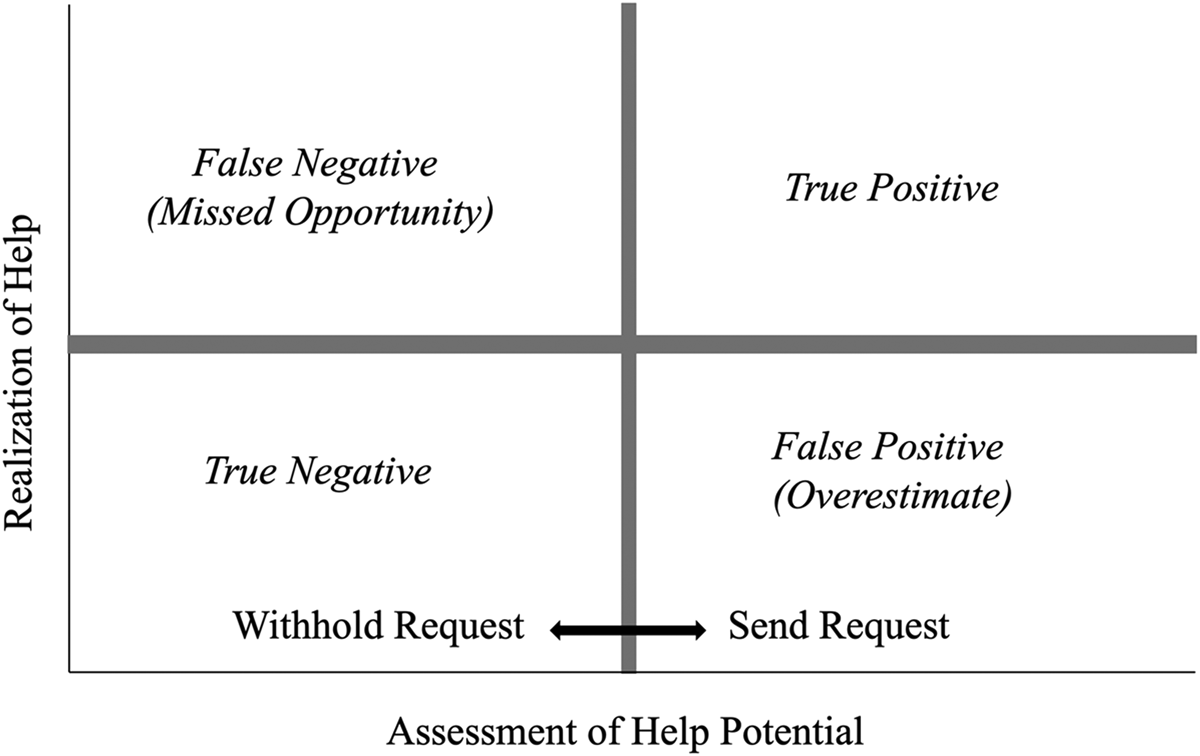
Assessments and realizations of help.
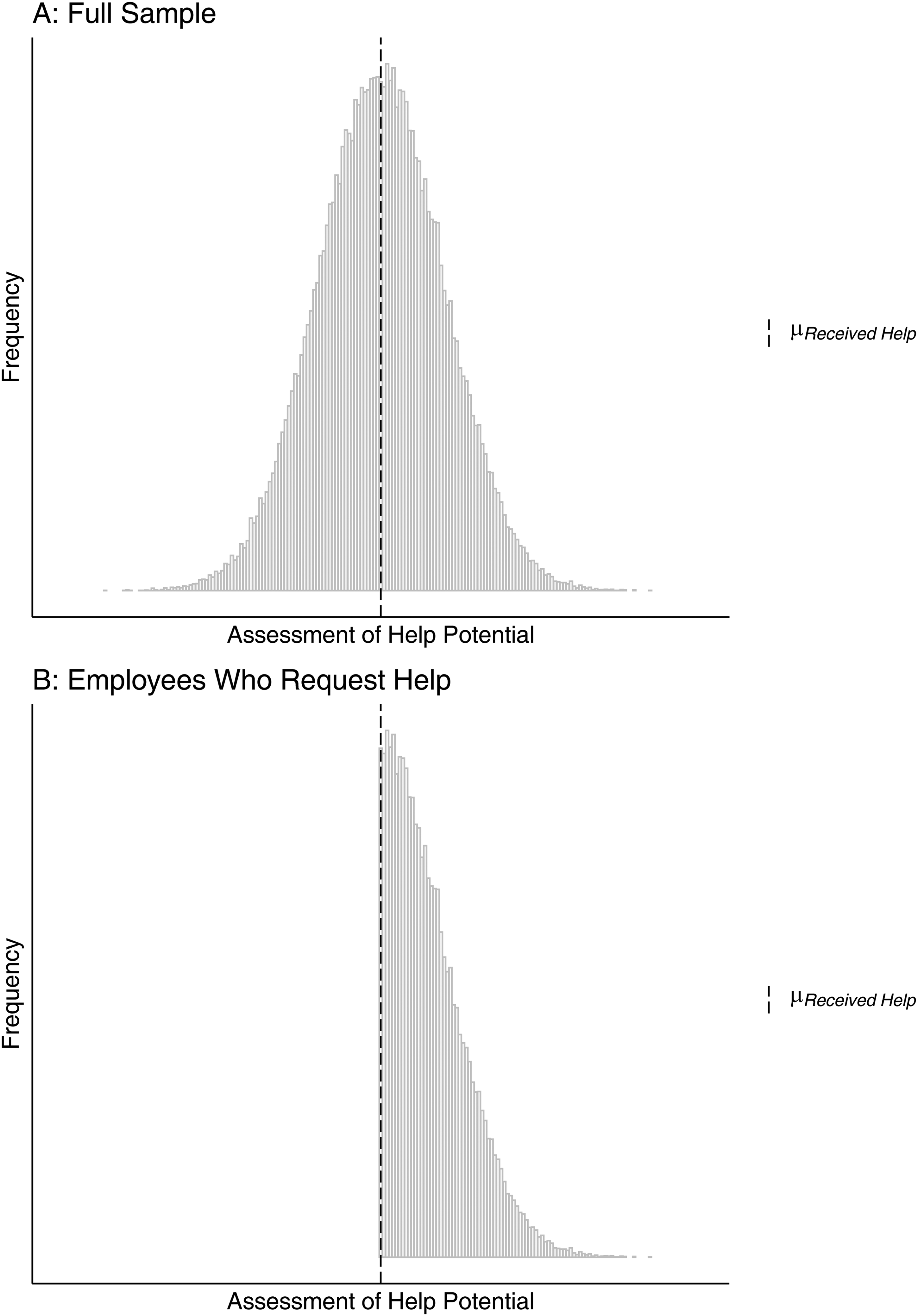
Unbiased but noisy assessments of potential help. The full sample contains both over and underestimates (A), whereas employees who send a request (B) have a greater chance of receiving help that is lower than forecasted.
Forecasts and/or actions of helpers need not be biased to produce the phenomenon (Figure 2). What matters is that judgments are noisy and help-seekers self-select into those that do and do not send requests. Assessments of help potential may be unbiased such that the mean of employee forecasts sits exactly on the mean of received help—on average, forecasts may accurately predict received help (Figure 2A). Due to self-selection, though, only some employees send requests (Figure 2B); among them, there will be a greater proportion experiencing help that is lower than forecasted. In short, a self-selecting group of overly optimistic people are the only ones asking for help, leading to disappointment.
Discussion
To explain why many are let down with the help they receive, we developed a theory that integrates models of help-seeking, chance, and self-selection. Employees assess the potential for help around them—they form beliefs about whether colleagues will assist if called upon. Employee assessments are noisy: irreducible unknowns in an employee's environment cause his or her assessment to be subject to error. As such, the entire sample of employees may contain roughly the same number of over and underestimates of help potential. Due to regression toward the mean, extreme beliefs are often followed by less extreme received help (in either direction). But not every employee asks for help. Only those with sufficiently high beliefs send a request—and it is those employees who have a greater chance of holding inflated assessments. Among those who ask, then, received help will appear underwhelming.
Theory and Research Implications
This work offers several contributions to theory and research. It challenges conventional wisdom by suggesting that poor communication and helper biases need not be present for the phenomenon to occur. Such an alternative does not dispute the significance of existing explanations, for which much evidence exists. Rather, it suggests that there may be other and perhaps more fundamental effects that are sufficient to yield the phenomenon. Moreover, the explanation provided here does not rely on characteristics that a priori dispose individuals in the direction of the outcome to be explained (Fiedler, 2000). Instead, variation among individuals makes both under and overestimation probable—it is only after self-selection that a trend in a certain direction occurs. To be clear, we are not suggesting that employee beliefs are subject to random error. Randomly distributed estimation errors are sufficient as an assumption, but they may not represent a fundamental description of reality. Random variation is a conservative assumption sufficient to explain an observed pattern, but we are not arguing that beliefs within the minds of employees are random.
This work also extends several literatures, including (a) chance models of organizational behavior, which typically examine firm performance or growth (Barnett, 2008; Mancke, 1974; Riccaboni et al., 2008; Sutton, 2002) and (b) the work of Nebus (2006) by integrating noisy judgments with sampling. The current theory suggests that, consistent with the notion of bounded rationality (Simon, 1955), there are unknown features that cause assessments to imperfectly correlate to received help, even if employees understand the abilities of their colleagues.
How could this theory be empirically distinguished from others? To choose among competing theories, each of which explains the same event, the path forward is to find some new question to which the theories offer different answers. A brief discussion of this topic should provide ideas for future research. Consider and contrast three theories: one consistent with the ideas articulated in this article (noisy sampling theory), one stating that targets have behavioral defects (lazy targets theory), and one stating that poor communication thwarts helping (poor communication theory). Each offers a reason for the empirical finding that help-seekers are disappointed with received help. Our task now is to identify new situations to which the theories provide different answers. An obvious start would be to contrast a control group with a group completing cognitive training. This training would focus on errors of perception, regression to the mean, and other major components of cognitive behavioral therapy. Its goal would be to reduce the SD of the perception errors so that extreme expectations (either high or low) would be removed from the initial assessment distribution. In short, people would have more realistic expectations. The noisy sampling theory predicts that the training group would exhibit lower disappointment compared to the control group. The lazy targets theory predicts that both groups would exhibit roughly the same disappointment. The poor communication theory also predicts equal disappointment among both groups. Second, we could examine locations where it is easier for employees to ask for help. Perhaps a company implements an online portal allowing workers to quickly post issues requiring assistance. Perhaps a company changes from a more traditional layout to an “open door” policy in which employees work side by side in a shared office space, removing any physical barrier to someone asking for help. The noisy sampling theory predicts that, having now made it easier for those with low expectations to ask for assistance, we would witness reduced disappointment following the office upgrades. More precisely, we would witness a greater proportion of “low expectation” employees among the senders. The lazy targets and poor communication theories predict no change after the upgrades. Finally, many applied-oriented books applaud some companies over others for their altruistic, energetic, and conscientious employees (Grant, 2014). The lazy targets theory predicts that disappointment should be low within these companies, whereas the noisy sampling theory predicts disappointment even in situations with a high proportion of altruistic targets.
An important boundary to the current theory is the level of abstraction of assessments and realized help. Help assessments can be partitioned into many parameters or dimensions, and the same is true for received help. Some parameters, for example, might include, will the target respond (yes/no; compliance)? Will the help be useful (value)? Will it be on time (speed)? Will I lose face by asking (esteem)? Will asking initiate an exchange contract (social exchange)? Will the person I ask tell others (social)? Will they respond with a pleasant emotional tone (affect)? The parameters could even become more specific once a particular domain of study is examined: for example, will the individual use my preferred software (GitHub over Dropbox)? All of these combine to form a belief about help (X). After a seeker asks for assistance, a similar set of parameters form the realization of received help (Y). Once again, revealed help (Y) is a general, aggregate variable formed by the combination of many dimensions (e.g., the target responded, did not tell others, with a given emotional tone, etc.). If a seeker has a high estimate of compliance but a low estimate of, say, speed, then the seeker may not be let down if help is granted but delayed—it depends on the weight given to each parameter. Partitioning beliefs in this way will no doubt be a fruitful avenue for future research, but the current theory is abstracted, simply, into a belief about help (X) and a realization of help (Y). There are many interesting questions on the nature of forming beliefs: which dimensions are common, whether some are given more weight than others, the extent to which people exchange parameters when one is met and another is not, or whether such an event indeed leads someone to be unsatisfied. Given that the current research integrates sampling, beliefs, and regression to the mean, we abstracted from the specific parameters and referred simply to X and Y, help assessments and revealed help, respectively. For the purposes of the current presentation, one value for potential (which is a function of many things) and one value for realization (which is a function of many things) were used.
Finally, the work by Bohns et al. (Bohns, 2016; Bohns et al., 2016; Newark et al., 2017; Newark et al., 2014) provides an interesting contrast to the current theory—comparing them reveals future directions. Across several studies, people underestimate whether others will comply with a request. Participants, for example, are told to imagine asking others to fill out a questionnaire. Then, participants predict how many people will say “yes” to these requests. Predictions are often below actual response levels, and this effect may, initially, seem to counter the propositions described in this article—and the data in the opening paragraph. There are important differences. The participants know that they will be sending requests, so although the studies capture beliefs about potential help, there is no opportunity for those beliefs to translate into differences in action. There is no self-selection. Participants are aware that they will be interacting with others, so in a sense, the decision to “enter” has already happened. The self-filtering that comes through selection without coercion is a key aspect of the research described here. Therefore, the next step for empirical work would be to extend the work by Bohns et al. by allowing participants to self-select after estimating. Have all participants make estimates of co-worker help, and then let participants choose whether to solicit help from others. This scheme would directly test the idea that those with higher estimates tend to be more likely to ask for help. Moreover, the scenarios, be they real or imagined, are often social rather than work-related. As Kozlowski and Bell (2003) note, behavior in organizations occurs within a system driven by task demands and interdependence. There may be additional insights by examining the nature of compliance in more realistic scenarios in which self-selection can occur.
Practical Implications
The ideas presented in this article manifest in the real world. When expectations are not met, many are ready to blame leaders or help-seeker targets. In a study on young workers conducted by Deloitte (2018), employees reported that business leaders needed to show greater responsiveness to employee needs. Year-to-year data showed that workers, especially young employees, “sent a strong signal that those higher expectations were not being met” (p. 13). The consultants then argued, “rather than accepting that as a negative, we view an opportunity for leaders to fill what younger workers see as a stark leadership void” (p. 13) and “companies have a clear and achievable opportunity to the extent they want to enhance their standing in the eyes of millennials, Gen-Z respondents, and students” (p. 27). In other words, leaders, managers, and corporate executives were at fault. Little emphasis was given to the idea that young workers reporting unmet expectations may have had unrealistic expectations. In the workplace, high beliefs need not be followed by equally high levels of received behavior. Similarly, calls for faculty to undergo training emerged after Harvard undergraduates filed complaints stating that they were disappointed with faculty-student mentoring (Crimson, 2005). It was taken as given that faculty were underperforming. There was no mention of the idea that those who complained may have also had inflated and therefore unlikely-to-be-met expectations. In these specific examples, and among others across various consulting blogs (Carucci, 2019; Larose, 2019), sampling and noisy beliefs go unnoticed; target defects are taken as given; leaders are often blamed. The theory offered in this article sheds light on these issues from a different angle.
There are two other practical implications, one for managers and the other for employees. Managers should recognize that poor perceptions of received help may not reflect inadequate communication or deficient helping among their subordinates. These issues can certainly occur in organizations, and there is much research documenting their antecedents and outcomes (Bolino et al., 2015; Ng & Van Dyne, 2005; Vignovic & Thompson, 2010; Zohar & Polachek, 2014). This research, however, suggests that unbiased but noisy judgments paired with self-selection are sufficient to yield the phenomenon. Any feature of organizational life that makes sending a request easier for employees could be used to correct it. Said differently, based on this research, one goal for managers is to find ways of lowering the cutoff at which employees decide to ask for help so that even unfavorable assessments lead to action.
Prior research points to multiple levers that managers have at their disposal to influence the likelihood of employees asking for help. For instance, safety climate refers to the various ways that shared perceptions of safety are valued in the workplace, and one form of this construct has to do with feelings of security regarding asking for help (Griffin & Curcuruto, 2016). Extant safety climate research suggests that managers can significantly influence the formation of a psychological safety climate (Shen et al., 2015). For instance, transformational leader behaviors such as individualized consideration (wherein the manager focuses on the needs of each employee to maximize their potential) have been shown to increase trust and in turn psychological safety among employees (Avolio et al., 1999; Koopmann et al., 2016). Similarly, supportive leadership behaviors—defined as behaviors that provide “emotional, informational, instrumental and appraisal support” (Rafferty & Griffin, 2006, p. 39)—can enhance follower efficacy and thereby elicit help-seeking (Jansen et al., 2016). Lastly, research has suggested that stress and reduced well-being can induce negative perceptions of help-seeking behaviors (Weiss et al., 2021). A critical means by which managers can help alleviate the stress experienced by employees is by providing social support (Karasek et al., 1982), and this effort may then translate into greater amounts of help-seeking (Ganster et al., 1986; Maiuolo et al., 2019).
This research also has implications for employees. One way to tackle the issue of noisy beliefs is to provide training to employees regarding faulty judgements, as these errors of judgment are bound to exist given the complexity and uncertainty surrounding the decision to seek help. This effort could be done in the vein of unconscious or implicit bias training (Atewologun et al., 2018; Tia Moin & Van Nieuwerburgh, 2021), which has been found to reduce automatic, subconscious biases that affect individual decision making (usually in the context of biases that lead to discrimination against outgroup members; Girod et al., 2016; Jackson et al., 2014). It could also be used to make employees aware of the likelihood of under or overestimating the level of help they will receive.
Next, employees can also be trained on specific statistical concepts like regression to the mean. Indeed, there is evidence from related fields such as educational psychology that decision making can be improved even in brief training sessions on statistical concepts, one being regression to the mean (Fong et al., 1986; Nisbett, 2013). These findings have also been replicated in laboratory settings (Larrick et al., 1990; Nisbett et al., 1982) wherein researchers found that participants learned from short training sessions on regression to the mean and the law of large numbers, improving “their reasoning about how much evidence is needed to reach accurate beliefs” (Nisbett, 2015, p. 9). We propose that these findings can be extended and applied to training programs targeted at increasing instances of help-seeking at work. Specifically, training employees on concepts like regression to the mean, even in a limited capacity, is likely to provide employees with an enhanced ability to make decisions accounting for any biases due to this mechanism. Further, given the likelihood of encountering events in everyday life in which regression to the mean manifests (Nisbett, 2015), we believe neglecting these ideas in management practice would be to the detriment of individual and organizational performance.
Finally, training and development programs can also help employees limit overestimates by ensuring that errors do not correlate. Mathematically, this means that the noise in judgments across requests for a single employee is independent. Substantively, this means that the unknowns of one helper differ from any others. When an employee sends requests to different colleagues, s/he limits his chances of overestimation by sending the requests to people with independent errors. However, independent does not mean that the colleagues are unfamiliar or different in character, but that the unknowns of one differ from the unknowns of the other. In a sense, the employee may randomize his requests, ensuring that the errors of one help target are, to the best of his ability, different from the errors of another. Organizations can experiment with creative training programs that train and coach employees to adopt such unconventional practices to reduce the incidences of overestimation.
Conclusion
Whereas previous research examined personality, stereotypes, and poor communication as the forces underlying an empirical finding in the help-seeking literature—namely, help-seekers are often disappointed with the help they receive—we proposed that noisy beliefs combine with self-selection and regression to the mean to yield this phenomenon. Our perspective fits within the recent literature on chance models in organizational science, as well as the long-standing sampling frameworks in psychology. It calls attention to the nature of asking for help, a domain that is at times overlooked in studies of citizenship. We explained how beliefs about potential help are subject to noise, though this error in judgment need not be biased in a particular direction across the entire sample prior to action. Those with unreasonably high beliefs, then, are the most likely to solicit help, thereby setting the stage for regression to the mean to unfold. This work offers a generative perspective capturing simple mechanisms that combine to produce an empirical regularity. It should appeal to researchers interested in citizenship, help-seeking, and statistical insight, and to managers interested in cultivating a thriving organizational community. We hope that it refines the ongoing discussions in the field and inspires useful and insightful future research.
Footnotes
Funding
The author(s) received no financial support for the research, authorship, and/or publication of this article.
