




Abstract
Due to its devastating consequences, research needs to theoretically and empirically disentangle different sub-types of destructive leadership. Based on concepts derived from aggression research distinguishing re- and proactive aggression, we provide a process model differentiating abusive supervision and exploitative leadership. High versus low arousal negative affect is installed as the central mediating factor determining (1) whether perceived goal-blockage (leadership antecedents) leads to abusive supervision versus exploitative leadership and (2) whether a specific leadership behavior leads to active versus passive follower behavior (leadership consequence). Further, theoretical anchoring of individual and contextual moderators onto the model's process paths is provided and exemplary hypotheses for concrete moderation effects are deduced. Based on the provided process model, we highlight four recommendations to facilitate process-based construct differentiation in future research on destructive leadership. To precisely understand the differences and commonalities in different forms of destructive leadership will ultimately enable custom-tailored inter- and prevention.
Plain Language Summary
Negative leadership—also named “destructive” leadership—has very bad effects on followers and organizations. There are not just one, but many forms of destructive leadership and it is important to understand where different sub-types come from (i.e., to understand their antecedents) and which specific effect they have (i.e., to understand their consequences). In this paper, we focus on better understanding two forms of destructive leadership, namely abusive supervision and exploitative leadership. These two forms are similar to the two main forms of aggression. Abusive supervision is similar to reactive aggression, an impulsive “hot blooded” form of aggression. Exploitative leadership is similar to proactive aggression, a premeditated “cold blooded” form of aggression. We explain the parallels between the two forms of aggression and the two forms of leadership and provide a model which allows to predict when one versus the other form of leadership occurs and to which follower behavior they lead. An important factor in this model is the physiological characteristic of the emotional reaction to an event (i.e., arousal). An emotional reaction can be high in arousal; for instance, anger is a high arousal negative emotional reaction. On the contrary, boredom, for instance, is a low arousal negative emotional reaction. Dependent on whether both a leader and a follower react to a negative event (e.g., not getting what they want, being treated badly by others) with high or low arousal, their behavior will be different. We explain how this mechanism works and how it can help us to better predict leaders' and followers' behavior. We also outline how individual characteristics of the leader and follower and characteristics of their environment and context interact with arousal and their behavior.
Keywords
Most—if not all—organizations rely on skillful leadership to optimize their potential, unite followers, reduce conflict, and distill various centrifugal forces into success (Peus et al., 2016). While positive forms of leadership (e.g., Antonakis et al., 2003) enable individuals, organizations, and societies to flourish, destructive forms of leadership can have devastating consequences (Schyns & Schilling, 2013). This negative impact is magnified psychologically as humans perceive and process negative input more intensely than positive input (Unkelbach et al., 2008). Furthermore, negative behavior is generally more harmful than an equivalent positive behavior is helpful (Baumeister et al., 2001). Also, destructive leadership—which presents itself with many faces—not only negatively affects the direct target but also indirectly impacts the target's environment (Hoobler & Brass, 2006). The immense and widespread negative influence of destructive leadership therefore necessitates nuanced empirical investigations into its antecedents as well as its consequences in order to obtain a better understanding of how individuals and organizations could prevent or react to destructive leadership.
In this paper, we will review the evolution of constructs in research on destructive leadership and evidence its antecedents and consequences. Against this background, we will draw on aggression research by suggesting a process model which outlines how arousal mediates leader antecedents and follower consequences of two exemplary forms of destructive leadership characterized by opposite arousal states, i.e., abusive supervision (Tepper, 2000) versus exploitative leadership (Schmid et al., 2019).
Positive forms of leadership and its effects on followers and organizations have been studied extensively in the past (Antonakis et al., 2003; Antonakis & Day, 2017). Traditionally, the focus of leadership research was on unraveling and explaining those forms of leadership that facilitate a desired consequence among followers or in organizations, most notably transformational and charismatic leadership (Bass, 1985a, 1985b). Over the course of the last two decades, particular moral forms of leadership (Lemoine et al., 2019), such as ethical leadership (Brown & Treviño, 2006a, 2006b), authentic leadership (Peus et al., 2013; Walumbwa et al., 2008), and servant leadership (Liden et al., 2008; van Dierendonck, 2011) emerged (for an overview, see Zhu et al., 2019).
An acknowledgement that the dark side of leadership is equally in need of scientific attention has emerged more hesitantly. Initially, it was suggested that leadership entailing negative behavior or consequences contradicts the very definition of “what leadership is” (Yukl & van Fleet, 1992) and could not therefore be defined as leadership. And yet, the last two decades have seen an increase in research on destructive forms of leadership, which has generated ample theoretical and empirical insights on various forms of destructive leadership (for an overview, see Krasikova et al., 2013; Schyns & Schilling, 2013; Tepper et al., 2017).
Various definitions of destructive leadership have been introduced, mostly originating from a ground-breaking conceptualization by Einarsen et al. (2007) as a continuous display of influential behavior by a leader causing harm. Over time, the term “destructive leadership” has arisen to mean more than one specific construct and this has become an umbrella term. In addition, recently, its initially somewhat basic definition was rendered more precise by highlighting its deliberate foci. For instance, Schyns and Schilling (2013) specified in their seminal meta-analysis, that the dark side of leadership takes on many forms, depending on whether the perception of or actual behavior is discussed, whether action is intentional, which types of behavior (i.e., physical, verbal, non-verbal) are included in the conceptualization, and to what extent consequences are considered. Krasikova et al. (2013) defined destructive leadership in their comprehensive overview as volitional behavior while also stressing that the leader does not have to be consciously aware of their intent to harm (James & LeBreton, 2010, 2012). These authors thereby pioneered the demarcation of clear destructive forms of leadership from adjacent phenomena, such as non-volitional harmful leadership behavior, ineffective leadership (e.g., due to incompetence), and simply non-existent or laissez-faire leadership. They outlined two further manifestations of destructive leadership: the leading of followers toward harmful goals and employing harmful methods of leading. These can—but do not necessarily have to—co-occur, i.e., either type is sufficient to define destructive leadership.
Focusing on the history of research on destructive leadership, several developmental landmarks stand out. The first study on antecedents and consequences of destructive forms of leadership was published in 1997 and the number of publications has increased steadily ever since. Studied constructs diversified across time. Early conceptualizations included petty tyranny (Ashforth, 1997) and abusive supervision (Tepper, 2000), followed by—for instance—supervisor undermining (Duffy et al., 2006), aversive leadership (Bligh et al., 2007), despotic leadership (De Hoogh & Den Hartog, 2008), destructive leadership (Aasland et al., 2010), narcissistic leadership (Hochwarter & Thompson, 2012), toxic leadership (Aubrey, 2012), and exploitative leadership (Schmid et al., 2018).
The high and ever-increasing number of constructs used in past research on destructive leadership warrants integration. It necessitates there being a clear distinction between overlap and differentiation within this construct space (as demanded by Krasikova et al., 2013; Le et al., 2010; Shaffer et al., 2016; Thoroughgood et al., 2018), as well as a specification of basic distinctive processes underlying different leadership behaviors (DeRue et al., 2011; Piccolo et al., 2012; van Knippenberg & Sitkin, 2013). This work follows those suggestions and develops a process model on the differentiation between abusive supervision and exploitative leadership based on their antecedents and consequences.
One way of illuminating the basic distinctive processes underlying different forms of destructive leadership which shows promise is to focus on criterion validity (Crocker & Algina, 1986; McDonald, 2013; Novick, 1966). Criterion validity refers to the function of a construct when predicting independent consequences and criteria. Constructs can be differentiated based on their consequences (e.g., physical aggression leads to physical injury while psychological violence does not) or, even if consequences are similar, based on their antecedents. Criterion validity, therefore, predicts the fact that constructs require differentiation in the case of either distinct antecedents or consequences, since this implies differing underlying processes and/or potential intervention strategies.
The general idea of conceptualizing destructive forms of leadership as a process (antecedents—leadership—consequence) has emerged gradually. In early research on destructive forms of leadership—when petty tyranny was proposed as a construct—Ashforth (1994) was already recommending investigating individual predispositions and situational facilitators (i.e., antecedents) of petty tyranny as well as their effects on followers (i.e., consequences). In 2007, Tepper provided the first review on antecedents and consequences of negative leadership (mainly on abusive supervision) and set the stage for an emergent model. He focused on the time continuum, including supervisor perception of injustice and contract violation (antecedents), abusive supervision (leadership), and various effects (consequences; subordinates’ attitudes, resistance, aggression and deviance, performance contributions, psychological distress, and family well-being). Furthermore, his work considered differentiable entities (i.e., the character and behavior of supervisors and subordinates, as well as the work context). Similarly, by proposing the toxic triangle model of destructive leadership, i.e., describing characteristics of leaders, followers, and environmental contexts in reference to destructive leadership, Padilla et al. (2007) underlined the importance of considering all levels of analysis involved in order to fully grasp destructive leadership. Building on the toxic triangle model, Thoroughgood et al. (2018) integrated further theories and focused on the role of followers in the destructive leadership process. They proposed a cohesive taxonomy of vulnerable followers, i.e., the type of follower associated with destructive leadership. Krasikova et al. (2013) went even further and described destructive leadership “as a product of dispositional and contextual factors” (p. 1316). Thoroughgood et al. (2018) demand an inclusive definition that acknowledges “destructive leadership as (i) a group process involving flawed, toxic, or ineffective leaders, susceptible followers, and conducive environments; consisting of (ii) destructive group or organizational outcomes, as well as (iii) a dynamic time frame” (p. 2). Throughout the last two decades therefore, the field has clearly moved toward including process elements (i.e., antecedents and consequences) in its theorizing of destructive leadership. The dyadic process—particularly as regards leaders and followers—constitutes the core of previous theorizing.
Leader antecedents and follower consequences of destructive leadership
When it comes to leader characteristics as antecedents of destructive forms of leadership, ample evidence is provided. Factors such as compromised mental health (e.g., depression: Byrne et al., 2014; Dionisi & Barling, 2019; Tepper et al., 2006/ emotional exhaustion: M. M. Fan et al., 2020; Walsh & Arnold, 2018), problematic personality traits (e.g., high Machiavellianism: Kiazad et al., 2010; Lyons et al., 2019; Wisse & Sleebos, 2016/ high narcissism: Lyons et al., 2019; Nevicka et al., 2018), or low self-control (Mawritz et al., 2017; Yam et al., 2016) have been associated with higher levels of destructive leadership.
While leaders and their characteristics undoubtedly play a crucial role in the emergence of destructive forms of leadership, they do not operate in a vacuum. In other words, there is no such concept as “absolute evil” in leadership—leader characteristics interact with followers-related and organizational variables to create a multifactorial bed on which destructive forms of leadership grow. The antecedents of various forms of destructive leadership can, however, be analyzed not only at the leadership level, but also at that of the follower (e.g., deviant behavior), and the organization/environment (e.g., downsizing of a company). To conceptualize this point of view, Krasikova et al. (2013) tailored their theoretical model toward destructive leadership as being a result of a leader's perceived goal-blockage and thereby, they substantially advanced theorizing in the field. Without neglecting the many interactive and recursive elements within the leadership process, the field acknowledges perceived goal-blockage as the central construct which anchors the leadership process. Perceived goal-blockage leads to destructive forms of leadership. Perceived goal-blockage is described as a complex phenomenon comprising two central aspects. On the one hand, leaders experience perceived goal-blockage if their goals are misaligned with organizational goals (Krasikova et al., 2013). On the other hand, leaders also perceive goals as blocked if their own and/or organizational goals are thwarted by followers (Krasikova et al., 2013). Krasikova et al. (2013) further outline how the interplay between leaders’ characteristics and organizational context can enhance perceived goal-blockage. To assign a central role to goal-blockage honors both the complexity and multifactorial nature of the destructive leadership process. Note that the focus lies on “perceived” goal-blockage: whether there is an actual objective goal-blockage is of secondary interest, more pertinent is whether a leader subjectively experiences it. Thereby, goals are understood as the engagement in satisfactory activities. These can include concrete performance or career goals (e.g., promotion, monetary success), psychological needs (e.g., acknowledgement, respect, status, self-efficacy), or positive affect (e.g., pleasure, fun, excitement). Rooted in this broad understanding of goals, a leader's perceived goal-blockage has evolved as the central anchor point of the destructive leadership process (Krasikova et al., 2013).
Emphasizing the dyadic process underlying leadership, it is negative consequences at the follower level that constitutes the most prevalent outcome in research on destructive leadership by far. A wide range of active (i.e., outwards directed / high energy) versus passive (i.e., more inwards directed / low energy) behaviors have been studied as being consequences of destructive forms of leadership. When it comes to active behaviors, followers have been shown to respond with aggression (Burton et al., 2011; Burton & Hoobler, 2011; Brees et al., 2014; Carleton et al., 2016; Dupré et al., 2006; Lian et al., 2014; Pradhan et al., 2019a; Richard et al., 2018), counterproductive work behavior (Akram et al., 2019; Brender-Ilan & Sheaffer, 2019; Chu, 2014; Duffy et al., 2006; Goswami et al., 2019; Ju et al., 2019; Low et al., 2019; Ogunfowora, 2013; Shoss et al., 2013; Simon et al., 2015; Watkins et al., 2019; Yang et al., 2019), deviance (Avey et al., 2015; Javed et al., 2019; Mackey et al., 2015; Mawritz et al., 2017; Rice et al., 2020a; Schmid et al., 2019; Thoroughgood et al., 2018; Valle et al., 2019; Vogel et al., 2016; Wang & Jiang, 2014), or reactance (Bligh et al., 2007; Goswami et al., 2015; Haggard & Park, 2018; Liu et al., 2010; Tepper et al., 2001). Destructive forms of leadership have also been linked with passive follower behaviors such as withdrawal (Allen et al., 2016; Chi & Liang, 2013; Huang et al., 2020; Kim et al., 2019; Mawritz et al., 2014; Wei & Si, 2013), turnover / turnover intention (Agarwal, 2019; Ogunfowora et al., 2019; Palanski et al., 2014; Pradhan et al., 2018; Ramdeo & Singh, 2019; Rice et al., 2020a; Schmid et al., 2018; Pradhan et al., 2019a; Wang & Chan, 2019), and silence (Al-Hawari et al., 2020a; Burris et al., 2008; Carnevale et al., 2018; Huang et al., 2019a; Huang et al., 2019b; Jung & Yoon, 2019; Kiewitz et al., 2016; Ouyang et al., 2015; Park et al., 2018; Wang et al., 2020a; Wang & Jiang, 2015; Wu et al., 2018b; Xu et al., 2020; Yao et al., 2019; Xu et al., 2015).
In summary, extensive and robust theorizing as well as evidence suggests that (1) leader's perceived goal-blockage is a crucial precursor and (2) negative active/passive follower behavior is a crucial result of destructive leadership. In the following, we will outline this dyadic process further by focusing on specific forms of destructive leadership and introducing concepts of research originating in the field of aggression.
The hot and cold in destructive leadership
In the context of this work, we will focus on two forms of destructive leadership, i.e., abusive supervision (Tepper, 2000) and exploitative leadership (Schmid et al., 2019) 1 . These two constructs lend themselves to being differentiable focuses for three reasons. Firstly, they frame the historic development of research on destructive leadership—with abusive supervision being the first construct concretely measurable to emerge and exploitative leadership being the most recent. Secondly, these two constructs are characterized by clearly differentiable yet parallel definitions—with abusive supervision involving impulsive and exploitative leadership signified by more deliberate courses of destructive action. Thirdly, abusive supervision and exploitative leadership are—to date—the only two constructs in research on destructive forms of leadership which have been directly compared within an empirical framework, if not with respect to their antecedents, then at least with respect to their consequences (Schmid et al., 2019).
Abusive supervision. Abusive supervision is defined as the “subordinates’” perceptions of the extent to which supervisors engage in the sustained display of hostile verbal and nonverbal behaviors, excluding physical contact” (Tepper, 2000, p.178). It was introduced as one of the first constructs in research on destructive forms of leadership based on theoretical conceptual considerations. Tepper's (2000) 15-item Abusive Supervision Scale as well as its frequently used shortened 5-item version (Mitchell & Ambrose, 2007) includes items such as “[the leader] ridicules me,” “puts me down in front of others,” or “tells me I am incompetent.” The definition and measurement of abusive supervision focuses on overtly displayed, often impulsive negative behavior. The construct points at leaders’ anger and its immediate expression in front of and toward employees. Note that Mitchell and Ambrose's (2007) work magnifies this perspective on the construct, having introduced a 5-item short measure which explicitly and deliberately focuses on items assessing active impulsive behavior (e.g., shouting, putting an employee down in front of others); this short measure has become the dominant tool with which to assess abusive supervision.
Exploitative leadership. Rooted in the motivation to provide a more nuanced picture of destructive leadership, specifically taking leaders’ self-interest into account, Schmid et al. (2019) developed the construct of exploitative leadership. They define exploitative leadership as “leadership with the primary intention to further the leader's self-interest. Such leaders exploit others by (1) acting egoistically, (2) exerting pressure and manipulating followers, (3) overburdening followers, or, on the other hand, (4) consistently underchallenging followers, allowing no development” (Schmid et al., 2019, p.1404). The construct of exploitative leadership and how to measure it has been developed based on test-theoretical principles (exploratory followed by confirmatory factor analysis, Schmid et al., 2019). The establishment of its differential value within a nomological network has further confirmed that exploitative leadership is best described as falling into one (or more) of five separate but related sub-dimensions, i.e., genuine egoistic behavior, exerting pressure, undermining development, taking credit, and manipulative leader behavior (Schmid et al., 2019). The 15-item Exploitative Leadership Scale includes items such as “[the leader] passes the teams work off as his or her own,” “manipulates others to reach his or her goals,” or “does not give me opportunities to further develop myself professionally because his or her own goals have priority” (Schmid et al., 2019).
Due to there being striking parallels with respect to definitions and prevalent constructs, research on destructive forms of leadership also benefits from research into aggression. Aggression research has been developing constantly over the course of many decades. In their seminal work on human aggression which merges historic and updated research streams, Anderson and Bushman (2002) define aggression as “any behavior directed toward another individual that is carried out with the proximate (immediate) intent to cause harm” (p. 28). They add that, furthermore, the conditions of (1) the perpetrator's belief that their behavior will harm and (2) the victim's motivation to avoid said harm need to be met in order to classify a behavior as aggressive. The parallels between this conceptual approach to negative behavior and the development of definitions in research on destructive leadership are self-evident with destructive leadership literally focusing on the intent to harm in a leadership-specific context (Einarsen et al., 2007; Krasikova et al., 2013).
When it comes to different types of aggression, the distinction between reactive and proactive aggression has proven to be a fruitful and widely used concept (Crick & Dodge, 1996; Miller & Lynam, 2006; Poulin & Boivin, 2000; Raine et al., 2006). In general terms, reactive and proactive aggression are similar in that they both intend to harm and fundamentally different in that the former is characterized by impulsiveness, high arousal, and immediacy, while the latter by deliberation, low arousal, and planful action. More specifically, proactive aggression “refers to acts committed in negative affective states such as anger or frustration, or in response to provocation” (Miller & Lynam, 2006, p.1470). Proactive aggression has been “characterized as instrumental, organized, and “cold-blooded,” with little evidence of autonomic arousal” (Raine et al., 2006, p. 160). Abusive supervision—based on its definition and measurement that focuses on impulsive and overtly harmful action toward subordinates—is, therefore, close to the idea of reactive aggression. 2 In contrast, exploitative leadership centers explicitly around premeditated, deliberative, and proactively destructive behavior. Leaders consciously exploit an employee's work and hinder personal development to serve their self-interest. As such, the construct resembles the idea of proactive as opposed to reactive aggression.
Although far more recent, the introduction of exploitative leadership as a construct in research on destructive forms of leadership mirrors developments in aggression research. Just as with exploitative leadership in the leadership field, evidence on proactive as opposed to reactive aggression has also accumulated more gradually in the aggression field. One reason for this might be that proactively aggressive behavior—as with exploitative leadership—is more subtle in that the actor's high and deliberate intrinsic motivation to harm is often difficult to observe (Raine et al., 2006). This can divert societal and scientific attention and makes a phenomenon hard to identify, measure, and—therefore—study. In contrast, reactive impulsive aggression—as with abusive supervision—is out in the open and unable to be overlooked; circumstances making those constructs primary and early foci of aggression and leadership research respectively. Even though more premeditated forms of destructive behavior might only be obvious at second glance, their immensely negative impact—often rooted in the planful deliberation of how to maximize the intended harm and gain—should not be underestimated. Proactive aggression, for instance, has been linked with particularly severe and violent crimes (Cima et al., 2013; Miller & Lynam, 2006; Woodworth & Porter, 2002). Importantly, it is not our intention in the slightest to make the case that one of the two sides (proactive versus reactive / abusive versus exploitative) is more important, harmful, or relevant, but we simply wish to emphasize that—in order to capture destructive behavior and its impact—any scientific perspective must incorporate both. The mutual exclusivity of reactive and proactive aggression is debated in aggression research (Bushman & Anderson, 2001). Even so, the field also emphasizes that both forms of destructive behavior can co-occur (Fite et al., 2006); in other words, while both behaviors are conceptually different and can be attributed to distinct constructs, they can—of course—be displayed simultaneously or consecutively by one individual depending on the context. For instance, an individual can impulsively shout at a provocateur (reactive aggression) and then premeditate revenge (proactive aggression). Not only can both forms of aggression co-occur within one individual, but also within one aggressive act (Bushman & Anderson, 2001). A bank robbery, for instance, might be deliberately planned to obtain financial resources and power (proactive aggression), but on the scene, a robber can be triggered by a costumer's behavior and impulsively lash out (reactive aggression). What it comes down to is that reactive and proactive aggression are distinct but parallel dimensions (Poulin & Boivin, 2000; Stanford et al., 2003). Similar assumptions can be made about abusive supervision versus exploitative leadership. A leader can put an employee down in front of others (abusive supervision) and subsequently hinder the same employee's personal development to maximally exploit labor (exploitative leadership). Likewise, even the most consistently exploitative leader might lash out impulsively when triggered by an employee's seemingly sub-optimal performance.
When it comes to the antecedents of reactive versus proactive aggression, Crick and Dodge (1996) provided a popular framework, i.e., the Social Information Processing Model (SIPM). The model states that the emergence of reactive versus proactive aggression (enactment) is fueled by differential pattern in preceding information encoding, mental representations, response accessing, and response evaluation. Reactive aggression results from problems in the early stages of information processing; for instance, information encodings and representations rooted in a hostile attribution bias (“this employee bumped into me because he/she wanted to provoke me” instead of “…because he/she lost balance”) have been uniquely linked with high arousal (e.g., anger) and reactive aggression (Crick & Dodge, 1996; Gagnon & Rochat, 2017; Tuente et al., 2019). In contrast, proactive aggression and the preceding low arousal (e.g., boredom) is fueled by problems in the later stages of information processing, namely during selection and evaluation of potential behavioral responses; for instance, expecting rewards such as personal gain or pleasure from displaying aggressive behavior (“I will get praised if I pass others’ work off as my own” or “I enjoy / find it exciting to see others being exploited”) increases proactive aggression (Crick & Dodge, 1996; Hubbard et al., 2001; Smithmyer et al., 2000). Note that this seminal model on the antecedents of re- versus proactive aggression (Crick & Dodge, 1996) can be applied organically to the notion of perceived goal-blockage being the central anchor point to the destructive leadership process (Krasikova et al., 2013). Following the model's logic, leaders’ perceived goal-blockage leads to different levels of arousal and, thereby, leadership behaviors depending on whether it occurs in early versus late stages of social information processing. While perceived goal-blockage rooted in the early stages of social information processing (e.g., “this employee's behavior is a personal attack”) will lead to high arousal negative affect (e.g., anger) and high levels of abusive supervision, perceived goal-blockage rooted in the later stages (e.g., “I cannot advance my personal advancement enough; if only I could sell my employees’ work as my own”) will be accompanied by low arousal (e.g., boredom) and favor high levels of exploitative leadership. Paralleling the central theoretical perspectives on aggression and destructive leadership research (social information processing & perceived goal-blockage) and applying them to the concrete example of differentiating reactive from proactive aggression and abusive supervision from exploitative leadership, highlights the theoretical potential which lies in fusing together these two streams of thought.
The fact that abusive supervision and exploitative leadership cater to a more impulsive and “reactive” versus a more premeditated “proactive” dimension suggests that they differ with respect to antecedents and consequences. While aggression research is rooted in a widespread theoretical and empirical tradition of comparing constructs directly (i.e., theoretically and empirically differentiating re- from proactive aggression: Card & Little, 2006; Hubbard et al., 2010; Kempes et al., 2005), research on destructive forms of leadership has so far allocated relatively little attention to direct construct differentiation. Schmid et al. (2019) have provided initial evidence with respect to selected follower consequences of abusive supervision versus exploitative leadership. In two independent studies, they found that the inclusion of exploitative leadership over abusive supervision into regression models increased the predictive validity for both leadership behaviors’ negative relationship with job satisfaction and affective commitment as well as their positive relationship with burnout and workplace deviance (Schmid et al., 2019). This finding points toward differences in predictive validity between the two constructs and, thereby, their conceptual distinction. The specific process (antecedents—leadership—consequence) differentiating both leadership behaviors—i.e., which antecedents or affective reaction to perceived goal-blockage lead to abusive supervision versus exploitative leadership and which consequences result from abusive supervision versus exploitative leadership—remains to be examined. Enabling empirical research to specify this process necessitates a theoretical model that allows for the deduction of differential hypotheses on the processes underlying abusive supervision versus exploitative leadership. Such a model should describe (1) which antecedents lead to specifically abusive supervision, not exploitative leadership and vice versa, (2) which follower consequences result specifically from abusive supervision not exploitative leadership and vice versa, and (3) which variables moderate these processes. Drawing from concepts outlined in aggression research, we have built a respective process model.
Introducing arousal into the destructive leadership process
As outlined, the definitions of reactive and proactive aggression serve to differentiate their underlying states of arousal explicitly. While reactive aggression is characterized by high arousal or negative affective states, proactive aggression is, in contrast, characterized by low arousal (Miller & Lynam, 2006; Raine et al., 2006). So, when applying the reactive/proactive parallel to that of destructive leadership, one central assumption is that autonomic arousal also forms a crucial variable in differentiating these two perspectives on destructive behavior. Arousal describes the universal physiological reaction to any kind of stimulus which is relevant for an organism (Reisenzein, 1994). As such, arousal is defined by two central characteristics; arousal is always a physiological reaction to a concrete and specific experience (e.g., stimulus, individual, event) and this reaction is immediate, direct, and instantaneous (i.e., in its first instance not modifiable). Arousal is—next to valence—one of the two definitory elements of emotion (Barrett, 1998; Kensinger, 2004); any emotion can be located in a two-dimensional space spanning along the axes of low versus high arousal and positive versus negative valence. For instance, anger, fear, and frustration are prime examples of high arousal/negatively valenced emotions, while sadness or boredom is described as low. As the current work centers around destructive forms of leadership, we will focus exclusively on negative valence in the following and omit theoretical considerations on positively valenced emotions.
When aiming to understand the emergence of both leader and follower behavior, assigning a central role to arousal seems intuitive if drawing inspiration from aggression research based on the following basic mechanism. Behaviors are usually preceded by high versus low arousal affective states and this link is moderated by individual characteristics and context. For instance, anger is the archetypical—almost formative—high arousal emotion preceding reactive aggression (Wilkowski & Robinson, 2010). This does not, however, mean that anger necessarily leads to reactive aggression. On the one hand, their link is moderated by the personal characteristics of the actor; for instance, personality traits such as high neuroticism, low agreeableness, and low emotional intelligence intensify the effect of anger on aggression (García-Sancho et al., 2017). On the other hand, contextual variables moderate the process of anger inducing aggression; for instance, a long time period between the anger-inducing event and the opportunity to act enables a high arousal affect to calm and, thus, weakens the anger aggression link (Bushman et al., 2001; Joireman et al., 2003; Wang et al., 2020b). In a different example, a very supportive environment or peer-group can equally weaken the anger aggression link (Levendosky et al., 2002; O’Leary et al., 2007; Swartout, 2013).
Based on the described mechanisms, arousal is an interesting variable to introduce into the conceptualization of why a leader displays a certain behavior and why a follower reacts to a leader behavior in one way rather than another. So far, arousal has not played a fundamental role in research on destructive forms of leadership as usually, it is not directly assessed. However, indirectly the concept has already permeated the field. Although not in the context of differentiating abusive supervision versus exploitative leadership nor active versus passive follower behavior, it is the case that emotions characterized by different states of autonomic arousal have been studied in research on destructive leadership before.
Arousal and leader antecedents. On the one hand, leader affective states have been investigated as antecedents of destructive leadership. Most evidence focuses on anger (Kant et al., 2013; Mawritz et al., 2014), anxiety (Byrne et al., 2014; Mawritz et al., 2014), hostility (Garcia et al., 2014; Liang et al., 2016), and other unspecified negative affectivity in general (Eissa et al., 2019; Gabler et al., 2014; Naeem et al., 2019; Pan & Lin, 2018; Walsh & Arnold, 2018). Single studies have, further, linked irritation (Pundt & Schwarzbeck, 2018) and frustration (Eissa & Lester, 2017) on the side of the leader to destructive leadership behaviors. Notably, the affective states studied have been—as far as empirical papers have provided sufficient information to allow for categorization—high arousal states and were mostly, while not exclusively, investigated in the context of abusive supervision. However, empirical evidence needs to be extended toward other forms of destructive leadership, such as exploitative leadership. Furthermore, future research should include arousal explicitly—in addition to very general affectivity—in order to discover its mediating role in the effect of perceived goal-blockage on the emergence of destructive leadership.
Arousal and follower consequences. On the other hand, affective states within followers have been studied as consequences of destructive forms of leadership. For instance, elevated levels of high arousal states in followers such as anger (Ferris et al., 2016; Khan, 2020; Mitchell et al., 2015; Peng et al., 2019; Priesemuth & Schminke, 2019; Simon et al., 2015), anxiety (Huang et al., 2019b; Pyc et al., 2017; Tepper, 2000; Tepper et al., 2007), and frustration (Avey et al., 2015; Harris et al., 2013a; Harris et al., 2013b) have been linked with destructive forms of leadership. Elevated levels of low arousal affective states including insecurity (Li et al., 2020a; Otto et al., 2018; van Prooijen & de Vries, 2016; Wang et al., 2019), shame (Fatima et al., 2020; Peng et al., 2019), and depression (Bortolon et al., 2019) have been associated with destructive leadership equally. The field's task is now to establish links of these affective states empirically with specific forms of destructive leadership and active versus passive follower behaviors.
As outlined, the field can present initial evidence for the theoretically central role arousal and affective states play in the emergence of leader and follower behavior. The emerging picture describes the complex dyadic process of (1) leader arousal mediating the effect of leader antecedents on abusive supervision versus exploitative leadership and (2) follower arousal mediating the effect of destructive leadership on active versus passive follower behavior.
We have outlined the development of a process perspective on destructive forms of leadership. Leader antecedents, in particular perceived goal-blockage, are triggering the emergence of destructive forms of leadership, which in turn lead to negative active versus passive follower behavior as consequences. We have highlighted how focusing on two specific forms of leadership (i.e., abusive supervision versus exploitative leadership) enables the utilization of concepts from aggression research (i.e., reactive versus proactive aggression) and their underlying processes. We have introduced arousal as a central mediating construct and have reviewed evidence on leader affective states having been studied as antecedents and follower affective states as consequences of destructive leadership behaviors. The evidence outlined suggests that high and low arousal negative affect plays a crucial role in both the emergence of abusive supervision versus destructive leadership, as well as active versus passive follower behavior. In the following, we present a model which specifies the processes distinguishing between abusive supervision and exploitative leadership based on leader antecedents and follower consequences, focusing on the mediating role of arousal.
A process model on arousal and destructive leadership
Based on the theoretical considerations outlined and evidence subsequently reviewed, we present a model on the process underlying the antecedents and consequences of abusive supervision versus exploitative leadership (Figure 1). Rooted in the arousal theory of behavior—stating that arousal level can predict behavior differentially (Andrew, 1974; Herman et al., 2018)—this model specifies as a first step how high versus low arousal leads to abusive supervision versus exploitative leadership and subsequently, active versus passive follower behavior in reaction to those leadership behaviors. While focusing on the dyad of leader-follower behavior, the model provides theoretical anchoring of individual and contextual levels of analysis. The proposed process model is then outlined in detail and concrete propositions regarding exemplary moderations are deduced.
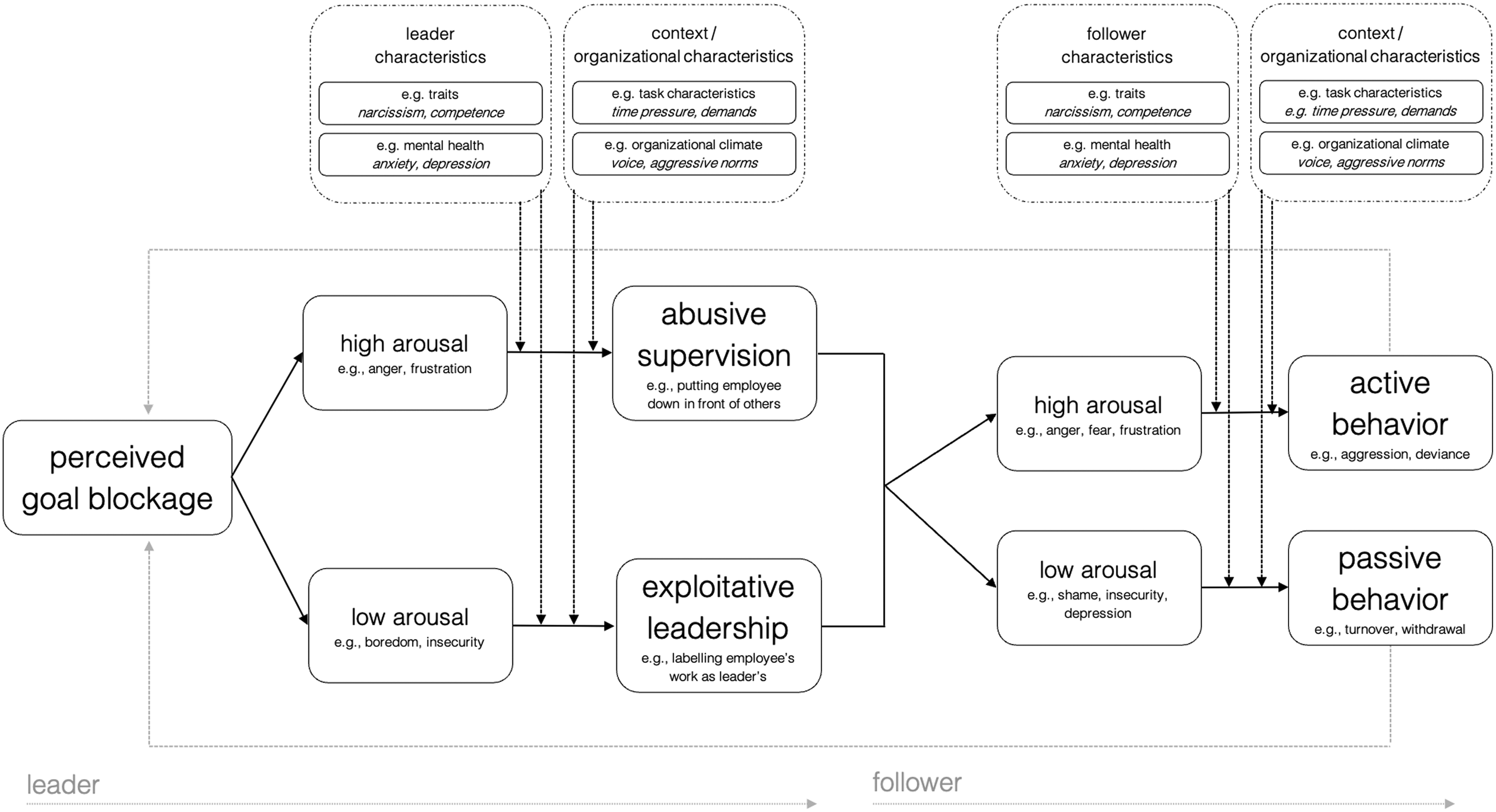
Process model differentiating antecedents and consequences of abusive supervision and exploitative leadership.
With respect to antecedents, the model assumes that abusive supervision versus exploitative leadership is caused by perceived goal-blockage on the side of the leader and that this effect is mediated by leader arousal. So far, no framework has aimed to explain how perceived goal-blockage triggers one specific type of destructive leadership behavior versus another. The development of our process perspective is rooted in the theoretical parallels between, on the one hand, abusive and reactive supervision and, on the other hand, exploitative leadership and proactive aggression. Thus, we propose leaders’ immediate affective reaction to perceived goal-blockage as the central mediating factor predicting the hot versus cold in destructive leadership. A range of emotions and arousal states have been studied in the field of destructive leadership including anger, frustration, and boredom. Fundamentally, these affective states can be classified into high arousal negative affect (e.g., anger, frustration) and low arousal negative affect (e.g., sadness, boredom).
If a leader's immediate affective reaction to perceived goal-blockage is high in arousal (e.g., he/she is angry), it is very likely that this will lead to a “hot” or impulsive type of destructive leadership behavior, such as, for instance, abusive supervision; an angry leader might react with overtly aggressive behavior toward employees. The link between high arousal negative affect, for instance anger, and reactive aggression is intuitive and backed up by ample evidence. The conceptualization of the anger-aggression link dates way back (Averill, 1983) and numerous theories have summarized the vast amount of empirical evidence supporting the causal link between anger and reactive aggression (Berkowitz, 2012; Lochman et al., 2010; Roberton et al., 2012; Wyckoff, 2016), including biophysiological models (Achterberg et al., 2016; Hortensius et al., 2012). Thereby, anger has been linked specifically with reactive not proactive aggression (White & Turner, 2014). The phenomenon that high arousal negative affect increases the likelihood of reactively destructive behavior is widely studied and respective findings organically translate into the assumption that, in the context of leadership, high arousal reactions to perceived goal-blockage also facilitate abusive supervision specifically.
If, on the other hand, a leader's immediate affective reaction to perceived goal-blockage is low in arousal (e.g., boredom), it is very likely that this will lead to a “cold” or controlled destructive leadership behavior, such as, for instance, exploitative leadership. While the link between low arousal and exploitation might seem less intuitive than its counterpart (hot emotions leading to proactive aggression), ample evidence points at the association of, for instance, boredom as a specific example of a low arousal affective reaction and destructive behavior. Self-report studies have also found positive associations between trait boredom and aggression in college (Dahlen et al., 2004; Rupp & Vodanovich, 1997; Wilson & Scarpa, 2013), community (Pfattheicher et al., 2020; Stephens & Sullman, 2015; van Tilburg et al., 2019), and clinical samples (Cao & An, 2020; Isacescu & Danckert, 2018). Interviews with “internet trolls” identified boredom as the prime motivator for harmful online behavior (Shachaf & Hara, 2010); this is especially interesting in this context as trolling is defined as a proactive rather than reactive destructive behavior. Pfattheicher et al. (2020) demonstrated a positive association between self-reported boredom proneness and aggression tendencies in online, military, and parenting contexts. They, furthermore, demonstrated that boredom proneness correlates with sadistic fantasies. Boredom is a low arousal and aversive emotion, resulting from wanting but being unable to engage in satisfying activities; feeling bored makes people seek out activities that will end their boredom, irrespective of associated costs (Westgate & Wilson, 2018). Boredom motivates people to seek out new experiences, even when those experiences are negative (Bench & Lench, 2019). These experiences are very often identified as the proactive, deliberate choice to harm others. Following this evidence and argument, our model assumes that a bored leader might react by deliberately planning the exploitation of employees, and therefore, that a low arousal affective reaction leads to exploitative leadership.
Proposition I: The leader's affective reaction to perceived goal-blockage impacts the resulting destructive leadership behavior; high arousal affective reactions lead to abusive supervision, while low arousal affective reactions lead to exploitative leadership.
With respect to consequences, the model assumes that the effect of abusive supervision and exploitative leadership on follower behaviors is mediated by follower arousal. Past research has clearly demonstrated that manifold forms of destructive leadership lead to an overwhelming array of negative consequences. Previous models have, however, not specified which leadership behaviors lead to which consequences. As an overview of the empirical status quo of the field demonstrates, the affective reactions of not only the leaders but also the followers (including, e.g., anger, sadness, boredom) are of utmost importance. We propose that the immediate affective reaction of followers to a specific type of destructive leadership behavior mediates their behavioral reaction.
If, on the one hand, a follower experiences an impulsive destructive leadership behavior (e.g., abusive supervision) the follower's immediate affective reaction might be, for instance, of high arousal (e.g., anger) and, thus, trigger “hot” or impulsive follower behavior (e.g., aggression toward co-workers). In certain ways, the follower consequences develop similarly to how reactively destructive leadership emerges. The type of arousal characterizing an affective reaction to an aversive event—in the case of the follower being subjected to destructive leadership—mediates, or in other words, influences which follower behavior will be displayed. Thereby, high arousal negative affect will lead to reactively destructive and therefore active or impulsive behaviors. This link can be deduced from models in the context of aggression research derived from the anger-aggression link widely studied (Achterberg et al., 2016; Averill, 1983; Berkowitz, 2012; Hortensius et al., 2012; Lochman et al., 2010; Roberton et al., 2012; White & Turner, 2014; Wyckoff, 2016).
If, on the other hand, a follower experiences a controlled destructive leadership behavior (e.g., exploitative leadership) the follower's immediate affective reaction might be, for instance, of low arousal (e.g., sadness) and therefore trigger less impulsive or passive follower behavior (e.g., turnover or reduced work engagement). The link between low arousal negative affect and passive or avoidance-oriented behaviors is well established (Leonidou & Panayiotou, 2022; Leventhal, 2008) and has been found in respect to real life (Rispens & Demerouti, 2016) and experimentally induced low arousal negative affect (Alexopoulos & Ric, 2007; Lecours et al., 2013). The arousal characterizing a negative affective reaction can even predict experiential avoidance, with low arousal predicting high levels of avoidance (Leonidou & Panayiotou, 2022). Generally, low arousal negative affect is a precursor of non-clinical depression on the level of cognition (Finucane et al., 2010), behavior (Woods & White, 2005), physiology (Osotsi et al., 2020; Shirai & Suzuki, 2017), and of course clinical depression (Csukly et al., 2009). This phenomenon translates to the work context and motivates our model's assumption that low arousal negative affective reaction to any form of destructive leadership leads to passive and avoidance-oriented behaviors on the side of the followers.
Proposition II: The follower's affective reaction to destructive leadership behaviors impacts resulting follower behaviors; high arousal affective reactions lead to active behaviors such as aggression, while low arousal affective reactions lead to passive behaviors such as withdrawal.
The proposed model emphasizes that leadership is an inherently recursive process. Active and passive follower behavior recursively impact a leader's perceived goal-blockage. Follower behaviors such as, for instance, deviance or withdrawal, directly affect if and to what degree leaders might perceive their goal as blocked. If a follower reacts to destructive leadership with aggression against co-workers, he/she will harm the team coherence and thereby, performance; the resulting low performance will impact the leader's future goal of delivering an outstanding team performance for, e.g., a product launch to his name. Similar scenarios would also arise when more passive follower behaviors, such as withdrawal or turnover, are also at play. The leadership process is, therefore, a loop, where outcomes of one destructive leadership behavior can trigger or be the antecedents of the next.
The process described does not emerge in isolation but is embedded in a complex system of interactions across all levels of analysis involved in leadership (i.e., leaders, followers, organization/environment). More precisely, the arousal-behavior link is not absolute, but subject to moderation effects. While arousal itself is an automatic immediate reaction to an experience (Reisenzein, 1994), its behavioral outcome is not. A high/low arousal negative affect does neither immediately, nor automatically, nor under every circumstance lead to a proactive/reactive behavior such as abusive supervision versus exploitative leadership, or active versus passive negative follower behavior. Instead, how affect impacts behavior is moderated by individual and contextual variables. On the one hand, this is bad news when it comes to reinforcing variables; negative behavior resulting from negative affect can be enhanced, if—for instance—an actor's problematic personality traits or contextual stressors add up. On the other hand, such moderation effects can also be good news when it comes to mitigating variables; negative behavior resulting from negative affect can be reduced, if—for instance—high self-control on the side of the actor or a resourceful environment come into play. Consequently, understanding the moderation effects is one key to ultimately reducing destructive behaviors, including destructive leadership.
Over the course of the following, we will briefly present an overview on the type of individual leader-/follower-related and contextual variables that have been studied in the field. We will then deduce exemplarily concrete propositions focusing on single individual and contextual moderators on both the side of the antecedents, as well as the consequences of destructive leadership.
When it comes to leaders, manifold leader characteristics have been studied. For instance, a variety of personality variables and traits such as low agreeableness (Breevaart & de Vries, 2017), low competence (Meglich et al., 2019), high entitlement (Whitman et al., 2013), high machiavellianism (Kiazad et al., 2010; Lyons et al., 2019; Wisse & Sleebos, 2016), high narcissism (Lyons et al., 2019; Nevicka et al., 2018), low neural executive control (Waldman et al., 2018), high perfectionism (Guo et al., 2020), and high psychopathy (Lyons et al., 2019; Mathieu & Babiak, 2016; Wisse & Sleebos, 2016) have been found to relate to destructive leadership. When it comes to compromised mental health, manifold aspects including alcohol abuse (Byrne et al., 2014), depression (Byrne et al., 2014; Dionisi & Barling, 2019; Tepper et al., 2006), emotional exhaustion (Fan et al., 2020; Walsh & Arnold, 2018), psychological distress (Y. Li et al., 2016), low sleep quality (Barnes et al., 2015; Tariq et al., 2020), and elevated stress levels (Burton et al., 2012; Li et al., 2020b; Shillamkwese et al., 2020) have been empirically linked to increased destructive leadership. Furthermore, low self-control (Mawritz et al., 2017; Yam et al., 2016) and a history of abuse (Garcia et al., 2014; Kiewitz et al., 2012) have been associated with destructive leadership behaviors. It is crucial to integrate these individual characteristics into the outlined process model. Focusing, for instance, on a leader's personality, we can assume that narcissism plays a central role in shaping the impact of leader affect on leadership behavior. Both grandiose and vulnerable narcissism have been linked with specific sub-dimensions of negative behavior and aggression (Lobbestael et al., 2014).
Our process model states that high arousal negative affect in response to perceived goal-blockage leads to elevated levels of abusive supervision. This path is not unalterable. A leader high in narcissistic traits will exhibit much higher level of abusive supervision compared to a leader with few or no narcissistic traits. Several mechanisms theoretically fuel this moderation effect. If, on the one hand, perceived goal-blockage and the subsequent high arousal affective reaction meet authority, superiority, self-admiration, and entitlement, the escalation toward negative behavior will be accelerated. On the one hand, a leader high in narcissistic traits might interpret the fact that a goal was not achieved as being down to the misconduct of the employees and view it as a personal attack paralleling the well-established concept of threatened egotism in narcissism literature (Baumeister et al., 2000). The leader might, then, completely overlook the complex root causes which might have caused the misconduct (e.g., refusal to work due to cognitive overload) and attempt to solve the problem by lashing out at employees (i.e., abusive supervision). On the other hand, when perceived goal-blockage and the associated negative affect develop in an individual who is self-critical, has a grounded sense of self-esteem, and a healthy notion of being a fallible human being (e.g., exposes few or no characteristics of grandiose narcissism), dynamics might be shifted toward finding more constructive solutions for affective tension. Specifically, a leader might ask employees for 360-degree feedback on why a goal was not achieved and consequently develop constructive ways to move forward and avoid similar scenarios in the future (e.g., understand that the task exceeded the employees’ cognitive capacity and either change it or provide further resources).
Proposition III (leader characteristic as moderator): High arousal negative affect leads to more abusive supervision when leader narcissism is high.
Exploitative leadership, in our process model, is preceded by low arousal negative affective reaction to perceived goal-blockage. This path is equally affected by individual moderators including personality traits. Psychopathy, for instance, is the most prominent personality trait (in extreme expression: personality disorder) that has been connected with proactive aggression exclusively, and therefore with strategic and premeditated negative behavior (Cima & Raine, 2009). Low arousal affective reaction to aversive events predicts both psychopathy and the likelihood of proactive aggression (Raine et al., 2014; Woodworth & Porter, 2002). When accompanied by high intelligence—presumably prevalent in individuals reaching high rank positions—, psychopathy can favor highly functional behavior in a competitive context and is widely discussed in leadership research (see “snakes in suits” phenomenon; Babiak et al., 2007 ). A leader might perceive the goal of career advancement as blocked and react with a low arousal affective reaction (e.g., boredom due to too little excitement). When accompanied by psychopathic traits, a likely response to this scenario could be the premeditated exploitation of employees without giving credit which enhances the whole department's performance, thereby, solely fostering the leader's excitement and career goals (i.e., exploitative leadership). In contrast, when accompanied by low psychopathic traits the level of exploitative leadership as an outcome of this scenario will likely decrease, because the leader will be less caught up in self-referential, sensation-seeking thought cycles and be more able to empathically and constructively react to employees.
Proposition IV (leader characteristic as moderator): Low arousal negative affect leads to more exploitative leadership when leader psychopathic traits are high.
When it comes to followers, characteristics such as less commitment (Aryee et al., 2007; Burris et al., 2008; Caesens et al., 2019; ; Luu, 2018, 2019; Tepper, 2000; Tillman et al., 2018; Schmid et al., 2019; Yan et al., 2020; Yu et al., 2016; Zhao et al., 2018) and low
Referring to our process model, individual characteristics on the side of the follower crucially shape the impact that the affective reaction to a leadership behavior has on that follower's behavior. Consider, for instance, the attribution style of a follower as a crucial moderating factor of high arousal negative affect triggering active follower behavior (e.g., aggression). Ample research has shown that ambiguous or even negative behavior has very variable effects in its recipient based on attribution processes (Lobbestael et al., 2013). If a leader behaves impulsively and shouts at an employee in front of colleagues (i.e., abusive supervision), this can trigger a high arousal negative affect (e.g., anger) within that employee. Based on the employee's attribution style, various outcomes are conceivable. While a hostile actor-based attribution style (e.g., “the leader did this on purpose to put me down and because he/she is mean”) will enhance the likelihood that the employee will act aggressively, a more situational attribution style (e.g., “today the leader is really stressed because of the shifting market conditions and missing resources, he/she lost their temper because it is his/her utmost goal to make us succeed as a company”) will temper the employeès likelihood toward acting with aggression.
Proposition V (follower characteristic as moderator): High arousal negative affect in followers leads to more active behavior (e.g., aggression) when the follower is characterized by a hostile attribution bias.
Contextual variables in research on destructive leadership often—albeit not exclusively—refer to the organization. Variables related to organizational norms and climate that have been associated with destructive leadership behaviors include aggressive norms within an organization (Restubog et al., 2011), justice related constructs (Gabler & Hill, 2015; Lian et al., 2012; Low et al., 2019; Ramdeo & Singh, 2019; Tepper, 2000; Velez & Neves, 2017; Zellars et al., 2002), low granted autonomy (Brender-Ilan & Sheaffer, 2019), and low organizational ethicality (Ogunfowora, 2013). Furthermore, work and task characteristics such as work overload (Harris et al., 2013a; Molino et al., 2019), missing resources (Bregenzer et al., 2019; Hochwarter & Thompson, 2012), job strain or tension (Harvey et al., 2007; Khan, 2015; Khan et al., 2010; Mackey et al., 2013; McAllister et al., 2018; Nahum-Shani et al., 2014), and organizational obstruction (Mackey et al., 2018) have been found to relate to destructive leadership. When focusing on communication and social interaction within a work context, team conflict (Farh & Chen, 2014; Gardner & Rasmussen, 2018), ostracism, low team cohesion / cooperation (Al Zaabi et al., 2018; Decoster et al., 2013; Priesemuth et al., 2014), and low team performance/productivity (Al Zaabi et al., 2018; Frazier & Bowler, 2015; Priesemuth et al., 2014) have been associated with destructive leadership behaviors. Adopting a process perspective, contextual variables moderate both the effect of the affective state of leaders on leadership as well as of followers on their reaction.
For instance, contextual variables such as time and performance pressure can determine leadership triggered by high arousal negative affect. Previous research has shown that time to act is a central determining factor in the emergence of aggression (Bushman et al., 2001; Joireman et al., 2003; Wang et al., 2020b). If a leader perceives a goal as blocked and experiences the resulting high arousal negative affect (e.g., anger), context-specific time and performance pressure on the side of the organization or the market will increase the likelihood that anger will lead to overt verbal aggression (e.g., abusive supervision). This effect occurs as there will be no chance for any deliberation processes or emotional recalibration to take place. On the one hand, a leader's high arousal after seeing a product launch fail due to flawed engineering will likely trigger their lashing out at subordinate engineers. Low arousal, in contrast, is not likely to lead to this, even if the situation were the same. The reaction will be stronger if, for example, management higher up sets an ultimatum for the respective product to be introduced by a certain date else the entire department will be cut. On the other hand, if a leader faces this situation but knows that management will be open to re-evaluate the launch date and provide any further resources needed (e.g., increase the engineering work force), dynamics will differ. This leader will now have the opportunity for emotion regulation and be able to take a proverbial “deep breath” before further instructing the subordinate engineers, therefore decreasing the likelihood of abusive supervision.
Proposition VI (contextual moderator): High arousal negative affect leads to more abusive supervision when time pressure (time until opportunity to act) is high.
On the side of follower behavior, contextual variables including organizational norms and climate play an equally vital role. Research has clearly shown that negative behavior, especially aggression, is never a one-way-street; contextual norms intensify or temper the negative behavior (cf. to alcohol intoxication leading to more aggression in the presence of aggressive norms, Parrott & Eckhardt, 2018). If facing exploitation by a leader, a follower might be frustrated (e.g., high arousal negative affect). According to our process model, such frustration can lead to active negative behavior, for example, as aggression toward leaders and/or co-workers. This process is affected by contextual moderators including aggressive norms. Within an organization characterized by aggressive norms (e.g., a law firm with an attack-style work ethic), a follower's frustration is much more likely to result in high levels of aggression than it would in an organization characterized by cooperativeness. In a context of aggressive norms, a frustrated follower will gear his/her behavior to the extent that leaders and co-workers display aggressive behavior when facing perceived goal-blockage and the resulting negative affect. In a context of cooperative norms, a follower will moderate negative behavioral reactions to frustration by explicitly observing and implicitly sensing his leaders and co-workers reverting to cooperation and communication when problems arise.
Proposition VII (contextual moderator): High arousal negative affect leads to more follower aggression when the organizational climate is characterized by aggressive norms.
Discussion
Theoretical and practical implications
The model and propositions outlined emphasize the importance of deliberately including arousal as well as individual and contextual moderators into explanatory frameworks on the emergence of abusive supervision versus exploitative leadership. Adopting this suggested perspective on destructive forms of leadership has various implications on theory and practice.
When it comes to theoretical implications, the line of thought presented highlights how—so far—detached streams of literature can be combined fruitfully to develop more nuanced process descriptions. It is surprising that research on destructive leadership rarely reverts to aggression research as a source of theoretical and empirical inspiration, although both fields share an interest in aiming to better understand negative, intentionally harmful human behavior (Anderson & Bushman, 2002; Krasikova et al., 2013). Aggression in its manifold forms is fundamental to the human experience (Crick & Dodge, 1996) and—rooted in that perspective—it can be argued to a certain extent, that destructive leadership is nothing but aggressive behavior in a leadership context. Therefore, intertwining theoretical aspects from both fields seems intuitive. While the introduction of manifold constructs is of merit in representing a phenomenon in its complexity, it can lead to fragmentation of empirical evidence. Research on destructive forms of leadership has generated numerous different constructs, but has provided next to no evidence on comparing these with respect to antecedents and consequences (exception Schmid et al., 2019). While disentangling the precursors and effects of the many different constructs in the field by directly comparing them within single empirical studies and respective replications is absolutely crucial, this type of work is demanding, time-consuming, and highly iterative. An additional way forward could be by way of theoretical considerations emphasizing underlying integrative tendencies (Anderson & Bushman, 2002). Aggression research, for instance, has profited from mapping the many expressions of aggressive behavior onto the hot-versus-cold plain field, distinguishing behavior based on high versus low arousal level (i.e., reactive versus proactive aggression; Card & Little, 2006; Hubbard et al., 2010; Kempes et al., 2005). Thereby, these dimensions are meant neither to be exclusive nor exhaustive; for instance, reactive and proactive forms of aggression can co-occur consecutively as well as simultaneously (Bushman & Anderson, 2001; Fite et al., 2006; Poulin & Boivin, 2000; Stanford et al., 2003). To introduce such basic dimensions into theorizing and thereby hypothesizing preceding empirical work, can, however, bring about an overwhelmingly complex construct space, deflect from repetitive and isolated empirical work on single specific constructs, and lead to applicable insights. Focusing on the hot versus cold in destructive leadership can have similar benefits. Differentiating between high versus low arousal or impulsive versus deliberative action when it comes to destructive forms of leadership can help integrate the overwhelming number of constructs, extend the focus beyond the striking dominance of abusive supervision as one specific form of destructive leadership in empirical work and thereby map the reality of negative leadership taking the manifold involved parties and contexts based on higher ecological validity into consideration. We therefore hope that spotlighting the hot versus cold in destructive leadership will inspire further theorizing, opening up ways to integrate and streamline the diverse and valuable, thought-fragmented evidence with respect to antecedents and consequences in the field.
It is important to note that the model presented focuses on clear-cut high- versus low-arousal negative affective states. However, there might be affective states involved which are not that clearly defined on the arousal intensity spectrum. A prime example for this type of affective state is guilt. While clearly aversive, guilt cannot be defined as a high- versus low-arousal state, but rather incorporates aspects from both sides (Weierich et al., 2010). With respect to follower consequences, Tröster & Van Quaquebeke (2021) outline that victims of abusive supervision might blame themselves and, thus, feel guilt; to resolve that guilt they invest in helping their abusive supervisor. This is in line with findings that when people feel guilty about something they have done, they are more likely to perform prosocial actions to eradicate their guilt (Xu et al., 2011). Tröster & Quaquebeke's perspective on destructive leadership is an outstanding example of what we hope to inspire with the model presented, i.e., the development of process models enabling the explanation of seemingly counterintuitive phenomena around destructive leadership (e.g., why would an abused employee help an abusive supervisor? why would a bored leader revert to exploitative leadership? why would followers subjected to the bad example of destructive leadership be aggressive themselves?). We believe that it is crucial to consider the mediating role of negative affective states as antecedents of destructive forms of leadership and their follower consequences. We therefore provide a process model on high- versus low-arousal negative affective states and hope to inspire conjointly with other similar work (Tröster & Van Quaquebeke, 2021) more out-of-the-box thinking which utilizes negative affect as a means of unraveling the complexity of destructive leadership, its antecedents, and consequences.
When it comes to practical implications, considering the mediating role of arousal states with respect to antecedents and consequences of destructive leadership opens up opportunities for both leader- and follower-oriented interventions. Arousal is an automatic response to an event of the human autonomous system and as such cannot be consciously controlled in the acute situation. This, however, does not mean that arousal and thereby affective reactions cannot be altered. Arousal is, for instance, one of the central target points of mindfulness-based stress reduction (Bishop, 2002; Kabat-Zinn, 2003) and similar forms of breathing meditation (Holmes, 1984; Jones et al., 2018). Such techniques instruct the practitioner to proactively learn to slow down and deepen their breathing and this is often accompanied by a reduction in heart rate (Lumma et al., 2015; Wu & Lo, 2008). These strategies not only lead to a direct reduction of arousal in the acute training situation, but they also mediate the reduction of affective reaction (Sears & Kraus, 2009), and have been shown to have long-lasting effects on arousal and affectivity beyond training (Gamaiunova et al., 2019). Meditation affects autonomic reactions (i.e., arousal) to negative stimuli far more than to positive (Pavlov et al., 2015). What it comes down to is that any intervention targeted at reducing negative affective reactions to adverse events and increasing stress resilience works via modifying affective reactions to stressors. Considering the mediating role of arousal states with respect to antecedents and consequences of destructive leadership therefore, is a way to put the brakes hard onto the destructive leadership process. Destructive leadership has devastating consequences (Schyns & Schilling, 2013) and, thus, its reduction is a pragmatic goal. One strategy for how to do so is to reduce stressors which introduce negative affectivity. Following this logic, in order to reduce destructive leadership, its precursor—namely perceived goal-blockage—must be reduced; to reduce negative follower consequences the stressor inducing those consequences - namely the destructive leadership itself - must be reduced. While this approach is intuitive and should always be promoted, in practice it is often unrealistic. Some leaders face continuous perceived goal-blockage just as some followers simply deal with destructive leaders. A low-threshold, pragmatic way of intervening—especially when removing the stressor is not (currently/yet) a concrete option—is to train both leaders and followers to increase their resilience to adverse events by reducing their negative affective reaction. Mindfulness training and other forms of meditation for stress reduction have successfully been applied in work contexts (Hafenbrack, 2017; Heckenberg et al., 2018). While this approach might not be entirely novel, its application in the context of destructive leadership finds theoretical fuel in the proposed process model focusing on the mediating role of arousal and, furthermore, enables a much more optimistic and practicable vision of how to reduce the widespread adverse effects of destructive leadership.
Directions for future research
The arousal-focused model presented aims at inspiring future research to include arousal and affect more frequently and deliberately and moreover, to tie it in theoretically to investigations on the emergence and impact of different destructive leadership behaviors. The task is to provide empirical evidence not only with respect to the propositions outlined above, but also to inspire newly generated hypotheses rooted in the process perspective provided. To succeed, future work can profit from following some guidelines.
Firstly, affective states in research on antecedents and consequences of destructive forms of leadership should be specified with respect to the underlying state of arousal. When it comes to studying affective states, research on destructive forms of leadership often examines unspecified negative affectivity (Brees et al., 2016; Eissa et al., 2019; Gabler et al., 2014; Glasø et al., 2018; Henle & Gross, 2014; Hoobler & Hu, 2013; Naeem et al., 2019; Pan & Lin, 2018; Schmid et al., 2018; Walsh & Arnold, 2018; Yagil et al., 2011). We advise studying specified affective states which vary in arousal, because variance in arousal and affect is theoretically relevant when it comes to explaining different processes underlying leadership. As specified in the model presented, different states of arousal in leaders lead to different leadership behaviors (e.g., abusive supervision versus exploitative leadership), and different states of arousal in followers lead to different follower consequences in response to those leadership behaviors (e.g., active versus passive behaviors). Affect is defined not only across one but two axes (Barrett, 1998; Kensinger, 2004) and research on destructive leadership therefore needs to account not only for valence (positive / negative), but also for arousal level. Without doing so, investigated processes remain unspecific.
Secondly, research on destructive forms of leadership needs to advance the measurement of affective states and arousal by including evidence-based self-report tools and physiology. Once the theoretical relevance of affective states and arousal for the emergence and impact of different destructive leadership behaviors has been recognized, it is worth carefully assessing how to measure them. Ample work has been done defining crucial issues with emotion measurement and evidence-based assessment strategies (Larsen & Fredrickson, 1999; Rogers, & Robinson, 2014). Arousal is—per definition (Reisenzein, 1994)—a physiological state. We can assess physiological states indirectly based on self-reporting (Walden et al., 2003). For instance, the self-assessment manikin (Bradely & Lang, 1994; Nabizadeh Chianeh et al., 2012) has been proven a valid, reliable, and practical tool with which to two-dimensionally assess acute affective states based on valence and arousal. Such a measure could be included effortlessly into classic study designs in leadership research. While the value of self-report measures and the practicability of their application should never be underestimated, physiological measures are self-evidently most suited to measure autonomic arousal. Heart rate (Wascher, 2021), heart rate variability (Nardelli et al., 2015), and electrodermal activity/skin-conductance/galvanic skin response (Keil et al., 2008) are direct indicators of autonomic arousal which should be utilized in research on destructive leadership. Admittedly, assessing physiological measures requires more effort than recording self-reporting. Nevertheless, these methods have slowly but surely found their way into research on (constructive) leadership (Hoogeboom et al., 2021; Waller et al., 2017) and evidence accumulated up till now has contributed to elaborate and practical guidelines on their application in the context of organizational research (Christopoulos et al., 2019; Massaro & Pecchia, 2019).
Thirdly, research on destructive forms of leadership needs to enable predictive and causal claims. To date, the overwhelming dominance of correlational study designs in research on destructive leadership implies that the bulk of currently available evidence—although very insightful and increasingly based on complex analysis techniques—neither enables predictive nor causal claims. Longitudinal studies (enabling predictive claims; Arjas & Eerola, 1993) and even more so experimental studies (enabling causal claims; Podsakoff & Podsakoff, 2019) are still scarce. The lack of evidence enabling predictive and causal claims not only highlights a generic gap often faced by social science (for leadership research in general see Avey et al., 2008), but creates a problem specific to the research of destructive forms of leadership. When it comes to destructive behavior, the predictive value of evidence (i.e., causal inferences on what triggers a certain destructive behavior and on what it will lead to) is of the utmost pragmatic relevance (Glueck & Glueck, 2013) due to the immense negative impact of destructive leadership. We need predictive evidence on the antecedents of destructive leadership behaviors in order to avoid those behaviors in the first place and we need evidence on their consequences in order to manage and counteract devastating outcomes. It is for this reason that research on negative and deviant behavior, including delinquency and crime (Katsiyannis et al., 2013; Leschied et al., 2008; Murray & Farrington, 2010), traditionally calls for longitudinal and experimental approaches. With our model, we hope to encourage more time-lagged and longitudinal studies investigating the timeline of the leadership process to be undertaken. Such approaches need to be intensified, as longitudinal research is crucial to better understanding a complex and dynamic social phenomenon such as destructive leadership. Future research should focus on the dyadic process underlying destructive forms of leadership (leader antecedents—leadership—follower consequences), while not neglecting the recursivity of this process (follower behavior recursively affects leader's perceived goal-blockage) and the context in which the process evolves (e.g., organizational moderators). Destructive leadership—similar to aggression—is never about one single individual showing one single behavior in one single situation. Different leaders interact with different followers, showing various destructive behaviors within and across situations. Furthermore, the multilevel perspective should not be overlooked as within an organization several units (e.g., teams) under various hierarchically organized leaders interact and both followers and leaders might be members of more than one unit.
While the identification of correlational relationships between constructs (e.g., leadership constructs, antecedents and/or consequences) is a major empirical task, a growing field must eventually translate this evidence into research designs enabling the establishment of causal links (Antonakis et al., 2010; Fischer et al., 2017; Martin et al., 2020). Experimental studies are a prime strategy when unraveling causal relationships (Podsakoff & Podsakoff, 2019). Field experiments especially (Gonzalez-Morales et al., 2018; Lange & Rowold, 2019) lend themselves to extending the research design portfolio toward that goal, although they are still rare in research on destructive forms of leadership. In order to design experiments which can enable causal claims, specific methodological challenges must be addressed. While the experimental studies in the field are innovative in widening the methodological portfolio of studying destructive forms of leadership, it has to be noted that they still do not approach destructive leadership as actual behavior. It might seem impossible to assess destructive leadership behaviorally, i.e., to observe actual destructive leadership behavior in a controlled setting. While such attempts are certainly challenging, it needs to be stressed that other fields investigating negative social interaction (e.g., aggression research) rose to that challenge more than two decades ago (Giancola & Parrott, 2008; Lobbestael et al., 2020; Taylor, 1967) and could serve as sources of inspiration. Field as well as laboratory experiments (Podsakoff & Podsakoff, 2019; Sieweke & Santoni, 2020) facilitate the usage of tools which not only enable a more direct measurement of actual behavior when compared to questionnaires (which can only focus on perceptions of behavior), but their specific methods also provide direct access to cognition and affect. Importantly, as a single experiment usually focuses on building evidence for single or a few causal links, more than with any other approach experimental work needs to be grounded in a process framework. Our model enables the deduction of specific, directed hypotheses which explicate concrete levels of measurement with respect to involved constructs.
Fourthly, research on destructive forms of leadership will profit from a theoretically guided implementation of individual versus contextual moderators into a process perspective. Note that—so far—knowledge of individual and contextual moderators is based on diverse evidence. Umbrella terms (e.g., personality traits or mental health) comprise manifold sub-constructs and similar constructs are often measured inconsistently. More inconsistency arises from the nomological characterization of variables; the same concepts are often studied interchangeably as antecedents of destructive leadership, consequences, mediators, or moderators. As the overwhelming majority of empirical evidence in the field draws from questionnaire-based correlational designs, we have little causally interpretable evidence at hand. While authors mostly provide sound theoretical considerations on where to place a construct in an empirical model, the sheer variety of theoretical ideas and model-placements for one and the same constructs hints toward the fact that overarching theoretical models, which enable the deduction of concrete hypotheses with respect to specific leadership behaviors, are still missing. While the critique of the field described might pose problems for the comparability of single studies, it does not detract from the broader picture we aim at painting here. We have plentiful evidence that personal and contextual characteristics play an important role for antecedents and consequences of various forms of destructive leadership. To elevate this rather generic statement to actionable insights, we need to insert these moderators into a model which specifies concrete process paths with respect to specific leadership behaviors.
In this paper, we provide propositions on two individual and contextual moderators, each deduced from the developed process model. Future research will hit a creative streak when extending the logic behind our suggestions to further moderating variables. Importantly, we aim at identifying specific categories of moderators—i.e., leader characteristics, follower characteristics, context / organizational characteristics. While in this article we focus on specific examples drawn for each of these categories, there are plenty more variables which can be discussed. When it comes to leader or follower characteristics, further personality traits (e.g., Machiavellianism, Big Five, competence), a broad range of mental health issues (e.g., anxiety, borderline, addiction), or other constraints (e.g., work-family situation, previous experience with destructive leadership) can play a role. When it comes to contextual / organizational characteristics manifold aspects of organizational climate (e.g., voice, implicit and explicit norms and values, justice, culture), task characteristics (e.g., demands, time pressure, importance, self-/leader-/organization-directed relevance), or external forces (e.g., crises, market developments, scarcity of resources) are relevant. Inspiration on which individual and contextual characteristics to focus on can be drawn from both previous research on such variables in the context of destructive leadership as well as prominent moderators from aggression research. A focus on moderators is one promising avenue which could develop interventions modulating behavior—whether this might be destructive leadership or negative follower behavior.
Conclusion
Following the arguments outlined, the field can succeed in adopting a process perspective on how arousal mediates the emergence of specific leadership behaviors (i.e., abusive supervision versus exploitative leadership) and follower reactions to those leader behaviors (i.e., active versus follower behavior). As destructive leadership has immense and widespread negative impacts, research needs to continue down the path of better understanding its antecedents and consequences. Future empirical investigations should extend their current focus by deliberately including arousal and affective state and by providing predictive and causal evidence on the differentiation of specific leadership behaviors. Generated insights will open up new vistas on how to deal with and prevent destructive leadership in practice.
