




Abstract
Most research on commuting has focused on its negative aspects and consequences (i.e., stress). However, some work has also begun to recognize that there may be positive aspects to commuting. In this paper, we develop a perspective that has so far received limited attention, highlighting how the commute can be experienced as desired and beneficial “me time”, due to the fact that it inhabits a “third space” that is less associated with work or home role requirements. Drawing upon and integrating theories and research on commuting, leisure, recovery, and identity, we first define this construct and then develop a theoretical model that aims to address key questions regarding predicting motivation to engage in “me time”, beneficial outcomes of “me time”, and potential moderators of these effects. Consequently, our proposed model offers both research and practical implications for commuting employees as well as their employers, families, and society.
The majority of research on commuting has focused on its negative aspects and consequences (i.e., stress). However, increasingly, some work has also begun to recognize that there may be some positive aspects of commuting. Despite some scholars acknowledging the potential benefits of commuting, most still conceptualize the commute as simply a necessary transition between domains (i.e., work and home). In this paper, we seek to bring a new perspective to the literature, highlighting how the commute can be experienced as desired “time to myself”. We therefore develop a theoretical model that aims to address key questions surrounding this phenomenon, including what is “me time” during the commute, who is more likely to uses the commute for “me time”, what are the situational factors that facilitate or inhibit choosing “me time”, what positive outcomes can be expected when engaging in “me time”, and what conditions are likely to affect this process. We also discuss the underlying mechanisms for this process. As a result, our proposed model presents both research and practical implications for commuting employees as well as their employers, families, and society.
Introduction
Commuting to and from work is a central experience in the daily lives of many employees (Olsson et al., 2013). Historically, research on the commute has treated it as a necessary “cost” of work. This is because, for most workers, work and home traditionally occupy separate physical spaces. As a result, the majority of past research has focused on commuting time and stress (e.g., Novaco et al., 1990; Schaeffer et al., 1988), generally finding that longer and more stressful commutes are negatively related to well-being, as well as poorer work and family outcomes (e.g., Koslowsky et al., 2013; Zhou et al., 2017). Yet, although a recent large-scale study found that longer commutes are associated with lower job satisfaction and leisure time satisfaction, it was not related to overall life satisfaction (Clark et al., 2020). This is likely because the negative aspects of the commute are often balanced by the better employment, income, or housing that is made possible by the longer commute (Lyons & Chatterjee, 2008) – highlighting the tradeoffs that employees must often weigh.
Although the commute is commonly viewed as a burden to be managed, research indicates that there may also be positive aspects of commuting. In fact, many individuals are relatively satisfied with their commute (Ory et al., 2004), and most individuals desire some commute time (Redmond & Mokhtarian, 2001). Additionally, research in the organizational sciences has also conceptualized one's commute as a period of liminality, meaning that it can be used to effectively transition or manage boundaries between the work and home spheres (Jachimowicz et al., 2021). Indeed, during the novel coronavirus (COVID-19) pandemic when massive numbers of individuals rapidly transitioned to working from home due to the need for social distancing, some experts recommended and some individuals enacted a “fake commute” at the beginning and end of their workdays (e.g., Rogers, 2021). This further reinforces that there may be important and advantageous facets of commutes that are noticed and missed when the requirement of a commute is removed.
Despite growing interest and progress in examining the benefits of commuting in the literature, we argue that a key perspective regarding the potential value of commuting has largely been overlooked – the ability of the commute to provide valuable “me time” in the midst of people's busy lives. In other words, besides providing transition time, a commute can also be a gift because it can supply a much-needed time-out, including from one's work and family responsibilities (Jain & Lyons, 2008). For example, commuters can use this time for their own benefit, resting or engaging in social or solo activities (Salomon & Salomon, 1984). To this end, the purpose of our paper is to articulate a novel theoretical model and set a research agenda for the future study of “me time”, or time to oneself, during commutes. Specifically, we draw upon and integrate theories and research on commuting, leisure, recovery, and identity to address key questions surrounding use of commuting time for “me time”, including the who, what, when, where, and why of this phenomenon (i.e., who is mostly likely to engage in “me time” during the commute, what conditions facilitate and/or hinder “me time” during the commute, when “me time” during the commute is likely to occur, where “me time” during the commute is possible, and why “me time” during the commute has positive effects on one's recovery).
Our paper contributes to the literature in a number of key ways. First, we add to the growing body of research that recognizes that there may be positive aspects or outcomes of commutes. Specifically, whereas the extant literature tends to conceptualize the commute as a stressor and drain on resources, we offer that the commute can also be structured and used for recovery or to replenish resources. Second, we contend that although some individuals may treat their commute as a liminal time and space that allows them to detach from one domain and/or prepare to enter another more effectively, others may view and use their commute as a separate “third space” to fulfill goals or motives that are not associated with their work or home domains. Therefore, we contribute to the literature by theorizing the conditions under which individuals may be apt to use their commute in this alternative manner.
Third, although some individuals may spend their commute recovering via engagement in social activities (e.g., calling friends), many individuals choose to be alone or engage in solitary activities during their commute. However, to date, the psychological and organizational sciences literatures have generally considered being alone to be undesirable, focusing on the negative consequences of social isolation and loneliness. Accordingly, the literature has neglected examining the potential draw and benefits of solitude or time to oneself (Long & Averill, 2003). Thus, our work also contributes more broadly to delineating contexts in which being alone may be desired and associated with more positive outcomes.
Defining “me time” during the commute
“Me time” is a colloquial term that has been used by interviewees in commuting studies to describe time that can be spent on activities that deviate from other roles in one's life (Basmajian, 2010). Specifically, “me time” during one's commute is a unique form of leisure-crafting (i.e., the proactive pursuit and engagement in leisure activities targeted at fulfilling personal needs, such as human connection or personal development; Petrou & Bakker, 2015). As such, we define “me time” during the commute as consisting of involvement in commute activities that the person is intrinsically motivated to engage in, which are not role requirements of their work or home roles, and that promote recovery via meeting personal needs.
Although this can potentially include activities that may provide some benefit to the work or home roles, such actions are not required by or necessarily expected from role senders (i.e., those individuals whom you associate with in a given role; Shockley & Allen, 2015) in either domain. For example, perhaps an employee chooses to learn something new during the commute (e.g., a new language) that is not required, or even encouraged, by their job, but rather reflects their personal interests. This reflects “me time” even if the new skill may ultimately prove advantageous in one's work (e.g., helps the individual access new clients, gets one considered for a desirable expatriate opportunity in the future). By contrast, such an activity would not be reflective of “me time” if an employee was learning a language during their commute primarily because their supervisor suggested they do so.
More generally, commuters can have various experiences when they are commuting to and from work, but not all of these reflect “me time”. One central experience that has received substantial attention is the stress associated with the commute. For example, Schaeffer et al. (1988) found that the demands of the commute (e.g., rush hour or driving complex routes) precipitate higher stress levels. This interest has continued to grow in recent years, with studies increasingly examining the underlying psychological processes (e.g., control, effort, predictability) that affect the commuting stress experience (e.g., Koslowsky et al., 2013; Zhou et al., 2017). These studies typically focus on what happened to the individual during the commute (i.e., external factors imposed on the individual), but do not usually consider what the individual chooses to do during the commute. One notable exception is a study by Shaw et al. (2019), which examined the benefits (e.g., trip enjoyment) and disadvantages (e.g., stress and fragmented attention) of multitasking while commuting.
We note that even if no explicit choice is made and no action is taken regarding how to spend the commute time, different cognitive processes can still fill up this time. This includes negative cognitions, such as rumination or future-related worries, but also neutral or more positive cognitions, such as daydreaming or mind-wandering. Regardless of the positive or negative valence of the experience, if the person did not proactively choose how to spend their commuting time, then they did not engage in “me time”. Said differently, choosing to not engage in any specific activity and just relax, such as by staring at the scenery out a train window, embodies “me time” during the commute as long as this was the person's choice rather than an inability to decide on what to do.
In contrast, individuals can also make more volitional choices regarding how to spend their commute. Specifically, depending on the feasibility of engaging in certain activities during their commute, some commuters may choose to engage in work tasks while commuting (e.g., taking a work call, answering work emails), and others may choose to engage in home tasks (e.g., online grocery shopping, planning what to cook for dinner). Both these choices are likely made in an effort to address or reduce demands in the respective domain. These choices and activities may exercise the individual's autonomy and help mitigate stress in those domains via proactive coping, leading to overall increased well-being (Sohl & Moyer, 2009). However, they are not taking a “time-out” from the role requirements of work and home, and these actions are not aimed at recovery (defined as the process through which psychophysiological systems return to their baseline levels from activation in response to external demands; Wendsche & Lohmann-Haislah, 2017). Therefore, we contend that proactive coping in the form of engaging in work or home-related activities during one's commute does not constitute “me time”. This is because we conceptualize “me time” as fundamentally about fulfilling personal needs linked to an identity or aspect of the self that is distinct from work- and home-related identities. Consequently, “me time” only includes activities or experiences that the person actively chooses and that they are not obligated to do.
Although we recognize that individuals can also engage in “me time” outside of their commute, we argue that there are several elements of the commute that make it a time and space particularly suited for “me time”. Namely, the unique characteristics of the commute help set it apart from other parts of the day and make it ripe for having meaningful “me time”. Whereas prior organizational scholars have typically conceptualized the commute as a “bridge” between the work and home spheres (e.g., Jachimowicz et al., 2021), qualitative research suggests that many commuters instead see their commute as a “third space” that is distinct from both domains (Wilhoit, 2017). Moreover, the liminality of the commute leads to greater ambiguity with regard to the obligations one has to fulfill. In other words, this break from the structures and demands of the work and home domains can psychologically free individuals to decide how to spend this time, providing an outlet for activities and identities that do not have a place in their work and home domains in ways that also do not disrupt these other domains. In this sense, “me time” during one's commute may also differ from “me time” outside of one's commute due to both its regularity and “protected” nature (i.e., it is a necessary part of one's day if one works away from the home), leading to different psychological experiences (e.g., less guilt for spending time on oneself).
Additionally, the commute is different from both work and home domains because many commuters spend it alone (though we acknowledge that for commuters who have a commuting partner, the commute may be experienced somewhat differently). As a result, individuals have greater freedom to choose how to spend their commute in a way that is typically not afforded to them in the work and home domains, where other members of that role-set (e.g., co-workers, spouse) may exert significant pressure for the individual to act in accordance with their own preferences (Shockley & Allen, 2015). Furthermore, being alone is an opportunity to disengage from stressful activities, and in that way to experience recovery, as well as feeling authentic and true to ourselves (Nguyen et al., 2021). In point of fact, people tend to particularly desire solitude after work if they had high levels of social interactions during work hours (Ren, 2016), and commuters generally predict solitude will result in more pleasure or positive emotions for them than connecting with strangers on their commute (though this is not necessarily the case in reality, Epley & Schroeder, 2014). Overall, whereas “me time” outside of the commute can be equated with general leisure time, the experience of “me time” during one's commute differs from general leisure time and activities in important ways.
The experience of “me time” during one's commute is distinct from both other commuting experiences and activities as well as from other types of leisure time and activities that occur outside of the commute.
Theoretical development
After defining some of the unique features of “me time” during one's commute, we now turn to introducing our theoretical model (see Figure 1). First, our model seeks to articulate key antecedents of this experience, many of which occur prior to the commute, including the factors that make it more likely that individuals will desire to engage in “me time” as opposed to engaging in work or home tasks or not consciously choosing to engage in any activities. Second, our model also describes what occurs during the commute, including clarifying the types of activities that individuals may choose to engage in so as to meet their personal needs and promote recovery, and identifies contextual factors that enable or interfere with one's ability to engage in the desired “me time” activity during the commute. Finally, our model delineates the beneficial consequences of engaging in “me time” during the commute that may extend beyond the commute, including influences on the work and home domains.
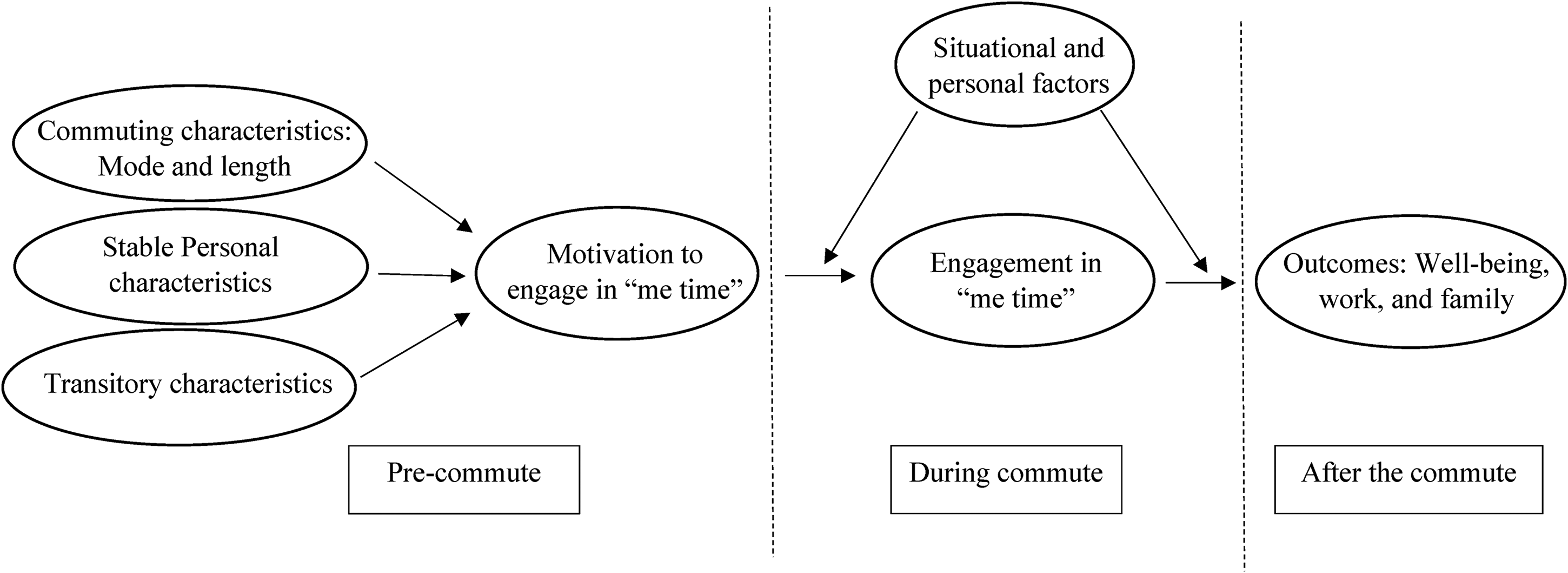
The conceptual model of commuting “me time”.
Pre-commute factors
Commute characteristics
Different modes of travel for one's commute (e.g., car, train, biking, walking), the length of the commute, as well as additional commute characteristics (e.g., its predictability, the potential existence of a commuting partner) generate constraints or facilitators for “me time” during one's commute. With regard to the mode of travel, prior research indicates that when comparing commuting via car to other modes of commute, car-commuters tend to experience more negative health outcomes, including weight gain, cardiovascular disease, and sleep problems (Hansson et al., 2011, Sugiyama et al., 2013; Warren et al., 2010). In contrast, the use of active transit (e.g., walking, biking) and public transportation modes tend to contribute not only to physical well-being, but also to general psychological well-being (Martin et al., 2014). However, these are overall findings that do not consider the specific activities that commuters engage in during their commute, and likely reflect at least one key difference between car and more active commuters – physical activity. Although there is substantial variance in the level of physical activity among active commutes, there is virtually always at least some minor exercise, whereas car commuters are almost always sedentary throughout their commute.
Despite the benefits of an active commute, walking or biking are incompatible with many activities, including reading, writing, or using a screen. Therefore, there are limits to the activities that these commuters can engage in simultaneously. Similarly, driving also creates constraints on what other activities can be done safely at the same time. By contrast, using public transportation often includes several steps for the commute (e.g., “Walk, train, walk”, “bus, train, walk”; Wilhoit, 2017). This provides an opportunity to engage in different “me time” activities or to split the time between work tasks, home tasks, and “me time”. However, this also potentially creates demands on the commuter in terms of managing their time across the segments of the commute. Transfers within one's commute also incur “transfer penalties” (e.g., discomfort, safety concerns, emotional stress), meaning that the time spent on transfers is more costly than time spent on other parts of the commute (Iseki & Taylor, 2009). In this sense, it may be preferable to choose a commute with fewer segments, even if it is somewhat longer overall, because a longer time spent in each segment may allow for more meaningful “me time” activities while lowering the demand of managing the transitions of the commute, thereby depleting fewer resources.
Mode of travel affects motivation to engage in “me time” during the commute and constrains or facilitates the chosen “me time” activities.
The other key characteristic of one's commute is the length of time. Although individuals may be willing to undertake a longer commute if it makes it possible for them to get a better job or a better house (Clark et al., 2020), a longer commute would likely be perceived as undesirable. When asked what their ideal commuting time would be, most individuals choose a travel time of 30 minutes or less, but very few choose no travel time at all (Páez & Whalen, 2010; Redmond & Mokhtarian, 2001). This indicates that there may be a curvilinear relationship between travel time and satisfaction with one's commute: If the travel time is too low, a commuter may perceive there is insufficient time to engage in meaningful “me time” or even to transition psychologically between domains. However, when a commute is too long, it is likely to lead to disruption in other domains that people may blame on their commute, especially for individuals who have many demands on their time (though interestingly, those who have longer commutes are more likely to have a spouse who does not work, in part because longer commutes are correlated with higher wages; Morris & Zhou, 2018). As such, a commute that is very long might lead commuters to be more motivated to use their commute for work or home tasks rather than choosing to spend their commute on themselves due to necessity or feelings of guilt. In fact, prior research has found that individuals who are time-poor tend to “borrow” from time that facilitates their personal well-being (i.e., sleep) in order to meet work and family obligations (Barnes et al., 2012), and there is often a perception that leisure time is optional and can be delayed or omitted in an effort to fulfill more pressing demands (Adkins & Premeaux, 2012).
Ideal commute time may be linked to the activities that one typically chooses and even the mode of commute. Actual and ideal commute time seem to be more aligned for active commuters and public transportation users than for car commuters (Páez & Whalen, 2010). This indicates that commuters value their commute, at least in terms of benefits to role transition, and more indirectly suggests that active commuters and those using public transportation have an easier time finding value in the entire length of their commute.
Length of travel time affects motivation to engage in “me time” during the commute.
The predictability of the length and challenges of the commute may also play a part in the likelihood employees would be motivated to use their commute for “me time”. When the length is predictable, it is easier to plan some activities (e.g., knowing there is enough time for an episode of a show/podcast or to make some progress on a knitting project). Similarly, when the commute's challenges are predictable (transitions when taking public transportation or more challenging parts of a car/bike ride), the commuter can anticipate interruptions to the planned activity, and it is easier to choose and engage in a suitable “me time” activity.
Predictability of the commute affects motivation to engage in “me time” during the commute and the chosen “me time” activities.
It is important to note that not all employees need to commute, as some people work from home. Furthermore, not all commuters have a choice between different commuting modes, or even a choice between specific routes within the same mode of commute. For example, some areas do not have reasonable access to public transportation and distances may be too great to walk or bike. When the choices are narrow in terms of mode or route of the commute, individuals may feel a lack of control or autonomy over their time, and this hindering perception may lead to less motivation to choose “me time” during the commute. This effect is likely similar to how autonomy increases motivation and engagement in the work domain (Bakker et al., 2014). However, although commuters with limited choices (in modes, routes, or activities) may be less motivated to engage in “me time” during the commute, we believe they have much to gain if they do make volitional choices in spending their commute on themselves. This is because on top of the gains associated with the specific activities, their sense of control over their commute will increase.
Control over the commute affects motivation to engage in “me time” during the commute.
Stable personal characteristics
The question of who is more likely to be motivated to use their commute to fulfill personal needs is important because it is likely that not all individuals will recognize they could or desire to engage in “me time”. For instance, individuals who are higher on independent self-construal, who tend to see themselves as unique and as set apart from others (Markus & Kitayama, 1991; Singelis, 1994), may be more likely to realize the possibility of engaging in “me time” during their commute. This is due to the fact that individuals higher on independent self-construal tend to be driven to achieve their desired independence rather than being driven by their relationships with others or their membership in collectives. Thus, these individuals may be particularly likely to seek out time throughout their day to fulfill their personal needs and may be more apt to ignore the pressures exerted upon them by others (e.g., spouse, coworkers), as doing so may help them to maintain or enhance positive self-views. This would also suggest that commuters in more individualistic cultures may be more likely to use the commute for “me time” compared to those in more collectivistic cultures.
Another relevant individual difference variable is locus of control, or the tendency to attribute the cause and control of events to oneself (i.e., internal locus of control, or internals) versus to elements outside the control of oneself (i.e., external locus of control, or externals). Control over aspects of the commute (e.g., choice in route, the internal environment of the car) is an important predictor of commuting stress (Schaeffer et al., 1988), and hence, is very relevant to the individual's ability to choose “me time” for their commute. Internals generally experience less anxiety than externals (Spector, 1982) and may, therefore, be less susceptible to commuting stress; thus, removing one obstacle to choosing “me time”. Under the same set of circumstances, internals are more likely to attempt to control their environment and to problem solve. This means internals are both more likely than externals to be motivated to engage in “me time” during their commute generally, and are more likely to overcome any obstacles that may arise as part of the specific journey.
A third relevant category of characteristics reflect differences in attitudes towards time. Individuals vary in their time styles (Usunier & Valette-Florence, 2007) and preferences for doing several tasks simultaneously (i.e., polychronicity) versus preferring to work on tasks in a sequential manner (i.e., monochronicity). These differences can be reflected in performance and satisfaction, depending on the multitasking demands of the situation (König & Waller, 2010). Therefore, if the commute presents high demands, such as switching modes of travel, having a better ability to multitask (polychronicity) may be associated with choosing “me time” during the commute. This is because those who are less able to multitask may find it more difficult to focus on “me time” while also attempting to meet the demands of the commute itself.
Finally, another personal factor that may be at play is role boundary preference. Individuals with a strong preference for segmentation (i.e., low boundary flexibility and permeability) may have a different typical pattern for how they use their commute time. Specifically, prior research suggests that integrators are more likely than segmentors to use their commute to engage in tasks from the work or home domains due to higher role blurring (Ashforth et al., 2000). Segmentors, on the other hand, would be more likely to treat the commute as a separate space, and may therefore be more likely to use it for “me time”.
Certain personal characteristics (i.e., independent self-construal, internal locus of control, time style, and role boundary preference for segmentation) affect motivation to engage in “me time” during the commute.
Transitory characteristics
It is important to recognize that commute experiences can be conceptualized as a multilevel phenomenon. Research indicates that over time, individuals tend to form routines for how they spend their commute (Corvellec & O'Dell, 2012). For example, an individual may develop a commute routine such that they spend the commute to work getting ready for the workday and completing some work tasks, whereas they reserve the commute home for “me time”. As another example, one of the author's commute routine is segmented by mode; typically working on work tasks on the train, which forms the bulk of her commute, and engaging in “me time”, often in the form of leisure reading, listening to a podcast, or watching a downloaded show, on the bus and subway as they are a smaller portion of the commute and occur in more rapid succession. Thus, individuals may systematically differ from others in their commute routines (i.e., between-person differences).
However, choices can also be made that break the pattern, as generated by transitory needs or circumstances that differ from the norm (i.e., within-person differences). For example, a worker may plan to engage in work tasks rather than their typical “me time” during their commute as the result of an abnormally high workload (i.e., high time pressure) on a given day and their subsequent inability to mentally detach from work (Syrek & Antoni, 2014). Alternatively, commuters who typically use their commute to fulfill work and home responsibilities may be motivated to use their commute for “me time” when their need to detach and reduce their stress levels is greater than usual. That is, they may be more likely to choose to engage in “me time” when their time in the prior domain (i.e., home before the morning commute, work before their evening commute) was especially stressful (Wilhoit, 2017). Finally, commuters may break from the norm and desire to engage in “me time” during their commute as a form of self-affirmation in reaction to an event that threatens one's adequacy (Cohen & Sherman, 2014). Perhaps an employee's boss criticized and yelled at them about their performance on a work task that day, and deciding to give time to other aspects of their identity beyond their work role allows this individual to maintain or regain a positive sense of self. This may be particularly the case if the chosen activity creates opportunities for feelings of competence or mastery.
Therefore, the stable characteristics of both the commute and the commuter shape the routine motivation for behavior on the commute to fulfill stable (person-level) needs. In addition to those stable needs, transitory needs can affect the individual's motivation to engage in “me time” during the commute on a specific day. Together, these stable and transitory characteristics predict the commuter's motivation to engage in “me time” before the journey begins. However, the translation of this motivation into actual engagement in “me time” during the commute and the degree to which individuals can reap benefits from engagement in “me time” depends on additional factors that are described below.
Both stable and transitory characteristics affect motivation to engage in “me time” during the commute.
During the commute
Engagement in “me time”
Choosing “me time” activities can help satisfy various personal needs and facilitate recovery. Specifically, we discuss three major types of needs: physical needs, psychological approach needs, and psychological avoidance needs. Physical needs have been described as the most basic in Maslow's hierarchy of needs (Maslow, 1948). This is because when these needs are not satisfied, the human body cannot function optimally. These needs include food, drink, sleep, warmth, and shelter. Physical activity is another physiological need. Indeed, more active commutes are associated with better physiological and psychological well-being than car commutes (e.g., Martin et al., 2014). Nevertheless, the commute time is not the only way to satisfy the basic need for physical activity, as this need can be met in the work or home domain if driving is the chosen (or only relevant) option for one's daily commute to and from work. In such cases, the car-commute can be used to meet other physical or psychological needs, while the need for physical activity can be satisfied outside of the commute.
The basic psychological needs are akin to psychological nutrients that are essential for individuals’ adjustment, integrity, and growth. The main focus in the psychological literature has been on the three basic needs of autonomy, relatedness, and competence. Autonomy refers to the need to feel in control and ability to make decisions for oneself. Relatedness refers to the need for interpersonal warmth and care. Competence refers to the need to feel effective and experience mastery (Deci & Ryan, 2000). In contrast, newer conceptualizations are not focused on specific facets of psychological needs, but rather distinguish between psychological approach and avoidance needs (De Bloom et al., 2020).
Psychological approach needs reflect the need to pursue positive states of growth and creation of new resources. For the most part, the three basic needs of autonomy, relatedness, and competence reflect the desire for growth and resource generation and are, therefore, approach needs. In contrast, psychological avoidance needs reflect a desire to avoid negative outcomes, reduce effort, and avoid depleting one's resources. Examples include safety and relaxation needs (De Bloom et al., 2020). The different needs that can be met with the various “me time” activities are shown in Table 1. Each activity corresponds with various needs, and all activities, by virtue of the fact that they were chosen by the individual, also help satisfy the need for autonomy.
Commuting “me time” examples of activities in different travel modes and their associated needs.
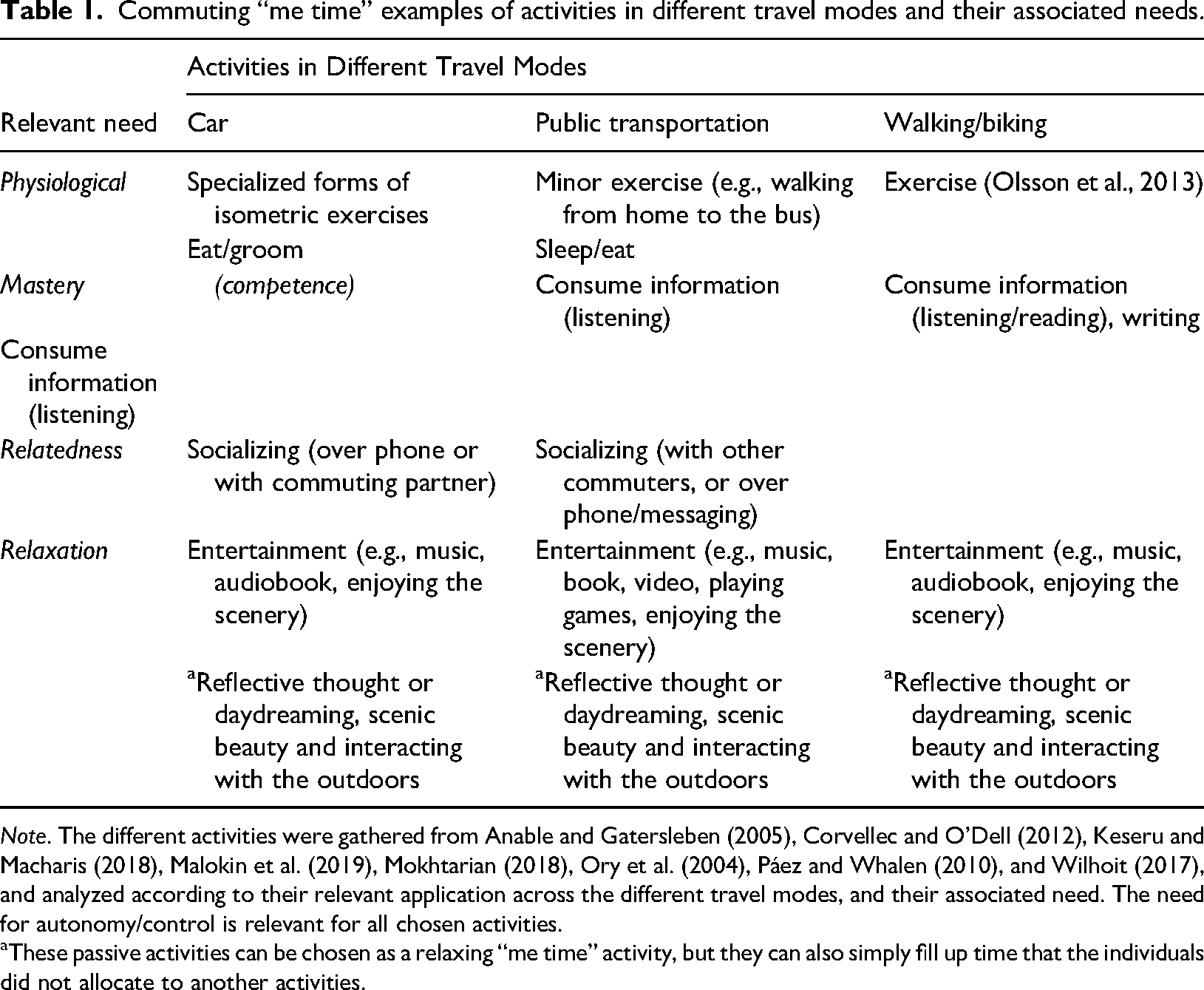
Note. The different activities were gathered from Anable and Gatersleben (2005), Corvellec and O'Dell (2012), Keseru and Macharis (2018), Malokin et al. (2019), Mokhtarian (2018), Ory et al. (2004), Páez and Whalen (2010), and Wilhoit (2017), and analyzed according to their relevant application across the different travel modes, and their associated need. The need for autonomy/control is relevant for all chosen activities.
aThese passive activities can be chosen as a relaxing “me time” activity, but they can also simply fill up time that the individuals did not allocate to another activities.
Two main principles of need fulfillment are: (1) the satisfaction of needs does not have to be provided by a particular source but can be filled by other means, and (2) once a need is satisfied, additional sources filling this need offer diminishing returns (Vogel et al., 2015). Optimal functioning can be achieved if individuals focus their crafting efforts (i.e., engage in activities) on their unfulfilled needs (De Bloom et al., 2020). Therefore, we anticipate that if a person has needs that are not sufficiently satisfied in the work or home domains, they will likely attempt to satisfy these needs during their commute.
However, some activities that fulfill personal needs may be impossible during the commute, especially if they require specific environments (e.g., woodworking, yoga), and other activities are more or less accessible depending on the mode of the commute. For example, using the commute time for physical exercise is inherently built into more active forms of commute (e.g., walking or biking), is more minor if using public transportation, and is unlikely if one is driving work (unless one parks some distance away from the destination). Therefore, the list of potential “me time” activities depend on the mode of the commute, beyond the needs and preferences of the individual. Thus, Table 1 provides an exemplar list of activities, and their specific applications in each mode of commuting.
Constraints of the commute affect the chosen “me time” activities during the commute in service of personal needs.
The translation of motivation for “me time” into successful engagement in “me time” during the commute depends on moderating factors that pertain both to the circumstances of the commute and to individual factors. Many of these factors, described in the following sections, can not only moderate (i.e., hinder or aid) engagement in “me time”, but also moderate the translation of engagement in “me time” during the commute into beneficial outcomes in different domains (i.e., work, family, health) as described in the model.
Moderating situational factors
Transitory characteristics and needs were described earlier as factors that influence motivation to engage in “me time” during the commute, and examples included a day with an abnormally high workload or an otherwise stressful day at work that makes salient the need for relaxation or self-affirmation. However, there are additional transitory circumstances that may not affect one's motivation, but rather one's ability to enact the desire for “me time” during the commute. For example, if a commuter uses public transportation but there are no available seats, that commuter has a more limited choice of activities (i.e., only those that can be done while standing). On the opposite end, some public transportation options make it easier to “feel at home”; for example, by furnishing the public space of the train with one's private items (Corvellec & O'Dell, 2012). Another example is a change in the route and length of the commute. If external events result in a need to change the route (e.g., car accident requiring an alternate route be taken), then the new demands of the commute, including the potential arrangements that need to be made for the commute or the planned activities for after the commute (if there are delays), may make it harder to engage in “me time”. In contrast, unexpected delays while already on the commute can also create a new segment of time that the individual can now use for “me time”. This might be particularly true if individuals were equipped with tools that enable engagement in the desired activities during the unexpected wait (Shaw et al., 2021). Further, there may be personal differences in the ability to make the best of such new or unexpected circumstances, as described next.
Transitory circumstances affect the ability to enact the motivation for “me time” during the commute.
Moderating personal characteristics
In addition to contextual factors that may enable or interfere with the ability to enact the motivation to engage in “me time” during the commute, personal characteristics may affect both the ability to engage in, and the degree to which individuals can benefit from engaging in “me time”. An important construct in this regard is liminality competence, which may explain to some extent why some individuals are better able to use their commute time to accomplish goals (i.e., work/home tasks as well as “me time” activities). The term ‘liminality competence’ describes the ability to work in the liminal conditions of transient and mobile work, reflecting people's abilities to handle fluid and flexible work conditions (Borg & Soderlund, 2015). Liminality competence can be developed via three processes: (1) understanding the value of in-betweenness, including finding the benefits of higher flexibility; (2) embracing the role as an inside-outsider, which includes being able to negotiate responsibilities and incorporate elements from external domains; and (3) translating the liminal experience through reflexivity, including reflecting on the work situation and the individual's role in it (Borg & Soderlund, 2015). These processes are likely also relevant in developing the competence to use the commute for meaningful “me time” because the three components easily translate to the commute as a “third space”. If one is able to perceive and understand the value of commute time, incorporate elements (e.g., abilities, needs) from other domains, or use the commute time for reflective thought (as opposed to keeping busy; De Vries, 2015), this individual would have a better chance of using the commute time for meaningful “me time”. Of course, this individual would also be more likely to use the commute for completion of work or home tasks as demands from these domains arise, as they would generally be better able to make the most of their commute time.
Additionally, it is interesting to consider who may benefit most from “me time” during the commute. For instance, those high on liminality competence may also be better at experiencing the benefits from “me time” during one's commute due to their increased competency at operating in liminal conditions. A related construct, attentional agility, or the extent to which individuals can redirect attentional resources back to what they were doing after an intrusion (Grotto et al., 2021) may also predict how beneficial the commute can be. This ability should impact how efficiently one is able to use the commute time for a chosen “me time” activity despite the interruptions or intrusions that are characteristic of many commutes. This ability has been shown to have beneficial outcomes in various domains, including well-being and work and home/family, albeit in a different context – resuming non-work activities after a work intrusion (Grotto et al., 2021).
Furthermore, individuals with high demands in both the work and home domains, such as busy working parents, tend to have little time for themselves. These individuals may especially need and appreciate this “time out” from their multitude of demands. Jain and Lyons (2008) discussed how for some individuals, travel time may be the only opportunity to undertake some activities (e.g., listening to music of one's personal choice), thereby making “me time” particularly valuable and beneficial for them. Indirect evidence for this idea can be gleaned from a natural quasi-experiment study that examined the effects of changing to a better commuting route (before this change, commuters had to transfer trains in order to complete their commute, while after the change, they had a direct train) on commuting stress (Wener et al., 2005). Results showed that one subgroup of the participants, female commuters with children living at home, benefitted more than other commuters from this change. In fact, some writing has suggested that this population may especially struggle with overstimulation due to role demands and lack of time for themselves (Christian-Smith, 1993; Schulte, 2019).
We acknowledge that there are likely boundary conditions around these enhanced benefits. As an example, for an exhausted working mom, a commute that is long enough for some meaningful time to oneself may be beneficial, and preferable to a shorter but more stressful commute. However, a very long commute may not be advantageous– as that is likely to contribute to her inability to meet role obligations (e.g., helping kids with their homework) and may engender additional stress (Roberts et al., 2011).
Personal characteristics (e.g., liminality competence, attentional agility, level of demands in the home domain) affect the ability to engage in as well as the benefits from engaging in “me time” during the commute.
Post commute
Consequences of engaging in “me time”
In this section, we detail why time to oneself during the commute is theorized to be related to beneficial outcomes. Namely, “me time” is an opportunity to meet basic needs, which accrues or restores resources. In fact, recent research reveals that engaging in less “me time”, operationalized as solitary pursuits, than desired is associated with worse well-being (i.e., poorer mental health, less energy, greater stress; Ren, 2016). Therefore, spending the commute time on oneself is likely beneficial to the individual's well-being. Additionally, we also predict that engaging in “me time” has the potential to benefit work and home domains.
Satisfying one's needs via “me time” can increase the individual's physical as well as psychological well-being. Specifically, active commuting plays an important role in employees’ general health (Baker et al., 2021). There is strong evidence linking active commutes to reduced BMI and percentage body fat compared to car-only commutes (Flint & Cummins, 2016), and an overall reduction in cardiovascular risk (Hamer & Chida, 2008).
As for psychological well-being, Martin et al. (2014) found that physical activity undertaken whilst commuting to work (i.e., time spent walking) increased psychological well-being, and that switching from car to active travel increased psychological well-being. They explained their findings by arguing that “intrinsic enjoyment is gained from the exercise or relaxation associated with active travel” (p. 301). This intrinsic enjoyment is likely due to the fulfillment of a basic need. Similarly, Olsson et al. (2013) found that satisfaction with one's commute (which can be expected when engaging in more “me time” during this time) has a substantial influence on overall happiness, and that social and entertainment activities either increased positive emotions or decreased stress levels and boredom.
The beneficial effects of “me time” may last beyond the commute. For example, Van Hooff (2015) found that after returning home from work, employees’ serenity levels were predicted by relaxation during the commute, as well as by detachment during the commute (if work demands were high). Relaxation and detachment during the commute can be difficult to achieve, especially when the commute itself has associated physical, cognitive, or mental demands. However, by shifting the focus towards “me time” activities that promote relaxation and detachment (see Table 1) the employee can seek to improve their recovery and well-being. This work is important because it highlights the notion that experiences during the commute have the potential to influence recovery, thereby positively spilling over into the home domain. Further, it highlights the importance of detachment and relaxation as mechanisms for recovery because they help to reduce demands. However, these are not the only mechanisms for recovery; recovery can also be achieved via opportunities for learning and mastery, though through different mechanisms. Said otherwise, relaxation promotes recovery by reducing general demands and restoring resources that were depleted, whereas learning and mastery are tools for gaining new resources (Sonnentag & Fritz, 2007). This explains why regardless of the specific choice of “me time” activities during the commute, there is an expected benefit for the individual's well-being.
Engaging in “me time” during the commute positively affects general well-being.
Further, engaging in “me time” facilitates a positive experience during the commute, which can also hold benefits for the employing organization. This is because employees who experience negative feelings during the commute are likely to attribute those feelings to their job, because their job is the reason they were commuting in the first place (Jachimowicz et al., 2021). That is, people who blame their organization for their poor or unpleasant commute are likely to feel dissatisfaction towards their jobs, in line with a source attribution perspective (Shockley & Singla, 2011). Conversely, a more pleasant commute, as could be the case when utilized for “me time”, may be viewed as a boon or gift from their organization and contribute to more positive attitudes toward the company. Downstream, more positive job attitudes should be related to a host of important workplace outcomes, including better work engagement, higher job performance, and lower turnover intentions.
Improving the commute in a way that reduces commuting demands and allows for more “me time” (e.g., by switching to a route that does not require a train-change) likely results in reduced self-reported stress as well as reduced work strain, which is associated with greater job satisfaction and engagement (Wener et al., 2005). This is important because some evidence indicates that employees appear to believe that they should be appropriately compensated for unsatisfying commutes (Robles, 2018). Said otherwise, the commute appears to be considered by workers as part of their “exchange” with their employer. This suggests that workers’ who see their pay as inequitable with their commute could perceive the situation as unjust, and seek to “balance the scales” with their organization by engaging in counterproductive work behaviors. For example, by stealing time from the organization because they rationalize that their long commute should “count” as part of the time they are giving to their organization. Overall, the arguments laid out above indicate that a good commuting experience should be beneficial not only to the employee's well-being, but for many of their work outcomes too.
Engaging in “me time” during the commute positively affects work outcomes such as job satisfaction and engagement.
Finally, another domain that can benefit when one engages in quality “me time” during the commute is the home or family domain. First, relaxation and detachment during the commute are associated with serenity levels upon returning home from work, affecting the state in which employees begin their time in the family domain (Van Hooff, 2015). Moreover, the commute can affect performance in the family domain (defined as “the fulfillment of obligations and expectations stemming from the roles associated with participation in the family domain”; Chen et al., 2014, p. 193). Positive and negative experiences at work spill over into other life domains via increased or depleted resources, respectively (Kinnunen et al., 2006). We argue that commuting experiences can spill over in the same way. That is to say, just as commuting stress can result in negative spillover to the home domain, the positive aspects of the commute (e.g., privacy, protected time) that allow for meaningful “me time” can lead to positive spillover to the home domain (Novaco & Gonzalez, 2009).
There is some evidence that the act of crafting itself also crosses domains (Demerouti et al., 2019). Although their study was focused on the work-home interface, Demerouti et al. (2019) found that seeking resources (e.g., challenge-seeking, reducing demands) in one domain predicted the same behavior in the other domain. Further, this was especially the case when the individual had high levels of autonomy. This spillover process is likely fueled by positive emotions that contribute to initiating and sustaining proactive behaviors. Additionally, resource-seeking behaviors in the first domain makes such proactive strategies more salient and accessible for employees in the following domain. When applied to the commute, it is likely that seeking resources during the commute, which is at the heart of “me time”, will spill over and affect resource-seeking in the home or family domain, increasing overall meaning and enrichment across multiple life domains.
Engaging in “me time” during the commute positively affects home or family outcomes.
Generally speaking, needs that are satisfied in one domain can enhance the individual's mood and positively spill over to other domains (see De Bloom et al., 2020). Therefore, meaningful “me time” during the commute is likely to result in beneficial well-being outcomes, as well as better work and home outcomes. This is in part because “me time” is often inherently enjoyable or provides an emotional release, requires little effort or resource investment, and at the same time increases available resources that can be used across different life domains. In this sense, individuals should be hesitant to relinquish their valuable “me time” during their commutes in favor of work or home demands, as this might harm their recovery, and could ultimately contribute to a resource loss spiral (e.g., Demerouti et al., 2004).
Discussion
Commuting often takes up a significant portion of one's day (Burd et al., 2021). As such, it is critical to understand how commuting time can be used advantageously; for example, as a source of valuable “me time” that enhances employee recovery, health, and well-being. In this paper, we have defined “me time” during one's commute and developed a novel theoretical model that seeks to capture its antecedents, consequences, and boundary conditions.
Our proposed conceptual model holds important implications for commuting theory and research. Specifically, it will help to guide new research that examines the psychological benefits of commuting. To date, the majority of the organizational literature on commuting emphasizes the draining and stressful nature of the commute, largely ignoring the possibility that commuting time may serve as an important “third space” that can be used to facilitate recovery from stress by some individuals (Calderwood & Mitropoulos, 2021). We are hopeful that our model will serve as an impetus for research on this traditionally overlooked perspective by providing propositions related to who is mostly likely to engage in “me time” during the commute, what conditions facilitate and/or hinder “me time” during the commute, when “me time” during the commute is likely to occur, where “me time” during the commute is possible, and why “me time” during the commute has positive effects on one's recovery, health, and well-being as well as work and home spheres. Ultimately, we contend that the research that results from this theorizing will greatly extend both the commuting literature as well as the employee recovery literature, which up to this point has largely focused on recovery at home or during work breaks (Sonnentag et al., 2017), neglecting the possibility that there may be other times or spaces that people may utilize for this purpose.
Methodological considerations
In order to effectively test the propositions laid out in our model, one must consider a number of methodological issues. Accordingly, below, we briefly review some of the relevant research design considerations, as well as potential challenges.
In terms of data gathering approaches, both qualitative and quantitative approaches have been successfully used in the past to study experiences during the commute. For example, in terms of a qualitative design, Wilhoit (2017) conducted a series of semi-structured interviews with commuters to uncover different perspectives on commuting, as well as what elements of the commute made it “sacred time” for participants. The interview questions in this study pertained both to descriptions of participants’ activities during the commute as well as their attitudes and feelings. Such qualitative designs may be helpful for expanding upon the theoretical propositions in our proposed model in order to capture additional factors that facilitate “me time” during the commute, because the material gathered from employees often extends beyond the specific variables that are measured in quantitative research.
Additionally, quantitative designs are also important for testing our propositions. For instance, within-person designs, such as experience sampling studies whereby each participant answers the same set of questions each day for a number of days, allows researchers to distinguish between more stable variables and transient daily experiences. For instance, using this approach, Van Hooff (2015) was able to link experiences during the commute to beneficial outcomes in the home domain. Such designs could be particularly useful when attempting to disentangle the routine from the surprising aspects of the commuting experience, or more generally, examining within-person versus between-person processes. For example, this type of design can examine whether there are different “me time” choices (whether or not to engage, as well as chosen activities) if the commuter has an always-busy public transportation commute versus a surprisingly busy public transportation commute.
Quantitative studies at the between-person level (e.g., cross-sectional designs) can also be used to effectively test our model propositions. Such designs are better suited to examine how routines are formed around commuting activities that hold personal benefits for the individual. For instance, if at first certain “me time” activities were deemed effective, then a pattern may emerge indicating that engaging in one type of activity in the past will predict future engagement in that same activity, thus forming the routine. Optimally, such between-person designs would also be longitudinal, and their first measurement point would be when the individual is new to their commute (Spector & Pindek, 2016).
One challenge may be choosing the appropriate level (between- or within-person) for addressing a specific question. For example, as noted above, a routine may form around certain activities whereby reaping benefits from them in prior journeys will increase the chances of choosing them again in the future (e.g., reading a book during the commute today helped me relax, and consequently, I will read a book tomorrow as well). However, examining the same question using a within-person design or by examining a single commuting episode may result in different conclusions, because satisfying a need with a specific activity may lead the individual to move on to satisfying other needs via other activities (e.g., after reading for 30 min during the commute I was sufficiently relaxed, and moved on to a different activity).
Another challenge when using quantitative designs to study “me time” during the commute is that there is no existing measure for this construct. Future research will need to wrestle with what may be the best approach to construct such a measure as there are multiple paths forward. For example, one possibility is to create a “me time” during the commute measure that focuses on specific needs (or needs categories) that were satisfied during the commute without specifying all activities that the commuter engaged in. This may prove difficult because people may not easily relate to and distinguish among abstract needs. Therefore, special care should be taken when creating such a measure. An alternative approach would be to generate a list of activities that can be presented to the commuter, who can then report the percentage of time during the commute that was invested in each activity. The difficulty here is that some activities would be considered “me time” by one person, but a demand by another. Additionally, future work should aim to separate the desire to engage in “me time” during the commute from the successful enactment of this desire.
Finally, we suggest that another design that could be used to effectively assess the impact of “me time” during the commute is a field experiment. Supporting this argument, Wener et al. (2005) used a natural quasi-experiment whereby an anticipated change to a train line was utilized and before-and-after measures were taken. However, a full experiment can also be conducted whereby participants in an intervention group (but not those in a control group) are encouraged or trained to establish a “me time” routine for their commute, and changes to well-being, family, or work outcomes are assessed. Additional measures can also be incorporated to assess differences in aspects of the commute and individual differences to identify boundary conditions. Such an intervention should use a protocol that can effectively combat existing routines, for example by including mental practice (Heskiau & McCarthy, 2021). One main challenge when conducting field experiments in this domain is that the commute has inherent unpredictability (e.g., trains running late), and this unpredictability must be taken into consideration (used as a covariate /control variable) even if it is not a variable of interest in the study.
Future directions
Future directions for developing the proposed line of research may reflect technological and societal changes. For example, recent work addressed the ways in which travel time is evolving: technological advancements are broadening the range of potential commuting activities (e.g., virtual reality may allow participants to engage in activities that were previously incompatible with their commute, such as those requiring specific settings or equipment), allowing for more or better quality benefits during the same commuting length. Additionally, technological advancements in the modes of transport can potentially change the length of the commute itself (Malokin et al., 2019).
Furthermore, following the COVID-19 pandemic, many people may experience a substantial long-term change in their commute pattern: some have moved further from city centers and have substantially longer commutes, but many also have more flexible work arrangements whereby they are only commuting to work on some days. This can have substantial effects on forming and maintaining commuting routines and may change the “regular” nature of commutes, such that workers can no longer count upon these slices of their day that allows for time for themselves. We encourage future research that examines how the COVID-19 pandemic may have changed the commuting experience, including the use of the commute for “me time”.
Practical implications
Ultimately, our theoretical perspective on whether and how commuters spend their commute on fulfilling personal needs has practical implications for individuals, organizations, and society. In terms of the benefits for individuals, the commute time can be used to satisfy one or more of individuals’ basic physiological or psychological needs, likely leading to increased well-being as well as positive outcomes in individuals' other life domains. The high degree of autonomy in how to use their commute time allows individuals to invest this time in regaining resources that are most depleted (e.g., mastery if both work and home domain are not abundant in mastery opportunities, relaxation if the work and home domains are stressful). Accordingly, if an individual has the option of choosing between commuting via car or using a more active commute, they will stand to gain more physiological and psychological benefits by choosing the active commute. However, if a car commute is the only relevant commuting mode, other needs can be satisfied during the commute, and the individual will have to satisfy the need for physical activity in another domain. Regardless of the mode, creating a routine of “me time” activities for the commute is recommended, as is adapting such routines when the individual's needs or the commuting characteristics change (either gradually over time or temporarily resulting from atypical events). One important note here is that well-meaning encouragement from role senders (e.g., spouse, supervisor) for an individual to engage in “me time”, including during their commute, or what activities they should engage in for “me time” may not always be a good idea, as such actions could inadvertently decrease the individuals’ feelings of “me time” autonomy.
Additionally, employers are likely to benefit indirectly from employees’ decisions to engage in “me time” during their commutes, as the recovery and well-being benefits are likely to spill over into other domains, including work. Accordingly, it is in the best interest of employers to create conditions that make it easier for employees to secure their “me time” (rather than continue working during the commute). For instance, supervisors can engage in better boundary practices themselves, and can ensure that employees are not contacted (e.g., via email) after their official “workday” has ended. Indeed such ‘right to disconnect’ legislation is increasingly gaining traction (Von Bergen et al., 2019). Such actions will help to facilitate the opportunity for “me time” during the commute (and possibly beyond). Such “me time” should result in better recovery for their employees, which may ultimately lead to positive employee outcomes, such as greater work engagement (Sonnentag, 2003).
More broadly, we argue that the availability of commuting options that are conducive to “me time” have societal implications as well. Namely, if individuals can use their commuting time to recover from stress by engaging in “me time”, it is likely that their overall health, especially if the commute is active (Baker et al., 2021) and happiness (Olsson et al., 2013) will increase, thereby contributing to a healthier and more productive and fulfilled society. Accordingly, when it comes to public transportation options (e.g., train, bus), we urge policy makers to consider the benefits of relaxation and recovery during commuting when determining how to allocate tax money for public transportation improvements.
Conclusion
Overall, we contribute to the literature by presenting a theoretical model that opens up new avenues for research on the potential antecedents and benefits of using the commute for “me time”. We also map potential boundary conditions pertaining to both commuting characteristics and individual differences, leaving room for future investigations to develop ways to overcome these hindering factors and allow more individuals to reap the benefits of using the commute for “me time”. Ultimately, future empirical tests of the tenets of our model will provide practical implications for individuals to better craft their commute.
Footnotes
Funding
The author(s) received no financial support for the research, authorship, and/or publication of this article.
