




Abstract
The few studies that have considered psychological processes during the commute have drawn an ambiguous picture, with some emphasizing the negative and others the positive consequences of commuting. Drawing on self-determination theory, we develop a framework that expands on the costs and benefits of commuting for employees’ subsequent domain-related functioning at work and home. Specifically, we propose employees’ basic needs satisfaction and processes of autonomous and controlled self-regulation as mechanisms that explain how psychological commute characteristics spill over to domain-related functioning through experienced subjective vitality. In doing so, we introduce a taxonomy of psychological commute characteristics and highlight the importance of separating these underlying subjective characteristics from objective aspects of the commuting environment. Our research encourages scholars to conduct within- and between-person studies to examine how the objective commute environment and associated psychological commute characteristics affect employees’ self-regulation.
What happens during the commute does not stay within the boundaries of the commute: Aversive experiences such as being stuck in a traffic jam may spill over to lower engagement in work or home activities. Similarly, positive incidents such as flowing to work uninterruptedly can positively impact subsequent experiences such as flowing (i.e., being fully engaged) when performing tasks at work or at home. How can this be explained? Our article suggests that commuters enter motivational states when going and coming from work. For instance, they feel that everything is going easy and under one's control (autonomous self-regulation) or they feel that the commute is effortful and externally determined (controlled self-regulation). These motivational states influence subjective vitality after the commute, which in turn predicts how employees function at work or at home. Importantly, while objective aspects of the commute environment (for instance, the length of one's commute or one's means of transportation) have an impact on these motivational states, we argue that they do so via psychological commute characteristics perceived by the commuter. We focus on the latter and predict employees’ motivational state during the commute in the form of the fulfillment of their basic needs (i.e., feeling autonomous, competent, and related during the commute) as determined by different psychological commute characteristics (decision latitude, psychological stimulation, social characteristics, physical aspects, insecurity). Our work can inspire research that investigates why different employees perceive their commute differently as well as why the same employee may experience different motivational states during their commute from day to day. We end with practical recommendations for communities, organizations, and the commuter themselves.
Keywords
The prevalence and relevance of commuting as a daily activity for most employees across the globe prompted scholars from various fields to study aspects of people's commutes, such as commute mode choice and commuting patterns, as well as their consequences. In fact, disciplines such as operations management and logistics have dedicated entire journals to research on commuting, focusing predominantly on objective aspects of the commute. For example, a leading journal in transportation research regularly publishes studies on topics such as ride-sharing systems intended to solve traffic congestion (Alisoltani et al., 2021), route choice behavior (Zhu et al., 2021), or the costs of congestion (Anas, 2020). Relatedly, scholars have investigated commuting patterns and developed interventions to reduce congestion (e.g., Offiaeli & Yaman, 2021; Tu et al., 2018).
Whereas such research on objective aspects of the commute has important implications for the design and development of transport infrastructure and traffic management, this substantive body of knowledge in the field of transportation research has not yet been matched by an equally rich understanding of the psychological processes that occur during the commute and their consequences for employees after the commute (Scheiner & Holz-Rau, 2017). This is surprising, as initial evidence suggests that the same objective aspects of the commute may have beneficial or detrimental consequences and that these effects are not restricted to the commute itself but can have cross-domain implications for employees’ day-to-day work-related functioning (e.g., Gerpott et al., 2021; Ma & Ye, 2019; van Hooff, 2015) and wellbeing (Lorenz, 2018; Novaco & Gonzalez, 2009). The implications of this emerging stream of research are, however, to date not well understood, as the few existing studies present an ambiguous picture. On the one hand, some studies have emphasized the psychological costs of commuting in the form of depleted self-regulatory resources at work and reduced work engagement (Gerpott et al., 2021; Zhou et al., 2017). On the other hand, there is also evidence that if employees make productive use of their commute (for example, by thinking about their upcoming work role or engaging in intellectually stimulating activities such as listening to a podcast or reading an article), commuting can also have positive consequences (Jachimowicz et al., 2021; Wilhoit, 2017). Investigating psychological mechanisms that explain the beneficial and harmful consequences of commuting can thus help us to coalesce this evidence to obtain a comprehensive picture of the role of commuting for subsequent domain-specific functioning (i.e., employees’ attitudes and behaviors in the work domain and at home).
To advance our understanding of the costs and benefits of commuting, we first differentiate between objective aspects of the commute environment and subjectively perceived psychological commute characteristics. Second, we propose that more autonomous in contrast to controlled forms of self-regulation during the commute represent a psychological mechanism that accounts for the impact of psychological commute characteristics on employees’ functioning in the work- and home domain. Specifically, we argue that commuting and activities during the commute require employees’ self-regulation, which refers to the purposeful goal-direct regulation of impulses, cognitions, and behaviors (Carver & Scheier, 2001). We further draw on self-determination theory's (SDT; Deci & Ryan, 2000) distinction between autonomous and controlled forms of self-regulation. Whereas autonomous self-regulation is experienced during activities that individuals perceive to be emanating from themselves and thus consistent with their intrinsic goals, controlled forms of self-regulation occur when actions are involuntary and result from external or internal pressures (Deci & Ryan, 2000; Van den Broeck et al., 2021). Whereas autonomous self-regulation is experienced as effortless and even facilitates employees’ psychological resources, controlled self-regulation depletes psychological resources (Deci & Ryan, 2000). Ryan and Frederick (1997) conceptualize subjective vitality—a positive state characterized by aliveness and enhanced psychological and physical energy—as a core psychological resource. SDT further posits that the satisfaction of three basic psychological needs, namely the need for autonomy (i.e., a sense of ownership), competence (i.e., a sense of mastery or skill development), and relatedness (i.e., a sense of belonging or connectedness), are core antecedents that facilitate autonomous as opposed to controlled self-regulation. Our central proposition is thus that the degree to which a commute contributes to fulfilling an employee's basic psychological needs determines whether one is more likely to experience autonomous or controlled self-regulation during the commute. The respective form of self-regulation will in turn spill over to one's domain-related functioning through changes in psychological energy in the form of subjective vitality (Ryan & Frederick, 1997). Figure 1 summarizes our theoretical model.
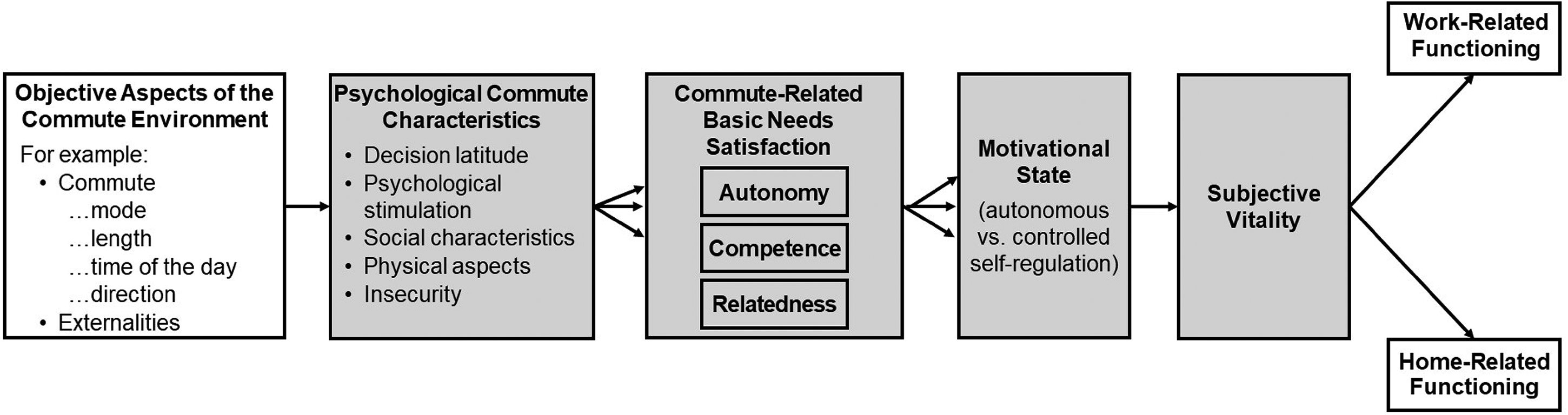
Conceptual model: A self-determination perspective on commuting and subsequent domain-related functioning. Note. Boxes in grey indicate intraindividual, psychological variables, whereas the white boxes indicate characteristics or behaviors that can be objectively observed.
Our research offers three contributions to the literature. First, we add a psychological perspective to insights from transportation research on objective aspects of the commute to better connect these disjointed research fields. Specifically, we propose that it is important to link objective aspects of the commute to a theory-driven taxonomy of psychological commute characteristics. We further argue that the link between experienced psychological commute characteristics and associated commute-related basic needs satisfaction can help us explain why the effects of commuting on domain-related functioning can fundamentally differ between commuters and commute occasions. To develop our theoretical propositions, we draw from the work characteristics literature (Karasek et al., 1998) to develop a comprehensive taxonomy to describe the characteristics of a commute in terms of its (1) decision latitude, (2) psychological stimulation, (3) social characteristics, (4) physical aspects, and (5) insecurity. Second, our proposition to examine commuting through a self-determination lens can help disentangle the ambiguous findings on the consequences of commute experiences. More specifically, by outlining the psychological processes that occur during a commute, our model contributes to understanding why commuting can be beneficial and harmful for employees’ domain-related functioning.
Given that the focus of our model is not only on the spillover (i.e., processes that transition from one into another domain; Edwards & Rothbard, 2000) between the commute- and the work but also the -home domain, we go beyond the previous research, which, for the most part (for an exception, see van Hooff, 2015), has neglected commute-to-home spillover (Calderwood & Mitropoulos, 2021). Our study provides a theoretical foundation for scholars who seek to investigate the domain-related consequences of the work- and home commute simultaneously. Lastly, in an attempt to further integrate the transportation literature with recent theoretical advancements of SDT (Vansteenkiste et al., 2020), we outline a comprehensive future research agenda that explores the role of organizational and individual-level factors in our research model and outlines important methodological questions to be addressed in future studies.
Towards a psychological perspective on commuting
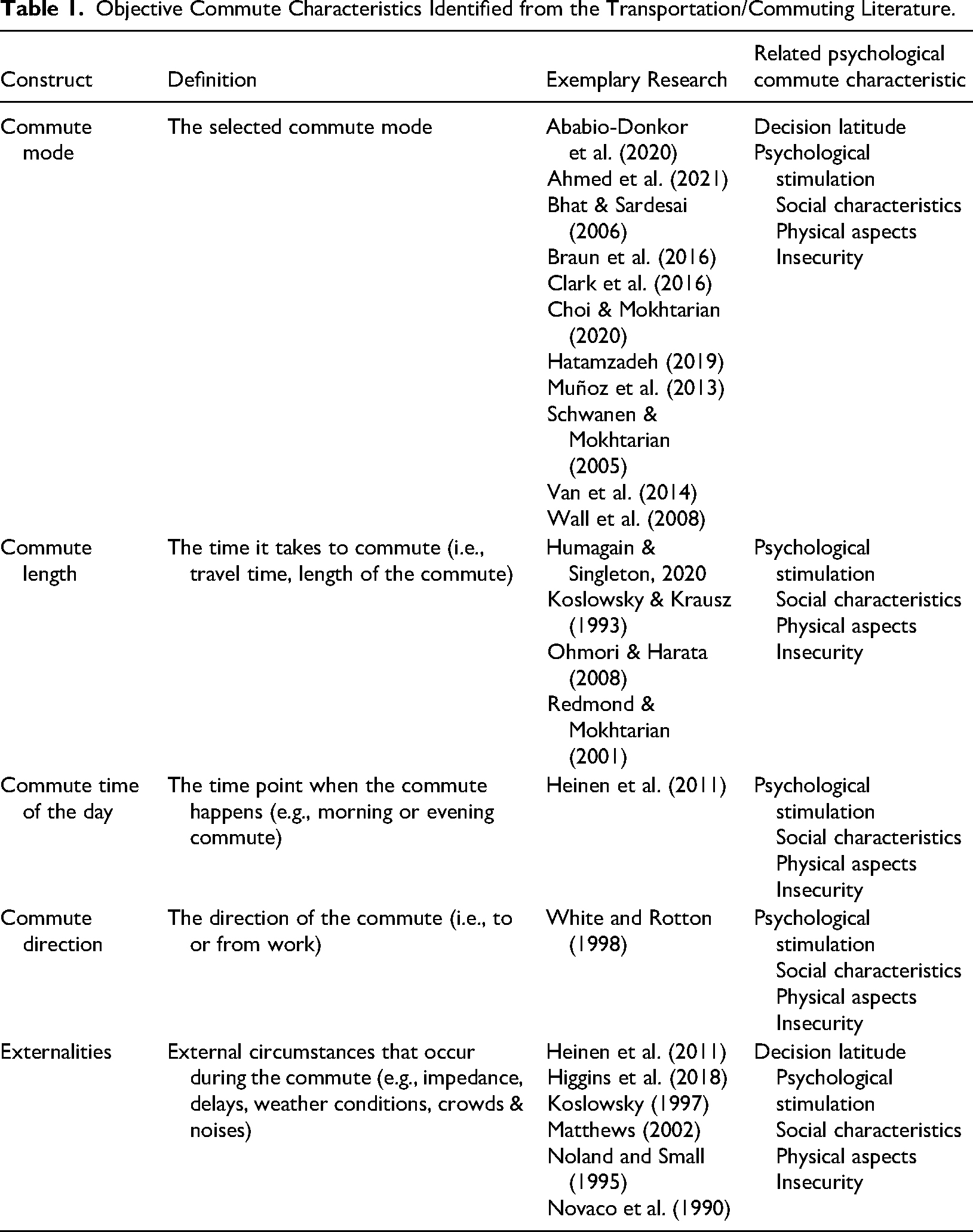
The transportation literature has made significant contributions to our understanding of the implications of commuting by using rigorous methods to study objective environmental aspects of the commute. Specifically, a review of the literature (see Table 1 for an overview) highlights the relevance of numerous partly interrelated objectively measurable aspects of the commute for employees’ functioning in the home- and work domain. While offering important insights into objective aspects of the commute, such an approach falls short in terms of comprehensively accounting for the underlying continuous characteristics of a commute that are subjectively experienced by individuals and that drive their subsequent domain-related functioning. This is not to say that the transportation literature has not also used survey-based approaches to explore the subjectively experienced positive and negative impacts of commuting (see, for example, Julsrud & Denstadli, 2017; Shaw et al., 2019; Tang et al., 2020). Instead, we argue that there is a lack of a guiding conceptual framework that could persuasively help us aggregate research evidence, which is important because it may help guide scholars’ attention when studying commuting. More specifically, it can prevent construct proliferation and waste resources on introducing purportedly new constructs that are highly correlated with existing psychological constructs but not identified as such.
Objective Commute Characteristics Identified from the Transportation/Commuting Literature.
Similarly, it can support organizational psychology scholars to avoid the jangle fallacy (i.e., studying constructs already covered in the transportation literature albeit with different labels) and instead focus on truly novel ideas. Furthermore, developing a comprehensive taxonomy of psychological commute characteristics that systematically captures latent psychological experiences during the commute can help us to (1) coherently integrate the transportation literature with psychological research on commuting to understand the costs and benefits of commuting, (2) explore how differences in objective aspects of the commute between commuters and associated psychological commute characteristics influence employees subsequent domain-specific functioning, and (3) pinpoint how changes of experienced commute characteristics within commuters (i.e., on different days or commute occasions) influence work-related functioning. Our theoretical model thus addresses a crucial shortcoming of commuting research because outlining how employees experience their commute and developing a corresponding taxonomy of psychological commute characteristics can be an important linchpin to understanding how objective aspects of the commute affect employees’ functioning after the commute (Novaco et al., 1990; Ye & Titheridge, 2017).
To advance our theoretical understanding of psychological commute characteristics, we draw on SDT to emphasize that these characteristics affect employees’ self-regulation during the commute (Deci & Ryan, 2000; Ryan & Deci, 2000). We propose that applying the job characteristics model (Karasek et al., 1998) as a framework that is well established in the nomological net of SDT to another domain (i.e., commuting) allows establishing important connections between the organizational psychology- and transportation literature (see also Mayer & Sparrowe, 2013). Specifically, previous research has positioned job characteristics as crucial determinants of employees’ basic needs satisfaction (De Cooman et al., 2013; Van den Broeck et al., 2016). The underlying logic is that the structure of the environment or context impacts the extent to which the three basic psychological needs are met (Deci et al., 1981). Accordingly, we propose that similarly to how job characteristics can affect employees’ functioning at work via the former's influence on basic need satisfaction, associated forms of self-regulation, and psychological resources, psychological commute characteristics can influence employees’ basic need satisfaction during one's commute. This, in turn, has downstream consequences for people's available resources, which spill over to domain-related functioning.
When choosing the job characteristics model as an appropriate theoretical framework to develop our proposed taxonomy, we also considered alternative models in commuting research. We found that these approaches tend to focus on one or two commute characteristic/s while not similarly developing a comprehensive taxonomy of other potentially relevant commute characteristics. Thus, our theoretical framework relying on the job characteristics model not only accounts for these characteristics that are part of other commuting models but also allows us to integrate aspects of these models. For instance, Novaco et al. (1990) dissect the relevance of commute impedance for strain in their theoretical model while not considering other commute characteristics (see p. 234). Schaeffer et al. (1988) focus primarily on commute control as a resource to attenuate the effects of commute impedance. The commuting stress model (Koslowsky, 1997) also puts commute impedance at its center and differentiates between commute impedance and predictability. However, it does not delve deeper into other sources of and remedies against commuting stress. Shaw and colleagues’ recent conceptualization of commute multitasking (2019) primarily alludes to psychological stimulation and social characteristics as important psychological commute characteristics. Given the comprehensive nature of the job characteristics model and its established approach within the SDT literature, we opted for this model rather than applying a plethora of different commute models.
As previously outlined, the Job Content Questionnaire developed by Karasek et al. (1998) is a widely used classification in the work characteristics literature. It identifies the following five facets of work characteristics: decision latitude, psychological factors, social aspects, physical characteristics, and job insecurity. We transfer the underlying classification of the Job Content Questionnaire (Karasek et al., 1998) to the field of commuting and adapt the five dimensions to describe the characteristics of a commute in terms of its (1) decision latitude, (2) psychological stimulation, (3) social characteristics, (4) physical aspects, and (5) insecurity. In line with the structure of the Job Content Questionnaire, we further specify nine sub-dimensions, which we link to the satisfaction of different psychological needs (see Table 2). These psychological commute characteristics can be used to investigate people's subjective experiences of the objective aspect of the commute.
Psychological Commute Characteristics.
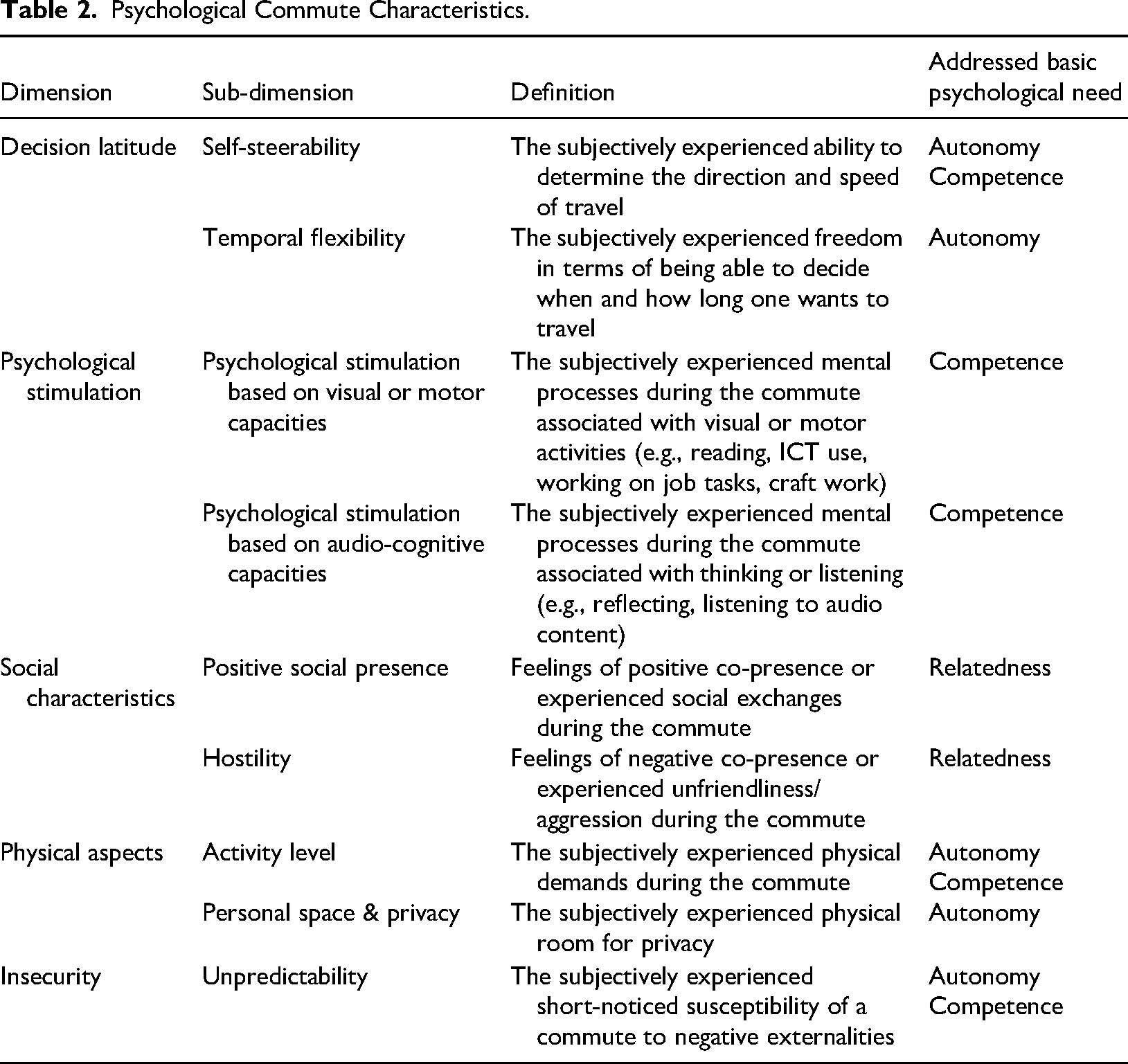
Table 3 illustrates the use of our proposed taxonomy to understand the impact of different commute modes (i.e., public transport, car, automated vehicle, carpooling, cycling, walking) on psychological commute characteristics. However, we would like to highlight that our taxonomy is by no means limited to deriving assumptions about the degree to which a specific commute mode relates to people's basic needs satisfaction via their experienced psychological commute characteristics. Instead, we encourage scholars to use this taxonomy to study how objective aspects of the commuting environment, such as commute mode, the length, time of the day, the direction of the commute, and externalities (e.g., bad weather) can impact one or more psychological commute characteristics and determine how an individual experiences their commute. 1 Disentangling the objective aspects of the commute from associated psychological commute characteristics is necessary because of the well-established differentiation between objective indicators and psychological experiences in psychology in general (Frese & Zapf, 1988) and in commuting research in particular (Koslowsky, 1997).
Exemplary Classification of Commute Modes with Regard to Possibilities to Experience the Psychological Commute Characteristics.
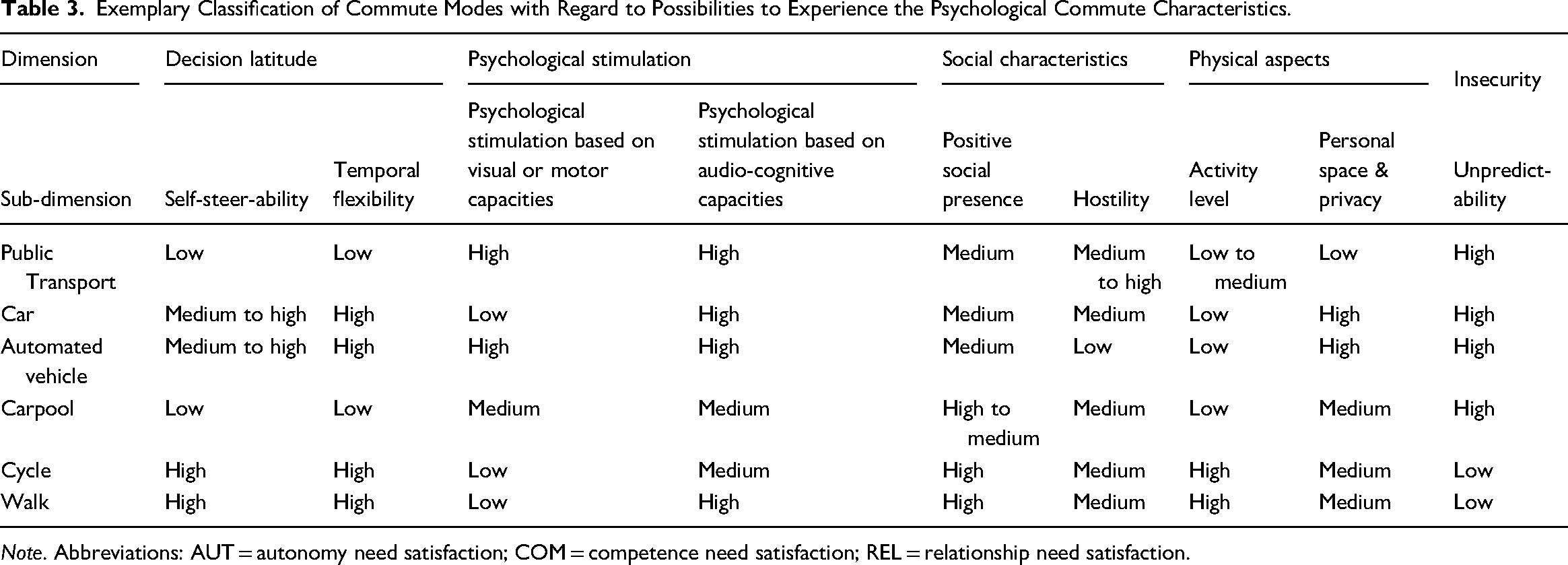
Note. Abbreviations: AUT = autonomy need satisfaction; COM = competence need satisfaction; REL = relationship need satisfaction.
Objective aspects of the commute impact psychological commute characteristics.
While the transportation literature has long highlighted that commuting can have both positive and negative consequences (Gripsrud & Hjorthol, 2012; Humagain & Singleton, 2020; Jain & Lyons, 2008; Mokhtarian & Salomon, 2001; Redmond & Mokhtarian, 2001), the emerging stream of commuting research in the field of organizational psychology has yet to simultaneously account for the costs and benefits of commuting as these have only been examined in separate studies. On the one hand, research on the “dark side” of commuting suggests that subjective experiences of commute demands drain psychological resources and thereby impair employees’ functioning at work (e.g., Gerpott et al., 2021; Zhou et al., 2017). On the other hand, studies have also identified a “bright side” of commute experiences in the form of joy and satisfaction during commutes (Ingvardson et al., 2020; Jensen, 2009) or productive use of one's commute time (Jachimowicz et al., 2021; Lyons & Chatterjee, 2008; Lyons et al., 2007; Malokin et al., 2019, 2021). We next draw on SDT to integrate these two perspectives to more precisely capture the full range of psychological processes that occur during the commute, potentially impacting employees’ subsequent domain-related functioning. After explaining the backend of our model (see Figure 1), we then turn to the core connecting mechanism, namely commute-related basic needs satisfaction as the link between commute characteristics on the one side and self-regulation processes on the other side.
Self-determination theory, self-regulation during a commute, and spillover to domain-related functioning
One of the core tenets of SDT is to outline how individuals self-regulate when experiencing intrinsic as opposed to extrinsic motivational states (i.e., the force that drives the direction, intensity, and persistence of behavior; Pinder, 2008) and the associated implications of different forms of self-regulation for employees’ psychological resources (Deci & Ryan, 2000; Ryan & Deci, 2000). That is, when people engage in activities that are fully aligned with their core interests and values (i.e., are intrinsically motivated), they experience autonomous self-regulation. This form of self-regulation is inherently pleasant and facilitates psychological resources (Van den Broeck et al., 2021). In contrast, when engaging in activities motivated by external or internal pressures (i.e., extrinsically motivated), individuals engage in controlled self-regulation. Controlled self-regulation drains psychological resources due to the mental effort to regulate behaviors, cognitions, and emotions to override their inherent desires (Deci & Ryan, 2000). To summarize, the main difference between the aforementioned two forms of self-regulation is that experiencing autonomous (as opposed to controlled) self-regulation when engaging in an activity can facilitate (vs. drain) psychological resources, as individuals engage in activities that are inherently pleasant and fully corresponding with individuals’ inherent interests and desires (Van den Broeck et al., 2016). Ryan and Frederick (1997) propose subjective vitality as a psychological resource available to the self. In other words, when “one is free of control, unburdened by external controls, and feeling capable of effecting action, then one should report higher vitality” (Ryan & Frederick, 1997, p. 530). In line with the notion that work- and home-related functioning critically rely on an individual's available psychological resources (Quinn et al., 2012), empirical research found a positive link between subjective vitality and cross-domain functioning as well as well-being (Bertrams et al., 2020; Dubreuil et al., 2014; Liu et al., 2021a; Ryan & Frederick, 1997).
Applying the core tenets of SDT to commuting, we propose that experiences of autonomous self-regulation during the commute enhance employees’ subjective vitality, which in turn affects employees’ subsequent domain-related functioning. This mechanism is referred to as spillover, which reflects a process that links two domains (Edwards & Rothbard, 2000; Lambert, 1990). Spillover implies that energetic resources such as subjective vitality do not remain constrained within one domain but rather transition across domains and unveil their beneficial impacts in another domain. Whereas studies drawing on SDT have provided convincing empirical support for the cross-domain spillover of energetic resources in general (Deci et al., 2017) and specifically between work and home (e.g., Gombert et al., 2020; Kim & Beehr, 2020; Rivkin et al., 2021), commuting as a unique “domain” between work and home has not yet received much consideration (see Keeney et al., 2013). Hence, we propose that the satisfaction of employees’ basic needs and associated states of autonomous self-regulation during the commute facilitate subjective vitality, which spills over from the commute- to the post-commute domain. Consequently, these states of heightened subjective vitality will foster functioning in the work- (i.e., completing the activities and fulfilling the duties that they need to carry out according to their employment contract) or home domain (e.g., supporting family members and friends; engaging in household chores). Furthermore, enhanced subjective vitality could even facilitate employee behaviors that mainly rely on the availability of psychological resources, such as extra-role behaviors at work (i.e., organizational citizenship behavior such as helping others at work; Liu et al., 2021b) or recreational activities in their leisure time at home (e.g., going to the gym, meeting friends; Sonnentag, 2018). On the flip side, experiences of controlled self-regulation during commutes result in impaired subjective vitality, which has negative consequences for cross-domain functioning at work or home. We propose that this spillover of autonomous or controlled self-regulation via associated subjective vitality on employees’ domain-related functioning is particularly applicable to the commute experience. This is because commuting occurs in close temporal proximity to the work- and home domains, which increases the likelihood of spillover effects (Cohen et al., 2003).
Commute-related autonomous (controlled) self-regulation enhances (impairs) subjective vitality, which, in turn, spills over and affects their domain-related functioning after the commute.
The centerpiece: Commute-related basic needs satisfaction as the connecting link
According to SDT (Deci & Ryan, 2000; Ryan & Deci, 2000), the degree to which individuals experience states of either autonomous or controlled self-regulation is determined by the fulfillment of their basic psychological needs for autonomy, competence, and relatedness. SDT describes these needs as fundamental nutrients: Like a plant that needs sunshine, water, and minerals to grow, the satisfaction of these needs results in people experiencing growth and enhancement in states of autonomous regulation and associated subjective vitality (Van den Broeck et al., 2016). First, the need for autonomy refers to an individual's desire to act with a sense of ownership, choice, and volition (Deci & Ryan, 2000); that is, individuals want to feel that they are the originators of their actions and are not being pushed or pulled into certain activities by external circumstances (Van den Broeck et al., 2010). Second, the need for competence refers to the natural tendency to strive for a sense of mastery over the environment and the ability to optimally use and develop one's skills (Van den Broeck et al., 2016). Third, the need for relatedness refers to the human desire to feel connected to others, which manifests, for example, in the experience of being needed or feeling accepted and cared for by others (Deci & Ryan, 2000).
Drawing on the close links between basic needs satisfaction, autonomous self-regulation, and domain-related functioning (De Cooman et al., 2013; Milyavskaya & Koestner, 2011), we propose that the psychological commute characteristics determine cross-domain functioning through fulfilling (or thwarting) employees’ needs for autonomy, competence, and relatedness during the commute. To further delineate this notion, we next delineate how the proposed taxonomy of nine psychological commute characteristics impacts autonomy, competence, and relatedness need satisfaction during the commute (cf., Table 2).
Decision latitude
Decision latitude is defined as the control a person has during their commute and constitutes a resource that consists of two subdimensions: self-steerability and temporal flexibility. Self-steerability refers to an individual's ability to determine the direction and speed of travel. It is theoretically related to the concept of organizationally mediated possibilities for employees to make decisions about their work (Humphrey et al., 2007; Karasek et al., 1998). In the commuting context, the possibilities are contingent on the chosen commute mode and externalities (e.g., congestion and delays). Although the sub-dimension of self-steerability mainly fulfills an individual's need for autonomy during a commute because it allows commuters to make autonomous choices regarding their route and speed of their commute, it can – at least to some extent – also satisfy an individual's sense of mastery (i.e., competence need fulfillment). This is because being able to decide where to travel and at what speed allows individuals to achieve optimal levels of concentration and match their locomotion with their skill level for the chosen commute mode (Te Brömmelstroet et al., 2021).
Self-steerability during the commute facilitates commute-related autonomy- and competence needs satisfaction, resulting in higher levels of autonomous self-regulation.
Temporal flexibility refers to the time dimension of decision latitude and reflects the commute-related degree of freedom in terms of allowing people to decide when they want to travel. It is important to highlight again that this sub-dimension refers to the perception of the commute domain; there are, of course, external factors in the home and work domain that independently impact temporal flexibility (e.g., fixed work schedules, school timetables). In the commuting context, temporal flexibility is contingent on the commute mode choice (e.g., lower when employees must adhere to the schedules of other carpoolers) and externalities (e.g., road closures). Experiencing high temporal flexibility should satisfy employees’ need for autonomy, thus positively influencing their autonomous self-regulation.
Commute-related temporal flexibility facilitates an individual's commute-related autonomy need satisfaction resulting in higher levels of autonomous self-regulation.
Psychological stimulation
Psychological stimulation (during a commute) relates to the concept of task variety as a resource in the work characteristics literature (Humphrey et al., 2007; Karasek et al., 1998). Generally speaking, this dimension concerns mental processes during the commute that represent psychological stimulation based on visual or motor capacities (e.g., reading, working on a laptop, knitting) and -audio-cognitive capacities (e.g., reflecting, audio content). As psychological stimulation in terms of visual motor capacities and audio-cognitive capacities can contribute to the individual development of the respective capacities, we argue that psychological stimulation facilitates commute-related competence needs satisfaction. To illustrate, using a language learning app on one's train ride to work can satisfy one's need for competence by improving one's proficiency in a new language. Similarly, listening to a science podcast can contribute to one's understanding of a new subject and thereby also facilitate competence needs satisfaction.
Interestingly, and as we discuss in more detail in the future research section, we are not aware of any study comparing the effectiveness of different psychologically stimulating activities (e.g., reading vs. listening) with regard to fulfilling individuals’ commute-related need for competence. We, therefore, formulate general propositions and conclude that when people can and deliberately do engage in stimulating psychological activities during their commute, they experience more autonomous self-regulation through commute-related competence need satisfaction. While we are aware of research suggesting that multitasking as a psychologically stimulating activity during the commute can be a double-edged sword (Shaw et al., 2019), we argue that the negative effects of such psychologically stimulating activities during the commute only occur when the activity itself does not satisfy the need for competence or any of the other two basic psychological needs.
Perceived psychological stimulation based on visual or motor capacities during the commute facilitates commute-related competence need satisfaction, resulting in higher levels of autonomous self-regulation.
Perceived psychological stimulation based on audio-cognitive capacities during the commute facilitates commute-related competence need satisfaction, resulting in higher levels of autonomous self-regulation.
Social characteristics
Commuting is an activity that offers opportunities to connect with others, whether it be face-to-face (with other commuters), via electronic devices such as smartphones (with anyone), or simply by experiencing a shared commute (e.g., cycling or walking together). However, not every social contact during a commute may be welcome. For example, being on a crowded train is unlikely to satisfy one's need for relatedness as contact with others, in this case, is not desired. Furthermore, even deliberately chosen social interactions during the commute (e.g., talking to a friend or family member) can be experienced negatively (see Shaw et al., 2019). Depending on the nature of social contact, we conceptualize two subdimensions of social characteristics, that is, positive social presence (i.e., a resource) and hostility (i.e., a demand) during a commute (Shaw et al., 2019) which either satisfy or thwart a person's need for relatedness, respectively.
When positive social presence occurs, we expect a beneficial impact on an individual's need for relatedness fulfillment (i.e., serving as a resource). Yet, commuters may also be subject to hostility that negatively affects their feelings of relatedness with others. In its extreme, similar to how the organizational psychology literature (Cortina et al., 2001; Karasek et al., 1998) emphasizes that one can have hostile confrontations with supervisors or coworkers, unpleasant confrontations with others are possible when traveling from home to work or vice versa (Phillips & Smith, 2003). To summarize, interacting with others while commuting can be a double-edged sword that can serve as a resource and a major source of stress (i.e., demand) during a commute.
Positive social presence during the commute facilitates commute-related relatedness need satisfaction, resulting in higher levels of autonomous self-regulation.
Hostility during the commute reduces an individual's commute-related relatedness need satisfaction, resulting in higher levels of controlled self-regulation.
Physical aspects
The work characteristics literature (Karasek et al., 1998) classifies the physical aspects of jobs in terms of perceived physical demands and work conditions. We thus differentiate two physical aspects relevant for commuting, that is, activity level as well as personal space and privacy. Concerning the activity level, a difference between work and commute characteristics should be noted: Whereas high physical job demands are a stressor that can often have long-term consequences for employees’ well-being (e.g., back pain, musculoskeletal disorders), this is mostly not the case for the activity level during the commute. Specifically, more active modes of commuting have been consistently linked to feelings of freedom, mastery, and greater enjoyment (e.g., Chatterjee et al., 2020). This is because physical exercise during an active commute can help retain physical abilities and strength which contribute to employees’ autonomy need satisfaction in terms of higher overall mobility (Parra-Rizo & Sanchís-Soler, 2021). This goes along with active forms of commuting possessing several long-term health benefits, such as improved cardiovascular fitness and a reduced likelihood of mortality (Deenihan & Caulfield, 2014; Hamer & Chida, 2008).
An individual's activity level during the commute facilitates commute-related autonomy and competence needs satisfaction, resulting in higher levels of autonomous self-regulation.
Work conditions describe the environment in which an individual works. Regarding commuting, the equivalent to work conditions is the personal space and privacy offered during a commute. The preference for an appropriate amount of personal space (with the minimum desirable space varying between cultures) is inextricably linked to people's need for autonomy (Kupfer, 1987). That is, individuals may feel uncomfortable (Cox et al., 2006) and limited in terms of autonomy if others invade their personal space (Evans & Wener, 2007) and commuters may have fewer behavioral options due to the lack of personal space and privacy (e.g., working on a laptop in a crowded train can be unfeasible; Bilotta et al., 2018; Gripsrud & Hjorthol, 2012). Accordingly, we conceptualize the lack of personal space and privacy as a demand, which is detrimental for employees when commuting.
The lack of personal space and privacy during the commute reduces commute-related autonomy need satisfaction, resulting in higher levels of controlled self-regulation.
Insecurity
In commuting, the equivalent to job insecurity—a major risk factor in people's perceptions of their work (Lee et al., 2004)—is how unpredictable a commute is. The unpredictability of a commute fundamentally impacts people's autonomy- and competence need fulfillment because of its close relationships with feelings of freedom of decision and personal impact. Empirical research has already identified unpredictability as a psychological commute characteristic with negative consequences for commuters’ strain (Denstadli et al., 2017; Evans et al., 2002; Gottholmseder et al., 2009; Sposato et al., 2012) and satisfaction levels (see Higgins et al., 2018). Noland & Small (1995) suggest that unpredictability has an impact on commuters’ departure decisions because they need to factor in additional time to compensate for unforeseen events prolonging the commute length. This means that commuters will not be able to depart at their chosen ideal time. Experiencing unpredictability commuters will have a higher cognitive load and thus face problems when trying to mentally control the environment (Kluger, 1998). Moreover, unpredictability should distort commuters’ sense of deploying their cognitive and motoric skills in an optimal way (see Te Brömmelstroet et al., 2021). Taken together, unpredictability should have negative consequences for one's autonomy- and competence need satisfaction.
Unpredictability during the commute reduces commute-related autonomy- and competence needs satisfaction, resulting in higher levels of controlled self-regulation.
Future research agenda
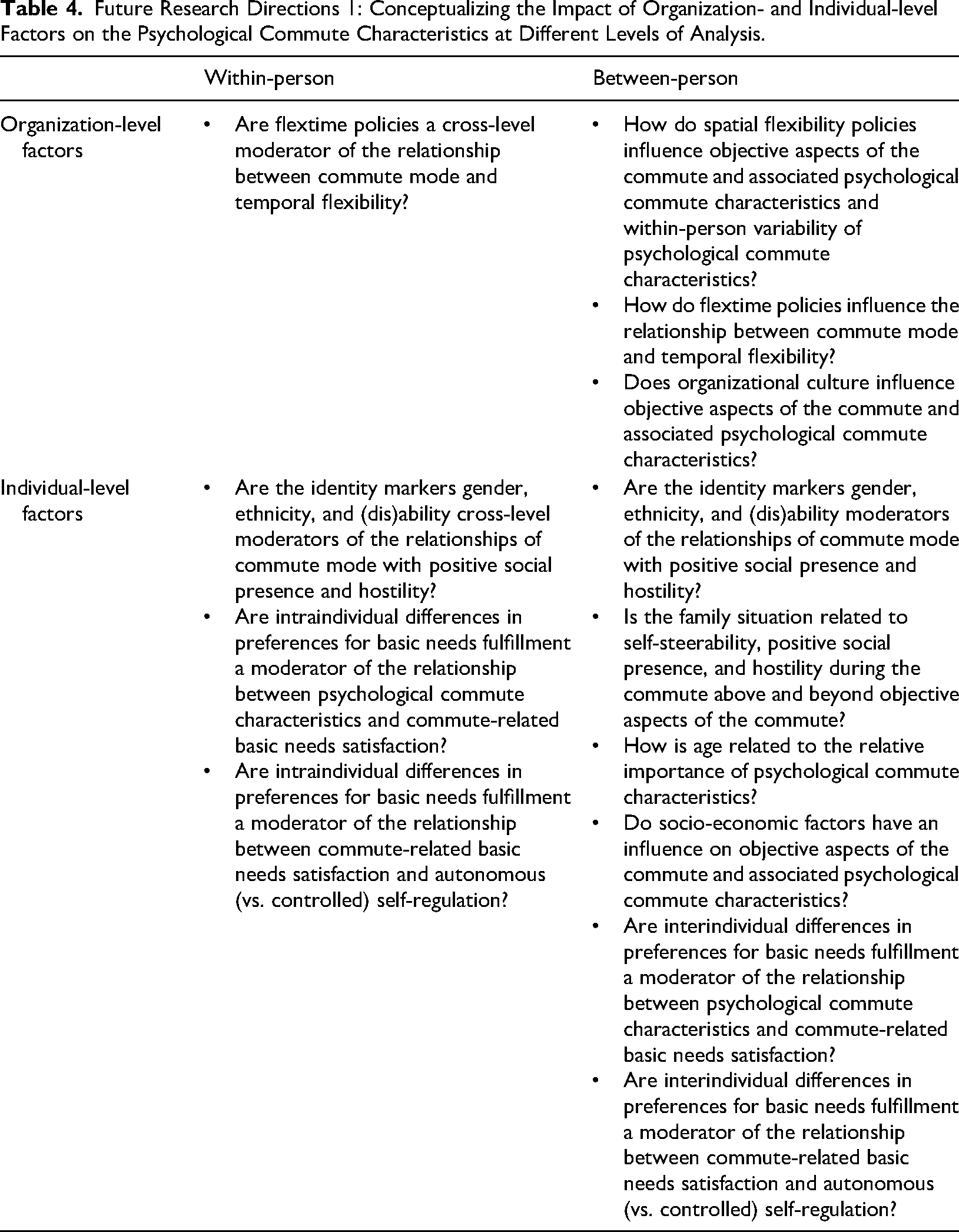
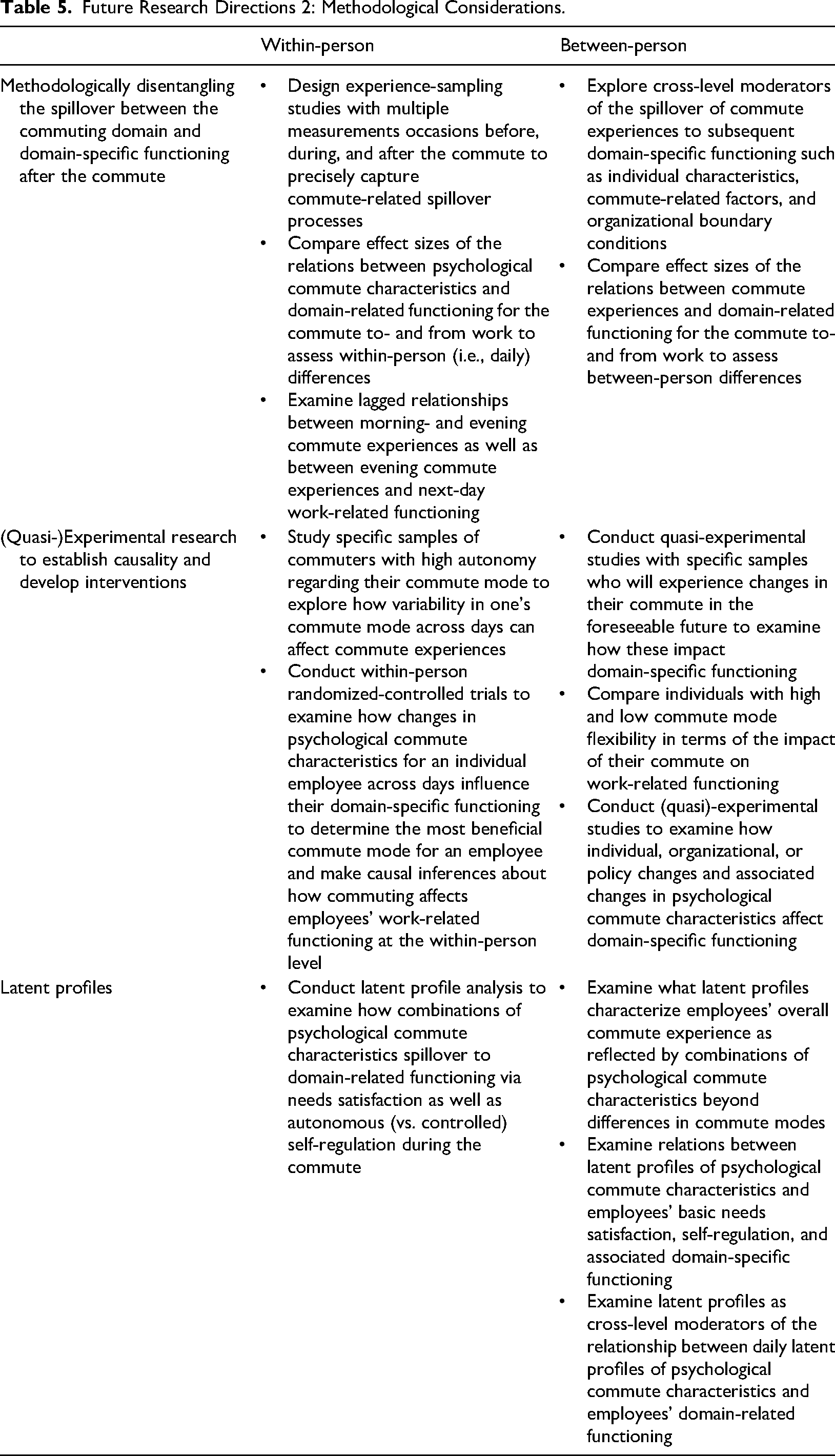
First and foremost, our taxonomy of psychological commute characteristics and the conceptual model of commuting and subsequent domain-related functioning should empirically be tested. In the following, we thus expand on related conceptual (see Table 4) as well as methodological avenues that can guide future research (see Table 5). This future research agenda aims to guide scholars in advancing our understanding of how objective aspects of the commute are related to psychological commute characteristics and associated basic needs satisfaction, which can be either beneficial or detrimental for domain-specific functioning through the availability of psychological resources in the form of subjective vitality.
Future Research Directions 1: Conceptualizing the Impact of Organization- and Individual-level Factors on the Psychological Commute Characteristics at Different Levels of Analysis.
Future Research Directions 2: Methodological Considerations.
Conceptual avenues for future research
The role of organizational factors for psychological commute characteristics
One promising avenue for future research is to expand our understanding of the relevance of organization-level factors (i.e., organizational policies, culture, norms and values, and geographical location) for psychological commute characteristics.
Organizational policies that affect spatial flexibility and flextime may affect employees’ commute mode choice and associated psychological commute characteristics on the between- and within-person levels. To illustrate the increasing use of information and communication technology associated with social distancing measures introduced during the COVID-19 pandemic have prompted increases in teleworking and hybrid work, which offers employees the opportunity to work in different locations (e.g., in a café, at home, in a shared workspace) on some days but then commute to work on other days (Apollo Technical, 2022). This higher spatial flexibility can impact changes in attractiveness associated with different commute modes, which have further implications for the experience of psychological commute characteristics. For example, while an employee may be discouraged from cycling to work for an hour five days a week, they may consider cycling to work two days a week. Moreover, spatial flexibility could be related to within-person variability of psychological commute characteristics because employees may travel to and from different places with different commute modes with associated effects on psychological commute characteristics. Furthermore, flextime policies offered by the organization pertain to employees’ greater “[d]iscretion of their worktime” (Thompson et al., 2015; p. 727). Future research should test whether flextime policies buffer the relationship between commute mode and temporal flexibility experienced during the commute both on the between- and within-person level. In the absence of a fixed work schedule, employees might experience a certain degree of temporal flexibility during the commute even if they use commute modes such as public transport (on some days).
Organizational culture is likely to influence employees’ commute mode choice and psychological commute characteristics on the between-person level (Ostroff et al., 2013; Schein & Schein, 2017; Schneider et al., 2013). An organization's culture is evident in its artifacts (e.g., clothes, behavioral routines) and norms that can also pertain to commuting (see Guell et al., 2012; Hudde, 2022). On the one hand, organizations with a hierarchical culture characterized by conformity and predictability produce visible artifacts such as formal attire, car keys on meeting tables, and a sophisticated parking system. On the other hand, an adhocratic culture (often present in start-up organizations) encourages employees to be risk-taking, creative, and adaptive to deliver innovation. Interestingly, in different organizations, active commuting is understood differently in terms of its status, which should play a role in employees’ commute mode choice and thus in their experienced psychological commute characteristics (see also Van Malderen et al., 2012). Taken together, we invite future research to shed more light on the role of organizational culture in psychological commute characteristics.
The role of individual-level factors for psychological commute characteristics
Turning to the individual level, we invite future research to shed light on the role of (1) demographics, (2) socio-economic factors (see Berliner et al., 2015; Paleti et al., 2013; Shaw et al., 2019), and (3) preference for basic needs fulfillment in our research model.
First, the relevance of demographics (i.e., gender, ethnicity, [dis]ability, family situation, and age) for objective aspects of the commute and by association psychological commute characteristics should be examined in future research. To begin with, although differences in commute length between men and women are shrinking, there is still a gender gap in commuting (Crane, 2007). For example, women are more likely to use public transport, feel threatened, or experience security concerns while commuting (Perez, 2019). Future research might want to examine whether gender moderates the relationship between commute mode on the one hand and positive social presence and hostility on the other hand at the within- and between-person level. The identity markers ethnicity and (dis)ability might have a similar function as boundary conditions of the relationship between commute mode and the psychological commute characteristics and should be investigated at both levels of analysis. Also, the family situation may impact commute mode choice with knock-on effects for psychological commute characteristics (see Cass & Faulconbridge, 2016). For example, being responsible for the school run makes it more likely that an employee uses a car to commute. Accordingly, previous research has demonstrated that having younger children in one's household is associated with a lower likelihood of choosing active commuting modes (Mattisson et al., 2018). On the between level, the family situation may be related to self-steerability and social characteristics of the commute above and beyond objective aspects of the commute. Age as another demographic factor may be relevant for determining commute mode choice with downstream consequences for psychological commute characteristics, as the lifespan perspective suggests (Carstensen, 1995; see also Malokin et al., 2021). With increasing age, employees experience different challenges and opportunities tha should impact commute mode choice. For example, positive social presence should be more relevant for older than younger commuters, whereas the activity level may lose relative importance (see Carstensen et al., 1999). Future research might want to investigate how age and the subjective importance of psychological commute characteristics are interrelated on the between-person level.
Second, future research should establish whether socio-economic factors influence psychological commute characteristics via objective aspects of the commute on the between level. For example, individuals with higher income or wealth can afford a car or even an automated vehicle (see DeLoach & Tiemann, 2012; Ha et al., 2020; Ye & Titheridge, 2017), which should go along with several positive psychological commute characteristics (see Table 3). Moreover, higher income or wealth means that one has more options concerning the place of residence, which can be optimized in terms of its ‘commutability’ (e.g., short commute length, availability of high-quality mobility infrastructures such as bicycle lanes, continuous sidewalks, and high network connectivity; Calthorpe, 2016). Accordingly, it is worthwhile to investigate whether socio-economic factors indirectly affect psychological commute characteristics via objective aspects of the commute.
Finally, we like to direct future research towards investigating the role of commuters’ preferences for basic needs fulfillment in our model (see Figure 1). This construct can be viewed as a motivational profile, which determines how much a person strives to fulfill their need for autonomy, competence, and relatedness, respectively (Haivas et al., 2014). Scholars have argued that the preference for needs fulfillment varies between individuals and can also fluctuate within individuals (i.e., across time; Gillet et al., 2009; Ratelle et al., 2007; Vansteenkiste et al., 2007). Between-person differences in preference of needs fulfillment entail, for example, that some people may generally value relatedness, whereas others particularly strive for competence and autonomy (Haivas et al., 2014). On the other hand, within-person or state differences are reflected by the individual changing their preferences for need fulfillment depending on, for example, the needs that have already been fulfilled at work or home on a particular day. In line with this notion, research has demonstrated that the degree of needs fulfillment at work and in a person's leisure time does not only vary between individuals but also within the same individual, for example, across different days or events (e.g., De Gieter et al., 2018; Gerpott et al., 2021; Hewett et al., 2017; Kuykendall et al., 2020). Accordingly, we suggest that future research should examine how inter- and intraindividual differences in preferences for basic needs fulfillment influence the strength of the relationship between psychological commute characteristics and basic needs satisfaction during the commute. For example, whereas for a person with a low preference for relatedness need satisfaction, engaging in a few social interactions during the commute may be sufficient for experiencing high relatedness needs satisfaction, an individual who has a high preference for relatedness needs satisfaction requires comparably more social interactions during the commute to experience high relatedness needs satisfaction. This argument also holds for individuals with an increased preference for autonomy- and competence need satisfaction with regard to commute characteristics that address the respective need satisfaction. Furthermore, individual preferences for basic needs fulfillment may be a boundary condition of the relationship between the satisfaction of autonomy, relatedness, and competence needs and the resulting form of self-regulation. Turning again to the exemplary person with a low preference for relatedness need satisfaction who may simultaneously possess a high preference for autonomy, a fulfillment of the relatedness need during the commute may only be weakly associated with the experience of autonomous self-regulation. In contrast, satisfying their need for autonomy would result in a disproportionally high autonomous state. Providing support for this assumption, Kasser's (2002) self-determination theory of values suggests that needs satisfaction leads to autonomous self-regulation if the right needs (i.e., those matching an individual's preferences) are satisfied (see also Kasser & Ryan, 1996; Sheldon & Kasser, 1995).
Methodological avenues for future research
Our proposed theoretical framework also points toward more advanced methodological approaches. First, the proposed framework is applicable to commute experiences both during the home-to-work and work-to-home commute and outlines that commuting is a unique ‘domain' with spill over effect to subsequent cross-domain functioning at work and home. However, except for one study (van Hooff, 2015), research has yet to consider the spillover effects of work-to-home commutes on subsequent domain-specific functioning at home. This is surprising given the rich body of literature on the spillover effects of aversive morning commutes to the work domain (Calderwood & Mitropoulos, 2021) or of aversive work experiences to the commute domain (Burch & Barnes-Farrell, 2020; Calderwood & Ackerman, 2019; Clinton et al., 2022; Turgeman-Lupo & Biron, 2017). When testing our model empirically, we would thus consider it a particularly valuable endeavor to delve deeper into the psychological processes occurring during the work-to-home commute and their consequences (e.g., positive commute-to-family enrichment, engagement in physical activities, and health-related behavior) by designing studies with several measurement points before, during, and after the commute. This would also allow researchers to unpack processes over time, for example, and address novel research questions such as whether one's experiences during the morning commute may influence the evening commute or how experiences during the evening commute may even spill over to the next day and affect employees’ functioning. Relatedly, it would be interesting to compare what people do and how they experience their home-to-work commute compared to the work-to-home commute. For example, while it may be beneficial for competence need satisfaction to think about work tasks on the way to work, listening to a non-work-related podcast instead of continuing to work may be better to experience competence need satisfaction during the home commute. At the between-person level of analysis, it is also important to consider individual, organizational, and commute-related boundary conditions as cross-level moderators that could influence the proposed spillover effects from the commute domain to functioning in the domain after the commute. Furthermore, some of the mentioned suggestions for future research on the within-person level could also be examined at the between-person level to explore interindividual differences (cf., Table 5).
Second, the majority of research on commuting is based on correlational data and thus precludes causal conclusions as well as associated specific recommendations (Calderwood & Mitropoulos, 2021; Kristal & Whillans, 2020). Accordingly, future research may conduct experimental or quasi-experimental research to allow drawing causal conclusions about the role of commuting in employees’ domain-related functioning. For example, laboratory and field studies could manipulate different aspects of the objective commute environment (i.e., commute mode) either between- or within-person (i.e., across days). Moreover, scholars may use (quasi-) experimental designs by surveying employees with high degrees of autonomy concerning how they commute or those who plan to change jobs within an expected timeframe (e.g., six months) with associated implications for the commute. Such studies could investigate whether job changes are associated with changes in aspects of the objective commute environment with downstream consequences for psychological commute characteristics and employees’ functioning. Field experiments and (quasi-) experimental studies could also focus on specific commutes, organizations, and even entire communities to test how aspects of the objective commute environment influence psychological commute characteristics, commute-related basic need satisfaction, and associated outcomes. At the commute level, daily diary studies involving interventions (Michiels & Onghena, 2019; Ohly et al., 2010) may be conducted to manipulate, for example, commute characteristics and investigate their consequences. For instance, music features (i.e., key, complexity, tempo, volume, and lyrics) might be used to induce psychological stimulation during a commute (see Keeler & Cortina, 2020), as it is possible to listen to music almost everywhere. At the organizational level, naturally occurring episodic changes associated with large-scale organizational transformation represent an opportunity to conduct quasi-experimental field studies. Future research might capitalize on employees moving to a new site, alterations of work schedules, and the introduction of new mobility policies to examine the relevance of commute mode characteristics. In addition, at the community level, it is possible to conduct experimental intervention studies (cf. Rydstedt et al., 1998 worked together with the Stockholm Transport Agency to investigate the consequences of improving the transport system for bus drivers). Future research may wish to shift the focus and investigate how changes in public transport and traffic infrastructure (e.g., the introduction of free public transportation, an upgraded cycling infrastructure) relate to psychological commute characteristics and associated outcomes among commuters. Such studies may not only allow scholars to establish causal relations between commuting and domain-specific functioning but may also provide recommendations on how to shape commutes to promote rather than harm employees’ domain-specific functioning.
Finally, to extend our classification of psychological commute characteristics, future studies may utilize latent profile analysis to identify whether the proposed taxonomy of psychological commute characteristics based on the job-characteristics model (Karasek et al., 1998) can be represented by certain commute profiles. While on the between-person level, scholars could investigate how these profiles affect employees’ needs satisfaction, self-regulation, and associated functioning, these profiles could also be examined at the within-person level as well as used as cross-level moderators that affect how specific psychological commute characteristics are related with employees’ needs satisfaction and associated self-regulation during the commute.
Practical implications
Generally, our framework offers a balanced consideration of commute experiences that not only conceptualizes the need-thwarting but also highlights the need-fulfilling aspects of one's commute. Our framework thus can potentially encourage employees to actively shape their commutes by thinking about ways to utilize the psychological commute characteristics. Recognizing that people's beliefs about depleting activities matter considerably for their detrimental effects (Job et al., 2010; Konze et al., 2019; Rivkin et al., 2021), organizations could begin by offering workshops in which they inform employees about the potential costs and benefits of different forms of commuting. Furthermore, organizations may also provide resources intended to promote psychological stimulation during commutes. For example, an organization could offer free access to audio content such as podcasts, audiobooks, or online courses that employees could listen to during their commutes.
In addition, organizations can use different leverage (i.e., mobility policies, work schedules, and organizational climate/culture) to support their employees in crafting their commute. First, mobility policies intended to foster commute modes that support employees’ basic need satisfaction can be introduced. As shown in Table 3, we identified active commute modes as advantageous. For example, organizations might consider financial rewards (e.g., company discounts for bicycles) or the provision of relevant facilities (e.g., investment in a community's bicycle infrastructure, bicycle storage; Van Malderen et al., 2012) to improve beneficial psychological commute characteristics associated with certain (e.g., active) commute modes. On the flip side, having a small number of expensive parking spots far away from the workplace as well as replacing company cars with high-quality (electric) bicycles should discourage driving as a commute mode with knock-on effects on psychological commute characteristics. Yet, employees cannot walk or cycle to and from work if it takes too long. Organizations should choose their locations carefully and settle/move close to their (future) employees (e.g., the University of Luxembourg, which moved to a new campus, making commuting more sustainable for staff and students; Sprumont et al., 2014).
A straightforward implication from our taxonomy is that organizations should offer employees flexible working hours when possible. Such working hours increase the likelihood of autonomy need satisfaction through increased temporal flexibility and thus allow employees to start and end their working days with more resources (Dettmers et al., 2020).
Lastly, we encourage organizations to carefully reflect on their organizational culture and assess whether it favors a commuting mode that aligns with organizational productivity goals (Gerpott et al., 2021; Zhou et al., 2017). Arguably, for organizational change to happen, it is essential to provide employees with an attractive vision for the future and offer resources and role models that correspond with this vision (Schein & Schein, 2017). This may involve, for instance, leaders as prominent role models who are not by default choosing the car as a commute mode.
Conclusion
As the lyrics from the song “Road Rage” quoted at the beginning of this article illustrate, it seems that while commuting can trigger “road rage” employees can also consider “taking it easy” and enjoy their commutes. In this paper, we drew on SDT to develop a comprehensive framework that links a taxonomy of commute characteristics to people's basic needs satisfaction during commutes. We further outlined downstream consequences for individuals’ domain-related functioning via their subjective vitality. We hope that our work inspires future research to investigate the bright and the dark sides of commutes simultaneously by employing designs that make it possible to obtain an integrated perspective on spillovers from people's experiences at home to the commute to the workplace and back again.
Footnotes
Declaration of conflicting interests
The author(s) declared no potential conflicts of interest with respect to the research, authorship, and/or publication of this article.
Funding
The author(s) received no financial support for the research, authorship, and/or publication of this article.
