



Abstract
This paper seeks to explain when and why people respond to status threat at work with behaviors oriented toward either self-improvement or interpersonal harming. To that end, we extend the established static social comparison perspective on status threat. Specifically, we introduce the notion of temporal proximity of status threat, which is informed by five temporal social comparison markers. We argue that people construe distal future status gaps as a challenge (and thus show self-improvement-oriented responses), but construe a more proximal status gap as a threat (and thus engage in negative interpersonal behaviors). Further, we introduce three factors of uncertainty that may render the underlying temporal comparison less reliable, and thereby less useful for guiding one's response. Overall, our temporal social comparison theory integrates and extends current theorizing on status threat in organizations by fully acknowledging the dynamic nature of social comparisons.
Keywords
The desire for group status is deeply ingrained in human nature (Anderson et al., 2015; Barkow et al., 1975; Mitchell et al., 2020)—and thus reasonably extends to modern-day work (Garcia et al., 2013). Amidst the competitive nature of many workplaces (Charness et al., 2013) in which status tends to be a zero-sum good (Anderson, 2004; Frank, 1985), employees constantly gauge whether their status is under threat (Anderson et al., 2006). Status reflects the degree of influence one possesses over resource allocations, conflicts, and group decisions (Berger et al., 1980). A perceived lack of status in comparison to relevant (i.e., usually similar) others, or a perception of status threat, motivates the affected individuals to act to (preemptively) close that gap (Duffy et al., 2012; Lee & Duffy, 2019). Such actions can come in the form of positive, self-improvement-oriented behaviors directed at elevating employees’ own status, such as higher motivation, effort, or learning from the more successful coworker (Crusius & Lange, 2015; Schaubroeck & Lam, 2004; Spence et al., 2011). Alternatively, the actions can be negative, destructive behaviors that are directed at lowering the competitor's status: for instance, via social undermining, interpersonal harming, or deception (Duffy et al., 2012; Edelman & Larkin, 2014; Parks et al., 2002). But what are the features of the status gap that motivate individuals to improve themselves or undermine others?
Building on previous studies, we question and extend the common conception of status threat as the result of an unfavorable social comparison of one's present position on relevant status dimensions (e.g., job performance, Lam et al., 2011). Instead, we acknowledge that individuals need to gauge their potential status in the future in order to maintain high status (Reh et al., 2018; as also replicated in Briker & Walter, 2021). We thus propose that the temporal proximity of a future status threat is an important factor in predicting whether employees react with positive, improvement-oriented behaviors or with negative, destructive behaviors. To do so, we add a temporal dimension to the cognitive process underlying employees’ assessments of status threat—namely, social comparisons (Festinger, 1954). We argue that people will compare their temporal trajectories on relevant status dimensions in order to extrapolate whether and when they must expect a threat to their future status. To that end, and going beyond previous work in the field (Reh et al., 2018), we specify that people consider a range of temporal markers that characterize social comparison: Outside of the traditionally considered relative position on a comparison dimension, people specifically weigh their own and others’ relative velocity, acceleration, mean position over time, and their respective minimum and maximum position. Moreover, we introduce three factors of uncertainty—fluctuations, time span, and interruptions in individual's observation—that impede the reliability of the comparison, which then weakens the impact of those temporal markers on employees’ assessment of status threat (see Figure 1).
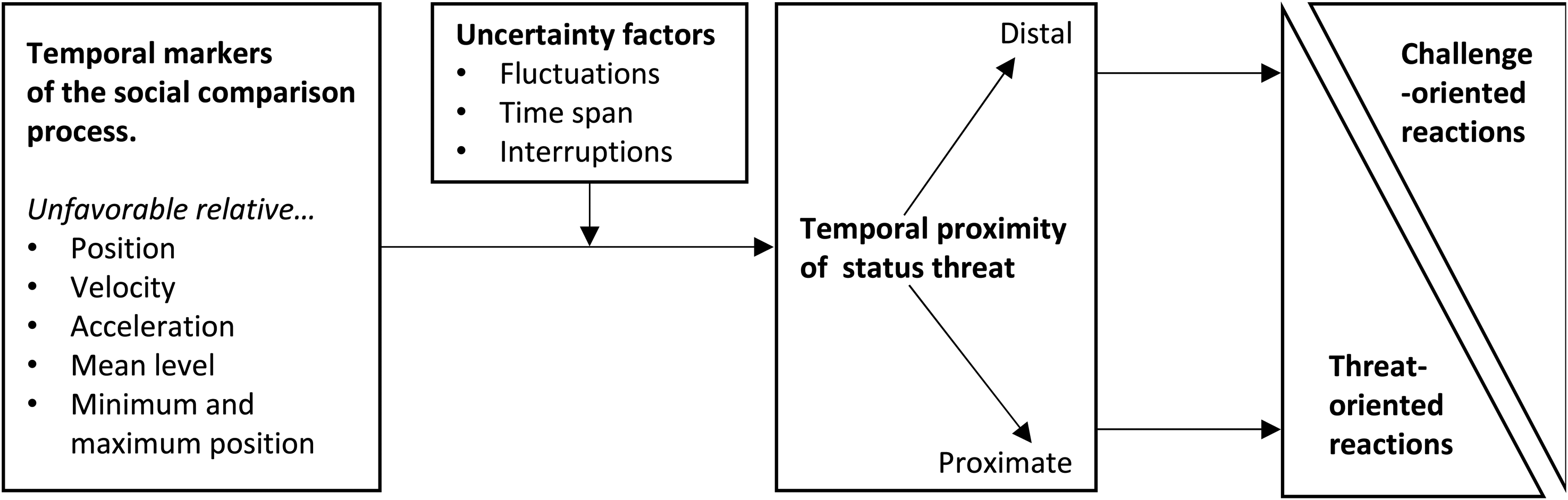
Theoretical model.
The resulting temporal social comparison theory contributes to the literature on status threat and interpersonal behavior at work, as well as to social comparison research. First, our theory solves a conundrum of current static social comparison accounts, that is: Why do people sometimes feel threatened by and harm coworkers whose status is currently lower than theirs (i.e., high potentials) (Campbell et al., 2017)? We address this issue by introducing temporal proximity of status threat (i.e., proximate vs. distal) as a core mechanism that links status threat to positive versus negative behavior. To maintain high status, individuals need to gauge their status in the future, and respond accordingly in the present either by “hustling” more (if time allows) or by sabotaging the other (if time has run out). Second, our theoretical framework elaborates on social comparison as the cognitive process underlying employees’ reaction to status threat (i.e., construct specification, Fisher & Aguinis, 2017). Social comparison theory (Festinger, 1954) posits that social comparison is the result of two individuals gauging their relative position at one point in time (Redersdorff & Guimond, 2006) and then using their standing to predict outcomes (Suls & Wheeler, 2000). However, Albert (1977) already noticed that this construct does not capture within-person changes in the comparison dimension over time. In response, he introduced the concept of temporal self-comparison where individuals compare their current standing with their past standing. Surprisingly, he did not expand the notion of temporal self-comparisons to include other individuals’ perceptions of how peers have changed over time. In short, social comparison theory (Festinger, 1954) investigated differences at the between-individual level, while temporal comparison theory (Albert, 1977) focused on the within-individual level. Here, we integrate both between-person social and within-person temporal comparisons into one comprehensive, mixed-level theory. In this way, we extend the two ideas by accounting for the temporal changes that occur between a focal employee and others. We also enhance nascent work in this field (Reh et al., 2018) by broadening the discussion to include different temporal markers that people may use.
The temporal dimension in social comparison and status threat
Status plays a central role in employees’ self-concept because of its many advantages and relational implications (Fiske, 1991). People with high status not only report higher subjective well-being, but seem to enjoy better health, higher self-esteem, more influence (Berger et al., 1980), and more respect and support from others (Anderson et al., 2001, 2006). Meanwhile, low status elicits negative emotions (Kemper, 1991) and impairs performance (Marr & Thau, 2013). People are particularly sensitive to having low status (Crusius & Lange, 2016) or losing status (Carson Marr et al., 2019); thus, they seek to defend or regain their status when it is threatened by someone (Reh et al., 2018; Tajfel & Turner, 1986). Individuals enjoy high status in a group when they compare better than others on dimensions such as performance, salary, relationship quality with coworkers or their leader, benefits, or career progression (Brown et al., 2007). In line with social comparison theory (Festinger, 1954; Tesser, 1988), such comparisons occur between an actor and a relevant other. Relevance here is usually determined by similarity—which, at work, is often signaled by overlapping hierarchical levels and functions (Lam et al., 2011; Messersmith et al., 2011). For instance, a comparison of pay to gauge one's status is more relevant if it involves two coworkers with similar ranks rather than an intern versus the CEO.
Importantly, status tends to be a zero-sum good in organizations (Anderson, 2004; Frank, 1985). As Blader and Yu (2017) describe: “[…] individuals’ rank within their groups’ status hierarchies is primarily an issue of their comparative position, not of whether their degree of status is low or high in relation to any absolute standards” (p. 17). Thus, one can only enjoy higher status when others have lower status, which is why status is sometimes treated as a precious resource akin to scarce goods in economic theory (Frank, 1985). We therefore expect people to compete for status gains, which entails outperforming others on relevant dimensions.
Alleviating status threat may occur via two broad routes: leveling oneself up versus leveling the other person down (Cheng et al., 2013; Crusius & Lange, 2016). Indeed, employees may strive to reach the same status level as their superior coworker, or even surpass it, by improving their own performance (van de Ven et al., 2009)—perhaps through increased effort, learning, help seeking, and collaboration (Lange & Crusius, 2015; Schaubroeck & Lam, 2004; van de Ven et al., 2011). At other times, employees may be motivated to knock the superior person down (van de Ven et al., 2009) through undermining (Duffy et al., 2012) or disparagement (Salovey & Rodin, 1984). They may, for instance, seek to get ahead by engaging in cheating, deception, social undermining, or overt sabotage (Duffy et al., 2012; Parks et al., 2002; Salovey & Rodin, 1984).
The common thread in the aforementioned studies is that they treat the social comparison process that leads to a perceived status threat in a cross-sectional, static way (Albert, 1977; Redersdorff & Guimond, 2006). By contrast, we extend recent research (Reh et al., 2018) to argue that a temporal perspective on comparisons may better reflect the occurrence and unfolding of status threat at work. The lack of such a temporal perspective goes back to the theories conceptualizing these comparisons (Festinger, 1954). Social comparison theory (Festinger, 1954) conceptualizes the social comparison at the between-person level as two individuals’ relative standing at one point in time (Redersdorff & Guimond, 2006). Later, Albert (1977) introduced temporal self-comparisons to capture individuals’ present standing in comparison to their past standing (within-person level). Our theory integrates and extends temporal self-comparisons to how individuals compare themselves to others over time—that is, temporal social comparisons. The resulting mixed-level temporal social comparison theory proposes that an employee's comparison of one's own temporal trajectories on a relevant comparison dimension (relative to referent others’ temporal trajectories) affect the temporal proximity of status threat and, by extension, the subsequent behavior at the between-person level.
The disregard for temporal information is evident in the current slate of empirical studies on this topic. Indeed, many of them manipulate social comparison by providing participants with information on their performance in an ability test relative to another person (Rijsman, 1974; Van Yperen & Leander, 2014). This thinking extends to field studies, which ask participants to describe their own and a friend's employment opportunities (Dunn et al., 2012) or use supervisor ratings of employees’ performance at one point in time (Jensen et al., 2014). Implicit in these studies is that the comparison only refers to the present situation. However, it is unclear whether people inform their judgments by referring solely to the status quo or whether they also take temporal dynamics into account. To confound the issue, theories on social comparisons seem to treat social comparison judgments as static and typically ignore the possibility of temporal dynamics (Albert, 1977; Redersdorff & Guimond, 2006). For example, a field study by Lam et al. (2011) explicitly ruled out that downward comparisons might elicit negative interpersonal behaviors; presumably, they did not assume that a downward comparison can morph into an upward comparison in the wake of temporal changes. Yet, such a static view of comparisons mismatches with organizational realities that are inherently dynamic. Due to the length and frequency of contact with their coworkers, employees usually have more information available than a single social comparison at one point in time would reveal. For instance, employees may know if their performance was always better than their coworker's performance or if that coworker has outperformed them at some point in the past.
Only recently have researchers begun to consider that employees compare with each other over time. Reh et al. (2018) found that employees in competitive organizations mentally extrapolated their coworkers’ future status threat by comparing the development of their own status relative to the coworkers. Employees who perceive lower future status for themselves experience envy—and consequently, socially undermine these coworkers. The underlying idea, foundational to the present paper, is that employees are motivated to predict their status in the future. Therefore, single-point social comparisons can only be interpreted meaningfully when considering their temporal context.
Our theory builds on the idea that a coworker can potentially threaten a focal employee's status in the future, which can motivate subsequent behaviors to reduce the future status threat (Reh et al., 2018). We extend Reh et al. (2018) findings to develop an integrative theory that captures status threat in its full temporal spectrum. We focus on how employees gauge the temporal proximity of a status threat: in other words, whether a coworker represents a nearby or distant threat. For instance, employees might expect that a coworker who performed better in the last round of performance evaluation will still outperform them in the next round. Or they may recognize that a weaker coworker's excellent trajectory could render them a competitor in two or three years if this development continues. In both cases, the status threat is in the future, yet the temporal distance differs—as does the time that remains for employees to alleviate said threat. Whereas the first scenario requires employees to engage in actions that immediately alleviate the status threat, employees in the latter case have ample of time and, as a direct consequence, more possibilities how to defend and maintain their status. As we will argue, this temporal proximity has important implications for employees’ behavioral choices.
Moreover, we expand the range of temporal markers that employees may use for comparison. Reh et al. (2018) differentiated between employees’ current relative position and their relative trajectory to predict future status threat. Here, we argue that one needs to consider the full temporal complexity of employees’ status over time that may deviate from linear developments and also account for the fact that such information will often be imperfect. In response, we propose five temporal markers of social comparisons over time and three factors of uncertainty that reduce the reliability of employees’ predictions. This collection was motivated by one of the core ideas of our theory, which is that variability in past trajectories of comparison dimensions matters for employees’ assessment of the temporal proximity of status threat and their future behaviors. As such, this list of temporal markers and uncertainty factors may not be exhaustive. Rather, it represents those markers that we could identify as reflective of employees’ cognitive calculus when predicting their future status.
Temporal markers of the social comparison process
Temporal markers—reflecting a function of time in a social comparison—can be thought of in physical terms. Thus, in addition to individuals’ relative position to each other, we derive new markers based on principles rooted in research on representational momentum. This literature investigates how people's implicit principles of motion shape how they cognitively extrapolate perceived trajectories from the past into the future (Barnes et al., 2012; Kozhevnikov & Hegarty, 2001; Markman & Guenther, 2007, Reb & Greguras, 2010). The basic rationale is that people expect motion on social dimensions (e.g., status) to continue in the future, much like on physical dimensions (Pettit et al., 2013). For instance, if a person's status has been rising in the past, people mentally extrapolate this trajectory and expect it to rise in the future as well (Pettit et al., 2013). A decreasing trajectory would be expected to continue and lead to lower future status. The idea that people use information from the past to simulate future events is also supported in research on mental time travel (Suddendorf et al., 2009) and future-oriented cognition (Szpunar et al., 2014). By “traveling” both forward and backward in their memory, individuals can prepare for future events (e.g., the proximity of future status threat). We apply these rationales to the study of social comparison to derive the temporal markers of relative velocity and, by extension, relative acceleration. We also advance individuals’ relative mean level and their relative minimum and maximum position in the past (see Figure 2). We posit that these markers elicit status threat when their comparisons are unfavorable. Our underlying assumption in all this is that employees monitor and analyze their “status trajectories”.
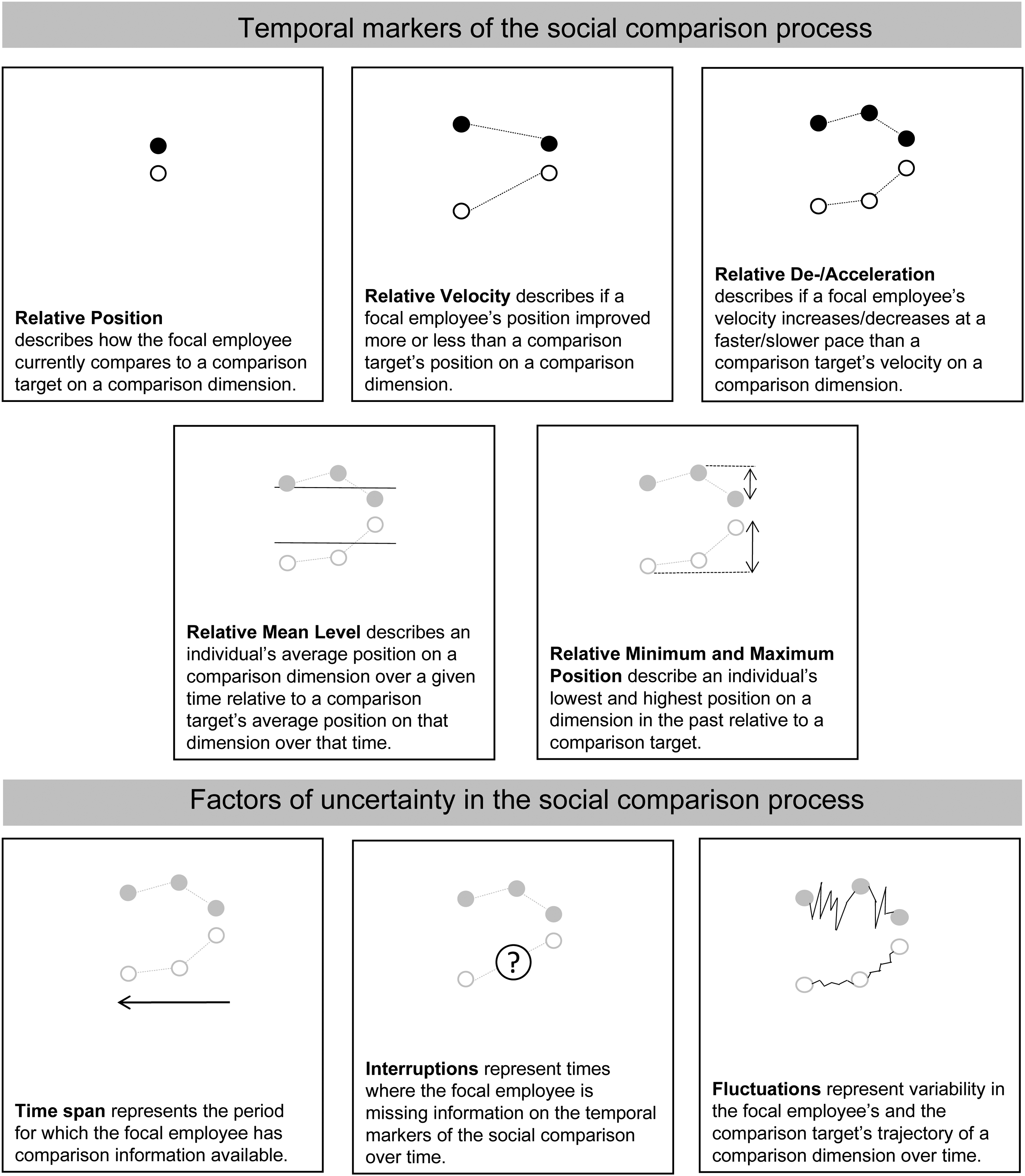
The five temporal markers and three factors of uncertainty of the social comparison process over time. Note that the example given for each marker represents just one constellation of how the respective comparison could manifest. For ease of understanding, we kept the first and last status level of the focal employee and the comparison person constant across the examples.
In formulating our propositions, we use the term unfavorable to describe when the focal employee scores worse on the comparison dimension relative to a coworker. We find this terminology to be more suitable than “lower” or “worse” because it also encompasses situations in which the focal employees’ absolute development is positive (e.g., positive velocity or acceleration), but the comparison person's development is more positive (or alternatively, both show a negative development, but the degree is smaller for one person). For instance, both the focal employee's and the comparison person's sales could have decreased in the past, but the focal employee could have shown a steeper decrease. In this case, both developments are negative in an absolute sense, but the focal employee's decrease was more unfavorable.
Relative position
Relative position describes how two individuals currently compare to each other on a comparison dimension, irrespective of their past or expected future standing. Employees’ relative position reflects the social comparisons that Festinger (1954) originally proposed in his seminal work: Individuals feel uncertain about their standing in their social group and, given a lack of objective standards, evaluate themselves against similar others’ performance on available dimensions (Buunk et al., 2007; Suls et al., 2002). These comparisons have classically been termed upward (i.e., with those who are better) and downward (i.e., with those who are worse) comparisons (Wheeler & Miyake, 1992). A large body of literature has investigated the effects of these static social comparisons on organizationally relevant outcomes (see Greenberg et al., 2006 for a review). For instance, Duffy et al. (2012) found that employees socially undermine coworkers when they feel that said coworkers are superior.
In short, employees consider factors such as their relative (sales) performance, their career progression, or the quality of their interpersonal work relations when parsing their current status in the organization (Michinov, 2005).
The current position is easily accessible in employees’ memory, not only because it describes the present moment, but also because it provides a basis for allocating most organizational rewards. For instance, companies distribute end-of-year bonuses based on employees’ performance (e.g., sales) in comparison to others up to a specific date. In Figure 2, the employee with the higher position (the black dot) should enjoy more status than the employee with the lower position (the white dot).
Employees’ relative position may also serve as an anchor for future judgments in the absence of other comparison information. The magnitude of the difference in their own position relative to others informs employees about how far away the “other” is in terms of status. In this regard, our approach differs from previous research that oftentimes considered the direction of the comparison in a binary fashion (i.e., favorable vs. unfavorable, e.g., Brown et al., 2007), but not necessarily the magnitude of the difference in the comparison dimension. For instance, when looking at one's job performance, an employee will probably feel differently threatened by a comparison with a coworker who consistently underperforms than about a coworker who performs at more or less similar levels. Indeed, this “difference in difference” may indicate to employees how soon any upcoming changes in relative position (in this case, job performance) could flip a current status advantage, simply because it (usually) takes more time to reduce a larger difference. Thus, we expect:
The more (less) unfavorable the focal employee's relative position on a comparison dimension (i.e., close vs. far away), the more proximate (distal) the experienced status threat.
Relative velocity
We propose that employees will also assess their future relative position by comparing the velocity of their status curve over time against that of their coworkers. Relative velocity describes whether a focal employee's position has improved or decreased more or less than a comparison target's position on a comparison dimension (Johnson et al., 2013). Relative velocity thus captures whether a focal employee's status is increasing or decreasing (positive or negative slope) and whether the increase or decrease is rather steeper or rather flatter in comparison to a coworker. As such, both the direction of change (increase vs. decrease) and the speed of change (steep vs. flat) matter for velocity comparisons. For instance, the second panel in Figure 2 shows one employee whose position is slightly decreasing over time (black dots) and another employee whose position is more steeply increasing (white dots). In this case, the coworker is demonstrating a more favorable velocity that, should it continue, will grant them better future status than the focal employee. The important question here is whether the two trajectories are expected to cross in the future. This could happen with different directions (as in Figure 2), but also when the trajectories point in the same direction (e.g., both show an upward slope, but one person's speed is faster, and that person catches up over time).
We reason that employees predict their future status by mentally extrapolating their past velocity relative to a coworker's past velocity into the future (Reh et al., 2018). For instance, employees who compare themselves to a coworker will expect (a) higher future status than this coworker if their past career progression was steeper (positive relative velocity) than their coworker's trajectory or (b) lower future status if the coworker's career progression was steeper (negative relative velocity). These two examples depict scenarios in which both coworkers’ velocity follows the same direction (positive in the first and negative in the second scenario). Naturally, for scenarios in which two coworkers’ velocities differ in their direction (i.e., one increasing, one decreasing), the comparison is favorable for the one with increasing velocity. In this case, the speed of change signals the magnitude of how (un)favorable the velocity comparison is. Note that employees’ absolute velocity can be positive or negative (their position can have increased or decreased), but for their future status assessment, it is their relative velocity (whether they improved more or less than a coworker) that is decisive (Reh et al., 2018).
Research has well documented the importance of within-person velocity for social judgments. For example, employees receive more favorable performance evaluations when their performance increased (versus decreased) in the past above and beyond their current performance level (Reb & Greguras, 2010). Likewise, changes in performance predict promotion decisions beyond absolute performance levels (Alessandri et al., 2021). Moreover, executives whose pay raises remain relatively strong over time are less likely to leave their company, irrespective of their absolute pay relative to other executives (Tröster et al., 2018). Pettit et al. (2013) showed that individuals and organizations with the same current status are perceived as higher in status when they recently rose versus when they dropped to their current position. The underlying mental calculus is that inter-temporal changes in status are extrapolated to the future, so that positive changes lead to higher future status expectations. Recently, Reh et al. (2018) extended this argument to relative velocity. They found that employees whose development was less favorable than their coworkers’ inferred that they would have lower future status, which triggered envy and social undermining toward said coworkers. Building on this idea, we reason that employees can gauge the proximity of future status threat based on the magnitude of their peers’ relative velocity. Hence:
The more (less) unfavorable the focal employee’s relative velocity on a comparison dimension, the more proximate (distal) the status threat.
Relative acceleration
Changes in comparison dimensions will often not occur linearly. Some new employees see their status rise quickly (at least initially) because they are good networkers, develop a strong relationship with their leader(s), and are assigned to prestigious projects. At some point, though, their status curve may level off because their performance does not align with the organization's expectations. As others start to question their competence, the employees may experience a stagnating career. In other instances, employees at the bottom of the organizational hierarchy may struggle to improve their status upfront due to low formal authority or meager attention. Their status may quickly rise, however, once they manage to reach higher formal positions, show stellar performance, and develop high-quality relationships (see Figure 2 for such a scenario). These different trajectories describe variations in acceleration, which describes whether a number on a dimension (e.g., salary) changes at an increasing or decreasing pace. Whereas velocity information describes a linear slope, acceleration information describes an exponential function.
We propose that employees will consider their relative acceleration in order to sharpen their understanding of their relative velocity. The two employees from the above example can occupy the same position and show the same status trend (i.e., the same velocity), but differ in the acceleration of their status over time. All else equal, the second employee with higher acceleration will likely enjoy higher status in the future. In a social comparison situation where an employee currently enjoys higher status than a coworker, but expects to have lower status in the future based on a velocity comparison, the relative acceleration will inform the focal employee about whether the threat is temporally nearby or distant.
There is preliminary evidence that people mentally account for acceleration and alter their behavior in response. Consider Shen and Hsee (2017), who performed a series of experiments to investigate the effects of individual acceleration scores on performance. They let participants perform a task and presented them with acceleration scores that randomly increased with an accelerating or decelerating pace. Participants who were presented with accelerating scores performed better on subsequent tasks than those who saw a decelerating score or received no such information. Arguably, this was because the accelerating number suggested even higher scores in the future. Importantly, accelerating scores predicted performance beyond position and velocity information (Shen & Hsee, 2017). In sum, relative acceleration feeds into employees’ comparisons in which their status changes in the same direction (i.e., both show an upward or downward slope) or one person is catching up (i.e., upward or downward slope in combination with neutral slope). Hence, we propose:
The more (less) unfavorable the focal employee’s relative acceleration on the comparison dimension, the more proximate (distal) the status threat.
Relative mean level
Mean level describes an individual's average position on a dimension over a certain period. In organizations, relevant mean levels comprise an employee's average performance evaluations or average salary over several years. We argue that relative mean level illustrates the “big picture” and thus informs status threat above and beyond relative position. With this factor, employees can account for multiple data points instead of a single snapshot of their relative position. A social comparison based on relative mean level should enhance confidence that a certain comparison level will persist in the future because it is based on richer data (as a caveat, see our discussion of variability in the following section). For instance, it should make a difference whether or not a coworker outperformed an employee in terms of sales only this year or in every prior year. In the first case, the relatively lower sales in the current year can be ignored because they might be an exception. However, the relative performance differences become more difficult to ignore in the second case, undergirding the status threat posed by said coworker. The fourth panel in Figure 2 depicts such a scenario whereby one employee maintains a continually higher position than a coworker.
In existing field studies on social comparison and interpersonal harming, it is possible that the participants made comparisons of their mean performance levels. For instance, Lam et al. (2011) asked participants to think of a two-week time frame before measuring how their performance compared to their team members’ performance. Similarly, Kim and Glomb (2014) instructed participants to consider the performance feedback they received in the past year. While these instructions did not explicitly ask participants to consider their relative mean performance level, it is likely that participants aggregated their relative performance level over time. In another study, Messersmith et al. (2011) used a five-year average of executives’ relative pay level to predict turnover. While these studies were not designed to test predictions of temporal social comparisons, all of them found that unfavorable relative mean levels lead to less desirable outcomes. Still, it is unclear whether these findings would explain variations in the outcomes if one accounted for participants’ current relative position. In sum, relative mean levels should be particularly relevant for assessing the temporal proximity of status threats. Hence:
The more (less) unfavorable the focal employee’s relative mean level in the comparison dimension, the more proximate (distal) the status threat.
Relative minimum and maximum position
While the relative mean describes a comparison tendency, it lacks an assessment of variability. We suggest that employees will compare their relative minimum and maximum past positions to assess whether and when a coworker threatens their future status. These two factors respectively describe an individual's lowest and highest position on a past dimension compared to another person's lowest and highest position on the same dimension.
Maximum and minimal reference points affect individuals’ goal setting (e.g., Brendl & Higgins, 1996; Corker & Donnellan, 2012; Giessner et al., 2020), their negotiation behavior (e.g., Schaerer et al., 2020), and even their performance evaluations of others beyond mean performance and performance trend. Lee and Dalal (2011) argued that such extremities are more visible and, therefore, more influential for judgment and decision processes. In a study with undergraduate students, Lee and Dalal (2011) presented different dynamic performance profile vignettes that manipulated performance trend, mean, as well as the extremities (minimal, maximal, or none). Participants were asked to role-play as a supervisor and evaluate the future performance of these profiles; their judgments were indeed influenced by the extremities above and beyond the effects of mean and trend.
In the context of social comparisons, research by Garcia et al. (2006) showed that critical boundaries—like the highest and the lowest rank in a tournament (similar to minimum and maximum positions)—provide individuals with a reference frame for their judgment. Without these different levels, it would be harder to assess high and low levels of, e.g., sales performance. As such, such levels are likely to be very salient points within an employee's career trajectory (e.g., receiving the highest bonus in one year or being reprimanded for really bad performance). In the context of temporal social comparisons, these relative minimum and maximum levels serve as important anchor points for evaluating future potential. For instance, in the fifth panel of Figure 2, the employee with a higher position at present had an even higher position in the past. Practical examples of status-relevant maximum positions include promotions to a higher position (Schaubroeck & Lam, 2004) or receiving an award or a prize (e.g., employee-of-the-month award, winning a sales competition) (Brown et al., 2007) or outstanding in-role performances in their actual job (Lee & Dalal, 2011; Reb & Cropanzano, 2007). Examples of status-relevant minimum positions include employees’ worst status levels (e.g., at the beginning of their career). Given that previous research has shown that performance extremities influence the evaluation of future performance expectations (Lee & Dalal, 2011; Reb & Cropanzano, 2007), we also expect that these play an additional role in the social comparison process with co-workers to predict the temporal proximity of status threat.
Unfavorable comparison of the focal employee’s minimum level (i.e., lower minimum past performance) on the comparison dimension will result in more proximate status threat.
Unfavorable comparison of the focal employee’s maximum level (i.e., lower maximum past performance) on the comparison dimension will result in more proximate status threat.
Factors of uncertainty
In addition to the temporal markers, we introduce three factors of uncertainty that affect the reliability of employees’ inferences about the temporal proximity of status threat. These factors can be interpreted as moderators: higher uncertainty weakens the relationship between marker comparisons and status threat perceptions. In our context, uncertainty refers to the subjective judgment that temporal social comparison information is unreliable and cannot be used to make an accurate prediction about status threat. In contrast, when uncertainty is low (i.e., employees have accurate and reliable comparison information available), there should be a stronger link between the temporal markers and the temporal proximity of status threat. Importantly, the comparison under high uncertainty does not become less threatening: it simply becomes fuzzier (see our discussion about high-uncertainty comparisons in the directions for future research). The situation is comparable to a confidence interval around a statistical estimate: When the confidence interval is large, it may include positive, zero, or negative effects, creating ambiguity about the likely true effect that could alter decision-making. Likewise, when uncertainty is high, an employee will have little confidence in the temporal proximity of status threat and thus be unsure about appropriate behavioral response.
Issues of uncertainty arise when the comparison information is incomplete or ambiguous. Here, we advance three factors of uncertainty that may shape employees’ perceptions of their present and future status: time span, interruptions, and fluctuations. To derive these factors, we assumed that social comparisons provide a continuous stream of data over time. Reliable conclusions from these data depend on (a) the number of data points, like the sample size in statistics, which we call time span; (b) the completeness of these data, like missing data in statistics, which we call interruptions; and (c) variations in the data points, similar to variance in statistics, which we call fluctuations. We expect that employees will be attentive to these uncertainty factors because of their fundamental drive to attain status (Anderson et al., 2015). The bottom panel in Figure 2 graphically presents the three factors of uncertainty. While this list may not be exhaustive, it illustrates how inferences about the temporal proximity of status threat become less reliable due to the “noise” in social comparison information.
Time span
An implicit assumption in our theorizing is that employees have comparison information that covers a time span that is long enough to mentally extract information on the temporal markers. Here, time span refers to the period for which the focal employee has comparison information available. The longer the time span, the more information employees can use to form their judgment, and by extension, the more reliable the comparison will be (Ullrich et al., 2013). That said, different comparison dimensions need different lengths of time to provide meaningful insights. For instance, employees need at least three years worth of comparison information about annual salary to extract relative velocity or acceleration. Or, if performance is formally evaluated every quarter, employees need to go back several quarters to compare their performance over time. For other dimensions, such as employees’ interpersonal relationships at work, the time span can be shorter. Figure 2 (panel 6) depicts a scenario in which employees have three time points available for comparison.
Uncertainty arises when employees do not have full information on the comparison dimension over the relevant period. One constraining factor here is employees’ joint tenure with the comparison person. When two employees have spent less time working together, it is harder for them to accurately compare themselves over time. Employees might still be able to gather information on the time before they worked alongside the comparison person (e.g., through LinkedIn or personal stories), but that information is likely less reliable. This might not be possible in other cases: for instance, when the employee and/or the comparison person is a trainee or has worked in a position that is not comparable to the current one. Hence:
A shorter comparison time span weakens the relationship between the temporal markers and the temporal proximity of status threat. The effect of the temporal markers on the temporal proximity of status threat will be stronger at a longer (vs. shorter) time span that employees can use for the social comparison.
Interruptions
Another implicit assumption in our theorizing is that employees have complete information to mentally extract the temporal markers. Employees continuously monitor their relative standing on status-relevant dimensions (Anderson et al., 2015), which is actively fostered by the workplace environment. However, there are times where the flow of comparison information may be interrupted: for instance, when a focal employee and the comparison other work on different projects or spend time abroad. Similarly, during a sabbatical or when recovering from an illness, a focal employee is cut off from unofficial streams of information, like gossip. In statistical terms, such interruptions are comparable to missing data: Consider Figure 2, where information on position is missing for one employee at the second time point.
The presence of such interruptions over time impedes employees’ mental calculus for assessing the temporal proximity of status threat. The more information that is missing, the more unreliable employees’ evaluations become—again similarly to statistics, where we lose power for testing with an increasing number of missing data points. Thus, we argue that the uncertainty arising from interruptions will weaken the relationship between the temporal markers and employees’ assessment of the temporal proximity of status threat:
An increasing number of interruptions over the comparison timeframe weakens the relationship between the temporal markers and the temporal proximity of status threat. The effect of the temporal markers on the temporal proximity of status threat will be stronger at low in comparison to high numbers of interruptions.
Fluctuations
Besides the more stable, long-term changes in employees’ status that occur due to velocity, employees’ development on status-relevant dimensions will often show fluctuations, with some employees fluctuating more than others (Fox et al., 1995). Fluctuations represent variability in the comparable trajectories of a focal employee and the comparison target over time. For instance, employees’ job performance may vary because of personal factors, organizational events, or external factors. Employees who encounter a challenging life event (e.g., illness, death of a relative) may temporarily struggle and show lower performance (Weiss & Cropanzano, 1996), but return to their previous performance level after a period of recovery. Similarly, organizational events such as a merger may induce stress among employees, which can make it more difficult to cultivate and develop strong relationships with leaders and coworkers. These events might not affect all employees to the same degree, leading to differences in fluctuations among coworkers. Panel 8 in Figure 2, for instance, depicts two employees who differ in how much their position over time fluctuates. Such fluctuations are characterized by their frequency of change anywhere within the minimum to maximum range, with some comparison dimensions being less variable (e.g., formal position) than others (Barnes et al., 2012; Reb & Cropanzano, 2007; Reb & Greguras, 2010).
We propose that such fluctuations induce uncertainty regarding the temporal proximity of status threat. Consider, for example, a case where a focal employee's and a coworker's sales fluctuate on a weekly basis. The former may have outperformed the latter two weeks prior, but achieved lower sales in the previous week and outperformed again in the current week. If these fluctuations continue, it is hard to say whether the coworker actually threatens the focal employee's status. Likewise, ambiguous changes in the comparison dimension make it difficult to extrapolate a future trajectory: Employees need to question whether an improvement in status can be attributed to positive velocity, acceleration, or short-term fluctuations. For instance, a sudden rise in a comparison other's sales could be interpreted as an outlier instead of the beginning of a positive trend. However, fluctuations should not affect comparisons of relative position, which represents a snapshot of the current situation that should be independent of past fluctuations. Hence:
An increasing number of fluctuations over the comparison timeframe weaken the relationship between the temporal markers (except for relative position) and the temporal proximity of status threat. The effect of those temporal markers on the temporal proximity of status threat will be stronger at low in comparison to high fluctuations.
Temporal proximity of status threat predicts challenge- and threat-oriented behaviors
Considering the zero-sum nature of status (Anderson, 2004; Frank, 1985), individuals can ascend in their social group via two different, yet not mutually exclusive, routes: They can engage in actions that increase their own status or decrease the status of others. In other words, they can engage in positive and negative status moves (Kim et al., 2019). Research on the psychology of status (Cheng et al., 2013) conceptualizes these different routes as the demonstration of dominance versus the gaining of prestige. The dominance route encompasses coercive behaviors such as intimation or withholding resources (e.g., through social undermining or victimization). The prestige-based route entails individuals being recognized and respected by others for their superiority (e.g., in terms of skills), which are presumed to have positive consequences for the group (Cheng & Tracy, 2014). We draw on this dual pathway model of attaining status to differentiate between challenge-oriented behaviors (i.e., like those for gaining prestige) and threat-oriented behaviors (i.e., like those when exhibiting dominance).
Because of the importance that employees attribute to status (Anderson et al., 2015), one could assume that employees will leverage both behavior types in the effort to achieve or defend status. However, threat-oriented reactions are a double-edged sword: If the organization detects unethical behaviors such as cheating or social undermining, the offending employee risks losing reputation (and status), as well as credibility and likability among coworkers (Tripp et al., 2002). Therefore, employees need to carefully gauge the amount of threat-oriented behaviors they will use to alleviate status threat. We argue that employees will only use them in the face of more proximate status threats. That said, self-improvement behaviors may be insufficient when employees think that their own efforts will not alleviate the status threat. Thus, there is an open question regarding when employees will gravitate more toward challenge- versus threat-oriented reactions to defend their status.
Previous research suggests that the reactions to a superior other depend on the attainability of said person's level on the comparison dimension (Dineen et al., 2017; Lockwood & Kunda, 1997). Unfavorable social comparisons are more likely to elicit the motivation to improve oneself when the comparison other's level looks attainable—for instance, when there is enough time to reach said level (Lockwood & Kunda, 1997). However, when the superior other's successes seem unattainable, individuals may feel threatened and demoralized (Tesser, 1988). For example, when considering envy among job searchers, Dineen et al. (2017) found that applicants put in more effort at the beginning of the search, but engaged in more resumé fraud the longer the search went on. The longer duration of the search suggested to job seekers that their goal was unattainable because their efforts had not yet led to success. The authors termed this concept temporal-based pressure, which is high (vs. low) when situations are perceived as less (vs. more) changeable (Dineen et al., 2017). We presume that a similar pressure can occur for future status threat depending on its temporal proximity.
When employees perceive the status threat as distal, the temporal distance gives employees time to change the situation and ward off the threat through their own efforts (cf. Lazarus, 1991). When maintaining one's status or achieving higher status seems attainable, individuals should focus their attention on the comparison dimension and be motivated to show higher effort to reach the superior level of the comparison person (van de Ven et al., 2009). Thus, in response to distal status threat, it is functional to engage in behaviors that help employees reach the same level as the comparison other without the risks of negative, harmful behaviors.
Accordingly, individuals who experience more distal status threat interpret the desired position of the superior other as a challenge and react with self-improvement-oriented behaviors intended to reach the same level. They can take different pathways to achieve this: First, employees can try to improve their status by showing higher motivation, effort, and performance (Tai et al., 2012). Second, they can use superior others as role models, learning from, emulating, or collaborating with them (Lange & Crusius, 2015; Lee & Duffy, 2019; Schaubroeck & Lam, 2004). Third, they could cooperate with and help the superior other (Doyle et al., 2016). This latter choice may seem counterintuitive, as helping a threatening comparison other may further augment a status threat, but it may also increase employees’ own status by underlining their competence and value as a team member (Hardy & Van Vugt, 2006). Relatedly, the employee could change the actual task context. For instance, senior researchers who suspect that junior researchers might overtake them in h-factor or similar publishing metrics might start communicating their own performance more in terms of developing young researchers rather than publishing. Over time, they can establish a reputation as a successful mentor, which increases their status in the scientific community. Together, such challenge-oriented behaviors allow employees to reduce distal status threats by improving their own status over time.
More distal status threat leads to challenge-oriented (rather than threat-oriented) types of actions to reduce the status threat,
On the other hand, when employees perceive the status threat as already proximate, the temporal-based pressure increases the likelihood of threat-oriented behaviors due to employees finding it more difficult to protect their status through (more time-consuming and uncertain) self-improvement. Such proximate status threats discourage employees by underlining their inferior position and focusing their attention on the comparison person rather than the comparison dimension (Lockwood & Kunda, 1997; Tesser, 1988). Accordingly, they will gravitate toward undesirable actions to swiftly reduce the status of potentially superior others (Dineen et al., 2017; Menon et al., 2012).
Again, different pathways exist to this end: The first group of behaviors targets the comparison other directly. These reactions comprise hostility, sabotage, and uncooperative behavior (Parks et al., 2002; Salovey & Rodin, 1984), as well social undermining (Duffy et al., 2012), interpersonal harming (Lam et al., 2011), and victimization (Kim & Glomb, 2014). The second group consists of counterproductive, unethical work behaviors such as cheating, deception, and fraud (Dineen et al., 2017; Pettit et al., 2016). And third, employees may disparage the respective underlying comparison dimension. In the publishing example, senior researchers might start disparaging the value of junior researchers’ successful publications by commenting, for instance, that publishing is all fake and that those who publish in top journals are often doing unethical, non-replicable research. Such efforts would be aimed at damaging the foundation of those junior researchers’ reputation.
Such destructive behaviors can help employees close existing status gaps (rather than preventing future status gaps), despite their risks of weakening one's own status (Tripp et al., 2002). They also do not require employees to improve their standing, which might be difficult due to employees’ limited abilities. As such, they are particularly useful for reducing proximate status threats. Challenge-oriented behaviors would be less effective for reducing more proximate status threats because they (likely) have not proven successful in the past and their effects often only unfold in the long-term.
More proximate status threats lead to threat-oriented (rather than challenge-oriented) types of actions to reduce the status threat.
In sum, the proximity of the status threat should determine whether employees show challenge- or threat-oriented behaviors, or both. Importantly, these behaviors are not mutually exclusive in our model; they can co-occur to varying degrees if the status threat is somewhere in between very proximate and very distal (as indicated by the overlapping triangles in Figure 1).
Discussion
When and why does status threat at work bring out the best and the worst in people? To answer this question, we investigated employees’ social comparisons and their behavioral reactions from a temporal perspective. Our temporal social comparison theory includes five temporal markers (position, velocity, acceleration, mean level, and minimum and maximum position) and three factors of uncertainty (fluctuations, interruptions, and time span) that together describe how employees assess status threat and its temporal proximity. The intent to reduce status threat, so we argue, propels employees toward desirable reactions when the status threat is in the more distant future, but toward more undesirable reactions when the status threat is proximate or already present.
Understanding status threat in its inter-temporal context provides a better reflection of work realities. Our model illustrates that employees’ cooperative (i.e., self-improvement-oriented) and competitive (harm-oriented) behaviors emerge from challenging versus threatening status comparisons. Previous research has shown that unfavorable (static) comparisons in competitive situations can spur both productive and counterproductive behaviors (Campbell et al., 2017; Lee & Duffy, 2019; Obloj & Zenger, 2017). Some employees may be competitors in the present but less so in the future, whereas others might not seem threatening today but pose a threat to one's status tomorrow (Reh et al., 2018). Our differentiation of status threat along a temporal dimension encourages different predictions about how employees behave toward coworkers in the present and the future.
The notion that employees show positive behaviors in response to more distal status threats also aligns with a growing body of research on the positive consequences of status threat and rivalry (Lee & Duffy, 2019; Milstein et al., 2022; Schaubroeck & Lam, 2004). In contrast to the more traditional view on status threat as a purely destructive phenomenon (Dunn & Schweitzer, 2006), this line of research highlights that employees may increase their job performance (Schaubroeck & Lam, 2004) or learn from a more successful coworker (Lee & Duffy, 2019). While respective studies honed in on personal characteristics (Tai et al., 2012), the relationship to the comparison other (e.g., friendship, Lee & Duffy, 2019), or features of the social context (Crusius & Lange, 2016) to explain the consequences of status threat, our model focuses on the nature of the status threat and its temporal proximity. We used the technique of construct specification (Fisher & Aguinis, 2017), which is one approach of theory elaboration that “involves identification or refinement of theoretical constructs so that they more accurately reflect empirical realities” and “[…] can be used to improve construct validity and scope” (p. 444). By refining the construct of social comparison into multiple temporal markers and uncertainty factors, our theory can help explain when and why employees change their behaviors to reduce status threat over time—namely, when the estimated temporal distance of the status threat diminishes or increases.
In addition, our theory significantly extends classic social comparison theory (Festinger, 1954) by better illustrating the occurrence and nature of status threat. Because employees work together for longer periods of time, a temporal perspective more realistically reflects the comparisons that arise from employees having a joint history with their coworkers. Whereas classic social comparison research often relied on experimental designs focused on between-person differences (e.g., Morse & Gergen, 1970), our theory also incorporates the within-person changes in relevant comparison dimensions over time that may lead to changes at the between-person level in the future. In organizations where employees constantly monitor their status (Anderson et al., 2015), these changes often do not come as a surprise; instead, employees can observe individual trajectories as they develop. Thus, theories that describe status threat in organizations seem well advised to account for these temporal variations and their consequences. Whereas the field is starting to acknowledge and account for the dynamic nature of status and status threat (Kakkar et al., 2019; Pettit & Marr, 2020; Reh et al., 2018; Zhou et al., 2022), we are not aware of any integrative theory that conceptualizes status changes over time, how these changes come about, and how they unfold in challenge- and threat-oriented behaviors. With temporal social comparison theory, we have addressed these gaps.
Implications for future research
For future research, there are open questions about the boundary conditions that modulate both the relationship between the temporal markers and the temporal proximity of status threat (the a-path in our model), as well as the relationship between the temporal proximity of status threat and behavior (the b-path). On the a-path, we argue that factors of uncertainty weaken the influence of the temporal markers. Accordingly, one might wonder what happens in highly uncertain situations in which employees can hardly draw conclusions from the temporal markers. Future research could test which personal and situational characteristics affect whether employees construe a status threat as more proximate or distal in situations of high uncertainty. For instance, employees’ temporal focus—that is, the relative proportion of their past-, present-, and future-focused cognition (Shipp et al., 2009)—could affect the salience of information about more proximate versus distal status threats. The same might be said for employees’ need for closure—that is, their need for complete information versus being able to act on fairly meager information (Webster & Kruglanski, 1994).
On the b-path, the question arises as to how much of the challenge- and threat-oriented behaviors employees show (i.e., their strength). Based on previous social comparison research (Lockwood & Kunda, 1997; Tesser, 1988), we propose that the relevance of the comparison dimension for employees’ status should determine the strength of the behavioral reaction. Employees compare on a variety of dimensions (Tesser et al., 1988), but not all comparisons feed into their status. Accordingly, we would expect that employees are particularly concerned about unfavorable comparisons on status-relevant dimensions (Crusius & Lange, 2016), such as their career progression. Employees’ reaction to proximate and distal status threats should be stronger for comparisons on such dimensions (Cottrell & Neuberg, 2005). In this regard, future research could also consider the status level of the focal employee (Garcia et al., 2006). Indeed, employees seem to react stronger to status threat and status loss when they are/were in high-status positions (Marr & Thau, 2013) or are at the lower end of the status hierarchy (Vriend et al., 2016). It is possible that status level could exert a curvilinear effect on the relationship between status threat proximity and the magnitude of employees’ behavioral reactions.
One important goal for future research is to refine the measurements of status threat and its underlying comparisons. Extant field studies, using social comparisons as an antecedent to negative interpersonal behavior, have been unspecific about the role of time, even if they asked participants to think of a time frame before answering how they compare to another person. For instance, Lam et al. (2011) instructed participants to “think about their own and their team members’ performance in the last two weeks” before answering the question “How do you compare with this team member?” (Lam et al., 2011, p. 592). Similarly, Kim and Glomb (2014) asked participants to “consider their performance review or feedback by their supervisor over the past year” (p. 5) before rating their task performance relative to their coworker. Participants’ reported comparisons could have reflected (a) their current relative performance, (b) their average relative performance over this period, or (c) a combination of both. Thus, these studies conflated current performance with performance trajectories and mean performance. Without this nuance, there is an open question about people's expectations of their future status. The temporal markers we introduced provide an avenue for future research to assess perceptions of a status threat's temporal proximity. In this way, the field may be able to better predict how employees will move to alleviate the status threat.
One avenue for future measurements could be to look at people's relative position to each other over time as a mathematical function that can be used to derive the temporal markers. Mathematically, velocity and acceleration are the first and second derivatives of an individual's position as a function of time. Minimum and maximum position can be calculated by equating the first derivative of this function to zero. Current position can be directly taken from the function, while mean level can be calculated by averaging the available data points. Of course, the amount of data points required for such analyzes is larger than what is typical for multi-wave field studies. However, researchers can draw on large, publicly available datasets that contain information on executives’ salary (e.g., Messersmith et al., 2011; Tröster et al., 2018), use sports data (Bothner et al., 2011), or leverage other organizational Big Data (Wenzel & Van Quaquebeke, 2017) that reflect status. Moreover, performance data (e.g., sales) can often be broken down into smaller temporal units to provide more fine-grained data on employees’ trajectories over time.
Another question for future research concerns the interplay of the five temporal markers in employees’ perception of status threat. How do employees weigh the different markers if they provide conflicting information? Some markers may be more predictive of proximate status threat (e.g., current position) or future status threat (e.g., acceleration). One way to look at this could be to investigate situational characteristics that affect how employees mentally weigh different temporal markers. Some situations could prompt employees to focus more on assessing potential proximate status threats than distal ones (or vice versa). For instance, an upcoming promotion decision could make proximate status threats particularly salient, whereas a promotion decision that will be made in one year could shift employees’ attention toward distal status threats. Another possibility could be that people weigh some markers more when other markers feature ambiguous information. When employees’ performance strongly fluctuates, information on velocity and acceleration may be hard to extract. Thus, employees may put more weight on comparisons of mean levels to assure themselves that their current relative position is a reliable indicator of their status. The interpretation of some markers might also depend on whether the situation is framed in terms of gains or losses (Kahneman & Tversky, 1984). In situations in which gains are salient (e.g., an award), relative maximum levels would be more important because they indicate potential. When situations are framed in terms of losses (e.g., during layoffs), relative minimum levels might be more impactful due to indicating potential worst outcomes. At the same time, existing research is conflicted about whether minimum or maximum positions are more important. For instance, Lee and Dalal (2011) argued and found that negative extremity (minimal positions) are more influential because they are more salient (Rozin & Royzman, 2001) and diagnostic (Skowronski & Carlston, 1989). However, research by Reb and Cropanzano (2007; see also Reb & Greguras, 2008) suggests that positive performance extremities (i.e., maximum positions) influence future performance evaluations. One way to explain these mixed findings is with the cue-diagnosticity model of impression (Skowronski, 2002; Skowronski & Carlston, 1987), which argues that negative (versus positive) cues are more informative when making judgments about a person's morality (versus competence). A focal employee's status relative to a peer can depend on cues related to competence (e.g., best or worst sales performance), but also to moral behaviors (e.g., best team member or unethical behavior at work). Future research could thus test whether minimal or maximal past position predict the temporal proximity of status threat differently, depending on whether the status-relevant behavior is cue diagnostic for morality or competence judgments.
It should be noted again that, mathematically, some of the temporal markers may be converted into each other, but we suspect that they will operate separately on a psychological level. For instance, when employees have information on their current relative position, relative velocity and acceleration, they could estimate an approximation of their relative mean level over time. Yet, we expect that employees would rather estimate their relative mean level by itself rather than mentally combine other markers. The mental process of calculating the relative mean level out of other markers seems quite complicated and strenuous, resembling what is called “System 2 thinking” in dual-process models of reasoning (Evans, 2003, 2008; Morewedge & Kahneman, 2000). On a continuum, System 2 thinking represents a slow and controlled way of processing information (Evans, 2008). In situations in which employees seek to evaluate threats, we would expect them to utilize faster modes of information processing (so-called System 1 thinking; Evans, 2008) and estimate the relative mean level on their own.
On that topic, scholars could explore the amount of cognitive effort and conscious attention required to process information on temporal markers. Given the complexity of some markers, do people really act in such a rational and calculating fashion? The referenced research clearly shows that people make use of at least single markers; considering individuals’ strong evolutionary motivation to maintain and acquire status (Anderson et al., 2015), they should be highly motivated to monitor social comparison information. However, we are not aware of any research that has investigated several of these markers simultaneously. One could assume that situational factors that require employees’ immediate attention (e.g., distractions) or that limit their ability to process comparison information (e.g., cognitive load or fatigue) will likely reduce employees’ mental capacity to predict the temporal proximity of status threats. In such situations, we would expect that employees rely on the most salient markers in the situation or engage in a cognitive short-cut (e.g., using just one or two markers, or making use of simple heuristics that have proven to be adaptive in a given context). In some situations, acceleration or minimum and maximum position might be most salient because they represent change from the status quo. This could occur in situations that lie ahead in the future: for instance, the announcement that a team leader will be replaced in a couple of months. Other situations, like an upcoming performance evaluation, may render present-focused markers (e.g., relative position or mean level) more salient.
Another question revolves around the psychological time span that employees choose for the comparison. With the exception of current relative position, all the temporal markers vary as a function of the time span chosen: A longer time span means more “data points” and thus more accurate interpretations of the markers, but going too far back in time means that some information might have lost its relevance. For instance, employees in the finance industry who consider comparison information from before the financial crisis risk overestimating a coworker's achievements, which would affect comparisons of mean level as well as minimum and maximum positions. Moreover, it may be less informative for an employee to consider a coworker's long-past achievements, like comparing with a researcher who had one top publication 15 years ago, but has not published another paper at the same level ever since. Future research could test how far employees go back in their social comparisons and how they discount for temporal distance in their assessments.
Finally, it must be noted that our theory operates at the individual level. By way of social identification, the boundaries between oneself and others can become blurry to the extent that others are considered an extension of oneself (Aron & Aron, 1986). Thus, it is possible that a superior other will not trigger status threat because there is psychologically no “other”; instead, the focal person may experience pride vicariously through the superior performer. In this case, the logical comparison would be other groups that one perceives as competition (Brewer & Weber, 1994). Future research could test our framework at the intergroup level.
Practical implications
The temporal perspective on status threat has different practical implications for employees, managers, and organizations. For employees, a better understanding of the mechanisms through which status trajectories affect their own and others’ perceptions of status threat can offer insight into others’ seemingly counterintuitive behavior. Employees who have made great progress might wonder why certain coworkers or supervisors are not as cooperative and helpful as they used to be. Or employees might be confused as to why a coworker, who performs less well and has not developed as positively as themselves, still receives more support from their supervisor. Our theory suggests that these behaviors may occur because the focal employee represents a more proximate status threat for others and therefore receives less support. This is particularly relevant for so-called rising stars, who might want to consider changing their workplace if they perceive that their steep development is too threatening for some in their current work environment.
For managers, the temporal perspective may help them to better understand status conflicts (Bendersky & Hays, 2012) and the resulting behaviors that cannot be explained by current status differences. Monitoring their employees’ status over time might enable managers to recognize potential status struggles before they unfold counterproductively. For instance, they might intervene by assigning employees different responsibilities so that they can build status independently and feel less threatened by others’ achievements. Otherwise, managers could focus appraisal talks on distal rather than proximate threats, thereby reaping the benefits of challenge-oriented responses and avoiding the social costs of threat-oriented behaviors.
Finally, for organizations, there is an ongoing question about how to maintain a motivated workforce, in which employees perform and cooperate at their highest level while refraining from negative behaviors (Larkin et al., 2012). Organizations could influence the perceived attainability of status in order to ensure that status differences motivate rather than discourage employees (Lockwood & Kunda, 1997). In this context, competitive reward systems become questionable because they augment the undesirable effects of threatening comparisons (Reh et al., 2018). Turning away from competitive reward systems toward more cooperative, team-oriented incentive systems may help to minimize the experience of status threat as well as its subsequent social costs (Gläser et al., 2017).
Conclusion
The desire to maintain and enhance status is a source of constant motivation for employees—whether to engage in productive behaviors intended to improve themselves, or to succumb to counterproductive behaviors intended to lower the status of coworkers. Indeed, a pivotal aspect of employees’ cognition is their mental calculus around status and potential status threats—both in the present and in the future. By investigating social comparisons in their full temporal spectrum, we are better able to understand their genesis and consequences. Our proposed temporal social comparison theory suggests that status satisfaction in the present may be shattered by expected status threats in the future; likewise, the status dissatisfaction of today may become more bearable when perceiving a brighter tomorrow.
Footnotes
Declaration of conflicting interests
The author(s) declared no potential conflicts of interest with respect to the research, authorship, and/or publication of this article.
Funding
The author(s) received no financial support for the research, authorship, and/or publication of this article.
