




Abstract
This article offers initial theorizing on an understudied phenomenon in the workplace: the meeting after the meeting (MATM). As an informal and unscheduled event, the MATM takes place outside managerial control and has potentially far-reaching consequences. However, our current knowledge of the MATM relies primarily on practitioner observations, and conceptual work that integrates the MATM into the larger meeting science literature is missing. This article fills this gap by outlining key defining features of the MATM that can be used to structure future research. Moreover, and based on theorizing concerning the affect-generating nature of meetings, we develop an affect-based process model that focuses on the antecedents and boundary conditions of the MATM at the episodic level and shines light on meetings as a sequential phenomenon.
Plain Language Summary
This article sheds light on an understudied but rather common phenomenon in the workplace: The meeting after the meeting (MATM). Defined as an unscheduled, informal and confidential communication event, the MATM has the potential to create new structures in everyday organizational life. Yet, our current knowledge of this particular meeting type is very limited and largely based on anecdotal accounts by practitioners. To guide future research, this article first outlines key features of the MATM, focusing on when the MATM occurs, where it takes place, how it takes place, why it takes place, and who is involved in the MATM. Next, this article presents an affect-based process model of the MATM. To this end, antecedents and boundary conditions at the episodic level are outlined, highlighting that meetings should be seen as interconnected, sequential events.
Workplace meetings are such ubiquitous communication events in modern organizations that they shape the day-to-day realities of employees and management. As a result, they have received increased scholarly attention in recent years (e.g., Mroz et al., 2018). As communication can vary in its degree of formality (i.e., the extent of prespecification, conventionality, and rule-boundedness; Kraut et al., 1990), meetings can take on both formal as well as informal forms. 1 However, the existing body of research largely focusses on meetings as discrete formal events (cf. Duffy & O‘Rourke, 2015), reflecting an overall “tendency to focus on highly visible formal interaction (e.g., strategy meetings, management briefings, public events, presentations by senior company figures, etc.) and to assume that this is where the important work is done” (Oswick & Richards, 2004, p. 114). As a result, meeting research seems to almost categorically rule out unscheduled and more informal meetings and has thus largely isolated itself from the broader literature on informal communication in organizations (Kello & Allen, 2020; for an exception, see Holmes & Stubbe, 2015).
This is unfortunate, as informal interactions appear instrumental to understanding those aspects of organizations that cannot be fully controlled (Stohl, 1995). For instance, by allowing individuals to enact roles outside of their formally occupied position within the group or organization, informal communication appears particularly relevant in the face of novel and uncertain events (e.g., Argote, 1982; Hartman & Johnson, 1990). While the formal organization is recorded in organization charts and establishes clear lines of communication, “the informal organization consists of spontaneous, emergent patterns that result from individuals’ discretionary choices” (Kurland & Pelled, 2000, p. 427; see also Stohl, 1995). By examining these informal communication events, new possibilities arise for describing coordination in groups and organizations (Boden, 1994; Mishra, 1990).
It is also surprising from a practical perspective that meeting research has paid so little attention to the role of informal meetings, as organizations appear to increasingly focus on promoting informal conversations in the workplace to gain momentum in collaboration (Coradi et al., 2015; Stryker & Santoro, 2012; Tuncer & Licoppe, 2018). This becomes particularly apparent in modern office architecture. Open floor plans and multifunctional office areas have gradually replaced a dreary office architecture (think cubicles and long dark hallways), which reinforces the organizational hierarchy instead of breaking it. While informal exchanges used to be limited to the small office kitchen or watercooler (i.e., watercooler talk; Blithe, 2014; Waring & Bishop, 2010), large office spaces today are purposely complemented by meeting areas that invite rather than stifle casual exchange among employees. That is, modern workspaces for the new way of work are specially designed to enable interaction between employees to facilitate informal exchange, knowledge transfer, and spontaneous innovations (Lindsay, 2014; Waber et al., 2014).
The result of this gap in the extant meeting literature is not only that we currently pay such little attention to important interactions that take place outside of formal meetings but also that we treat meetings as discrete and isolated events (for rare exceptions, see Jarzabkowski & Seidl, 2008; Laapotti & Mikkola, 2019). Specifically, as highlighted by Duffy and O‘Rourke (2015), “an often neglected aspect of meetings [is] the way in which meetings relate to each other as collective rather than isolated episodes of interaction” (p. 223). By focusing on formal meetings alone, we lack an understanding of the relationships that unfold between meetings and shape the larger organizational structure. For instance, meeting participants frequently make references to both past and upcoming meetings (i.e., retrospective sensemaking and prehensive sensemaking, Duffy & O‘Rourke, 2015; see also Weick, 1995). This combination of retrospection and preview shows that meetings have ties to what has happened as well as implications for future meeting interactions. That is, what happens between meetings is important not only to make sense of preceding meetings but also to explain what may happen in meetings that follow. The temporal focus on meetings and their succession in time is thus essential for seeing meetings as the complex phenomena they are rather than as simple tools for management and coordination.
Accordingly, we need to advance an understanding of the informal and unscheduled events that surround formal meetings and explain how these evolve and relate to other workplace phenomena. Specifically, formal meetings may not be able to fully serve all the important task- and relationship-focused purposes (e.g., sharing information, making decisions, managing conflict, e.g., Allen et al., 2014; Holmes & Marra, 2004; Mroz et al., 2018) that they are intended to, meaning that participants may leave a formal meeting with some degree of ambiguity that warrants further discussion. This state of ambiguity can lead to what we call the meeting after the meeting (MATM). Although no official numbers exist, based on practitioner observations, the MATM can be described as a fairly common communication event in modern organizations (Fishburne, 2014; Lauby, 2015; Sudakow, 2017). Outside of managerial control, the MATM might be just as important (or even more important) to group and organizational functioning than the formal meeting that precedes it. Yet, research on this particular meeting phenomenon is scarce and practitioners’ perspectives on the MATM differ. We argue that is time to expand the focus of meeting science to include the MATM. Consequently, with this article, we offer a first attempt to conceptualize the MATM and the role it plays in the overall group and organizational context.
The current article offers two major contributions. First, we contribute to the literature on workplace meetings and specifically the role of informal meetings by presenting a detailed conceptualization of the MATM. By providing the narrative that explains how one meeting is tied to the next, the MATM enables us to shift from the dominant perspective that considers meetings as isolated, independent events to a more holistic view of meetings as they unfold over time. Second, we outline an affect-based process model containing antecedents and boundary conditions of the MATM at the episodic level. We thereby provide clear starting points for future research directed at understanding meetings as sequential and interconnected events within the broader group and organizational context.
We begin by defining the MATM and its key characteristics, including the key purpose it serves. In a next step, we map out the factors that determine the MATM. We conclude with theoretical implications for meeting research and practical ideas for dealing with the MATM from a managerial perspective.
Conceptualizing the meeting after the meeting
Broadly speaking, nearly all prior meeting definitions have in common that they define meetings in terms of purposeful and work-related interactions between individuals (see e.g., Boden, 1994; Rogelberg et al., 2006; Schwartzman, 1989). Accordingly, as a meeting after a meeting, the MATM refers to interactions that focus, whether directly or more indirectly, on workplace business. Importantly, the business that is dealt with during a MATM may not necessarily be in line with official workplace goals (see also the literature on counterproductive and uncivil meeting behaviors, e.g., Allen et al., 2015b; Lehmann-Willenbrock et al., 2016; Odermatt et al., 2018). We therefore acknowledge that the MATM may sometimes even upset group or organizational goals and thus specific decisions made in the meeting preceding the MATM. Moreover, it should be noted that the business discussed during a MATM may not necessarily be task oriented. Instead, the MATM can also revolve around the personal relationships of the meeting participants, including evaluative talk about absent coworkers (Hallett et al., 2009).
To guide this article, we define the MATM as an unscheduled, informal, and confidential communication event that arises as a consequence of a previous formal meeting and is initiated by a subset of the participants who attended the original meeting. In what follows, we provide a detailed conceptualization of the MATM. To this end, we first outline the key features of the MATM with regards to when it takes place, where it takes place, how it takes place, why it takes place, and who is involved. We then discuss the boundaries of the MATM by distinguishing it from other, similar constructs.
Defining features of the meeting after the meeting
When does it take place?
The MATM is a naturally occurring, informal unscheduled conversational event that follows a previous formal meeting. As an unscheduled and informal meeting, the MATM is not arranged in advance (in terms of time, place, and meeting attendees), does not follow an agenda, and does not rely on an appointed chair who structures the interaction by controlling the conversational floor, especially concerning turn-taking and topic progression. Regarding the MATM, it is precisely this unscheduled nature (i.e., the meeting is born out of the situation) that is central to understanding the MATM. Since the MATM emerges as a consequence of a previous formal meeting, the meeting is considered an episodic phenomenon. However, the MATM cannot be classified as a purely spontaneous event in the classic sense, as the term usually implies that something arises without a discernible external stimulus (Merriam-Webster, n.d.). Rather, the MATM has a direct relation to the formal meeting that precedes it and is driven by specific events during that meeting. Likewise, we do not classify the MATM as a purely opportunistic event (e.g., when two colleagues meet by chance at the coffee machine or in the elevator and make small talk; cf. Waber et al., 2014); instead, we assume that it is deliberately sought out.
In terms of timing, the MATM does not necessarily have to immediately follow the formal meeting. That is, we locate the meeting from an event-time perspective. Whereas clock-time refers to seconds, minutes, hours, dates, etc. that are conventionally used to compartmentalize everyday life and organizational functioning, event-time refers to the ordering and sequencing of activities (including meetings) arising from their inherent relationships rather than their mere chronological sequencing according to clock-time (Avnet & Sellier, 2011). This means that although the meeting is located after the formal meeting, it can be delayed up to a few days—the important thing is that it serves the purpose of making sense of this specific formal meeting (see the section on “why does it take place?” for more on this purpose). This view is in line with previous findings on the effects of voice in meetings and subsequent affective reactions. Utilizing a diary design, Starzyk et al. (2018) showed that employees’ evaluative judgment of their behavior during a particular meeting often extends into the next day, as evaluation processes require some degree of cognitive appraisal, integration of information, and memory consolidation (Judge et al., 2014). In sum, we assume that cross-meeting connectivity is primarily a result of the overlapping or shared content of the meetings and a retrospective view of the meeting events in the original meeting rather than pure temporal proximity.
Where does it take place?
The meeting takes place in the context of work and can take place in a number of different places. Building on previous findings on informal workplace encounters (Fayard & Weeks, 2007; Holmes & Stubbe, 2015; Mills, 2010), likely spaces may include small-group discussions in the cafeteria, tearoom, hallway, or even the photocopier room. Moreover, the MATM can also take the form of a more private interaction that occurs behind closed doors in employees’ offices. In line with current definitions of meetings (e.g., Allen et al., 2015a), we also explicitly include virtual interaction spaces despite research on the specifics of virtual meeting interactions requiring development, particularly the familiarity of interaction via digital media (Blithe, 2014). Compared with classic formal meetings, which have rather high visibility in organizations, the MATM takes place more often in secret and in a confidential atmosphere (see also Dores Cruz et al., 2021).
How does it take place?
Because of the informal nature of the MATM, communication in the MATM is rich and more interactive (Kraut et al., 1990). In informal meetings, the management of talk approximates more naturally occurring conversational turn-taking, which means turns are self-initiated and result from the natural flow of conversation (Asmuß & Svennevig, 2009). Contributions by the meeting participants thus build on each other in that they are logically connected to prior contributions (Holmes & Stubbe, 2015). Moreover, informal communication is less dictated by the formal roles and functions participants have within the group or organization (Johnson et al., 1994). Accordingly, the MATM allows participants to share their knowledge in a safe, confidential, and less hierarchical setting and, if necessary, contribute thoughts and opinions they did not feel comfortable sharing in the original formal meeting (see also Morrison, 2014).
Why does it take place?
As mentioned above, even though unscheduled and informal, the MATM is a meeting, meaning that it takes place for a specific reason related to group and/or organizational functioning. Drawing from affective events theory (Weiss & Beal, 2005; Weiss & Cropanzano, 1996), we argue that the formal meeting preceding the MATM acts as an affect-generating event, which can result in both negative and positive affective reactions to the meeting. Previous research has repeatedly shown that formal meetings have affective significance in that they directly relate to employees’ emotion regulation in the form of surface acting (Shanock et al., 2013; Shumski Thomas et al., 2018), changes in group affect throughout a meeting (Lei & Lehmann-Willenbrock, 2015), and more fine-grained expressions of humor and laughter during the meeting (Kangasharju & Nikko, 2009; Lehmann-Willenbrock & Allen, 2014; Rogerson-Revell, 2007). Accordingly, formal meetings serve as affective events, and the appraisal of these affective events may have a long-term impact on employees’ attitudes and behaviors far beyond the direct meeting context (Rogelberg et al., 2010; Starzyk et al., 2018). Simply put, participants react emotionally to things that happen in meetings, evaluating this reaction helps participants draw meaning from the meeting, which will then influence how meeting participants will act in the future.
In reviewing the formal meeting preceding it, the MATM thus essentially offers participants the opportunity to make sense of their meeting interactions in retrospect (see Duffy & O‘Rourke, 2015; Scott et al., 2015). Sensemaking is a dynamic process, triggered by unexpected or novel events that require some form of explanation. This explanation, in turn is influenced—directly or indirectly—through one's social context (Maitlis & Christianson, 2014; see also Maitlis, 2005; Weick, 1995). Applied to the meeting context, the MATM thus provides a context where individuals collectively develop explanations for events that took place in the preceding formal meeting. However, it is not the events in the formal meeting alone, but the affective reactions towards these that fuel participants’ desire to engage in sensemaking (see Maitlis et al., 2013). Accordingly, the MATM provides a space where participants make sense of affective reactions that were triggered by the preceding formal meeting, helping them to regain control over the situation and adjust future behavior.
For instance, the meeting leader may unexpectedly have cut a meeting short, resulting in negative affective responses for most of the other participants. During the MATM that follows, the remaining meeting participants may jointly develop a narrative that links their negative affective response to the overall sense of not being valued enough by the meeting leader. By virtue of this narrative, the participants of the MATM will likely alter their behavior in subsequent formal meetings, such as by offering less constructive comments or possibly even by showing counterproductive meeting behavior (e.g., coming late to meetings, engaging in side talk). Through its primary sensemaking purpose, the MATM serves two further, secondary purposes. First, it enables participants to regain control over their affective reactions following the formal meeting by voicing their (dis)approval and providing emotional support to each other (Alicke et al., 1992; Kowalski, 1996; Nils & Rimé, 2012). Even just the possibility of voicing problems and concerns within a safe space may help participants regulate their affective response. For instance, employees who show problem-focused voice during meetings (i.e., express concerns about inefficiencies and poor performance; Morrison, 2011) have been shown to experience less negative affect later on (Starzyk et al., 2018). Second, the MATM may also serve an important group regulatory function in that it establishes subsequent behavioral norms within the group. In this sense, the MATM is “a kind of informal policing device” (Foster, 2004, p. 86), such that if meeting participants assume that others will speak negatively about them after the formal meeting, this can potentially discourage norm-violating behavior. For example, if a colleague goes into a formal meeting completely unprepared and cannot answer certain questions about the status of the joint project, the MATM following this meeting could lead to the reinforcement of group norms. Of course, these evaluations about others do not always have to be negative (see Brady et al., 2017), and the MATM can also serve to reinforce group norms through sharing favorable views about the meeting leader or other colleagues. For example, the meeting leader might be praised for having run a particularly productive meeting or a colleague might get recognition for a great presentation, thereby setting the standard for future formal meetings. Finally, the establishment of behavioral norms does not have to occur solely through evaluations of people but can also result from a task-focused MATM that aims at a common understanding of the group's goals, roles, and tasks.
Who is involved?
Following the definition of a meeting by Rogelberg et al. (2006), the MATM consists of two or more people. In describing the MATM, the minimum number of participants is less important than the maximum number of participants. To distinguish the MATM as a separate meeting from the previous meeting, the same people must not participate. Due to its unscheduled nature and a potential focus on delicate topics (e.g., gossip about the meeting leader), the MATM is always smaller than the original meeting from which it was born. If the MATM had an identical constellation of participants, it would be a mere continuation of the original meeting. 2
Another important aspect of the MATM is the relationship between the meeting participants. Since the meeting is not planned, it emerges from the situation through mutual and often implicit agreement. This presupposes a certain degree of familiarity among the meeting participants. Therefore, the MATM has been described as a context “where people share their opinions with trusted others” (Dores Cruz et al., 2021, p. 13). Drawing on the gossip literature, this can also be referred to as a context of congeniality (Foster, 2004), meaning that the participants share a common interest and a certain level of concern for the MATM.
Differentiation from similar constructs
To provide conceptual clarity, the following section distinguishes the MATM from nomologically similar phenomena already established in the literature (Podsakoff et al., 2016). Specifically, we outline how the MATM stands in relation to post-meeting small talk or chit-chat (Methot et al., 2020), debriefing meetings (Allen et al., 2018b; Tannenbaum & Cerasoli, 2012), and gossip (Brady et al., 2017). An overview based on four relevant characteristics is provided in Table 1. The characteristics we use for comparison refer to structural features of the different forms of communication and their main purposes.
Comparison of characteristics of the meeting after the meeting, post-meeting small talk, debriefs, and gossip.
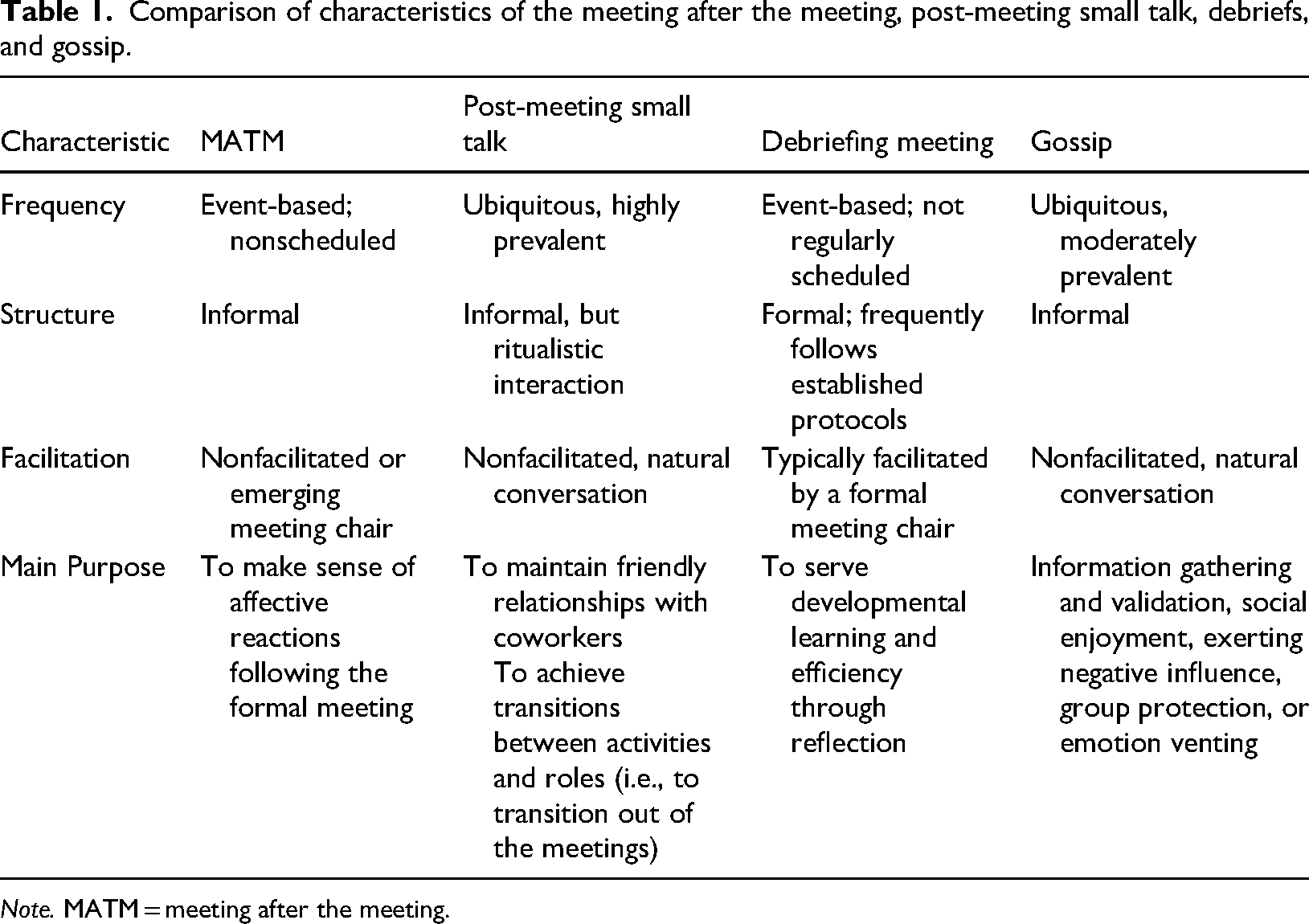
Note. MATM = meeting after the meeting.
Post-Meeting small talk
Small talk in organizations is generally defined as “short, superficial, or trivial communication that does not convey information core to task completion” (Malinowski, 1972/1923, as cited in Methot et al., 2020, p. 3). It is a common activity in organizations and occurs in a wide variety of situations. Whereas initial research has already specifically addressed the role of pre-meeting small talk (Mirivel & Tracy, 2005; Yoerger et al., 2015), post-meeting small talk has been largely neglected. Building on the general role and importance of small talk, we can assume that post-meeting small talk promotes friendly interactions and helps individuals to transition between roles and activities (Ashforth et al., 2000). For instance, Methot et al. (2020) described “individuals may engage in small talk to psychologically disengage from a meeting and transition into their lunch break” (p. 10).
This disengagement function of small talk highlights that post-meeting small talk is most likely not related to the specific agenda items that were discussed but focuses on private or social topics (e.g., plans for the weekend, sports). Yet, as noted frequently in ethnographic work, it is quite difficult in practice to draw a clear line between different forms of workplace talk (Holmes, 2000; Miriviel & Tracy, 2005). The boundaries between formal meeting talk and post-meeting small talk are likely to be fluid, ultimately suggesting that formal meetings should not be viewed as a completely isolated communication event (Duffy & O‘Rourke, 2015).
A key difference between post-meeting small talk and the MATM is that small talk can be seen as a ritualized behavior that takes place after every meeting, whereas the MATM is not a regular event. Further, although both forms of communication can be classified as informal, small talk is usually shorter in duration. The most striking difference is reflected in the name, namely that the MATM is a meeting (and is recognized as such by its participants, see Schwartzman, 1989), and post-meeting small talk is not. That is, while the MATM refers to work-related interactions related to the functioning of the group or organization (as per definition of a meeting, e.g., Boden, 1994; Rogelberg et al., 2006; Schwartzman, 1989), post-meeting small talk neither has to be work-related nor does it occur for reasons other than wanting to be friendly or polite. As a result, post-meeting small talk is not necessarily related to events that occurred during the formal meeting preceding it, nor does it have to carry any specific consequences for future meetings. The MATM, however, is triggered by affective reactions and focuses specifically on topics of the previous meeting or interpersonal relationships of the participants.
Debriefs
Debriefs are a particular type of meeting “in which teams discuss, interpret, and learn from recent events during which they collaborated” (Allen et al., 2018b, p. 504). Debriefs were originally used in the form of after-action reviews in the military and subsequently transferred to other high-responsibility teams (e.g., health care, aviation). However, meta-analytical findings have shown that this form of team learning activity is also suitable for teams outside high-responsibility environments (Tannenbaum & Cerasoli, 2012). Debriefs follow a formal structure, often accompanied by an established protocol, and are typically facilitated by a meeting chair. This can be the team leader, but also a team member, external coach, or instructor. Originally, debriefs were used mainly on an ad hoc basis after a critical event, but now, debriefs are often used independently from critical performance episodes (Allen et al., 2018b). The main purpose of debriefs is their diagnostic nature and related developmental intent. This means that debriefs are used to look back together on team events, reflect on specific positive and negative team behaviors, and identify clear starting points for further collaboration.
Debriefs differ from MATM primarily because of their formal nature. Debriefs are official meetings that are highly structured, whereas the MATM is informal and not documented in official records. Moreover, debriefs have a very clear objective: they promote learning within the team. While the MATM also contributes to sensemaking, it is much more diverse as the triggers that lead to the MATM arise from the situation (as described in the following section).
Gossip
Broadly defined, gossip refers to “the exchange of information about absent third parties” (Foster, 2004, p. 81) and is usually conceived of as evaluative (Brady et al., 2017). Despite its bad reputation (often equated with malicious talk), gossip can be considered as a behavior which is instrumental to social functioning (e.g., Beersma & Van Kleef, 2012). Accordingly, individuals are assumed to gossip for five main reasons tied to their social role (Beersma & Van Kleef, 2012; Dores Cruz et al., 2019): 1) To gather and validate information (e.g., acquiring new information about the gossip target or making sure whether other group members share one's opinion of said target); 2) for social enjoyment (e.g., entertaining oneself and others); 3) to exert negative influence (e.g., to convince other group members of one's negative opinion of the target); 4) to protect and regulate the group through maintaining group norms (e.g., to establish how group members are allowed to behave); and 5) to vent pent-up emotions, that is, the urge to share emotionally evocative experiences.
As opposed to post-meeting small talk and debriefs, gossip is not a construct that is distinctly different to the MATM. In fact, gossip is a behavior which is likely to occur during the MATM, specifically in terms of its group regulatory function. However, gossip can occur in many other situations other than during a MATM, and importantly, the MATM is not only characterized by gossip. That is, even if the MATM is strongly relationship-oriented and includes evaluations about other meeting participants’ behaviors during the formal meeting, this does not necessarily mean that these other participants are absent from the meeting (as per definition of gossip). For instance, one may be annoyed and confused by the fact that one's colleagues engaged in side talk during the meeting but did not dare to voice this anger until the meeting leader left the room. Moreover, as mentioned earlier, the MATM can also serve task-focused purposes, such as by constituting a space for participants to develop a common understanding of their goals, roles, and tasks and it thus not restricted to evaluations about people.
Finally, another important distinction is that gossip is not just event-based and can thus occur at any time, irrespective of a formal meeting. Through its function of information gathering and validation, gossip may form a part of the sensemaking process (e.g., by learning about the other participants’ opinion of the formal meeting leader's behavior) but its content may just as well pertain to people and events that are completely unrelated to the formal meeting. Accordingly, as opposed to the MATM, gossip does not serve the primary purpose of explaining individuals’ affective reactions towards an event (i.e., the formal meeting).
The MATM: An affect-based process model
To determine how the MATM ultimately fits into the larger meeting science literature, several antecedents and boundary conditions must be investigated. The affect-based process model that we present in the following (see Figure 1) describes the factors contributing towards the occurrence of the MATM. Considering that not all formal meetings will necessarily elicit a subsequent MATM, we focus on those aspects that determine whether the formal meeting a) is associated with novel or unexpected events that require explanation (i.e., sensemaking); and b) elicits the necessary affective reactions that fuel sensemaking (see Maitlis et al., 2013). Accordingly, even though the occurrence of the MATM is likely a multilevel phenomenon with factors at individual, group, and organizational levels that more generally influence sensemaking tendencies or environmental uncertainty, we focus on the immediate factors that trigger the occurrence of the MATM.
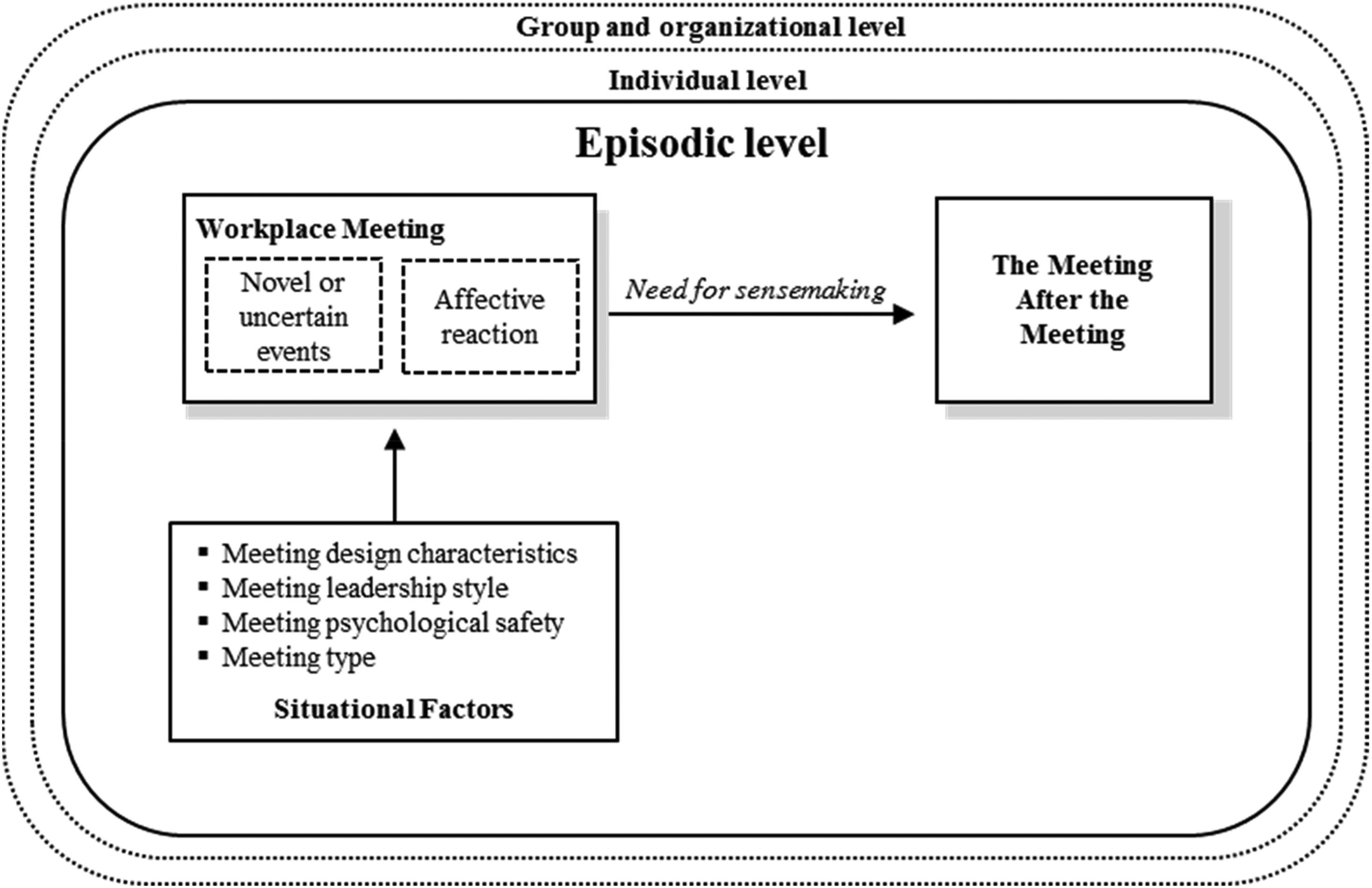
Affect-based process model of the meeting after the meeting.
Specifically, we argue that the triggers for the MATM will first and foremost be situated in the formal meeting proceeding the MATM, which requires an episodic view of the two meeting events. As described earlier, we assume the MATM can be understood as a sensemaking process fueled by an affective reaction to the previous meeting. This affect is essential to understanding the daily experiences and behaviors of employees in organizations (for reviews, see Barsade & Knight, 2015; Brief & Weiss, 2002; Zapf et al., 2021).
In a recently published taxonomy of affective work events (Ohly & Schmitt, 2015), meetings were frequently cited as pivotal work events that lead to a change in employees’ experiences and feelings. Although prior research and articles in practitioner journals have mostly focused on the negative aspects of meetings, Ohly and Schmitt's findings (2015) highlight that meetings function as both negative work events (e.g., “endless discussion at the meeting without satisfying results”, p. 24) and positive work events (e.g., “attended a funny meeting with good atmosphere. We laughed a lot”, p. 27). This ambivalence is also reflected in the so-called love/hate relationship with meetings (Lehmann-Willenbrock et al., 2016).
The MATM can then be seen as an affect-based response to the formal meeting that helps meeting participants manage their emotions and make sense of their meeting experiences. Moreover, through sharing one's interpretation of an affective reaction (e.g., that one feels angry because of the incessant side talk by other participants of the formal meeting or that one is proud to have been praised by the meeting leader for the excellent presentation given during the formal meeting), the MATM can help participants to regain control over their social environment and obtain emotional support from others (see e.g., Jolly & Chang, 2021). In the case that the formal meeting is experienced as a positively toned event, the MATM can serve to give space to these positive emotions and share favorable impressions from the meeting with others, which is in line with previous research showing that positive affect is associated with higher levels of interpersonal communication and collegial interactions (Cunningham, 1988; McGrath et al., 2017). In the case that the formal meeting is perceived as a negatively toned event, the MATM can be used to vent these negative emotions. Negative work events have been shown to be predictors of counterproductive work behaviors that help regulate emotions, reduce stress, and regain control (e.g., Matta et al., 2014; Penney & Spector, 2005).
In sum, we argue that the occurrence of the MATM is triggered by participants’ affective reactions towards specific (uncertain, novel) events that took place during the preceding formal meeting. From this perspective, the MATM constitutes a crucial link between series of formal meetings, explaining how events that occurred in one meeting trigger behaviors in subsequent meetings and thereby how meeting behaviors solidify or evolve over time. However, not all events that occur during the formal meeting are unexpected or novel, nor will they necessarily provoke affective reactions. Accordingly, not all formal meetings trigger a subsequent sensemaking process, and thus the occurrence of a MATM. Specifically, we argue that a range of situational factors moderate the relationship between a formal meeting and the occurrence of the MATM (see Figure 1).
Situational factors
While the situational factors we propose in Figure 1 and elaborate on in this section may not be exhaustive, they reflect key factors that influence meeting structure and climate. Specifically, we argue that meeting structure and climate are pivotal to understanding both how meeting events may necessitate sensemaking and why they provoke affective reactions (thereby triggering the occurrence of the MATM), as these situational factors determine the degree to which participants are free to voice their ideas, concerns, and evaluations during the formal meeting.
Meeting design characteristics
In reviewing the existing meeting science landscape, initial attempts have been made to summarize evidence-based recommendations for meeting design characteristics that contribute towards successful meetings (Lehmann-Willenbrock et al., 2018; Mroz et al., 2018). Meeting design can encompass physical (e.g., lighting, room temperature), temporal (e.g., meeting length, promptness of meeting start and end), procedural (e.g., using an agenda, taking minutes), and attendee (e.g., inviting only those participants who have expertise relevant to the meeting, having a meeting facilitator) characteristics that can influence meeting satisfaction and effectiveness (Cohen et al., 2011; Leach et al., 2009; Odermatt et al., 2015). It seems likely that a poorly designed meeting would provoke the occurrence of a MATM. First, it gives room for unexpected events to take place. For instance, without a set agenda, topics may be raised that team members could not sufficiently prepare for in advance. Next, it is a breeding ground for negative affective responses. This may range from annoyance at other meeting participants engaging in long monologues that fail to move the meeting forward (because there is no agenda and no one to facilitate the meeting) to frustration for having to wait around for team members who are late to the meeting (see also Allen et al., 2018a).
Meeting leadership style
Likewise, meeting leadership may play an important role in the appraisal of meeting events. Meetings regularly center on discussions, problem-solving, and decision-making that require input from all meeting attendees (Mroz et al., 2018). Whether all meeting participants can contribute their views depends largely on the meeting leader's behavior and actions (e.g., Allen & Rogelberg, 2013). Various studies have, therefore, focused on the role of the meeting leader and the resulting symmetries and asymmetries in meeting interactions (for an overview, see Mroz et al., 2020). For instance, even though controlling the conversational floor (e.g., by assigning speaker turns and regulating topic progression) can contribute to more efficiency (Asmuß & Svennevig, 2009), it can also prevent people from expressing their opinions freely. Accordingly, research suggests that effective leaders take care not to overstructure their meetings (Van der Haar et al., 2017) and that it may be more important for leaders to show consideration during meetings (e.g., by identifying and addressing meeting attendees’ concerns) than to initiate structure (Odermatt et al., 2017). As a result, meeting leadership is likely to influence the occurrence of a MATM, such that high levels of initiating structure (without corresponding levels of consideration) result in unanswered questions and pent-up emotions, the combination of which triggers subsequent sensemaking processes. The affective reactions towards a formal meeting high in initiating structure and low in consideration may be both negative as well as positive, for instance because team members want to praise other members or share humorous anecdotes but did not find the time to do this during the formal meeting.
Meeting psychological safety
Beyond the meeting leader, we argue that the general microclimate that is created during formal meetings will relate to the occurrence of a MATM. A decisive factor here is likely to be psychological safety, which describes people's “perceptions of the consequences of taking interpersonal risks in a particular context” (Edmondson & Lei, 2014, p. 24). Psychological safety is central to individuals contributing ideas and actions and specifically addressing critical issues (Edmondson & Lei, 2014). In the context of formal meetings, the construct of meeting psychological safety (Shumski Thomas et al., 2018) is based on the views of individual meeting participants regarding their perceptions of the climate in the meeting (e.g., “The people in my last meeting were able to bring up problems and tough issues.”). Shumski Thomas et al.'s (2018) research shows that surface-level acting (i.e., suppressing undesired emotions and faking expected—mostly positive, affiliative—emotional displays) during meetings is related to lower levels of psychological safety. Accordingly, a lack of meeting psychological safety suggests a meeting climate where participants feel that they cannot authentically voice questions, doubts, or emotions, which would likely lead to unresolved issues cueing up over the course of the formal meeting. Uncertain or novel events during formal meetings low in psychological safety will thus provoke negative affective reactions (e.g., fear), thereby increasing the occurrence of the MATM, such that views and concerns are informally shared after the formal meeting with a select group of participants.
Meeting type
Finally, it could well be the case that the MATM occurs more frequently after certain types of formal meetings than others. Most of the existing meeting research refers to the generic staff meeting, which is characterized by participants knowing each other well, the meeting taking place regularly in this constellation, and participants reviewing recent events and updating each other (Kello & Allen, 2020). Such meetings can be seen as routine events (similar to e.g., shift change meetings), which will require little subsequent explanations (i.e., sensemaking) in comparison to other meeting types (e.g., project team meetings). Moreover, affective events theory (Weiss & Cropanzano, 1996) suggests that the intensity of an affective reaction generated by a sensemaking trigger depends on how important that event is to personal goals (see also Maitlis et al., 2013). Accordingly, meetings that are less important to the participants’ personal goals (e.g., committee meetings where an individuals’ involvement is usually only temporary) may trigger less intense (positive or negative) affective reactions than others and are thus less likely to lead to the occurrence of a MATM.
Discussion
The overarching aim of this article was to drive research on the MATM by providing (1) a detailed conceptualization of the MATM, and (2) an affect-based process model that describes the occurrence of the MATM and which may serve to guide future research on the MATM and, more generally, on meetings as a sequential phenomenon.
Theoretical implications
This article contributes to recent theorizing on meetings in several key ways and is intended to offer a starting point for empirical research on the MATM. First, a core contribution of this paper is to introduce the MATM into organizational psychology and management research. That is, we call attention to the study of this rather pervasive informal communication event, discriminate the MATM from similar forms of communication in the workplace (namely, post-meeting small talk, debriefing meetings, and gossip), and position the MATM as an event worthy of investigative focus. Of particular importance here is the processual view of meetings (i.e., the link between the formal meeting and the informal MATM). We thereby urge future researchers adopt a perspective that sees meetings as series of interconnected events that jointly shape employees’ experiences at work (Duffy & O‘Rourke, 2015), rather than continuing to treat them as isolated discrete events. More specifically, we suggest that further research on the MATM can provide important insights into how structure unfolds outside formal control.
Second, this article advances research on workplace meetings by illuminating the conditions that contribute to the emergence of the MATM. Specifically, the affect-based process model that we presented contextualizes the MATM in time and describes which factors inherent in the formal meeting may spark a MATM. By virtue of this episodic perspective, the model highlights the complex nature of the MATM and offers explanations for why the MATM is more prevalent in some situations than others. We thus encourage future researchers to use this model as a guiding framework for further investigations on meetings as a sequential phenomenon.
Third and finally, the conceptualization developed in this article provides a theoretical framework to understand the various outcome implications that might result from the MATM. Building on the affect-based process view of the MATM, the primary purpose of the MATM is for participants to make sense of their affective reactions towards the preceding formal meetings. Through this process of sensemaking, participants can reduce ambiguity and create order (Weick, 1995; see also Scott et al., 2015). Further, the conceptual work of this article points to the potential of the MATM for regulating both individual affect as well as intragroup relations. That is, meeting participants can use the MATM to lend and seek emotional support, strengthen friendships, and create more cooperative interaction patterns (see also Barsade & Knight, 2015). However, the effects of emotion sharing, particularly in the form of emotion venting, can also likely be critical, namely when meeting participants use the MATM to regain control by undermining decisions made in the formal meeting or attempting to reinforce group norms through gossip (Beersma & Van Kleef, 2012).
Practical implications
Based on the conceptual work presented in this article, we derive some initial recommendations for dealing with the MATM from a more practical side. From a managerial perspective, the MATM probably does not meet expectations or hopes placed on proper meeting behavior, and thus is likely to be perceived as a form of organizational misconduct. Although managers will probably discourage these gatherings—especially those meetings that are more negatively toned—they cannot be completely prevented and are an essential part of the informal organization (Stohl, 1995). Thus, rather than viewing the MATM as something unwanted that should best be discouraged or silenced, the MATM can be a valuable warning sign for managers. Because of its informal nature and potential focus on delicate topics, the MATM reflects important issues with leadership and group dynamics. If attended to, managers can use the MATM to indirectly gain important insights into their employees’ everyday experiences at work. By developing a sensitivity for these post-meeting interactions, managers can make an effort to understand their employees’ perspectives.
Furthermore, understanding the MATM also means understanding that meeting discourse is context-dependent. Based on work concerning workplace gossip, we know that information raised in one context can have a different meaning in another depending on the people involved in the conversation and the confidentiality of the meeting (Hafen, 2004; Mills, 2010). Thus, an incident that was discussed purely as information in a formal meeting can turn into a gossipy conversation in the MATM. Awareness of how meeting talk travels between formal and informal meetings can help managers understand how meetings impact interpersonal dynamics and ultimately the structure that emerges from meetings. In short, meetings should not be viewed as events that take place in a social vacuum. A systemic view of meetings that emphasizes interconnectivity (e.g., by recognizing the role of the MATM as a link between formal meetings) is more helpful in making sense of the potential disorder that follows from meetings (Duffy & O‘Rourke, 2015; Schwartzman, 2015).
Avenues for future research
Our discussion of the MATM provides a point of reference for a range of future research endeavors. Based on anecdotal observations and reports in the management literature (Fishburne, 2014; Lauby, 2015; Sudakow, 2017), it can be assumed that there is no one MATM in terms of the topics discussed and the focus of the meeting. Instead, the MATM could take on various forms and thus be related to a range of different both functional as well as dysfunctional outcomes. Future research could thus be directed at developing a typology of the MATM. For instance, as an affect-laden event, the formal meeting preceding the MATM can result in both positive and negative affective responses, meaning that the MATM itself could be discerned in terms of its positive vs. negative affective valence. Second, the MATM can revolve more or less strongly around tasks or around interpersonal relationships, meaning that one MATM may differ from another in terms of a task vs. a relationship focus (following the established classification in related research areas, see e.g., Bales, 1950; Jehn, 1995). Potential cross-classifications of these differences in valence and focus could lead to different archetypes of the MATM which could guide both research and practice in terms of determining the outcome implications of a particular type of the MATM.
A further aspect warranting future research is the role of the MATM as a link between formal meetings and thus a change of perspective that regards meetings as a series of interconnected events that unfold their meaning and effect over time. Next to theoretical considerations that deal with the evolution of meeting structures, roles, and behaviors over sequences of formal meetings and MATMs, we would encourage empirical research on meetings that draw on longitudinal measurement designs. This would enable researchers to analyze the extent to which certain behaviors occur, but also emotions depend on prior meetings as well as the explanatory function of the MATM in predicting behaviors and emotions in successive meetings. Moreover, the episodic perspective on meetings we take in this article would call for the application of non-linear analytical procedures, such as lag-sequential or recurrent quantification analysis (for an application of these procedures to meeting data, see e.g., Lehmann-Willenbrock et al., 2013; Meinecke et al., 2020). These approaches would enable researchers to investigate, for instance, the likelihood of MATM occurrence as a function of meeting type or patterns of emotional reactions over a series of formal meetings and MATMs.
Finally, it would be interesting to specifically investigate the role and occurrence of the MATM in virtual contexts. Virtual collaboration is generally associated with higher levels of ambiguity than face-to-face interaction, given there are fewer (or even no) observational opportunities and thus less information on other team members’ work environments, actions, thoughts, and feelings (e.g., Handke et al., 2022; McLarnon et al., 2019). Accordingly, virtual collaboration likely requires more sensemaking processes, yet at the same time, it provides less opportunities for informal, unscheduled conversations (Lechner & Tobias Mortlock, 2021; Webster & Staples, 2006). Initiating a MATM after a formal virtual meeting would involve different strategies than in a face-to-face context, where meeting participants share the same physical space and may just remain in the meeting room or catch up in the hallway. In a virtual MATM, participants would thus likely adopt strategies such as starting a parallel “meeting” through the chat function offered in most videoconference platforms or on other instant messaging channels or waiting for the meeting leader to leave the virtual meeting room first. At this stage, qualitative research may be particularly suited to uncover the different ways in which virtual team members may organize MATMs and how this relates to team functioning.
Conclusion
To conclude, the MATM is an unscheduled, informal, and confidential communication event that has the potential to create new structures in everyday organizational life. Empirical research is now needed to test the relationships postulated in the corresponding affect-based process model as well as to develop typologies based on the current conceptualization of the MATM. In doing so, we can develop a richer understanding of the MATM regarding its different forms and effects.
Footnotes
Declaration of Conflicting Interests
The author(s) declared no potential conflicts of interest with respect to the research, authorship, and/or publication of this article.
Funding
The author(s) received no financial support for the research, authorship, and/or publication of this article.
