



Abstract
In this conceptual paper, we define a person's meeting mindset as the individual belief that meetings represent opportunities to realize goals falling into one of three categories: personal, relational, and collective. We propose that in alignment with their respective meeting mindsets, managers use specific leadership claiming behaviors in team meetings and express these behaviors in alignment with the meeting setting (virtual or face-to-face) and their prior experiences with their employees. Employees’ responses, however, are also influenced by their meeting mindsets, the meeting setting, and prior experiences with their managers. The interplay between managers’ leadership claiming behavior and their employees’ responses shapes leader–follower relations. Embedded in the team context, the emerging leader–follower relations impact the meaning of meetings. We outline match/mismatch combinations of manager–employee meeting mindsets and discuss the influence that a manager and employee can have on each other's meeting mindset through their behavior in a meeting.
Keywords
Meetings involve people talking to each other and thereby creating meaning. Scholars have emphasized that the meaning of meetings in general, and team meetings in particular, is influenced by context-dependent purposes, such as information sharing, brainstorming, problem-solving, or socializing (Hansen & Allen, 2015; Scott et al., 2015). Managers have attracted particular attention in that regard, as their position of formal power allows them to shape meeting agendas and enforce decisions. Furthermore, they attend numerous meetings, with Lehmann-Willenbrock et al. (2018) reporting that managers spend up to 80% of their working hours in meetings. Using formal power to guide meetings is, however, not the same as enacting leadership, which is defined as the exhibition of a goal-directed social influence process that requires the acceptance of employees, who are supposed to follow (Antonakis, 2018). To convince others to follow and give meaning to a meeting (i.e., steering individuals toward a preferred understanding of the organizational reality; Duffy & O’Rourke, 2015), managers attempt to craft meeting interactions through leadership claiming behaviors, which employees can either endorse or reject. The dynamic process of managers claiming leadership and employees responding to these signals shapes the leader–follower relations between managers and their employees, which in turn creates a collective meaning of the meeting.
Thus far, however, it remains unclear why managers prefer to engage in different forms of leadership claiming behaviors in team meetings and what influences whether employees endorse or reject these signals. Going beyond concrete meeting purposes, we argue that managers and their employees enter meetings with certain mental representations that shape their behavior and that they continue to update these representations over the course of a meeting. To describe the content of these meeting-related mental representations, we coin the term meeting mindsets. Meeting mindsets refer to how people define the meaning of meetings in terms of the degree to which these social situations represent an arena in which one can attempt to realize one of three classes of goals: personal, relational, and collective (Brewer & Gardner, 1996; Flynn, 2005). From the perspective of a manager, perceiving a team meeting as (a) a setting in which they can strategically position and promote themselves reflects a personal meeting mindset; (b) seeing a meeting as an opportunity to shape collaborations and to distribute tasks represents a relational meeting mindset; and (c) understanding a meeting as an opportunity to strengthen the team identity and increase team members’ willingness to go the extra mile for the team reflects a collective meeting mindset. We argue that a manager's meeting mindset determines the forms of behavioral signals through which they claim leadership to wield influence in a meeting. Employees react to these behaviors, with their responses being guided by their own meeting mindsets. Depending on the (mis-)match combination of meeting mindsets, the employees will either endorse or reject the manager's leadership claiming. The resulting leader–follower relation then feeds back to influence the manager's next leadership claiming behaviors and meeting mindset. As such, employees are not passive recipients of leadership but rather play an active role in shaping leadership and managers’ meeting mindsets. In a team meeting context, several of these leader–follower relations emerge and jointly influence the meeting mindsets and meeting behaviors of the attendants. Through this interactive process, the enacted collective meaning of a meeting manifests and also feeds back into the general meeting mindsets of attendants.
Although our theorizing focuses on leader–follower interactions within a specific meeting, with these interactions being shaped by (mis-)matches between the meeting mindsets of the manager and their employees, it is important to note that such meetings are embedded in time and space. Managers and employees enter a meeting with a specific mental representation of the personal, relational, or collective goals that should be achieved (i.e., their prior meeting mindsets). We propose that certain parts of these prior representations are activated when entering a meeting depending on the prior experiences with each other in previous meetings and the meeting setting, which can be virtual or face-to-face. To illustrate, a manager cannot signal their status in a virtual meeting by sitting at the head of a table, a typical leadership claiming behavior (DeRue & Ashford, 2010). However, a manager can, for example, employ technology to craft their online appearance (e.g., via a high-resolution webcam) or use symbols to convey a competent image (e.g., through positioning a bookshelf in the background), set up alternative communication channels to craft exchange relationships (e.g., open parallel conversations in personal chats to negotiate tasks and roles), or establish new forms of note-keeping (e.g., visual boards) to craft a collective team experience and support shared team cognition. Similarly, an employee can endorse (e.g., by using emoticons) or reject (e.g., by turning off the camera) a manager's leadership claiming behavior through different behavioral signals in a virtual as compared to a face-to-face setting. Furthermore, the meeting setting influences how an employee may endorse or reject a manager's leadership claiming behaviors depending on their interactions with other employees who are also participating in the meeting. For example, in a face-to-face setting, the other participants’ nonverbal reactions to the manager's behaviors may be more easily visible than in virtual settings, which can influence a focal employee's reactions to leadership claiming. In contrast, in virtual settings, multi-tasking and side conversations (e.g., the exchange of backchannel messages with other participants) outside of the manager's knowledge are a common phenomenon (Cao et al., 2021), thus offering a different form of peer influence that can modify an employee's reaction to leadership claiming. To summarize, both prior experiences and the meeting setting shape meeting attendants’ respective activated meeting mindsets (i.e., the mental representations of the classes of goals that should be realized in the present meeting). The manager's and employees’ activated meeting mindsets in turn shape their behavior, the emerging leader–follower relation and ultimately how all parties involved perceive the meaning of meetings. Figure 1 illustrates the proposed relationships by depicting our conceptual model.
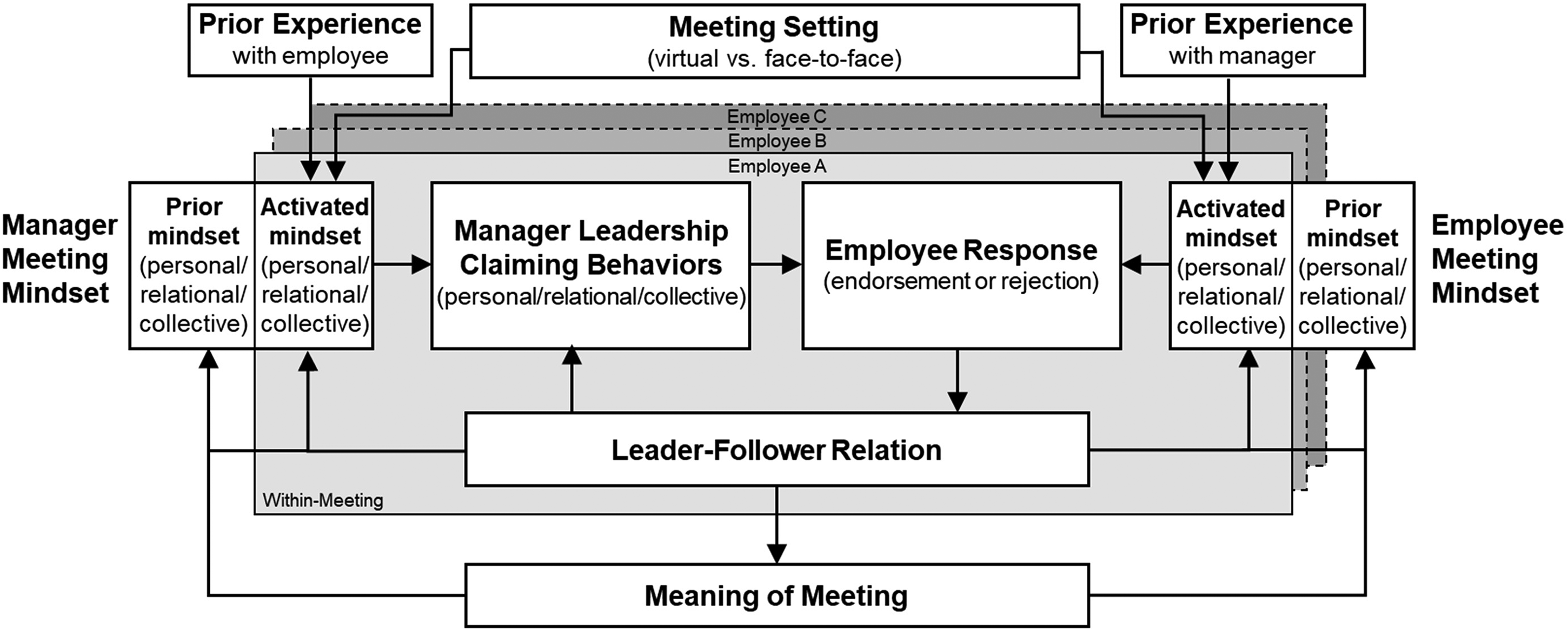
Conceptual model: The interplay of manager behavior and employee response in meetings. Note: The grey box displays the within-meeting interaction process in an employee-manager dyad; the dashed dark grey boxes in the background indicate that the proposed dynamic interplay exists as many times as there are employees in the meeting. These interplays are inextricably linked with each other (i.e., emergent team impact on the manager).
In developing our conceptual model, we make three contributions to the literature. First, we add to the meeting literature by introducing the concept of meeting mindsets. We borrow the idea for this construct from the identity orientations literature (Flynn, 2005) and adapt it to the meeting context to explain why managers and employees enact, endorse, or reject different forms of interactions in meetings. The insights derived from this theoretical reasoning also contribute to practice, as our dynamic account of meeting mindsets emphasizes that mindsets toward meetings can be activated by contextual features such as prior experiences with the other meeting attendants and the setting of a meeting (virtual vs. face-to-face). Moreover, activated meeting mindsets are continuously updated over the course of a meeting, and thereby the meaning of meetings can be changed. Second, by connecting theorizing on meeting mindsets with a social exchange perspective on leadership, we put goals and mindsets center-stage to account for the dynamic interactions that shape leader–follower relations through the alignment of meeting mindsets over the course of a meeting. Specifically, we introduce different combinations of manager and employee meeting mindsets and discuss who may adapt to whom and how this process shapes meeting interactions. In doing so, we contribute to an emergent stream of literature (Fairhurst & Uhl-Bien, 2012; Güntner et al., 2021; Uhl-Bien & Carsten, 2018; Uhl-Bien et al., 2014) that emphasizes the active role of employees in shaping leader–follower relations in general and managers’ meeting mindsets in particular. Lastly, we also consider that the enactment of meeting mindsets is embedded in time and space, thereby specifically extending the e-leadership literature (e.g., Avolio et al., 2014; Larson & DeChurch, 2020) by identifying leadership claiming behaviors unique to the virtual environment and mapping them onto the proposed meeting mindsets.
Managers’ Meeting Mindsets and Preferences for Leadership Claiming Behaviors
Identity scholars (Brewer & Gardner, 1996; DeRue & Ashford, 2010; Flynn, 2005) have long subscribed to the notion that the ways in which people engage in interactions, what they expect from others, and the outcomes they hope to achieve while engaging in social situations are strongly influenced by the way in which they see themselves as acting entities in the social world. We transfer this notion to the meeting context to explain why meeting attendants prefer certain forms of exchange in meetings. As such, our focus lies on the nature of meeting communication itself as a means to reinforce or alter the cognitive structures of meeting attendants and thereby reinforce or change the collective understanding of the meaning of meetings and participants’ roles within them (Scott et al., 2015). In particular, we coin the term meeting mindset to refer to the mental representation through which a person creates expectations regarding meetings, determines appropriate behavior during meetings, and processes the information presented in meetings. In other words, a meeting mindset can be understood as a lens or frame of reference that people use to look at and make sense of the interactions that occur in meetings.
The identity literature (Brewer & Gardner, 1996; Flynn, 2005) describes three fundamental mindsets or orientations 1 : personal, relational, or collective. Transferred to the meeting context, this mental representation shapes behavior: When a manager attends a meeting, how they attempt to wield social influence is influenced by their idea of what types of goals (i.e., personal, relational, or collective) people aim to achieve in meetings. Depending on a manager's meeting mindset, fundamental leadership functions such as exhibiting task-, relation-, or change-oriented leadership behavior can be expressed in very different ways. For example, a manager may engage in a change-oriented behavior such as communicating a vision by connecting it to their individual values (personal mindset), rooting a vision in their relationship with specific employees (relational mindset), or emphasizing how a vision could contribute to the greater good (collective mindset). Furthermore, the signals that a manager employs to express their meeting mindset need to be adapted to the meeting setting (i.e., whether the meeting takes place virtually or face-to-face). Virtual meetings are planned gatherings conducted with the help of technology that allows meeting attendants to see and hear each other while they are participating from different locations. Physical face-to-face meetings are characterized by interactions taking place between participants who are present in the same physical environment during a meeting. Many behaviors that support influence attempts in physical settings—such as manipulating artifacts associated with leadership (DeRue & Ashford, 2010), keeping interpersonal distance (Dean et al., 1975), or moving one's body in a dominant way (Reh et al., 2017)—can hardly be employed in the same way in virtual settings. Hence, changes in context (i.e., from a physical to a virtual meeting environment or vice versa) can require managers to adapt the signals they use to claim leadership (Larson & DeChurch, 2020). Such context changes thus present a pertinent window of opportunity to change the meaning of meetings because the adapted information environment requires managers to adapt the cues used to claim leadership (Labianca et al., 2000) and offers employees new opportunities to react to these signals.
Personal Meeting Mindset
Individuals with a personal meeting mindset believe that people are self-interested and self-oriented in their behaviors. Accordingly, individuals with this type of mindset expect themselves and others to strive for self-focused goals, aim for direct reciprocation, and explicitly discuss exchange conditions in meeting interactions (Flynn, 2005). They draw energy and self-esteem from personal successes and personal traits or characteristics, which they consider to be unique and distinct from those of others. Meetings are thus not their preferred way to spend their time (Rogelberg et al., 2006), and, if people with a personal meeting mindset need to attend meetings, they tend to use them as arenas for self-promotion and the fulfillment of their own needs. Accordingly, managers with a personal meeting mindset seek to enact leadership through devising personal crafting strategies that focus on their appearance via self-promotion (i.e., presenting themselves in the best possible light) and endorsing tit-for-tat-exchanges (i.e., providing security for the collaboration of self-interest-maximizing employees). Managers can use several verbal and non-verbal tactics in meetings to craft their appearances and create leader-like impressions. Verbal tactics such as emphasizing previous experiences and successes, making comparisons with others, highlighting the importance of individual achievements, or providing compelling visions based on one's own values work equally well in both face-to-face and virtual settings. Non-verbal leadership claiming behavior, in contrast, may need to be adapted to the meeting setting. Table 1 illustrates some tactics that managers may use to convey a personal meeting mindset in both virtual and face-to-face meetings.
Leadership Claiming Behaviors Reflecting Personal, Relational, and Collective Meeting Mindsets in Face-to-face and Virtual Meetings.

Note: The possibilities for crafting verbal signals (i.e., what people say) do not differ much between physical face-to-face and virtual meetings. We thus present these strategies in an integrated for both meeting settings. In contrast, the possibilities for crafting non-verbal (i.e., not using or involving words or speech) and para-verbal (i.e., how people speak, e.g., pitch of voice, prosody, intonation) signals as well as meeting setup and technology do differ to quite some extent between physical face-to-face meetings and virtual meetings. Therefore, we present these latter strategies separately for both types of meetings.
Relational Meeting Mindset
Individuals with a relational meeting mindset believe in the power of dyadic relationships in which interaction partners balance both their own interests and those of others (Flynn, 2005). In contrast to people with a personal meeting mindset, those with relational meeting mindsets are more willing to invest in relationships, even if reciprocation is not immediate. However, should they not receive anything back from the interaction partner over time (i.e., lack of reciprocation), they may give up on a good relationship with that person. Accordingly, people with a relational mindset judge each relationship separately to determine the degree of self- and other-interest they are willing to show in specific social exchanges. Managers with a relational meeting mindset seek to enact leadership through relational crafting strategies that focus on the definition of roles and responsibilities, as well as reciprocation. Furthermore, they use the fulfillment of role-appropriate behavior as a frame of reference with which to evaluate employees’ behavior (Flynn, 2005).
When conceptually deriving managerial meeting behaviors rooted in a relational mindset, it becomes evident that nearly all research in this area is based on the Leader–Member-Exchange (LMX) construct. The LMX literature has recently been criticized based on both conceptual (e.g., unclear definitions and unclear nomological net) and empirical (e.g., lack of suitable measurement tools) problems (Gottfredson et al., 2020). These criticisms indicate the need to go back to the drawing board and to not blend the cause (i.e., meeting behavior) and effect (i.e., the resulting leader–member relationship). In that regard, studies from the organizational communication and organizational discourse literatures can inspire theorizing in organizational psychology. Studies from these domains analyzed actual communication behaviors in leader–member interactions to disentangle managers and employees’ use of power moves and social distance language forms (Courtright et al., 1989; Fairhurst & Chandler, 1989). To shape the relations in a meeting, managers with a relational meeting mindset may claim leadership by defining what is role-appropriate for each meeting attendant when interacting with them in the team meeting context. For example, a manager can start a meeting with a power move and may consider it role-appropriate to be the first person to speak or give themselves and selected others more speaking time throughout the meeting. As meetings are increasingly moving into the virtual environment, managers with a relational meeting mindset may need to express some of their leadership claiming behaviors in different ways in virtual as compared to physical face-to-face meeting settings. Specifically, while verbal behaviors to craft exchanges are expected to work equally well in virtual and physical face-to-face meetings, managers will likely use context-specific power signals to shape distinct leader–employee relations with every meeting attendant in the online setting. Table 1 outlines some verbal, non-verbal, and para-verbal signals; physical artifacts; and technological means that managers may specifically apply in virtual or physical face-to-face meeting settings to express a relational meeting mindset.
Notably, managers with a relational meeting mindset do not engage in behavior that is consistent across all employees but instead adapt their leadership claiming behaviors to the degree of negotiated legitimacy with every employee. Negotiated legitimacy describes the degree to which certain behaviors are permissible in the respective working relationship based on previous implicit or explicit agreements. To illustrate, a manager can allude to insider information that only some of the attending employees know or assign certain roles (e.g., taking minutes, timekeeping) only to certain meeting attendants. Additionally, managers can non-verbally shape the relational inclusion or exclusion of certain meeting attendants by how often they look at them (Shim et al., 2020), thereby also guiding the attention patterns of other team members (Dalmaso et al., 2011). The mindset reflected in these managerial influence behaviors is that those meeting attendants who deliver more deserve to be rewarded with higher attention and recognition. Such exclusive treatment should motivate employees with less positive leader–follower relations to strive to improve their relations with their manager, too.
Collective Meeting Mindset
Individuals with a collective meeting mindset believe that people are other-oriented and strive for the best for the collective in their behaviors (Flynn, 2005). People with such a mindset are convinced that members of a group should do well irrespective of whether or not there is direct reciprocation, as, one day, their efforts will be rewarded (i.e., indirect reciprocation). Accordingly, extra-role exchanges and affect-focused interactions, which can include self-disclosure components between all meeting attendants, are self-evident for individuals with a collective meeting mindset. They are concerned about the welfare of others and define their momentary sense of self in relation to the group they are part of (i.e., social identity).
Managers with a collective meeting mindset seek to enact leadership in meetings through employing collective crafting strategies that encompass leadership behaviors focused on encouraging meeting attendants to shift from self-interest and role-appropriate behavior to focusing on the collective interest and welfare (Johnson et al., 2012). In doing so, managers with a collective meeting mindset craft the identity of the team itself (who “we” are; Haslam et al., 2020) and thereby also shape meeting attendants’ cognitive representations of the team (team cognition) and emergent team processes (team trust). More specifically, managers with a collective meeting mindset claim leadership by guiding meeting attendants to include everyone and modeling behavior that they would like to see every member of the team exhibit (Day & Harrison, 2007). Managers with a collective meeting mindset believe that the best can be achieved if a sense of “we” is created during meetings, which means that their meeting communication focuses on, for example, addressing all team members, asking questions to determine how team members interpret their goals, or providing a direction that strengthens the collective identity of the meeting attendants. For managers with a collective mindset, claiming leadership can (seemingly paradoxically) also imply giving power away to support more distributed forms of leadership. In their eyes, doing so is not paradoxical, as managers with a collective meeting mindset do not see themselves as being distinct from other meeting attendants. Meta-analytic research (Steffens et al., 2021) on leader group prototypicality (i.e., the extent to which the manager is perceived to embody the shared social identity of the group) provides support for the notion that the managerial meeting behavior of acting as part of the team is successful to claim leadership. This is because managers’ influence is contingent on the extent to which they represent what is prototypical for the group of meeting attendants, and the managerial crafting of a shared team identity (cf. “crafting a sense of us”; Haslam et al., 2020) can even enhance managers’ group prototypicality.
The meeting setting again influences whether and to what extent a collective meeting mindset is activated and expressed. Table 1 provides some insight into how managers with a collective meeting mindset transmit their leadership claiming behaviors in a virtual (as compared to a physical face-to-face) meeting context to be able to effectively craft team cognition and develop team trust in an online setting.
Overview of Propositions.
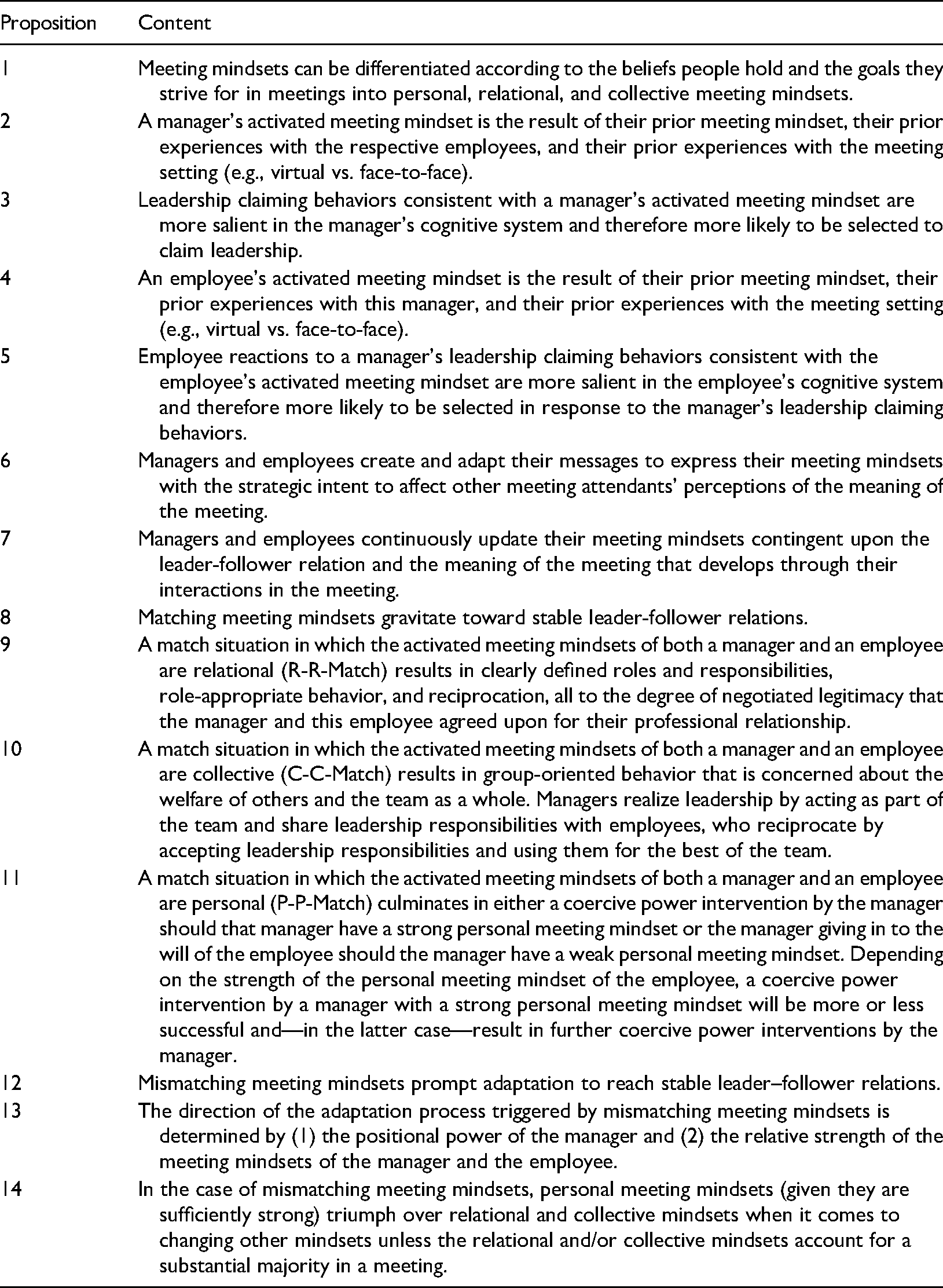
Our first proposition summarizes the above analysis of the differences between personal, relational, and collective meeting mindsets:
Conceptualizing Meeting Mindsets As Malleable Mental Representations
Although a person's mindset or orientation is often closely connected with their motives and self-definition, a person's meeting mindset is different from the understanding of an identity as a relatively stable feature (i.e., the answer to the question “Who am I?”). That is, a meeting mindset is more narrowly defined (i.e., focused on meeting-related mental representations) and can be updated over time through interactions with other people in meetings in which the activated components of one's meeting mindset shape the interaction. This reasoning is in line with the understanding of those identity scholars who state that a person's active self-concept can change from individual to relational or collective levels, which in turn alters the basis for self-identities and social motivation (self-interest, others’ benefit, and collective welfare, respectively; Flynn, 2005; Lord et al., 2016). It also resonates with a discursive understanding of identity as a temporary and processual construction that is regularly reproduced and negotiated in social interactions, thereby offering a means by which managers can wield influence (Alvesson & Willmott, 2002; Sveningsson & Larsson, 2006).
Transferred to the meeting context, it is important to consider that the activated meeting mindsets of attendants with which they enter a conversation do not exist in a social vacuum based only on their prior meeting mindsets but are instead influenced by prior experiences with the others who are present in the meeting as well as the meeting setting (i.e., virtual vs. face-to-face). The activated meeting mindsets of meeting attendants shape the initial messages that they convey in a meeting. More specifically, this entails that a manager's initial leadership claiming behaviors result from strategic intent based on their activated meeting mindset, which they express by considering the anticipated reactions of employees (informed by prior experiences with those employees) as well as the means through which they can communicate (i.e., virtual vs. face-to-face). The reason is that leadership claiming behaviors that are consistent with a manager's activated meeting mindset are more salient in that manager's cognitive system (i.e., more easily accessible in memory; Higgins, 1996) and are therefore more likely to be retrieved from memory. From the manager's perspective, these leadership claiming behaviors are most appropriate for the current meeting setting. In summary, leadership claiming behaviors that are consistent with a manager's activated meeting mindset are thus more likely to be selected for claiming leadership in meetings. Propositions 2 and 3 summarize these ideas:
A manager's leadership claiming behaviors trigger both intended and unintended consequences that manifest in the reactions of employees, who interpret the manager's behavior through the lenses of their own meeting mindsets, prior experiences with the manager, and the meeting setting (i.e., virtual vs. face-to-face). Propositions 4 and 5 explicate these processes from the perspective of the employee:
During the ongoing social exchange that occurs in a meeting, the attendants continuously update their meeting mindsets (see Figure 1). This line of argumentation fits with the conceptualization of meeting interactions as strategic (Beck & Keyton, 2009) in the sense that creating and adapting messages to express one's meeting mindset constitute a strategy intended to affect other meeting attendants’ perceptions of the meaning of the meeting. Furthermore, our theorizing is in line with the idea of ascribing meetings an ongoing socialization function (Scott et al., 2015; Scott & Myers, 2010), which entails that meetings continuously constitute, change, and reinforce (power) relationships and offer guidance in terms of how both leader and follower roles should be enacted.
Our dynamic perspective implies that we recognize leadership as a mutual influence process in meetings that is not automatically granted to individuals holding hierarchical supervisory roles. Instead, leadership is socially constructed and must be negotiated in interactions through both direct and indirect verbal, para-verbal, and non-verbal behaviors or symbols (DeRue & Ashford, 2010; Fairhurst & Grant, 2010; Uhl-Bien, 2006). Individuals interpret these signals, which entails that they attempt to capture the perceived intent or mindset behind a message (Beck & Keyton, 2009). However, going beyond a focus on leader and followership claiming and granting processes in meetings (cf. DeRue & Ashford, 2010), we propose that it is not only leader and follower roles that are shaped in meetings through social construction processes; instead, we argue that the resulting leader–follower relations have broader implications for the meanings that managers and employees ascribe to meetings and the lens through which they perceive themselves in such interactions (i.e., their meeting mindsets).
We next elaborate on different combinations (i.e., matches or mismatches) of manager and employee meeting mindsets that can manifest in meeting interactions. Specifically, we develop propositions specifying which party may be more likely to adapt their meeting mindset to that of the other and thereby jointly shape the meaning of a meeting. To allow for precise theorizing, we discuss the proposed mechanisms on the dyadic level (i.e., between one manager and one employee). However, typically, several employees interact with a manager in a team meeting. We therefore conclude the delineation of our framework by considering the role of the team context in our theorizing. Specifically, we introduce the notion that the proposed dynamic interactions exist exactly as many times as there are employees in a meeting.
Match or Mismatch Between Meeting Mindsets and Their Consequences
We next consider the interplay of the meeting mindsets of managers and their employees in the temporal context of a meeting (Sonnentag, 2012). What happens when managers claim leadership in a meeting by expressing behaviors that reflect their respective meeting mindsets? Evidently, meeting attendants need to respond to these behaviors. They do so not as blank slates but rather based on the perspective suggested by their activated meeting mindsets. For each attending employee, there can be a match (i.e., congruence) or a mismatch between their own and a manager's activated meeting mindset. More specifically, nine combinations are possible (cf. Figure 2). Three combinations represent match situations in which both an employee and a manager hold a personal (P-P-Match), relational (R-R-Match), or collective (C-C-Match) mindset, respectively. Six combinations constitute mismatches (i.e., the activated mindset of an employee and that of a manager comprise a personal-relational, personal-collective, or relational-collective mindset mismatch combination). From a theoretical perspective, our model addresses three types of mindset constellations that impact the likelihood that one interaction partner will adapt their activated meeting mindset to that of the other, which in turn will stabilize the emerging leader–employee relation: (1) the match of activated meeting mindsets, (2) the mismatch of activated meeting mindsets, and (3) the team context of activated meeting mindsets in interaction.
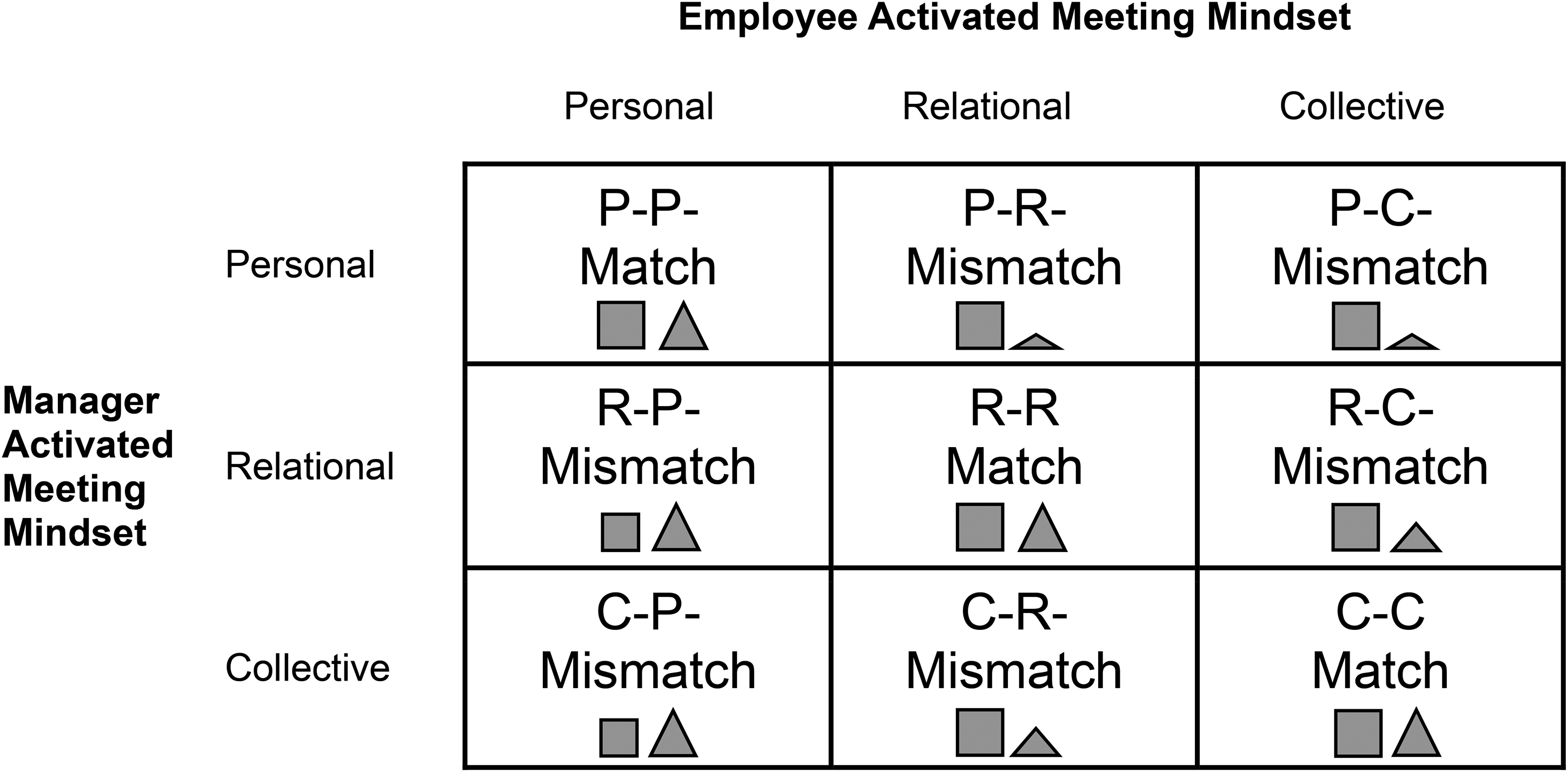
Possible combinations of match/mismatch of manager-employee meeting mindset. Note: The rectangle symbolizes the manager, the triangle symbolizes the employee, the size of the respective symbol indicates the amount of influence to change the interaction partner's meeting mindset. For the three match combinations, the rectangle and the triangle have the same size, indicating that an equilibrium develops that is characterized by a stable manager-employee relation. When the rectangle is larger than the triangle (i.e., P-R; P-C; C-R, R-C), this indicates that the manager's impact on the employee's meeting mindset is larger than the impact of the employee on the manager and vice versa.
Match of Meeting Mindsets: Stable Leader–Follower Relation
When a manager's behavior (which expresses their activated meeting mindset) matches an employee's activated meeting mindset, the employee will feel validated in their meeting expectations, and the manager will feel accepted in terms of the way in which they exhibit social influence. Through their conversations, the manager and the employee confirm each other's view of the meeting purpose, resulting in a stable leader–follower relation.
Notably, the stability of a leader–follower relation does not automatically indicate high effectiveness or satisfaction with this relationship. Due to the shared feature of inclusiveness, which involves integrating others into one's self-identity, the R-R-Match and the C-C-Match situations are indeed likely to be perceived as representing a high-quality relationship by the manager and employee involved. More specifically, the R-R-Match situation puts the establishment of roles and responsibilities at center stage. The manager and employee negotiate their respective roles and responsibilities, clearly define what is expected from each other and what role appropriate behavior looks like, and engage in mutual reciprocation for fulfilling expectations. Their interactions go beyond a pure tit-for-tat approach and instead establish a relationship in which manager and employee trust each other that reciprocation will eventually be granted. As a consequence, their leader–follower relation will develop into a well-established dyadic exchange relationship in which the partners agree on a spectrum of expectable and acceptable behaviors.
Similarly, the C-C-Match situation renders group-oriented behavior salient. The manager and employee define their momentary sense of self in relation to the group that they are part of (i.e., social identity). In a C-C-Match situation, both parties are concerned about the welfare of others, and the meeting behavior of acting as part of the team is therefore successful to claim leadership. Managers with a collective meeting mindset provide direction that strengthens the collective identity of meeting attendants (Haslam et al., 2020) and share leadership in the interest of the team as a whole. Employees with a collective meeting mindset positively respond to such behavior and reciprocate by accepting leadership responsibilities, thus contributing to successful distribution of leadership responsibilities in the team and stable leader–follower relations.
However, in the P-P-Match situation, the quality of the leader–follower relation is presumably not that positive. This is because when a manager and an employee each hold activated personal meeting mindsets (which entails that they are motivated by their own goals and personal welfare), it is not very likely that they will act in ways that satisfy each other's expectations (Jackson & Johnson, 2012). Consider, for instance, a manager with a personal meeting mindset who selects a specific qualified employee in a meeting to support them in a project that, if successful, might help the manager to secure a promotion. If that employee also has a personal meeting mindset and should the project not be in line with that employee's self-interest, then the employee may attempt to argue that it would be better if another employee would support the manager in this project. The result might be additional influence attempts by the manager and prolonged discussions, which could result in a coercive power intervention by the manager and corresponding negative feelings on the part of the employee. Needless to say, the resulting situation is unlikely to be to the satisfaction of all parties. However, our point is that in most cases, the coercive power intervention by the manager will end the discussion and lead to an unsatisfactory but stable relationship between the manager and the employee without either of the two having changed their meeting mindset. It should be noted, however, that not all managers will have a personal meeting mindset strong enough to lead them to invest the energy required to enforce their will on such an employee. Similarly, not all employees will have a weak enough personal meeting mindset to be willing to give in to a manager's coercive power intervention. When this is the case and the manager refrains from the power struggle with the respective employee, the manager will ultimately give in and find a different solution (e.g., assigning the task to another employee).
To conclude, irrespective of the consequences for the effectiveness or satisfaction with a leader–follower relation, a match situation generates a stable leader–follower relation in which neither the manager nor the employee changes their meeting mindset as a result of the interaction between the two of them. In the case of a P-P-Match, however, the manager and the employee agree to disagree. Depending on the strength of the manager's and the employee's meeting mindsets and, as a consequence, the amount of energy they are willing to invest to get their will accepted, the manager or the employee will ultimately succeed in imposing their will on the other party.
Mismatch Between Meeting Mindsets: Adaption to Reach a Stable Leader–Follower Relation
Should there be a mismatch in meeting mindsets, the manager and the employee may have difficulty interpreting each other's behavior, consider it inappropriate, and experience confusion (Tsai et al., 2017). This issue can be solved should one person adapt to the meeting mindset of the other and a stable leader–follower relation emerge as a result.
However, who is more likely to yield in a meeting and thus more likely to adapt to the other person's meeting mindset—a manager or an employee? To answer this question, we propose that the degree to which a manager or an employee can influence the other's meeting mindset through their behavior in a meeting depends on (1) their respective positional power, (2) the relative strength of each person's meeting mindset, and (3) the type of mismatch situation. Given that a manager typically occupies a more powerful position within an organization, we propose that they will invoke influence on employees to adopt their understanding of the classes of goals that should be achieved to the classes of goals the manager is striving for in the present meeting. More specifically, we argue that the positional power of the manager acts as a contextual influence cue that employees use to construct and interpret the situation in a way compatible with the meeting mindset of the manager and, as a consequence, at least in part adapt their own meeting mindset accordingly (cf. Salancik & Pfeffer, 1978). Concerning the relative strength of meeting mindsets, we contend that the meeting mindsets of managers and employees need not necessarily be equally strongly pronounced. We propose that stronger meeting mindsets will be more impactful than weaker meeting mindsets in terms of influencing the adaptation process triggered by a mismatch between meeting mindsets.
Beyond the positional power of the manager and the relative strength of the meeting mindsets, a third factor is believed to influence the adaptation process triggered by mismatching meeting mindsets, namely the type of mismatch. Drawing from and extending the identity orientations framework (Flynn, 2005), we propose that not all mismatching situations are created equal. This is because the tit-for-tat strategy of a meeting attendant with a personal meeting mindset exploits the relational or collectively driven behavior of the other. In the absence of a shared social norm among meeting attendants that would prevent such exploitation, the person with the personal meeting mindset will prevail. A prerequisite for such a shared norm seems to be that relational and/or collective mindsets account for a substantial majority in a meeting.
Integrating the claims made in Propositions 13 and 14 results in the notion that the “impact advantage” of a manager due to their more powerful position manifests in all mismatch combinations (i.e., P-R, P-C, R-C, C-R) with the exceptions of those two in which the employee holds a personal meeting mindset (i.e., R-P, C-P; depicted by the relatively smaller size of the squares in Figure 2). In the P-R and P-C mismatches (i.e., the manager holds a sufficiently strong personal meeting mindset and the employee a relational or collective, respectively), as well as when the employee holds a sufficiently strong personal mindset (i.e., R-P, C-P), the individual with the personal meeting mindset (irrespective of their position power) always has greater potential to lead the other person's meeting mindset in a more self-orientated direction. Consider, for instance, a manager with a collective meeting mindset interacting with a new team member who has a personal meeting mindset. The manager will attempt to influence and, if necessary, use their position power to change the meeting behavior of the new team member and thus that member's meeting mindset. However, should the manager realize that the new team member fails to stop deviating from the collectively endorsed meeting mindset and that the team as a whole is being exploited by the self-focused behavior of the new team member, the manager will adapt their meeting behavior to match the personal-oriented style of the new employee. In line with this notion, theoretical accounts of ethical leadership propose that role stressors or manager-directed deviance can lead managers from prosocial and moral behavior to amoral management (Greenbaum et al., 2015).
In the remaining two combinations—the manager holds a relational meeting mindset and the employee a collective meeting mindset (R-C) or vice versa (C-R)—we expect that the manager has a greater impact on changing the employee's meeting mindset through their behavior. In a C-R situation, the collectively oriented manager will direct influence attempts at the relation-oriented employee in an attempt to get the employee to change their meeting mindset to a collective mindset. The fact that the relation-oriented employee derives their self-worth from having high-quality relationships and satisfied partners is conducive to the success of these influence attempts (Flynn, 2005). As a consequence, the relation-oriented employee is likely to switch to a collective orientation to satisfy their manager's claim and to establish a high-quality relationship with the manager. In contrast, in an R-C situation, due to their positional power, the manager may not be inclined to strive for a satisfied partner in the same way as the employee, as the manager might derive their self-worth to a greater degree from defining role relationships that are consistent with their mindset and idea of leadership. Accordingly, the relation-oriented manager might be more reluctant to switch their meeting mindset to the collective ideas of the employee but may instead strive for an individually satisfactory relationship with that employee. Nevertheless, the employee holding a collective mindset might be successful in changing the manager's meeting mindset in a team context in which the employee does not act alone but is rather supported by other employees with a collective meeting mindset—a topic we turn to next.
No Manager (and no Employee) Is an Island: The Team Context
The mechanisms outlined thus far (for an overview of allpropositions, see Table 2) manifest on the dyadic level—that is, between one manager and one employee. In a meeting context, however, typically several employees interact with a manager, which entails that the proposed dynamic processes exist exactly as many times as there are employees in the meeting. Figure 1 illustrates this through the dashed dark grey boxes in the background, which indicate that the proposed dynamic interplay exists as many times as there are employees in the meeting. These interplays are inextricably linked with each other (i.e., joint team impact on the manager). In that regard, the size and unity of a team (Oc & Bashshur, 2013) are essential determinants of followers’ impact on their manager. Importantly, unity in that regard refers to an overlap not only in employees’ meeting mindsets but also in their interpretation of the manager's messages as reflecting a personal, relational, or collective mindset (Beck & Keyton, 2009; Hollingshead et al., 2007). Although precisely determining how many employees with an individual, relational, or collective meeting mindset would be required in one meeting to change a manager's meeting mindset is beyond the scope of this model, the underlying logic can be extended to the team context: The more employees with a specific meeting mindset are present and the stronger these employee mindsets are, the more reluctant those employees will be to change their mindsets and the more willing they will be to attempt to change the way in which their manager tries to wield social influence in the meeting (cf. Park & Hinsz, 2006).
To illustrate, let us return to the situation in which a manager with a collective meeting mindset is confronted with an employee with a personal meeting mindset. As long as only one employee deviates from the manager's personal meeting mindset, with other meeting attendants all holding collective meeting mindsets, the manager may attempt to contain the situation via influence attempts directed specifically at this employee. Should these attempts prove unsuccessful, the manager may ultimately switch to a more tit-for-tat behavioral strategy (representing an activated personal meeting mindset) for this specific employee only. However, in a meeting in which a manager with a collective meeting mindset is confronted with not one but several employees with a personal meeting mindset, it is more likely that the manager will not be able to achieve the self-imposed collective goals in the meeting. Rather, the manager might also switch to a personal meeting mindset to protect themselves from exploitation by the majority of other meeting attendants holding personal meeting mindsets. A more positive outcome, however, can occur when the majority of meeting attendants hold a collective meeting mindset; in such cases, over the course of several meetings, the attendants might prove successful in changing the meeting behavior of their personal meeting mindset manager to match the collective focus of the team. This change can occur because the meeting attendants’ shared collective mindset prevents exploitation of individual team members by the manager and motivate meeting attendants’ to attempt to change their manager's meeting mindset (cf. “strength in numbers”; Park & Hinsz, 2006).
Depending on the size of a team, a very high number of possible constellations of meeting mindsets can potentially manifest in a team meeting. The larger the team or the shorter its history of working together (e.g., a newly formed project team), the more probable that constellations representing all three forms of meeting mindsets may emerge in a single meeting. Our point is that the interaction dynamic that unfolds in a meeting based on a certain mindset constellation will still be determined by the three principles we have outlined: (1.) Matching meeting mindsets gravitate toward stable leader–follower relations. (2.) Mismatching meeting mindsets provoke adaptation to reach stable leader–follower relations. (3.) The adaptation process is governed by the positional power of the manager, the relative strength of the manager's and employees’ meeting mindsets, and the premise that personal meeting mindsets (given that they are sufficiently strong) triumph over relational and collective mindsets when it comes to changing other mindsets (unless relational and/or collective mindsets account for a substantial majority in a meeting). In the latter case, the majority constellation prevents that those who belong to the majority are exploited by the behavior resulting from the personal meeting mindset of one or more attendants.
Theoretical Implications and Future Research Directions
Most previous research has studied effective leadership behavior in meetings through the lens of team effectiveness (e.g., Hoogeboom & Wilderom, 2015), thereby overlooking the fact that meetings also have a socialization function in which attendants influence what they expect from others, and which outcomes they hope to achieve in social situations (Scott et al., 2015). With the present contribution, we shift the focus to the underlying mindsets that shape the interactions between managers and employees in meetings, the relationships that emerge from these interactions, and the consequences for the activated meeting mindsets of the interaction partners.
An important implication is that our conceptual account can explain why many individuals experience meetings as unsatisfying occasions for self-promotion. That is, as specified in Figure 2, individuals with a personal meeting mindset tend to overrule other attendants without realizing that they are doing so (Scopelliti et al., 2015), thereby changing the type of behavior that others show and that is considered acceptable in a meeting. While this activation of personal meeting mindsets may stabilize leader–follower relations, it is an unhealthy equilibrium that transforms the meaning of meetings into arenas where attendants solely pursue their personal interests. Eventually, this unhealthy equilibrium may make those with a personal meeting orientation unhappy because they have to spend their time in meetings with others who strive for positive joint interactions; in addition, this equilibrium may also leave those with a relational or collective meeting mindset unsatisfied because their needs are similarly not fulfilled. To conclude, the concept of meeting mindsets can be used as a theoretical tool by which to make sense of the experiences of meeting attendants. By focusing on matches versus mismatches between meeting mindsets in a team context, our framework allows deriving theoretical predictions of how these experiences bring about changes in attendants’ meeting mindsets and the way meetings are performed. When one recognizes that the collective meaning of meetings at the team level is embedded in a larger organizational context, it follows that meetings can ultimately sustain or change the collective focus on personal, relational, or collective goals in organizations (Scott et al., 2015).
In terms of conceptual extensions of our model, it seems worthwhile to acknowledge that we contribute to the literature by contrasting virtual and physical face-to-face meetings, whereas business meetings in the future will likely increasingly be conducted in a hybrid form (Rappaport, 2020). The need to adapt social influence signals to a hybrid form allows managers to experiment with new leadership claiming behaviors and provides employees with novel opportunities to endorse or reject their managers’ behaviors. Newly established or changed leader–follower relations, in turn, modify the perceived meaning of meetings, thereby ultimately changing the mindset that managers and employees hold toward meetings. Accordingly, we suggest developing new theoretical accounts of how managers exhibit leadership claiming behavior in hybrid meetings (i.e., gatherings with a combination of physical and virtual attendance; Cichomska et al., 2015). For example, it is conceivable that managers with a personal meeting mindset may find it easier to claim leadership when they are among those individuals who are attending physically. This is because more traditional status symbols of leadership can be used and physically present attendants tend to be more salient and dominant in meetings (Cichomska et al., 2015). To increase their social influence, managers with a relational meeting mindset may encourage those team members with whom they have better relationships to attend via the same channel as themselves. In hybrid meetings, physically present team members tend to more strongly identify with other physically present team members compared to those team members who are attending virtually, a phenomenon which poses a particular challenge for managers with a collective meeting mindset (Fiol & O’Connor, 2005). To create a sense of “we,” a manager will likely attempt to use their social influence to persuade members to use means of communication that allow all team members to participate and connect equally, which entails that both physically present and virtually attending employees can share their ideas, knowledge, and emotions using technology (Kahlow et al., 2020).
As another conceptual extension of our model, it might be fruitful to theorize as to the implications of different meeting mindsets being activated at the same time. While, for conceptual clarity and theoretical frugality we focused our theorizing on singular meeting mindsets being activated, future extensions of our model might aim to retain this conceptualization's strength and overcome some of its limitations by incorporating the idea that, in principle, meeting mindsets—like identities (cf. Walker, 2021)—need not necessarily operate exclusively. Put differently, personal, relational, and collective meeting mindsets might no longer be defined by mindset content, but rather be treated as three independent continua that any potential mindset varies along across contexts (cf. Walker, 2021).
In terms of directions for future empirical research, a test of the proposed conceptual account seems warranted as a first step. Scholars could certainly further explore the role of the team context by investigating how different constellations of employees with individual, relational, or collective meeting mindsets in one meeting can influence the manager's meeting mindset and the emerging meaning of the meeting. Furthermore, future research could help to empirically pinpoint the timeframes across which the meaning of meetings changes and the accompanying beliefs with which individuals approach meetings (i.e., their meeting mindsets). Developing a suitable research design would likely require several steps should scholars wish to refrain from solely using questionnaire data to capture managers’ and employees’ meeting mindsets, as survey measures may make it difficult to capture meeting processes through a high-resolution lens (i.e., high sampling frequency; cf. Klonek et al., 2019).
To provide some inspiration, scholars could develop an objective method for identifying meeting mindsets by using topic modeling to analyze text material in a pilot study (e.g., Banks et al., 2018; Doldor et al., 2019; Speer, 2020) to find typical expressions reflecting each meeting mindset. They could then videotape regular meetings between the participating managers and their employees over several months and code the leadership claiming behaviors and employee responses that occur in the meetings utilizing the markers identified in the pilot study. Such an approach would make it possible to capture changes in the expressed mindsets over time; it could also be complemented with a survey asking the managers and employees about their perceptions of the intention of the messages expressed in meetings and the meaning of each meeting. As an alternative to questionnaires, scholars could also conduct a retrospective analysis (Jordan & Henderson, 1995) relying on semi-structured interviews to capture meetings attendants’ perceptions of and comments about key meeting moments. The interviewees’ reflections could either be captured by encouraging retrospective interpretations of specific meeting interactions (Beck & Keyton, 2009; Hoogeboom & Wilderom, 2015) or by asking participants to review recordings of their meeting behavior and explain their motivations and intentions (Elsbach & Kramer, 2003). The obtained data set would not only provide rich material with which to test and extend the proposed model but also help to bridge behavioral and perception research as well as offer opportunities to showcase how deductive analytic work can be combined with inductive analyses and multiple forms of triangulation to move research on meetings and leadership forward.
Furthermore, a practically relevant future direction would be to draw from research in related fields, such as social psychology (e.g., Oyserman & Lee, 2008; Molden, 2014), and think about how the meeting mindsets of attendants could be changed to make meetings more effective. One possible strategy by which to change the meeting mindsets of attendants and/or the meaning of meetings might be to use priming (i.e., providing cues that activate or trigger certain motives in a person's memory). This technique has been successfully used in research on diversity beliefs (e.g., Cho et al., 2017) and demonstrated to have at least a short-term influence on how people behave in social interactions. Similarly, we would expect that scholars may be able to develop micro-interventions that impact the meeting mindsets of attendants. For example, to reduce the influence of diverse meeting mindsets on interaction dynamics, participants may be asked to read a short text, or a manager may present a video at the beginning of a meeting that represents behaviors in line with the meeting mindset they would like to see. Such an approach may set the stage for subsequent meeting interactions and be even more effective than communicating general meeting norms or guidelines. In that regard, it would be also interesting to explore whether managers and employees can become better at observing and analyzing their own meeting communication to behave even more strategically when attempting to influence each other's meeting mindsets (Courtright et al., 1989).
Lastly, our model implies that the meaning of meetings is not set in stone and that both managers and employees can adapt their inner beliefs about what people strive for in meetings. In that regard, a central assumption is that the employee is not a passive follower in the leadership process but instead actively and voluntarily influences it through their own initiative. While we focused here on specifying leadership claiming behaviors, future researchers may want to further explore the role of employee perceptual processes (i.e., how do employees interpret the strategic intent reflected in the behavior of their managers?) as well as the concrete behaviors that employees show to endorse or reject their managers’ influence attempts in virtual or face-to-face meetings. In the same way that scholars developed coding schemes to capture leadership claiming behaviors (e.g., Gerpott et al., 2019; Schlamp et al., 2021), we would also consider it a valuable endeavor to develop comprehensive coding schemes for capturing different supportive and resistant follower behaviors (Güntner et al., 2021). Furthermore, future research could continue to consider the central role of followers in terms of altering a manager's meeting mindset, and thus the perceived meaning of meetings, to expand our model. For example, new team members represent a change to the team c context, and the addition of new members could potentially serve as a tipping point that amends the meeting mindsets of all other attendants. To conclude, we hope that our work inspires scholars to further study the importance of meetings as arenas in which not only leader- and follower identities are shaped but also individuals’ fundamental beliefs concerning what meetings are conducted for (i.e., meeting mindsets) are endorsed or changed.
Footnotes
Declaration of conflicting interests
The authors declared no potential conflicts of interest with respect to the research, authorship, and/or publication of this article.
Funding
The authors received no financial support for the research, authorship and/or publication of this article.
