



Abstract
Mindfulness has grown from an obscure subject to an immensely popular topic that is associated with numerous performance, health, and well-being benefits in organizations. However, this growth in popularity has generated a number of criticisms of mindfulness and a rather piecemeal approach to organizational research and practice on the subject. To advance both investigation and application, the present paper applies The Balance Framework to serve as an integrative scaffolding for considering mindfulness in organizations, helping to address some of the criticisms leveled against it. The Balance Framework specifies five forms of balance: 1) balance as tempered view, 2) balance as mid-range, 3) balance as complementarity, 4) balance as contextual sensitivity, and 5) balance among different levels of consciousness. Each form is applied to mindfulness at work with a discussion of relevant conceptual issues in addition to implications for research and practice.
Plain Language Summary
In order to appreciate the value of mindfulness at work researchers and practitioners might want to consider both the benefits and potential drawbacks of mindfulness. This paper presents a discussion of both the advantages and possible disadvantages of mindfulness at work organized in terms of the five dimensions of an organizing structure called The Balance Framework.
Mindfulness, “the awareness that arises from paying attention in a particular way, on purpose, in the present moment, and non-judgmentally” (Kabat-Zinn, 1994, p. 4), has been shown to confer numerous advantages (e.g., Brown & Ryan, 2003; Eberth & Sedlmeier, 2012; Farb et al., 2010; Grossman et al., 2004; Hofmann et al., 2010; Jamieson & Tuckey, 2017; Jha et al., 2007, 2010), which are theorized to occur largely through the control of attentional resources (Good et al., 2016). The growing recognition of the benefits of mindfulness has led to exponential growth in the popularity of mindfulness practices across broad settings, including organizations (Sutcliffe et al., 2016). For example, Glomb et al. (2011) argue that mindfulness promotes enhanced employee relationships, resilience, and task performance as a result of its positive effects on the self-regulation of emotional, cognitive, behavioral, and physiological phenomena. Glomb et al. (2011) enumerate several processes, including response flexibility, decreased rumination, and the decoupling of the self from experience that are proposed to characterize these self-regulatory effects and mediate the relationships between mindfulness and work outcomes. Recently, Good et al. (2016) summarized the literature on mindfulness at work and presented a framework that builds on many of the same processes and outcomes enumerated by Glomb et al. (2011) to indicate workplace outcomes for which there is existing empirical evidence, such as work performance, and those for which more research is needed, such as performance variability.
The increased interest in mindfulness has produced a complementary rising wave of criticism (see Walsh, 2016). For example, Van Dam et al. (2018) argue that insufficient attention has been paid to the potential for mindfulness to produce deleterious outcomes. Britton (2019) suggests that mindfulness can be too much of a good thing. Bravo et al. (2016) suggest that the variable-centered analyses that characterize most mindfulness research may mask different consequential mindfulness profiles, highlighting that disparate components of mindfulness may operate synergistically. Good et al. (2016) argue that more attention needs to be paid to context in mindfulness research in organizations. Waldron (2019) argues that insufficient attention is paid to unconscious processes in mindfulness.
Researchers have sought to address the emerging wave of criticism by calling for a more nuanced perspective on mindfulness. For example, Van Dam et al. (2018) suggest that contemporary misunderstandings of mindfulness may lead people to be “harmed, cheated, disappointed, and/or disaffected” (pp. 37–38), and that “a more balanced perspective on the pros and cons of practicing mindfulness” (p. 42) is warranted. Addressing calls for a more balanced and nuanced view of mindfulness would offer a more robust understanding of mindfulness in organizations in addition to a stronger appreciation of its limitations and boundary conditions which could better inform research and practice on the topic.
To this end, in the present paper we apply The Balance Framework (Gruman et al., 2018) to the study of mindfulness in organizations in an effort to present an inclusive picture of the phenomenon that recognizes its advantages, but also acknowledges its shadow side and boundary conditions, which are often neglected. The Balance Framework explicitly highlights that all positive phenomena have nuanced natures and conditions that influence when they are, and are not, advantageous. The body of literature on the potential downsides of mindfulness is insufficient to allow for even tentative conclusions to be drawn. As such, this paper is not a review, but a conceptual analysis and call to action to conduct research employing a more balanced perspective on mindfulness so as to “fill the gaps” by elucidating not only its benefits, but its potential disadvantages. Such research should allow for a more robust conceptualization of the construct and a better understanding of how mindfulness and mindfulness training can be best implemented in organizations.
The present paper makes several contributions to research and practice. First, in applying The Balance Framework to mindfulness we offer researchers an effective way to conceptualize mindfulness, providing a more thorough picture of the construct and practice, and highlighting novel avenues for future research. Second, applying The Balance Framework to mindfulness and stimulating balanced research on the topic will serve to address some of the criticisms leveled against mindfulness. Third, a more balanced perspective allows practitioners to develop, test, and refine more effective mindfulness interventions that better support employees. To help orient the reader, in the next section we describe the construct of mindfulness and present The Balance Framework in more detail before applying it to research and practice on mindfulness in organizations.
Mindfulness
Individual-level mindfulness is studied both as a construct in the form of a trait or state (e.g., Brown & Ryan, 2003), and as a practice that can be developed or implemented (e.g., Baer, 2003; Good et al., 2016). Although scholars have not yet achieved consensus on a specific definition of mindfulness, it is commonly conceived and operationalized with two components reflecting 1) present-moment awareness and 2) an attitude that is accepting, non-judgmental and open to experience (Bishop et al., 2004; Cardaciotto et al., 2008; Lau et al., 2006). Other conceptualizations of mindfulness (e.g., Baer et al., 2006; Walach et al., 2006) generally reflect further distinctions among these two primary components. In this paper we therefore conceptualize mindfulness as awareness that is oriented to the present-moment and characterized by the quality of non-judgment (e.g., Kabat-Zinn, 1982, 1994). This two-component definition has its origins in Eastern mindfulness, which has Buddhist roots, versus Western mindfulness (e.g., Langer, 1989), which reflects a socio-cognitive approach and considers how an individual creates new cognitive categories or distinctions in their perceptual context (Weick & Putnam, 2006). Whereas Western mindfulness is primarily concerned with intrapersonal cognitive processes, mindfulness as we refer to it here encompasses intra- and interpersonal phenomena because the definition includes awareness of internal and external experience. We elected to focus on this approach to conceptualizing mindfulness because it is the most common conceptualization and best exemplifies extant research and practice.
The balance framework
In order to help effectively conceptualize phenomena that make life most worth living (Seligman, 1999), Gruman et al. (2018) developed The Balance Framework, which arose partly in response to criticisms leveled against the field of positive psychology, the science of optimal human functioning (Linley et al., 2006; Seligman, 1999). The Balance Framework reflects developments in positive psychology that involve a growing recognition of the nuanced nature and complexity of ostensibly positive phenomena. Lomas and Ivtzan (2016) suggest that the initial introduction of positive psychology toward the end of the last century (Seligman, 1999) represented the first wave of positive psychology, and the increasing appreciation of the intricacy of positive phenomena represents the second wave. Along with second wave positive psychology, The Balance Framework represents a “new phase of maturity” in the study of positive constructs (Lomas & Ivtzan, 2016, p. 1754). However, The Balance Framework incorporates ideas that are absent from second wave positive psychology, such as the potential benefits of manifesting positive phenomena within an ideal range (Gruman et al., 2018).
The Balance Framework explicitly elucidates that all ostensibly positive phenomena have nuanced natures and conditions that influence whether and when they may be considered beneficial and desirable. The value of The Balance Framework is that it offers a parsimonious way to conceptualize positive phenomena in a manner that recognizes their nuanced nature, highlighting important but often overlooked issues. Specifically, considering positive phenomena through the lens provided by the framework introduces research questions that might otherwise be minimized or overlooked, thus advancing both research and practice. The Balance Framework has been applied to the study of workplace well-being (Gruman & Choi, 2020), employee engagement (Saks & Gruman, 2021), the interrelationship of optimism and pessimism (Gruman et al., 2017), and, along with second wave positive psychology, has been recognized as a development within positive psychology that effectively captures the interaction of positive and negative experiences (Howell & Passmore, 2019).
Although mindfulness is one of the most commonly studied constructs within positive psychology (Donaldson et al., 2015) and has been shown to have salutary effects on human flourishing (e.g. Brown & Ryan, 2003; Dane, 2011; Glomb et al., 2011), there lacks a strategic framework that can address a balanced view of its nature, the conditions under which it is optimally deployed, and the circumstances in which it actually may be detrimental. The purpose of the present paper is to apply The Balance Framework to mindfulness in order to fill a gap in the literature and offer researchers and practitioners a more nuanced and comprehensive lens through which to understand and study mindfulness at work. The application of The Balance Framework to mindfulness suggests several limitations that emerge from examining mindfulness with the limited perspective that currently characterizes the field and allows for a consideration of how a more balanced perspective may offer solutions to some of the criticisms of mindfulness in research and practice. Viewing mindfulness through a balanced lens may contribute to a more theoretically and methodologically robust field of study, providing a roadmap for researchers to investigate this often-misunderstood construct (Purser & Milillo, 2015). Additionally, a more balanced perspective may provide practitioners with a more effective way to think about mindfulness and apply it in organizations.
To best understand positive phenomena, The Balance Framework specifies five ways to consider balance: 1) balance as tempered view, 2) balance as mid-range, 3) balance as complementarity, 4) balance as contextual sensitivity, and 5) balance among different levels of consciousness. Together, the five balance perspectives offer a comprehensive framework for conceptualizing and applying positive phenomena that are intended to promote flourishing individuals in thriving communities (Seligman, 1999). In the following sections we explain the five ways of conceptualizing balance as they apply to mindfulness and present empirical findings and conceptual issues that bear on each conceptualization.
Applying the balance framework to mindfulness
Balance as tempered view
The Balance Framework suggests that phenomena that are typically considered as positive and desirable may also include negative, undesirable aspects, and vice versa. Therefore, even ostensibly positive phenomena might be best regarded in a tempered, even-handed fashion. Mindfulness is generally understood as a positive phenomenon that is indisputably pleasant and beneficial. However, the question arises: Is mindfulness an unmitigated good? Might there be some potentially negative aspects to mindfulness? Should the construct and practice of mindfulness perhaps be considered with a more tempered view?
Below, we consider these questions by discussing three non-orthogonal areas in which mindfulness has been found to offer advantages but has also been shown to present challenges: affect/well-being, cognition, and motivation/behavior. These areas have been selected because they effectively encapsulate the realms in which much mindfulness research has been conducted and are consistent with categories used in prior surveys of the literature (e.g., Good et al., 2016). We note that within each of these areas, much of the available evidence for potential deleterious effects of mindfulness comes from research conducted outside of organizations. As such, the findings should be considered as indirect evidence that needs to be supplemented with studies conducted in workplace environments.
Affect/well-being
Most studies that have explored the consequences of mindfulness in general, and workplace mindfulness in particular, have focused on affective and well-being outcomes such as positive affect, negative affect, anxiety, and stress (Eberth & Sedlmeier, 2012; Jamieson & Tuckey, 2017). In these studies, a significant relationship between mindfulness and desirable outcomes is generally observed. For example, meta-analytic results demonstrate that mindfulness is associated with reduced stress, anxiety (Chiesa & Serretti, 2009; Hofman et al., 2010), and depression (Hofman et al., 2010), and enhanced emotion regulation (Tomlinson et al., 2018), mental health, physical health and well-being (Grossman et al., 2004; Tomlinson et al., 2018). Importantly, positive affective and well-being effects of mindfulness have been shown to occur among healthy individuals at large (Khoury et al., 2015), and employees specifically (Lomas et al., 2017, 2019).
However, there are a growing number of reports of unwanted or adverse effects of mindfulness practice and mindfulness meditation. For example, Brooker et al. (2013) found that an occupational mindfulness training program produced increases in negative affect, perceived stress, and anxiety, and a decrease in job satisfaction among employees.
In their online survey of people practicing mindfulness and meditation, Cebolla et al. (2017) found that 25% of respondents reported unwanted effects, the most common being anxiety, depersonalization, and loss of consciousness or dizziness. Although 39% of these symptoms were transitory, 10% were continuous and 1% of respondents reported discontinuing their practice as a result.
Anderson et al. (2019) surveyed a sample of Western meditators, the majority of which practiced mindfulness meditation. They found that 20% of their sample reported adverse effects including negative emotional and psychological outcomes such as scary thoughts, social and interpersonal drawbacks such as disconnection, stressful personal changes such as existential dread, and serious adverse events such as hallucinations.
Based on a set of semi-structured interviews with meditators, including those who practiced mindfulness meditation, Lomas et al. (2015) found that approximately 25% of their data reflected adverse effects, which included upsetting thoughts and emotions, and the intensification of mental health issues. Importantly, Lomas et al. (2015) indicated that their participants sometimes came to regard the adverse effects as beneficial challenges that eventually promoted their well-being. Indeed, “negative” states may be crucial for the development of insight (e.g., Sharf, 2015). That said, there is evidence that mindfulness is sometimes associated with undesirable emotional/well-being outcomes.
Cognition
Mindfulness has been shown to be associated with a number of cognitive benefits such as improved working memory capacity and a reduction in distracting thoughts (Mrazek et al., 2013), decreased susceptibility to biased decision-making (Hafenbrack et al., 2014), and enhanced performance on cognitive tasks assessing verbal fluency and processing speed (Zeidan et al., 2010). Systematic and meta-analytic reviews have shown that mindfulness is associated with reduced rumination (Tomlinson et al., 2018), improved cognition and attention (Eberth & Sedlmeier, 2012) and enhanced executive functioning such as inhibitory control (Cásedas et al., 2020; Chiesa et al., 2011). In general, mindfulness has been shown to generate benefits with respect to a number of aspects of cognitive functioning that are of great relevance in organizations (Chiesa et al., 2011).
However, there is also preliminary research suggesting that mindfulness may compromise some aspects of cognitive functioning. For example, there is evidence that dispositional mindfulness undermines implicit learning, the ability to acquire knowledge of rule-based complexities independently of conscious effort or awareness (Reber, 1989). Whitmarsh et al. (2013) found that more mindful individuals were less sensitive to discerning the structure of implicit grammatical sequences in an artificial grammar learning task. Similarly, in two studies Stillman et al. (2014) found that individuals who were higher in mindfulness were less adept at detecting patterns in implicit sequence learning tasks. As suggested by Whitmarsh et al. (2013), implicit learning is facilitated by tendencies to respond habitually and automatically, a condition that appears to be undermined by mindfulness. We will revisit the relationship between mindfulness and automatic processing in a subsequent section.
Using word recognition and recall tasks in three experiments, Wilson et al. (2015) found that a 15-minute mindfulness exercise made participants more susceptible to false memories compared to control participants, and argued that this occurs because mindfulness compromises individuals’ reality-monitoring accuracy. Thus, there is preliminary evidence that mindfulness is sometimes associated with deleterious cognitive outcomes.
Motivation/behavior
Mindfulness has been shown to be associated with a number of positive motivational and behavioral outcomes such as autonomous forms of motivation (Donald et al., 2020), reduced impulsivity (Lu & Huffman, 2017), greater behavioral regulation (Brown et al., 2007), increased persistence (Imtiaz et al., 2018), less defensive responding to threatening stimuli (Niemiec et al., 2010), and goal progress through the mediating effect of self-concordant goal setting (Smyth et al., 2020). In the workplace, mindfulness has been shown to foster prosocial behavior (Hafenbrack et al., 2020), and to be associated with reduced turnover intentions (Reb et al., 2017), higher work engagement (Leroy et al., 2013), and meta-analytic evidence suggests that mindfulness is positively associated with job performance (Lomas et al., 2017).
However, there is also evidence that mindfulness may have undesirable motivational and behavioral effects. For example, in a series of studies, Hafenbrack and Vohs (2018) found that short, 8- to 15-minute mindfulness meditation sessions compromised how motivated participants felt in completing the tasks they were assigned (e.g., solving anagrams). This may be because participants felt controlled by the assigned task. As suggested by Donald et al. (2020), controlling environments may make mindful individuals less motivated and more disengaged.
Schindler et al. (2019, studies 3 and 4) found that inducing mindfulness reduced participants’ feelings of guilt and intentions to repair the damage they caused after moral transgressions. Schindler et al. (2019) note that their results do not provide any evidence of the mechanisms underlying their observed effects and that further research is needed.
Initial efforts to practice mindfulness may also deplete self-regulatory resources (Evans et al. 2014) which may compromise task performance. Additionally, although there is evidence that mindfulness can enhance sleep quality and duration (Hülsheger et al., 2015). Britton et al. (2010) found that mindfulness-based cognitive therapy was associated with a physiological measure of lower-quality sleep. Their study involved a sample of partially remitted depressed individuals, so their results may only generalize to employees suffering from mood dysregulation.
It has also been suggested that mindfulness may serve as a means of placating employees while perpetuating malignant organizations (e.g. Good et al., 2016). As Purser and Milillo (2015) state, practicing mindfulness out of context “reduces it to a self-help technique that is easily misappropriated for reproducing corporate and institutional power, employee pacification, and maintenance of toxic organizational cultures” (p. 3). They argue that in accentuating nonjudgmental awareness contemporary definitions of mindfulness constrain employees’ ability to effect normative changes in organizations. Relatedly, Hafenbrack (2017) argues that the accepting attitude engendered by mindfulness may lead employees to think less about desired future outcomes and consequently decrease their motivation to achieve goals. Good et al. (2016) similarly question whether mindfulness might lead employees to accept mistreatment in the form of abusive supervision and inhibit adaptive responses. However, contrary to the suggestions that mindfulness turns employees into uncritical drones and promotes passive acceptance of organizational dictates, Baer (2015) argues that mindfulness is in fact more likely to promote proactive, engaged behavior. Preliminary research supports this latter view, providing evidence that mindfulness encourages adaptive, flexible responding (Baron et al., 2018; Carmody et al., 2009), and makes employees more sensitive to mistreatment (Walsh & Arnold, 2020).
In sum, there is evidence that mindfulness is not an unmitigated good. In their review of mindfulness meditation, Van Dam et al. (2018) caution that the media in particular has overlooked the potential for mindfulness and meditation to cause various types of harm, and suggest that adverse effects can include the intensification or recurrence of preexisting conditions or the development of new unwanted, harmful symptoms. Van Dam et al. (2018) suggest that participation in mindfulness practices may, in fact, be contraindicated for certain individuals. Although more research is needed to corroborate and extend the findings presented above, as well as more fully explore underlying processes, they nonetheless suggest that mindfulness can have negative consequences in addition to the celebrated positive consequences and may be better understood in a more tempered fashion.
Future research on balance as tempered view
There appears to be preliminary evidence to suggest that mindfulness can have deleterious effects on affective/well-being, cognitive, and motivational/behavioral outcomes that are relevant to employees and organizations. Ensuring that the potential negative implications of mindfulness are adequately considered is critical in the formation of a balanced perspective. An overly positive portrayal undermines mindfulness research and misinforms those who decide to engage in mindfulness practice. Drawing attention to the negative aspects of mindfulness would help to address the criticism that mindfulness is marketed as an all-purpose treatment with little downside. Unfortunately, most mindfulness studies do not assess potential adverse effects (Lindahl et al., 2017) and much of the available evidence is anecdotal in the form of case studies (e.g., Anderson et al., 2019). As a result, there is relatively little high-quality, scientific knowledge on this topic, including a lack of knowledge of what causes adverse effects and how to manage them (Lindahl et al., 2017). More research is therefore needed that specifically examines the possible deleterious effects of mindfulness in organizations, the conditions under which such effects may occur, and the individuals who may be most prone to them.
Research is also needed on the time-course of negative effects and on whether they may potentially serve as part of a longer-term growth process that ultimately generates positive outcomes. Of note, most of the research on the negative effects of mindfulness has been conducted outside of organizations. Of the 11 papers cited in this section that analyzed primary data on the negative effects of mindfulness, only one (Brooker et al., 2013) involved research conducted in an organizational setting. More research is needed exploring the potential deleterious effects of mindfulness within organizations specifically. Also, as noted by Jamieson and Tuckey (2017), because most research on mindfulness in organizations has focused on affective and well-being outcomes, it is important that future research focus on a broader set of workplace outcomes such as performance and productivity.
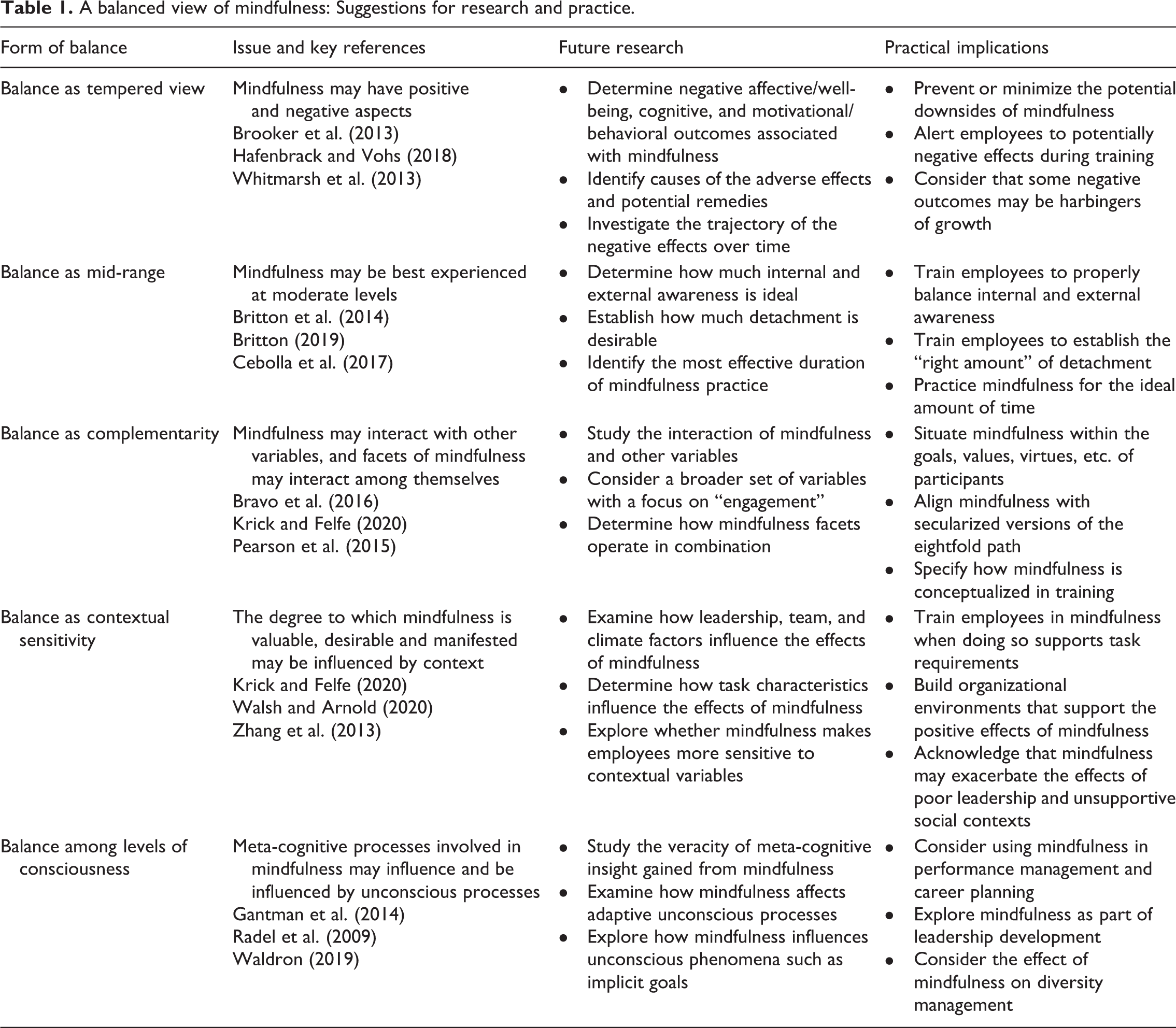
The next four sections will present other aspects of The Balance Framework that shed light on factors that may help to understand the benefits and drawbacks of mindfulness. Table 1 presents a summary of these issues.
A balanced view of mindfulness: Suggestions for research and practice.
Balance as mid-range
The second component of The Balance Framework suggests that it may be preferable for positive characteristics to be exhibited at moderate rather than maximum levels (Gruman et al., 2018). As noted by Grant and Schwartz (2011): “All positive traits, states, and experiences have costs that at high levels may begin to outweigh their benefits, creating the non-monotonicity of an inverted U” (p. 62). Pierce and Aguinis (2013) refer to this as the “too-much-of-a-good-thing effect” and provide examples from leadership, human resources, and other areas of organizational studies to demonstrate that when certain inflection points are reached, phenomena that are usually beneficial begin to cause harm. Can mindfulness be too much of a good thing?
The vast majority of mindfulness studies have demonstrated that high levels of mindfulness are associated with more desirable outcomes than low levels of mindfulness, suggesting that cultivating a high level of mindfulness among employees is beneficial. For example, high levels of mindfulness are associated with better communication, reduced conflict, and less emotional reactivity than low levels of mindfulness (Good et al., 2016). More mindful employees report greater levels of well-being (Malinowski & Lim, 2015), lower levels of work-related stress (Bazarko et al., 2013; Wolever et al., 2012), less work-family conflict (Allen & Kiburz, 2012), better job performance (Dane & Brummel, 2014), and more work engagement than their less mindful counterparts (Leroy et al., 2013). Highly mindful employees have been found to benefit more from workday respites generating higher intrinsic motivation and work engagement, and lower work stress and emotional exhaustion (Chong et al., 2020). At high levels, trait mindfulness has been found to offset the negative effects of materialism on mental health but at low and medium levels of mindfulness, materialism is significantly linked to worse mental health (Wang et al., 2017).
Mindful leadership research has also demonstrated that more mindfulness is better that less mindfulness. For example, leaders with higher levels of mindfulness are less likely to engage in abusive behavior toward their employees when the latter perform poorly (Liang et al., 2016). Similarly, Reb and colleagues (2019) found that higher levels of leader mindfulness were positively associated with employee in-role and extra-role performance through the mediating effect of relationship quality. In short, high levels of mindfulness have been shown to be associated with positive, desirable organizational outcomes. However, it is conceivable that more moderate levels of mindfulness may sometimes be advantageous. Below we consider whether or not there is any evidence for such an assertion.
Can mindfulness be overdone?
The literature on mindfulness implicitly endorses the assumption that higher levels of mindfulness are always desirable, with little consideration or discussion of an ideal range. However, it is possible that undesirable outcomes may occur when individuals are “too mindful.” In a review of research on whether an excess of mindfulness may be disadvantageous, Britton (2019) explains that a number of mindfulness-related processes have been shown to demonstrate non-monotonicity and can be detrimental at elevated levels. For example, there is evidence that sleep quality is enhanced at moderate levels, and compromised at high levels of mindfulness (Britton et al., 2014).
The idea of “too much of a good thing” is not new. The philosophical idea dates back to ancient Greece (Aristotle, 2004) and within the domain of science researchers recognized more than a century ago, for example, that there is an optimal, mid-range level of arousal to achieve maximal performance (Yerkes & Dodson, 1908). Yet, in research and practice on mindfulness this fundamental principle is largely overlooked. It has been suggested that mindfulness training is like physical training in that more practice may produce greater benefits (Parsons et al., 2017). However, this analogy ignores the fact that physical training can be overdone and cause injury (Meeusen et al., 2013). Considering that mindfulness may be best practiced in a middle range may enhance theorizing about the construct and better inform mindfulness practices. Crucially, however, research to date has tended to examine linear relationships between mindfulness and various outcomes. We should also note that there is no research on this topic within organizational contexts, so arguments and evidence suggesting a desirable mid-range of mindfulness in organizations should be considered tentative.
The downfalls of too much awareness
As noted earlier, mindfulness involves directing attention and awareness to one’s present-moment experiences. Mindfulness thus cultivates self-awareness and situational awareness (Brown & Ryan, 2003). However, whereas a moderate level of mindful awareness enables individuals to register and respond to internal and external circumstances effectively (Reb et al., 2015), an excess of awareness may be damaging. Consider interoception, which refers to the awareness of signals reflecting one’s physiological state (Murphy et al., 2017). de Jong et al. (2016) reported evidence that mindfulness-related increases in interoception were associated with less depression; however, once past a medium range of physiological awareness, negative effects might accrue. For example, past research has found that high levels of interoception characterize a number of anxiety disorders (Murphy et al., 2012). Beyond interoception, high levels of self-focused attention have been shown to be positively associated with poor mental health (e.g., Sahdra et al., 2017), substance abuse (Eisenlohr-Moul et al., 2012) and decreased pain tolerance (Evans et al., 2014). Of great concern, some of these negative and unwanted effects have been observed as outcomes of mindfulness meditation training itself (e.g., Cebolla et al., 2017; Evans et al., 2014). Cebolla and colleagues (2017), for instance, found that unwanted effects were most common among meditators who practiced focused-attention meditation, and when practicing for more than 20 minutes.
Ingram (1990) notes that self-focused attention can vary in terms of degree, duration, and flexibility. He also notes that dysfunctional patterns, such as an excessively internal focus of attention, can lead to self-absorption and may play a role in producing pathological outcomes such as depression and anxiety. Although the specifics of Ingram’s (1990) model have been questioned (Pyszczynski et al., 1991), Mor and Winquist (2002) provide meta-analytic evidence that self-focused awareness is indeed associated with outcomes characterized by negative affect such as depression, dysphoria, and anxiety. They also found several moderators of this association including gender, age, and type of self-focus (e.g., rumination, self-focus valence). Thus, there is evidence to suggest that the self-focused attention that characterizes mindfulness may be optimally implemented at moderate levels, and, as argued by Ingram (1990), optimal functioning may be best achieved by a balance between an internal and external focus.
Just enough detachment
The favorableness of mindfulness at mid-range is again illustrated by the process of decentering. Decentering (also called reperceiving, or detachment) occurs during mindfulness when individuals dis-identify with immediate experience, distancing themselves from the situations they face by choosing to observe their thoughts, feelings, and experience from a third-party perspective (Kessel et al., 2016; Shapiro et al., 2006). Decentering allows individuals to enact a more controlled response to events and has been identified as one of the critical mechanisms supporting the effectiveness of mindfulness training (Hölzel et al., 2011). For example, it has been shown that changes in decentering mediate the relation between mindfulness-based stress reduction interventions and outcomes (e.g., reduced anxiety; Hoge et al., 2015). However, in excess, decentering may be problematic. For example, at high levels of decentering there is a risk of losing touch with current experiences, hindering the ability to act on thoughts and cognitions. Britton (2019) suggests that decentering may produce dissociation and depersonalization. This detachment may manifest as withdrawal from social situations, avoiding intimacy, and anhedonia (i.e., a lack of engagement or decreases in the capacity to feel pleasure with life’s experiences; Chapman et al., 1976). Mindfulness practices may train individuals to use a set of self-regulation techniques that have the unintended effect of extreme detachment, isolating individuals from existing relationships or muting both positive and negative experiences. On this point, Britton’s (2019) question is astute: “How does one ensure that mindfulness produces the optimal level of psychological distance that ‘steps back’ far enough but not too far?” (pp. 160–161). In sum, there is preliminary evidence to suggest that mindfulness may sometimes be best experienced at more moderate levels.
Future research on balance as mid-range
Evidence of non-monotonicity has been observed in a number of relationships involving occupational health such as those between leadership and stress (Harris & Kacmar, 2006), and job autonomy and well-being (Stiglbauer & Kovacs, 2018). Research is needed that explicitly examines how mindfulness in organizations may sometimes be “too much of a good thing,” addressing the criticism that more mindfulness is always better (Britton, 2019). To enrich our understanding of mindfulness at mid-range, researchers should consider the implication of non-monotonicity for study design and subsequent data analytic procedures. Relying exclusively on linear methods and analyses may leave substantial variation unaccounted for. For example, in lieu of employing traditional Likert-type scales, which are typically used to assess mindfulness, researchers might also consider using too little/too much rating scales in order to detect curvilinear relationships between mindfulness and outcomes (Vergauwe et al., 2017). Similarly, using nonlinear analyses (e.g., nonlinear regression, nonlinear SEM, multilevel nonlinear modeling) would provide information regarding the true distribution of mindfulness among employees and advance understanding of how mindfulness relates to employee and organizational outcomes.
We also note that all of the argumentation and evidence for the non-monotonic benefits of mindfulness comes from outside of organizational scholarship. This work needs to be supplemented with research and application using employee samples in organizational settings so that valid conclusions can be drawn. For instance, from a practical perspective, trainers should experiment with different “doses” of mindfulness training to determine the best level of intensity, timing, and duration. Dose-response relationships between mindfulness and outcomes would shed light on the ideal levels of mindfulness for producing desirable organizational outcomes, and, perhaps, highlight the levels at which undesirable outcomes become more frequent or likely.
It is important to note explicitly the crucial detail that balance as mid-range intentionally suggests a “mid-range” as opposed to a “mid-point” (Gruman et al., 2018). This is because the ideal level of mindfulness is likely not the mean of the lowest and highest potential scores on a particular scale, and because the ideal level of mindfulness may vary among individuals and situations.
Balance as complementarity
The third component of The Balance Framework involves balance as complementarity (Gruman et al., 2018), which considers how multiple variables operate in conjunction. Gruman et al. (2018) explain that adopting a balanced perspective involves examining not only the level of a single variable between two ends of a continuum, as discussed in the previous section, but also balance among multiple variables. A balanced perspective of mindfulness would involve studying how mindfulness may interact with other variables and appreciating the way in which different facets of mindfulness may interact among themselves.
The majority of mindfulness research demonstrates that mindfulness is effective at independently predicting positive outcomes. For example, meta-analyses have demonstrated that mindfulness in isolation is positively associated with desirable organizational outcomes such as job satisfaction, performance, interpersonal relationships, health, well-being, and prosocial behavior (Donald et al., 2019; Lomas et al., 2019; Mesmer-Magnus et al., 2017), and negatively associated with undesirable organizational outcomes such as stress, anxiety, burnout, depression, distress, and work withdrawal (Lomas et al., 2019; Mesmer-Magnus et al., 2017).
Substantially less research has examined specific facets of mindfulness (e.g., non-judging of experience; Baer et al., 2006), but this research similarly has demonstrated that individual facets in isolation are associated with positive outcomes. For example, Baas et al. (2014) found that the mindfulness facet of observation was associated with creativity. Cameron and Fredrickson (2015) found that after recalling a pro-social act, the mindfulness facet of present-focused attention was associated with more positive emotions, and the facet of nonjudgmental acceptance was associated with less negative emotions. Similarly, the facets of attention and non-judgment have been shown to be most strongly associated with work engagement (Gunasekara & Zheng, 2019), and the non-judgment facet has been shown to significantly mediate changes in all dimensions of burnout among employees participating in a workplace mindfulness-based intervention (Kinnunen et al., 2020). The question arises whether mindfulness might best promote positive organizational outcomes in combination with other variables, and similarly, whether the effects of mindfulness facets might be best understood when considered together. Below, we consider whether or not there is any support for these ideas, noting again that the evidence should be considered tentative because the majority of it comes from outside organizational contexts.
Mindfulness complemented by other variables
There is some evidence that mindfulness interacts with individual differences in producing outcomes. Much of this research focuses on the Big Five personality factors. For example, Krick and Felfe (2020) found that compared to those lower in neuroticism and openness to experience, police officers higher in these personality factors benefited more from a workplace mindfulness training intervention. Similar results were obtained by Nyklíček and Irrmischer (2017) who found that neuroticism moderated changes in anxiety levels among participants who took part in mindfulness-based stress reduction training. Fang et al. (2019) found that extraversion and neuroticism moderated the positive relationship between trait mindfulness and sleep quality among nurses. Winning and Boag (2015) found that conscientiousness and extraversion moderated the effect of a brief mindfulness induction on participants’ cognitive empathy. However, the research in this area is limited. Although there exists research that examines the degree of association between mindfulness and some individual differences (e.g., Giluk, 2009; Miao et al., 2018), there is a paucity of research that examines how mindfulness may be moderated by other broad characteristics such as personality, intelligence, and emotional intelligence, or narrow traits such as need for cognition, tolerance of ambiguity, and narcissism, in producing organizational outcomes.
Mindfulness facets
The various conceptualizations and operationalizations of mindfulness depict the construct with a different number of facets. It is sometimes characterized as having a single awareness dimension (e.g., Brown & Ryan, 2003), two dimensions involving variants of awareness and acceptance as noted earlier (e.g., Cardaciotto et al., 2008), or multiple dimensions (e.g., Baer et al., 2006; for an overview see Bergomi et al., 2013). Research has demonstrated that when multiple facets of mindfulness are considered together, different profiles are associated with dissimilar outcomes, underscoring the value of considering the facets in combination. For example, using latent profile analysis based on scores from the Five Facet Mindfulness Questionnaire (Baer et al., 2006), Pearson et al. (2015) identified four mindfulness profiles and found that participants in the “judgmentally observing” group (high scores on the observing facet and very low scores on the non-judging of inner experience and acting with awareness facets) manifested the poorest outcomes on four measures of emotional health. They also found that participants in the “non-judgmentally aware” group (high scores on the non-judging of inner experience and acting with awareness facets) displayed adaptive emotional outcomes, highlighting the interaction between “awareness” facets and non-judgment. These results are consistent with other research demonstrating that participants with a “judgmentally observing” profile exhibit the lowest levels of psychological flexibility and self-regulation (Bravo et al., 2016), have the highest level of poor mental health, and, somewhat surprisingly, the highest levels of life satisfaction and effectiveness (Sahdra et al., 2017).
Together, these results suggest that a failure to consider how the various facets of mindfulness operate synergistically may undermine occupational health, and that to effectively predict organizational outcomes associated with mindfulness it may be valuable to consider multiple facets in combination. Consideration of individual mindfulness profiles can also help to inform the design of tailored mindfulness interventions, capitalizing on individuals’ strengths and working to address deficits identified in a profile. We urge researchers to study the various potential combinations of mindfulness facets as supplements to assessing mindfulness with total scale scores.
Mindfulness as part of a system of engagement
Research on mindfulness might also be enhanced by considering a broader set of processes and outcomes than those conventionally studied. Mindfulness research and practice has traditionally focused on “mindfulness-as-relief” which concerns how mindfulness can help to reduce suffering, as opposed to “mindfulness-as-engagement” which focuses on the way in which mindfulness can promote active participation with life’s challenges. For example, although there is a plethora of research on the relationship between mindfulness and the minimization of physical and psychological problems (e.g., Grossman et al., 2004), there is a virtual absence of research on the way in which mindfulness might enhance high-quality decision-making that leads to successful action. By complementing research on “mindfulness-as-relief” with “mindfulness-as-engagement” both researchers and practitioners might develop a richer appreciation of the benefits of mindfulness and a better understanding of its practical value. We urge more organizational research on outcomes reflecting “mindfulness-as-engagement”.
A greater emphasis on “mindfulness-as-engagement” would involve a stronger focus on behavioral outcomes as opposed to those that are cognitive or emotional. Because behavior is influenced by guidance systems involving variables such as values and ethics (e.g., Bardi & Schwartz, 2003), placing greater emphasis on behavior also raises the profile of these latter variables, which would address one of the criticisms of contemporary mindfulness research.
Specifically, research and practice on mindfulness has been criticized for ignoring the ethical principles and discriminative sensibilities that were part of the Buddhist framework within which mindfulness was traditionally practiced (e.g., Bodhi, 2011; Monteiro et al., 2015). Although it is not necessary, or even advisable, for secular mindfulness to conform to the goals of traditional Buddhist practice (Purser, 2015), this criticism underscores the fact that the orientation to attention that characterizes contemporary mindfulness is only one part of a larger system of effective living. Mindfulness may be best understood when complemented with a structure for evaluating the relative value of particular thoughts and actions in terms of the extent to which they support conduct that leads to individual and collective flourishing in organizations, as opposed to the simple relief from, or tolerance of, mental discomfort (Monteiro et al., 2015).
A balanced approach could therefore complement mindfulness with goals, motivations, values and/or ethical frameworks that serve an orienting function that promotes larger life and work objectives. Although it can be, this orienting function need not be based on an explicitly moral foundation (Kabat-Zinn, 2011). Baer (2015) suggests that the orienting function can be served through a consideration of personally meaningful values which are similarly leveraged in a number of intervention approaches, core virtues such as wisdom and justice that have been delineated in the field of positive psychology, and specific character strengths such as curiosity and humility through which the virtues can be expressed. The complementary nature of mindfulness and these orienting constructs is further exemplified by the fact that mindfulness may help to identify when particular constructs (e.g., the character strength of appreciation) is overused, in line with the idea of balance as mid-range.
In a related vein, we note that mindfulness is traditionally part of an “eightfold path” that leads to the cessation of suffering (Bodhi, 1994). However, these other path factors are largely ignored in contemporary discussions of mindfulness in general and in organizations in particular (Purser & Milillo, 2015). In a manner akin to the way in which mindfulness has been secularized, we propose that it may be possible to develop secularized versions of the other aspects of the eightfold path that can be applied in organizations. For example, “right intention” may be considered as compassion (Cho et al., 2018), and/or other domain-relevant constructs. “Right effort” may be understood within the context of the orienting factors noted above. Mindfulness could then be considered in terms of the degree to which it supports or undermines these other secularized versions of the components of the eightfold path by observing their interactive effects on organizational outcomes.
In sum, there is evidence to suggest that mindfulness might best promote positive organizational outcomes in combination with other variables, and that mindfulness facets might be best understood when considered together. Future research is needed to test these ideas.
Future research on balance as complementarity
Little research applying balance as complementarity to mindfulness has been conducted in general settings, and even less so in organizations, making this an area ripe for investigation. Conceptualizing mindfulness as complementarity places the emphasis on understanding the precise nature of mindfulness, delineating the construct and suggesting its nomological network. A perusal of the literature reveals that definitions of mindfulness demonstrate significant variation. Confusion around the mindfulness construct creates uncertainty when interpreting and comparing study findings. Results from different mindfulness studies may at times seem at odds with each other, however such differences may be an unintended result of the various ways in which mindfulness is operationalized (Bergomi et al., 2013). Similarly, the way in which mindfulness interacts with other variables may depend on how mindfulness is conceived and measured. To minimize this issue, studies should discuss how the specific way mindfulness has been conceptualized may explain the findings. With this in mind, more research is needed on the ways in which mindfulness, as a process, state, and trait, interacts with both broad and narrow individual differences in generating employee and organizational outcomes.
While there is no gold standard for defining and measuring mindfulness (Grossman & Van Dam, 2011), researchers should be open to complementing existing conceptualizations of mindfulness with new facets. For example, scholars have suggested that non-attachment may represent a previously unconsidered dimension of mindfulness (Sahdra et al., 2017). Non-attachment is defined as “a flexible, balanced way of relating to one’s experiences without clinging to or suppressing them” (p. 819), has been shown to be distinct from existing facets of mindfulness and offers incremental validity in predicting outcomes (Sahdra et al., 2016). Future research that incorporates nonattachment may shed even more light on the mindfulness profiles that best support employees.
Purser and Milillo (2015) criticize contemporary mindfulness practices in organizations because they are divorced from their soteriological roots, and characterize them as a form of “technical spirituality” (Driscoll & Weibe, 2007). We question Purser and Milillo’s (2015) argument that mindfulness must be faithful to its original Buddhist conceptualizations because the ultimate goal of secular mindfulness is not spiritual. However, we agree with their point that in deviating from its original formulations, the application of mindfulness in organizations should be cognizant of what is being omitted. The ways in which mindfulness should be balanced may depend on the way mindfulness is conceptualized. A number of authors have noted that the contemporary definition of mindfulness, involving non-judgmental, present-moment awareness, does not accurately reflect traditional conceptualizations of the construct, which include both a recollective and evaluative function (Dorjee, 2010; Dreyfus, 2011; Purser, 2015; Purser & Milillo, 2015). In line with balance as complementarity, further research is warranted on the ways in which mindfulness might fruitfully incorporate these functions, perhaps as a second step after initial skill in non-judgmental awareness has been developed. This research has direct implications for organizational practice.
In sum, there is evidence to suggest that research and practice on mindfulness may be enhanced to the extent that factors complementary to current definitions of mindfulness are considered more fully. This, along with further research on the complementary nature of disparate facets of mindfulness, would address the criticism that research in this area pays insufficient attention to the way various features of mindfulness operate synergistically.
Balance as contextual sensitivity
Balance as contextual sensitivity, the fourth dimension of The Balance Framework, recognizes that whether phenomena should be understood as positive or negative may depend on the context. Gruman et al. (2018) clarify that “balance as contextual sensitivity” differs from “balance as complementarity” in that the latter concerns within-person combinations, whereas the former involves situational moderation. Applied to mindfulness, contextual sensitivity concerns the fact that the degree to which mindfulness is valuable, appropriate, and hence desirable, may be influenced by the context in which it occurs.
Mindfulness has been shown to be associated with desirable outcomes in a variety of organizational contexts, including operating environments that are unpredictable, chaotic and dangerous such as those of Navy SEALs (Fraher et al., 2017) and frontline healthcare workers during crises (Rodriguez-Vega et al., 2020). Mindfulness has demonstrated benefits in high reliability contexts where errors can have catastrophic effects such as nuclear power plants (Zhang et al., 2013) and emergency rooms (Westphal et al., 2015). It has also been shown to offer advantages in contexts that make employees susceptible to burnout and emotional exhaustion such as public offices, schools, and nursing homes (Dierynck et al., 2017; Hülsheger et al., 2013; Meiklejohn et al., 2012; Shapiro et al., 2006). Mindfulness has also been found to be beneficial in situations that require high self-regulation and moral maturity (Hülsheger et al., 2020) and in contexts that are mentally fatiguing due to multi-tasking (Kudesia et al., 2020).
Overall, the benefits of mindfulness have been demonstrated in a wide variety of organizational contexts. However, context can exert a strong influence on organizational phenomena (Johns, 2006) so the question arises whether mindfulness is invariably positive and beneficial in all organizational contexts? Below we consider the evidence for this assertion. As will become apparent, compared to the other components of The Balance Framework, a greater amount of research has been conducted within organizations to support a consideration of how balance as contextual sensitivity may apply to mindfulness.
The leadership context
Leadership is one contextual variable that may influence the benefits of mindfulness in organizations. For example, building on the empirical evidence that mindfulness is associated with creativity (Lebuda et al., 2016), Cheung et al. (2020) examined this relationship in work environments and found that mindfulness was associated with employee creativity, but only in the context of perceived humble leadership. In a sample of employees from three companies in China, Cheung et al. (2020) found that employee mindfulness was associated with employee creativity through the mediating effect of creative process engagement, and that this effect was moderated by perceived leader humility. Specifically, the indirect effect of mindfulness on creativity was significant when perceived leader humility was high, but nonsignificant when perceived leader humility was low. Cheung et al. (2020) suggested that perceived leader humility serves as a cue to employees that creativity is a legitimate act. Thus, there is evidence to suggest that the degree to which mindfulness proves beneficial in organizations is contingent on having appropriate leadership.
As noted earlier, mindfulness involves enhanced internal and external attention and awareness, which may make mindful employees more sensitive to the influence of cues and behaviors of leaders (Eisenbeiss & Van Knippenberg, 2015). Evidence for this idea is provided by Eisenbeiss and Van Knippenberg (2015) who studied a sample of supervisor-follower dyads in Germany and found that follower mindfulness moderated the effect of supervisor ethical leadership on follower discretionary work behaviors. Specifically, they found that at high levels of follower mindfulness ethical leadership was more strongly related to follower extra effort and helping behavior. As suggested by Eisenbeiss and Van Knippenberg (2015), “highly mindful followers are…more attentive to what leadership and management influences are unfolding in their work surrounding” (p. 186).
However, there is evidence to suggest that heightened attentiveness to the signals and behaviors of leaders may not always prove beneficial. Walsh and Arnold (2020) demonstrated that mindfulness-induced enhanced sensitivity to leaders may have desirable or undesirable effects on employees depending on the nature of the leaders’ cues and behavior. Walsh and Arnold (2020) explored the effect of mindfulness on the well-being of employees who worked with either transformational or abusive leaders. In a sample of full-time employees from a range of industries, Walsh and Arnold (2020) found that transformational leadership was positively associated with employee well-being, abusive supervision was negatively associated with employee well-being, and mindfulness moderated these relationships such that the associations were significant only at high levels of employee mindfulness. Similarly, at low levels of transformational leadership, highly mindful employees reported very low levels of well-being. Walsh and Arnold (2020) concluded that mindfulness intensifies the impact of leadership on employee well-being through its influence on employees’ awareness of and attention to leader behavior. They further note that their results suggest that there is a dark side to mindfulness and that it may sometimes be harmful in organizations by intensifying the effects of poor leadership.
Although only a burgeoning area of investigation, preliminary evidence suggests that mindfulness may make employees more attuned to the cues and behaviors of leaders, however this enhanced attention may not be invariably beneficial for employees or organizations. It would appear that mindfulness may sometimes foster undesirable outcomes by enhancing employees’ attention to and awareness of disagreeable aspects of ineffective leadership and exacerbating its negative effects.
Team context and organizational climate
A second category of contextual issues that may influence the evaluation, appropriateness and utility of mindfulness in organizations involves the social context. Certain work environments may foster attitudes and social norms that enhance or reduce the acceptability and benefits of mindfulness (Vonderlin et al., 2020).
One contextual social factor that may impact the value of individual employees’ level of mindfulness is team mindfulness which refers to “shared perception among team members that their interactions are typified by present focused attention and awareness, and by experiential, nonjudgmental processing of team experiences” (Yu & Zellmer-Bruhn, 2018, p. 325). Liu et al. (2020) found that employee mindfulness was associated with work engagement through the mediating effect of recovery level, and that team mindfulness moderated this effect. Specifically, the relationship between employee mindfulness and recovery level was stronger when team mindfulness was high, and the indirect effect of mindfulness on engagement was only significant at high levels of team mindfulness. In short, team mindfulness created a social context in which individual employee mindfulness was supported and generated a desirable work outcome.
The results by Liu et al. (2020) suggest that individual mindfulness may be more prevalent and beneficial in workplace social contexts that have norms that encourage mindfulness. In support of this idea, Krick and Felfe (2020) found that the effectiveness of a mindfulness-based intervention was stronger among police officers who perceived favorable social norms for such interventions. The effectiveness of the intervention was weaker among officers who believed that their colleagues thought that participating in a mindfulness intervention was a “ridiculous,” “waste of time” suitable only for “weak” people (p. 104). Krick and Felfe (2020) thus demonstrated the importance of social norms and workplace climate in moderating the potential benefits of mindfulness in organizations.
Lawrie et al. (2018) also demonstrated that the workplace climate influences mindfulness. Lawrie et al. (2018) found that psychosocial safety climate (PSC)—shared perceptions of an organization’s interest in the health and safety of employees—moderated the effect of daily job control on daily mindfulness such that the relationship was stronger at higher levels of PSC. Lawrie et al. (2018) suggested that PSC serves as a signal that it is safe for employees to use their available resources thus creating a climate conducive to fostering mindfulness.
Similarly, Kao et al. (2021) argued that mindfulness would make employees more sensitive to situational cues in organizations and would therefore increase the impact of workplace climate on employee behavior. In support of this contention, Kao et al. (2021) found that compared to highly mindful employees who worked in the context of a weak safety climate, highly mindful employees who worked in the context of a strong safety climate engaged in more safety compliance and safety participation behaviors. In line with Walsh and Arnold’s (2020) contention that mindfulness makes employees more sensitive to the signals gleaned from leaders, Kao et al. (2021) concluded that mindfulness enhances awareness of and attention to the cues available in organizations which subsequently influences behavior.
The results of the preceding studies suggest that the workplace social context may influence the extent to which mindfulness is accepted, beneficial, and positive for employees and organizations. This is a nascent area of inquiry in need of further research.
The task context
A third contextual variable that may influence the value and positivity of mindfulness in organizations is task requirements. Lyddy et al. (2021) suggested that the benefits of mindfulness might be strongest in contexts that require little surface acting. They offered this suggestion after finding that mindfulness moderated the effect of surface acting on employee performance through the mediating effect of self-control depletion. Specifically, more mindful employees demonstrated a stronger association between surface acting and self-control depletion, and the relationship between surface acting and job performance, which was mediated by self-control depletion, was stronger among more mindfulness employees. Put another way, mindfulness compromised the job performance of more mindful employees who engaged in surface acting by increasing self-control depletion. Lyddy et al. (2021) employed a trait measure of mindfulness, but their results suggest the possibility that state mindfulness or mindfulness training may similarly deplete self-control resources and compromise performance among employees who work in contexts in which surface acting is required.
Dane (2011) suggested that the effect of mindfulness on performance in organizations would depend on employees’ task requirements. In particular, he proposed that because it involves wide externally oriented attentional breadth, mindfulness will foster high performance in dynamic task environments that involve repeated, interdependent decisions, but lead to performance decrements in static task environments which require focusing narrowly on tasks. Supporting evidence for this proposition is provided by Zhang et al. (2013) who found that a high level of trait mindfulness was significantly positively associated with the task performance and safety participation of nuclear reactor employees engaged in jobs high in complexity (control room operators monitoring more than 1000 displays and responsible for the safety of the whole system), but was non-significantly associated with these outcomes among employees engaged in jobs low in complexity (field operators with limited decision freedom). Zhang et al. (2013) explained these effects by suggesting that the benefits of the time-consuming, continuous attention that characterize mindfulness only outweigh its costs in complex jobs.
Conversely, Good et al. (2016) suggest that the attentional stability, control, and efficiency that characterize mindfulness will offer performance benefits more broadly and generalize to routine tasks in static contexts. However, Good et al. (2016) note that there is an absence of research on “task and contextual features that may significantly interact with mindfulness in predicting performance” (pp. 123–124) and that there is a paucity of research on the mindfulness mechanisms that drive performance (c.f., Lyddy et al., 2021). This is an important gap in the literature because recent research suggests that contrary to the suggestion that mindfulness involves exclusively wide attentional breadth (Dane, 2011), or prolonged attention (Zhang et al., 2013), it may be better characterized by the capacity to direct attention as appropriate (Feng et al., 2018). As Feng et al. (2018) suggest: mindfulness can at times be narrow-focused attention on an object, and at other times a broad and general awareness that is open to the emergence of internal and external stimuli. In other words, one’s scope of attention varies depending on the situation one is currently in, and thus neither narrow attention not broad awareness is a definitive indicator of mindfulness. (p. 447)
The available research is inconclusive about whether mindfulness offers performance benefits across different work contexts in addition to the mechanisms and moderators of these effects. Further research is warranted.
Socio-cultural considerations
The broader socio-cultural context may influence the degree to which mindfulness is regarded in a positive light and proves fruitful. Different cultures manifest diverse views of what constitutes appropriate emotions, behaviors, ethics and norms and thus the extent to which mindfulness is valued will vary between cultural contexts (e.g., Christopher, Charoensuk, et al., 2009; Christopher, Christopher, & Charoensuk, 2009). Cultures with differing values regarding, for example, arousal states may have divergent perceptions about the effectiveness of mindfulness, depending on the norms that govern the emotional context and particular display rules guiding emotional expression (e.g., Miyamoto & Ma, 2011). For instance, Chinese and Chinese-American cultures, relative to European cultures, value low-arousal positive states (e.g. contentment) more than high-arousal positive states (e.g. excitement; Lim, 2016) suggesting that mindfulness may be more accepted in the former, compared to the latter, cultural context. As noted by Hyland et al. (2015), cultural differences may influence the success of mindfulness interventions; however, there is currently very little research on this topic.
Future research on balance as contextual sensitivity
Overall, there is evidence to suggest that the degree to which mindfulness is valuable, appropriate, and desirable in organizations may be influenced by the context in which it occurs. The foregoing discussion suggests a number of opportunities for mindfulness research involving balance as contextual sensitivity. First, research is needed on how leadership influences the effects of employee mindfulness in organizations. Studies should explore explicitly whether mindfulness makes employees more sensitive to the cues and behaviors of leaders and the extent to which this impacts follower job attitudes and work behavior. This research should investigate the effects of mindfulness in the context of both productive and unproductive leader cues and behaviors. Research is also needed on the situational characteristics and individual difference variables that may influence these effects.
Second, research is warranted on how the social context impacts mindfulness at work. The research suggesting that mindfulness makes employees more sensitive to workplace climate (Kao et al., 2021; Lawrie et al., 2018) raises important questions: If mindfulness increases employees’ awareness of and attention to situational cues that promote desirable workplace behaviors, what happens when mindful employees work in climates that support undesirable or unethical behavior? What are the consequences of mindfulness when employees work in climates that implicitly support the padding of expense reports, shirking environmental regulations, or actively ignoring safety standards? Does mindfulness multiply the impact of objectionable climates in the same way that it may augment the impact of desirable climates? Or, as suggested by Eisenbeiss and Van Knippenberg (2015), does mindfulness encourage moral conduct? Might the effect of mindfulness interact with an employee’s personality or values in generating desirable or undesirable behavior in specific climates? Such questions warrant empirical attention.
Third, research is needed on whether mindfulness will prove equally beneficial in all work environments. The preponderance of studies on workplace mindfulness interventions have been conducted in occupations such as education and healthcare that have positive climates for the promotion of psychological health (Eby et al., 2019; Krick & Felfe, 2020). As such, the outcomes of workplace mindfulness interventions in contexts with less supportive climates remain unclear (Krick & Felfe, 2020). Studies comparing the effectiveness of mindfulness interventions in different workplace climates would be highly informative. Similarly, the value and benefits of trait and state mindfulness in non-supportive work climates are unknown. In line with research on person-environment fit (Kristof-Brown et al., 2005), it is possible that employees who are highly mindful in organizational contexts that do not support mindfulness may find themselves at a disadvantage.
Fourth, more research is needed exploring how task requirements moderate the effect of mindfulness at work. It remains unclear whether mindfulness offers performance advantages in all task environments or whether its potential benefits are restricted to a subset of such contexts such as those involving complex, dynamic tasks. Additionally, it would be informative to examine whether the amount of training or experience employees have with mindfulness serve as additional moderators of these effects. If mindfulness initially broadens attentional scope but then, as proficiency increases, it promotes greater attention regulation, it will impact employees in different ways at different levels of training or experience, thus potentially moderating the impact of task requirements in dissimilar ways. Whether mindfulness practice does, in fact, alter attention in this manner, and its effects on job performance, are open questions that warrant additional research.
Finally, more research is needed on the impact of culture on mindfulness across geographical locations in addition to within locations characterized by cultural diversity. A key question concerns the extent to which cultural context moderates the relationship between mindfulness and employee performance, health and well-being. Such research, in addition to investigations directed toward the other issues noted in this section, would offer a more balanced perspective of mindfulness and address the criticism that mindfulness research and practice pay insufficient attention to context.
As Sutcliffe et al. (2016) note, knowledge of organizational factors related to mindfulness is sparse and represents an area ripe for further research. More research is needed on the ways in which work environments foster or hinder mindfulness and influence its value, desirability, and efficacy. Not only would this research provide knowledge of the work environments in which mindfulness may be most beneficial, it could also suggest contexts in which mindfulness might prove counterproductive and strategies to mitigate such effects. As suggested by Vonderlin et al. (2020), “several contextual characteristics may influence the acceptability and potential benefits of [mindfulness-based programs in the workplace] including working conditions, organizational culture, social norms, and work patterns in specific industries or professions” (p. 1580). In agreement with Dane (2011), we suggest that mindfulness is not an unequivocal asset or liability but rather that its value, and the degree to which it should be considered positive, may be influenced by the conditions or work contexts in which it occurs.
Balance among levels of consciousness
The final dimension of The Balance Framework involves balance among different levels of consciousness. This dimension highlights that a failure to consider the various levels of consciousness may present a limited perspective of ostensibly positive psychological phenomena and foster less-than-ideal outcomes in organizations. As suggested by George (2009), it is important to consider different levels of consciousness when trying to understand organizational behavior because the way in which employees respond to their jobs and behave in organizations is influenced by unconscious, automatic processes. In this section we consider whether there is any evidence to suggest that the degree to which mindfulness should be regarded as positive might be informed by considering employees’ different levels of consciousness. Once again, we note that the arguments and evidence in this section should be considered as speculative of the effects of mindfulness in organizations given that most of it comes from outside organizational contexts.
Acknowledging other frameworks for conceptualizing distinctions among conscious states, Schooler et al. (2015) distinguish among three levels of consciousness—an unconscious level that involves processes to which individuals have no conscious access; a conscious level involving mental awareness, but not necessarily reflection on the contents of that awareness; and a meta-conscious (or meta-awareness) level involving explicit awareness of the contents of consciousness. A fourth, preconscious level, can also be considered involving mental contents stored in long-term memory that can be drawn into consciousness at will (Wilson, 2002).
The literature on mindfulness concentrates overwhelmingly on the meta-consciousness level and an attempt to observe and consider one’s own automatic psychological processes. For example, Shapiro et al. (2006) note that mindfulness promotes “reperceiving,” a meta-cognitive change in perspective that allows individuals to disidentify with immediate experience. Similarly, in organizations, Glomb et al. (2011) note that mindful meta-awareness allows employees to create distance between themselves and the content of their thoughts, emotions and experiences which fosters greater understanding of their own internal processes. Jankowski and Holas (2014) advanced a metacognitive model of mindfulness which describes how individuals can become meta-aware of not only the contents of consciousness but also meta-aware of this meta-awareness.
This meta-awareness allows individual to “de-automatize” habitual responses and maladaptive reactivity (Kang et al., 2013). Indeed, this is one of the most commonly espoused benefits of mindfulness. Largely through this meta-cognitive de-automatization, a number of authors have suggested that mindfulness can encourage the development of self-awareness and insight into one’s own thoughts, emotions and patterns of behavior, which, in turn, is what leads to positive outcomes (Kang et al., 2013; Nakajima et al., 2019; Nyklíček et al., 2020). Indeed, research has suggested that meta-consciousness and the de-automatization of unconscious, habitual processes that occurs through mindfulness is associated with numerous desirable outcomes including enhanced well-being (Fuochi & Voci, 2020), prosocial behavior (Berry & Brown, 2017), higher sensitivity to environmental features (Shankland et al., 2021), reduced stress (Carmody et al., 2009), and lower depression and anxiety (Orzech et al., 2009). However, this focus on meta-cognition and insight raises a number of questions concerning levels of consciousness in mindfulness research and practice including the degree to which they may contribute to undesirable organizational outcomes. We now consider whether or not there is any evidence to support this claim.
Meta-awareness
It is axiomatic in the secular mindfulness literature that meta-cognitive self-awareness is accurate. However, decades of research in cognitive and social psychology have revealed that self-awareness is often inaccurate and that “looking inward” is often not a valid method for self-understanding (Pronin, 2009). The errors to which meta-cognitive processes are subject may have deleterious consequences for organizational processes that involve self-insight, such as leadership development (London, 2002). Insight involves having a clear idea of why one thinks, feels, and acts as one does (Grant et al., 2002). However, in observing and trying to understand their own psychological processes, people are adept at confabulation, rationalization, and erroneous inference, which occurs outside of conscious awareness (Melnikoff & Bargh, 2018; Schwartz, 2015; Wilson, 2002). For example, Nisbett and Wilson (1977) reported the results of a study in which insomniacs enjoyed better sleep after ingesting a pill they were told would cause arousal. This occurred because participants were able to attribute their arousal to the pill instead of themselves. However, when asked to account for their enhanced sleep quality, participants invoked contrived explanations, such as having successfully handling stressors in their lives. Nisbett and Wilson (1977) concluded that people sometimes display little insight into the reasons for their behavior. Importantly, such faulty insights may orient individuals toward future actions that are ineffective or potentially detrimental. For example, as part of a leadership development process, a leader who practices mindfulness and develops the erroneous insight that their poor performance is due to insufficient assertiveness, may become more assertive and alienate their employees.
One commonly studied aspect of mindfulness is describing or labeling one’s experiences (Baer et al., 2006). However, as evidenced by Nisbett and Wilson (1977), description processes can be faulty and meta-conscious labeling may improperly characterize experience. As Schooler et al., (2015) note, techniques such as mindfulness that encourage people to pay attention to their internal processes do not guarantee that their reports are accurate. As suggested by Greenwald and Banaji (2017) “When people attempt to report on their conscious perceptions and judgments, they do so not based on valid introspection, but by using traces of past (possibly biased) experience to construct (possibly invalid) theories of current data” (p. 868). As a result of these cognitive and social psychological tendencies, it would appear that the accuracy of the meta-cognitive insights derived from mindfulness cannot be assumed, and should be subject to empirical scrutiny to assess their validity, and so that organizational processes on which they may be based can be most effectively implemented.
The adaptive unconscious
Implicit, and often explicit, in theorizing about mindfulness and de-automatization is that unconscious processing leads to dysfunctional outcomes that mindfulness helps to curtail. However, much, if not most, unconscious processing is adaptive and useful. As suggested by Bargh and Morsella (2008), research has revealed a “sophisticated, flexible, and adaptive unconscious behavior guidance system [that is] of high functional value” (p. 78). Similarly, Wilson (2002) notes that, “[t]he adaptive unconscious does an excellent job of sizing up the world, warning people of danger, setting goals, and initiating action in a sophisticated and efficient manner” (pp. 6–7). Indeed, research has demonstrated that unconscious, automatic thought often leads to superior outcomes than deliberate, conscious reflection (Wilson, 2002). By presuming that the ability to intercept automatic thinking is invariably beneficial, current research may have insufficiently considered the role mindfulness plays in potentially undermining adaptive unconscious processes that can be of benefit to employees and organizations.
We noted earlier that mindfulness is associated with less implicit learning (e.g., Stillman et al., 2014). There are other examples of mindfulness undercutting adaptive unconscious processes. For instance, Radel et al. (2009) found that more mindful students were not affected by potentially beneficial primes reflecting autonomous motivation that were included in an instructor’s PowerPoint presentation. Radel et al. (2009) suggested that mindful individuals may be too self-focused to exploit advantageous environmental features that are registered unconsciously. This idea is corroborated by other research demonstrating that mindfulness is negatively associated with intuitive performance (Remmers et al., 2015).
Other evidence for the idea that mindfulness may undermine adaptive unconscious processes comes from the literature on skilled performance which demonstrates that trying to exert conscious control over automated behaviors can be counterproductive (Beilock & Carr, 2001). As noted by Gantman et al. (2014), “when behaviors have been automated, consciously monitoring the enactment of learned physical skills results in suboptimal performance as the behavior no longer requires conscious direction” (p. 250). In contrast to Dane’s (2011) suggestion that mindfulness may promote task performance among employees with high task expertise by allowing them to take note of and consider their intuitions about tasks, mindfulness may interfere with the task performance of those high in task expertise by short circuiting the adaptive, automatic thoughts and ensuing behaviors that derive from well-developed intuitions. To build on an example offered by Dane (2011), experienced firefighters who enact mindfulness may disrupt efficient and effective decision-making driven by unconscious, tacit intuitions that would otherwise have generated appropriate behavior and high performance. In sum, there is preliminary evidence to suggest that the degree to which mindfulness can be considered positive is effectively informed by considering different levels of consciousness.
Future research on balance among levels of consciousness
The preceding discussion suggests a number of avenues for further investigation. Most prior theory and research in this area has occurred outside of organizational contexts. Research is needed in organizational settings on the veracity of meta-cognitive insights gleaned through the practice of mindfulness, and the ways in which such insight may reflect unconscious tendencies for meaning-making. For example, research could examine whether mindfulness influences the degree to which employees accurately self-diagnose the sources of performance problems involving personal shortcomings. Similarly, research could explore whether the induction of mindfulness influences the recognition of the precipitants of thought and behavior, and processes such as the construction of work identity (Dutton et al., 2010). Knowledge garnered from such research would have direct implications for the role of mindfulness in organizational processes that involve insight such as leadership development, performance management and career planning.
Future research should also consider the ways in which mindfulness may influence unconscious motives by, for example, investigating the effect of mindfulness on processes that may influence the accuracy of insight, such as motivated reasoning (Kunda, 1990). In a similar vein, research is needed on whether other unconscious phenomena such as implicit self-conceptions, attitude strength, or implicit values might be changed through mindfulness practice.
To elaborate on this point, consider that Brown and Ryan (2003, study 3) found that whereas there was no relation between implicit and explicit affect valence for people low in mindfulness, a positive relationship existed for people higher in mindfulness. The authors proposed that people higher in mindfulness were more attuned to their implicit emotions and brought their conscious affective experience in line with their unconscious affect (Brown & Ryan, 2003), but it is also possible that an unconscious confluence drove changes in implicit affect. We suspect that much of the value derived from the practice of mindfulness accrues from changes occurring at the unconscious level, which reflect alterations in the way mental contents are automatically activated and classified (Bargh, 1994). To explore this possibility researchers could, for example, employ the implicit association test (Greenwald et al., 1998) as a means of studying how mindfulness may influence the structure of unconscious cognition in support of efforts such as promoting diversity in organizations.
A very important avenue for future research is to explore the ways in which mindfulness impacts what are typically considered adaptive unconscious processes. For example, studies could examine the ways in which mindfulness impacts employees’ ability to develop tacit knowledge during training and development, and how the use of such knowledge is employed in management decision-making (e.g., Brockmann & Anthony, 2002). Similarly, research could examine whether mindfulness influences the successful enactment of automated behavior at the employee level and routines at the organizational level. Studies are also needed to explore the boundary conditions and moderators of these effects.
We agree with Waldron (2019) who argues that it is important that we “articulate more clearly and systematically how nonconscious affective and cognitive processes underlie and influence the conscious processes that have heretofore…been the primary focus of mindfulness practice” (p. 30). Such an articulation would provide a more balanced perspective of mindfulness, suggesting new avenues for research that may have important implications for organizational practice.
Discussion
Mindfulness is an enormously popular topic that is being applied in organizations of all types and is associated with desirable employee and work outcomes. In their review of mindfulness at work, Hyland et al. (2015) note: “a growing body of research shows that mindfulness can decrease stress, increase mental and physical health, and cognitive functioning, and improve performance and well-being” (p. 595). This conclusion is buttressed by several meta-analyses demonstrating that mindfulness is associated with numerous beneficial outcomes (Bartlett et al., 2019; Chiesa & Serretti, 2009; Eberth & Sedlmeier, 2012; Grossman et al., 2004; Lomas et al., 2019; Querstret et al., 2020; Vonderlin et al., 2020). In the workplace, empirical research using employee samples has found that mindfulness displays a positive relationship with desirable outcomes such as engagement, and a negative relationship with undesirable outcomes such as burnout (Jamieson & Tuckey, 2017; Lomas et al., 2019). Mindfulness is therefore a valuable construct for understanding and promoting employee performance, health, and well-being (Vonderlin et al., 2020). However, research and practice on mindfulness has been somewhat parochial and has generated a number of criticisms which have important implications for understanding and applying mindfulness in organizations.
A balanced approach to mindfulness
The Balance Framework presented in the present paper offers a parsimonious and relatively comprehensive structure for considering mindfulness research and practice in organizations. Importantly, it not only presents researchers with a scaffolding that allows them to consider mindfulness through a more nuanced and objective lens, but it also shines the spotlight on research questions that address outstanding issues that can advance understanding and enhance application. It also addresses some of the criticisms leveled against mindfulness.
Balance as tempered view addresses the criticism that mindfulness research and practice have generally ignored the potentially deleterious outcomes associated with mindfulness. Balance as mid-range deals with the criticism that mindfulness may sometimes be too much of a good thing. Balance as complementarity addresses the criticism that mindfulness research has overlooked how different aspects of mindfulness and other variables may operate in tandem. Balance as contextual sensitivity deals with the criticism that mindfulness research pays insufficient attention to context. Balance among levels of consciousness addresses the criticism that mindfulness research and practice have overlooked the importance of unconscious processes. As outlined throughout this paper, each of these ways of considering balance has important implications for understanding and applying mindfulness for the benefit of employees and organizations. Although it certainly does not address every criticism leveled against mindfulness, The Balance Framework offers a succinct structure with broad implications for considering research and practice on the topic.
Sedlmeier et al. (2012) suggest that the greatest hindrance to meditation research, including mindfulness meditation, is a lack of precise theories. We suggest that the absence of a proper framework for understanding mindfulness is an equally pernicious impediment to research and practice. In the same way that a theory serves to guide hypothesis development, a framework serves to orient researchers and practitioners to important considerations that might otherwise be overlooked. The Balance Framework offers a structure within which advances in research and practice can be comprehensively considered and implemented to provide a more robust and accurate picture of mindfulness and its effects in organizations. As suggested by Lyddy et al. (2021), “without considering both the costs and benefits of mindfulness, our current understanding of mindfulness and its implications is incomplete” (p. 2). Building on Nielsen and Miraglia’s (2017) ideas concerning realist evaluation, we suggest that a balanced approach to mindfulness in the workplace should consider who benefits from how much mindfulness, in what ways, through what mechanisms, in what contexts?
More research is needed on the interaction and relative importance of the various ways in which mindfulness can be balanced. For example, in the balance as mid-range section we suggested that an excess of mindful self-awareness may be problematic, and in the balance as complementarity section we presented evidence that the awareness facet of mindfulness may be problematic if the acceptance facet is not also practiced. The question thus arises, can high levels of mindfulness be healthy as long as acceptance is present? Similarly, in the balance as tempered view section we highlighted that mindfulness can produce negative effects and in the balance as complementarity section we noted that mindfulness may interact with individual differences. Although we know this is true for people suffering from certain psychological disorders, less is known about the potential dangers of mindfulness for people without diagnosable psychological pathologies and employees generally. Undoubtedly, negative effects are more likely for certain individuals than others raising the question of how balance as complementarity interacts with balance as tempered view. A crucial question for future research therefore concerns the ways in which the components of The Balance Framework themselves operate in a balanced fashion.
Moving forward
More research is needed that specifically examines the possible deleterious effects of mindfulness in organizations, the conditions under which such effects may occur, the individuals who may be most prone to them, and how potential negative implications can be mitigated. As suggested by Hyland et al. (2015), practicing mindfulness may not benefit some people and may upset others. Therefore, not only is research needed on the boundary conditions of mindfulness in organizations (Jamieson & Tuckey, 2017) but caution must be exercised when implementing mindfulness training. It is vitally important for trainers to consider the characteristics of the individuals to whom they provide mindfulness training and select out those who may be ill-suited (Lustyk et al., 2009).
As Hülsheger (2015) notes, it is unclear whether the celebrated benefits of mindfulness for individuals translate into benefits for organizations. As employees become more mindful, they may search for new jobs, strive less for promotions, or stop working after hours (Hülsheger, 2015). There is a paucity of research on this topic and it represents an important avenue for future investigations. Additionally, practitioners should be alert to the potential for negative organizational outcomes and be prepared to take steps necessary to mitigate or address them. Such steps should include recognizing that mindfulness may serve to highlight that certain employees may not represent a good fit with the job or organization.
Although research has demonstrated potential deleterious effects of mindfulness, the prevalence and seriousness of these effects remain poorly understood and most studies do not measure undesirable effects (Lindahl et al., 2017). Also, the extent to which findings from different populations will generalize to employees is unclear. More research is needed to assess the frequency, pervasiveness and contextual basis of adverse outcomes to assess the scale and scope of this issue in organizations and determine the extent to which negative outcomes associated with mindfulness represent a significant and/or common versus minor and/or infrequent matter.
As we have noted repeatedly, many of the findings discussed in the present paper involve research conducted outside of organizational contexts. Although the processes involved in mindfulness are identical regardless of context, the target of mindful attention and the associated outcomes may differ. For example, unlike mindfulness at home, mindfulness at work may lead an employee to realize that they do not fit with the culture of an organization and seek alternative employment. There are therefore mindfulness dynamics that may be exclusive to organizational environments. In line with balance as contextual sensitivity, we encourage research that explores the similarities and differences between mindfulness at work and other contexts.
Existing evidence supporting the value of a more balanced perspective of mindfulness tends to be based on research of adequate quality. However, some of it includes weak design issues such as small samples (Whitmarsh et al., 2013), questionable manipulations of mindfulness, and a lack of control conditions (Hafenbrack & Vohs, 2018) that potentially limit the validity, reliability, and generalizability of the findings. Nonetheless, there is enough empirical evidence of sufficient quality to suggest the desirability of further research. Overall, the variable quality of research related to this topic is typical of research on mindfulness in general (Davidson & Kaszniak, 2015; Huynh et al., 2019). In their review of the impact of mindfulness on performance and well-being at work, Lomas et al. (2017) found that many studies exhibit poor quality designs, for example, lacking randomized controls. It should go without saying, but research applying a more balanced perspective to mindfulness should be of high-quality in order to hasten the development of useful knowledge. For example, mindfulness research should include control variables such as intelligence and personality that offer alternative explanations for a study’s effects (Good et al., 2016). Research on mindfulness training should include a definition of mindfulness used in the study, discussion of the intervention protocol, trainer experience, attrition and compliance, and involve randomized controlled trials when possible, with active control conditions and manipulation checks (Jamieson & Tuckey, 2017). It is hoped that the methodological sophistication of research applying a balanced perspective to mindfulness research will exceed the modest improvements in the quality of mindfulness research that have been observed so far (Goldberg et al., 2017).
Conclusion
Mindfulness research in organizations is still in an early stage (Sutcliffe et al., 2016), however there is enough research available to suggest that a more systematic, integrated way of conceptualizing mindfulness may be advantageous. A balanced understanding of mindfulness at work encourages more sophisticated research and more effective practice that may better support employees and organizations. Using The Balance Framework to conceptualize mindfulness is one step toward this goal and an effort to conduct research and practice on mindfulness more mindfully.
