




Abstract
Background:
Ustekinumab was approved in 2016 for the treatment of moderate–severe Crohn’s disease (CD). Clinical trials and real-world studies have suggested ustekinumab to be a safe and effective treatment; however, studies to date infrequently use imaging techniques to predict response to biologics in CD.
Objectives:
We assessed the 2-year real-world effectiveness and safety of ustekinumab in a tertiary CD cohort with the use of novel imaging techniques.
Design:
Retrospective cohort study.
Methods:
Retrospective data were collected between 2016 and 2021. Study end points included ustekinumab persistence, biological and/or clinical response and remission at 12, 18 and 24 months. Statistical analysis included demographic and inferential analyses.
Results:
In all, 131 CD patients [57.3% female, median age of 26.0 (21.0–37.0)] were included. Patients were non-bio naïve, and the majority received ustekinumab as third- or fourth-line treatment. At 24 months, 61.0% (80/131) persisted with ustekinumab [52.7% (69/131) steroid free]. Clinical response was reported in 55.2% (37/67), clinical remission in 85.7% (57/67), biological response in 46.8% (22/47) and biological remission in 31.9% (15/47) of patients at 24 months. The low outcome numbers were attributable to missing data. Improvements in routine disease markers, including C-reactive protein and Harvey–Bradshaw Index, were also reflected in magnetic resonance imaging-derived disease scores. The presence of penetrating CD, an -ostomy and sarcopenia were all predictors of poorer ustekinumab outcomes (p < 0.05).
Conclusion:
Ustekinumab is effective in non-bio-naïve CD patients with non-stricturing, non-penetrating disease with an unremarkable safety profile but may be less effective in those with penetrating disease, -ostomies and sarcopenia.
Introduction
Crohn’s disease (CD) is an inflammatory bowel disease (IBD) that is characterized by relapsing transmural inflammation affecting any part of the gastrointestinal tract from the oropharynx to the perianal area, with extraintestinal manifestations and associated immune disorders. 1 CD frequently presents with segments of diseased and normal bowel; during periods of remission, diseased areas of bowel can return to normal. 2 This characteristic leads to patients experiencing intermittent symptoms of varying severity.3–5
There is currently no cure for CD, and therefore treatment focuses on inducing and maintaining disease remission by controlling inflammatory response and managing the effects of that inflammatory response.4,6,7
The current biological therapies that are approved for use in CD patients include anti-tumour necrosis factor (TNF) agents (infliximab, adalimumab), vedolizumab (anti-α4β7-integrin) and ustekinumab (anti-interleukin-12 (IL-12)/23). 8 Ustekinumab was licensed in 2016 in Europe and the United States for treatment of adults with moderate to severe CD who have failed or were intolerant to treatment with immunomodulators, corticosteroids and at least one TNF antagonist. 9 It is a fully human IgG1κ monoclonal antibody that binds to the shared p40 protein subunit of human cytokines IL-12 and IL-23.
The UNITI trials reported improved clinical remission rates at week 6 and long-term efficacy and safety of ustekinumab up to 92 weeks compared to placebo in CD patients who had previously failed anti-TNF or conventional therapy. 10 Real-world cohort studies have reported broadly similar clinical response and remission rates with ustekinumab therapy in non-bio-naive CD patients.11–15 Viola et al. 16 found that at 52 weeks, 43% of CD patients achieved steroid-free clinical remission, and 62% had clinical response. A recent meta-analysis reported slightly lower rates, with 31% [95% confidence interval (CI), 25–8%] achieving clinical remission and 23% (95% CI, 17–29%) achieving steroid-free clinical remission at 1 year. 17 Overall, studies suggest that ustekinumab is safe and effective in the real-world treatment of CD.
The aforementioned studies generally measure clinical, biochemical and endoscopic indices to assess response to ustekinumab therapy. Imaging techniques are infrequently used to predict and assess response to biologics in IBD patients, although various magnetic resonance imaging (MRI)-derived scores have been shown to accurately evaluate disease activity. 18 A novel scoring system that uses MRI is The Magnetic Resonance Enterography Global Score (MEGS) which evaluates the entire small bowel and incorporates extraintestinal manifestations to better demonstrate full disease burden. 19 However, to date, few studies have looked at MEGS in relation to ustekinumab response.
In addition, MRI or computed tomography (CT) can be used to assess patient body composition at the third lumbar (L3) vertebra, as a surrogate measure of total body fat and muscle volume. 20 CD patients commonly present with malnutrition, such as low muscle mass, and a few studies have suggested that this could be predictive of CD surgical outcomes. However, there is currently no available information on how these factors impact on ustekinumab treatment.21–23
The aim of this study is to assess ustekinumab safety and efficacy in a real-world cohort of non-bio-naive CD patients at a tertiary centre and identify variables that may influence therapy outcomes. In addition to routine clinical parameters, we used MRI-derived scores, such as MEGS, to evaluate clinical response in patients with small bowel disease, and L3 scores to evaluate patient body composition.24,25
Materials and methods
Study design and population
This single-centre retrospective cohort included 131 CD patients who received ustekinumab between 2016 and 2021. The hospital’s clinicians and nurses screened all CD patients who had their first intravenous infusion of ustekinumab between November 2016 and March 2019 using the hospital’s electronic patients database (known as EPIC). Inclusion criteria for our study were as follows: patients >18 years who were starting ustekinumab therapy with a confirmed diagnosis of CD, based on standard clinical, radiologic, endoscopic and histological criteria; active inflammation at ustekinumab initiation, defined by a Harvey–Bradshaw Index (HBI) ⩾ 5, and/or C-reactive protein (CRP) ⩾ 5 mg/L and/or faecal calprotectin (FCP) ⩾ 250 μg/g and/or endoscopic/radiological assessment. All patients who met these inclusion criteria were included in the study (n = 131). Data were then retrospectively collected for up to 24 months after ustekinumab initiation by review of the hospital’s electronic medical records.
Ustekinumab administration protocol
The first dose of ustekinumab is given as an intravenous infusion. The infusion dose is dependent on a patient’s weight, such as 260 mg/h for patients weighing <55 kg, 390 mg/h for patients weighing 55–85kg and 520 mg/h for patients weighing >85 kg. Subsequently, patients are given a maintenance subcutaneous injection (90 mg) after 8 weeks. Response to ustekinumab was assessed at week 16 to decide whether to continue maintenance therapy at 8- or 12-week intervals. Treatment was also continued for those deemed to be unresponsive to initial treatment when it is warranted by other clinical considerations.
Data collection and outcomes
For each patient, gender, age, smoking status, family history, surgical history, duration of disease, age at diagnosis and CD treatments were recorded. Disease characteristics were recorded in accordance with the Montreal classification. We evaluated both clinical and biological response and remission at each dose using HBI, FCP, endoscopy, MRI, CRP, as well as haemoglobin, white blood cell count and platelet levels.
In addition, further analysis was done for those patients who had a routine MRI or CT scans as part of standard of care at ustekinumab initiation and at 12 months after ustekinumab initiation. No additional MRI/CT scans were taken for the purpose of this study. Routine MRI scans were analysed to determine three disease activity scores: simplified Magnetic Resonance Index of Activity (sMaRIA), Clermont and MEGS score.24–28 The sMaRIA and MEGS indices measure bowel wall thickness, mural oedema and perimural oedema, with sMaRIA also including ulceration and MEGS including contrast enhancement and extraluminal ancillary features. The Clermont score is similar to the sMaRIA but replaces perimural oedema with the apparent diffusion coefficient, a parameter derived from diffusion-weighted imaging. Further details are provided in the Supplemental Tables 1–3. Routine MRI or CT scans were also analysed to determine patient body composition at the L3 vertebrae using the program Sliceomatic (version 7.0, Tomovision, Montreal, Canada). This showed patient skeletal muscle mass, visceral adipose tissue (VAT), skeletal adipose tissue (SAT) and intramuscular adipose tissue (IMAT) in both square centimetre and the Hounsfield unit. Skeletal muscle mass was then further used to calculate patient skeletal muscle index using the Martin et al. equation, categorizing patients as having sarcopenia or not.29,30
Primary non-response was defined as the absence of clinical improvement (as determined by patients’ consulting clinician) within 16 weeks and further drug discontinuation, whereas loss of response was defined as drug discontinuation due to secondary loss of response (as determined by patients’ consulting clinician as a result of absence in clinical improvements) after response to the drug during induction. At 12, 18 and 24 months, ustekinumab persistence, response and remission (both clinical and biologic) were recorded. Ustekinumab persistence was defined as those patients who were still on ustekinumab therapy. Any patients who did not have CRP or HBI measurements at 24 months were considered missing with regard to clinical or biological response/remission. Clinical response was defined as a HBI reduction of three or more points compared to baseline, and clinical remission as HBI of less than 5. Biological response was defined as a 50% reduction in CRP if CRP was >5 mg/L at baseline and biological remission as CRP <5 mg/L. Patients who had a discontinuation of treatment for other reasons, such as adverse events, were also defined as non-responders.
MRI response was defined as improved or absent signs of inflammation including contrast enhancement and bowel thickening. Endoscopic response was defined as the presence of mucosal healing or as the absence of ulcers in all endoscopically visualized bowel segments.
Statistical methods
Continuous variables were reported as medians with interquartile ranges; categorical variables reported as frequency and percentages. Chi-squared tests were used to compare categorical variables where appropriate. Spearman correlations were utilized to measure the association between continuous variables, and Wilcoxon signed-rank tests were used to compare repeated measures over time. Predictors for outcomes were analysed using with Kaplan–Meier curves, univariate cox regression (with right censoring) and univariate logistic regression. Results were expressed as hazard ratios or odds ratios and their 95% confidence intervals (CIs). The analysis was performed with IBM SPSS Statistics version 27.0 (Chicago, IL). The level of statistical significance for all tests was set at p < 0.05.
Results
Study population
In all, 131 CD patients were included in this study. Table 1 summarizes patient clinical and demographic characteristics; 54.2% (71/131) had undergone previous IBD-related surgery including small bowel resection [17.6%, (23/131)], ileocaecal resection [13% (17/131)] and any colectomy [16.7% (22/131)]. 21.4% (28/131) of patients having an ostomy. 24.4% (32/131) of patients had already previously received three biological agents with 64.1% (84/131) having been exposed to two anti-TNF agents. At ustekinumab initiation, 19.8% (26/131) of patients were on steroids and 40.5% (53/131) of patients were on concomitant immunomodulators, including 18.3% (24/131) on azathioprine, 17.6% (23/131) on methotrexate and 4.6% (6/131) on 6-mercaptopurine. 48.1% (63/131) of patients were on ustekinumab monotherapy. 47.3% (62/131) of patients were started on 8-weekly maintenance dosing, while the remaining 52.7% (69/131) of patients were started on 12-weekly maintenance dosing and were converted to 8-weekly dosing at various times during the 24-month follow-up. These various time points did not always coincide with the study time point of 12, 18 and 24 months.
Demographic, disease characteristics and therapy history of 131 CD patients initiating UST and with follow-up of at least 24 months during study period.

Extraintestinal manifestation = any conditions developed as a consequence of CD affecting the joints, eyes and/or skin.
BMI, body mass index; CD, Crohn’s disease; CRP, C-reactive protein; FCP, faecal calprotectin; HBI, Harvey–Bradshaw Index; IBD, inflammatory bowel disease; IMMs, immunomodulators; IQR, interquartile range; TNF, tumour necrosis factor; UST, ustekinumab.
Persistence, response and remission outcomes
At 24 months, 61.0% (80/131) of patients persisted with ustekinumab. Due to missing follow-up data (mainly due to the COVID-19 pandemic), response and remission rates may be over/underestimated. Clinical response was noted in 55.2% (37/67), clinical remission in 85.7% (57/67), biological response in 46.8% (22/47) and biological remission in 31.9% (15/47) of patients at 24 months. Notably, the lower clinical response found in this study (in comparison to clinical remission rates) is attributed to the fact that response rates require a relative decrease in HBI compared to patient baseline HBI in contracts to remission rates which are an absolute value.
In addition, 52.7% (69/131) of patients had steroid-free persistence at 24 months. Steroid-free response and remission rates were the same as mentioned for non-steroid-free response and remission rates (Table 2). The outcome trends were also noted at 12 and 18 months (Table 2). No patients experienced endoscopic response at 12, 18 and 24 months (notably endoscopy response has not been assessed in most patients). Furthermore, MRI response was reported in 66.7% (12/18), 44.4% (4/9) and 46.2% (6/13) of patients at 12, 18 and 24 months, respectively.
Outcomes per location and previous biologics at 12, 18 and 24 months after ustekinumab initiation.
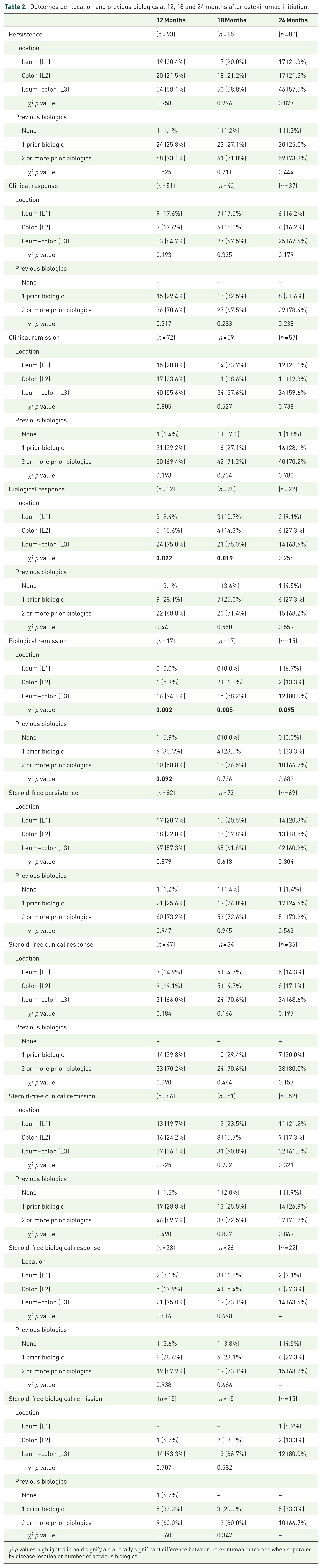
χ2 p values highlighted in bold signify a statiscally significant difference between ustekinumab outcomes when seperated by disease location or number of previous biologics.
Persistence at 12 months was 71.0% (93/131) and 64.9% (85/131) at 18 months. With the caveat of missing data for these outcomes, clinical response and clinical remission rates were 59.3% (51/86) and 83.7% (72/86) at 12 months, and 57.1% (40/70) and 84.3.9% (59/70) at 18 months, respectively. Similar trends were noted with biological response and remission and their steroid-free counterparts. Biological remission and response were significantly higher in patients with ileocolonic disease (L3) compared to the other locations of disease (p < 0.05). The number of prior biologics used did not appear to influence outcomes.
Predictors of ustekinumab persistence
The mean time until ustekinumab discontinuation in the patient cohort was 18 months (95% CI, 16.5–19.4) (Figure 1(a)). Ustekinumab persistence did not correlate with response or remission (both clinical and biologic) rates within this cohort. There was a significant difference in persistence at 12, 18 and 24 months in patients with an -ostomy [log-rank p value = 0.061 (borderline), 0.026, 0.040, respectively], with -ostomy patients being on ustekinumab for an average of 16.7 months compared to 20.4 months for patients without an -ostomy (Figure 1(b)). Other significant predictors of persistence were sarcopenia and concomitant immunomodulators (Figure 1(c) and (d), Table 3). Cox regression indicated that at 18 and 24 months, patients were up to 2.3 times more likely to discontinue ustekinumab if they had an -ostomy (Table 3). Sarcopenia was of borderline significance at 12 months (p = 0.082) and 18 months (p = 0.058), whereby sarcopenic patients were 3.3 times more likely to discontinue ustekinumab by 18 months. Finally, patients with higher amounts of IMAT and VAT were more likely to discontinue ustekinumab compared to patients with lower concentrations of adipose tissue, supporting the notion that sarcopenic patients were more likely not to persist with ustekinumab. Due to a lack of association found between other baseline characteristics, such as disease activity, and an ostomy and sarcopenia, multiple testing was not performed.

Kaplan–Meier Curves for overall cohort persistence (a) and significant predictive factors, including stoma (b), concomitant immunomodulator (c) and sarcopenia (d).
Univariate Cox and logistic regression results.

The results shown are only those with significance or borderline significance.
At pre-induction of ustekinumab.
BMI, body mass index; CRP, C-reactive protein; FCP, faecal calprotectin; HBI, Harvey–Bradshaw Index; HR, hazard ratio; HU, Hounsfield unit; IMAT, intramuscular adipose tissue; sMaRIA, simplified Magnetic Resonance Index of Activity; OR, odds ratio; VAT, visceral adipose tissue.
Predictors of ustekinumab response and remission
In addition to predictive factors for the persistence of ustekinumab, various predictive factors were found for the response and remission rates of ustekinumab. Logistic regression revealed that patient demographics including ethnicity, gender, family history and extraintestinal manifestations were significant predictors of clinical or biological outcomes at 12, 18 or 24 months (Table 3). Male patients were 2.5 times more likely to achieve biological response compared to females, and the presence of extraintestinal manifestations in general and particularly involving the joints, made biological response and remission less likely (p < 0.05, Table 3).
Logistic regression also revealed that CD phenotypic characteristics, including disease behaviour, disease location, prior immunosuppressant therapies (biologics or immunomodulators) and raised baseline inflammatory or disease indices, were predictive of outcomes at 12, 18 and 24 months (Table 3). Biological response to ustekinumab therapy does not necessarily correlate with clinical response, especially in patients with penetrating disease, where it appears to be less effective. Patients with B3 (penetrating) disease were 78.0% less likely to achieve clinical response at 12 months compared to B1 (non-penetrating, non-stricturing) disease patients. However, B3 patients were more likely to achieve a biological response compared to B1 patients. Study results show that patients with L3 (ileo-colonic) disease are approximately five times more likely to achieve biological response by 18 months, compared to patients with L1 (ileal) disease, which was not associated with penetrating disease in the patients with L1 disease.
Patients on prior thiopurines and infliximab bio-naive patients were more likely to achieve remission at 12 months. Prior thiopurine therapy did not appear to affect response and remission at 24 months. However, interestingly, infliximab bio-naïve patients were less likely to achieve clinical response at 24 months.
Finally, patients with low IMAT were 23% less likely to achieve biological response to ustekinumab at 24 months compared to patients with high IMAT (p = 0.042). Patients with a low sMaRIA score were 31% less likely to achieve clinical response at 12 months compared to patients with a high sMaRIA score (p = 0.070, borderline). No further multiple testing was performed due to a lack of association between baseline characteristic and significant findings, such as disease behaviour.
Evolution of biomarkers
Figure 2(a) to (c) shows the evolution of HBI, CRP and FCP observed over 24 months. Notably, patients’ HBI at baseline was significantly higher than patient HBI at 12, 18 and 24 months (p < 0.05). As expected, clinical blood markers showed improvements in disease activity during ustekinumab therapy. CRP levels were statistically higher at baseline [12 (3–30) mg/L] compared to 12 months [7 (2–19) mg/L, p = 0.004], 18 months [5 (2–12) mg/L, p = 0.001] and 24 months [3 (2–9) mg/L, p < 0.0001). Platelet and haemoglobin levels also significantly improved between baseline and 24 months (p < 0.05). Imaging markers, total MEGS score (p = 0.002), total sMaRIA score (p = 0.039) and total Clermont score (p = 0.035) were significantly lower 12 months post-ustekinumab therapy (Figure 2(e) and (f)).

Evolution of HBI (a), CRP (b), FCP (c), BMI (d), total MEGS score (e) and total sMaRIA score (f) over 24 months. Values reflect the median, bars reflect the 95% CI, and the * signifies statistically significant difference from baseline (Wilcoxon signed-rank test).
In addition to clinical disease markers, Figure 2(d) shows that BMI was significantly lower at baseline [21.6 (19.6–25.4) kg/m2] compared to 18 months [22.1 (20.9–23.9) kg/m2] post-ustekinumab induction (p = 0.002). This reduction in BMI is probably clinically relevant notwithstanding the lack of available information on artificial nutrition interventions. No significant difference was reported in BMI between baseline and 12 and 24 months. Interestingly, changes in patients’ BMI were not reflective of changes in body composition. No significant difference was found in L3 vertebrae body composition measurements (VAT, SAT, IMAT and skeletal muscle index) between baseline and post-ustekinumab therapy (p > 0.05).
Discontinuation/adverse events and subsequent therapy
Three (3/131) patients had severe side effects, including an allergic reaction to ustekinumab (2/131) and a severe IBD flare needing immediate switch to infliximab (1/131). 51/131 (38.8%) patients discontinued ustekinumab within the 24-month follow-up due to loss of response, missing CRP or HBI measurements and/or due moving to a different hospital to continue their care. Further details about these patients baseline characteristics are provided in Supplemental Table 4. 35% (18/51) of patients started another immunosuppressant therapy [33.3% (6/18) vedolizumab; 22.2% (4/18) infliximab, 5.6% (1/18) adalimumab, 11.1% (2/18) azathioprine, 11.1% (2/18) methotrexate, 16.7% (3/18) steroids]. Just over 33% (17/51) of patients went on to have surgery. 5.8% (3/51) of patients required artificial nutrition therapy (2/51 parenteral nutrition). 23.5% (12/51) of patients have no record of any other treatment after ustekinumab discontinuation, and one patient is now deceased.
Discussion
In our single-centre, 2-year real-world study, the majority of CD patients treated with ustekinumab were non-bio-naïve, receiving third- or fourth-line therapy. At 24 months, 61.0% (80/131) of patients persisted on ustekinumab, with an unremarkable safety profile. Clinical response was observed in 59.3% of patients at 12 months with similar trends noted for biological response (reduction in CRP). Various predictive factors were examined with respect to persistence, response and remission outcomes. Patients with penetrating CD, an -ostomy or sarcopenia receive less benefit from ustekinumab.
CD patients with penetrating disease were less likely to have clinical response to ustekinumab compared to those with non-penetrating, non-stricturing disease at 12 months. It may be expected that patients with progression of disease to stricturing or penetrating phenotypes have bowel damage that is more refractory to medical therapy. 31 Indeed, two Canadian cohort studies reported that ustekinumab therapy was less effective for patients with stricturing CD.32,33 In addition, another study found that penetrating complications were associated with lower rates of clinical and biological remission at 48 weeks. 34 Other studies found no difference in ustekinumab response between different disease behaviours.35–38
With regard to disease location, our study also showed that CD patients with ileo-colonic disease were more likely to achieve biological remission than patients with ileal disease. Several studies have shown that patients with colonic CD had lower CRP levels and improved response rates to ustekinumab therapy compared to CD patients with other disease locations.32,36,39 On the contrary, a more recent multicentre study found that patients with ileocolonic or colonic CD were less likely to respond to ustekinumab. 38 As such, to date, no consensus has been reached in the literature regarding the efficacy of ustekinumab therapy in CD patients with different disease locations.
Our study showed that CD patients with an -ostomy are less likely to persist on ustekinumab. There is a paucity of data in the literature regarding the efficacy of biological therapy in patients with -ostomies, as most studies exclude such patients from their analyses.36,40 In addition, the presence of an -ostomy often implies underlying complicated and/or medically refractory CD. 41 As such, the presence of an -ostomy can be considered as a proxy of disease severity, with lower ustekinumab persistence in this cohort, in keeping with our results.
Furthermore, sarcopenia is highly prevalent in IBD, with recent studies reporting a prevalence of 40–50% in CD patients.42,43 The pathogenesis of sarcopenia in CD patients is multifactorial, and includes chronic inflammation, increased gastrointestinal losses, reduced nutritional intake and increased nutritional requirements. We found a higher prevalence of sarcopenia (62.5%) in our tertiary CD cohort receiving third- or fourth-line ustekinumab therapy, probably due to a high proportion of patients with severe, extensive and/or medically refractory disease. To our knowledge, this study is the first to show that sarcopenia is predictive of poorer ustekinumab outcomes. To date, studies have found that low muscle mass was a risk factor for anti-TNF treatment failure, and infliximab therapy increased both muscle volume and strength.44,45 Recent studies have also found that sarcopenia is an independent risk factor for undesirable outcomes after surgery.46,47 Interestingly, it has been reported that CD patients with sarcopenia have higher CRP levels compared to those without. 48 Overall, this study shows that sarcopenia, rather than BMI, may be predictive of ustekinumab efficacy, suggesting that mechanisms of treatment failure may involve muscle mass rather than total body mass. However, more extensive research is needed to confirm study findings.
Longitudinal data in this cohort showed that surrogate markers of disease activity significantly improved after ustekinumab initiation. In line with previous research, HBI, CRP and platelet count all significantly improved in CD patients given ustekinumab therapy.49,50 This cohort also showed significant improvements in MEGS, sMaRIA and Clermont scores. However, extent of disease activity (as evaluated by these MRI-derived scores) was not predictive of ustekinumab outcomes. Multiple studies have validated the use of these MRI-derived scores to evaluate disease activity in CD and show that these closely correlate with endoscopic scores and clinical activity markers.51,52 A 2016 study even suggested that the sMaRIA score is a reliable marker to monitor CD patients on anti-TNF therapy. 53 While no studies have yet evaluated MRI scores in relation to ustekinumab, our study supports their utility for monitoring ustekinumab therapy.
Limitations of our study included the inherent bias of retrospective data, as well as the amount of missing data reflected in the response and remission rates, mainly due to the COVID-19 pandemic. No power calculation was performed due to limited preliminary data for such calculations. Furthermore, due to missing data, it was hard to pinpoint the number of primary non-responders in this cohort. In addition, response and remission rates may be over/underestimated due to missing data. These limitations were counterbalanced by strengths which included long-term real-world follow-up of non-bio-naive CD patients third- or fourth-line ustekinumab therapy and the use of new novel techniques such as MRI-derived disease activity scores and L3 scores.
Conclusion
In conclusion, this study shows that ustekinumab is an effective and safe treatment for non-bio-naïve CD patients. The presence of penetrating CD, an -ostomy and sarcopenia were all independently associated with reduced ustekinumab effectiveness. As such, our findings suggest that these factors should be considered when choosing drug therapies for patients. In addition to routine assessment, screening for sarcopenia and MRI-derived disease activity scores could be beneficial in identifying patients at risk of failing ustekinumab therapy. However, further prospective multicentre studies are needed to fully understand the importance of these predictive factors.
Supplemental Material
sj-docx-1-taj-10.1177_20406223231189072 – Supplemental material for Two-year real-world outcome data from a single tertiary centre shows reduced ustekinumab persistence in a non-bio-naïve Crohn’s disease cohort with penetrating disease, -ostomies and sarcopenia
Supplemental material, sj-docx-1-taj-10.1177_20406223231189072 for Two-year real-world outcome data from a single tertiary centre shows reduced ustekinumab persistence in a non-bio-naïve Crohn’s disease cohort with penetrating disease, -ostomies and sarcopenia by Saskia Inniss, Konstantinos C. Fragkos, Lisa Whitley, Rachel Wimpory, Eleanor Rebello, Ana Lisboa, Tanvi Khetan, Jasmine Hassan, Kate Simpson, Anisha Bhagwanani, Roser Vega, Ioanna Parisi, Paul Harrow, Edward Seward, Sara McCartney, Stuart Bloom, Andrew M. Smith, Andrew Plumb and Farooq Z. Rahman in Therapeutic Advances in Chronic Disease
Footnotes

References
Supplementary Material
Please find the following supplemental material available below.
For Open Access articles published under a Creative Commons License, all supplemental material carries the same license as the article it is associated with.
For non-Open Access articles published, all supplemental material carries a non-exclusive license, and permission requests for re-use of supplemental material or any part of supplemental material shall be sent directly to the copyright owner as specified in the copyright notice associated with the article.
