




Abstract
This article concerns the convergences and the divergences between the European Union (EU) and the European Convention on Human Rights (ECHR) systems of procedural guarantees in criminal law. It is a comparative research focusing specifically on primary sources of EU law, the ECHR, and the case law of the European Court of Justice (ECJ) and the European Court of Human Rights (ECtHR). The aim of this article is to draw up a comprehensive overview of the ECHR system to compare it with the EU system of procedural guarantees. This article starts off with the hypothesis that even though some differences are present between these two systems, they now largely overlap with each other. This hypothesis is proven in the article with the analysis of the ECHR and the EU systems of procedural guarantees with reference to the relevant legislation and case law of the ECJ and the ECtHR.
Introduction
Procedural guarantees that are enshrined in criminal law have multiple origins. On the one hand, their development started in the seventeenth century in England where an agreement set out multiple guarantees in the criminal procedure, including the privilege against self-incrimination and the right to call witnesses for one’s own defence. 1 On the other hand, guarantees also started to develop under the French revolution when the Constituent Assembly adopted a decree which guaranteed the right to a legal counsel during the criminal procedure. 2 Later on, procedural guarantees in criminal law were reiterated in multiple sources of international human rights law. The Universal Declaration of Human Rights was among the very first international documents that laid down the right to a fair trial. 3 Notwithstanding its non-binding nature, the declaration marks an important milestone in the development of procedural guarantees in criminal law. It defined the criteria of a fair trial including the right to an independent and impartial tribunal, the presumption of innocence and – most important to the subject of the article – set out that guarantees shall be provided to the suspect and the accused until proven innocent or guilty. 4 The European Convention on Human Rights (ECHR) even went so far as to clarify the guarantees that shall be provided to the suspect and the accused. Article 6(3) stipulates that everyone charged with a criminal offense shall be informed of the charge in sufficient detail and in a timely manner, 5 be provided with sufficient time to prepare for their defence, 6 be entitled to defend themselves in person or through legal assistance of their own choosing and be given legal assistance free of charge if necessary, 7 be entitled to examine and have examined witnesses and have free assistance of an interpreter if necessary. 8
The above rights – including the presumption of innocence – form the basis of procedural guarantees in national criminal justice systems to this day. 9 They serve to protect the fundamental rights of the suspect and the accused – so as to avoid a practice where they are regarded as objects rather than subjects – in the criminal procedure where the state is in a more powerful position than the individual. 10 For a long time, procedural guarantees in criminal law developed only in the context of national criminal justice systems. They are supposed to reflect consensus influenced by the social and cultural characteristics of a state. However, when judicial cooperation in criminal matters between European Union (EU) member states – commonly referred to as EU criminal law – started to develop, 11 procedural guarantees gained another nexus. They gradually became more and more important as new cooperation systems based on the principle of mutual recognition were created for judicial cooperation in criminal matters resulting in an ever-closer interconnection of criminal justice systems of member states. 12 The first and by far the most successful one among them was the European Arrest Warrant which quickly became the model cooperation system that inspired further legal instruments in this field. However, scholars critiqued this framework for not providing sufficient protection for fundamental rights, the principles of legality, proportionality and necessity. 13
As a result, starting from the early 2000s, a process unfolded that consisted of various communications, 14 policy recommendations, 15 impact assessments 16 and finally legislative pieces adopted by EU institutions, 17 revolving around the harmonisation of procedural guarantees in criminal law in member states. This process is viewed by a Hungarian scholar, Petra Bárd as part of the EU spill-over process, where the great efficiency of criminal cooperation between member states necessitated the strengthening of the position of the individual – including the suspect and the accused – in the criminal procedure due to the threat of violation of their fundamental rights in that process. 18
Stemming directly from this need, over the last two decades, the EU has harmonised procedural guarantees so much so that now an EU system of procedural guarantees truly exists. This system was mostly inspired from the ECHR system of procedural guarantees. 19 However, they do differ from each other in certain aspects. This article aims to shed light on the convergences and divergences between the EU and the ECHR systems of procedural guarantees in criminal law. It intends to focus on how comprehensive the EU system is taking the ECHR system as the minimum standard it needs to meet. In doing so, it will highlight that the EU system almost entirely granted the protection that derives from the ECHR. Not to mention that there are certain procedural rights that are better protected by the EU system than by the ECHR. However, it will also shed light on the shortcomings of the EU system and offer a solution for mitigating them.
In order to do so, this article will first briefly introduce the process that led to the establishment of the current system of procedural guarantees in the EU, which will be followed by the comparison of the ECHR and the EU framework for the protection of the right to a fair trial, especially its procedural guarantees. Furthermore, the article will compare the substance of the procedural guarantees laid down in the ECHR and the case law of the European Court of Human Rights (ECtHR) and in the EU directives harmonising these procedural guarantees in member states. The comparison regarding each procedural guarantee will be accompanied by an evaluation of how the EU system of procedural guarantees holds up to the standards applicable in the ECHR system. In doing so, the article will present the current state of play in terms of the procedural guarantees in the EU. The comparison will not only utilise the directives harmonising procedural guarantees in member states, but also the case law of the European Court of Justice (ECJ). This article applies a comparative approach. Its added value lies in the fact that even though many scholars analysed the directives, 20 such a comparative overview has been last carried out over ten years ago. 21 That comparison dating from 2011 showcased various aspects in which the legislation of member states fell short of the ECHR standards. 22 However, without a fully accomplished EU system of procedural guarantees, there could not be any discussion about how EU legislation compares to the ECHR. Now, that the EU system of procedural guarantees can be considered much more advanced, it is worth carrying out the same analysis between the two systems.
The genesis of the EU system of procedural guarantees in criminal law
The importance of harmonising procedural guarantees in criminal law was first recognised expressly by the European Commission which called for it already in a communication adopted in 2000. 23 It advocated for harmonisation, since the EU’s sui generis system of judicial cooperation is based on the principle of mutual recognition of judicial decisions. 24 The principle allows for the recognition and execution of judicial decisions without the need of their substantive analysis whether they hold up to the standards of the criminal justice system – including procedural guarantees – of the executing member state. 25 In essence, the principle made it possible for member states to avoid the harmonisation of their criminal justice systems. Harmonisation in EU law stands for the approximation of different branches of laws in the member states with setting out the same standards for every legal system. 26 The difference between mutual recognition and harmonisation is that the former does not require the laying down of universally applicable standards. In other words, member states recognise each others’ criminal justice systems as being equal to their own even though they may significantly differ from each other. 27 Thus, this advanced form of judicial cooperation was initially not met with a harmonised system of procedural guarantees in criminal law regardless of the Tampere conclusions which called for harmonisation as the other basis of criminal cooperation between member states. 28 Instead, their development took place in a national setting for the most time. This posed a significant problem in that member states need to recognise and execute judicial decisions, such as the European Arrest Warrant, which are issued based on different sets of procedural guarantees, thus contributing to possible fundamental rights violations. Moreover, the lack of harmonisation was only one part of the problem, as the case law of the ECtHR repeatedly indicated that procedural guarantees in criminal law were not protected sufficiently by member states even though they were contracting parties to the ECHR. 29
Later on, the Council confirmed the need for harmonising procedural guarantees as a necessary measure to implement the principle of mutual recognition in criminal matters. 30 In 2003, the European Commission published a green paper which identified the procedural guarantees which should be harmonised for the protection of the suspect and the accused in the criminal procedure throughout the EU. 31 This document became the basis of the European Commission’s proposal for a framework decision attempting to achieve this harmonisation in 2004. The proposal would have harmonised the right to legal assistance, the right of defence, the right to interpretation and translation, procedural guarantees for suspects and accused persons with special needs and the right to communication and information. 32 Even though the proposal presented a comprehensive system of procedural guarantees, member states refrained from adopting it, since they viewed it as affecting their criminal justice systems too much. 33 It would have been too much of a step forward for member states to give up some of their competence in criminal law at this point, since it is the cornerstone of state sovereignty. 34 Thus, the first attempt of harmonising procedural guarantees eventually failed in 2007. However, the Council remained determined to achieve harmonisation in this field and adopted a roadmap in 2009 which set out measures for the strengthening of the status of the individual in the criminal procedure resembling largely to the 2004 proposal. The roadmap identified six measures to achieve to realise sufficient protection for the suspect and the accused. It called for the harmonisation of the right to translation and interpretation, the right to information, the right to the assistance of a lawyer, the right to communication and procedural guarantees for suspects and accused persons with special needs in the criminal procedure. In addition to that, it called for a green paper concerning the harmonisation of rules on pre-trial detention. 35 The roadmap specifically called for harmonisation that meets the standards set out in the ECHR. 36
The roadmap was realised in a series of directives achieving a high level of harmonisation in the field of procedural guarantees in criminal law in EU member states. Directive 2010/64/EU harmonises the right of the subject of the criminal procedure to interpretation and translation. 37 Directive 2012/13/EU approximates rules regarding the right to information in the criminal procedure. 38 Directives 2013/48/EU and 2016/1919/EU introduced minimum rules regarding the right to legal counsel and free legal aid in the criminal procedure. 39 Directive (EU) 2016/343 achieved a harmonised set of minimum standards in connection with the presumption of innocence and the right to be present at the trial. 40 Last, but not least, Directive (EU) 2016/800 set out a list of procedural guarantees for child subjects of the criminal procedure. 41 However, the last directive will be omitted from the scope of the analysis as neither the ECHR, nor the case law of the ECtHR establish specific guarantees for child or any other specific subjects of the criminal procedure who may be in need of special procedural guarantees.
How are the EU’s procedural guarantees holding up to the standards of the ECHR?
This point concerns the comparison of the ECHR and the EU systems of procedural guarantees in criminal law. The structure of the comparison will follow Article 6 ECHR starting with the presumption of innocence which will be followed by the right to information, the right of defence, the right to defend oneself in person or through legal counsel, the right to examine or have examined witnesses and last, but not least, the right to interpretation. The comparison of the two systems will take place in the same sub-points ending in an evaluation of how sufficiently the directives meet the ECHR standards. The evaluation will always be visualised in a figure that showcases which element of the procedural guarantee in question is present both in the ECHR and the EU system, or only in the ECHR or only in the EU system (see Figures 1-6). I will only utilise the substance of the directives for the figures. As such, the case law of the ECJ will be omitted, since it greatly relies on the case law of the ECtHR.
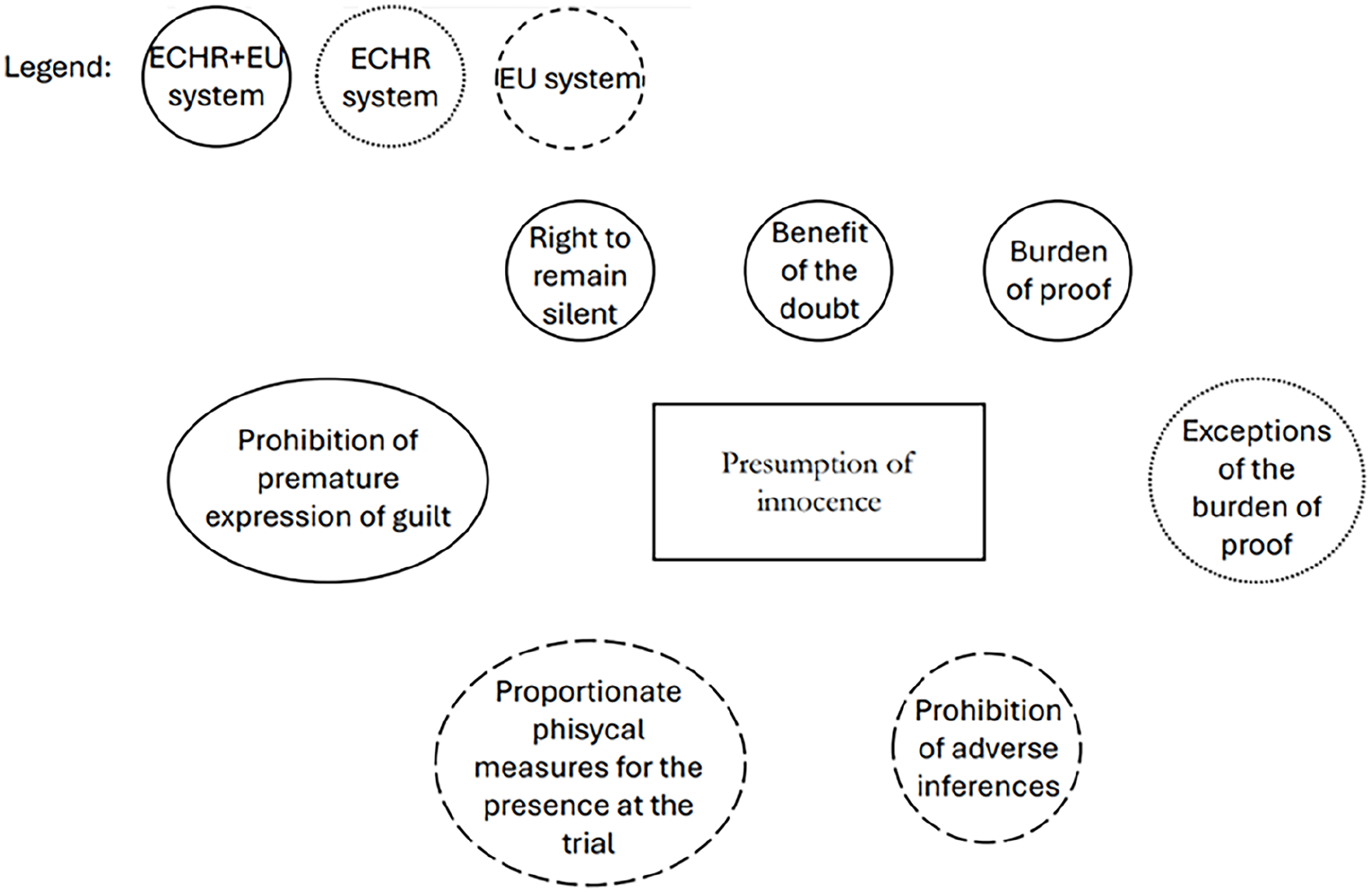
Convergences and divergences between the presumption of innocence in the EU and the ECHR system of procedural guarantees.
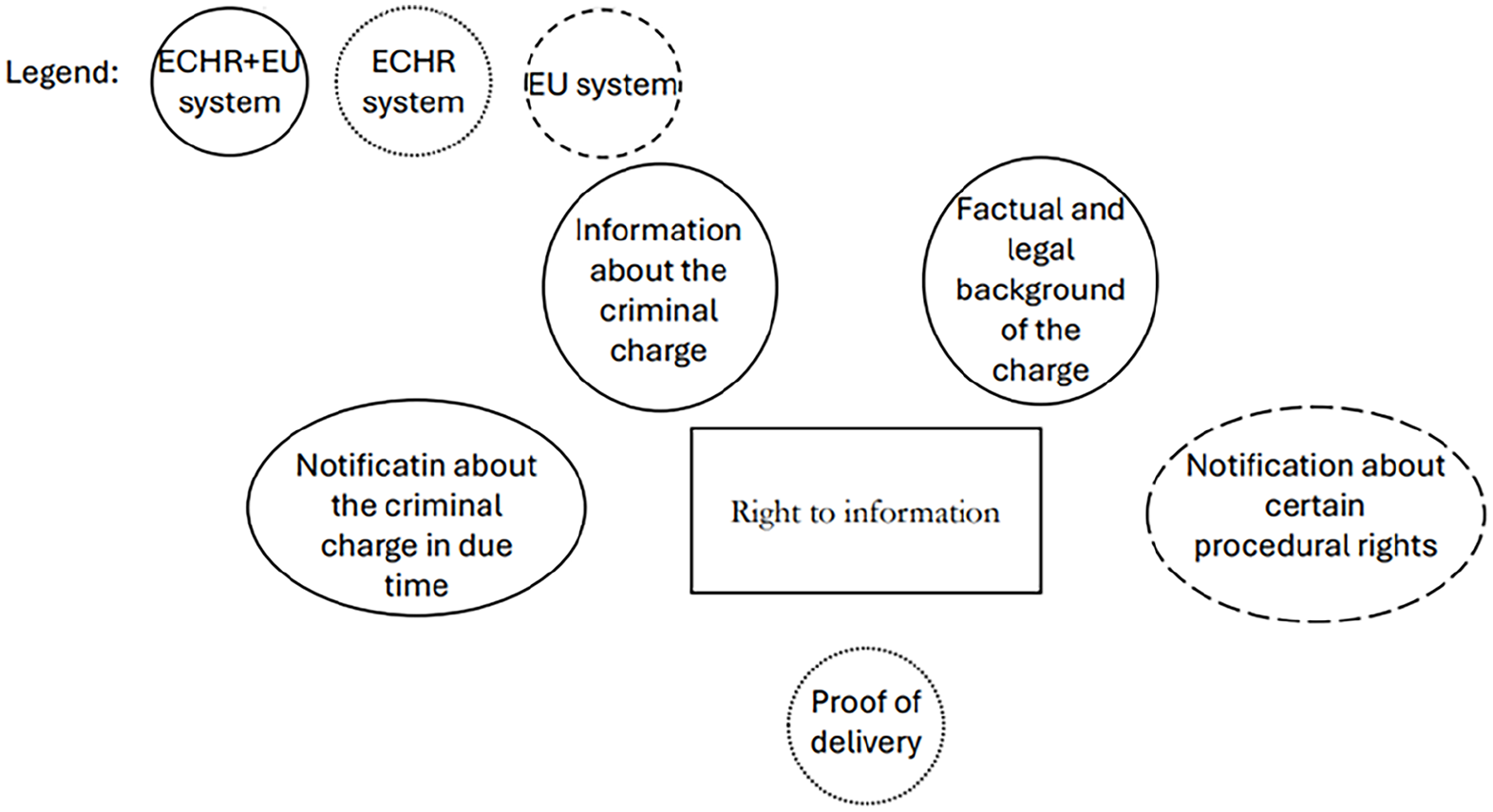
Convergences and divergences between the right to information in the EU and the ECHR system of procedural guarantees.
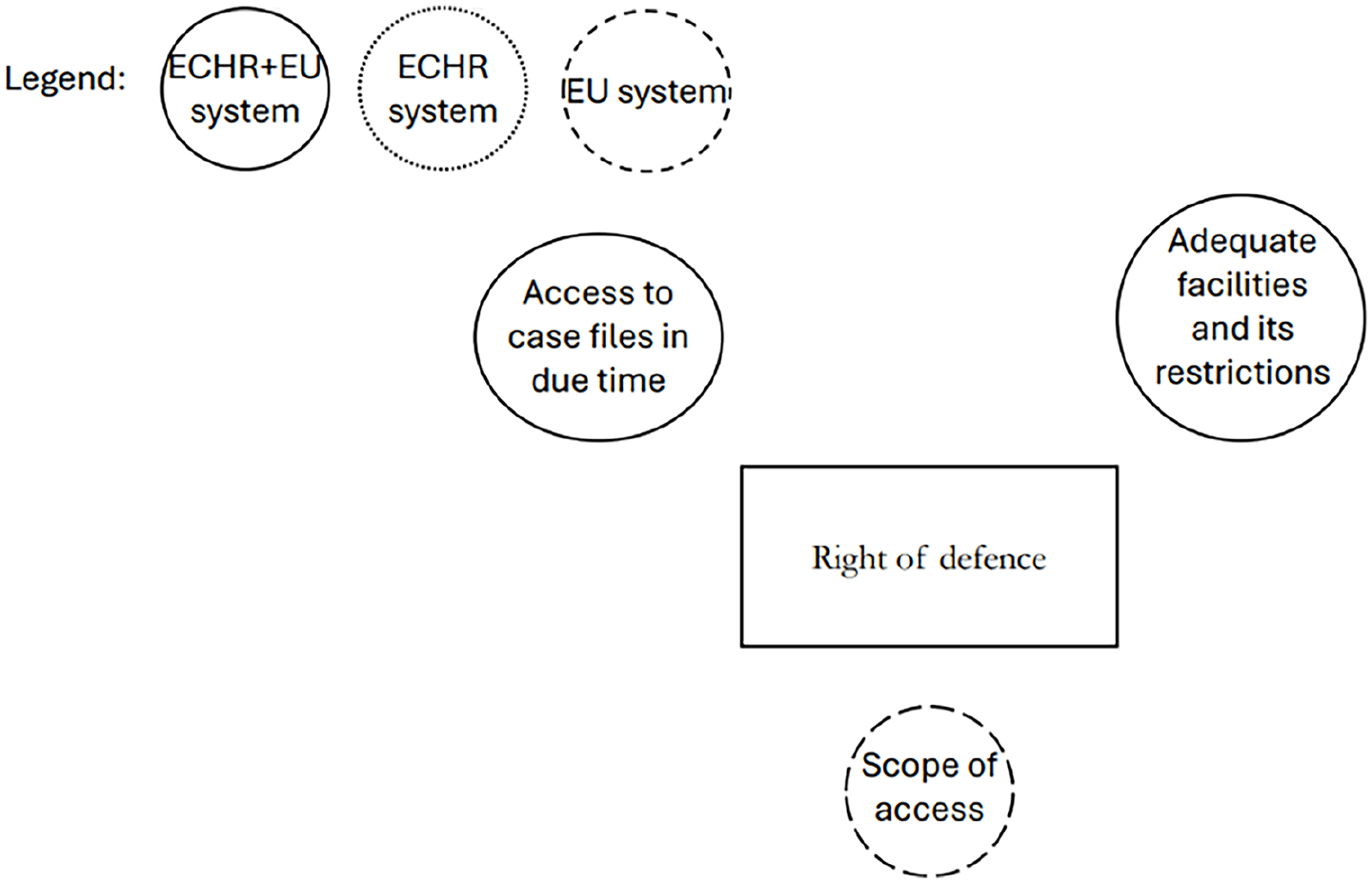
Convergences and divergences between the right of defence in the EU and the ECHR system of procedural guarantees.
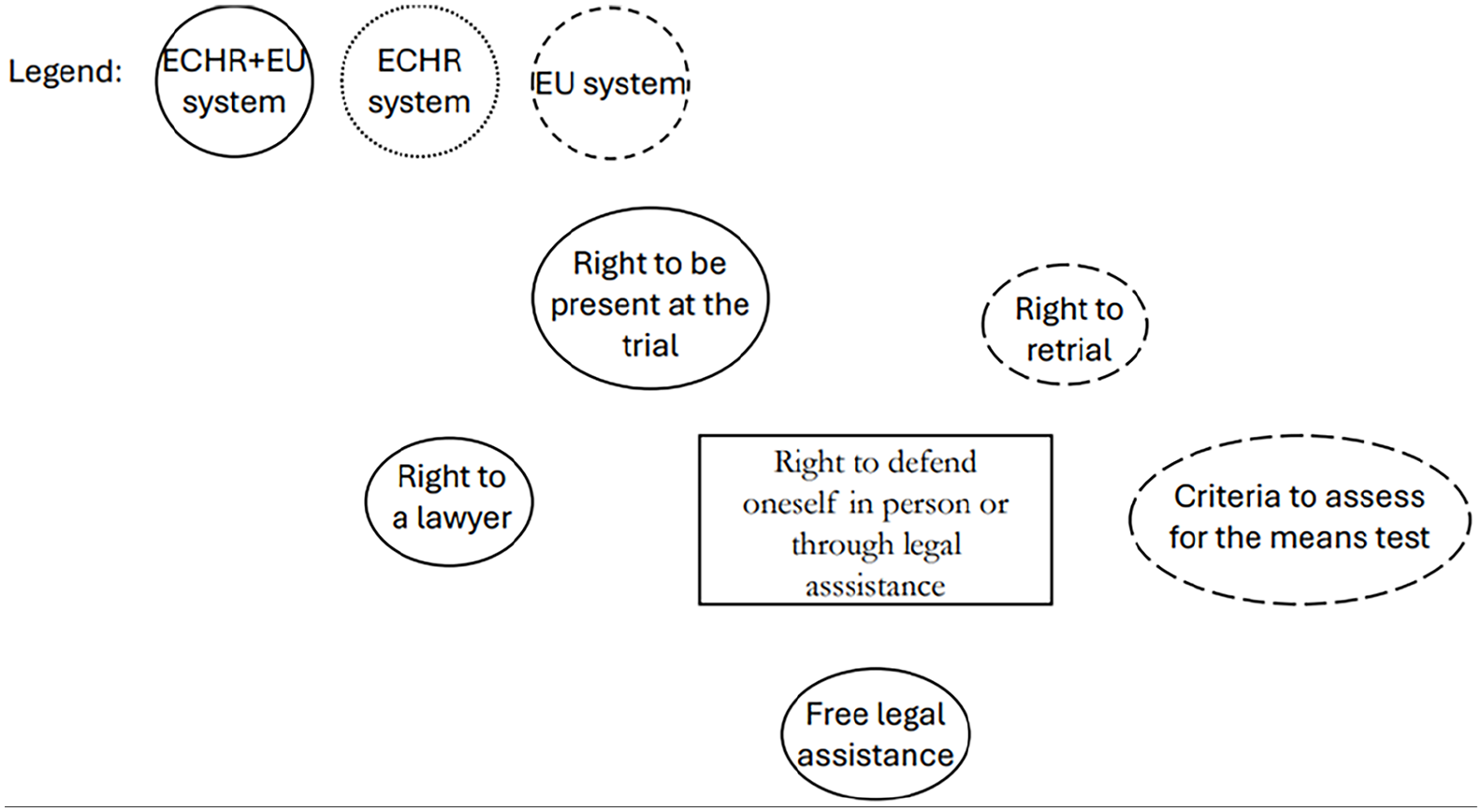
Convergences and divergences between the right to defend oneself in person or through legal assistance in the EU and the ECHR system of procedural guarantees.
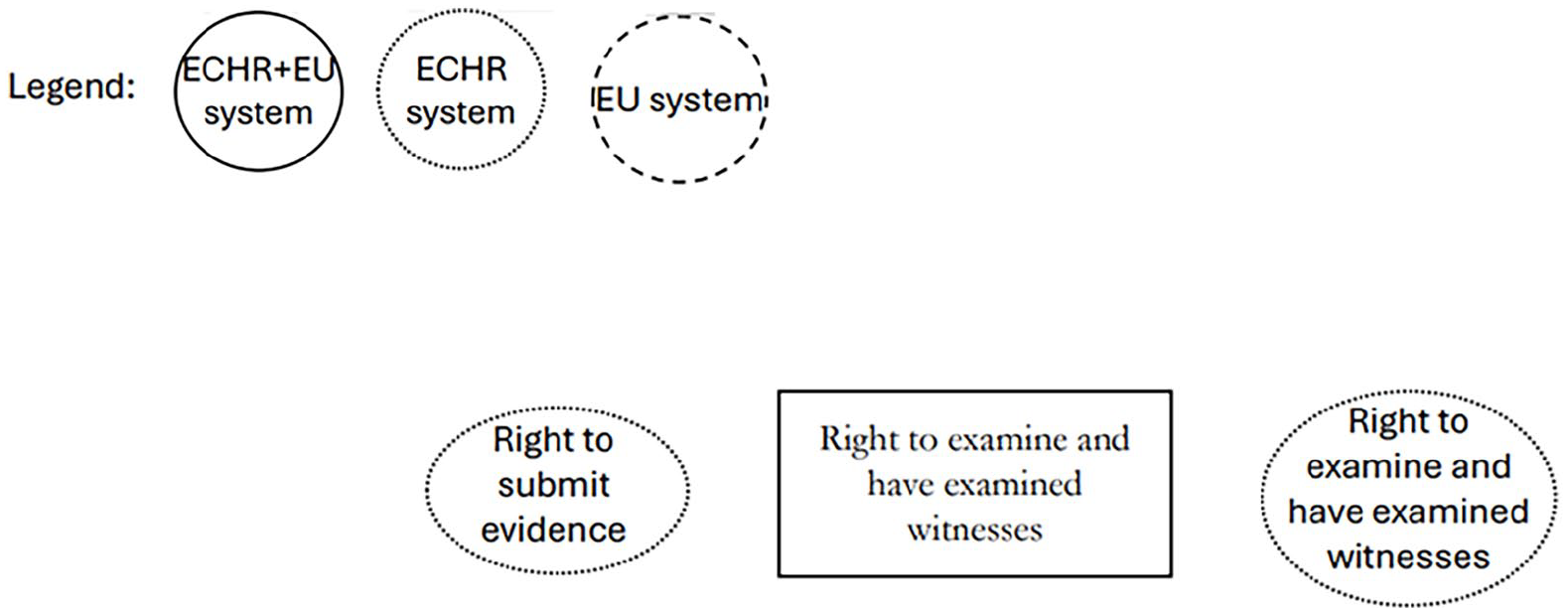
Convergences and divergences between the right to examine and have examined witnesses in the EU and the ECHR system of procedural guarantees.
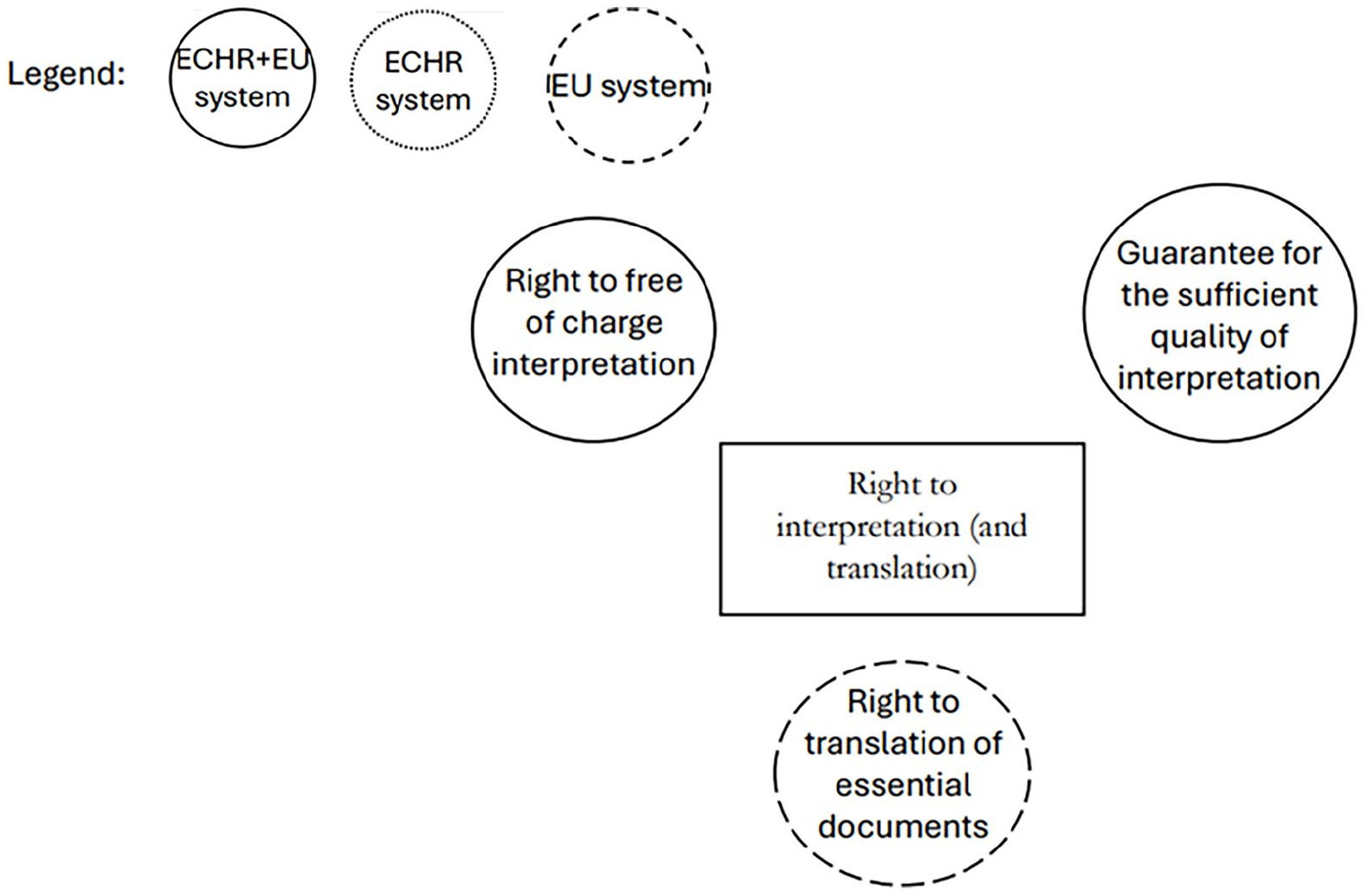
Convergences and divergences between the right to interpretation (and translation) in the EU and the ECHR system of procedural guarantees.
Nonetheless, before delving into the comparison, the relationship of Article 6 ECHR and Articles 47 and 48 of the EU Charter of Fundamental Rights (CFR) should be discussed. First and foremost, Articles 47 and 48 CFR corresponds to Article 6 ECHR. Consequently, as prescribed by Article 52(3) CFR, they can be considered to have the same meaning and scope as their counterpart in the ECHR. 42 However, if we take a closer look at their wording, it can be observed that they are not so detailed as Article 6 ECHR.
‘Article 47 CFR Everyone whose rights and freedoms guaranteed by the law of the Union are violated has the right to an effective remedy before a tribunal in compliance with the conditions laid down in this Article. Everyone is entitled to a fair and public hearing within a reasonable time by an independent and impartial tribunal previously established by law. Everyone shall have the possibility of being advised, defended and represented. Legal aid shall be made available to those who lack sufficient resources in so far as such aid is necessary to ensure effective access to justice’.
43
‘Article 48 CFR 1. Everyone who has been charged shall be presumed innocent until proved guilty according to law. 2. Respect for the rights of the defence of anyone who has been charged shall be guaranteed’.
44
They lay down the right to a fair trial in general supplemented with the right to – free of charge – legal assistance, the presumption of innocence and the right of defence. However, other procedural guarantees are not set out by the CFR. Therefore, the directives setting out procedural guarantees for the suspect and the accused – hereinafter referred to as the subject when I need to refer to the suspect and the accused together – are of utmost importance as they codify the standards of the ECHR and the case law of the ECtHR in connection with the right to a fair trial in EU law.
This is quite beneficial for the subjects of the criminal procedure as the written codification of the standards greatly contributes to a unified status of the individual. In addition, EU directives can be better enforced than the ECHR standards due to the shared responsibility of applying EU law between the ECJ and national courts in member states. 45 Last, but not least, the directives extended the scope of application of the CFR as its scope only includes cases when member states execute EU law. 46 Thus, with the directives regulating specific guarantees to the right to a fair trial, Articles 47 and 48 CFR has become applicable in member states.
The presumption of innocence
Article 6(2) ECHR stipulates that ‘everyone charged with a criminal offence shall be presumed innocent until proven guilty according to law’. 47 Despite the brief reference to this right in the ECHR, the ECtHR established that the presumption does not only stipulate that the subject shall not be presumed guilty until proven so according to law, 48 but it also prescribes rules regarding the burden of proof, the principle of in dubio pro reo, the prohibition of premature expressions of the subject’s guilt, and the right to remain silent, also referred to as the protection against self-incrimination. 49 Directive (EU) 2016/343 addresses all of the above aspects of the presumption. It lays down the essence of the presumption forbidding authorities to start with the preconception of the subject’s guilt, 50 that is supplemented by sufficient limitations on the public reference to guilt, the burden of proof and the privilege against self-incrimination.
The directive places the burden of proof on the prosecution in line with the standards established by the ECtHR. Therefore, the prosecution is responsible for proving the criminal guilt of the accused and any doubt should benefit them. The second obligation is expressly set out in Article 6(1) of the directive stipulating the competent court to seek out not only inculpatory, but also exculpatory evidence. 51 The ECtHR even went so far as to clearly establish that the burden shall not be shifted to the defence. 52 In contrast, the directive fails to do so. It only prescribes the general obligation by placing the burden of proof on the prosecution. Consequently, it missed an opportunity to clearly define the exceptions from the general rule which – in turn – were established by the ECtHR. Accordingly, certain presumptions of fact and of law are allowed under the ECHR regime, such as the presumption of criminal liability of smuggling which may be inferred from possession of narcotics. 53 In addition to that, criminal law may shift the burden of proof in cases when the public interest so dictates. For example, the Hungarian Criminal Code requires the accused to prove that any earning gained during the time of participating in a criminal organisation was not acquired through criminal acts. 54 Such presumptions, however, shall always be proportionate to the legitimate aim sought to be achieved. 55
In addition, Directive (EU) 2016/343 manages to implement every important standard set out by the ECtHR in connection with the right not to incriminate oneself. It essentially entitles the subject to remain silent when questioned. Under the ECHR regime, this allows the subject not to cooperate with authorities in sharing any information about the allegations. 56 This protection is granted by the directive in Article 7(1)-(3) with similar exceptions from it as established by the ECtHR. 57 While the ECtHR held that the subject may be legally obliged to submit themselves to certain tests, such as the provision of blood, and urine samples or bodily tissue for DNA samples, 58 the directive enables law enforcement and judicial authorities to gather any evidence which has an existence independent of the will of the subject. 59 The wording of Article 7(3) of the directive allows for a wider scope of physical evidence to gather in the criminal procedure regardless of the will of the subject. Furthermore, Article 7 of the directive does not only extend the enforcement capabilities of the competent authorities, but it also limits the freedom of the competent court to evaluate the evidence in a pending procedure in that it forbids to draw an adverse inference from the fact that the subject chose to remain silent when questioned about the offence they are accused of having committed. 60 The same standard does not exist under the ECHR regime, as it allows for the drawing of inferences from the decision to remain silent, albeit it limited their use in that inferences cannot be the sole or decisive evidence in the conviction. 61
Moreover, the ECtHR held on multiple occasions that the presumption of innocence strongly obliges judicial and public authorities, including police officers, the president of the republic and ministers to refrain from referring to the subject as guilty in their public statements and judicial decisions, 62 except for those ones which establish criminal liability. This requires making a fundamental distinction between suspicion, accusation and conviction that a person committed an offense. 63 Article 4 of the directive achieves exactly this standard when it forbids any reference to the guilt of the subject until it is confirmed according to law. The directive provides the exact same exceptions from the rule as laid down in the case law of the ECtHR. 64 The prohibition was confirmed by the ECJ in case C-377/18 where it was asked to assess whether referring to a subject of a criminal procedure in the plea bargain as the perpetrator, instead of as the accused, is in line with the directive. 65 It decided that the plea bargain must refer to the subject as the accused, not the perpetrator, as the latter would convey that the person is guilty of committing the offence even though their criminal guilt has yet to be established as the plea bargain did not concern them, but other subjects of the criminal procedure. 66 Thus, the ECJ established that referring to the accused as the perpetrator in the plea bargain would clearly violate the presumption of innocence. It is also worth mentioning that the directive requires member states to limit the use of measures of physical restraint on the subject when presenting them at the trial to the absolute necessary, 67 that is a practical requirement in line with the case law of the ECtHR.
Last, but not least, every aspect of the presumption of innocence regulated in the directive is protected by a general reference to the right legal remedy in Article 10 of the directive. 68 As such, it can be established that the directive did manage to implement most of the standards of protection laid down in the ECHR and the case law of the ECtHR in connection with the presumption. It even established a higher standard of protection in connection with the privilege against self-incrimination in that the directive introduces a general prohibition of the drawing of adverse inferences from the decision of the subject to remain silent during their questioning and with the public references to guilt in that it lays down a proportionality requirement for the application of physical measures against the subject when they are presented at a trial. However, one area where the directive lacks the standards set in the case law of the ECtHR is the exceptions from the prohibition of shifting the burden of proof. I believe that it would have been beneficial to define the exceptions employed by the ECtHR. Instead, the exceptions are now regulated individually by member states and safeguards for such situations may vary in every one of them.
The right to information about the accusation
Article 6(3)(a) ECHR stipulates that everyone charged with a criminal offence shall be ‘informed promptly, in a language which he understands and in detail, of the nature and cause of the accusation against him’. 69 Thus, the ECHR expressly sets several obligations in connection with the right to information about the criminal charge. Not only does it stipulate that the information must concern the factual and legal basis of the charges, 70 but also that the accused shall be informed in due time to enable them to prepare for their defence and to be informed in a language which they understand. 71 Directive 2012/13/EU prescribes all of the above standards except for the linguistic requirement which is regulated by Directive 2010/64/EU that will be discussed later.
Accordingly, the directive requires authorities to inform the accused about the criminal act they are accused of having committed. The information must be sufficiently detailed so as to safeguard the fairness of the proceedings and allow the accused to prepare their defence. This requirement is only accomplished if the accusation informs the accused about the nature and legal classification of the constituting behaviour, thus the factual and legal background of the charge as elaborated by the ECtHR as well. 72
As for the manner in which that information shall be provided, the ECtHR has established further standards. Directive 2012/13/EU complies with most of these requirements when laying down written standards for the information about the charges. First and foremost, the information about the accusation must actually be delivered to the accused who shall receive it. 73 Although a similar obligation is lacking from the directive, the ECJ has mitigated this shortcoming. In its case C-615/18, a penalty order was delivered to the accused via a person authorised to accept the serving of any court document. 74 The ECJ held that German legislation which does not require the authorised person to make sure that the court documents, including the penalty order is indeed served to the accused, but requires essentially the accused to inquire about the serving of documents is in violation of EU law. 75 The ECJ argued that informing the accused of the charges serves the effective exercise of the right of defence. 76 Thus, it is without question that authorities must make sure that the accused receives the information about the charge.
In addition to that, the ECtHR held that information must be sufficiently detailed for the accused to be able to understand the charges against them. 77 This is expressly set out by Article 6(1) of the directive. 78 Moreover, the information must be provided in due time so that the accused can prepare for their defence. 79 This requirement is met by the directive through obliging authorities to inform the accused of the charges at the latest by the time when the accusation is submitted to the court. 80 As for the language of the information, the ECHR stipulates that it shall be provided in a language that the accused understands, however, the ECtHR did note that a written translation is not always required. On the other hand, the lack of written translation shall not prevent the accused from preparing for their defence. 81 A similar approach is demonstrated by Directive 2010/64/EU, which provides for the translation of the indictment, if necessary. Thus, it will be discussed in connection with the right to interpretation. Moreover, Directive 2012/13/EU establishes a higher standard of protection for the accused in that if they are detained or arrested, they must be informed of the reasons for it. 82 The notification about any changes in the charge is subject to the same standards. 83
Another important aspect of the directive is that it significantly expanded the scope of the right to information. Even though the case law of the ECtHR does set out that the subject must be informed of their right to legal assistance, interpretation and to remain silent, 84 the ECHR does not expressly require authorities to inform the subject about them. In contrast, the directive sets out a list of procedural rights which the subject must be informed of including the above listed rights. 85 It even goes so far as to establish a separate list of rights which the subject must be informed of in case they are arrested or detained. 86 This information, for example on the maximum hours or days the subject may be detained are of great importance to safeguard the fairness of the procedure. 87
Thus, the directive sufficiently implemented the most important standards the ECHR and the case law of the ECtHR established in connection with the right to information. Where it failed to do so, that is in connection with the obligation to make sure that the subject receives the information about the charges, the ECJ established the same standard as set out by the ECtHR. Hence, the directive significantly improves the status of the subject of the criminal procedure.
The right of defence
Article 6(3)(b) ECHR stipulates that everyone charged with a criminal offence shall ‘[. . .] have adequate time and facilities for the preparation of his defence’. 88 Ultimately, the right of defence consists of two layers. It stipulates that the subject shall have the opportunity to organise their defence, and it serves to establish equality between the prosecution and the defence. 89 For this, they need to have sufficient time and accessibility to case files for this. 90 It is Directive 2012/13/EU which facilitates the right of defence in EU law mostly in line with the ECHR regime.
As for the assessment of the timely criterion, the ECtHR noted that it should be based on the nature of the proceedings and the complexity of the criminal case pending. 91 The more complex the case, the more time is necessary for the preparation for the defence. Moreover, additional time for preparation shall be provided to the accused under certain circumstances, such as the reclassification of the charge or the submission of new evidence. 92 The criterion also extends over the serving of the judgement. It shall be served in due time so that the accused can lodge an appeal before its time-limit expires. 93
The directive only sets a deadline for the provision of access to case files and material evidence which is when the merit of the accusation is submitted to the court. However, it does note that, it should be granted in due time to allow the effective exercise of the right of defence. In addition, the directive requires the provision of additional time should further evidence is submitted to the court. 94 These rules, although in a more abstract form, do comply with the ECtHR standards. Furthermore, the ECtHR also interpreted the notion of adequate facilities. It held that adequate facilities require an unrestricted access to case files for the accused. 95 The subject must be entitled to study and take notes or make copies of the results of the investigation throughout the criminal procedure with few exceptions, especially when the fundamental rights of another individual or an important public interest must be safeguarded. 96 The directive did not miss to lay down the right to access free of charge, and it also introduced similar restrictions in Article 7(4)-(5) of the directive. 97
Last, but not least, the directive arguably lays down rules in connection with the scope of the right of defence which holds added value compared to the standards of the ECHR and the ECtHR. Article 7(1)-(2) of the directive defines the scope of access when setting out qualitative requirements regarding which evidence and which documents should be accessible to the subject at the very least. The scope includes all material evidence which is necessary to safeguard the fairness of the procedure and documents related to a specific case which are necessary to challenge effectively the lawfulness of arrest or detention of the subject. 98 The qualitative requirements should be especially useful in cases when it is necessary to assess whether the subject was granted access to all necessary evidence and documents.
In conclusion, I believe that Directive 2012/13/EU refers to the most important requirements in connection with the subject’s access to case files, thus the right of defence. However, it does so in more abstract terms on multiple occasions such as regarding the definition of facilities and the timely criterion which leads me to believe that – at least partly – they will remain to be governed by the standards set out by the ECtHR. Although this may give rise to different case law in member states, there have not been any cases before the ECJ, which would indicate that this legislative approach resulted in the violation of that right.
The right to defend oneself in person or through legal assistance
Article 6(3)(c) ECHR stipulates that everyone charged with a criminal offence shall have the right ‘to defend himself in person or through legal assistance of his own choosing or, if he has not sufficient means to pay for legal assistance, to be given it free when the interests of justice so require’. 99 This guarantee also has a three-fold layer entitling the subject to execute their defence in the criminal procedure either by themselves or through legal assistance. It also obliges states to provide legal aid free of charge to the subject if they lack the sufficient financial means to pay for the services of a lawyer. 100
First and foremost, it should be emphasised that the subject’s right to represent themselves at the trial is not expressly regulated by any of the directives that concern the procedural guarantees of the subject in the criminal procedure, whereas both the ECHR and the case law of the ECtHR establish it with certain restrictions in the form of mandatory assignment of a lawyer. 101 In contrast, Directive (EU) 2016/343 regulating the right to be present at the trial only sets out the right of the accused to retrial that is subject to specific circumstances. 102 It defines the criteria that need to be considered when assessing whether the accused waived their right to be present at the trial. It requires authorities to inform the accused of the trial and the consequences of not appearing on it. 103 Informing the accused of the trial is enough in case they are represented by a lawyer. 104 The latter rule decreases the duties of the authorities in that the consequences of non-appearance need not be included in the notice as the lawyer representing the accused can inform them about these consequences. This regulation is essentially in line with the case law of the ECtHR which held that the absence of the accused from the trial rids the criminal procedure of its fairness if it cannot be properly established that the accused waived their right to be present at the trial. The waiver can be considered lawful when the subject can reasonably foresee the consequences of their conduct of not appearing at the trial. 105
The presence of the subject at the trial and other procedural measures was reaffirmed by the ECtHR in another context as well. It established that without their presence, they would not be able to submit and challenge evidence or exercise their right of defence and right to interpretation. 106 As such, the right to be present at the trial is an important corollary of these guarantees. Although the directive does facilitate the subject’s right to actively participate in the trial by providing the right to retrial with specific guarantees, it fails to expressly set out the substance of the right to be present at the trial by defining the specific procedural actions the accused should be allowed to take, such as examining the witnesses.
As for the right to legal assistance – free of charge if necessary –, Directives 2013/48/EU and (EU) 2016/1919 undertake to implement the standards set out by the ECHR and the case law of the ECtHR. This procedural guarantee plays a major role throughout the criminal procedure. Its importance is highlighted by the fact that the ECtHR established that legal assistance must be provided to the subject at every stage of the criminal procedure, not only in the trial phase, 107 but also as early as specific procedural measures such as the questioning, or the taking of the subject into police custody or pre-trial detention. 108 Directive 2013/48/EU caters for these standards in more ways. On the one hand, it guarantees the right to a lawyer right from the point when the subject is notified that they are either suspected or accused of having committed an offense. 109 The notification does not even need to have an official form that was underpinned by the ECJ in its case C-209/22, where the offenders were stopped by police officers who wanted to test them for drugs and alcohol. However, before that would have happened, the offenders confessed that they possess narcotic substances. 110 The police officers then conducted the search of the persons and the vehicle without informing them about their right to legal assistance. 111 The ECJ considered the execution of investigative measure after a confession to be an implicit form of suspicion. 112 As such, police officers should have informed the subjects of their right to legal assistance. 113 Without that, the effective exercise of the right of defence cannot be guaranteed. 114 On the other hand, the directive stipulates that legal assistance shall be accessible to the subject even before the trial if they are deprived of their liberty and on specific investigative measures, such as on the questioning by the police, identity parades, confrontations and reconstructions of the crime scenes at the minimum. 115 The lawyer shall be entitled to participate effectively on those investigative measures. 116
However, it is not enough to provide the possibility to choose a lawyer. The ECtHR held that states must make sure that communication between the subject and the lawyer is confidential. Its limitation is subject to very strict conditions. 117 The same is prescribed by the directive. 118 The limitations on the right to access to a lawyer are also defined based on the standards set out by the ECtHR. 119 They are allowed only in the pre-trial stage, they must serve to prevent the violation of serious interests such as the protection of the life of a person, 120 and they must be proportionate, strictly limited in time and the subject must be able to challenge any such decision before a judicial authority. 121
Last, but not least, the third layer of this guarantee requires states to provide legal aid to the subject. While the right to legal assistance is regulated in Directive 2013/48/EU, legal aid is regulated in a separate directive, but completely in line with the ECHR and ECtHR standards. Directive (EU) 2016/1919 sets the scope of the right to legal aid to be the same as the scope of the right to legal assistance. 122 Although the material criteria are not laid down by the ECHR for when legal aid shall be provided, the ECtHR did define them by setting out the conditions which should be assessed by states when assessing the need to provide legal assistance. They shall decide based on the subject’s financial situation and the interests of justice in the pending case. 123 The same criteria are set out by the directive as well. It obliges member states to conduct either a merit or a means test or both if they choose to do so. 124 In addition, it was emphasised by the ECtHR that such legal assistance must be practical and effective. 125 Thus, authorities are required to intervene if it is brought to their attention that the subject is not represented effectively by the assigned lawyer. 126 According to Directive (EU) 2016/1919, member states are required to guarantee the efficiency of legal assistance through a variety of measures including the operation of an effective legal aid system, the provision of sufficient training for professionals and enabling the subject to request a replacement of the lawyer providing legal assistance if necessary. 127
In conclusion, the directives sufficiently implemented the ECHR standards for the right to access to legal assistance and the right to legal aid with some novel instruments as well, while the efficiency of Directive (EU) 2016/343 will be discussed in the next point. For example, Directive (EU) 2016/1919 provides guidance on how to assess the financial means of the subject that is an addition to the ECHR standards. It obliges member states to consider not only the financial means of the subject, but also the family situation of the person, the costs of legal assistance and the costs of living in that specific member state. 128 This is an important practical addition which can efficiently guide the judicial authorities in the assessment of the means of the subject. In addition to that, Directive 2013/48/EU introduces the right to contact consular authorities and to have a third person informed of the deprivation of liberty and the right to communicate with third persons while deprived of liberty, 129 that is an essential element of the right to a fair trial. Nevertheless, the right to communication is not expressly set out in the ECHR or the case law of the ECtHR.
The right to examine witnesses
Article 6(3)(d) ECHR stipulates that everyone charged with a criminal offence shall have the right ‘to examine or have examined witnesses against him and to obtain the attendance and examination of witnesses on his behalf under the same conditions as witnesses against him’. 130 This guarantee does not only entitle the accused to examine witnesses at the trial, but also to call witnesses to be examined by the court. In addition to that, the ECtHR established extensive standards for the protection of the accused in case the witness does not appear before the court thus depriving the accused of this right. As already referred to in the previous point, the right to be present at the trial, and any procedural action that can be taken by the subject associated with this right is not regulated efficiently by the corresponding directive. Instead, Directive (EU) 2016/343 only sets out when the absence of the accused at the trial can be considered the waiver of the right to be present at the trial. Nevertheless, the ECJ established in more of its judgements that the same standards apply in connection with the rights of the accused at the trial as set out in the case law of the ECtHR.
This guarantee first and foremost requires that evidence must be produced in the presence of the accused at a public hearing including the production of witness statements. 131 In this context, it is important to enable the accused to challenge the testimony and ask questions from the witness. 132 This standard was firmly reiterated by the ECJ in its case C-348/21, where the witnesses were expelled from Bulgaria. Consequently, their testimony could not be presented at the trial. 133 Regardless of the absence of the witnesses, the prosecution intended to rely on their statements as evidence through their presentation at the trial. 134 The ECJ was tasked with deciding whether such evidence – taken in the absence of the accused – can be lawfully utilised at the trial. 135 It held that Bulgarian legislation allowing for the use of evidence taken without the absence of the accused opposes EU law. In answering the question, it relied on the ECHR and the case law of the ECtHR and it held that such legislation would reduce the right to be present at the trial to a passive right. 136 In the cited case, the ECtHR reiterated that the accused must be allowed to examine and have examined witnesses at the trial. 137 The ECJ’s judgement clearly confirmed that the right to be present at the trial must be accompanied with the right to take certain actions at the trial – the substance of the right to be present which was left out from Directive (EU) 2016/343.
Even though the presence of the witnesses at the trial is of utmost importance to safeguard the fairness of the trial, their non-attendance may be justified by a good reason according to the ECtHR. Proper justifications include the inability of the authorities to secure the presence of the witness, 138 or the personal situation of the witness, such as their death or fear of testifying before the court. 139 In such cases, authorities need to make sure that the weakened status of the accused is met with the necessary counterbalances and an assessment whether non-contested statements are reliable. 140 Counterbalances include – among others – the requirement that a judgement shall not be solely based on a non-contested witness testimony, 141 and the possibility for the defence to give their version of the events and also cast doubt on the credibility of the absent witness. 142
The ECJ followed the case law of the ECtHR in this regard as well. It held, that the witness may be absent from the trial for good reason. However, it emphasised that there must be sufficient guarantees to safeguard the accused if the testimony of the absent witness constitutes the sole or the decisive basis of the conviction. 143 In doing so, it referred to multiple judgements of the ECtHR which set out the assessment criteria for evaluating whether the right to a fair trial is violated in cases of absent witnesses. 144 The ECJ even went so far in case C-347/21 as to give guidance on how to safeguard the fairness of the procedure when the accused cannot be present at the trial when the witness is heard. It held that in such cases, it is of utmost importance to allow the accused to confront the witness about their testimony at a later hearing during the trial. However, the witness testimony is not necessary to be repeated. 145 Instead, the accused must acquire the copy of the minutes of the examination of the witness which can serve as the basis for them to ask questions or even challenge the statement. 146
In addition to that, the ECHR also enables the accused to submit evidence including calling on witnesses and have them examined by the court. Although this is a very important guarantee, it is not unlimited. The ECtHR held that accused may only call a witness to the court if their evidence is necessary for the establishment of the truth. 147 This standard has not yet been confirmed by the ECJ.
To sum up, Directive (EU) 2016/343 partly succeeded in implementing the ECHR standards for the right to be present at the trail in a very detailed manner. Laying down the criteria which must be considered when assessing whether a waiver of the right took place is very practice-oriented making it more efficient than its corresponding guarantee in the case law of the ECtHR, however, the directive failed to address the rights of the accused at the trial. Even though this shortcoming was mostly mitigated by the case law of the ECJ, it cannot be considered an optimal solution compared to the other directives. Without the clear establishment of the ECtHR standards in EU law, there is a risk that those standards will remain applicable in the member states which can also lead to differences in the guarantees provided to the subject as is the case in connection with the right to access to case files and evidence as well.
The right to interpretation
Article 6(3)(e) ECHR stipulates that everyone charged with a criminal offence shall ‘[. . .] have the free assistance of an interpreter if he cannot understand or speak the language used in court’. 148 This rule first and foremost prescribes that states need to provide the assistance of an interpreter free of charge to the subject if necessary. This service is not dependant on their financial means. The costs of interpretation may not be claimed back from them. 149
Directive 2010/64/EU serves to regulate the right to interpretation and also translation in the criminal procedure according to the standards of the ECHR and the ECtHR. It prescribes the right to interpretation and translation to be provided to the subject free of charge from the moment suspicion is communicated to them until the resolution of any appeal. 150 In addition to that, the directive obliges member states to establish a sufficient process or mechanism for assessing whether the subject is in need of linguistic assistance to understand the criminal procedure as required by the ECtHR. 151 Furthermore, the ECtHR held that scrutiny over the quality of interpretation is of utmost importance since the interpretation must enable the subject to properly understand the criminal procedure as this is the prerequisite of defence. 152 In line with this standard, member states are also required to have quality control over the interpretation and translation provided to the subject throughout the criminal procedure. 153
While interpretation in the criminal procedure is extensively dealt with by the ECtHR, it is noteworthy that neither the above article of the ECHR, nor the case law of the ECtHR prescribe translation in the criminal procedure as a rule. This does not mean that translation is excluded in the context of the right to interpretation; however, it is not required from authorities to translate any document. Instead, an interpreter must always assist the subject in understanding documents and case files which are served to them during the criminal procedure. 154
In contrast, the directive goes beyond the standards of the ECHR and the ECtHR when establishing the self-standing right to translation of so called ‘essential documents’. While the neither the ECHR, nor the case law of the ECtHR set out that written translation is generally required from authorities, the directive makes this rule the norm instead of the exception. 155 It even creates an open-ended definition of what an essential document is which obliges authorities to translate any judgement, the charge or indictment and every decision depriving the subject of their liberty. 156 Moreover, authorities may deem any other document worthy of translation based either on their own discretion or the reasoned request of the subject. 157 The right of the subject to such a request is even protected by the obligation to set up a remedial process against decisions turning down these requests. 158 On the other hand, the directive expressly enables the subject to complain about the insufficient quality of interpretation and translation. 159 Finally, the directive provides for interpretation between the subject and their legal counsel if necessary. 160
To sum up, Directive 2010/64/EU overachieved its task by not only taking standards from the ECHR and the case law of the ECtHR regarding the right to interpretation in the criminal procedure but also expanding the material scope of this right to the communication between the subject and the legal counsel, and the translation of essential documents. Moreover, the directive reinforced this right by expressly establishing remedial processes for when they are violated by law enforcement or judicial authorities. Not to mention that the case law of the ECJ is outstanding in supporting these novel standards and mechanisms. For example, in case C-242/22 PPU TL, the ECJ found that the so called ‘DIR’ under Portuguese criminal procedure code – a decision obliging the subject to share their current address and notify the authorities about any subsequent change in this address 161 – to be an essential document, since it sets out a series of obligations and serious procedural consequences in the event of non-compliance with those obligations. 162 In addition to that, in case C-564/19 IS, the ECJ deemed the proper scrutiny over the quality of interpretation to be so important that the lack of it can result in the suspension of a criminal procedure if the accused is not present due to the possibility of violation of their right to defence. 163
Conclusion
The above analysis shows that the EU legislation realised a significant convergence of the EU system of procedural guarantees to the ECHR system. The EU system is upheld even by the case law of the ECJ as demonstrated with several judgements. Furthermore, the directives have definitely achieved added value in this area. First and foremost, it should be emphasised that the directives introduced procedural guarantees which can be considered novelties even in comparison with the ECHR system. For example, Directive 2010/64/EU obliges member states to provide written translation of ‘essential documents’ save for exceptional circumstances. Directive 2012/13/EU directly sets out the list of rights that the subject must be informed of
Second, the directives are explicitly beneficial for the status of the individual in the criminal procedure as they codified and clarified procedural guarantees in EU law which were only set out previously by Articles 47 and 48 CFR and their application was limited by the scope of the CFR. Thus, the EU system of procedural guarantees, relying greatly on the ECHR system, backed up by the case law of the ECJ as well, is a very thorough system that meets the original requirement laid down in the 2009 roadmap of the Council to incorporate the ECHR guarantees. Hence, it significantly contributes to the strengthening of the status of the individual in the criminal procedure. It provides a mostly adequate response to the original problem which gave rise to its development, namely the efficiency of criminal cooperation between member states based on the principle of mutual recognition which often gave rise to the jeopardy of fundamental rights.
Although the directives can be considered a success in codifying most of the procedural guarantees and corresponding standards of the ECHR system, the differences between the two systems should not be dismissed. The analysis proved that they do differ on multiple aspects. For example, the directives do not expressly set out an obligation for the prosecution to make sure that the subject is indeed served with the documents including the charges, and they also failed to clearly set out standards in connection with the facilities that should be provided to the subject in connection with the right of defence. Furthermore, Directive (EU) 2016/343 failed to legislate the exceptions from the burden of proof that has the potentially adverse effect of giving rise to differing state practice in this regard. Last, but not least, there is also the problem of not defining the substance of the right to be present at the trial.
These divergences are slightly mitigated by the fact that even if legislation is lacking, the ECJ is quite willing to rely on the standards of the ECtHR when they are missing from the directives which definitely lessen the effects of the shortcomings of the EU system. 164 As such, divergences between the EU and the ECHR systems can be considered insignificant at the moment. However, the most reassuring resolution of this issue would be the EU’s accession to the ECHR as that would strengthen the application of the standards established in the case law of the ECtHR and not reiterated in the above directives. The EU’s accession could be useful for another reason as well. It could provide the highest standard of protection for the subject of the criminal procedure as it would combine the best legislative and jurisprudential approaches applied in the EU and the ECHR systems and strengthen the current practice where the ECJ already relies on the ECtHR when it does not have anything else to use for argumentation.
Footnotes
Declaration of conflicting interests
The author declared no potential conflicts of interest with respect to the research, authorship, and/or publication of this article.
Funding
The author disclosed receipt of the following financial support for the research, authorship, and/or publication of this article: The research is financed by 2024-2.1.1-EKÖP provided by the Ministry of Culture and Innovation, National Fund for Research, Development and Innovation, under the university research grant programme EKÖP-24-1.

1.
John Witte, ‘A New Magna Carta for the Early Modern Common Law: An 800th Anniversary Essay’ [2015] Journal of Law and Religion 428, 434.
2.
Nicolas Derasse, ‘Words and Liberty: Hopes for Legal Defence During the French Revolution’ [2012] Quaderni storici 745, 752–3.
3.
Universal Declaration of Human Rights, UN General Assembly A/RES/217(III) (UDHR), David Harris, ‘The Right to a Fair Trial in Criminal Proceedings as a Human Right’ [1967] International and Comparative Law Quarterly 352.
4.
Articles 10–11(1) UDHR.
5.
Article 6(3)(a) European Convention of Human Rights, 1950 (ECHR).
6.
Article 6(3)(b) ECHR.
7.
Article 6(3)(c) ECHR.
8.
Articles 6(3)(d)–(e) ECHR.
9.
The right to a fair trial is the cornerstone of democratic societies. It is indispensable in constructing a criminal justice system which abides by the rule of law. See Parveen Gul and Bahadar Ali, ‘The Concept of Fair Trial’ [2016] Journal of Law and Society 179, 180; Ryan Goss, ‘The Disappearing “Minimum Rights” of Article 6 ECHR: the Unfortunate Legacy of Ibrahim and Beuze’ [2023] Human Rights Law Review 1, 2
10.
Bettina Weisser, ‘The European Convention on Human Rights and the European Court of Human Rights as Guardians of Fair Criminal Proceedings in Europe’ in Darryl K. Brown, Jenia Iontcheva Turner and Bettina Weisser (eds), The Oxford Handbook of Criminal Process (OUP 2019) 2; Petra Bárd, ‘Jogállamiság és európai büntetőpolitika’ [2016] Jogtudományi Közlöny 435, 439.
11.
See for example Valsamis Mitsilegas, Maria Bergström and Theodore Konstadinides (eds), Research Handbook on EU Criminal Law (Edward Elgar 2016); Helmut Statzger, International and European Criminal Law (Hart 2018); Kai Ambos and Peter Rackow (eds), The Cambridge Companion to European Criminal Law (Cambridge University Press 2023); Stefano Ruggeri (ed.), Human Rights in European Criminal Law (Springer 2015).
12.
Bárd, ‘Jogállamiság és európai büntetőpolitika’ (n 10) 441–2; Valsamis Mitsilegas, EU Criminal Law After Lisbon: Rights, Trust and the Transformation of Justice in Europe (Hart 2018) 154
13.
Massimo Fichera, ‘The European Arrest Warrant and the Sovereign State: A Marriage of Convenience?’ [2009] European Law Journal 70; Susie Alegre and Marisa Leaf, ‘Mutual Recognition in European Judicial Cooperation: A Step Too Far Too Soon? Case Study – the European Arrest Warrant’ [2004] European Law Journal 200; Luisa Marin, ‘Effective and Legitimate? Learning from the Lessons of 10 Years of Practice with the European Arrest Warrant’ [2015] New Journal of European Criminal Law 326, 335; Lorena Bachmaier Winter, ‘Mutual Recognition and the Role of the CJEU: The Grounds for Non execution’ [2015] New Journal of European Criminal Law 505.
14.
Communication from the Commission to the Council and the European Parliament. Mutual Recognition of Final Decisions in Criminal Matters, COM(2000) 495; Communication from the Commission to the European Parliament and the Council. An area of freedom, security and justice serving the citizen, COM(2009) 262.
15.
Tampere European Council 15 and 16 of October 1999, Presidency Conclusions; Programme of measures to implement the principle of mutual recognition of decisions in criminal matters, OJ C012. 15.1.2001.
16.
Green Paper from the Commission, Procedural Safeguards for Suspects and Defendants in Criminal Proceedings Throughout the European Union, COM(2003) 75.
17.
Directive 2010/64/EU of the European Parliament and of the Council of 20 October 2010 on the right to interpretation and translation in criminal proceedings [2010] OJ L 280/1; Directive 2012/13/EU of the European Parliament and of the Council of 22 May 2012 on the right to information in criminal proceedings [2012] OJ L 142/1; Directive 2013/48/EU of the European Parliament and of the Council of 22 October 2013 on the right of access to a lawyer in criminal proceedings and in European arrest warrant proceedings, and on the right to have a third party informed upon deprivation of liberty and to communicate with third persons and with consular authorities while deprived of liberty [2013] OJ L 294/1; Directive (EU) 2016/343 of the European Parliament and of the Council of 9 March 2016 on the strengthening of certain aspects of the presumption of innocence and of the right to be present at the trial in criminal proceedings [2016] OJ L 65/1; Directive (EU) 2016/800 of the European Parliament and of the Council of 11 May 2016 on procedural safeguards for children who are suspects or accused persons in criminal proceedings [2016] OJ L 132/1; Directive (EU) 2016/1919 of the European Parliament and of the Council of 26 October 2016 on legal aid for suspects and accused persons in criminal proceedings and for requested persons in European arrest warrant proceedings [2016] OJ L 297/1.
18.
Bárd, ‘Jogállamiság és európai büntetőpolitika’ (n 10) 442.
19.
OJ C295/1-3. 4.12.2009. Preamble (13), Valsamis Mitsilegas, ‘The European Union and the Rights of Individuals in Criminal Proceedings’ in Darryl K. Brown and others (eds), The Oxford Handbook of Criminal Process (OUP 2019) 12
20.
See for example Libor Klimek, ‘Letter of Rights for Persons Arrested on the Basis of a European Arrest Warrant: A Novelty under the Directive 2012/13/EU’ [2013] International and Comparative Law Review 163, 168–9; Libor Klimek, Mutual Recognition of Judicial Decisions in European Criminal Law (Springer 2017) 586–664; Statzger, International and European Criminal Law (n 11) 165–7; Roberto Kostoris, ‘The Protection of Fundamental Rights’ in Roberto Kostoris (ed.), Handbook of EU Criminal Procedure (Springer 2018) 85–90; Antonio Balsamo, ‘The Content of Fundamental Rights’ in Roberto Kostoris (ed.), Handbook of EU Criminal Procedure (Springer 2018) 99–172; Kai Ambos, European Criminal Law (Cambridge University Press 2019) 137–41; Richard Vogler, ‘Lost in Translation: Language Rights for Defendants in European Criminal Proceedings’ in Stefano Ruggeri (ed.), Human Rights in European Criminal Law (Springer 2015) 95–111; Lorena Bachmaier Winter, ‘The EU Directive on the Right to Access to a Lawyer: A Critical Assessment’ in Stefano Ruggeri (ed.), Human Rights in European Criminal Law (Springer 2015) 111–35
21.
Laurens van Puyenbroeck and Gert Vermeulen, ‘Towards Minimum Procedural Guarantees for the Defence in Criminal Proceedings in the EU’ [2011] International and Comparative Law Quarterly 1017–1038.
22.
ibid 1038.
23.
COM(2000) 495, p. 16.
24.
Tampere European Council 15 and 16 October 1999, Presidency Conclusions, para 33.
25.
Valsamis Mitsilegas, ‘The European Model of Judicial Cooperation in Criminal Matters: Towards Effectiveness Based on Earned Trust’ [2019] Revista Brasileira de Direito Processual Penal 565, 571.
26.
Werner Schroeder, ‘Limits to European Harmonisation of Criminal Law’ [2020] eucrim 144.
27.
Puyenbroeck and Vermeulen, ‘Towards Minimum Procedural Guarantees’ (n 21) 1020; Krisztina Karsai, Az alapelvek rendszere az európai büntetőjogban (Szegedi Tudományegyetem 2015) 108.
28.
Tampere European Council 15 and 16 October 1999, Presidency Conclusions, para 37.
29.
Proposal for a Council Framework Decision on certain procedural rights in criminal proceedings throughout the European Union, COM(2004) 328, pp. 3, 9; For example Pélissier and Sassi v France case where the European Court of Human Rights found that Articles 6(3)(a)–(b) were infringed of the accused, or Czekalla v Portugal case where the ECtHR found that Article 6(3)(c) was violated. See Pélissier and Sassi v France App no 25444/94 (ECtHR, 15 March 1999), para 63.; Czekalla v Portugal App no 38830/97 (ECtHR, 10 January 2003), para 71.
30.
OJ C012. 15.1.2001. p. 12.
31.
COM(2003) 75, p. 4.
32.
Articles 2–14 COM(2004) 328.
33.
Valsamis Mitsilegas, ‘The Constitutional Implications of Mutual Recognition in Criminal Matters in the EU’ [2016] CML Rev 1277, 1305.
34.
Valsamis Mitsilegas, Joerg Monar and G. Wyn Rees, The European Union and Internal Security: Guardian of the People? (Palgrave Macmillan 2003) 7
35.
OJ C295/1-3. 4.12.2009. p. 3.
36.
OJ C295/1-3. 4.12.2009. Preamble (13).
37.
Directive 2010/64/EU.
38.
Directive 2012/13/EU.
39.
Directive 2013/48/EU; Directive (EU) 2016/1919.
40.
Directive (EU) 2016/343.
41.
Directive (EU) 2016/800.
42.
Article 52(3) Charter of Fundamental Rights OJ C364/1.
43.
Article 47 CFR.
44.
Article 48 CFR.
45.
Damian Chalmers, Gareth Davies and Giorgio Monti, European Union Law: Cases and Materials (Cambridge University Press 2010) 143.
46.
Article 51(1) CFR.
47.
Article 6(2) ECHR.
48.
Monsterrat de Hoyos Sancho and Salvador Guerrero Palomares, ‘Directive 2016/343 on the Strengthening of Certain Aspects of the Presumption of Innocence in Criminal Proceedings’ in Coral Arangüena Fanego, Montserrat de Hoyos Sancho and Alejandro Hernández López (eds), Procedural Safeguards for Suspects and Accused Persons in Criminal Proceedings. Good Practices Throughout the European Union (Springer 2021) 57.
49.
William A. Schabas, The European Convention on Human Rights: A Commentary (OUP 2015) 288, 300; European Court of Human Rights’ Guide on Article 6, Right to a fair trial (criminal limb) (updated on 31 August 2024), para 386.
50.
Article 3 Directive (EU) 2016/343; María Luisa Villamarín López, ‘The Presumption of Innocence in Directive 2016/343/EU of 9 March 2016’ [2017] ERA Forum 335, 343.
51.
Sancho and Palomares, ‘Directive 2016/343’ (n 48) 58; Article 6 Directive (EU) 2016/343.
52.
Telfner v Austria App no 33501/96 (ECtHR, 20 March 2001), para 15.
53.
Paul Mahoney, ‘Right to a Fair Trial in Criminal Matters Under Article 6 E.C.H.R.’ [2004] Judicial Studies Institute Journal 107, 123.
54.
Hungarian Criminal Code (Act no. C of 2012) § 74/A(1)(a).
55.
Janosevic v Sweden App no 34619/97 (ECtHR, 23 July 2002), para 101.
56.
Schabas, The European Convention on Human Rights (n 49) 300.
57.
Article 7 Directive (EU) 2016/343.
58.
Schabas, The European Convention on Human Rights (n 49) 301; Mahoney, ‘Right to a Fair Trial’ (n 53) 124.
59.
Article 7 Directive (EU) 2016/343.
60.
Article 7(4) Directive (EU) 2016/343.
61.
Yvonne Daly et al., ‘Human Rights Protections in Drawing Inferences from Criminal Suspects’ Silence’ [2021] Human Rights Law Review 696, 699.
62.
European Court of Human Rights’ Guide on Article 6 of the European Convention of Human Rights, Right to a fair trial (criminal limb) (Updated on 31 August 2024), para 390.
63.
Ismoilov and Others v Russia App no 2947/06 (ECtHR, 24 April 2008), para 166.
64.
Article 4 Directive (EU) 2016/343.
65.
Case C-377/18 AH and Others [2019], paras 21–25.
66.
Case C-377/18 AH and Others [2019], para 44.
67.
Article 5 Directive (EU) 2016/343.
68.
Article 10 Directive (EU) 2016/343; Paweł Wiliński and Karolina Kiejnich-Kruk, ‘Right to Effective Legal Remedy in Criminal Proceedings in the EU: Implementation and Need for Standards’ [2023] Review of European and Comparative Law 147, 162.
69.
Article 6(3)(a) ECHR.
70.
Pélissier and Sassi v. France App no 25444/94 (ECtHR, 25 March 1999), para 52.
71.
Schabas, The European Convention on Human Rights (n 49) 308.
72.
Article 6(1) Directive 2012/13/EU cf. Penev v Bulgaria App no 20494/04 (ECtHR, 7 January 2010), para 33.
73.
European Court of Human Rights’ Guide on Article 6 of the European Convention of Human Rights, Right to a fair trial (criminal limb) (Updated on 31 August 2024), para 421.
74.
Case C-615/18 Staatsanwaltschaft Offenburg [2020], para 13.
75.
ibid para 57.
76.
ibid para 62.
77.
Mattoccia v Italy App no 23969/94 (ECtHR, 25 July 2000), para 60.
78.
Article 6 Directive 2012/13/EU.
79.
European Court of Human Rights’ Guide on Article 6 of the European Convention of Human Rights, Right to a fair trial (criminal limb) (Updated on 31 August 2024), para 433.
80.
Article 6(3) Directive 2012/13/EU.
81.
Hermi v. Italy App no 18114/02 (ECtHR, 18 October 2006), para 68.
82.
Article 6(2) Directive 2012/13/EU.
83.
Article 6(4) Directive 2012/13/EU.
84.
Lalik v. Poland App no 47834/19 (ECtHR, 11 May 2023), para 62.
85.
Article 3 Directive 2012/13/EU.
86.
Article 4 Directive 2012/13/EU.
87.
Klimek, ‘Letter of Rights’ (n 20) 168–9.
88.
Article 6(3)(b) ECHR.
89.
European Court of Human Rights’ Guide on Article 6 of the European Convention of Human Rights, Right to a fair trial (criminal limb) (Updated on 31 August 2024), para 440.
90.
Schabas, The European Convention on Human Rights (n 49) 308. As such, the proper information about the charges is closely related to the right of defence. See Dallos v. Hungary App no 29082/95 (ECtHR, 1 March 2001), para 47.
91.
Gregacevic v. Croatia App no 58331/09 (ECtHR, 10 July 2012), para 51.
92.
European Court of Human Rights’ Guide on Article 6 of the European Convention of Human Rights, Right to a fair trial (criminal limb) (Updated on 31 August 2024), para 447.
93.
ibid para 450.
94.
Article 7(3) Directive 2012/13/EU.
95.
Schabas, The European Convention on Human Rights (n 49) 308.
96.
Rasmussen v Poland App no 38886/05 (ECtHR, 28 July 2009), para 48; Natunen v Finland App no 21022/04 (ECtHR, 31 March 1999), para 40.
97.
Article 7(4) Directive 2012/13/EU; Serena Quattrocolo, ‘The Right to Information in EU Legislation’ in Stefano Ruggeri (ed.), Human Rights in European Criminal Law New Developments in European Legislation and Case Law after the Lisbon Treaty (Springer 2015) 89.
98.
Article 7 Directive 2012/13/EU.
99.
Article 6(3)(c) ECHR.
100.
Schabas, The European Convention on Human Rights (n 49) 310.
101.
European Court of Human Rights’ Guide on Article 6 of the European Convention of Human Rights, Right to a fair trial (criminal limb) (Updated on 31 August 2024), para 466.
102.
Article 8 Directive (EU) 2016/343.
103.
Article 8(2)(a) Directive (EU) 2016/343.
104.
Article 8(2)(b) Directive (EU) 2016/343.
105.
Sejdovic v Italy App no 56581/00 (ECtHR, 1 March 2006), paras 82, 87.
106.
106.Jussila v Finland App no 73053/01 (ECtHR, 23 November 2006), para 40.
107.
Imbrioscia v Switzerland App no 13972/88 (EctHR, 24 November 1993), para 37.
108.
Dayanan v Turkey App no 7377/03 (ECtHR, 13 October 1999), para 31; Beuze v Belgium App no 71409/10 (ECtHR, 9 November 2018), para 134.
109.
Article 2(1) Directive 2013/48/EU; Mitsilegas, ‘The European Union and the Rights of Individuals’ (n 19) 5.
110.
Case C-209/22 Rayonna prokuratura Lovech, TO Lukovit [2023], paras 18–9.
111.
ibid para 31.
112.
ibid para 43.
113.
ibid para 44.
114.
ibid para 41.
115.
Articles 3(2), 3(3)(c) Directive 2013/48/EU.
116.
Article 3(3)(b) Directive 2013/48/EU.
117.
Sakhnovskiy v Russia App no 21272/03 (ECtHR, 2 November 2010), para 102.
118.
Article 4 Directive 2013/48/EU
119.
Simeonovi v Bulgaria App no 21980/04 (ECtHR, 12 May 2017), para 117.
120.
Article 3(6) Directive 2013/48/EU.
121.
Article 8 Directive 2013/48/EU.
122.
Article 2 Directive (EU) 2016/1919.
123.
Quaranta v Switzerland App no 12744/87 (ECtHR, 24 May 1991), para 27.
124.
Article 3(2) Directive (EU) 2016/1919.
125.
European Court of Human Rights’ Guide on Article 6 of the European Convention of Human Rights, Right to a fair trial (criminal limb) (Updated on 31 August 2024), paras 512–3.
126.
Schabas, The European Convention on Human Rights (n 49) 311.
127.
Article 7 Directive (EU) 2016/1919.
128.
Article 4(2) Directive (EU) 2016/1919.
129.
Articles 5–7 Directive 2013/48/EU.
130.
Article 6(3)(d) ECHR.
131.
European Court of Human Rights’ Guide on Article 6 of the European Convention of Human Rights, Right to a fair trial (criminal limb) (Updated on 31 August 2024), para 521.
132.
Schabas, The European Convention on Human Rights (n 49) 312.
133.
Case C-348/21 HYA and Others [2022], paras 16, 18, and 21.
134.
ibid para 22.
135.
ibid paras 37-38.
136.
ibid para 42.
137.
Gani v Spain App no 61800/08 (ECtHR, 19 February 2013), para 36.
138.
Gossa v Poland App no 47986/99 (ECtHR, 9 April 2007), para 55.
139.
European Court of Human Rights’ Guide on Article 6 of the European Convention of Human Rights, Right to a fair trial (criminal limb) (Updated on 31 August 2024), para 533.
140.
Schabas, The European Convention on Human Rights (n 49) 312.
141.
ibid 313.
142.
Schatschaschwili v Germany App no 9154/10 (ECtHR, 15 December 2015), para 131.
143.
Case C-348/21 HYA and Others [2022], para 55.
144.
Al-Khawaja and Tahery v. The United Kingdom App nos 26766/05 and 22228/06 (ECtHR, 15 December 2011); Schatschaschwili v. Germany App no 9154/10 (ECtHR, 15 December 2015), para 107; Dimitrov and Momin v. Bulgaria App no 35132/08 (ECtHR, 7 June 2018), para 52.
145.
Case C-347/21 DD [2022], para 35.
146.
ibid paras 37–8.
147.
Perna v Italy App no 48898/99 (ECtHR, 6 May 2003), para 29.
148.
Article 6(3)(e) ECHR.
149.
Öztürk v Germany App no 8544/79 (ECtHR, 21 February 1984), para 58.
150.
Articles 1(2), 2(1), 3(1), 4 Directive 2010/64/EU.
151.
Article 2(4) Directive 2010/64/EU cf. Schabas, The European Convention on Human Rights (n 49) 314.
152.
Hermi v Italy App no 18114/02 (ECtHR, 18 October 2006), para 70.
153.
Articles 2(8), 3(9) 5(1) Directive 2010/64/EU.
154.
Schabas, The European Convention on Human Rights (n 49) 315.
155.
Articles 3(1), 3(7) Directive 2010/64/EU
156.
Article 3(2) Directive 2010/64/EU; Mitsilegas, ‘The European Union and the Rights of Individuals’ (n 19) 2.
157.
Article 3(3) Directive 2010/64/EU.
158.
Article 3(5) Directive 2010/64/EU; Debbie Sayers, ‘Protecting Fair Trial Rights in Criminal Cases in the European Union: Where Does the Roadmap Take Us?’ [2014] Human Rights Law Review 733, 742.
159.
Articles 2(5), 3(5), 5(1) Directive 2010/64/EU.
160.
Article 2(2) Directive 2010/64/EU.
161.
Case C-242/22 PPU TL [2022], para 14.
162.
Case C-242/22 PPU TL [2022], para 60.
163.
Case C-654/19 IS [2021], paras 136–7; Ágoston Mohay and István Szijártó, ‘Criminal Procedures, Preliminary References and Judicial Independence: Abalancing Act? Case C-564/19 IS’ [2022] Maastricht Journal of European and Comparative Law 629, 635.
164.
See for example Case C-377/18 where it noted that Directive (EU) 2016/343 does not regulate how the accused should be referred to in a plea bargain which they do not agree to. Consequently, the ECJ decided to draw inspiration from the case law of the ECtHR. See Case C-377/18 AH and Others [2019], paras 42, 44; In addition, the ECJ greatly relied on the case law of the ECtHR in defining the substance of the right to be present at the trial and the procedural guarantees that should be awarded to the accused if the witness is absent from the trial. See Cases C-347/21 and C-348/21 detailed in point 3.5.