




Abstract
Prison inspection and monitoring bodies are becoming central players in European Arrest Warrant (EAW) decision-making. These bodies write reports on prison conditions and examine their compliance with fundamental rights. Now that poor prison conditions can be a basis to refuse an EAW’s execution, these bodies are becoming increasingly important actors in EAW decision-making process. While this is so, there is a remarkable lack of analysis on the legal structures and activities of such bodies. This article addresses this absence by presenting findings from the first European Union (EU)-wide study of prison inspection and monitoring bodies, providing new insights into the nature of these bodies. It provides both empirical insights into these structures for overseeing detention conditions and doctrinal analysis. It assesses the implications of an increased role for such bodies in the Area of Freedom, Security and Justice.
Keywords
Introduction
Poor prison conditions are now a well-established threat to mutual trust. Where prison conditions breach fundamental rights, it is possible for a judicial authority to postpone and, in extreme circumstances, refuse the execution of a European Arrest Warrant (EAW). The seminal decision of Aranyosi and Căldăraru, 1 and the subsequent clarifications and affirmations in LM, 2 ML 3 and Dorobantu, 4 have made it clear that executing judicial authorities must seek objective and up-to-date information about prison conditions in EAW cases when an issue about the compliance of those conditions with fundamental rights arises. Since that decision, a number of executing judicial authorities have used of reports by prison inspection and monitoring bodies when making assessments of the prison conditions in a Member State. Reports of these bodies are becoming much more common as well as more influential in EAW decision-making when prison conditions are being used as a basis to resist the execution of an EAW. Very little is, however, known about the legal frameworks which govern then, and their operation in practice. This gap in the literature is striking in the light of the decisive role their reports can play in consequential decisions affecting mutual trust and cooperation.
Prisons are by their nature far from public view, contain many people with histories of disadvantage, mental illness and drug addiction, and where there is a power imbalance between the authorities and those detained. Oversight of what happens in prisons is necessary to ensure that fundamental rights are protected and the rule of law is upheld. It is often challenging to obtain information about prison conditions, especially when those conditions are in another Member State. Prison inspection and monitoring bodies can play a crucial role in addressing this information deficit. Generally, their role is to visit prisons, write reports on their findings and issue recommendations to the prison authorities concerning suggested improvements. Such bodies exist in all Member States and the United Kingdom, and they therefore have a potentially significant role in EAW decision-making concerning detention conditions. This role raises several questions. Most fundamentally, we need to know what kinds of prison inspection and monitoring bodies exist within the European Union (EU), what their functions are, what powers they possess and what kinds of information they provide. The article argues that, with a new and potentially important role for prison oversight bodies emerging in the Area of Freedom, Security and Justice, it is essential to understand the kinds of bodies which will be called upon for information. Executing judicial authorities need good information about bodies which can provide useful, and perhaps decisive, information in consequential decisions. This article seeks to fill the gap in knowledge about prison oversight bodies in the EU. Drawing on the first EU-wide survey of prison oversight bodies, the article provides an overview of prison inspection and monitoring structures in the EU. It then examines the powers which such bodies have, finding considerable variability across states. The article focuses attention on the types of reports these bodies produce, noting that it is through reports that such bodies are likely to have the most influence in EAW cases. The article proceeds to explore examples where national judicial authorities have already used such reports in their EAW judgments. The increased understanding on how prison inspection and monitoring bodies operate in Member States offered by this study will be of benefit to scholars of the EAW procedure and all those involved in its practical operation. The article further examines the implications of the new role for prison inspection and monitoring bodies in the area of mutual trust, suggesting, in particular, that there is a need for more guidance at EU level to support the operation of prison oversight bodies.
Prison conditions and the EAW: The role of inspection and monitoring bodies
Fundamental rights issues in prisons have become increasingly prominent concerns for EU institutions. 5 The link between detention conditions and the operation of mutual trust was made clear in a resolution of the European Parliament in 2014, which expressed concern that the unacceptable conditions in detention facilities within the Union could impact upon the effectiveness of the EU’s mutual recognition instruments. 6 In 2017, the Parliament went further, 7 describing detention conditions as a ‘decisive element in the application of the principle of mutual recognition of judgments’. 8 The threat to mutual trust posed by poor prison conditions crystallised in the decision of the European Court of Justice of Aranyosi and Căldăraru. The Court held that the execution of an EAW may be suspended if there is evidence that the prison conditions in which the person who is the subject of the EAW is so poor as to breach fundamental rights. Where the executing judicial authority finds that there is a real risk that an individual who is the subject of an EAW will be exposed to inhuman or degrading treatment by reason of the detention conditions to which she/he will be returned, the execution of the warrant must be postponed. If the existence of the risk cannot be discounted within a ‘reasonable’ 9 time, then the executing judicial authority must decide whether the surrender process should be ended. Before an executing judicial authority takes such a significant step, however, it must examine evidence concerning the nature of the prison conditions in question. 10 The first step in the process examines the general conditions of detention and systemic deficiencies. Once this has been established, it is necessary to conduct an individualised assessment of the precise conditions in which the person will be detained. It is in this context that prison inspection and monitoring bodies are becoming important players in the EAW system.
The test for whether an EAW can be postponed in situations where there are concerns about the compliance of prison conditions with fundamental rights was considered at some length in Aranyosi and Căldăraru and was subsequently confirmed in LM
11
and ML.
12
The first step in this test is for the executing judicial authority to assess the presence of risk to fundamental rights posed by the impugned prison conditions. To conduct that examination, the executing judicial authority must first rely on information that is ‘objective, reliable, specific and properly updated on the detention conditions’ prevailing in the Member State.
13
Such a review is directed to the general level of detention conditions. If the judicial authority considers that there is a real risk of inhuman or degrading treatment at the general or systemic level, a further step commences. The first step, alone, cannot lead to a decision to refuse to execute a warrant. The judicial authority must engage in ‘a further assessment, specific and precise, of whether there are substantial grounds to believe that the individual concerned will be exposed to that risk’ in the requesting Member State.
14
To quote the test from the decision in full: The mere existence of evidence that there are deficiencies, which may be systemic or generalised, or which may affect certain groups of people, or which may affect certain places of detention, with respect to detention conditions in the issuing Member State does not necessarily imply that, in a specific case, the individual concerned will be subject to inhuman or degrading treatment in the event that he is surrendered to the authorities of that Member State. Consequently, in order to ensure respect for Article 4 of the Charter in the individual circumstances of the person who is the subject of the EAW, the executing judicial authority, when faced with evidence of the existence of such deficiencies that is objective, reliable, specific and properly updated, is bound to determine whether, in the particular circumstances of the case, there are substantial grounds to believe that, following the surrender of that person to the issuing Member State, he will run a real risk of being subject in that Member State to inhuman or degrading treatment, within the meaning of Article 4.
15
Prison inspection and monitoring bodies are tasked with examining and investigating prison conditions and reporting on their findings. They have an explicit focus on supporting the promotion of human rights and are often independent of the prison authorities, giving an extra level of comfort to the executing judicial authority about the provenance and accuracy of the information being supplied. Such bodies are therefore highly likely to be called upon to provide information in EAW cases. 19 Indeed, the Court has encouraged the use of these reports in Aranyosi and Căldăraru and in ML, where it stated that executing judicial authorities may request information concerning the presence of national and international mechanisms for monitoring in the State. 20 As described further, we see an increasing number of executing judicial authorities in Member States already using reports of prison inspection and monitoring bodies in their assessments of prison conditions and drawing on the conclusions of these bodies when deciding not to execute a warrant. Prison inspection and monitoring bodies are therefore becoming increasingly important actors in the EAW machinery. In the next section of this article, we provide an overview of European legal frameworks for prison inspection and monitoring bodies. We then examine the cases in which prison inspection and monitoring bodies have been called upon to provide information in such cases.
Prison inspection and monitoring bodies under European and international law
There is presently no obligation under EU law for a Member State to have a prison inspection and monitoring body. The Council of Europe’s European Prison Rules, however, require its Member States to establish internal or governmental inspection bodies for prisons and external or independent forms of prison monitoring. The rules have the status of a Recommendation from the Committee of Ministers and are non-binding. The European Court of Human Rights places a good deal of reliance on the rules when deciding cases concerning prison conditions and the rules therefore have considerable authority. Rule 9 describes the basic principle that ‘all prisons shall be subject to regular governmental inspection and independent monitoring’. The rules are currently in the process of revision and their associated commentary was revised in 2018. Rule 92 presently states that: Prisons shall be inspected regularly by a governmental agency in order to assess whether they are administered in accordance with the requirements of national and international law, and the provisions of these rules. Such independent monitoring bodies shall be guaranteed: a. access to all prisons and parts of prisons, and to prison records, including requests and complaints, that they require to carry out their monitoring; b. choice of which prisons to visit, including by making unannounced visits and which prisoners to interview; and c. permission to conduct private and fully confidential interviews with prisoners and prison staff.
The United Nations’ Optional Protocol to the Convention Against Torture (OPCAT) contains specific requirements to set up prison oversight bodies. OPCAT requires States Parties to create ‘National Preventive Mechanisms’ (NPMs). These bodies are given the authority and powers to visit places where people are deprived of their liberty, not only prisons. Their remit is to seek to prevent torture and inhuman and degrading treatment or punishment through visits by independent bodies. 21 As will be shown below, most EU countries have an NPM. NPMs were created by Article 3 of OPCAT, which states that ‘each State Party shall set up, designate or maintain at the domestic level one or several visiting bodies for the prevention of torture and other cruel, inhuman or degrading treatment or punishment’. The purpose of OPCAT, set out in Article 1, is ‘to establish a system of regular visits undertaken by independent international and national bodies to places where people are deprived of their liberty, in order to prevent torture and other cruel, inhuman or degrading treatment or punishment’. States Parties are obliged to allow visits by NPMs to any place where people are or may be deprived of their liberty. OPCAT obliges States Parties to grant NPMs certain minimum powers. These are set out in Article 19 and include the power to regularly examine the treatment of detained persons and to make recommendations to the authorities with the aim of improving treatment and conditions. Article 20 of OPCAT obliges States Parties to grant NPMs certain powers including access to all information concerning the numbers of people deprived of their liberty and their locations; access to all information on treatment and conditions in places of detention; access to all places of detention; and the opportunity to have private interviews with people deprived of their liberty. Article 22 of OPCAT provides that the competent authorities of the State Party shall examine the recommendations made by the NPM and enter into a dialogue with it on how to implement the recommendations. States Parties must also undertake to publish and disseminate the annual reports of NPMs (Article 23).
While the EU does not presently have any specific legal instruments requiring Member States to establish prison inspection and monitoring bodies, the European Parliament has called on Member States and accession countries to sign and ratify OPCAT and also has encouraged the EU itself to sign and ratify OPCAT, as part of its policy vis-à-vis third countries. 22 Its 2019 guidelines on torture in third countries also exhort states to ensure all NPMs are fully independent, adequately resourced and trained, and that there should be multidisciplinary expertise on monitoring bodies. 23 The Parliament has also suggested that Member States should establish inspectorates for detention premises to be able to draw on the work of independent bodies in evaluating prison conditions. 24 While several international instruments oblige states to establish domestic-level prison inspection and monitoring bodies, no single model or type of body is required under any of these provisions.
Supranational prison monitoring bodies also exist, notably the Council of Europe’s European Committee for the Prevention of Torture and Inhuman or Degrading Treatment or Punishment (CPT) and the UN’s Subcommittee on the Prevention of Torture (SPT). These visit prisons usually every several years.
Prison inspection and monitoring bodies are therefore key elements in the protection of fundamental rights in prisons under international human rights standards. From Aranyosi and Căldăraru and the subsequent line of cases, reports of these bodies are to play a role when national judicial authorities are making decisions concerning poor prison conditions. Despite their important position, remarkably little is known about the types, structures, activities, powers and reports of prison inspection and monitoring bodies within the EU. To contribute to fill this gap, we provide the first comprehensive analysis of the prison inspection and monitoring bodies within what was, at the time of data collection, the EU28, drawing on the first EU-wide survey of prison oversight bodies – the European Survey on Prison Oversight Bodies.
Understanding prison inspection and monitoring bodies in the EU
In this section of the article, we provide information on the methodology used in collecting and analysing the information reported here.
Data collection
The target population for the study was NPMs and oversight bodies in EU Member States. Potential respondents were identified by reviewing official data, including relevant websites (e.g. United Nation Office of the High Commissioner) and information from the NPMs designated in each Member State. For countries which have not ratified OPCAT, potential respondents were identified through publicly available documents such as reports produced by international inspection and monitoring bodies appointed to the respective countries. Email and postal addresses were collected by the authors by a combination of public sources and personal networks.
The questionnaire was developed by the authors and pretested using a panel of five international experts on the field. 25 Data were collected between 29 January 2019 and 8 April 2019. Participants received advance notification about the survey. Postal prenotification letters were mailed to NPMs and oversight bodies in the 28 EU Member States. The invitations containing the survey URL were sent the following week. Non-respondents received up to three additional reminder emails and a telephone call. The survey closed on 8 April, with a 100% response rate. The survey, programmed using Qualtrics, took approximately 46 minutes to complete and no incentives were offered. The study was approved by the Research Ethics Committee of the School of Law at Trinity College Dublin, Ireland. Informed consent was obtained from every participant in the study.
Variables of interest
In this section, we describe the variables we examined in the study.
Characteristics of oversight bodies
Seven questions were asked about OPCAT and the characteristics of oversight bodies in their countries. These included OPCAT ratification as well as NPM status (i.e. designated or not). Countries with designated NPMs were queried about the years in which these bodies were designated and in which operations started. In addition, they were asked about the type of NPMs, the number of member organisations, and whether NPMs were specifically created to fulfil OPCAT obligations.
Members’ appointment
Four questions examined the appointment of the members of NPMs and other oversight bodies within the EU. These included who made the appointment and whether civil society was involved. Additionally, respondents were asked whether terms have maximum durations and whether appointments were renewable.
Powers
Legal powers were measured using two items that asked domestic bodies whether their terms and powers are clearly set out in a legislative text and whether their independence from prison and state authorities is guaranteed in legislation. NPMs and oversight bodies were also asked about their access in prisons.
Characteristics of reports
Several aspects of the reports produced by domestic bodies were analysed. These included the relative time devoted to this task, the types of reports produced, the publicising of annual reports, the format in which these reports are presented (stand-alone vs. larger reports) and whether they are presented to and discussed by the national legislative assembly or the Parliament. 26
Analytic strategy
Prior to the analyses, a data validation process was performed. This involved checking for internal inconsistencies across the responses (i.e. where conflicting information was provided in response to different questions within the questionnaire), as well as cross-referencing responses with official, publicly available data. When inconsistencies in the data received were found, the respective states were contacted by email. The problems encountered were specified, and states were asked to provide clarifications or update their responses. This process was conducted between 6 May and 14 June, with responses from the 12 relevant states. Once the validation process was completed, descriptive statistics were computed for the study variables. To assess the association between the number of reports produced by oversight bodies and the year in which they started their operations, Pearson’s correlation coefficients were computed.
Findings: What kinds of prison inspection and monitoring bodies exist in the EU, and what do they do?
OPCAT status and NPM situation in the EU Member States + the United Kingdom
At the time of data collection, 25 of the 27 EU Member States + the United Kingdom had ratified OPCAT (see Table 1). The first countries to do so were Malta and the United Kingdom, in 2003. Belgium was the last of the 25 states to ratify the Optional Protocol, in July 2018. In accordance with OPCAT obligations, the countries in which the Optional Protocol had been ratified had NPMs in place, with the exception of Belgium. In addition, Latvia had established its NPM despite not having ratified OPCAT.
OPCAT status and NPM situation by state.
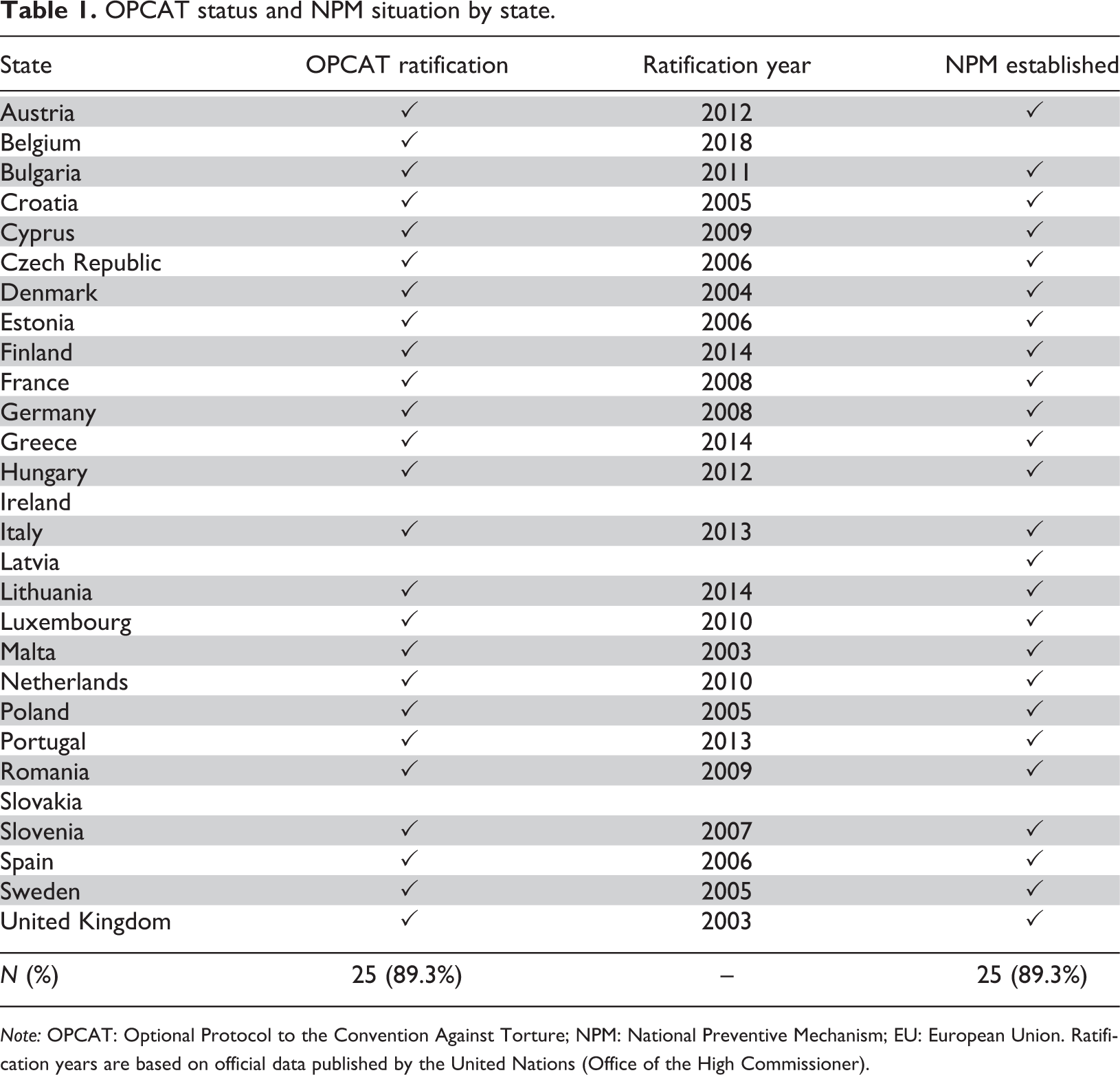
Note: OPCAT: Optional Protocol to the Convention Against Torture; NPM: National Preventive Mechanism; EU: European Union. Ratification years are based on official data published by the United Nations (Office of the High Commissioner).
Structure and characteristics of the NPMs within the EU + the United Kingdom
Of the 25 NPMs that have been established in EU member states + the United Kingdom, 12 were designated before 2010 and 12 after this benchmark. In a sizable percentage of cases (44.0%), the NPMs started their operations the same year as their designation (see Table 2). This was the case for Austria, Bulgaria, the Czech Republic, Estonia, Finland, Greece, Latvia, Luxembourg, the Netherlands, Poland and the United Kingdom. However, in 14 countries there was a gap between the time of their designation and the commencement of their operations. In most cases (eight states), this gap consisted of 1 year. The largest differences were found for Denmark and Sweden (3 and 5 years, respectively). These two countries were among the earliest in designating their NPMs (both in 2006), which started working in 2009 and 2011, respectively. Although Malta was the first state to designate its NPMs, due to the aforementioned gaps, in 2006, the Czech Republic was the first EU member state to have an operating NPM. 2014 was the year in which the most states designated their NPMs (Finland, Greece, Italy and Romania) and more NPMs began their operations (Finland, Greece, Lithuania and Portugal).
NPM characteristics by state.
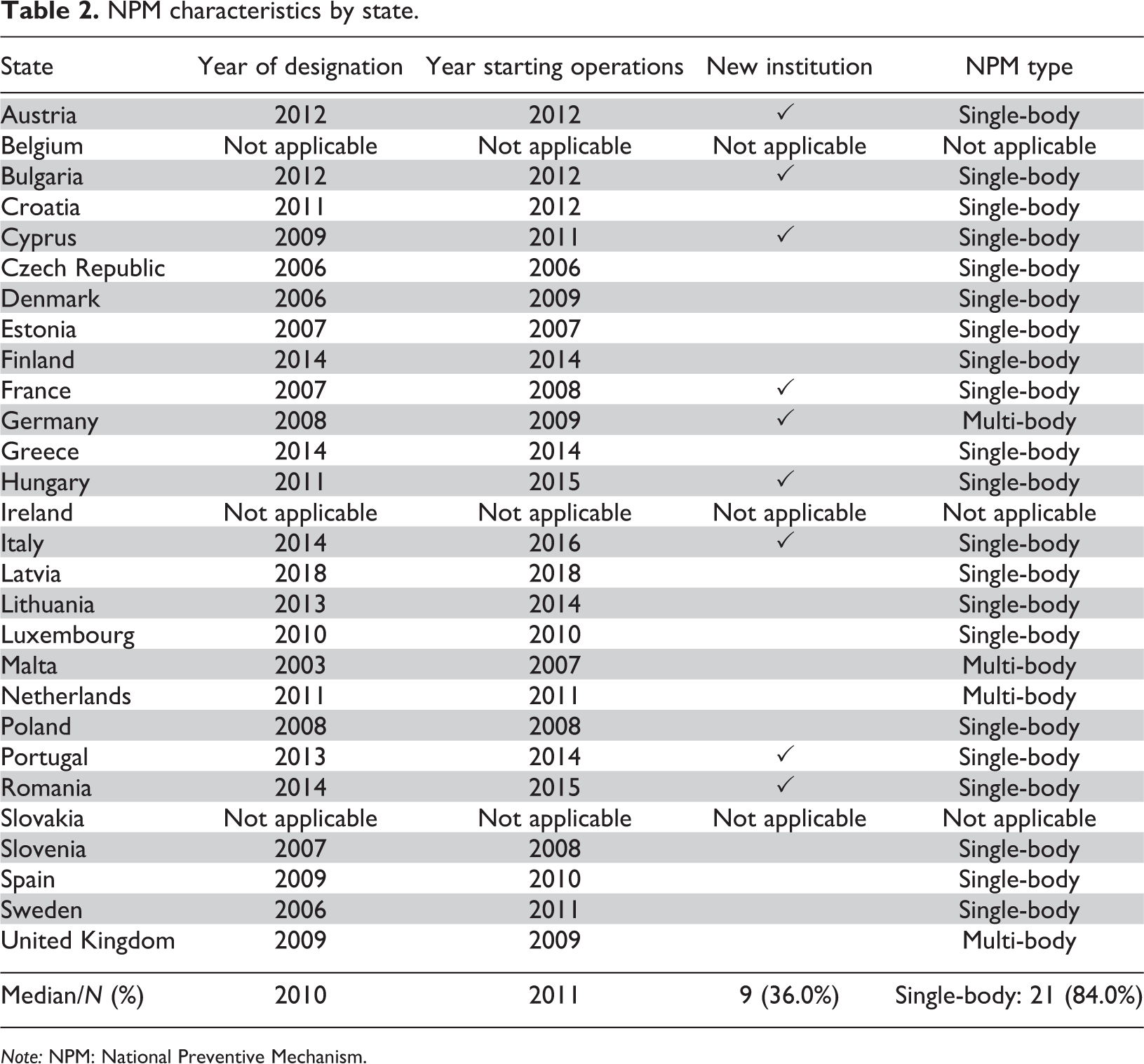
Note: NPM: National Preventive Mechanism.
The majority of the states indicated that they had designated existing institutions as their NPMs (64.0%). However, nine countries indicated having created new bodies to perform their obligations under OPCAT. In terms of structure, most NPMs consist of single institutions (84.0%), while Germany, Malta, the Netherlands and the United Kingdom have multiple bodies serving as their NPMs. Single-body institutions consist of one official body only comprising the NPM, whereas multibody institutions involve more than one, and sometimes many, official bodies working together as the NPM. The number of institutions comprising multibody structures ranges from 2 in Germany and Malta to 21 in the United Kingdom. In all cases where there are multibody institutions, one of the institutions acts as the coordinating body of the NPM. Although OPCAT does not prescribe any specific structure, the majority of the countries had established a department within the Ombuds Office or the Ombuds Office itself as their NPMs (19 states).
Appointment of the members of NPMs and oversight bodies and their training
To understand the functioning of oversight bodies in Europe, a series of questions examining the appointment of their members was included in the questionnaire. Some variability was found regarding who was responsible for this duty (see Table 3). In the three states in which NPMs had not been designated, the most recent appointments were performed either by the Parliament (Belgium and Slovakia) or by a Ministry (Ireland). In the case of countries with designated NPMs, Parliaments and Ministries were also responsible for the appointment of their members, either alone (Denmark, Germany, Italy and Luxembourg) or in conjunction with Ombuds offices (Austria and Hungary). However, the office that most frequently performed this task was the Ombuds office, appointing NPM members in 17 states. The remainder countries reported the assignments to be done by the President of the Republic (Italy) and by a Public Service Commission (Cyprus).
Appointment of the members of NPMs and oversight bodies in the EU + the UK.
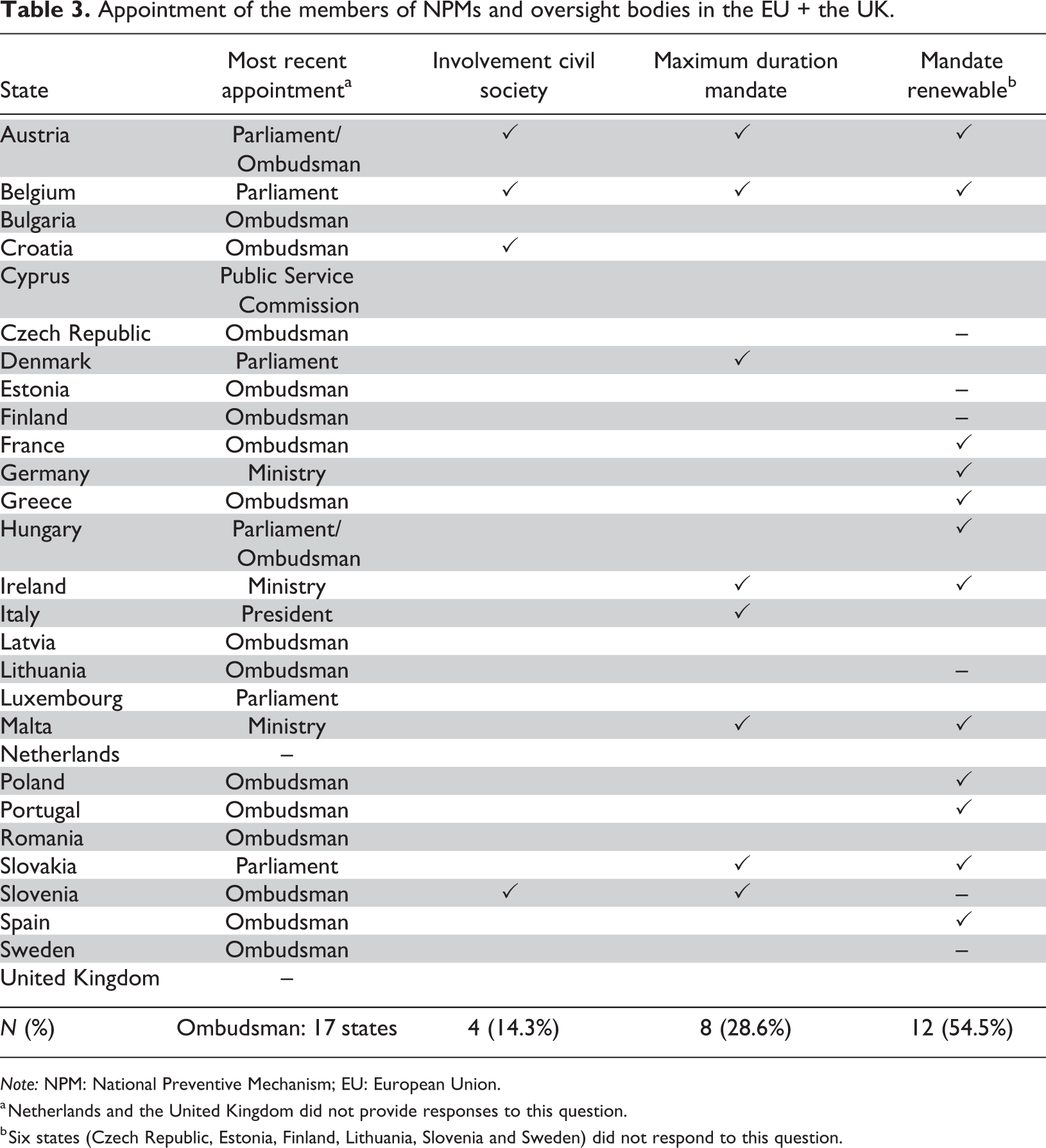
Note: NPM: National Preventive Mechanism; EU: European Union.
a Netherlands and the United Kingdom did not provide responses to this question.
b Six states (Czech Republic, Estonia, Finland, Lithuania, Slovenia and Sweden) did not respond to this question.
Only in a small percentage of states was civil society involved in these appointments. This was the case of three NPMs (Austria, Croatia and Slovenia) and one oversight body (Belgium). The remainder countries indicated that civil society did not participate in the appointment process. In terms of the duration of the mandate, all three states with no designated NPMs reported that there is a maximum duration, whereas most of the NPMs (n = 20, 80.0%) stated that there is no such limit of their members’ mandate. Despite there being a restriction on the time that members of these bodies can serve, in most cases the term of appointment could be renewed. This was true for the three states with no designated NPMs and for three of the five NPMs.
Respondents were also asked about the training provided to NPM members. Despite all of the NPMs indicating receiving training concerning the development of their competencies under OPCAT, its regularity varied by states. Approximately four in five reported that NPM members and staff receive training once a year or more (79.2%), with the reminder indicating a lower frequency.
Legal powers of NPMs and oversight bodies within the EU + the United Kingdom
With the exception of the United Kingdom, 27 all of the states with operating NPMs indicated that their mandate and powers are clearly set out in a legislative text. Similarly, the three countries in which NPMs had not been designated (Belgium, Ireland and Slovakia) stated that the mandate and powers of the domestic bodies that monitor the situation of prisons in their countries are set out clearly in legislative texts. States were also asked regarding the protection of NPMs’ independence in their legislation. Among the states with operating NPMs, all but two (the Netherlands and the United Kingdom) indicated that their independence from prison and State authorities is guaranteed in the legislation. The three states in which NPMs had not been established said that the independence of the domestic bodies that monitor prisons in their nations is guaranteed in the legislation.
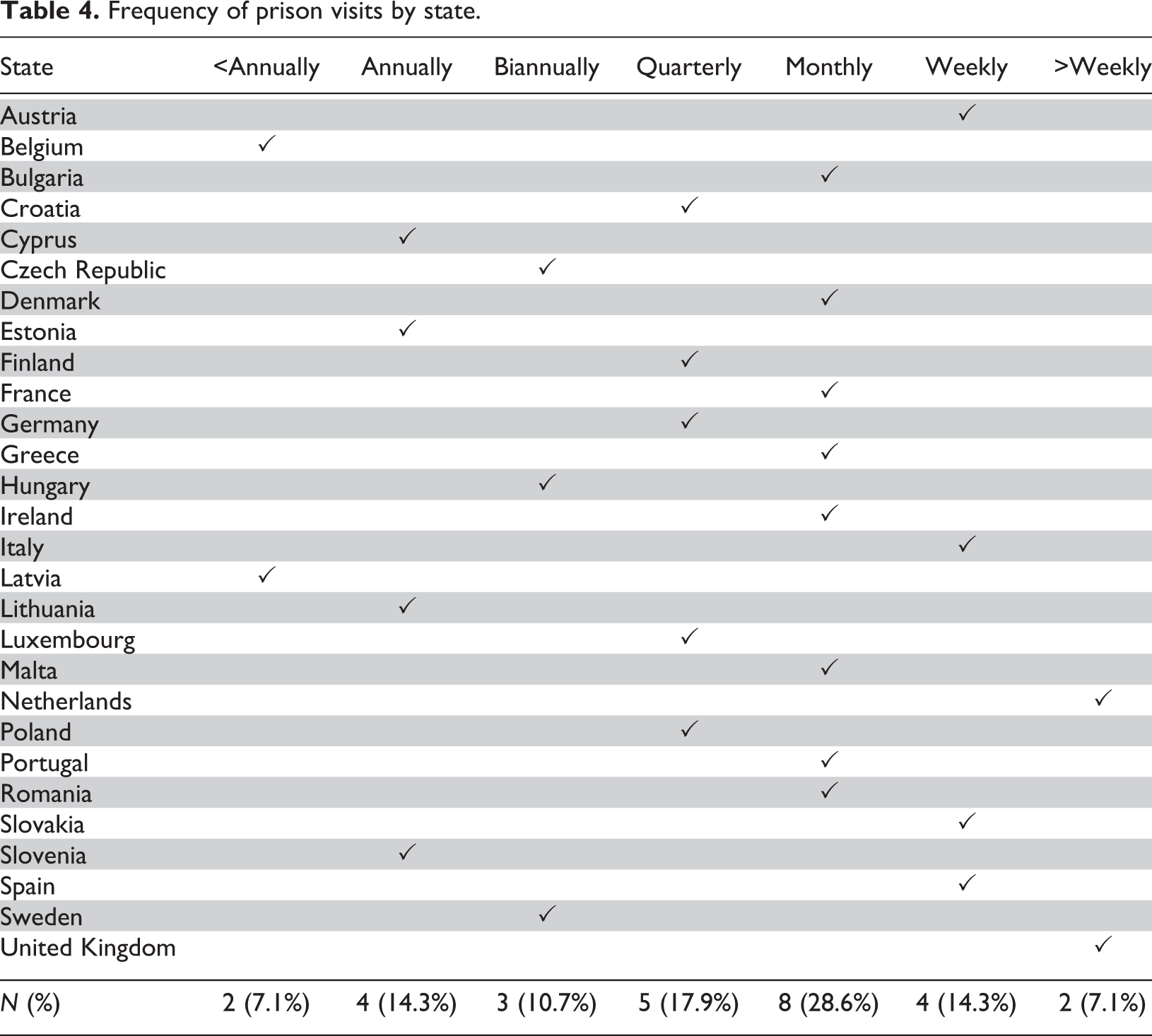
In addition to the powers recognised in the legislation, states were asked about their powers in practice. All of the NPMs and oversight bodies indicated that they have full access to prisons and confidential access to prisoners. With the exception of Ireland, all oversight bodies reported having full access to documents in prison and confidential access to staff. The frequency of visits, which is an important aspect concerning the topicality of the reports and the accuracy of their information, varied widely across states, ranging from less than annually (Belgium and Latvia) to more than once a week (the Netherlands and the United Kingdom). Half of the EU Member States + the United Kingdom conducted visits four times a year or less, while the other half visited prisons more often (see Table 4).
Frequency of prison visits by state.
Characteristics of reports produced by NPMs and oversight bodies
Issuing reports and recommendations was one of the activities to which NPMs and oversight bodies devoted the most time, with other tasks including training, disseminating information and results, and investigating and handling complaints. Specifically, a typical body invested 25% of their time performing this task (see Figure 1).
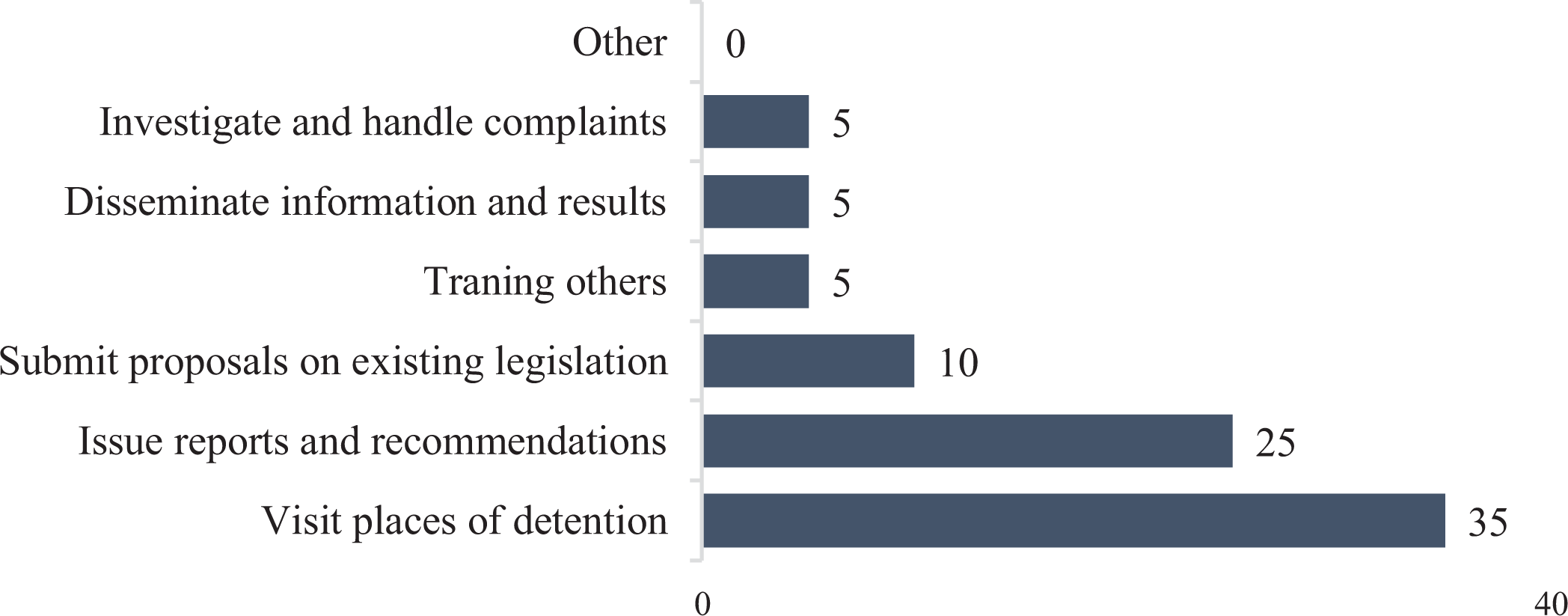
Percentage of the time devoted to different activities (median).
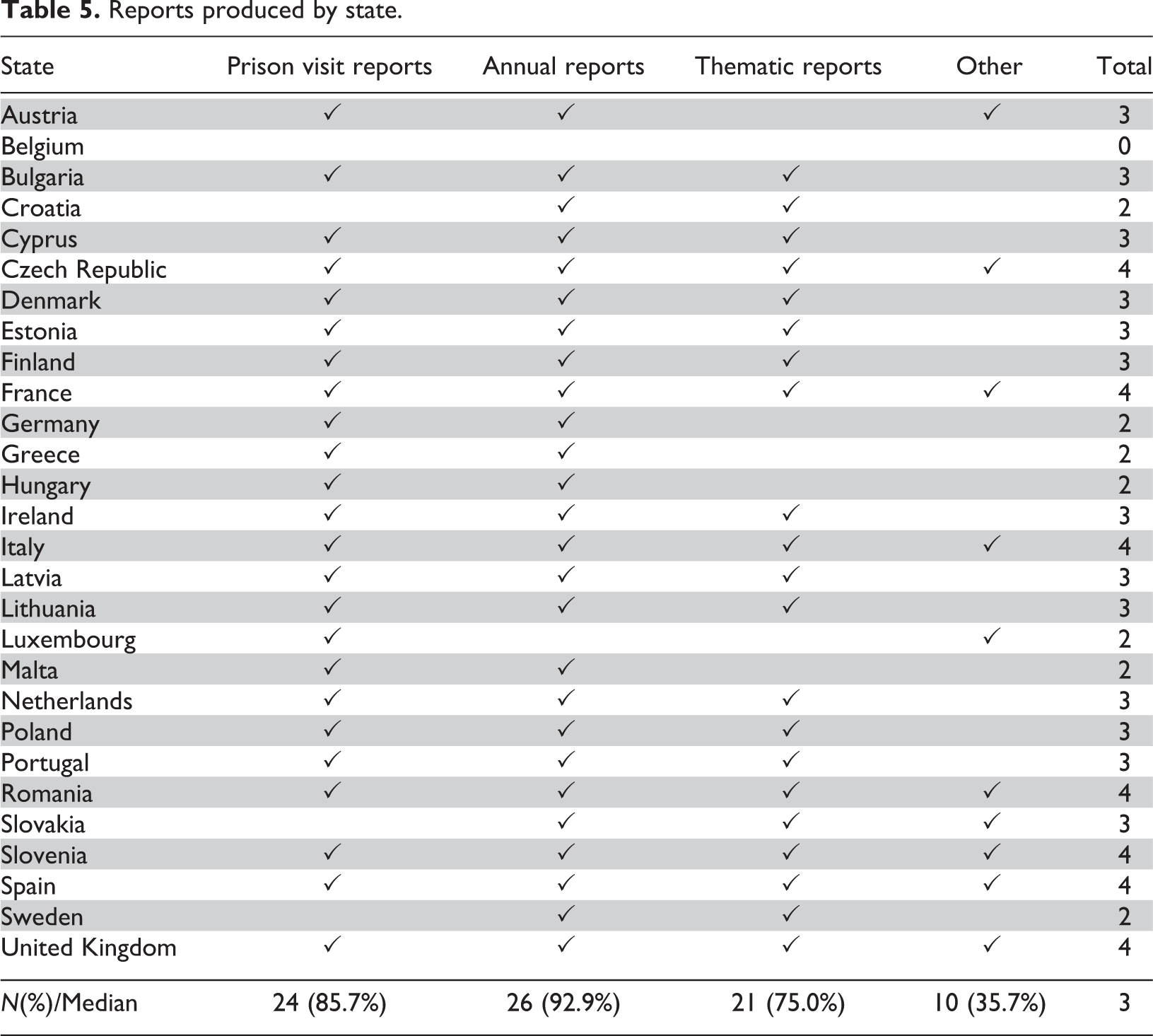
Only one state (Belgium) indicated its oversight body was not producing reports of any kind (bearing in mind OPCAT was ratified in 2018), with the reminder producing between two and four different types of reports (see Table 5). Among them, the most frequent were annual and prison reports, indicated by the vast majority of bodies (92.9% and 85.7%, respectively). These were followed by thematic reports, produced by three in four domestic bodies. Other reports, including those focusing on specific practices (e.g. use of restraints), and particular populations (e.g. children with incarcerated parents), were created by slightly over one-third of the NPMs and oversight bodies (35.7%). To determine whether more consolidated bodies produced more types of reports, bivariate correlations between the number of reports and the year in which bodies started their operations were computed. Results show a weak and non-significant correlation between the two, suggesting that the range of reports is not linked to the number of years that bodies have been developing their monitoring and inspection tasks (r = −0.10, p = 0.62).
Reports produced by state.
The majority of NPMs and oversight bodies not only indicated producing annual reports but also indicated making them publicly available. With the exception of Malta, all of the states producing these reports (n = 25) indicated publishing them. More variability was found regarding the format chosen to present them. While 17 bodies produce stand-alone reports, 9 indicated that their annual reports are part of larger reports. In terms of potential policy impact, most of the bodies (88.5%) indicated that their annual reports are presented to, and discussed, by their respective National Legislative Assemblies or Parliaments. The states indicating otherwise were Bulgaria, Czechia and Poland.
Understanding prison inspection and monitoring bodies in the EU + the United Kingdom
The results of this survey shed much-needed light on the types of prison inspection and monitoring bodies in EU Member States + the United Kingdom. They also have implications for executing judicial authorities and for EU institutions considering the operation of prison oversight bodies. It is notable that almost all EU Member States + the United Kingdom have designated an NPM. This provides a degree of consistency across Member States in the sense that all these bodies should, at least in theory, be operating under the shared legal framework of OPCAT. For executing judicial authorities, becoming familiar with the provisions of OPCAT will therefore be useful to understand the powers and purpose of the bodies whose reports they are using. Those reports are not written with future legal proceedings in mind and, certainly, not for the purposes of EAW hearings. NPMs have the objective of supporting the prevention of torture and ill-treatment by means of visits and dialogue with state authorities, and their reports will be written in a way which accords with those objectives. It is, of course, also notable that three EU Member States do not have an NPM, which may raise questions in the mind of an executing authority about the level of scrutiny of prison conditions in those states.
While the majority of EU Member States have designated NPMs, there is a good degree of variability in the length of time NPMs have been established. Twelve were established before 2010 and 12 afterwards, with the longest established NPM starting operations in 2006. Nine countries also created new institutions to fulfil their obligations under OPCAT. Some NPMs are therefore clearly only finding their feet and becoming established in their operations. However, we also find that the number of years such bodies have been active is not significantly associated with the number of reports they produce. This suggests that, in fact, new bodies are as active as older ones in this regard. It may explain to executing judicial authorities, however, why reports on particular prisons do not exist. It also may cause those authorities to consider whether it is realistic to expect an NPM to be able to monitor conditions with the regularity they might perhaps expect.
As a practical matter, lawyers and executing judicial authorities will need to be aware that some NPMs are single-body institutions, while others are multibody. A good example of this comes from the United Kingdom, where two types of bodies visit prisons and report on them. In the cases examined in this article, executing authorities have tended to draw upon reports of the prison inspectorate body, Her Majesty’s Inspectorate of Prisons. However, Independent Monitoring Boards also visit prisons. Executing judicial authorities and lawyers may therefore wish to ensure they have all available reports from NPMs at their disposal.
Executing judicial authorities may not inquire about the manner in which a prison oversight body has been appointed on the basis that they cannot look behind the source of the information due to the requirements of mutual trust and mutual recognition. However, our findings suggest that mutual trust and mutual recognition may not be automatically warranted in this area. For example, the Minister for Justice and Equality appoints the Inspector of Prisons in Ireland, while in most Member States the Ombudsman is responsible for the appointment. It cannot be said that all oversight bodies follow the same procedures in their establishment, nor that all follow best practice. Only four EU Member States involve civil society in the appointment of NPM members. The United Nations’ Paris Principles 28 govern the appointment of national human rights institutions, requiring that such bodies should be appointed in accordance with a procedure which ensures representation of civil society (e.g. NGOs, trade unions and social and professional organisations). While not strictly governing the appointment of prison inspection and monitoring bodies, they can be considered a benchmark of good practice for human rights protecting institutions. More generally, the manner of the appointment of an oversight body can raise issues about its credibility, 29 which may arise in EAW judgments. For example, the High Court of South Africa found that there is a positive duty on the State, taking international obligations into account, to ensure that the South African prison oversight body (the Inspecting Judge for Correctional Services) is operationally, financially and perpetually independent from the prison authorities. 30 Noting that independence requires independence in the manner of appointment, the method of reporting and the method of removal from office, the High Court considered that there was insufficient independence between the inspectorate body and the Executive. OPCAT also emphasises the importance of independence in the manner of appointment of NPMs, with the proper functioning of an oversight body highly dependent on its ability to regulate its own affairs. 31 It is notable that two countries in this study reported that their independence from prison and State authorities was not set out in the legislation. This situation may well be relevant in individual EAW cases, but we also argue that there is a need for an EU-wide position on the independence of prison oversight bodies, especially in circumstances where those bodies are being used as sources of evidence in EAW cases. This is an area where EU-wide action could assist in ensuring that prison oversight bodies meet minimum international human rights standards.
The powers of a prison inspection and monitoring body are central to its ability to produce useful reports which contain accurate and objective information. It is encouraging that all Member States have prison oversight bodies which have full access to prisons and confidential access to prisoners. Almost all (the exception being Ireland) have full access to documents in prison and confidential access to staff as well. Concerning up-to-date information, the picture is less positive. There is wide variation across Member States in terms of the frequency of visits by prison oversight bodies. Some visit very often, but in half of states, visits are conducted four times a year or less. When we consider that there may be many prisons within a state, this can mean that some prisons do not receive frequent visits. This situation raises issues for the contemporaneous nature of the information which prison oversight bodies can provide, which could limit its usefulness to executing judicial authorities. We suggest that there is also a need for guidance at the EU level on the frequency of visits made by prison oversight bodies, with some efforts at approximation, taking into account the size of the country, number of prisons and resources of the NPM.
The main way in which prison inspection and monitoring bodies influence, or at least affect, executing authorities is through their reports. The findings of this survey indicate that all prison oversight bodies in the EU, with the exception of Belgium, are producing reports of some kind, which is reassuring for executing judicial authorities. However, executing authorities are obliged to draw on specific and updated reports on particular conditions. In this respect, the picture is less encouraging in some states. Croatia, Slovakia and Sweden reported that they are not producing specific prison reports. One state, Malta, reported that its reports were not published. Executing judicial authorities may also have questions regarding whether or not the authorities take the reports of prison oversight bodies seriously. In the clear majority of cases (almost 90%), annual reports are provided to and discussed by national parliaments. Discussing reports is of course very different from acting on them, but this finding gives some indication of the willingness of the authorities to listen to what prison oversight bodies have to say.
On a practical note, the format of reports produced by prison oversight bodies within the EU is quite variable. Some bodies produce their own reports, but others have their reports carried in larger reports comprising other matters (e.g. a broader report on all the activities of an Ombudsman’s office). This poses challenges for those seeking specific information on prisons. Knowing where to look may not always be so obvious for those involved in EAW decision-making processes. In that regard, it is welcome that the EU’s Fundamental Rights Agency (FRA) has embarked on a project 32 to collate all reports of NPMs across the EU and place them in a database which should be easily accessible to anyone searching for information on prison conditions. Several issues, however, remain. No single template exists for NPM reporting, requiring executing judicial authorities to come to grips with a variety of reporting styles and formats. Translation of the reports is also usually necessary. These are practical barriers to the application of mutual trust and mutual recognition and will require further consideration as prison conditions are increasingly under scrutiny in EAW cases.
What role have prison inspection and monitoring bodies played in EAW cases to date?
There is some evidence that reports of prison inspection and monitoring bodies are being used in EAW decision-making and are having some influence in these processes. This section of the article explores the role of such bodies in existing cases. Prison inspection and monitoring bodies take a preventive approach towards ill-treatment. Writing reports for the purposes of supporting judicial decision-making is not a central part of their role. Judicial bodies have, however, made use of the reports of prison inspection and monitoring bodies when making decisions about prison conditions in a variety of contexts. The European Court of Human Rights has been referring to reports made by the CPT for many years now. 33 This Court has also referred to reports from domestic prison inspection and monitoring bodies as sources of information. 34
There is evidence that executing judicial authorities is choosing to rely on reports of prison inspection and monitoring bodies in their decision-making on EAWs. For example, the Court of Amsterdam postponed the execution of a warrant requested by the United Kingdom on the basis of poor conditions in a prison in Liverpool. 35 In doing so, it relied on reports of the UK’s prison inspection body, Her Majesty’s Inspectorate of Prisons, which is part of its NPM. The court held that there was a real risk of inhuman or degrading treatment evident from these reports, and postponement of the EAW was appropriate. The court stated that the NPM’s annual report and its other reports on the prisons were ‘objective, reliable, accurate and properly updated data’ of the type required in the Aranyosi and Căldăraru judgment. The court posed a question to the UK authorities, referring specifically to the report of the NPM, seeking a guarantee that the person at issue would not be placed in one of the three named prisons. The UK authorities submitted a letter from the Director General of the prison service which stated that efforts had been made to improve conditions, denying that they constituted inhuman or degrading treatment. The letter refused to guarantee that the individual would not be placed in one of the impugned prisons. Assessing this information, the court stated that the information provided by the UK authorities was both too general and insufficient to assume that the conditions had improved since the NPM’s report was written, and the real risk of inhuman or degrading treatment had not been eliminated. Interestingly, in a decision by the High Court of Ireland one month earlier, the court also referred to a report on Liverpool prison by the NPM but found that the conditions had been ameliorated since that report was made and that surrender could be ordered. 36
The IRK, or international chamber, in the Netherlands has used reports of the CPT in multiple cases involving concerns about detention conditions and has executed EAWs on the basis of assurances provided by the authorities that those subject to an EAW will not be detained in a particular prison or set of prisons. 37
Other courts are also using reports from prison inspection and monitoring bodies in EAW cases. A further example comes from England and Wales in the case of Mohammed v Comarca de Lisboa Oeste and others. 38 The applicant argued that surrendering him to Portugal would give rise to a breach of his fundamental rights on the basis of poor prison conditions in Lisbon Central Prison. Reports of the CPT and the Ombudsman (the Portuguese NPM) were put before the court. On the basis of the concerns raised in NPM and CPT reports, the court decided to seek supplemental information from the Portuguese authorities concerning the likely place and conditions in which the person would be held. This request also contained a question about the mechanisms which exist in Portugal for the monitoring of the conditions of detention. The court held that the reports of the Ombudsman in his role as the NPM for Portugal ‘clearly qualify’ 39 as information that is objective, reliable, specific and properly updated. 40 A similar picture is found in Ireland. In Minister for Justice and Equality v R.O. (No. 5), 41 the High Court took account of reports of the NPM for prisons in Northern Ireland, comparing them closely to the information provided by the Northern Ireland Prison Service about prison conditions, with reports from the UK’s NPM also referred to in Minister for Justice and Equality v McLaughlin. 42 Reports from the Hungarian NPM were also considered extensively in Minister for Justice and Equality v Kutas, 43 where Donnelly J relied on expert evidence which examined how the NPM was functioning in practice as well as reports of the NPM itself. In a separate case, the same judge held that the existence of prison inspection and monitoring mechanisms was a factor that an executing judicial authority can take into account when deciding whether there is a real risk of a breach of a person’s fundamental rights because of prison conditions. Reports from the Seimas Ombudsman in Lithuania were also examined in Minister for Justice and Equality v Tagijevas. 44 The Lithuanian government relied on a report of this body to the effect that concerns about the treatment of prisoners had been alleviated since a critical report of the CPT had been published about a particular prison, indicating that both those requesting and those resisting surrender are utilising reports of prison oversight bodies in EAW cases.
Here, we see executing authorities using these reports as ways to control, 45 or at least question, information provided by the central authorities or by the defendant. In this way, prison inspection and monitoring bodies are playing an interesting role in the EAW procedure, providing information which raises questions about the application of mutual trust and mutual recognition and prompting further analysis of official information. We also see another, more subtle, use of prison inspection and monitoring bodies’ reports in these cases. Since ML, the question of assurances provided by requesting states about prison conditions has become prominent in EAW cases. In ML, the Court held that executing judicial authorities should rely on assurances that the person will not be held in conditions breaching fundamental rights provided by the requesting authorities, at least in the absence of specific reasons to believe otherwise. Such an assurance is a factor that the executing judicial authority ‘cannot disregard’, 46 a point further reiterated in Dorobantu. 47
A comparable procedure of assurances was examined by the European Court of Human Rights in Othman v UK 48 which held that courts must examine the assurances provided to ensure that they are a sufficient guarantee that a person will not be subject to ill-treatment. This case concerned Jordan rather than another European state. One of the factors which a court must examine is whether compliance with the assurances can be objectively verified through diplomatic or other monitoring mechanisms. In neither Aranyosi and Căldăraru nor ML did the Court refer to the possibility of monitoring the implementation of assurances. The application of the principles of mutual trust and mutual recognition likely inhibited the creation of such a factor. However, an executing authority may still wish to be assured that there are some forms of inspection and monitoring of detention conditions. The idea that prison inspection and monitoring bodies can act as forms of comfort to an executing judicial authority in such a situation is seen in some cases. An early example comes from the Irish case of Minister for Justice and Equality v Jermolavjevs, 49 where Edwards J described the fact that the Latvian government permitted independent monitoring of prisons as ‘encouraging’. 50 More recently, in Minister for Justice and Equality v Henn, 51 a man was the subject of a warrant from Hungary. When examining whether there was a reason not to apply the principle of mutual trust, Donnelly J referred to the existence of the NPM in Hungary and its role in monitoring prison conditions, noting that it was possible to verify the compliance of the authorities with its assurances objectively. 52 In The Minister for Justice and Equality v R.O. (No. 5), 53 Donnelly J noted that there was a ‘robust inspectorate system’ for prisons in Northern Ireland and the prison authorities had previously responded actively to its reports. While this would not be a determinative factor on its own, it was something which could also be taken into account when making a decision on whether or not to execute a warrant.
The Court in Aranyosi and Căldăraru indicated that the presence of national or international mechanisms for monitoring prisons in a State is a factor which an executing judicial authority may consider in deciding on the execution of a warrant. However, the Court did not spell out there what use the executing judicial authority should make of such information. This point was clarified somewhat in Dorobantu 54 where the Court addressed the question of the relevance of measures intended to improve the monitoring of detention conditions. The Court held that monitoring, including judicial review of detention conditions, may be taken into account by an executing judicial authority when making an overall assessment of the conditions. However, legal remedies (rather than monitoring mechanisms) alone cannot avert the risk that the person will be detained in conditions in breach of fundamental rights. This suggests that bodies which review prison conditions can act as a form of comfort to executing judicial authorities, but their presence alone cannot mitigate what would otherwise be a breach of fundamental rights. Questions about the kind of comfort that may be provided arise. Is the authority to take the presence of such mechanisms as a way to monitor the specific conditions to which the person is to be returned, or is the existence of these bodies a general source of reassurance that fundamental rights are protected in prison? Is the absence of such a body to be taken as a factor leaning against the execution of a warrant? Or are executing authorities simply to seek information on other possible sources of evidence as to the conditions present in a particular State, such as that from oversight bodies? Further important issues remain to be explored. Dorobantu seems to prioritise the judicial exchange of information, with the executing judicial authority left to rely on the issuing authority for information. We see examples earlier whereby national courts examine reports put forward on behalf of the person whose surrender is sought, but there is no clarity yet from the Court of Justice concerning whether or not executing authorities may themselves seek out information above and beyond that which is supplied by the issuing judicial authority.
These and many other questions about the use of inspection and monitoring bodies’ reports in EAW cases remain. What is clear is that prison inspection and monitoring bodies are becoming central figures in the EAW process when prison conditions are at issue. It is surprising that we know so little about how these bodies operate.
Conclusion: Next steps for EU action
There are many implications arising out of the decision of the Court in Aranyosi and Căldăraru. One of the most critical is the nature of the evidence which can be used in making the highly consequential decision of whether or not to execute a warrant. Prison inspection and monitoring bodies have been placed in the spotlight when such decisions are being taken. Executing judicial authorities will need more information about the types of prison inspection and monitoring bodies in EU Member States, their functions and their reporting styles. This article has provided the first analysis of the structures, powers and operations of prison oversight bodies in the then EU28 in an effort to address the gap in knowledge which exists concerning such bodies. As this article has shown, this new role for prison inspection and monitoring bodies in the EAW raises several questions. First of all, some states have not implemented OPCAT, meaning that there is still not a universally applicable framework for the operation of such bodies across all EU Member States. Secondly, there is a good deal of variability in the operation of such bodies. This variability poses questions for the extent to which mutual trust and mutual recognition can apply to the bodies providing information on prison conditions, and whether or not executing judicial authorities will wish to probe into their powers, resources and functioning. It also lends credence to the Court’s position in Dorobantu 55 that the presence of measures intended to improve monitoring, such as complaints bodies, cannot of itself avert a risk of a breach of fundamental rights. The variety in approaches to inspection and monitoring we see through this survey, as well as outstanding questions about the responsiveness of the authorities, suggests that such a step would be premature. Thirdly, the EU may wish to take steps to support and perhaps harmonise the basic structures needed to carry out prison oversight. The work prison oversight do is already of central importance to the promotion of human rights in prisons across Europe. Now, Aranyosi and Căldăraru, and the subsequent case law, means their activities are of even greater importance to the functioning of an Area of Freedom, Security and Justice which is based on respect for fundamental rights. The question arises as to what role the EU should play in this particular area of fundamental rights. 56 Should it create its own minimum standards or avoid over-reach in its remit and instead support the full implementation of the European Prison Rules, the Mandela Rules and OCPAT? The EU currently supports dialogue between prison inspection and monitoring bodies, in the form of the European NPM forum, funded jointly with the Council of Europe. This network promotes the sharing of good practices and support for NPMs. Alongside the development of a database of NPM reports by FRA, we see the EU engaging in a characteristic, gentler, approach to integration in this area. 57 This approach might be sufficient where prison inspection and monitoring bodies act solely as human rights protections. However, their new role in decision-making on EAWs means that something stronger is required. This softer approach will need to be supplemented by legal frameworks to ensure EU prison inspection and oversight bodies act comparably and also meet international human rights standards. There is a need for EU guidance on the operation of prison inspection and monitoring bodies. These standards do not need to replicate those of other international instruments but instead should focus on more practical matters. Without forcing bodies to adopt a particular methodology, there should be guidance on the methodology which these bodies should use in conducting their inspection and monitoring activities to ensure that there is some consistency in the approach taken. Some standardisation in reporting styles would also be of benefit to the sharing of information about prison conditions in the EU. There must also be minimum standards when it comes to the independence of the body and its powers of access and confidential communication.
Deeper questions also remain. The bodies which exist in the EU for the purpose of providing oversight to prisons were not set up for the purpose of providing evidence in EAW cases, and it remains to be seen how this new demand on them will affect their actions. Will they feel pressure for example, knowing that their reports could be used to refuse the execution of EAWs, that is, will the possibility that their criticism will lead to the non-execution of warrants influence their reporting? The central role of independence of NPMs suggests that these bodies should be able to resist that pressure but NPMs which are not so secure may come in for criticism that will be difficult to withstand. More practically, should prison inspection and monitoring bodies be called on specifically by issuing judicial authorities to provide reports in this context, it will be necessary to dedicate resources to this task, and perhaps divert attention from their usual tasks. Will such bodies need to dedicate specific measures and resources towards responding to these requests? More research on the effects of Aranyosi and Căldăraru and its subsequent case law on this point is needed. This article also shows that we may see executing judicial authorities indirectly and subtly relying on prison inspection and monitoring bodies as ways to test the making of assurances by requesting Member States. The implications of this are unclear: What will happen if a prison inspection and monitoring body finds that an assurance given in an EAW case was not, in fact, complied with? Should executing judicial authorities follow the emerging trend noted in this article to use the fact that prison inspection and monitoring bodies exist in a Member State as a factor in favour of them finding that there is not a real risk of fundamental rights being breached, other intriguing consequences will emerge. In particular, EU bodies will have gone further than the European Court of Human Rights by creating a requirement on Member States to have prison inspection and monitoring bodies as ways to comply with Article 3 of the European Convention on Human Rights.
This article represents a first step towards greater understanding of bodies which have rather suddenly, and highly consequentially, become key players in the Area of Freedom, Security and Justice. The decisions in Aranyosi and Căldăraru, LM, ML and Dorobantu mean that prison inspection and monitoring bodies will come in for much greater attention than heretofore, whether they, Member States and EU institutions are ready for it remains to be seen.
Footnotes
Acknowledgement
The authors wish to thank the anonymous reviewers for their helpful and thoughtful comments on the text. We are indebted to Jean-Sébastien Blanc, Ian Cameron, Hugh Chetwynd, Deirdre Malone and Elina Steinerte for their insights on the questionnaire used in this study. We also wish to thank The Hon. Mr. Justice John Edwards, judge of the Court of Appeal, Ireland, Paul Gunning Barrister-at-Law, Mr. Jacqueline Kuijper, Advocaat, Ian Brownhill, Barrister-at-Law, Nasrul Ismail, and Anna Matczak for their kind and most generous assistance in providing information on cases in which reports of inspection and monitoring bodies have been used in cases. We also thank Sarah Curristan, Christine Morgenstern, Ciara O'Connell and Sophie van der Valk for their comments. Our deep thanks to those from the countries who participated in the survey and gave of their time and expertise very generously.
Declaration of conflicting interests
The author(s) declared no potential conflicts of interest with respect to the research, authorship, and/or publication of this article.
Funding
The author(s) disclosed receipt of the following financial support for the research, authorship, and/or publication of this article: This project has received funding from the European Research Council (ERC) under the European Union’s Horizon 2020 research and innovation programme (Grant Agreement No. 679362).
