



Abstract
Mandatory prison labour is not classed as part of the offender's punishment. The sentence is the years to be served in prison and on licence in the community. I argue that there is reason for reclassifying or reforming the current regime of prison labour in England and Wales. The argument for reclassification draws analogy to the place of labour in community orders and suspended sentences. If there is reason to reclassify prison labour, consideration of proportionality would require significantly reduced time in prison. However, there are important difficulties with establishing what reduction should be offered and operationalising any such reduction in a fair way. If prison labour is instead to be reformed so as to be non-punitive, this may require an overhaul, giving the offender a choice of whether to work and wider labour protections. Prison labour is lost when classed as neither punishment nor as employment.
Sisyphus twice cheated death. The details of the offences are contested, but the punishment is well known. For eternity, Sisyphus must push a boulder to the crest of a steep hill in Tartarus where it will fall back to the bottom for him to start pushing it again. To depict Sisyphus’ punishment as an eternity in the underworld would be true, but misleading because a fundamental part of his punishment is his labour. By comparison, the severity of sentences of imprisonment in England and Wales is measured with reference to the length of time to be served only, be it six months, 10 years, or life. Reference is not made to what happens during the sentence. Where prisoners undertake labour, should this be seen as part of their punishment? If it is, what effects does that have? These are the key questions that I will address in this article as I build arguments for the reconceptualisation or reform of prison labour.
I will, first, detail the current law, explaining that there is a regime of obligatory, paid, prison labour in England and Wales. I then turn to sketching what this labour entails. Though perhaps not Sisyphean, it has been described as ‘mundane, repetitive and unskilled.’ 1 Having undertaken this groundwork, I turn to examine whether prison labour is part of the offender's punishment and whether it should be so classed. Prison labour is neither part of the punishment nor a form of employment in England and Wales. It falls somewhere in the middle and misses out on key safeguards - such as proportionality constraints and the minimum wage - in consequence. I argue that prison labour in its present form should instead be understood as punishment. The argument relies on comparison to community orders and suspended sentences, where unpaid work is a part of the sanction. The core consequence of this argument is a need to reduce prison sentences to ensure proportionality. The important and difficult questions are as to how much any such reduction should be, and how it could be implemented. Given the difficulties with reclassifying labour as a punishment, I turn to query whether there could be a system of non-punitive prison labour. I suggest that there may be such a system rooted in voluntariness and labour law safeguards. I conclude by reflecting on the dangers of doing nothing; that is failing to reclassify or reform prison labour.
Is prison labour obligatory?
There is a regime of mandatory labour for offenders sentenced to immediate imprisonment. Section 31 of the Prison Rules 1999 provides that ‘A convicted prisoner shall be required to do useful work for not more than 10 hours a day’. 2 By comparison, where a prisoner has not been convicted, they may work, but are not obligated to do so. 3 Intentionally failing to work properly or refusing to work when required is a disciplinary offence, which can attract a penalty such as a forfeiture of privileges; deductions of earnings; additional days of imprisonment; and (perhaps ironically) exclusion from work. 4 I will return to the possibility of both an obligation to work and a refusal of the opportunity to work constituting punishments below. For now, it should be noted that if a prisoner fails to undertake work, they may also not receive pay at either the unemployed or employed rate. 5 Deductions may also be made based on performance/attendance. 6 Prison labour is obligatory.
What does prison labour entail?
We can now move from the statutory regime to build a fuller understanding of what prison labour entails. Do all prisoners work? What sort of work do they do? Are prisoners paid? Do they get weekends off? First, though prison labour is obligatory, it should not be assumed that all prisoners work. By way of example, the Chief Inspector of Prisons, Charlie Taylor, undertook an unannounced review of HMP Wakefield in 2022, during which he found ‘many unemployed prisoners’ and ‘half of the population locked up during the working day.’ 7 Such a finding does not appear to be exceptional. From April 2019 to March 2020 there were, on average, 12,500 prisoners and detainees working in public sector prisons, privately managed prisons, and immigration removal centres. 8 By comparison, in March 2020 the prison population was 83,052. 9 It is perhaps unsurprising then that in a 2021 White Paper, Government committed ‘to deliver a step-change in the number of prisoners who work in prison’. 10
Much of the work in prisons is repetitive and has been described as ‘mundane’ by the European Prison Observatory, 11 Independent Monitoring Boards, 12 and multiple commentators. 13 The types of work to be undertaken by prisoners must be approved by the Secretary of State. 14 In practice, the available work is varied. Jenna Pandeli et al report examples of prison services jobs - such as in prison laundries and kitchens - and work for commercial firms - to break-up electrical items for recycling, packing books, repackaging car parts, assembling household plumbing and waste management. 15 Further examples of labour undertaken by prisoners include cleaning prison wings, making windows, mailing magazines, welding and paint spraying. 16
Certain work in prison is more popular and placement on it is competitive. Pandeli et al provide the example of eight prisoners applying for vocational training in carpentry. 17 However, the fact that certain positions are applied for does not affect the obligatory nature of prison work. As the Industrial Tribunal explained in Alexander v Home Office, ‘When one reads the [Prison R]ules it is clear that he can be directed to work wherever the authorities of the establishment want him to go. He may apply for posts, he may express preferences, but he has no choice whatever.’ 18 In-keeping with this ruling, the above-mentioned eight prisoners had their applications rejected and were instead deployed to other work groups, which undertook more mundane work. 19
The 1999 Rules guarantee minimal time-off for prisoners. Section 31 specifies that prisoners shall be required to work for 10 hours a day, and does not provide exceptions for the weekend, bank holidays or other respite. Section 18, though, does provide exceptions for religious observance. A Christian prisoner will not be required to undertake ‘unnecessary work’ on Sundays, Christmas or Good Friday. Likewise, prisoners of other faiths shall not be required to work on days of religious observance. Interestingly, the section of the Rules concerning physical education does distinguish the ‘normal working week’ from the weekend and parts of the section on education likewise apply during the ‘normal working week’. 20 The only clear safeguard, then, in the Rules relates to religious observance, but the Rules imply that normal practice allows for weekends.
Prison Service Order 4460, concerning prisoners’ pay, contains a similar implication. It provides that prisoners will not be docked pay if they do not work on Sundays. 21 In addition, the Order provides more information on the ‘full working week’, which is said to normally consist of ‘ten morning, afternoon, or evening sessions, or five night shifts’. The length of these shifts is not specified. 22 A thematic review of weekends in prison by HM Chief Inspector of Prisons, published in March 2023, makes clear that in practice there is not a significant opportunity for prisoners to leave their wing during weekends and in consequence that only a ‘handful’ of prisoners work. 23 As a rule, then, work is obligatory apart from for religious exceptions, but policy and practice indicate less work is done on weekends.
As above, there were on average 12,500 prisoners and detainees working in the year ending March 2020. The Ministry of Justice also provides that this group provided around 17.4 million hours of labour. 24 This means that an average prisoner who worked for the whole year would have undertaken 1,392 hours of labour or around 27 hours per week. These figures indicate that even within the sub-set of prisoners who do work, many are not working for 10 hours a day consistently. However, this point cannot be taken to apply for all prisoners. The European Prison Observatory reports incidences of prisoners working up to 60 hours a week for private businesses in the United Kingdom. 25
Prisoners are paid for labour undertaken in prison. The minimum rate of pay is set out in Prison Service Order 4460 as £4.00 per week. This falls considerably short of the minimum wage of £11.44 per hour for those age 21 and over.
26
The rates paid in practice are low; and vary by prison, type of job, and prisoner status. A recent briefing by Nacro Justice ExChange provided the following examples.
HMP Pentonville standard weekly pay of £13.70 with an enhanced level of £18.60. HMP Send average weekly pay £13.93. HMP Berwyn kitchen workers working seven days a week receive £23.50 and mentors earn £18.40 per week for nine sessions. Rates of £7.50 to £15 per week are ‘not unusual’ for cleaning and servery workers.
27
Labour is not the only paid activity in prison to which the £4.00 minimum applies; other examples of constructive activities include training, behavioural programmes and educational activities.
28
The focus here, though, is on pay for labour because this is directly relevant to assessments of whether labour in prison ought to be considered part of the offender's punishment. We can conclude then that the work in prison is, as a point of law, obligatory, but that, in practice, many prisoners do not work. For those who do, the type of work is varied but is often mundane and poorly remunerated.
Is prison labour part of the punishment?
At present, labour undertaken by prisoners is not considered part of their punishment. The sentence is the time to be served in prison. 29 This is clear in legislation, sentencing guidelines, and guidance for judges. Legislation sets out maximum, and occasionally minimum, sentences of imprisonment with reference to the time to be served. By way of example, the Theft Act 1968 specifies a maximum sentence of seven years’ imprisonment for theft and a maximum of life imprisonment for robbery. 30 Some legislation does retain references to labour, with the principal offences in the Offences Against the Person Act 1861 all referring to ‘penal servitude’. 31 That term and that of ‘hard labour’ are, however, to be read as sentences of imprisonment following the abolition of penal servitude and hard labour in 1948. 32
Sentencing guidelines set out a structured, step-based, approach to sentencing. 33 They add detail and guidance to statutory limits moving from what sentence may be imposed for the type of offence to what sentence ought to be imposed in the particular case. The guidelines are prepared by the Sentencing Council of England and Wales, an independent body with a majority judicial membership. 34 Judges must follow sentencing guidelines unless it would be in the interests of justice to depart from them. 35 Sentencing guidelines set starting points and ranges for the sentencing of offences. Where those sentences are of imprisonment, the guidelines only mention the years to be served and not prison labour, with higher starting points and ranges for incidences of the offence that cause more harm and are committed in a more culpable manner. By way of example, the sentencing table for robbery from a dwelling is as follows. 36
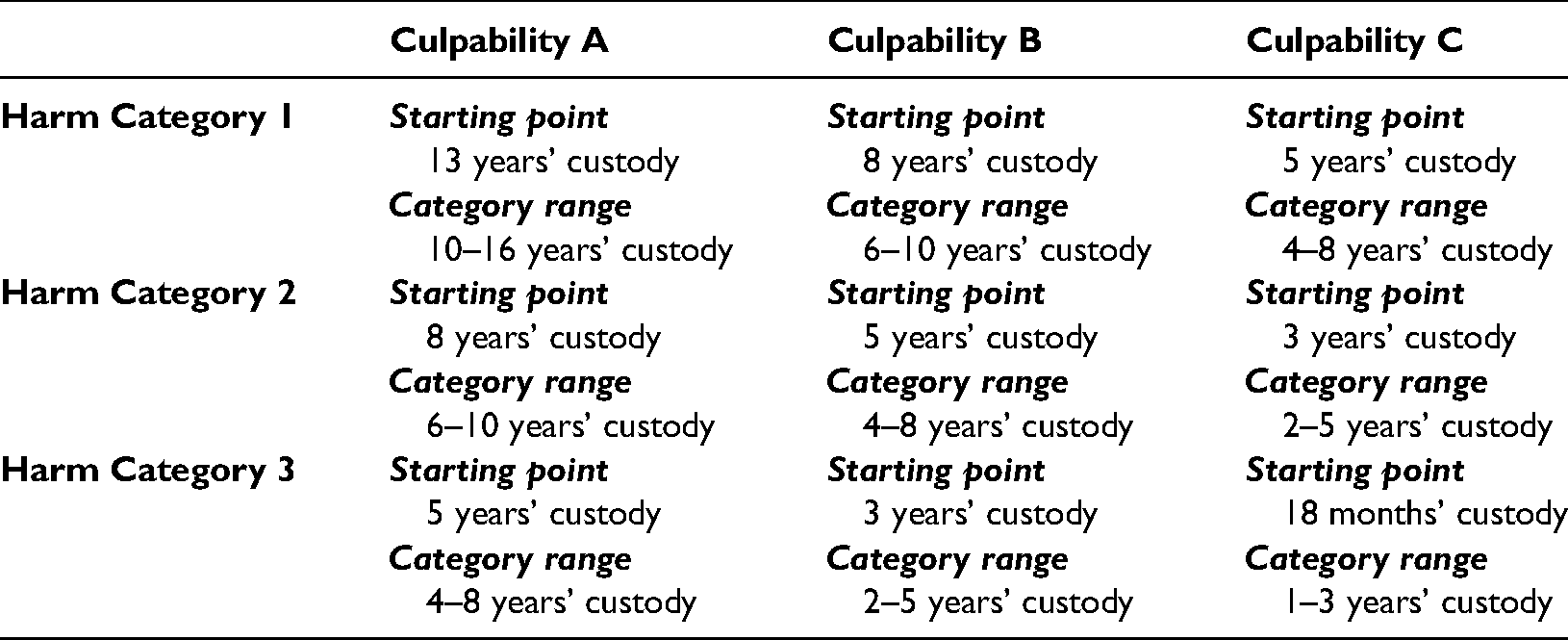
Judges are under a duty to explain the sentence that they impose.
37
An example explanation from the Crown Court Compendium (a guidance document for judges on Crown Court trials and sentencing) reads as follows: On count 1 of this indictment, the charge of wounding {name} on {date}, the sentence will be two years’ imprisonment. On count 2, the charge of assaulting {name} occasioning actual bodily harm on {date}, the sentence will be one year's imprisonment. The sentence on count 2 will run consecutively to the sentence on count 1, making a total sentence of three years in all. That is the least sentence that I can impose to mark the totality of your offending. You will serve up to half of your total sentence in custody and then…
38
Should prison labour, in its present form, be viewed as part of the punishment?
There is some hesitancy to classify prison labour as punitive. Evelyn Shea describes punishment as a ‘controversial mission’ of prison labour, 39 and the European Prison Rules state that ‘[p]rison work shall be approached as a positive element of the prison regime and shall never be used as a punishment’. 40 Such hesitancy may be based on an image of prison labour as harrowing treatment to include the breaking of rocks, the tread wheel, and the crank. 41 There are compelling reasons, from dignity, proportionality and parsimony, against a return to such practices. 42 Yet, a reconceptualisation of existing practices of prison labour as punitive may itself promote parsimony and proportionality. Before turning to those possibilities, I will make the conceptual case for considering prison labour as punitive in part A, and respond to important counterarguments in part B.
Arguments for classifying prison labour as punishment
I offer two overlapping arguments in favour of recognising prison labour as part of the offender's punishment. The first is that prison labour has core features generally associated with punishment, and the second draws on comparison more specifically to the place of labour in other types of sentence.
Mandatory prison labour shares core features with accepted forms of state punishment.
43
It is a consequence of a conviction for an offence. It is obligatory and it imposes hard treatment on the individual, both in terms of the direct obligation to work and the further sanctions that may be imposed on a refusal either to work or to work effectively. In addition, the purposes of prison labour overlap with the purposes of sentencing. The purposes of sentencing are detailed in section 57 of the Sentencing Code:
the punishment of offenders, the reduction of crime (including its reduction by deterrence), the reform and rehabilitation of offenders, the protection of the public, and the making of reparation by offenders to persons affected by their offences.
44
Prison labour likewise aims to reduce reoffending and to rehabilitate offenders. In a 2022 White Paper, the Government detailed a 10-year plan to tackle crime by creating ‘a prison system that properly rehabilitates criminals and prepares them for life on the outside.’
45
An important part of this plan was ‘A step change in offenders going into work inside prisons’.
46
Prison labour, much like accepted punishments, is a consequence of a conviction, imposes hard treatment on the recipient, and promotes purposes of sentencing.
But it is not just that prison labour has core features of punishment in the abstract. Mandatory labour is an important aspect of other sentences. As context, imprisonment is not the most common type of sentence imposed. In 2022, sentences of immediate imprisonment made up just 6.44% (67,812) of all sentences (1,052,271), with 4.02% (42,277) suspended sentences and 6.56% (68,994) community orders imposed.
47
Mandatory labour is an important feature of the community order regime and may also be imposed as part of a suspended sentence. A community order is a non-custodial sentence that can be imposed on offenders sentenced for an offence that may attract a custodial sentence.
48
A core feature of the community order is the imposition of requirements on the offender such as to undertake rehabilitative activities, curfews and unpaid work.
49
Sentencing Council guidelines on the imposition of community orders provide that a suitable requirement for a community order just below the custody threshold would be 150 to 300 hours of unpaid labour.
50
At least one requirement of a community order must generally be imposed for the purpose of punishment.
51
At the time of its inception, the Ministry of Justice envisioned that the unpaid work requirement would fulfil this purpose of punishment (along with reparation).
52
More recently, in 2017, the Ministry of Justice reaffirmed that unpaid work has a punitive purpose: Unpaid Work meets the sentencing purposes of punishment and reparation. For some offenders there are also rehabilitative benefits, as Unpaid Work can provide an opportunity to develop life and vocational skills that reduce the risk of reoffending.
53
Suspended sentences are a sentence of imprisonment as a matter of law, but they are served in the community. 54 They may have conditions attached to them. The available conditions mirror those available for community orders and thus include unpaid work. The above quotation on unpaid work meeting the purposes of both punishment and reparation was made in relation to suspended sentences as well as community orders. 55 An important point in the Sentencing Council's Guideline on imposing suspended sentences specifies that, ‘To ensure that the overall terms of the suspended sentence are commensurate with offence seriousness, care must be taken to ensure requirements imposed are not excessive.’ 56 The effect of a requirement, to include unpaid work, ratchets the severity of a suspended sentence. If proportionality is to be maintained, sentencing judges must be mindful of this effect.
Unpaid labour is an important feature of community orders and suspended sentences. It is a punitive feature of the sentences and effects the severity of the sentence. But a prisoner may have to undertake significantly more labour than a person made subject to a community order or suspended sentence. A prisoner may be required to work for 10 hours a day. A prisoner could then work for the maximum period of labour imposed under community orders within 30 working days. In less than two months, a prisoner may have to do the same amount of labour as that imposed as a standalone punishment on another offender who was right on the cusp of imprisonment. The current law appears remarkable in claiming that it is labour which makes non-custodial sentences punitive and severe, whereas the obligatory labour imposed on imprisoned offenders is non-punitive. The prison is a curious veil for penality. 57
A possible response here would be to note that a comparison between community orders and suspended sentences on the one hand, and immediate imprisonment on the other, may instead point in the opposite direction. More specifically, that immediate imprisonment has it right and that labour should be understood as non-punitive. It is, of course, right that comparison alone is insufficient to substantiate the claim that prison labour is punitive. But this alternative inference should be given short shrift when, as above, work in prison shares core features of punishment. Given that prison labour is mandatory hard treatment with rehabilitative/reparative purposes and follows from conviction, there is good reason to class it as punitive too.
Arguments against classifying prison labour as punishment
I now turn to five possible arguments against classifying prison labour as part of the prisoner's punishment: 1. prison labour is paid; 2. prisoners volunteer to work; 3. the withdrawal of the opportunity to labour in prison is a punishment; 4. prison labour forms part of the execution of the punishment as opposed to being an additional punishment; and 5. classifying prison labour as punitive may run contrary to international treaties.
Perhaps the most intuitive argument against reclassification is that prisoners are paid to work. Unlike those who undertake labour as part of a community sentence or a suspended sentence, those working in prison are remunerated. It is important to re-emphasise the low rates of pay in prison: the minimum pay per week is £4.00, with the examples of weekly wages in practice provided by Nacro Justice ExChange ranging from £7.50 to £23.50. 58 As a reminder, the minimum wage in the United Kingdom is £11.44 per hour for those aged 21 and over. A prisoner's weekly wage, then, is the equivalent of around one or two hours on minimum wage with the rest of the week unpaid. 59
Prisoner's minimum pay has not increased for over two decades. 60 Yet, the cost of items in prison has been said to be have increased noticeably over this time and has been impacted by the cost-of-living crisis. One prisoner interviewed by Nacro Justice ExChange captured the effect when they said, ‘Basic stuff on canteen has got a lot more expensive. A bag of rice used to be 89p but now it's £1.20. It's a really big change when the unemployment rate of 50p a day hasn’t changed for years and years.’ 61 Added to this is the cost of retaining contact with family and friends. It costs around £14 for 90 minutes of calls per week. 62 That may be a person's whole wage for the week for daily 10–15-minute phone calls. The rate of pay is so low in prisons, particularly when compared to the rising cost-of-living, that it cannot disrupt the classification of prison labour as punitive.
The argument that prisoners choose work may be constructed broadly or narrowly. The broad version runs that prison labourers desire to work because it breaks the monotony of time spent in cells and provides some income. As one respondent to Pandeli et al noted ‘It's boring…but it's better than being stuck in your cell all day.’ 63 The broad version of the argument must be placed in the context of the limited opportunities of prisoners to work as a point of practice. As above, most prisoners do not work. The narrower version runs as follows: some roles in prisons are very competitive, with many prisoners applying unsuccessfully. Those in competitive roles have opted-in and receive benefits such as higher pay rates, more interesting labour and qualifications, which may increase the probability and quality of employment on release. Yet the lesser of two evils is not a good. Work may be desired over non-work or better work over worse work, but prison labour remains an obligatory imposition following conviction, which is itself backed by sanctions. This is made clear in the Prison Rules as above. The Supreme Court has likewise described the prison labourer-prison relationship as ‘founded not on mutuality but on compulsion’, 64 and the Industrial Tribunal has described a prisoner as working ‘at the whim of the authorities.’ 65 Prison labour is not voluntary.
If an argument from voluntariness does not change the penal status of prison labour, what of the related argument that a particular prisoner may have a strong desire to undertake some form of prison labour? Say, X who wanted to be a carpenter and now has the chance to undertake relevant vocational training. The argument would then appear to be that the activity is seen as valuable, so it is not punitive, at least for that individual. But the penal status of a sanction is not a consequence of the view of any particular recipient. The effect must be set in a more standardised manner. By comparison, von Hirsch wrote Imprisonment qualifies as a severe penalty—because the interests in freedom of movement and privacy it takes away are normally so vital to a good life—despite the fact that a few defendants might happen to be claustrophiliacs.
66
A further argument against viewing prison labour as punitive may be drawn from the penalties for disciplinary offences in prison. Given that the refusal to allow a prisoner to work for 21 days or less is a punishment, can an obligation to work also be a punishment? 67 The former refusal may be said to instead point toward prison labour being understood as a benefit or an opportunity. It provides some remuneration and may offer respite from the pains of long periods in a cell. But there is no conceptual issue in classifying both mandatory labour and denial of labour opportunities as punishments. As Dirk van Zyl Smit and Frieder Dünkel write, ‘Both by making work of certain kinds and under certain conditions compulsory and by ending work to prisoners, prison life can be made intolerable.’ 68 Mandatory labour, as above, is liberty-depriving, resemblant of punitive conditions in other sentences, and is imposed on offenders following a conviction. By comparison, refusal to allow labour is an established penalty as a point of statute, which is unremarkable because it limits the capacity of the offender to earn money, which may significantly worsen their experience of imprisonment. 69 Though at first glance it may appear odd, there is reason to cast both mandatory labour and refusal of labour opportunity as punishments.
If an appellate court was tasked with examining whether prison labour is punitive, the counterargument that may hold the most weight is that the labour does not form a penalty but only part of the execution of the sentence of imprisonment. This divide between the execution of the penalty and the penalty itself has been recognised by both the European Court of Human Rights (ECtHR) 70 and the Supreme Court. 71 In essence, where a penalty itself is made harsher, this may give rise to issues under Article 7 of the European Convention on Human Rights (the prohibition on retrospective punishment), whereas if the manner in which the penalty is executed has changed to the applicant's detriment, the Article will not be engaged. An example of a change to a penalty would be if a sentence of five years had been imposed for assault occasioning actual bodily harm (the present maximum) and halfway through the sentence two more years were added. An example of what would likely be seen as a change of the execution of a penalty only would be if the prisoner was moved from a single occupation cell to a shared cell due to a growing prison population, but the length of their sentence remained the same.
This article is not the place for a full-length analysis of the divide between penalties and their execution, but some points may be briefly made. The initial one must be that there is some, limited, domestic authority to class prison labour as a punishment. Pullin v Prison Commissioners concerned whether protections in the Factories Act 1937 applied to prisoners. 72 As part of his judgment Lord Goddard wrote that ‘The work which is carried on in prisons is work which is penal in the sense that the prisoners are obliged to work as a consequence of their sentence.’ 73 This perspective is in keeping with the earlier analysis of the Prison System Enquiry Committee, which drew out the monotonous and purposeless nature of much prison labour to conclude that ‘Work is regarded not as a means to an end, emphatically not as a craft, but as a prescribed task to be fulfilled as part of the punishment of imprisonment.’ 74 One response here may be that less weight should be given to decisions in an employment context, such as in Pullin, when considering penal rights. The problem with this response is that it sets up a troubling situation where prison labour may be treated as punitive when employment rights are at stake, and more akin to employment when penal rights are at stake.
The ECtHR has held that the distinction between a penalty and the execution of a penalty should be made with reference to the ‘intrinsic nature’ of the sentence. 75 It is difficult to see how prison labour could be classed as either part of the penalty of imprisonment or the execution of that penalty, especially when mandatory labour is recognised as punitive for community orders. Not every prisoner must undertake labour: pensioners, for instance, are usually exempt. 76 In addition, the availability of labour varies; the nature of labour varies; and the pay for labour varies. Mandatory labour is not a part of the execution of a sentence of imprisonment. It is better understood as a secondary penalty. A comparison will assist here. Assume the Prison Rules required that prisoners must each week pay £100 to the state. Here, there would be a clear issue of sentences of imprisonment having become more severe because the prisoner would in effect be subject to the considerable additional penalty of repeated fines each week. Unpaid labour forms an important part of community order - a more severe sanction than a fine. Prison labour is an additional penalty.
The final argument against classifying prison labour as punitive draws on international treaties. First, the International Labour Organization's Forced Labour Convention 1930 provides for the suppression of forced labour. 77 The Convention, though, has an exception for labour imposed in ‘consequence of a conviction’. 78 The Convention then does not seem to prevent a significant challenge to reclassification. Secondly, Article 6 the International Covenant on Economic, Social and Cultural Rights 1966 provides for the right to work, and specifically for the right of each person ‘to the opportunity to gain his living by work which he freely chooses or accepts’. Unlike in the Forced Labour Convention, no explicit mention is made of exceptions such as for prison labour. In its 2013 report on Japan, the United Nation's Economic and Social Council noted concern due to the availability of imprisonment with assigned work in the Japanese Penal Code. It continued to note this was in breach of Article 6 of the ICESCR, and called for the abolition of ‘forced labour either as a corrective measure or as a penal sentence’. 79 By comparison then, could a recognition of prison labour as punitive in England and Wales lead to condemnatory statements?
It should first be noted, as above, that prison labour is already mandatory in England and Wales. The argument here is not to make prison labour mandatory, but to recognise that such mandatory labour is punitive. No issue was raised with respect to mandatory prison labour by the Economic and Social Council in its most recent review of the United Kingdom in 2016. 80 To the extent that mandatory labour gives rise to concern under the ICESCR, the proposed reclassification would seem to leave the United Kingdom at no greater risk of condemnation than as at present. Indeed, and as will be argued in the next section, reconceptualising prison labour may result in less labour being undertaken and less time being spent in prison. Any concern from international law with reconceptualisation may, though, speak in favour of more fundamental reform of the role of labour in prisons as opposed to reconceptualisation. This is a possibility to which I will return in the final part of this article.
There is good reason to consider prison labour as punitive based on comparison to the features of punishment generally, and to the role of labour in community orders and suspended sentences in particular. The five counterarguments considered (that labour is paid, that it is voluntary, that absence of labour is a punishment, that labour is part of the execution of the penalty, and that forced labour is contrary to international agreements) are insufficient to change the conclusion that prison labour should be considered part of the offender's punishment.
What follows from reclassifying prison labour as punishment?
Why does it matter if prison labour is punitive? Multiple safeguards follow from classifying measures as punitive, such as the prohibition on retrospective punishment in Article 7 of the European Convention and the heightened criminal fair trials safeguards in Article 6. My focus here, though, is on proportionality. A system of proportionality in sentencing seeks to impose more severe sanctions for more serious offences and less severe sanctions for less serious offences. This is because the severity of the sanction expresses official censure of the individual by the state. 81 Too much or too little sanction would convey an inappropriate amount of censure. In part A, I will detail the effect of recognising prison labour as a punishment on proportionality, before turning to the difficult question of reductions in part B.
Prison labour and proportionality
Proportionality is the core principle of sentencing in England and Wales. 82 The Sentencing Code contains multiple provisions that make this apparent. For example, section 230 specifies that a custodial sentence must not be imposed unless the offence was so serious that neither a fine nor a community order could be justified. Section 204 similarly states that a community order may only be imposed if the offence was sufficiently serious to justify it. Likewise, sentencing guidelines centre the concepts of harm and culpability, as in the above example table, so that more severe sentences are imposed for more serious offending.
If prison labour constitutes a punishment, this may raise issues of proportionality. The offences committed by imprisoned offenders would remain of a consistent severity. However, the punishment imposed on the offenders would be greater because it would be the sum of their period of imprisonment and their labour. In consequence, the offender would face greater state censure than their offence merited. In response, it may be queried whether there is really a threat to proportionality if the penal weight of every sentence is increased. Yes, a three-year sentence may be more severe than previously understood, as may be a six-year sentence, but given the labour would increase correspondingly with sentence length, proportionality would be retained. In other words, the counterargument runs that, yes, the punishments are tougher for everyone, but this does not affect proportionality.
To reply to this counterargument, it is useful to introduce two forms of proportionality. 83 Ordinal proportionality is a relative concept: more serious offences ought to receive more severe sentences, and less serious offences ought to receive less serious sentences. More fully, ordinal proportionality requires like offences to be sentenced alike (parity); more serious offences to receive more severe sentences (rank ordering); and the differences in penalties for offences to be reflected in the differences in the severity of sentence imposed (spacing). 84 Cardinal proportionality concerns the actual severity of sentencing. It relates more to overall sentencing levels because it requires the imposition of a sentence that is proportionate to the offence at issue. This is thus a non-relative concept in that if all sentencing levels were exceptionally high, 20 years for a theft may be ordinally proportionate, but it could not be cardinally proportionate.
With this context, two responses may be made to the above claim that recognising prison labour as a punishment does not threaten proportionality. First, increases in the level of punishment for those serving custodial offences threaten ordinal proportionality. In 2022, 67,812 offenders were sentenced to immediate custody. 85 Elevating the severity of up to 6.44% of punishments means there is too big a space between the sanctions for these offences and for those which did not receive an immediate custodial sentence. Spacing is thrown-off. The significance of the spacing issue is most apparent on the custody threshold. At present, 240 hours of obligatory labour carries significant penal weight on one side of the threshold, but on the other, considerably longer periods of obligatory labour carry no weight. The severity of sentences above the custody threshold is significantly undervalued. Whereas the offences on either side of the threshold may be close in seriousness, the sentences may be far apart in severity.
Secondly, the labour mandated as part of a sentence of imprisonment is significant. Prisoners may be required to work for 10 hours a day apart from on any days of religious observance. Within one month, a prisoner may be obligated to work for 240 hours. As above, in one or two months in prison, then, a prisoner may have to do the same amount of labour as that imposed as a standalone punishment on another offender who was right on the cusp of custody. The severity of this hidden punishment for prisoners may call into question whether higher level sentences are cardinally proportionate. There would appear to be the risk that the relationship between the severity of the sanction and the seriousness of the offence is lost. 86
Accounting for prison labour
If prison labour is to constitute part of the punishment imposed on the offender, how great an effect ought it have on their sentence? It is a notoriously difficult task to compare the severity of different forms of punishment, with Douglas Husak going as far as to say that the problem with finding a metric of penal severity ‘might well be insoluble.’ 87 But this is exactly what is required. We need to know how severe prison labour is, so as to establish what reduction to the overall sentence of imprisonment and labour is needed so as to ensure proportionality. 88 Assume that D received a sentence of 10 years’ imprisonment. Now assume that their labour during this sentence is appropriately classed as punitive. Would a 10% reduction to the overall length of the sentence (thus reducing the total time in prison and their labour) make the sentence proportionate, or would a 30% or 50% reduction be required?
Sentences of imprisonment ought to be substantially reduced in length to account for the punitive nature of prison labour. I would suggest that a figure as high as a 50% reduction may be justified. This argument builds from comparison to community orders, and in that sense intends to go beyond an account of sentence severity based only on common sense or intuition. 89 Severe custodial sentences are on the cusp of custody and may even be imposed when the custody threshold has been crossed. 90 A severe community order may entail 150–300 hours unpaid labour. Labour that may be imposed in just 15 to 30 working days in prison is almost the equivalent of a prison sentence of itself. A sentence of imprisonment may contain the equivalent of multiple community orders; that is, punishments nearly as severe as the imprisonment itself.
Yet, a significant majority of prisoners do not appear to work in practice and there is variation in the quantity and quality of work undertaken by the minority. This combination of de jure mandatory labour and de facto inconsistent labour creates problems for proportionality because any overarching reduction to sentences of imprisonment to account for the labour of a minority may work as a non-correction or an overcorrection. First, imagine two identical offences are committed by two people in identical circumstances. They would both previously have received sentences of 10 years’ imprisonment which would have included, as a point of law, mandatory labour. In practice, Prisoner A will work significantly on non-engaging labour, whereas Prisoner B will not work apart from as part of a competitive and progressive two-year work skills programme near the end of their sentence. If the above suggested 50% deduction was given to both prisoners, there would remain issues of proportionality because the same offending had resulted in significantly different sentences: ten years with mandatory labour versus ten years with a two-year skill building programme. A blanket reduction on its own, then, would not resolve issues of proportionality. In addition, a blanket reduction may cause issues of proportionality by providing a deduction where it was not needed. Prisoner C would have received a sentence of two years, but they now receive a sentence of one year to account for mandatory prison labour. They do not undertake any work whilst in prison. Their sentence would here have been reduced in a manner which makes it disproportionate.
An alternative model would be that any day on which an offender worked resulted in a reduction to their sentence. This may seem attractive in light of the difficulties of a standardised model. An individualised model would still have to settle on a general figure that accounted for the relative severity of a sentence of imprisonment and a sentence of imprisonment with mandatory labour. An individualised model may also pose practical difficulties in implementation with release points of thousands of prisoners changing by the day. Here it should be noted that release dates are far from immovable. In October 2023 the Lord Chancellor announced a scheme to move the release point of those who committed less serious offence forward by up to 18 days in light of prison overcrowding. 91 But a system so fluid that release points changed by the day would doubtless pose greater practical difficulties. Perhaps this problem may be overcome with monthly tallies of the effect of labour on total remaining sentence.
Serious consideration would also need to be given to the wider policy ramifications of allowing labour to reduce sentence length when there is too little labour opportunity in practice. With respect to the more limited question of proportionality, it may be said that sentences could be proportionate both where work was undertaken and accounted for and where it was not undertaken and not accounted for. In addition, if the daily reduction model was adopted, there may also have to be a headline reduction across sentences to account for the fact that labour may be imposed on nearly any day. Accounting for prison labour as a form of punishment thus raises significant questions for proportionality in theory and important and related operational questions. The point here is not to dispel attempts to account for prison labour, but to acknowledge that there are important issues to address.
Could a court find that a sentence imposed on a particular offender was manifestly excessive because of the labour such a sentence would require of them? Courts have shown a willingness to consider prison conditions when imposing sentences in the context of Covid and prison overcrowding. 92 Yet it would seem unlikely that an appellate court would class prison labour as punishment because of: 1. the well-established status quo of labour in prison; and 2. the courts’ continued willingness to rely on the (questionable) divide between the penalty and the execution of the penalty. Perhaps, then, there would be value in the Sentencing Council addressing the issue. The Council has previously delivered guidance on the impact of Covid on sentencing levels. 93 The Council now also has an established suite of guidelines for all of the main offences, with many having now been drafted and redrafted. It may well be that it is an opportune time to reflect on the levels of sentencing more generally across the system and the effect of prison labour on sentences of imprisonment. An alternative would be for the Justice Committee to examine the role of, and opportunities presented by, prison labour. Both standardised and individualised reductions could, for instance, work as part of a response to prison overcrowding.
Is there a way to make prison labour non-punitive?
The focus of this article has been to query whether prison labour, in its present form, should be recast as punitive and to address the consequences of such a reclassification. Given the challenges that would be posed by such a reclassification, in this last section, I want to outline another possibility. Prison labour may be reformed so significantly that it would no longer be appropriate to consider it punitive. Such a change may offer benefits for the prisoner and wider society and would avoid the above theoretical and operational challenges of reclassification. This section can only outline some of the reforms that could be adopted to make prison labour non-punitive and, of course, there are freestanding reasons that may be offered for each of the below proposals beyond their effect on classification.
For prison labour to be classed as non-punitive it may be reformed as follows:
Prison labour would be voluntary in law, not obligatory. Prisoners would be paid at least the minimum wage. Prisoners would benefit from wider labour law safeguards.
94
Reform of prison labour in this manner would distinguish it from the place of obligatory labour as part of community order or suspended sentence because of the heightened pay and wider labour safeguards, which do not apply in that context. In addition, the move to make labour voluntary would weaken the link between conviction and labour. To make prison labour voluntary would also align with the United Nations Standard Minimum Rules for the Treatment of Prisoners, ‘the Mandela Rules’ which specify at Rule 96(1) that ‘Sentenced prisoners shall have the opportunity to work’ and at Rule 97(2) that ‘Prisoners shall not be held in slavery or servitude’.
95
Voluntariness of itself, though, may be insufficient to reframe labour as non-punitive due to the power disparities in prisons. As Virginia Mantouvalou explains, captive labourers may be required to work not only because there is a legal compulsion, but because there is no practical alternative. 96 Likewise, the International Labour Organization writes in its report on the Eradication of Forced Labour that, ‘the requirement of such formal consent is not in itself sufficient to eliminate the possibility that consent be given under the menace of loss of a right or advantage.’ 97 Any de facto compulsion to work may weigh heavily in examining whether prison labour remained punitive. This explains why wider labour safeguards would be imperative to reclassification. Both of themselves and due to their effect on voluntariness (making it more meaningful), wider safeguards would move prison labour from being classified as punitive and make it more akin to employment.
Wider labour safeguards may include enhancing labour conditions, promoting occupational health and safety, and developing comparable systems of social security.
98
A full examination of what labour safeguards could be adopted is beyond the scope of this section, but brief comment can be made on the role of the minimum wage.
99
Mark Fairhurst, Chair of the Prison Officers’ Association, has explained how payment of the minimum wage could have numerous benefits for the prisoner and the wider community: If you’re paying prisoners the minimum wage, a third can go to the Victims’ Charter fund, a third to their savings for when they are released, and a third they can spend while they’re in prison. Instead of that small discharge grant, with the savings they could go out with a couple of thousand pounds. They’re also leaving with a work skill so not only can they get a job, but they can get away from all the negative peer pressure, maybe put a deposit down on a flat in another area and start afresh. We’re giving people hope, we’re giving people an opportunity to change.
100
In sum then, labour in prison does not have to be punitive. It could be voluntary, pay the minimum wage and respect wider labour safeguards. Such a system would certainly be preferable to the present position where prison labour is hidden, treated as neither punishment nor employment.
Conclusion
In Alexander, the Industrial Tribunal was faced with a question as to whether a prisoner was employed. 102 The Tribunal found the application for racial discrimination failed because Alexander's relationship with the prison was not contractual. But of more importance here is that the Tribunal was hesitant to describe the nature of labour under the Prison Rules: ‘Perhaps in any event it is not a good idea to try and define the situation…’ 103 This article has instead grasped the nettle by arguing that prison labour should, if kept in its present form, be reconceived as punitive. Prison labour is a significant deprivation of liberty; it follows from conviction; and it shares rehabilitative and reparative purposes with existing punitive measures. In addition, work is a core and punitive aspect of community orders. If prison labour was so reconceived, consideration of proportionality would suggest shorter prison sentences should be imposed. But there are noticeable difficulties with establishing quite how large any deductions should be and how they should be implemented. An alternative would be to amend the present practice of prison labour to centre voluntariness and labour law safeguards such as the minimum wage.
To class prison labour as punitive is as much question-raising as it is question-answering.
Further doctrinal analysis may require the input of labour lawyers on work itself and its boundaries. What are the limits of the activities that constitute prison labour and should any other activities adjacent to labour be conceived as punitive? It is easy to imagine how activities presently thought of as labour may be reframed as educational if the former classification was to affect sentence length. For example, packing small parts for hours on end could be said to teach precision, perseverance and time management despite being mundane labour. More contentious examples may also arise such as apprenticeships. Other questions may require the input of criminal justice scholars and criminologists. Should, for example, other aspects of prison regimes be considered hidden penalties that affect the calculation of a proportionate sentence such as, perhaps, the strictness of the regime, the facilities at the prison, limits on visitation or population density? And further still, an attempt to reconceptualise prison labour as punitive may stimulate penal theorists interested in the relative severity of punishments. An objective account of severity has been adopted here because the core focus has been on the conceptual question of whether prison labour is punitive. But two 10-hour days of imprisonment even in the same prison may be very different, and even if the same, may be experienced very differently by different prisoners. What, then, would proportionality require? Further, is there a practical and theoretically compelling means to reflect both the possibility of mandatory labour and an unknown amount of future mandatory labour at the time of sentence? Though such issues remain to be addressed, the important point here is that prison labour needs to be reconsidered. The pursuit of a perfect theoretical response should not be the enemy of good practical reforms. When prison labour is neither reconceived as punishment or reconstructed as more akin to employment, prisoners miss out on essential safeguards.
Footnotes
Declaration of conflicting interests
The author declared no potential conflicts of interest with respect to the research, authorship, and/or publication of this article.
Funding
The author received no financial support for the research, authorship, and/or publication of this article.
