




Abstract
Background
Fewer studies have analyzed the clinical trials within the digital therapeutics (DTx) domain, lacking the comprehensive scope to capture the full spectrum of global DTx research. This study provides a comprehensive bibliometric and text-mining analysis of the global research landscape of DTx clinical trials.
Objectives
This study aims to analyze the global research landscape of DTx clinical trials across diverse indications using bibliometric and text-mining analysis.
Methods
We utilized a data-driven approach to analyze 99 articles retrieved from databases (PubMed, Scopus, and Web of Science) spanning nearly a decade (2014-2023), allowing for a more thorough understanding of the progression and trends in DTx research. R Studio package and Vosviewer were used for data analysis.
Results
The findings showed a 56.5% annual growth in scientific production since 2020, with the most cited country, contributing author, and local cited source being the United States, Gerwien R, and Journal of Medical Internet Research, respectively. Trending research topics include sleep disorders, diabetes, anxiety, depression, mental health, blood pressure monitoring, and hypertension.
Conclusions
The findings emphasize the need for more robust randomized controlled trials to evaluate the effectiveness of DTx interventions and offer new insights and directions for future research in this rapidly growing field. This contribution is particularly significant given the increasing reliance on digital technologies for managing various medical conditions and improving patient-reported and healthcare outcomes.
Introduction
Within the dynamic landscape of cutting-edge healthcare, digital therapeutics (DTx), delivered through software applications or digital platforms, hold immense promise to alleviate burdens, enhance clinical outcomes, and empower healthcare providers to make well-informed treatment decisions. 1 Digital health funding surged by 79% in 2021, with projections indicating the global market to reach $13.1 billion by 2026, highlighting its economic impact and potential. 2 Stakeholders face complexities in DTx research, requiring robust clinical evidence and randomized clinical trials (RCTs) to validate the effectiveness/safety of DTx.3,4 An integrated approach is needed to recognize the potential benefits of DTx and explore uncharted therapy areas crucial for future treatment strategies.
Current studies on DTx interventions often focus on specific therapeutic areas [substance use disorder, sleep, anxiety, neurological disorders (e.g., autism, depression), chronic pain, and diabetes] or intervention types,1,5,6 leaving a gap in understanding the broader landscape of global DTx research. Existing studies utilizing bibliometric analyses were conducted for artificial intelligence in healthcare, 7 autism spectrum disorders, 8 mobile health apps, 9 health technology research, 10 and natural language processing techniques for clinical trial text analysis. 11 There is still a scarcity of scholarly inquiries related to the bibliometric analysis and text-mining of clinical trials with the DTx domain that provides a holistic view of the research landscape, limiting the comprehensive understanding of DTx clinical trial data. Leveraging bibliometric analysis, we performed an in-depth review of global DTx clinical trials to evaluate the scientific literature systematically and data-driven, thus addressing the research gap.
Bibliometric analysis has proven to be a powerful tool in assessing research productivity and gaps, identifying key topics and emerging research areas, understanding knowledge evolution, mapping existing studies, and identifying under-researched areas or lack of diversity in trial cohorts.12,13 We also employed text-mining techniques to extract meaningful information and discover hidden patterns in large text corpora, providing a comprehensive view of the research landscape. 14
This study is the first to evaluate the bibliometrics of DTx clinical trials. The study aimed to enrich the extant literature by assessing key themes and trends in DTx utilization, identifying influential authors, and discerning contributions from various countries, research institutes, and publishers, determining the key contributors and their impact on advancing DTx knowledge and practice, and gain insights into the main areas of interest. We explored answers to the following research questions: 1. What characterizes the key growth trends evident in research on clinical trials of DTx? 2. Who are the most influential authors, institutions, and journals in this field? 3. What are the recurring research themes and emerging topics within the domain of DTx?
Material and methods
The methodology followed for this study is presented in Figure 1 and discussed below. Methodology followed for Bibliometrics Analysis.
Database selection
We searched articles in Scopus and Web of Science (WOS) due to their high-quality indexing, extensive metadata, and compatibility with bibliometric tools.9,15–19 The academic journals might miss the recent trends in healthcare, therefore, we also searched PubMed, which covers biomedical literature and emerging topics. Regional databases were excluded due to limitations such as language barriers, narrower subject scopes, and varying indexing standards, but their research is often indexed within WOS and Scopus, ensuring comprehensive coverage.
Search strategy
A systematic search strategy was developed and applied to each database to retrieve high-quality articles on clinical trials or RCTs (Supplemental data A1). The publication period (2014 onwards) was chosen because the term ‘digital therapeutics’ was first used by Sepah et al. 20 in 2015. Therefore, any earlier articles might not be relevant to the current definition and scope of DTx. The screening process involved checking the titles and abstracts of the articles and excluding those that did not focus on the clinical trials of DTx products.
We excluded secondary data (reviews, systematic reviews, conference papers, letters to editors, editorials, book chapters, case studies, theses, and dissertations) to focus on primary research findings and avoid duplication. 17 This approach mitigates the risk of overemphasizing secondary interpretations, ensuring a balanced representation of primary data. To mitigate biases from these exclusions, we employed a comprehensive search strategy across multiple high-quality databases and consistently applied inclusion/exclusion criteria.
Data collection
Selection criteria
We followed a comprehensive systematic approach for a screening process to select the articles for analysis. The PRISMA flowchart is shown in Figure 2 and the PRISMA checklist is provided in Supplemental data A6. PRISMA flowchart.
A single reviewer (KG) screened the titles and abstracts of the identified articles. The identified articles were exported in either BibTeX ‘.bib’ or ‘.csv’ formats for Scopus, ‘.txt’ and ‘.csv’ for WOS, and ‘.txt’ for PubMed databases. To streamline the review process, mitigate redundancy, and eliminate non-relevant articles, all selected articles (N = 432) were imported into Rayyan software. 21
Data integration
The selected data was combined and converted into a suitable database file format (xlsx format) using R code (Supplemental data A2). The database file was analyzed using Biblioshiny in R studio.
The data was then visualized using Vosviewer (version 16.1.20). 22 Choosing an appropriate data format is a critical factor influencing the efficiency of data visualization tools such as Vosviewer. 22 Vosviewer selectively accepts data from specific sources such as WOS and Scopus. Therefore, it is imperative to utilize one of these formats for effective data visualization. The database. xlsx file, derived from the R package, is incompatible with Vosviewer due to the discrepancy in the file format, requiring a new file for data visualization. The CSV files were manually integrated into the Scopus format, as Caputo and Kargina (2022) 23 outlined. The final CSV file contained the data of all selected studies, which was then loaded into Vosviewer using the Scopus tab for data visualization.
Data analysis and visualization
A comprehensive bibliometric analysis 24 was conducted. Utilizing natural language processing techniques, we conducted text-mining employing the R package 14 to identify the hidden themes and patterns within a document set by grouping frequently co-occurring words. VOSviewer was employed to analyze coauthorship networks, co-citation patterns, keywords co-occurrence, and overlay visualization, thus providing a robust framework for understanding the landscape of DTx clinical trials.
Results
Overview of selected studies
A total of 99 studies were selected for analysis - RCTs (35), pilot (10), retrospective (7), real-world evidence (6), and the remainder comprised various other types, including feasibility, survey, and cost-effectiveness studies (see Supplemental data A5). DTx interventions are predominantly delivered through mobile/smartphone-based applications, virtual reality, web-based systems, and video games. DTx interventions are extensively researched in the context of neurological and psychological disorders (including depression, substance use disorders, mental health, sleep disorders, pain, hypertension, and diabetes. Thus, it highlights the diverse applicability and potential of DTx interventions in addressing various health conditions.
Main information of publications in combined database.

Key growth trends in research
The annual scientific production of articles and total citations (TC) per year (TCpY) for the articles on clinical trials of DTx (Figure 3) indicates an exponential growth pattern, with an annual percentage growth rate of 56.5% (from January 2019 to October 2023). The recent surge in clinical trials of DTx suggests that it is an emerging topic of interest within the research community, along with advancements in this field (digital diagnostics, clinical decision support tools, and remote patient monitoring tools). DTx interventions have shown positive patient outcomes, significantly improving mental health, chronic pain management, and cardiovascular health.
25
The ‘Digital Health Trends 2024’ report highlights the growing maturity of DTx, coupled with improved approval and reimbursement pathways, driving innovation and adoption for more effective and personalized patient care.
26
Annual Scientific Production and Mean citations per year.
In 2015, a single article 20 garnered an average of 119 TC, equating to 11.9 TCpY over 10 years. Conversely, in 2023, 37 articles were published, each receiving an average of 1.32 TC (0.66 TCpY) over 2 years. The 2015 article 20 had a higher impact than those published in recent years, except for 2020, wherein seven articles received an average of 32.14 TC (6.43 TCpY). Notably, more recent articles have less time to accumulate citations.
Thematic mapping
The thematic mapping, that is, network analysis of terms related to DTx clinical studies, indicates that ‘digital therapeutics’ was the most frequently occurring term (65 occurrences) (Figure 4). In the scatter plot graph, various health-related themes are categorized based on their development degree (y-axis), relevance degree (centrality) (x-axis), and quadrants depicting the development and relevance of themes. The findings indicate that digital health interventions (‘digital therapeutics,’ ‘mobile health,’ and ‘digital health’) are well-developed themes but less central (Basic theme quadrant). In contrast, themes like ‘artificial intelligence,’ ‘telerehabilitation,’ ‘cognitive training,’ and ‘music’ are less developed but highly relevant as they appear in the Emerging or Declining Themes quadrant, but the density (development degree) is towards the Niche Themes quadrant. Thus, we identified themes and their current status to guide future research or product development efforts. Thematic mapping.
Authors, their affiliations, and countries
Contributing authors
The concept of fractional authorship measures an author’s contributions to a collection of published articles, premised on the assumption that all co-authors contribute equally to each document. The top 10 relevant authors were identified based on the number of articles and the article’s fractionalized score is displayed in Supplemental data, Figure A1. The findings revealed that: • Gerwien R and Maricich Y are the most productive authors, with six articles each. However, Gerwien R has collaborated with fewer co-authors than Maricich Y, as indicated by their article’s fractionalized score (0.79 vs 0.72). Therefore, Gerwien R can be considered the most relevant author among the top 10. • Kim S has high expertise and independence in the research field, with the highest articles fractionalized score of 1.17 (published some articles as the sole author). • Anguera J has the lowest number of articles (3) and articles fractionalized score (0.39) among the top 10 authors, suggesting collaboration with many co-authors, indicating low relevance and contribution to the research. • The most cited publication was ‘Real-world evidence for a prescription digital therapeutic to treat opioid use disorder’ by Maricich Y et al., with 23 citations and 5.75 TCpY.
27
A smaller number of authors (53, 9%) have written two articles. Fewer authors have written ≥3 articles (≤1%). Only two (0.3%) authors had written six articles among all the authors. A greater proportion of authors contribute to one publication (551, 89%) in this research domain, whereas a smaller proportion contribute to several publications.
Top 10 Institutions
Of 294 global affiliations, the University of Toronto was the most relevant institution and had published articles on DTx for dementia, 28 multiple sclerosis, 29 and heart failure 30 (Supplemental data, Table A1).
Figure 5 displayed the ‘Affiliations’ production over time’ representing the number of articles produced by various affiliations between 2015 and 2023. Some affiliations, such as MIT, show a steady increase in article production, while others, like Henry Ford Hospital, exhibit fluctuating trends. Affiliations’ production over time.
Corresponding author’s country
The geographical distribution of the research productivity on DTx and the degree of international collaboration among the authors is displayed in Supplemental data, Figure A2. The USA leads with the highest publications (42), followed by South Korea (11) and Germany (10). Most publications from the USA are single-country publications (SCP) (39), suggesting more intra-country collaboration than international collaboration, while Germany has both SCP (6) and multiple-country publications (MCP) (4), indicating intra- and inter-country collaborations of authors.
The USA is the most dominant country in scientific production and citation impact, with 115 publications, 586 TC, and an average of 14 citations per article (Supplemental data, Table A2). South Korea and Germany are the second and third most productive countries, with 29 and 27 publications, respectively. Still, they have lower citation impacts than Japan and Portugal, with Portugal having the highest average article citations of 20. There are diverse countries involved in this field, each with varying degrees of collaboration and innovation.
The USA, South Korea, and Germany have a strong market demand for DTx interventions due to their supportive regulatory environment, robust research infrastructure and resources, substantial funding, national health insurance system supporting DTx, and a favorable reimbursement policy for DTx. 31 The dominance of the USA in DTx-related research can also be attributed to significant investment from public and private sectors. Other countries are making significant strides despite financial, regulatory, and infrastructural constraints, which limits large-scale clinical trials and research scope.
Co-citation (Cited authors)
Co-citation analysis is a method for studying the cognitive structure of science by tracking pairs of articles cited together by other articles. 32 Out of 4463 authors in the dataset, the top cited authors are Andersson G (highest total link strength: 1036; citations: 20), Manchaiah V (citations: 18), Beukes E (citations: 15), and Kario K (highest citations: 41).
Relevant source journals - highest number of publications, citations, and co-citations
The top 10 most relevant sources publishing articles on clinical trials on DTx research are Journal of Medical Internet Research (JMIR) (12 articles), JMIR Formative Research (7 articles), Frontiers in Digital Health and Hypertension Research (3 articles each), and Contemporary Clinical Trials, Digital Health, Frontiers in Psychiatry, JMIR Mental Health, JMIR Mhealth and Uhealth, and JMIR Research Protocols (2 articles each). These journals lead in disseminating research on DTx, a rapidly evolving field that uses digital health tools for evidence-based therapies.
Top 10 most global-cited documents
The article by ‘Kollins SH, 2020, Lancet Digital Health’ leads with 154 TC and 30.80 TCpY 33 (Supplemental data Table A3). This article reports the findings of an RCT of a digital intervention for pediatric attention-deficit hyperactivity disorder. 33 The article by ‘Xiao S, 2022, Ophthalmology’ 34 has the highest Normalized TC of 5.02, 31 TC, and 10.33 TCpY, which evaluates the efficacy and safety of a DTx for amblyopia (lazy eye). 34 The citation impact of the articles is influenced by the novelty, relevance, and quality of the research, as well as the journal’s reputation, publication year, and topic area.
Co-citation (Cited sources)
The co-citation analysis of 1075 sources and a citation threshold of eight yielded 36 sources divided into six clusters (Figure 6). Some terms are more central and connected than others, such as ‘J Med. Internet Res’ and ‘Plos one’, suggesting they are influential sources in the field of DTx. Some sources, such as ‘Diabetes Care,’ ‘Diabetes Technol Ther,’ and ‘N Engl J Med.,’ are clustered based on their co-citation links, indicating they are related to a specific subfield or theme. Co-citation – cited sources (network visualization).
Recurring research themes and their evolution
The thematic map (Figure 7) represents a shift in research focus areas or topics in the domain of DTx for the three time periods. Between 2015 and 2020, the research trends in ‘cognitive behavioural therapy,’ ‘randomized controlled trial,’ and ‘mobile health’ were prominent, indicating a sustained interest in psychological interventions, evidence-based research methodologies, and technology integration into healthcare delivery. Evolution of themes.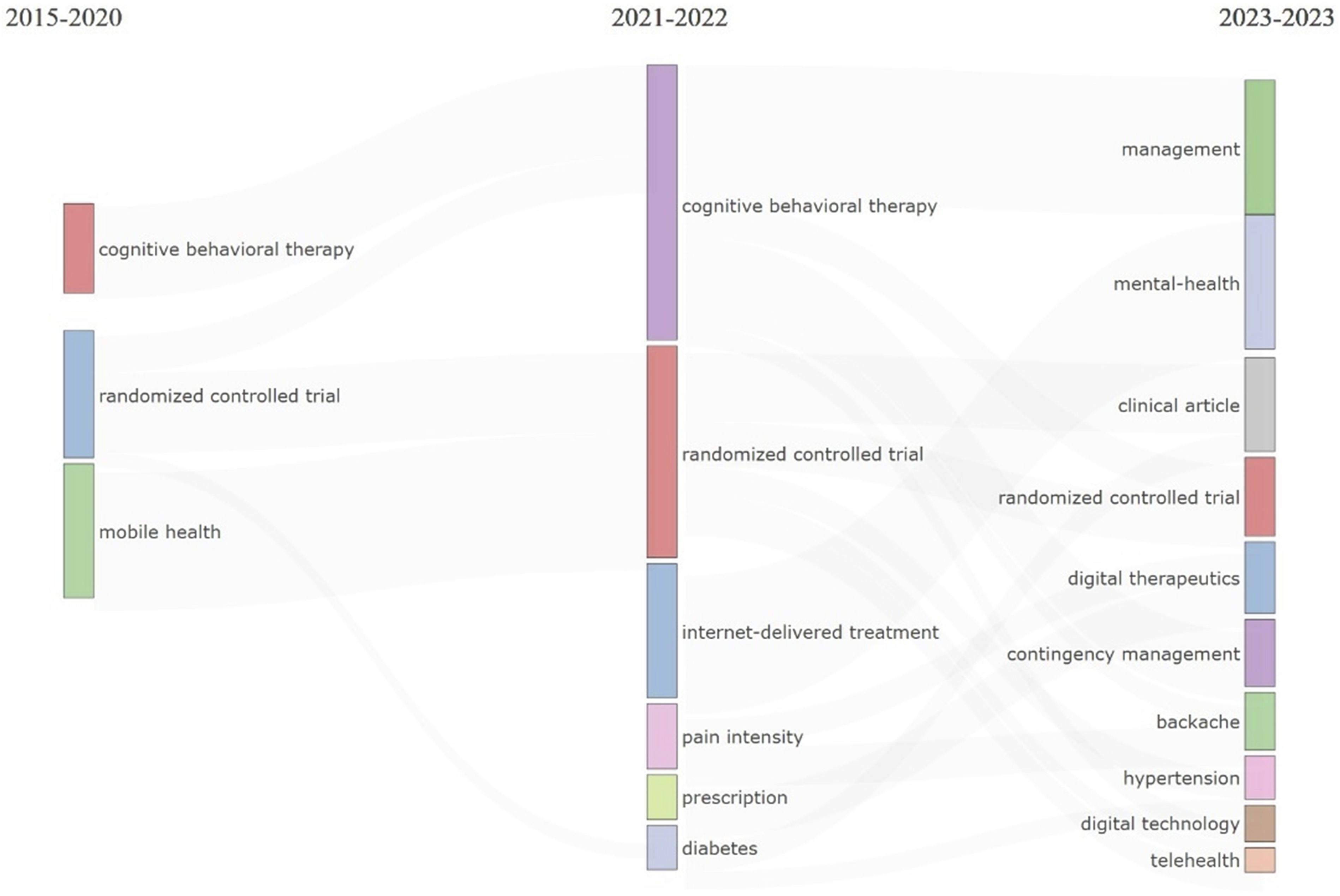
During 2021-2022, ‘cognitive behavioural therapy’ continued to dominate, suggesting an ongoing relevance of psychological (mental health) interventions. Similarly, ‘randomized controlled trial’ remained prominent and focused more on ‘cognitive behavioural therapy’ and ‘diabetes’. The emerging themes ‘internet-delivered treatment’ and ‘prescription’ based digital interventions indicate a shift in research focus towards digital health interventions for specific health conditions, ‘pain intensity’ and ‘diabetes.’
Since 2023-2023, the themes were diversified to include more specific areas such as ‘contingency management,’ ‘digital therapeutics,’ and ‘digital technology,’ in addition to the continuing themes of ‘randomized controlled trial,’ ‘management,’ and ‘mental health’. Theme ‘Pain’ evolved into ‘backache,’ ‘hypertension’, and ‘digital therapeutics’ suggesting a shift towards more specific health conditions and therapeutic approaches. These themes could suggest a future trend toward disease management strategies and continuity in rigorous research methodologies.
These time frames demonstrate a shift from traditional cognitive behavioral therapy and RCTs to ‘digital therapeutics,’ ‘digital technologies,’ ‘management strategies,’ highlighting the key area of interest and potential future research directions.
Three-field plot
The three-field plot elucidates the interconnections between authors (AU), their countries (AU_CO), and author keywords (DE) associated with their publications (Figure 8). Line opacity denote relationship intensity or frequency. Three-field plot.
The top 10 authors were affiliated with 10 countries (USA, Canada, Korea, Japan, Germany, India, Iceland, Australia, Brazil, and UK). The plot displays 20 different keywords related to DTx including ‘digital therapeutics,’ ‘mhealth,’ ‘mobile phone,’ ‘digital health,’ ‘randomized controlled trial,’ ‘ehealth,’ ‘anxiety,’ ‘mobile health,’ ‘mental health,’ ‘opioid use disorder,’ ‘prescription digital therapeutic,’ ‘lifestyle modification,’ ‘apps,’ ‘pain,’ ‘cognitive behaviour therapy,’ ‘behaviour change,’ and ‘hypertension.’ These keywords are linked to authors, showing the thematic focus of each author’s works. This visualization offers a holistic perspective on international collaborations and research themes, serving as an instrumental tool for bibliometric analysis to discern patterns and trends in a specific study domain.
Keywords co-occurrence
A co-occurrence analysis using Vosviewer identified 74 relevant terms (initial pool: 1145 keywords), resulting in 68 distinct items grouped into four clusters (Figure 9). The keywords with the highest total link strength were ‘controlled study’ and ‘digital therapeutics.’ Key terms related to technology including digital health, digital technology, digital therapeutic(s), mhealth, mobile phone, prescription digital therapeutic, and web-based intervention, indicate a strong focus on DTx interventions. Keywords related to medical conditions, including mental health (anxiety, depression) and sleep (insomnia, sleep disorder), indicate the areas of interest. Co-occurrence of all keywords (network visualization).
Discussion
The analysis presented in this article encapsulates the diverse landscape of treatment modalities, digital intervention utilization, disease conditions under study, patient care practices, outcomes assessment techniques, engagement strategies, and holistic well-being considerations within the DTx domain. Our study integrates bibliometric analysis and text-mining techniques to examine clinical trials on DTx interventions thoroughly. The analysis provides valuable insights into emerging trends within the space of clinical trials for DTx, identifying distinct themes and offering a deeper understanding of their implications within specific research domains and clinical trial settings.
The surge in publications from 2021 to 2023 indicates a rapid growth in the field, covering various health conditions and digital interventions, indicative of DTx’s broad applicability. Additionally, this study underlines unique growth patterns and citation practices, shedding light on the evolving landscape of DTx research. This analysis highlights the importance of both collaborative and independent study in driving innovation and addressing diverse health challenges. The widespread adoption of DTx hinges on various factors, including policymaking, digital literacy among healthcare professionals, and the inherent properties of DTx. 35
The findings uncover central topics like weight management interventions, patient-centric approaches for pain and anxiety management, and collective therapeutic interventions (Figure 10). The presence of terms such as ‘sham’ and ‘placebo’ indicates a focus on evaluating the effectiveness of digital interventions through controlled trials or assessments., while ‘music’ suggests exploring alternative therapeutic modalities (non-conventional approaches to patient care), highlighting current trends and paving the way for future research endeavors in the dynamic DTx landscape. Word cloud.
The adoption of DTx necessitates a thorough examination of ethical considerations, data privacy and security challenges, potential algorithmic bias, and patient consent issues in clinical trials to ensure equitable access to DTx interventions across varied populations. 36 Addressing these multifaceted complex challenges requires a comprehensive approach that involves enhanced data governance (i.e., data anonymization, safeguarding against unauthorized access and breaches, algorithm transparency/fairness), patient-centric approaches, and creating ethical guidelines for data sharing and secondary use.37,38 Adhering to regional and global regulatory guidelines will also ensure the ethical conduct of DTx clinical trials, 3 thereby, safeguarding patient autonomy and ensuring ethical data usage practices. 37
In conclusion, this study offers a detailed analysis of DTx clinical trials, revealing key research themes, clinical interventions, and technological advancements. It provides an extensive literature review, identifies research gaps, and outlines the evolution and challenges of DTx trials. DTx holds significant potential to broaden healthcare access and benefitting more patients. Future research should focus on advancing DTx solutions, such as AI-driven personalized interventions and the use of AR/VR-based therapies, and rigorously evaluating emerging areas like oncology, women’s health, pediatric conditions. These efforts will improve patient-centered care and inform policy directions.
Limitations
The study has the following limitations that warrant careful interpretation: (a) potential selection bias due to focusing on English articles and specific databases thus, limiting the generalizability of the findings; (b) data quality variability could impact the reliability of findings which may not encompass the full scope of DTx recent developments and regional variations in DTx; (c) publication bias can skew bibliometric analysis results by excluding unpublished or gray literature, and contextual disparities, leading to over-representation of positive results and under-representation of ongoing and recent developments, limiting the universal applicability of the results. This bias is significant as studies with positive outcomes are more likely to be published.; and (d) despite a smaller sample size of 99 articles, focusing on completed clinical trials provide a comprehensive overview of the current state of research, identifying key themes and research gaps in literature. For an emerging field with fewer empirical studies, a sample size of 50 and 100 still provides an acceptable result with a likelihood of some variances.39,40
Practice implications
This research carries substantial managerial implications for stakeholders involved in DTx clinical trials, accentuating the necessity to comprehend their rapid growth and evolution for strategic planning and resource allocation. It highlights key contributors, leading publishers, recurring research themes, thematic mapping, and factorial analysis, thereby directing decision-making procedures for efficient resource allotment and innovation in DTx solutions, ultimately improving patient outcomes and healthcare delivery.
The results offer significant insights for subsequent research on digital interventions, advocating for interdisciplinary strategies to address health challenges and scrutinizing publication patterns to evaluate their implications.
Supplemental Material
Supplemental Material - Deciphering the evolution of digital therapeutics: A bibliometric analysis of clinical trials
Supplemental Material for Deciphering the evolution of digital therapeutics: A bibliometric analysis of clinical trials by Kavita Garg, Vinaytosh Mishra, Krishan K. Pandey, Gaurav Kabra and Ashish Kaushal in Proceedings of Singapore Healthcare
Footnotes
Declaration of conflicting interests
The author(s) declared no potential conflicts of interest with respect to the research, authorship, and/or publication of this article.
Funding
The author(s) received no financial support for the research, authorship, and/or publication of this article.

Supplemental Material
Supplemental material for this article is available online.
References
Supplementary Material
Please find the following supplemental material available below.
For Open Access articles published under a Creative Commons License, all supplemental material carries the same license as the article it is associated with.
For non-Open Access articles published, all supplemental material carries a non-exclusive license, and permission requests for re-use of supplemental material or any part of supplemental material shall be sent directly to the copyright owner as specified in the copyright notice associated with the article.
