




Abstract
Introduction
Effectiveness of Patient Education Materials (PEMs) on NSAIDs is subjected to whether the patient is able to read and comprehend the information provided. This study assessed the readability, understandability and actionability of English-language NSAID-related PEMs targeted at patients or caregivers in Singapore.
Methods
PEMs obtained from healthcare institutions in Singapore and from two frequently used internet search engines using search terms “NSAID” or “non-steroidal anti-inflammatory drug” were analysed by two reviewers using Flesch-Kincaid Grade Level (FKGL) and Simple Measure of Gobbledygook (SMOG) to assess the readability of the PEMs. Patient Education Materials Assessment Tool for printable materials (PEMAT-P) and United Kingdom Association for Accessible Formats (UKAAF) was used to assess the PEMs’ understandability, actionability and physical properties.
Results
All 74 PEMs that were reviewed, except one, were assessed to be beyond readability of the general population which was defined as grade 6 and below. Their mean FKGL and SMOG scores were 13.3 ± 2.8 and 14.4 ± 2.1 respectively. There were no significant differences in the FKGL (p = .20) and SMOG scores (p = .52) between local and non-local PEMs. The PEMs satisfied majority of UKAAF’s requirements. The PEMs’ understandability and actionability scores were 80.5 ± 8.0% and 52.5 ± 19.0% respectively.
Conclusions
Current NSAIDs-related PEMs are pegged too high at a level for a significant portion of population in Singapore to read and comprehend the information for them to take appropriate actions to ensure safe use of NSAIDs to manage their medical conditions. However, they are generally well-designed to facilitate reading of the materials.
Keywords
Introduction
Non-steroidal anti-inflammatory drugs (NSAIDs) are commonly used worldwide for their analgesic, anti-inflammatory and antipyretic effects. 1 However, NSAIDs may also be associated with deleterious side effects such as gastrointestinal ulcers and haemorrhage, cardiovascular disease and acute kidney injury.2,3 Despite prescribing guidelines from internationally renowned societies and dispensing interventions,2,4 NSAID use remains prevalent among susceptible individuals such as older adults and those with cardiovascular, kidney and gastrointestinal risks.2,5,6 In particular, over-the-counter (OTC) purchases constituted 78% of NSAID use among older adults in Sweden. 7 OTC NSAIDs may contribute to the potentially inappropriate use of NSAID in at-risk individuals, since studies have identified gaps in patients’ knowledge regarding excessive dosing and concurrent exposure to other medications that may potentiate the risk of NSAID-associated adverse events.8,9
Hence, there is growing recognition that there is a need to improve the self-care knowledge and health literacy of at-risk individuals, 8 so that they can understand, evaluate and apply NSAID-related information to make informed health decisions regarding their use.10,11 Patient Education Materials (PEMs) in written and electronic forms are favoured since they are easily reproducible and can be dispensed by healthcare professionals to educate patients on the correct and appropriate use of NSAID. Yet, their effectiveness to improve patients’ health literacy may be compromised if the target users are unable to understand the PEMs. Data on the quality of NSAID-related PEMs that patients may encounter is scanty despite NSAIDs being one of the most used analgesics. Though Singapore currently has one of the best education system globally, about a quarter of its residential population aged 25 years and above in 2019 had only completed primary school education. 12 Older residents (42.1% of those aged 55 years and above) 12 made up a significant proportion of this group. There is thus concern whether current NSAID-related PEMs are written to match the literacy and reading capability of the general population. We conducted this study to assess the readability, understandability and actionability of NSAID-related PEMs available to the local population.
Methods
Data collection
English is the official national language and the latest census in 2020 reported that English was the language most frequently spoken at home in the resident population (48.3%). 13 Hence English-language NSAID-related PEMs targeted at patients or caregivers were included for this study.
All public and private hospitals, public primary care polyclinics, and a random selection of 50 private general practice clinics in Singapore were invited by phone call and mail to share their printed NSAID-related PEMs. A return mail was attached to each invitation to facilitate their sharing. NSAID-related PEMs were also obtained from the websites of these healthcare institutions using the search terms “NSAID” or “non-steroidal anti-inflammatory drug”. The internet may also be a source of medicines information as 98% of households have Internet access and 89% of residential population were Internet users in 2019. 14 Hence two frequently used internet search engines, Google and Yahoo, were used to identify NSAID-related PEMs that patients and caregivers may encounter. The following search terms were used: ‘NSAID information’, ‘nonsteroidal anti-inflammatory drug information’, NSAID patient education material’ and ‘nonsteroidal anti-inflammatory drug patient education material’ for an online search between Jan and July 2020. NSAID-related PEMs were downloaded or copied from the websites hosted by private and national corporations with materials approved by their expert panels, health education units of medical schools, centres or healthcare institutions, health information providers and not-for-profit organizations as directed by weblinks that showed one or more of the above search terms.
Readability
Readability is an objective measure of how well an individual understands the text that he/she reads and it is measured in terms of level of education. 15 PEMs with readability beyond grade 6 (equivalent to completing primary school in the local context) was defined as difficult according to recommendations from the American Medical Association and the National Institute of Health.
The Flesch-Kincaid Grade Level (FKGL) and Simple Measure of Gobbledygook (SMOG) were used to assess the readability of the PEMs for this study. Although several validated readability assessment tools such as Flesch Reading Ease score, Gunning Fog Index and Fry Readability Graph are available, the FKGL is an extensively validated tool that is highly correlated with the readers’ education level and with other readability formulas and is easy to administer. 15 The FKGL score is generated using the formula: 0.39 (words/sentences) + 11.8 (syllables/words) −15.59. 16 The higher the FKGL score, the greater the difficulty in comprehending the text. FKGL for this study was calculated using the readability statistic in Microsoft Word. A FKGL of 5th grade with Flesch Kincaid Reading Age (FKRA) of 5.9 and below is defined as very easy to read while a 6th grade (FKRA: 6.0-6.9) is defined as easy to read. 17 A 7th grade (FKRA: 7.0-7.9) defined as fairly easy to read, 8th and 9th grade (FKRA: 8.0-9.9) as conversational English, 10th, 11th and 12th (FKRA: 10.0-12.9) grades as fairly difficult to read. 17 A FKRA of 13.0-15.9, 16.0-17.9, and 18.0 and above are defined as difficult to read, very difficult to read and extremely difficult to read. 17
The SMOG, calculated via the formula: 3.1291 + 1.0430√number of polysyllabic words in samples of 30 sentences, 18 was also used to assess the readers’ readability because of its stricter assessment criterion which requires any reading material of a certain SMOG readability grade to be comprehensible by all individuals with that reading grade skills. This 100% comprehension ability criterion is not a requirement of other readability assessment tests mentioned earlier. 18 The higher the SMOG index, the greater the difficulty in comprehending the text. 15 A SMOG index of 4-5 which corresponds directly to school grade of 4-5 respectively is defined as very easy to read, while a SMOG index of 6, 7 and 8-9 are defined as easy to read, fairly easy to read and conversational English respectively. 19 A SMOG index of 10-12, 13-16 and 17 are defined as fairly difficult to read, difficult to read and very difficult to read respectively. 19 A SMOG index of 18 and above is defined as extremely difficult to read. 19
The SMOG scores were calculated using an online calculator accessed at https://www.textcompare.org/readability/smog-index. 19 As the validated SMOG assessment tool only counts text up to a maximum of 30 sentences, 18 10 consecutive sentences at the beginning, middle and end of the text were selected from texts were longer than 30 sentences. 18
The PEMs were prepared for computerised readability assessment via the following steps: • Text were copied directly or manually transcribed from the softcopy and hardcopy printed material into a Microsoft Word file.
19
• Titles, subtitles, headings, captions and visual aids were omitted as only complete sentences with running text which end with a full stop, exclamation or question mark will be involved in the count.
19
• Colons and semicolons within a sentence were removed.
19
• Decimal point of number were removed.
19
• Text such as copyright notice, disclaimers and author names that were not related to patient education were omitted.
19
• Abbreviations were spelled out. • Numbers and symbols were spelled out.
18
• For bullet points which could be considered as a sentence were formatted as complete sentence while those which could not be considered as a sentence, a preamble was added in front of each bullet point to form a complete sentence.
18
Format quality
The physical properties of the PEMs, such as the layout and design can affect the readability and comprehension of the reader.20,21 Alterations in typography of the reading materials may affect the reading rate, reading accuracy and comprehension. 22 The United Kingdom Association for Accessible Formats (UKAAF) stipulated 10 criteria for producing clear and large print for documents to the reading materials to most people, including those with low vision. 23
Understandability and actionability
Understandability of a PEM is related to whether the patient is able to process and explain key messages from the PEM, while actionability of the PEM is related to whether patients can identify what they can do based on the information presented. 22 The Patient Education Materials Assessment Tool for printable materials (PEMAT-P), the first validated scale to measure the understandability and actionability of PEM, 34 was chosen for its strong internal consistency, reliability, and evidence of construct validity. 24 The PEMAT-P consists of a 19-item understandability scale and a 7-item actionability scale. 25 Each item in the PEMAT-P has the response options of “Agree” and “Disagree”. Some items have additional response option of “NA” where applicable. A score of “1” was awarded for each “Agree” response while “0” was awarded for each “Disagree” response. 25 Each PEM was assessed independently by two authors (with initials BG and ST). The PEMAT-P understandability and actionability scores were calculated by dividing the total points scored by the PEMs by the total possible points and expressed as percentages. The higher the score, the more understandable or actionable the material.
Statistical analysis
All analyses were performed using Microsoft Excel and IBM SPSS Statistics 27 (IBM Corp., Armonk, New York). Categorical variables were presented as proportions and compared using Pearson chi-square test or Fisher’s test as appropriate. Continuous variables were summarised as means with standard deviations and compared using the Mann Whitney U test. All tests were two-tailed and statistical significance was defined as p < .05.
Results
This study identified 74 PEMs: 7 local PEMs were obtained from the online websites of local healthcare institutions (6 from public hospitals, one from public primary care institution and none from private general practice clinics) and 67 non-local PEMs were obtained from websites hosted by institutions outside of the country. NSAID PEMs (physical and online) from the local private hospitals and general practice clinics were not available.
Contents
Content covered by non-steroidal anti-inflammatory drug (NSAID)- related patient education material (PEM).
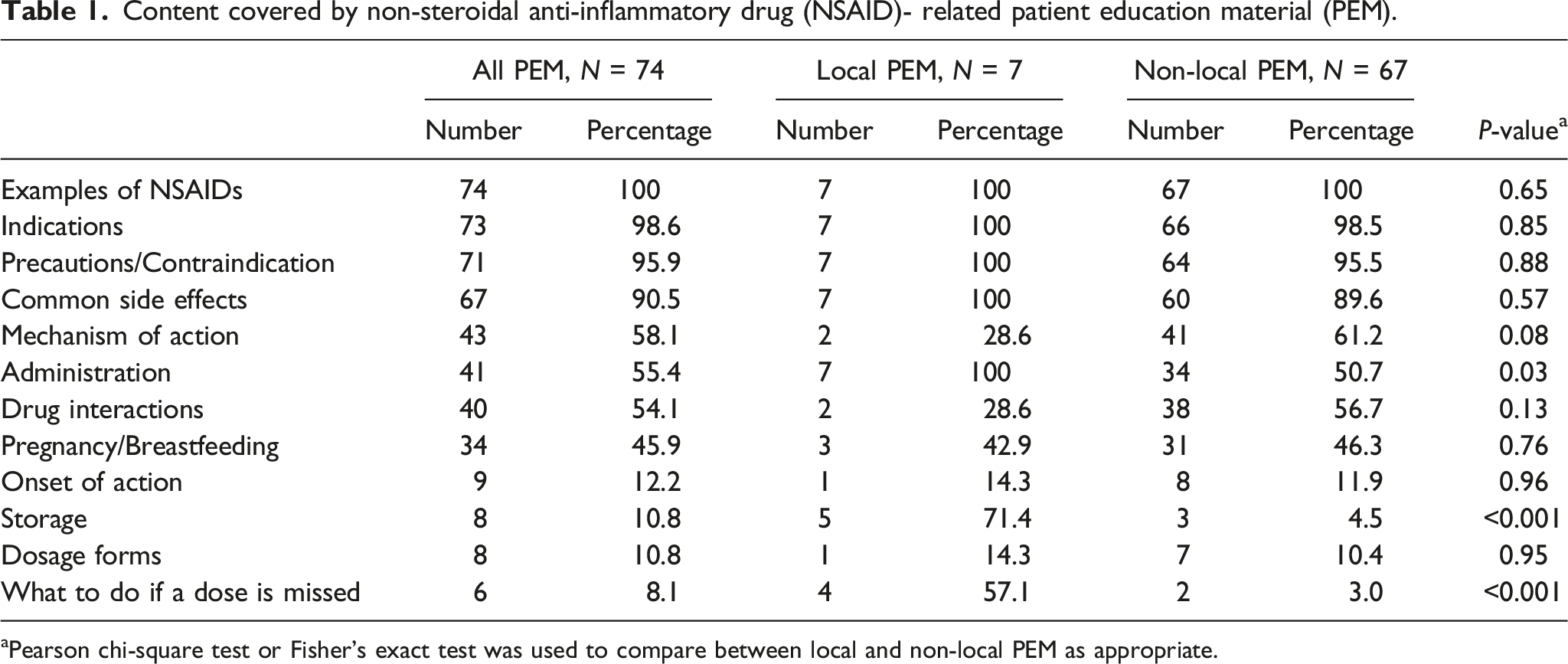
aPearson chi-square test or Fisher’s exact test was used to compare between local and non-local PEM as appropriate.
Readability
Readability, understandability and actionability of NSAID-related patient education materials.
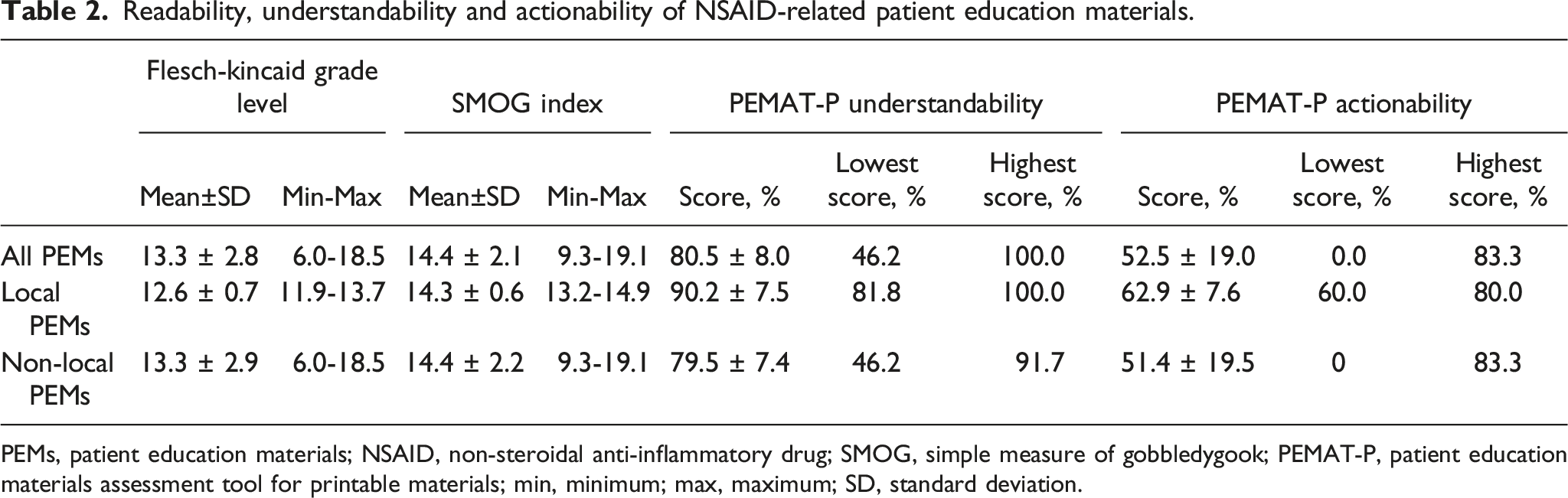
PEMs, patient education materials; NSAID, non-steroidal anti-inflammatory drug; SMOG, simple measure of gobbledygook; PEMAT-P, patient education materials assessment tool for printable materials; min, minimum; max, maximum; SD, standard deviation.
Format quality
The PEMs satisfied the majority of the UKAAF requirements (Supplemental Table S2). However, only half of the PEMs had font size of 12 or larger. The other format quality issues identified were use of large blocks of capital letters and narrow line spacing between the sentences, which made reading difficult.
Actionability and understandability
Table 2 shows the understandability and actionability of NSAID-related PEMs assessed according to PEMAT-P. The understandability scores were generally higher than the actionability scores. The local PEMs had significantly higher understandability scores than the non-local PEMs (90.2 ± 7.5 vs 79.5 ± 7.4 respectively, p = .006) and tended to have higher actionability scores (62.9 ± 7.6 vs 51.4 ± 19.5, respectively, p = .08).
Discussion
This study identified 74 NSAID-related onli PEMs, including 7 from websites hosted by local healthcare institutions. Only one met the recommended readability level of grade 6 and below (the equivalent of primary school education) as recommended by the American Medical Association and the National Institute of Health. 26 Notably, the older individuals who may be most at-risk for NSAID-related adverse events formed almost half of those with lower formal education, possibly due to limited educational opportunities during early nation-building. An Economic Co-operation and Development (OECD) report in 2016 noted that fewer than a third of Singapore adults were able to read dense or lengthy text which requires a reader to identify, evaluate and infer information. 27 While the NSAID-related PEMs evaluated in this study covered many categories of drug information, this supposedly useful information may not be properly understood by patients or their caregivers. Similarly, prior studies on written and online PEMs for diabetes, ophthalmology and peripheral neuropathy in other countries were found to be above the reading capability and comprehension level of the average patient.28–31 Such mismatches may result in imperative information being misunderstood or missed by the patients which in turn may lead to inappropriate or even erroneous NSAID use, thus posing a medication safety concern when PEMs are used to supplement medication counselling. However, as the literacy rate increases in subsequent years, future research will be required to re-evaluate the findings to determine the appropriate target education level for NSAID-related PEMs.
Interestingly, the local PEMs scored better in understandability and actionability than non-local PEMs. The PEMAT-P tool facilitates comparisons between different PEMs, 22 but does not recommend a cutoff score to define the optimum understandability or actionability of PEMs. 25 While the PEMAT-P tool is designed to be completed by healthcare professional who aim to select the most suitable PEM for patient care, the understandability and actionability of PEMs may also be assessed by a large and varied pool of patients who are the target users of the NSAID-related PEMs to obtain a more representative perspective that can be taken into consideration when developing or improving NSAID-related PEMs. 32
There are limitations in this study. Singapore is a multi-language society with diverse demographic, including seniors with low education levels and may primarily converse and/or literate in languages other than English. The retrieval of only English-language written PEMs using our pre-defined search terms may have restricted the PEMs included in the study, while patients may potentially search for PEMs in other languages. This study did not include video or audio PEMs. The PEMAT-P understandability and actionability was assessed by trained pharmacists as recommended by the PEMAT user guide, but may not be generalised to the general population with a different socioeconomic and education profile. Although almost half of the PEMs that were analyzed in this study had small font size, this may be less of a concern for online PEMs since the font size can be enlarged by the text adjustment function in electronic devices. Since the written form is among the most effective methods to disseminate medication-related information and improve patients’ medication knowledge and adherence,33,34 the findings from this study can help identify aspects where the NSAID-related PEMs should be improved so that patients and caregivers can derive the intended benefits. Future studies could look into the readability, understandability and/or actionability of NSAID-related PEMs written in other languages to ensure that they are written at a level that patients can read and comprehend.
Conclusion
Current NSAIDs-related PEMs are pegged too high at a level for a significant portion of population in Singapore to read and comprehend the information for them to take appropriate actions to ensure safe use of NSAIDs to manage their medical conditions. However, they are generally well-designed to facilitate reading of the materials.
Supplemental Material
Supplemental Material - Patient educational materials on non-steroidal anti-inflammatory drugs
Supplemental Material for Patient educational materials on non-steroidal anti-inflammatory drugs by Bandy Qiuling Goh, Cynthia Lim Ciwei, Sheila Toh Kai Xuan, Puay Hoon Lee and Ngiap Chuan Tan in Proceedings of Singapore Healthcare
Footnotes
Author contributions
All authors have contributed significantly and agree with the content of this review article.
Declaration of conflicting interests
The author(s) declared no potential conflicts of interest with respect to the research, authorship, and/or publication of this article.
Funding
The author(s) received no financial support for the research, authorship, and/or publication of this article.

Supplemental Material
Supplemental material for this article is available online.
References
Supplementary Material
Please find the following supplemental material available below.
For Open Access articles published under a Creative Commons License, all supplemental material carries the same license as the article it is associated with.
For non-Open Access articles published, all supplemental material carries a non-exclusive license, and permission requests for re-use of supplemental material or any part of supplemental material shall be sent directly to the copyright owner as specified in the copyright notice associated with the article.
