




Abstract
Background
Singapore General Hospital (SGH) Pharmacy department set up a novel 24-h medication locker service in November 2019 to serve hospital staff on work shifts who were unable to collect medication within the pharmacy operating hours. However, the initial uptake rate was modest.
Objectives
Primary objective was to increase the daily locker service uptake by staff from five lockers to 42 lockers (100%) in 6 months, starting from June 2020. Secondary objectives include exploring the cost savings and impact of the locker service on the pharmacy’s operational efficiency, as well as compare the medication collection experience of hospital staff using the locker service and in the pharmacy.
Methods
FOCUS-PDSA was the adopted QI methodology. Two Plan-Do-Study-Act (PDSA) cycles were used to implement the final identified solutions. PDSA cycle one focused on improving publicity and educational efforts. PDSA cycle two then focused on expanding the service to include the entire hospital campus staff and setting up a self-registration booth at the pharmacy entrance.
Results
The primary objective of achieving 100% locker utilization was attained in October 2020, with daily average service uptake rate increasing from 12.6 at baseline to 49.8 by the end of PDSA cycle 2. Annual pharmacist manpower savings of 0.88 Full Time Equivalent (FTE) was also achieved. Locker service users gave a higher average satisfaction score compared to those who collected from the pharmacy.
Conclusion
Project SAPPORO successfully increased the daily locker service, providing hospital campus staff with increased convenience and positive medication collection experience during the COVID-19 pandemic.
Introduction
The first imported case of the Coronavirus Disease (COVID-19) was discovered in Singapore on 23rd January 2020. 1 In response to the rising local transmission rates, the Multi-Ministry Taskforce implemented an elevated set of safe distancing measures, as a circuit breaker from 7th April 2020 until 4th May 2020. While essential services such as providing healthcare remained operational during this circuit breaker period, safe distancing measures on capacity limits and physical separation were strictly enforced to minimize risk of transmission. 2 In response to the circuit breaker, Singapore General Hospital (SGH) Pharmacy Department ramped up efforts to increase the operational capability of its medication delivery service team by closing one outpatient pharmacy, as well as promote the use of alternative medication supply models such as the use of pre-order prescription service and self-service secured medication lockers.
The self-service secured medication locker service was set up in November 2019 to service hospital staff on work shifts who were unable to collect medication within the pharmacy operating hours. This service was eligible for SGH staff who presented prescriptions orders for themselves or their family members. Exclusion criteria included those who were unfamiliar with their medications and would like to have medication counselling services from pharmacists, collection of fridge items and any urgent medication, and staff prescriptions from neighbouring healthcare institutions, otherwise known as SGH campus staff prescriptions.
To place an order request, SGH staff simply had to fill out and submit an order form along the prescription at the pharmacy reception. All prescriptions were clinically reviewed and any identified drug related problems were resolved via pharmacist interventions. SGH staff would then be contacted and counselled accordingly via tele-counselling if needed. After which, the requested medicine would be packed and parcelled for loading into the secured locker. Once the parcel was successfully loaded, SGH staff would receive a WhatsApp notification containing a unique 5-digit code and a corresponding QR code. They would then have a 48-h window to collect their medication parcels by manually inputting the 5-digit code or scanning the corresponding QR code into the locker interface system. After 48 h, they would receive an expired and uncollected parcel notification to collect from the pharmacy.
The service uptake during the initial 3 months was modest as the majority of hospital staff were accustomed to filling their prescriptions in the pharmacy, with only 5 out of 42 locker units used daily. However, there is newfound impetus to leverage on this service considering its unique contactless nature which is critical during the pandemic season. 3 Similar locker service models have also been successfully implemented in countries such as Malaysia, 4 Netherlands 5 and Taiwan 6 in response to COVID-19.
Project SAPPORO (StAff Prescription-bluPORt Optimization) is therefore developed, with the primary objective of increasing the daily locker service uptake by staff from five lockers to 42 lockers (100%) in 6 months, starting from June 2020. Secondary objectives include exploring the impact of the locker service on the Outpatient Pharmacy’s operational efficiency and comparing medication collection experience among hospital staff via locker service versus pharmacy counter.
Methods
Project SAPPORO is a Quality Improvement (QI) project conducted in an outpatient pharmacy in Singapore General Hospital between June 2020 to December 2020. FOCUS-PDSA 7 was the adopted QI methodology used to identify the core issues before designing and implementing a quality improvement project to solve the identified issues. FOCUS stands for Find, Organise, Clarify, Understand and Select while PDSA stands for Plan, Do, Study and Act.
Find a process to improve
With the closure of one outpatient pharmacy to support medication delivery service operations, patient load would inevitably be directed to the remaining front-of-house outpatient pharmacy. Considering the pharmacy infrastructural limitations and high risk of infection transmission in a crowded premise, patient flow and dwell time in the pharmacy had to be carefully managed. The pharmacy team identified low medication locker service uptake as an opportunity to segregate medication collection between hospital staff and patients, reducing congestion and infection transmission risk within the pharmacy. The resource availability, as well as the direct impact on both hospital staff and patients made this an attractive opportunity and important issue to resolve. A separate project was also developed to reduce patient dwell time in the pharmacy by triaging visiting patients for medication delivery service eligibility.
Organize to improve the process
The project team of three pharmacists and six pharmacy technicians was concurrently formed based on their roles in the pharmacy, with expertise ranging from Quality Improvement, Medication Locker Management, Clinical Review, Financial Billing and Pharmacy Operations. Members were consulted throughout the planning phase of the project, ensuring every stakeholder’s needs were met. Primary and secondary objectives were then developed using Specific, Measurable, Achievable, Relevant and Time-Bound (SMART 8 ) Goals.
Clarify the issue
The existing locker service workflow was mapped out in a flowchart and pain points were identified by the project team which would be used to generate subsequent root cause analysis. Stakeholders such as hospital staff, pharmacy staff, patients and hospital management were identified by their roles and degree of impact by the project. They were then engaged to identify concerns through surveys and subsequently addressed through team and department meetings respectively.
Understand the sources of variation
Root cause analysis was conducted using Cause and Effect Diagram
9
(Figure 1), generating potential root causes of low locker service uptake rate after considering process, environment, equipment and collecting staff-related factors. After eliminating non-modifiable root causes, feedback obtained earlier from stakeholders were taken into account to validate the remaining seven modifiable root causes. Top three root causes were then selected through multi-voting by project team members based on its impact, frequency and prevalence. 80/20 Pareto Principle Rule
10
was also adopted to prioritize the top 20% of root causes contributing to low locker service uptake rate, as shown in the Pareto Chart (Figure 2). The final three identified vital root causes were namely, only SGH staff were currently eligible for locker service, lack of educational materials to explain locker collection steps and limited publicity materials about locker service. Cause & effect diagram. Pareto chart.

Select the process to improve
Potential solutions targeted at the three vital root causes were brainstormed by the project team as illustrated by a Driver Diagram. Final solutions were then selected after all potential solutions were rated and scored according to time and cost savings, feasibility and sustainability parameters in a Prioritization Matrix
11
(Figure 3). The identified final solutions were to expand the locker service to the entire hospital campus staff and their family members, provide a parcel collection instruction leaflet for all staff who will be using the locker service, and set up a dedicated locker service self-registration booth outside the pharmacy. These solutions were also validated by the various stakeholders and obtained buy-in from hospital management. Driver diagram & prioritization matrix.
Plan-do-study-act (PDSA) cycle
Two plan-do-study-act (PDSA) cycles 12 were used to implement the final identified solutions
PDSA cycle one was conducted over a month from June to July 2020. It targeted the root causes of the lack of educational materials to explain locker collection steps and limited publicity materials about locker service. This was achieved by extensive publicity efforts such as increasing visibility of the service on the hospital intranet, actively distributing publicity materials and collection advisory leaflets detailing steps to use the locker service to all hospital campus staff visiting the pharmacy. The hospital staff clinic department was also engaged and trained to encourage visiting staff to use the locker service for medication collection. Daily feedback from hospital campus staff regarding their experience of using the locker service was then used to revise the relevant publicity materials. The purpose of PDSA cycle one was to strategically improve awareness and familiarity of the medication locker service within the hospital campus staff before transiting to PDSA Cycle 2.
PDSA cycle two was conducted from August to December 2020 to address the root cause that only SGH staff were currently eligible for locker service. This was achieved by seeking hospital senior management approval to expand the service to include the entire hospital campus staff who were collecting prescription orders for themselves or their family members, from any local healthcare institution, including neighbouring institutions, private General Practitioners (GP) and handwritten prescription memos. A self-registration booth was also set up at the pharmacy entrance, allowing hospital campus staff to conveniently submit their orders into a designated drop off box, without the need to queue and register at the pharmacy reception. Pharmacy staff deployed to manage the patient queue at the pharmacy entrance were also trained to encourage hospital campus staff to use the locker service and assist them with any queries. The overall enhanced locker service workflow is illustrated in Figure 4. Locker service workflow.
Outcome measures
Medication locker service uptake rate was defined as the absolute number of hospital campus staff who had their medication parcel successfully loaded into the secured locker. This was generated and collated daily via an in-house pharmacy queue system report by the project team.
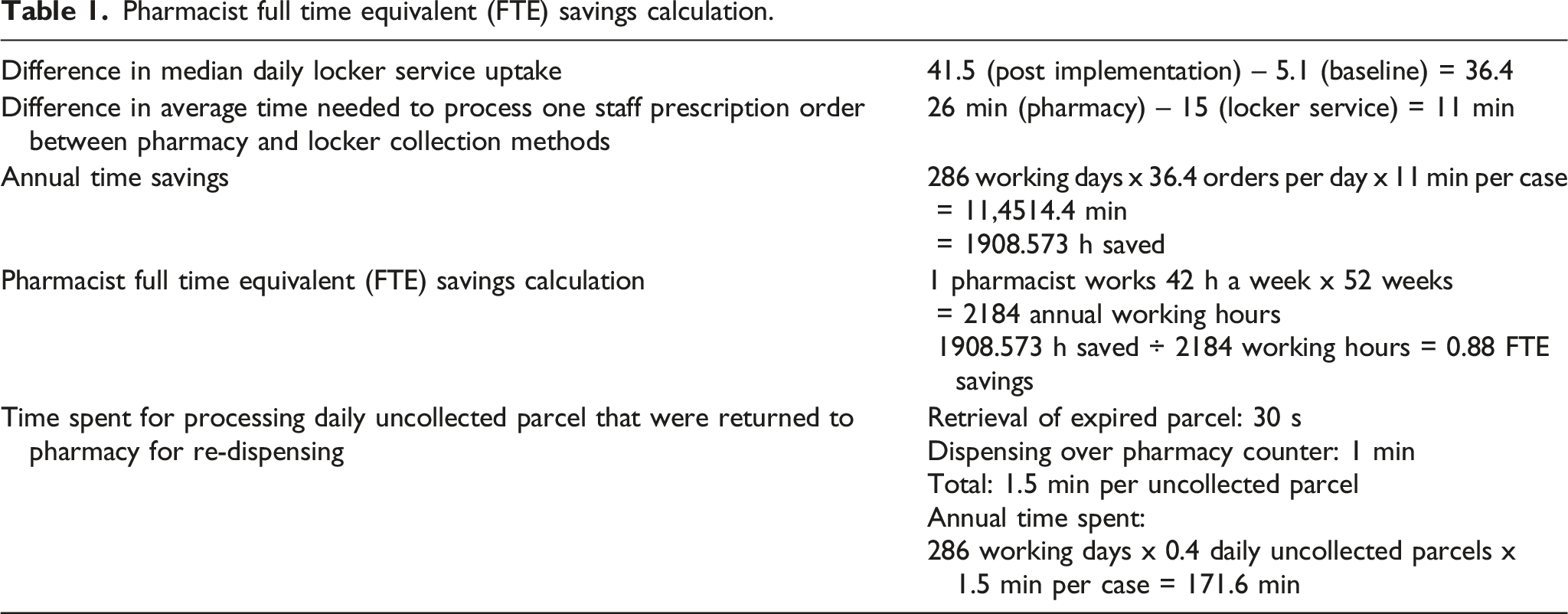
Impact of the locker service on the pharmacy’s operational efficiency was measured by calculating annual cost savings and pharmacist Full Time Equivalent (FTE) manpower-savings spent on processing campus staff prescriptions. Cost savings were calculated by inputting results from a time study comparing the processing time of a staff prescription using locker service against conventional workflow into a quality savings calculator tool provided by the hospital’s Quality Improvement department.
Efficiency of the service was also explored by comparing the daily number of uncollected medication parcels that are left unclaimed after a 48-h collection period in the locker before and after implementation. This data was collated daily by the project team.
Medication collection experience via the locker service compared to over pharmacy counters was evaluated through a staff satisfaction survey conducted from June to December 2020. A five-point Likert-scale was used to score the user’s overall satisfaction with collecting medication via the medication locker service and the pharmacy. A score of five represents most satisfied, four being satisfied, three being neutral, two being not satisfied and a score of one being least satisfied. Survey respondents were also asked to elaborate on their rating scores using open ended questions to obtain feedback and understand more about their medication collection experiences. Scores and feedback were collated at the end of the project by the team members.
Statistical analysis
Descriptive statistics were used to evaluate the locker service uptake rate and results from the user satisfaction survey. All analysis were performed using Microsoft Excel 2019 version software.
Results
Service uptake rate
The primary objective of achieving 100% locker utilization was attained 4 months into the project in October 2020. The results are summarized in Figure 5. Between June 2020 to December 2020, there were a total of 5699 orders placed by hospital campus staff to use the medication locker service. By the end of PDSA Cycle one in June 2020, the daily average service uptake rate increased from 12.6 at baseline to 26.7. The expansion of the locker service in PDSA Cycle two coupled with the setup of a self-registration booth further boosted the daily average uptake rate to 49.8 in December 2020. Daily median locker service uptake rate at baseline was 5.1, which increased to 41.5 post implementation. Run chart of locker service uptake rate.
Cost savings
Pharmacist full time equivalent (FTE) savings calculation.
Efficiency
Education and publicity efforts made in PDSA cycle one proved to be effective as daily uncollected parcels from the locker service decreased from an average of 2.8 before project implementation to 0.4 post implementation.
Hospital staff satisfaction
Results of the hospital staff satisfaction survey are summarized in Figure 6 and Table 2. A total of 90 hospital campus staff took part in the survey conducted from June to December 2020. 76 (84%) of them used the locker service previously. Of which, 74 (97%) indicated that they were satisfied or most satisfied with the locker service (score of four to 5). A higher average satisfaction score of 4.8 out of five was obtained for staff who collected their medications via the locker service whereas those who collected through the pharmacy gave a lower average score of 3.5. Notable reasons for staff preferring the medication locker service over pharmacy collection included notable convenience for shift workers, time consuming to queue in the pharmacy for medication and the flexibility of collecting their medication using a 24-h locker system. Staff satisfaction survey results. Open ended question responses to elaborate on their medication collection experiences.

Discussion
SGH is the first tertiary acute care hospital in Singapore to offer on-site medication collection service using a secured locker system. The modest initial service uptake rate was unexpected, given the postulated benefits of the 24-h medication locker service. FOCUS-PDSA QI methodology has longed been used as a Continuous Quality Improvement (CQI) framework by healthcare organizations worldwide to effectively design and implement CQI programs. 13 The adoption of FOCUS-PDSA methodology in Project SAPPORO was critical in identifying root causes which helped develop solutions that effectively addressed the initial modest locker service uptake rate. Regular stakeholders’ engagement and targeted staff training to improve awareness of the locker service and user confidence in the locker system were also key components to the success of the project.
Besides the effective use of FOCUS-PDSA methodology, successful increase in locker uptake could also have been attributed to the location of SGH within the campus. SGH is nested centrally, surrounded by three specialty centres, one community hospital, one polyclinic and the Ministry of Health. Nonetheless, majority of the locker service orders (80%) belonged to SGH staff.
Although the medication processing time using a locker service is documented to be longer as shown in other studies, 14 it is interesting to note that there was an overall time savings of 11 min via the locker service during the time study. This difference can be attributed to time saved during medication counselling and transition period between the point when the medications are packed and awaiting pick up by a counter dispenser. This suggests that the locker service may be particularly useful for pharmacies which are oversaturated with patients, and those who are on stable medication regimen and do not require any further counselling will benefit most from this service. This will in turn allow pharmacists to focus on providing value added counselling and medication management services to patients who need further assistance with their medication regimen. It remains to be seen if the public, especially the elderly or less tech savvy patients are receptive to this new medication supply model.
Before the locker service was set up, almost all of the daily unclaimed medication orders in the pharmacy belonged to hospital staff who were unable to return to the pharmacy in time. This was resolved as the locker service provided a 48-h collection window compared to 24-h in the pharmacy. The automated expired parcel WhatsApp notification system also ensured that there was no longer a need to contact staff to collect unclaimed medications. Overall, the successful reduction in daily uncollected parcels to 0.4 post implementation resulted in significantly less resources and time needed to manage unclaimed medication parcels as shown in Table 1.
There are other intangible benefits of Project SAPPORO which were not quantified in this report. Given that the majority of staff prescription orders are non-urgent in nature, the successful increase in the locker service uptake allows the pharmacy to prioritize resources to serve the needs of patients seeking medication refills and pharmacy services as manpower was diluted to support COVID-19 operations. The locker service also minimized unnecessary prolonged contact between campus staff and patients during this pandemic season. This strategy has been documented as a crucial factor in mitigating infection transmission risk, playing a role in preventing a COVID-19 cluster formation within the hospital. 15 Improved staff working environment is another unquantifiable benefit. As most healthcare workers are scheduled on work shifts, they tend to submit prescription orders during peak opening or lunch hours, only to return during their lunch breaks or after work to collect their medication. Disruption of lunch breaks and frustrations due to the need to queue and enter the pharmacy can affect their performance or even lead to safety lapses at work. 16 By setting up a self-registration booth, staff can quickly submit their orders during their break. 24-h operating locker system also allows staff to collect their medications outside the pharmacy operating hours, alleviating stress and may in turn prevent burnout during this pandemic season. 17 This was validated through open ended responses in the user satisfaction survey as to why they preferred to use the locker service.
Nonetheless, it is important to consider manpower and resource availability in the pharmacy to scale up the locker service operations. The current locker unit allocation process is done one order at a time via the locker vendor’s mobile application. This can be time consuming if there is a larger volume of parcel orders. One possible solution may be to integrate a bulk ordering mechanism into the workflow which enables a more efficient process.
Lastly, future studies include exploring the cost effectiveness of adopting such a similar medication locker supply model. As most medication locker service entails minimal medication counselling in its workflow process, further studies exploring its impact on patient safety, health literacy or other patient health outcomes such as medication adherence should be considered. This is important as there is limited knowledge about the impact of using a medication locker service.
Conclusion
Project SAPPORO successfully increased the daily locker service uptake, providing hospital campus staff with increased convenience and positive medication collection experience during the COVID-19 pandemic. FOCUS-PDSA QI methodology is a structured framework which can be used during the planning process of other new pharmacy services.
Footnotes
Acknowledgements
We would like to thank all staff at Block 4 Level 1 Pharmacy, Singapore General Hospital, for their role in the implementation of the medication locker service.
Author contributions
All authors were involved in researching literature, data analysis, reviewing and editing the manuscript and approving the final version of the manuscript.
Declaration of conflicting interests
The author(s) declared no potential conflicts of interest with respect to the research, authorship, and/or publication of this article.
Funding
The author(s) received no financial support for the research, authorship, and/or publication of this article.
Availability of data
The datasets generated and/or analysed during the current study are available from Neo Zhi Yang.
