



Abstract
Can people accurately predict how major political events will affect their views of themselves and the world? We assessed people’s accuracy in forecasting their affective reactions and changes in enduring psychological traits to the 2024 U.S. presidential election. In a three-wave longitudinal study, people made forecasts of their affective states and traits encompassing well-being (life satisfaction, meaning in life), views of the self (self-esteem, perceived control, optimism) and of the world (cynicism, experiences of disrespect, institutional trust) for the event of Democratic and Republican candidate victory twice: 3 weeks before the election (remote forecast) and on the election day (immediate forecast). Following the election results being called, people reported their experiences. Partisan losers overestimated the event impact on their affective reactions but also trait well-being, self-views and worldviews. Partisan winners did not display systematic forecasting errors. The results demonstrate that forecasting errors extend to predictions of changes in enduring traits.
Keywords
People spend a great deal of time engaging in prospection (future-oriented thought) (Baumeister et al., 2020; Jason et al., 1989). One important form of prospection is prediction (Szpunar et al., 2014). The accuracy of people’s predictions, whether about their future behavior (Armitage et al., 2015; Warshaw & Davis, 1984), financial well-being (de Meza & Dawson, 2021), or the effort required to accomplish a task (Newby-Clark et al., 2000), can have important consequences – in part because they are often inaccurate. People tend to display unrealistic optimism, overestimating the likelihood of positive and underestimating the likelihood of negative outcomes (Shepperd et al., 2013). A lack of accuracy has also been documented with respect to people’s forecasts of their reactions to positive or negative outcomes, with the existing literature largely concentrating on affective reactions (Gilbert et al., 1998; Wilson & Gilbert, 2005).
Yet, affect is merely one type of psychological reaction. Research on personality development has shown that personal, national, and global events can elicit considerably more changes than affect, including changes in enduring dispositions, such as subjective well-being (e.g., life satisfaction, meaning in life), as well as views of the self and of the world/the reality (Beasley & Joslyn, 2001; Bleidorn et al., 2016; Kim et al., 2022; Stavrova et al., 2022, 2026; Tran et al., 2026). However, little is known about people’s ability to accurately forecast changes in enduring traits in response to events.
Exploring this question is theoretically informative: while affective forecasting theories suggest that forecasts of event impact on enduring dispositions will be subject to the forecasting errors typically shown in forecasts of affective states, theories of self-consistency and self-continuity motivations (Kruglanski et al., 2018; Sedikides et al., 2023) and research on perceptions of change in the self and others (Eibach et al., 2003) make different predictions, suggesting that forecasts of changes in self- and worldviews, rather than leading to overestimation, may yield accurate predictions or even underestimation of change.
We assessed people’s accuracy in forecasting a broad range of psychological reactions to one of the most important political events in recent years – the 2024 U.S. presidential election. We chose to focus on the potential impact of an election because elections are highly identity-relevant events and powerful elicitors of anticipated emotions. Importantly, elections have served as a classic context in the affective forecasting literature, providing a well-established basis for comparison and making them a particularly suitable setting for studying psychological forecasting.
In addition to forecasts of affect, we examined forecasts of trait-like dimensions of psychological well-being, including cognitive evaluation (life satisfaction) and eudaimonic well-being (meaning in life), as well as self-views (self-esteem, optimism, and personal control beliefs) and worldviews (cynicism, perceptions of disrespect, and institutional trust). We refer to people’s predictions of their changes in these psychological constructs (psychological well-being, self-views and worldviews) as psychological forecasts.
Accuracy of Psychological Forecasts
Can people accurately predict whether and how they will change in response to collective events, such as a national election? When predicting how future events will impact their affective reactions, people suffer from an impact bias, a tendency to overestimate the emotional impact of events (Wilson & Gilbert, 2003, 2005). Specifically, in the election context, people tend to overestimate the emotional impact of their preferred candidate’s victory and defeat (Barber et al., 2023; Meyvis et al., 2010; Norris et al., 2011). Such affective forecasting errors are usually explained by people’s inability to appreciate how much other events will impact them in the future (focalism) and the tendency to underestimate the speed of psychological adaptation to negative events (immune neglect) (Wilson et al., 2000; Wilson & Gilbert, 2005).
Do people exhibit similar forecasting biases when predicting changes in more enduring trait-like aspects of themselves? Several theoretical perspectives suggest that forecasting might operate differently for more temporally stable aspects of the self. Affective states are more fleeting (and thus more open to change) than core components of psychological well-being such as life satisfaction and meaning in life (Kozma et al., 2000; Steger & Kashdan, 2007). Laypeople appear to recognize the transient nature of affective reactions (Labroo & Mukhopadhyay, 2009; Rocklage & Luttrell, 2021) and may therefore expect their evaluations of life satisfaction and meaning to be relatively insensitive to national election outcomes than affective states, leading to small or no overestimation errors. Similar reasoning could apply to self-views (self-esteem, perceived control and optimism) and worldviews (cynicism, experiences of disrespect and institutional trust) whose temporal stability is comparable to that of life satisfaction and meaning (Chen et al., 2016; Devine & Valgarðsson, 2024; Stavrova & Ehlebracht, 2019; Stavrova et al., 2020).
Yet, other theoretical considerations – theories of self-consistency and self-continuity motivations and the perception of change in the self and others (Eibach et al., 2003; Festinger, 1957; Sedikides et al., 2023) – allow for differential predictions regarding self- and worldviews. Specifically, people might overestimate the election impact on their worldviews and underestimate its impact on their self-views.
A defining feature of worldviews is that they encompass beliefs about others, society, and the world – that others’ behavior is motivated by self-interest (cynicism), that people are disrespectful (disrespect), and that democratic institutions are trustworthy (institutional trust). A defining feature of self-views is that they encompass beliefs about the self – about one’s ability to influence one's own outcomes (perceived control), one’s bright future (optimism), and being a person of worth (self-esteem). People are motivated to maintain a coherent sense of self that endures over time, linking their past, present, and future selves (Sedikides et al., 2023).
Historically, the subjective sense of self has been understood to emerge from the continuity between past and present experiences (James, 1890). Modern literature emphasizes people’s motivation for self-consistency (Festinger, 1957; McFarland & Ross, 1987; Swann et al., 1987) and self-continuity (Sedikides et al., 2023). For example, people tend to recall past attitudes as being more aligned with their present views than is truly the case (Goethals & Reckman, 1973; McFarland & Ross, 1987). People more readily perceive changes in others, society, and the world than in themselves and explain socio-political trends, such as polarization, as a change in other people but not themselves (Puklavec et al., 2026). Individuals even misperceive changes in themselves as change in the world (Eibach et al., 2003). Consequently, people generally do not expect themselves to change much in the future. According to the end of history illusion, people tend to believe that even if they have experienced some change in the past, their current self is no longer going to change (Quoidbach et al., 2013).
Taken together, when thinking about how the election will affect their self-views (self-esteem, perceived control, optimism), people might anticipate less change than in fact they will end up experiencing (underestimation error). In contrast, when thinking about how the election will affect their worldviews (i.e., views about others), people might anticipate more change than ultimately occurs (overestimation error).
Asymmetric Change and Temporal Distance
Impact bias appears more robust with respect to negative (than positive) events, an asymmetry commonly explained by immune neglect: a tendency to neglect how quickly one will make sense of and adapt to negative events (Gilbert et al., 1998). Consistently, most election studies find that partisan losers to make an overestimation error, ending up not as miserable with the outcome as they predicted (Barber et al., 2023; Frank et al., 2024; Gilbert et al., 1998; Levine et al., 2012; Meyvis et al., 2010; Norris et al., 2011). Yet, when it comes to the accuracy of the affective forecasts of partisan winners, there is disagreement, with reports of both overestimation errors (Barber et al., 2023; Levine et al., 2012), underestimation errors (Norris et al., 2011), and accuracy (Frank et al., 2024; Gilbert et al., 1998).
Besides event valence, forecast accuracy might vary depending on the temporal distance between the forecast and the event. On the one hand, accuracy might increase as the event approaches. People’s forecasts of what they will be like in the future are informed by what they are like in the present (Gilbert et al., 2002; Lang et al., 2013; Loewenstein et al., 2003). Present states are more strongly associated with future states the nearer in time the measurements are taken (Ajzen & Fishbein, 1977). This suggests that the closer the temporal distance between the forecast and the event, the more accurate the forecast will be. Here, we examine whether forecast accuracy depends on event valence (i.e., partisan winner vs. loser status) and the temporal distance between the time of the forecast and the event, comparing remote forecasts (made 3 weeks before the event) and immediate forecasts (made 1 day prior).
The Present Research
In a 3-wave longitudinal study across the 2024 U.S. presidential election, participants made psychological forecasts of their state affect and trait well-being (life satisfaction, meaning in life), self-views (optimism, personal control beliefs, self-esteem), and worldviews (disrespect, cynicism, institutional trust). They considered a Democratic and, separately, Republican victory in assessments taken 3 weeks before the election (Wave 1) and on election day (Wave 2). They reported their psychological experiences after election outcomes were announced (Wave 3).
Transparency and Openness
The longitudinal study was collected as part of a larger data collection effort (for preregistration of the data collection, see https://osf.io/hs5fj/overview and https://osf.io/y78h9/overview). All data relevant to the present research are reported here. The research questions and analysis plan were pre-registered separately: https://osf.io/3zk75/overview. We did not deviate from our pre-registered plans, unless indicated in the text. The data, study materials, and the analysis scripts are available at https://osf.io/5ch8s/overview. Part of the dataset reported here (Wave 3) has been used in one existing manuscript on a different research question (Stavrova et al., 2026). Specifically, we tracked participants’ well-being and personality across the election, without considering their forecasts. We report how we determined our sample size, all data exclusions (if any), all manipulations, and all measures in the study. The study has received ethics approval from the Ethics Review Board of the University of Lübeck.
Method
Participants
We recruited participants on Prolific, limiting the survey to U.S. residents aged 18 or older. Based on budget considerations, at Wave 1 (3 weeks before the election), we invited 750 participants using quota sampling to ensure equal representation of supporters of Democratic and Republican candidates (50% each) and, in line with our preregistration, only included people who had not yet voted.
At Wave 1, N = 747 completed the survey, N = 293 (39.2%) completed Wave 2 and N = 632 (85%) returned for Wave 3. Wave 2 took place after polls had closed but before the election results were announced. As the election outcome was announced relatively quickly, the survey was only open on the evening and night of the Election day, which led to the low participation rate in this wave. 1 Wave 2 included measures of voting behavior and whether participants voted for the Democratic or Republican candidate. This variable was used as a main indicator for partisan winning/losing status. The vast majority of participants (96%) indicated that they had voted in the election. Of those, 50.8% voted for Donald Trump, 47.3% voted for Kamala Harris and 1.8% voted for a third candidate. One participant failed the attention check and nine participants provided inconsistent information on their gender and ethnicity between Wave 1 and Wave 2 and therefore were excluded, as per our preregistration. The final sample thus consisted of 738 participants at Wave 1 (36% male; Mage = 43.85 years, SDage = 21.92), 286 participants at Wave 2 (49% male; Mage = 48.04 years, SDage = 30.43), and 623 participants at Wave 3 (36% male; Mage = 45.02 years, SDage = 22.97).
Effect Size Sensitivity Analyses
We performed an effect size sensitivity analysis (Giner-Sorolla et al., 2024) for each outcome variable, using 1,000 simulations with the simr package (Green & MacLeod, 2016). We focused on the partisan status (winner vs. loser) × judgment type (remote forecast vs. immediate forecast vs. experience) interaction. Specifically, of the two interaction effects (partisan status × remote forecast vs. experience and partisan status × immediate forecast vs. experience), we targeted the one that yielded the smaller effect. We aimed to determine at what effect size this interaction is detectable in our sample with 80% power at a two-tailed α = .05. The results showed that across the outcome variables, the smallest detectable interaction effect was |.26| (see Table S7).
Procedure
Wave 1 took place 3 weeks before the election (October 15, 2024), Wave 2 was conducted on election day (November 5, 2024), and Wave 3 was conducted on the first day following the announcement of the election results (November 6, 2024). Data collection for Wave 2 concluded once the election outcome was announced in the early hours of November 6, and Wave 3 started immediately afterward (Figure 1). Note that polling data throughout Waves 1 and 2 indicated a very close race (RealClearPolitics, 2024), such that participants’ forecasts were unlikely to be swayed by the expected likelihood of their candidate winning the race.
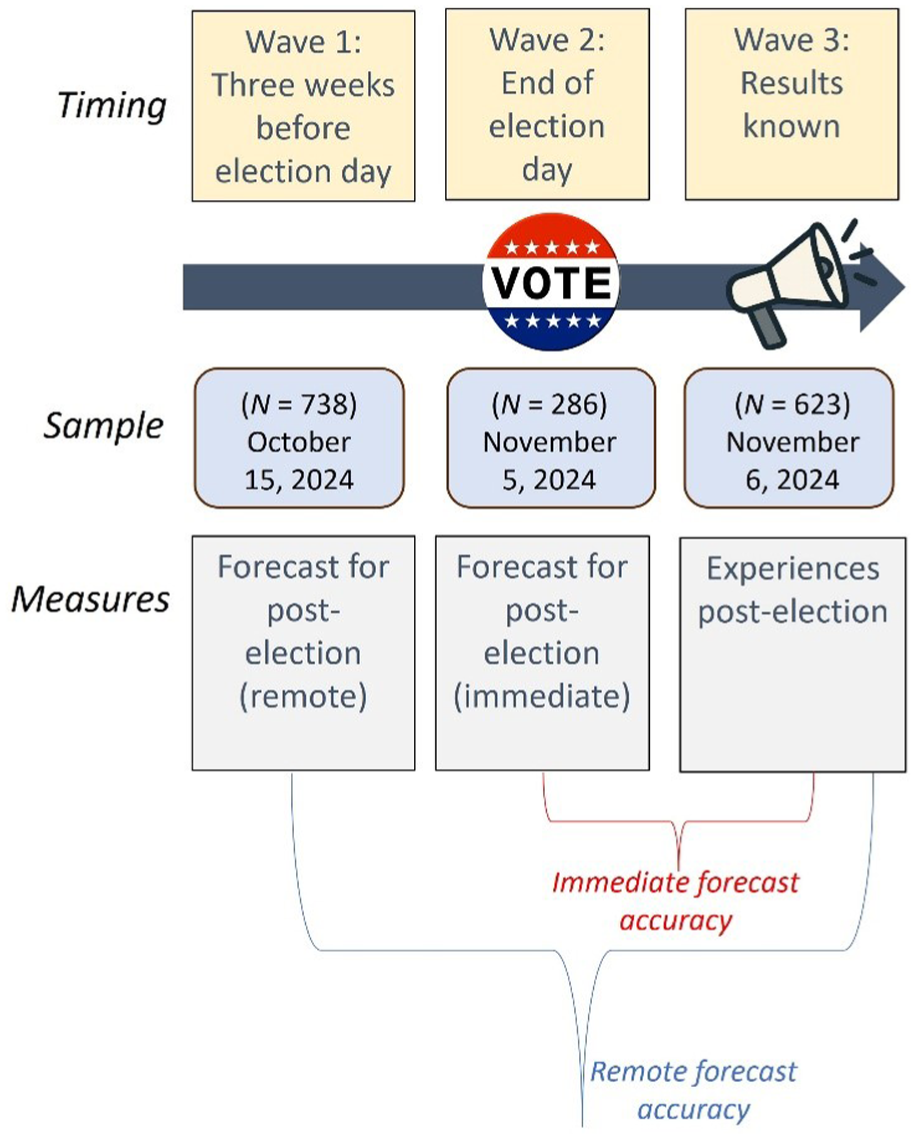
Study design and sample size
Measures
Psychological forecasts: At Waves 1 and 2, participants thought about their life if either the Democratic or, separately, the Republican candidate were to win and were instructed to make forecasts regarding their affect and trait well-being (life satisfaction, and meaning in life), self-views, (optimism, personal control beliefs, and self-esteem), and worldviews (cynicism, disrespect, and institutional trust). The order in which the forecasts were collected regarding the Democratic vs. Republican victory was counterbalanced.
Psychological experiences: At Wave 3, participants completed the same scales indicating their present experiences. These measures were included in Waves 1 and 2 as well, but these data are not analyzed for the purpose of this research. The origin of measures, item wording, and scale reliabilities are given in Table 1.
Overview of Measures.

Partisan Winner/Loser Status
We used two measures (separately) to operationalize partisan status: voting behavior and political ideology. We used participants’ voting behavior collected at Wave 3 (after election results were announced) where participants indicated whether they had voted (yes vs. no) and, if yes (96% of the sample), which presidential candidate they voted for: Harris, Trump, or a third-party candidate. We recoded the responses such that 1 = supported the winning candidate (voted for Trump), 0 = supported the losing candidate (voted for Harris or a third-party candidate). To measure political ideology, we used the following item: “How would you describe yourself politically? (1 = extremely liberal, 10 = extremely conservative)” (included in Wave 1). Given the election outcome, higher values can be considered stronger support for the winning candidate.
At the end, participants provided basic socio-demographic information, completed a conspiracy mentality questionnaire, and measured their interest in politics. These measures were not intended to be used in the present investigation, as indicated in the preregistration.
Results
Descriptive Statistics
Table 2 presents zero-order correlations among forecasts made at Wave 1 (remote forecasts) and Wave 2 (immediate forecasts) as well as Wave 3 experiences. For all variables, both forecasts were strongly associated with reported experiences. While this pattern points to some forecast accuracy, it does not, however, preclude forecast errors. Next, we consider the forecast-experience gap (i.e., forecast error) within subjects and examine whether it depended on partisan status.
Correlations Between Forecasts and Experiences.

Note. All correlations are significant with p < .001.
Forecast Errors
We compared forecasts for Wave 3 experiences that were obtained at Waves 1 and 2 with the experiences participants reported in Wave 3 using mixed-effects (also known as multi-level) regression model with random intercepts for participants. The model included judgment type as a within-subjects factor with three levels (remote forecast vs. immediate forecast vs. experience), partisan status as a between-subjects factor with two levels (partisan winner vs. partisan loser), and their interaction. A significant interaction will suggest that the forecast error (i.e., forecast-experience gap) differs by partisan winner/loser status. We used participants’ forecasts regarding the Republican candidate winning, as this was the result of the election. We originally pre-registered to start the analyses with models including only judgment type as predictor and add its interaction with the partisan status in the next step, but later realized that leaving out partisan status makes the results uninterpretable. Analyses were conducted for each outcome separately and outcomes were standardized before analyses.
The results revealed a significant effect of judgment type × partisan status interaction for all outcomes, except for search for meaning. This finding suggests that the forecast error depended on partisan winner/loser status. Table 3 shows the results of the omnibus test for the interactions. We then evaluated the direction and magnitude of the forecast error (i.e., forecast-experience gap) using pairwise comparisons with Tuckey adjustment among partisan losers and winners separately. The results of the pairwise comparisons are shown in Table 4. Finally, Figure 2 plots the average forecasts and experiences by partisan status.
Mixed-Effects Regression Models, Omnibus Tests.

Note. Judgment type: remote forecast vs. immediate forecast vs. experience (reference category); Partisan status: partisan winner vs. loser (reference category).
Mixed-Effects Regression Results, Pairwise Comparisons.

Note.β refers to a difference (in standard deviations) between experience and immediate forecast, experience and remote forecast, or immediate and remote forecast. For example, β = .61 (partisan losers, experience vs. immediate forecast column) indicates that after the election was called (Wave 3), partisan losers experienced .61 SD higher positive affect than they had predicted after having voted (Wave 2).

Psychological forecasts and experiences in Republican (partisan winners) vs. Democratic and third-party (partisan losers) voters. Panel (A) Psychological well-being. Panel (B) Self-views. Panel (C) Worldviews.
Partisan Losers
For partisan losers, the results were similar across all outcome variables. Democratic supporters believed that they would experience lower meaning, less life satisfaction, less positive affect, and more negative affect if Trump were to win the election than they in fact reported after Trump’s victory was announced. Likewise, Democratic supporters expected to be exposed to more disrespect as well to become more cynical and less trusting of institutions if Trump were to win than they actually reported following the election results. With respect to self-views, Democratic supporters underestimated their optimism, self-esteem, and personal control in the case of Trump’s victory. These forecasting errors were similarly observed in both remote forecasts (3 weeks prior to the election) and immediate forecasts (1 day before) – partisan losers were subject to an impact bias regardless of the temporal distance between the forecast and experience. One exception was institutional trust, where the forecast error was somewhat smaller for the immediate than the remote forecast. In sum, for partisan losers, we observed an impact bias not only for predictions of affective states, but also for predictions of trait well-being, self-views and worldviews.
Partisan Winners
For partisan winners, the forecast error was comparatively small or did not emerge at all (Figure 2). Republican supporters overestimated their post-election life satisfaction, positive affect, and optimism (compared to post-election experiences), but only when the forecast was made right before the election results were announced (immediate forecast). Republican supporters also predicted greater post-election institutional trust (compared to what they subsequently reported) with both immediate and remote forecasts. These participants expected higher post-election self-esteem than they actually experienced, regardless of the temporal distance between the forecast and event.
In contrast, for meaning in life and personal control, partisan winners made an underestimation error: they underestimated how much meaning in life and personal control they would experience if Trump were to win, but only when making the forecast 3 weeks (and not 1 day) before the election results were called. Finally, for negative affect, disrespect, and cynicism, we did not observe a significant forecast-experience gap, meaning that partisan winners made accurate forecasts with respect to these outcomes. In sum, for partisan winners, the impact bias did not consistently emerge for either affect, trait well-being or self- and worldviews.
Excluding Third-Party Voters
In the main analyses, individuals who voted for third-party candidates were grouped with Harris voters to form the category of partisan losers. Because third-party voters were likely aware of their extremely low chances of electoral success, the forecasting context for these voters may differ from that of major-party voters. However, given that only 1.8% participants voted for third-party candidates – an insufficient number to form a separate comparison group – we reran the main analyses excluding these voters. The results were substantively identical and are reported in Tables S3–S4 and Figure S2.
Political Ideology as an Alternative Indicator of Partisan Status
We repeated the analyses using political ideology as an alternative indicator of partisan status. Besides being available for the entire sample (both voters and non-voters), this measure has the advantage of containing no missing values from attrition, as it was collected in Wave 1. Political ideology and partisan winner (vs. loser) status showed a strong positive correlation (r = .80, p < .001), thereby justifying their use as alternative indicators of partisan status. Analyses using political ideology as an indicator of partisan winner (vs. loser) status provided the same pattern of results as analyses presented above. The results are shown in Tables S1–S2 and in Figure S1.
Discussion
Trying to foresee the future is an integral characteristic of being a human. People often try to predict how major events will affect them, both emotionally and in terms of more enduring traits (Szpunar et al., 2014). This effort is warranted, as research shows that people do change in response to life and global events (e.g., unemployment, terrorist attack, hurricane) (Bühler et al., 2024; Denissen et al., 2019; Stavrova et al., 2022; Wundrack et al., 2021). Here, we explored the accuracy of such predictions. Making use of the 2024 U.S. presidential election, we examined how accurately people predicted their affective states, as well as various aspects of their trait psychological well-being (life satisfaction, meaning in life), self-views (optimism, self-esteem, personal control), and worldviews (cynicism, disrespect and institutional trust) in response to electoral defeat vs. victory.
Forecasting Accuracy of Psychological Well-Being
We found evidence for an impact bias among partisan losers across several domains of well-being, including forecasts of fleeting well-being components (affect) as well as more enduring ones (meaning in life and life satisfaction). By contrast, we did not find convincing evidence for an impact bias in partisan winners, consistent with past studies of affective forecasts for positive events (Barber et al., 2023; Gilbert et al., 1998; Norris et al., 2011). While partisan winners overestimated positive affect and life satisfaction (but only with immediate forecasts), they made accurate forecasts of negative affect and underestimated meaning in life (but only with remote forecasts). These findings suggest that the impact bias of positive events might depend on the dimension of well-being as well as the temporal distance between the forecast and event.
Forecasting Accuracy of Self- and Worldviews
As people are motivated by self-consistency and self-continuity, and notice change more readily in others than in themselves (Eibach et al., 2003; Festinger, 1957; Puklavec et al., 2026; Sedikides et al., 2023), we proposed that with respect to self-views, people would underestimate the election impact, whereas for worldviews (i.e., views of others), they would overestimate it. The results did not support this notion. Partisan losers consistently overestimated how the election results would affect both their self- and worldviews. They expected their self-esteem, optimism, and sense of personal control to be harmed more by the defeat than was ultimately the case. Likewise, they anticipated becoming more cynical, less trusting of institutions, and experiencing more disrespect than they actually did following the electoral loss. This pattern stands in contrast to forecasting errors in partisan winners, which were rather minor in size and inconsistent in direction – echoing the pattern observed in forecasts of affective states.
Contributions, Limitations, and Implications
Existing research on how people forecast change in response to important events has been restricted to forecasts of affective states, showing that people often overestimate events’ emotional impact. What has remained unclear is whether people believe that major geopolitical events will alter more enduring aspects of the self, such as trait well-being, self-views, and worldviews. Theories of self-continuity and self-consistency motivation suggest that individuals would not expect excessive changes in these domains. Contrary to this expectation, however, individuals overestimated how much an electoral loss would shape their views of the self and the world. These findings are theoretically significant because they bring the affective forecasting literature into direct tension with theories emphasizing self-stability and indicate that forecasting mechanisms may override assumptions of self-continuity when individuals anticipate psychologically consequential political events.
Despite the general support for the affective forecasting theories, the present results also challenge them by uncovering instances in which the opposite of the impact bias emerged. Specifically, we observed two instances where people underestimated the event’s impact. Trump supporters underestimated how much meaning and personal control the victory would give them. These results add to the literature on how people underestimate the psychological impact of future events (Dunn et al., 2007; Lench et al., 2011) and to the research indicating that people often hold inaccurate lay theories about what will enhance or diminish their sense of meaning (Mead & Williams, 2022).
It remains unclear why people sometimes overestimate the impact of events and at other times underestimate it. One possible explanation lies in lay theories or normative beliefs about event impact. For instance, politics is rarely perceived as a source of personal control or meaning in life (O’Connor & Chamberlain, 1996; Scheffold et al., 2014), which may have led partisan winners to underestimate the extent to which Trump’s victory would enhance their sense of meaning and control. Another approach is to examine how cognitive and motivational processes, such as selective attention, self-enhancement, and defensive pessimism, influence people’s forecasts and, in turn, the extent to which these forecasts align with subsequent reality.
Another unexpected pattern we observed pertains to the role of temporal distance between forecasts and events – an aspect of forecasting that has received little attention in forecasting research (for an exception, see Finkenauer et al., 2007). For most outcomes, forecasts made closer in time to the event (i.e., immediate forecasts) were no more accurate than more distant forecasts. Given the low response rate at Wave 2 (when immediate forecasts were collected), we examined whether differential attrition or low statistical power could account for the findings. Participants who skipped Wave 2 did not differ from completers on political preferences, voting, socio-demographics, or forecasts, except that they were younger (Table S8). Because controlling for age did not change the results (Tables S5–S6 and Figure S3), differential attrition is unlikely to explain the lack of greater accuracy in immediate compared to remote forecasts. The average effect size for the difference between immediate and remote forecasts was small (β = .064), and a G*Power analysis for a two-tailed paired t test (α = .05) indicated that it would not have reached significance even if all Wave 1 participants had completed Wave 2 (power ≈ 50%), which speaks against the low power explanation.
Beyond showing that forecasting errors usually observed with affective forecasts extend to forecasts of more enduring characteristics, our study makes an additional contribution to the affective forecasting literature. Specifically, our study took place in the context of a Republican victory. Most existing affective forecasting studies have focused on the 2008 and 2020 presidential elections – both resulting in Democratic victories – with the exception being a 2004 gubernatorial election (Gilbert et al., 1998). These studies documented an impact bias for partisan losers who support the Republican Party (Barber et al., 2023; Frank et al., 2024; Levine et al., 2012; Norris et al., 2011). We showed that the impact bias with respect to affect extends to partisan losers who support the Democratic Party, addressing the confound between partisan loser/winner status and political ideology in most prior research, and indicating that immune neglect operates consistently across the political spectrum.
Could the forecasting error in our results represent a method artifact? Prior research suggests that impact bias may occur because people misinterpret forecasting questions as asking how they would feel about a candidate winning, rather than how they would feel after a candidate wins (Levine et al., 2012). As a result, their forecasts might reflect satisfaction with the result rather than their overall affect, whereas later they are asked to report their feelings in general, not specifically about the election results. While such a misunderstanding is plausible with respect to affect, affect was only one of the outcomes we focused on. It seems unlikely that participants would misinterpret questions asking them to predict their future worldviews and self-views as questions about their future satisfaction with the election results.
It is also important to note that most (96%) of our participants voted, which is higher than the voter turnout in this election (65.3%) (Census, 2024). It is possible that voters have a higher interest in politics and attribute a higher importance to election outcomes. That could have increased forecasting errors in our sample and suggests the need to replicate our findings in a sample of non-voters. Likewise, the present study studied psychological forecast accuracy in a bipartisan political system, which raises the question of generalizability to other political landscapes (e.g., multi-party systems) and cultural contexts. Last, although forecasting has often been studied in electoral contexts, it remains unclear whether people make similar psychological forecasting errors when anticipating the impact of other personal and global events.
Finally, our findings might carry practical implications. Specifically, they suggest that the self-views are more resilient to external events than people anticipate, that worldviews are more stable than laypeople expect, and that democratic turnover does not undermine individuals’ enduring psychological traits to the extent they fear. This knowledge may help temper pre-election political catastrophizing and support democratic stability.
Supplemental Material
sj-docx-1-spp-10.1177_19485506261445321 – Supplemental material for Psychological Forecasting in the 2024 U.S. Presidential Election
Supplemental material, sj-docx-1-spp-10.1177_19485506261445321 for Psychological Forecasting in the 2024 U.S. Presidential Election by Olga Stavrova, Dongning Ren, Sangmin Kim and Kathleen D. Vohs in Social Psychological and Personality Science
Footnotes
Handling Editor: Danny Osborne

Funding
The authors received no financial support for the research, authorship, and/or publication of this article.
Declaration of Conflicting Interests
The authors declared no potential conflicts of interest with respect to the research, authorship, and/or publication of this article.
Supplemental Material
The supplemental material is available in the online version of the article.
Notes
Author Biographies
References
Supplementary Material
Please find the following supplemental material available below.
For Open Access articles published under a Creative Commons License, all supplemental material carries the same license as the article it is associated with.
For non-Open Access articles published, all supplemental material carries a non-exclusive license, and permission requests for re-use of supplemental material or any part of supplemental material shall be sent directly to the copyright owner as specified in the copyright notice associated with the article.
