




Abstract
Having difficult conversations is a cornerstone of healthy relationships, yet people are often reluctant to initiate them. We propose that chatbots, with their remarkable ability to emulate human communication, can be harnessed to help people prepare for difficult conversations. In a pre-registered study (N = 1,371), participants who briefly prepared for a difficult conversation with a chatbot were significantly more likely to initiate that conversation in real life over the following week, compared to those in a control condition. This effect was partly driven by participants anticipating that the conversation would go better after discussing it with a chatbot. Our findings indicate that when deployed thoughtfully, chatbots can influence consequential real-world behaviour within existing social relationships.
Recent advancements in artificial intelligence (AI) have revolutionised human society, transforming not only how we work, problem-solve, and innovate, but also how we connect socially. The remarkable ability of AI to emulate human interaction has resulted in the rapid proliferation of social chatbots, which currently have hundreds of millions of users around the world (e.g., Inzlicht et al., 2024). An emerging body of literature provides mixed evidence about the social consequences of interacting with AI. Although brief social interactions with chatbots can enhance short-term feelings of social connection (e.g., De Freitas et al., 2026; Folk et al., 2024), sustained usage predicts increases in long-term loneliness (Folk & Dunn, 2026), raising concerns about whether chatbots may act as alluring but ultimately ineffective social companions. While further research on the risks posed by chatbots is needed, it is also imperative to consider and investigate ways in which this technology can be harnessed to support real human connections. One promising domain where this potential may be realised is in helping people communicate more effectively with one another. In particular, chatbots are poised to address a central stumbling block in human relationships: having difficult conversations.
Effective communication is vital for healthy social relations (e.g., Eğeci & Gençöz, 2006; Gottman et al., 1998; Koerner & Fitzpatrick, 2006; Reis & Shaver, 1988), and an important aspect of this is the ability to navigate difficult conversations. Indeed, conflict avoidance has been linked to a range of negative outcomes, such as dissatisfaction in marriages (Sanford, 2003), lowered adolescent mental health in families (Ubinger et al., 2013), and reduced trust in workplaces (Yang, 2015). Yet, people are often reluctant to have difficult conversations, be it delivering bad news (Tesser & Rosen, 1975), initiating apologies (Schumann, 2018), or confronting others (Cloven & Roloff, 1994). These conversations are also commonly dreaded in workplaces, particularly in professions such as health care that frequently require the transmission of sensitive, high-stakes information (Fallowfield & Jenkins, 2004). This reluctance to engage in discussions could partly result from an affective forecasting error, wherein people overestimate how negatively their conversation partner will react to their honesty (Levine & Cohen, 2018). How can people be better equipped to approach, rather than avoid, these challenging but consequential conversations?
One commonly recommended strategy to prepare for difficult conversations is practice (e.g., Polito, 2013; Priftanji et al., 2020). In a small sample of university students, Stutman and Newell (1990) found that most people reported engaging in some form of practice prior to confrontation, ranging from rehearsing with a friend a week in advance to planning how to initiate the conversation a few minutes beforehand. Participants who were interviewed in the study described several benefits of practice, including reduced anxiety, clearer organisation of thoughts, and a decreased likelihood of omitting key arguments during the conversation (Stutman & Newell, 1990). Despite these suggestive preliminary findings, there is a dearth of research testing the effectiveness of practice or other preparation strategies for difficult conversations. Some organisational interventions, which include sharing advice, role-playing situations, and receiving feedback, have shown lasting benefits for health care workers, such as improved confidence and communication skills (Fallowfield et al., 2002, 2003; Meyer et al., 2009). However, the intensive and lengthy nature of these interventions, which last several days, makes it difficult to ascertain whether brief interventions could have similar impacts. Moreover, there is not a single study testing the impact of preparing for difficult conversations in close relationships, beyond professional contexts.
The purported benefits of preparing for difficult conversations and the capacity of AI to engage in human-like interaction suggest a novel opportunity to use chatbots as practice conversation partners. However, the lack of empirical evidence in this area makes it unclear whether a brief, text-based interaction would meaningfully impact behaviour. It is also possible that people may not view AI as a credible stand-in for real conversation partners. At the same time, a growing literature suggests that chatbots offer distinct advantages that make them promising tools for practising difficult conversations. People often perceive chatbots as uniquely non-judgmental and are more willing to self-disclose to AI than to other humans (e.g., Greer et al., 2019; Lucas et al., 2014), which could help them be candid about their fears surrounding the difficult conversation. Chatbots are also capable of mirroring human conversational tones and dynamically adjusting to user input (e.g., Zhou et al., 2020), which may allow them to approximate the flow of real interaction more closely than traditional role-play exercises. Moreover, large-language models can synthesise massive amounts of information and succinctly present users with advice (e.g., Howe et al., 2023; Zhang, 2023), perhaps improving people’s overall expectations about how well the conversation will go. By offering a realistic yet low-stakes environment for preparation, chatbots may help encourage people to engage in difficult conversations and ultimately strengthen communication in human relationships.
To test this idea, we conducted a pre-registered study in which participants were randomly assigned to either prepare for a difficult conversation or engage in a neutral interaction with a chatbot. We predicted that those who prepared with the chatbot would be more likely to have the conversation compared to those in the control condition. We also predicted that people who prepared would anticipate higher quality conversations, which would mediate the effect of the intervention on interpersonal behaviour.
Method
Transparency and Openness
We pre-registered our hypotheses, methods, sample size, and planned analyses prior to conducting the study. The pre-registration, materials, data, and analysis code are publicly available on OSF at https://tinyurl.com/aidiffco.
Study Design
We conducted a two-part study to test our hypotheses. In Part 1, participants were randomly assigned to either prepare for a difficult conversation with a chatbot or have an unrelated neutral interaction with a chatbot. In the second survey, which was made available to participants starting 5 days after their completion of Part 1, we assessed whether they had engaged in the difficult conversation in the interim period.
Participants
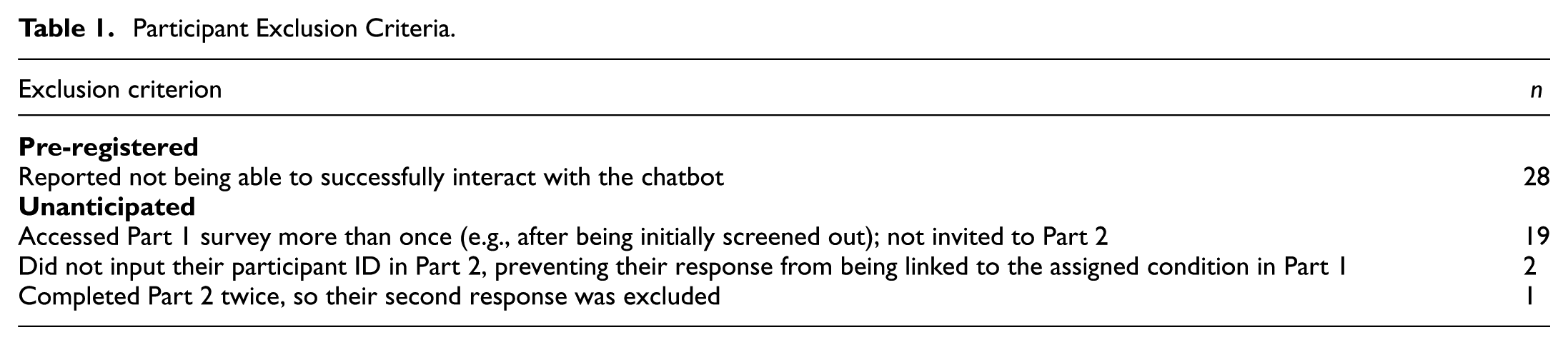
Participants were American and Canadian Prolific Academic workers who had previously completed at least 20 studies on the platform. As pre-registered, we screened out 346 ineligible participants who could not identify a difficult conversation that they were considering having. Of the 1,465 participants who completed Part 1, 1,371 returned for Part 2 (age: M = 38.91, SD = 12.93; 46% men). The rate of return did not significantly differ in the experimental condition (93.45%) and the control condition (93.71%; t(1458.1) = .2, p = .84). See Supplemental Online Material (SOM) for further details on variables that predicted return.
In addition to our pre-registered exclusion criteria, we excluded some participants for unanticipated reasons. Participant exclusion criteria are listed in Table 1.
Participant Exclusion Criteria.
Procedure and Measures
In Part 1 of the study, participants in both conditions were first asked to identify and describe a difficult conversation they were considering having, and then randomly assigned to a preparation or control condition. In the preparation condition, participants spent 6–12 minutes discussing this difficult conversation with a chatbot. In the control condition, participants asked a chatbot three pre-specified factual questions (e.g., ‘What is the capital city of New Zealand?’). Prior to each participant’s interaction, the chatbot was given a condition-specific prompt to guide the conversation, which remained invisible to participants (see SOM for details). The chatbot was powered by OpenAI’s ChatGPT 4o-mini technology, and the study was conducted in April 2025.
Following the manipulation, as pre-registered, participants rated how well they expected the conversation would go on a scale of 1 (Not at all) to 6 (Extremely). They also completed additional exploratory measures about their expectations of the difficult conversation and their current emotions, listed in Table 2.
Key Measures Used in the Study.

Part 2 of the study became available to respondents 5 days following their completion of Part 1 and remained open for 4 days. In this part, we asked participants whether they had the difficult conversation (our pre-registered behavioural outcome measure), reminding them that they would receive compensation regardless of their response, to reduce any motivation to be deceitful. Participants also answered exploratory questions about how the conversation went.
Results
Analyses for the key hypotheses were conducted as pre-registered. We conducted some additional exploratory analyses, labelled accordingly.
Descriptives
Most of the difficult conversations identified by participants in the study were intended for close relationships: approximately 30% for romantic partners, 25% for family members, and 20% for friends. People reported needing to talk about a range of serious matters, such as finances (e.g., confronting someone about their overspending; confessing a need for financial aid) and relationship needs (e.g., desiring more quality time; setting emotional boundaries). Another 20% of conversations were in the professional context, with participants hoping to discuss topics such as a lack of productivity with an employee, ask their boss for a raise, or tell their colleagues about their resignation. The remaining 5% of conversations were directed towards acquaintances of various kinds, from roommates and classmates to one’s gardener or pastor.
Participants in the experimental condition prepared for the conversation by engaging with the chatbot in varied and meaningful ways. Two research assistants independently coded these interactions for the ways in which participants prepared, and they resolved disagreements by discussing them. The research assistants were kept blind to the study aims. We found that 64% of participants planned out what they would say during the conversation (inter-rater reliability: .77), of whom 86% role-played, pretending the chatbot was their conversation partner (inter-rater reliability: .89). Twenty-nine percent of participants treated the chatbot as a source of advice, seeking reassurance or contingency plans, including how to phrase things tactfully, keep the conversation on track, and remain calm and constructive (inter-rater reliability: .72). Thirty-five percent anticipated possible reactions from their conversation partner, including, in at least one case, how to navigate potential tears (‘What if she cries?’; inter-rater reliability: .52). Overall, 87% of participants employed at least one of these coded techniques, demonstrating a willingness to engage seriously with the chatbot as a tool for preparation. We ran exploratory analyses testing whether the use of specific preparation strategies predicted key outcome variables, such as whether participants initiated the difficult conversation, which can be found in the SOM. See also Table S1 of SOM for descriptive information about duration and length of chatbot interactions in each condition.
Pre-Registered Analyses
Anticipated Quality of Conversation
We found that preparing for the conversation with a chatbot led to higher expectations of how well the conversation would go (M = 3.79; SD = 1.33), compared to the control condition (M = 3.63; SD = 1.34; t(1461.30) = 2.30, p = .022, d = .12, 95% CI = [.02, .22]).
Behavioural Outcome: Actual Conversation
In line with our primary prediction, a chi-square test revealed that a significantly higher proportion of participants assigned to prepare for the conversation with a chatbot ended up having the difficult conversation (65%), compared to participants who had a neutral interaction with a chatbot (59%; χ2 (1, N = 1,371) = 5.49, p = .019, φ = .06).
Mediation Analysis
As pre-registered, we also tested whether the effect of condition on the behavioural outcome was mediated by the anticipated quality of the conversation. Relative to the control, participants in the experimental condition expected that the conversations would go significantly better (b = .12, p = .032), which in turn significantly predicted the likelihood of having the conversation (OR = 1.27, p < .001). The direct effect of condition on the likelihood of having the conversation remained significant even after accounting for anticipated quality (OR = 1.06, p = .022), indicating partial mediation. The indirect effect was small but significant (b = .006, p = .012), suggesting that increased anticipated quality partially explained the effect of chatbot-aided preparation on behaviour (see Figure 1).

Indirect Effect of Experimental Condition on the Likelihood of Having a Difficult Conversation Through Increased Anticipated Quality of the Conversation.
Exploratory Analyses
Expectations About Conversation
Following the interaction with a chatbot, participants in the preparation condition perceived having the conversation as more important (p < .001). Preparing did not significantly impact perceptions of how difficult it would be to have the conversation or how anxious participants felt about it (see Table 3).
Effect of Condition on Expectations About the Conversation and Affect (All Exploratory).

Affect
We further tested for differences in affect following the manipulation. Although positive affect did not differ between conditions, participants reported feeling significantly more negative affect after discussing the difficult conversation than after having the control interaction with the chatbot (p = .005; see Table 3). This spike in negative affect likely occurred because participants in the experimental condition seriously considered having the difficult conversation.
Additional Mediation Model
We ran mediation analyses to explore whether perceived importance and anticipated quality of the conversation, as well as negative affect following the manipulation, mediated the relationship between preparation and the likelihood of having the conversation. We found that the effect of condition on the likelihood of having the difficult conversation was significantly mediated by anticipated quality (b = .005, p = .014) and perceived importance of the conversation (b = .02, p < .001). However, negative affect also significantly suppressed this relationship, making people who prepared with the chatbot less likely to have the conversation in real life (b = -.006, p = .012; see Table S2 in SOM).
Experiences of Conversation
Chatbots display high levels of sycophancy (e.g., Sharma et al., 2025) and tend to communicate in a tone that is more upbeat and empathetic than humans (e.g., Ayers et al., 2023). As such, it is possible that preparing with a chatbot could ‘backfire’ by creating false expectations for the conversation to go extremely well. However, we found that among participants who went through with the difficult conversation (N = 853), those who had prepared with a chatbot were similarly satisfied with this conversation as those in the control condition. There were also no significant differences in their perceptions of the quality, difficulty, or thoroughness of the conversation (p-values ranging from .155 to .816; see Table S3 in SOM).
Discussion
This study offers empirical evidence that AI can be harnessed to facilitate difficult conversations, potentially supporting human relationships. Participants who prepared for a difficult conversation with a chatbot were significantly more likely to initiate that conversation in real life, relative to those who had a neutral interaction with a chatbot. This effect was partly driven by an increase in the anticipated quality of the difficult conversation following preparation. Addressing interpersonal issues, such as admitting financial concerns to your partner, or setting emotional boundaries with a friend, is critical for maintaining healthy relationships (e.g., Gottman et al., 1998; Koerner & Fitzpatrick, 2006), yet people often struggle to initiate these conversations (e.g., Cloven & Roloff, 1994; Tesser & Rosen, 1975). Our findings indicate that with only a brief and simple intervention, chatbots can influence consequential real-world behaviour within existing social relationships.
While past research has hinted that practising difficult conversations may have benefits (e.g., Stutman & Newell, 1990), the present study offers the first direct causal evidence that such preparation can make people more likely to go through with these conversations. While the 6-percentage point difference in initiating the difficult conversation between the preparation (65%) and control conditions (59%) may appear modest, it indicates that if this intervention were provided to 1,000 people, about 60 additional difficult conversations would be expected to take place. Moreover, most participants in our study (81%) identified a conversation that they needed to have, suggesting that difficult conversations are very common. Thus, this otherwise modest effect may be far more consequential when scaled across the broader population.
It is conceivable that other ways of preparing for a difficult conversation could be more effective than interacting with AI – in particular, turning to a friend or therapist who can offer tailored feedback and support. Yet, not everyone has access to such social resources, and people may actually find it easier to discuss sensitive issues with an anonymous, non-judgmental chatbot (e.g., Skjuve et al., 2021). Interacting with AI may also be more appealing than journaling, a common low-tech alternative form of preparation. Indeed, in a supplementary study, we recruited a new sample of 200 participants on Prolific and found that 76% of participants chose to prepare for a difficult conversation by interacting with a chatbot instead of by journaling (see SOM for details). This preference suggests that self-directed reflection may feel more effortful and aversive, and that people may gravitate towards conversational formats of preparation. Although our research helps establish that people can use chatbots to prepare for difficult conversations, it remains limited in being unable to compare the relative efficacy of different methods. Future research should explore when and for whom different forms of preparation, such as chatbot interactions, human interactions, or journaling, are most effective and appealing.
It is also worth noting that experimental and control conditions in this study differed in how long participants interacted with the chatbot and how the chatbot was prompted to respond to participants. While designing the control condition, our priority was not to match the duration of and engagement in the conversation with the chatbot, as we did not see a plausible psychological mechanism through which having a long but unrelated discussion with a chatbot would lead people to initiate a difficult conversation with someone. Importantly, participants in both conditions identified, described, and considered the importance of the difficult conversation, which allows us to isolate the impact of preparing with a chatbot on the likelihood of initiating the conversation.
In addition, our sample was limited to participants from Canada and the US, and our results may not be generalizable beyond this population. Recent research has found that East Asians anticipate enjoying an interaction with a social chatbot more than North Americans, mediated by increased anthropomorphism of technology (Folk et al., 2025). This suggests that the benefits of practising difficult conversations with chatbots may be magnified in East Asian cultures. Conversely, people in other cultural contexts may have lower baseline familiarity with chatbots, which may provoke discomfort and undermine the effect of the intervention. Future research should study people from cultures that vary on these dimensions and measure individual-level attitudes towards and familiarity with AI.
Future research in this area can also explore how chatbot design shapes their effectiveness in preparing people for difficult conversations. On one hand, our findings indicate that increases in negative emotion after preparation were linked to a lower likelihood of initiating the conversation, implying that a warm and affirming chatbot may help buffer against this effect. On the other hand, a more realistic and grounded practice interaction might better prepare users by setting realistic expectations for how the conversation will unfold in real life. Existing AI tools tend to be sycophantic, using a largely positive and supportive tone (e.g., Ayers et al., 2023; Sharma et al., 2025), which suggests that participants in our study who prepared with the chatbot may have been set up for disappointment when they interacted with their human partner. However, we found no evidence for this ‘backfire’ effect, as there were no significant differences in participants’ actual experiences of the conversation between conditions. That said, future research could potentially identify how to enhance the intervention to not only increase people’s willingness to have difficult conversations, but also to improve the quality of these conversations when they occur. It is also possible that participants in our study who were assigned to prepare with a chatbot were inspired to continue preparing for the conversation in the following days, with a chatbot or in other ways. This could have been one of the mechanisms through which the intervention was successful, and research in this area could also examine whether there are accruing benefits to multiple rounds of preparation.
This foundational work also opens the door to testing this effect in specific contexts, such as workplace training, where this intervention could be scaled up to help users prepare for challenging professional interactions. Looking ahead, it will be further important to examine the long-term impact of using chatbots to prepare for conversations. Repeated preparation with the help of a chatbot may boost individuals’ confidence and enhance their communication style, ultimately improving their ability to handle real-life interactions. However, frequent reliance on a chatbot as a rehearsal partner may come at a cost, potentially diminishing individuals’ capacity for self-directed reflection or making them hesitant to engage in unscripted, spontaneous conversations without first consulting a digital proxy. Understanding these trade-offs will be critical as chatbots become more integrated into our everyday social lives.
Technological advancements often act as a double-edged sword for human connection. While smartphones allowed people to interact with others from all around the world, they also inhibited face-to-face social engagement (e.g., Dwyer et al., 2018; Kushlev et al., 2019). Likewise, AI has been simultaneously lauded as a new source of social connection and feared as the gateway to social erosion. Our findings indicate that when thoughtfully deployed, AI may support human relationships rather than replacing them, by serving as a bridge that helps people prepare for difficult conversations. Identifying the possibilities and boundaries of this technology in our social lives continues to be an important avenue for future work.
Supplemental Material
sj-docx-1-spp-10.1177_19485506261444068 – Supplemental material for Harnessing Artificial Intelligence to Facilitate Difficult Conversations
Supplemental material, sj-docx-1-spp-10.1177_19485506261444068 for Harnessing Artificial Intelligence to Facilitate Difficult Conversations by Charul Maheshka, Dunigan Folk and Elizabeth Dunn in Social Psychological and Personality Science
Footnotes
Handling Editor: Yuthika Girme

Funding
The authors disclosed receipt of the following financial support for the research, authorship, and/or publication of this article: This research was funded by Social Sciences and Humanities Research Council of Canada Grant F23-04301.
Declaration of Conflicting Interests
The authors declared no potential conflicts of interest with respect to the research, authorship, and/or publication of this article.
Supplemental Material
The supplemental material is available in the online version of the article.
Author Biographies
References
Supplementary Material
Please find the following supplemental material available below.
For Open Access articles published under a Creative Commons License, all supplemental material carries the same license as the article it is associated with.
For non-Open Access articles published, all supplemental material carries a non-exclusive license, and permission requests for re-use of supplemental material or any part of supplemental material shall be sent directly to the copyright owner as specified in the copyright notice associated with the article.
