



Abstract
Trait self-control is often equated with resistance, leaving open whether it also involves domain-general conflict minimization and the strategic indulgence of low-conflict desires. We reanalyzed four ambulatory assessment datasets (N = 559 participants with 32,049 measurement occasions) to test whether these mechanisms explain the well-being benefits of trait self-control. Results showed that individuals high in self-control experienced fewer desire-goal conflicts (conflict minimization) and pursued desires selectively (strategic indulgence), with both conflict minimization and strategic indulgence being associated with significantly better hedonic well-being. These findings challenge the notion of self-control as mere restraint, emphasizing its role in optimizing both goal attainment and well-being by making strategic choices about when it is beneficial to indulge in desires without undermining long-term goals. Future research should examine whether these strategies are intentional or byproducts of effective planning.
Many people aim to stay healthy, succeed at work, and build strong relationships. A robust predictor of these outcomes is trait self-control (TSC; de Ridder et al., 2012). Traditionally, TSC has been defined as the capacity to regulate thoughts, emotions, and behavior in line with long-term goals, often by overriding short-term desires to secure larger future rewards (Tangney et al., 2004). More recent theories sharpen this view by emphasizing that self-control problems arise specifically when desires conflict with goals (Kotabe & Hofmann, 2015). For example, a student may want to go out with friends but also needs to rest before an exam. In that moment, self-control involves prioritizing rest over immediate social enjoyment. Crucially, conflict is not constant: when academic demands are low, socializing may pose little threat to long-term goals and can even support well-being and other valued aims (Jia, Hirt, & Nowak, 2019; Khoo et al., 2024). This observation implies that effective self-control cannot be understood solely in terms of resisting desires, but must also account for when desire enactment is adaptive rather than detrimental.
This distinction matters because it yields different, testable predictions about daily desire enactment and affect. The classic view centers on inhibiting impulses when they interfere with long-term objectives. The conflict-based view suggests a more selective and context-dependent strategy: people high in TSC may not only resist desires when necessary, but also recognize when indulgence is safe and beneficial. Despite extensive theorizing, two issues remain unresolved. First, most research has treated self-control primarily as resistance or avoidance, leaving open whether high-TSC individuals differ in when they enact desires. Second, many studies focus on specific domains (e.g., eating, studying), limiting insight into whether TSC predicts domain-general patterns of desire regulation in everyday life. The present work directly addresses both limitations by examining desire enactment as a function of momentary conflict across diverse everyday contexts rather than within isolated behavioral domains.
This strategic perspective aligns with Duckworth’s notion of strategic self-control, which emphasizes proactively shaping situations, so conflicts are less likely to occur (Duckworth et al., 2016). Rather than relying on effortful, in-the-moment inhibition, high-TSC individuals may anticipate future conflicts and plan ahead—choosing environments, timing activities, and sequencing goals to reduce anticipated clashes. This implies foresight: using experience and contextual cues to judge whether a desire will interfere with other goals and adjusting behavior accordingly. Our contribution is to extend this strategic account from conflict avoidance to the timing of indulgence itself, a component that has received less empirical attention.
In principle, optimal self-regulation involves selectively engaging in hedonic pursuits when conflict is low and resisting desires when conflict is high. Such selectivity can protect long-term goals while also improving immediate well-being, because conflict can trigger intrusive thoughts that dampen enjoyment (Bernecker & Becker, 2021) and increase guilt after indulgence (Becker et al., 2019; Hofmann et al., 2013). Yet it remains unclear whether people high in TSC actually show this adaptive pattern in daily life, indulging more when conflict is low and refraining more when conflict is high. Although laboratory work suggests strategic indulgence and reward planning can support long-term success (Coelho do Vale et al., 2008; Jia, Hirt, & Koh, 2019), these processes have rarely been examined in naturalistic settings or tested alongside conflict minimization.
To address these gaps, we reanalyzed four ambulatory assessment datasets to examine how TSC relates to everyday goal pursuit. We hypothesized that high-TSC individuals manage the timing and context of hedonic versus instrumental goal pursuit more effectively, contributing to better hedonic well-being. By focusing on generic desires and goals, our approach provides a domain-general test of whether TSC predicts broad patterns of desire management, beyond isolated behaviors in specific contexts. This multi-dataset, domain-general ambulatory approach allows us to test whether strategic self-control manifests as systematic selectivity in desire enactment across daily life, rather than as isolated acts of resistance.
TSC and Conflict Minimization
TSC predicts success in work, health, and relationships even after accounting for factors such as intelligence and socioeconomic status (Cobb-Clark et al., 2022; de Ridder et al., 2012). It is also positively associated with hedonic well-being (Hofmann et al., 2014; Wenzel et al., 2021). But why are high-TSC individuals so successful and, on average, happier in daily life?
A common view portrays high-TSC people as unusually disciplined “resistors” who reliably inhibit temptations and align behavior with goals or values (Duckworth & Kern, 2011; Hofmann et al., 2009), sometimes even implying a rigid, joyless style (Lapka et al., 2023). However, this picture has been challenged. In one study, individuals higher in TSC consumed more unhealthy snacks after exerting self-control in a prior task (Imhoff et al., 2014). More importantly, ambulatory assessment work suggests that high-TSC individuals are not necessarily better at resisting desires in the moment (Hofmann et al., 2012). Instead, they report fewer desire–goal conflicts across everyday situations. We refer to this pattern as conflict minimization, 1 and prior evidence indicates it is linked to better hedonic well-being (Hofmann et al., 2014). This implies that TSC may operate less through exceptional willpower when conflict is high but more through experiencing fewer, weaker conflicts—making goal pursuit feel easier and less aversive.
The idea that higher TSC is associated with lower desire–goal conflict is supported by a growing body of research. Studies consistently show that high-TSC individuals experience weaker and less frequent conflicts (de Ridder et al., 2012; Gillebaart et al., 2016; Hofmann et al., 2012). Mouse-tracking work further suggests process-level differences: high-TSC individuals appear to detect and resolve conflicts earlier, showing less pull toward tempting options and faster resolution (Gillebaart et al., 2016; Stillman et al., 2017), consistent with reduced conflict during decision-making rather than merely biased retrospective reports.
One explanation for this reduced conflict is that individuals high in TSC actively minimize exposure to tempting situations, for example, by selecting less distracting environments (Ent et al., 2015; Hofmann et al., 2012).Notes 2 Some laboratory and field studies support this idea, showing preferences for distraction-free environments or greater physical distance from temptations, although results have been mixed and sometimes underpowered (Ent et al., 2015; Hennecke et al., 2019; Leduc-Cummings et al., 2022).
Given this mixed evidence, the present study aimed to clarify links between TSC, conflict minimization, and hedonic well-being using ambulatory assessment. This approach captures naturally occurring experiences more directly than many lab paradigms and allows testing whether conflict minimization helps explain the association between TSC and hedonic well-being.
TSC and Strategic Indulgence
The present research also aimed to test a second, novel explanation for why TSC is linked to higher hedonic well-being. Whether TSC is framed as strong willpower or as conflict minimization, both accounts can reinforce the stereotype that high-TSC individuals live with fewer pleasures (Lapka et al., 2023). This perception may persist because people often treat even harmless indulgence as evidence of failing at self-control (Fitouchi et al., 2022). Yet desire enactment can be adaptive: the capacity to enjoy desires, rather than merely suppressing them, has been linked to higher affective well-being (Bernecker & Becker, 2021), and its benefits can be comparable in magnitude to those associated with TSC, suggesting partly independent contributions.
Importantly, pursuing momentary pleasure does not necessarily undermine long-term success. For example, higher-achieving students are not less likely to attend college sporting events; instead, they appear to manage pleasure more strategically, compensating by scheduling more study time on non-game days (Jia, Hirt, & Koh, 2019). This pattern motivates the idea that high-TSC individuals may excel not only at avoiding conflicts but also at choosing when to indulge.
Strategic indulgence (Jia, Hirt, & Koh, 2019) is defined as a higher likelihood of enacting a desire when it poses little or no conflict with personal goals. Critically, this is not impulsive indulgence. It is a self-control–relevant skill that requires (a) monitoring desire–goal compatibility, (b) inhibiting enactment when conflict is high, and (c) permitting enactment when conflict is low. Because monitoring and discrepancy detection are central to control-theoretic models of self-regulation (Carver & Scheier, 1982), individuals high in TSC should be better able to identify low-conflict opportunities and trust that acting on a desire will not derail future goals. By contrast, individuals low in TSC may be less able (or less likely) to monitor conflict and therefore indulge more indiscriminately, including in situations that jeopardize long-term pursuits. Accordingly, we expected higher TSC to predict greater indulgence specifically under low-conflict conditions, supporting the view that high-TSC individuals are not uniformly restrictive but more strategic in balancing enjoyment and goal pursuit.
The assumption that people can anticipate conflict is consistent with self-regulation theories emphasizing continuous monitoring of goal progress and the compatibility of actions with valued goals (Carver & Scheier, 1982). Many desires arise in recurring contexts (e.g., evening leisure, socializing near deadlines), allowing learning about when indulgence is costly versus harmless. Indeed, there is evidence that links TSC to stronger habit formation (van der Weiden et al., 2020). High-TSC individuals may be especially sensitive to regularities, enabling proactive discrimination between low- and high-conflict situations and calibration of desire enactment accordingly.
Strategic indulgence should matter for well-being because the pleasure of desire enactment is often undermined when conflict is high. Intrusive thoughts about competing obligations can reduce enjoyment during the activity (Bernecker & Becker, 2021), and indulging against one’s goals can elicit guilt or shame afterward (Becker et al., 2019). When conflict is low, enjoyment can unfold with fewer cognitive intrusions and less guilt, making indulgence more purely hedonic. Thus, we hypothesized that strategic indulgence contributes to hedonic well-being by maximizing pleasure while minimizing negative self-conscious emotions.
Conceptually, this framework overlaps with goal-balancing and licensing perspectives, which emphasize flexible allocation across goals over time (Fishbach & Dhar, 2005; Khan & Dhar, 2006). However, whereas classic licensing often highlights compensatory indulgence after effort or restraint, our account emphasizes anticipatory regulation: indulging based on expected future conflict rather than past progress. Strategic indulgence, then, represents a forward-looking form of self-control that integrates conflict anticipation, goal balancing, and situational selectivity.
The Present Study
The present study tested whether the association between TSC and hedonic well-being 3 in daily life is explained by two processes: conflict minimization (experiencing weaker desire–goal conflict) and strategic indulgence (enacting desires especially when conflict is low). We hypothesized that higher TSC would predict (Hypothesis 1) weaker desire–goal conflict (cf. Ent et al., 2015) and (Hypothesis 2) a greater likelihood of enacting low-conflict desires. We further expected that (Hypothesis 3) weaker conflict would relate to higher hedonic well-being (replicating Hofmann et al., 2014) and that (Hypothesis 4) strategic indulgence would also relate to higher hedonic well-being. We tested these hypotheses by reanalyzing four ambulatory assessment datasets. By integrating conflict minimization and strategic indulgence within one empirical framework, this study provides a more comprehensive account of how TSC shapes everyday experience and well-being.
Beyond these pairwise links, our central claim is that conflict minimization and strategic indulgence jointly account for the TSC–well-being association. We therefore estimated both indirect effects in a single integrated model. Because mediators and outcomes were measured without temporal separation, these indirect effects reflect statistical mediation and should not be interpreted as causal.
Methods
Transparency and Openness
We confirm that all manipulations and exclusions were reported, but not all measures that were assessed in the original studies were included. We conducted secondary analyses of four ambulatory assessment datasets that were originally collected for different research purposes. More information can be found in the respective publication for Dataset 1 (Rowland et al., 2016), Dataset 2 (Friese & Hofmann, 2016), Dataset 3 (Milyavskaya et al., 2015, Study 4; Milyavskaya & Inzlicht, 2017), and Dataset 4 (Milyavskaya et al., 2021). Given the reanalysis of existing datasets, the sample sizes were not determined by the objectives of this present research. We did pre-register our analyses (https://osf.io/4q8b2/); therefore, they should be considered confirmatory. The data and analysis scripts are available on the Open Science Framework (https://osf.io/6s93v/).
Participants and Procedure
Our coordinated data analysis involved reanalyzing four datasets, for a total of N = 559 participants with 32,049 measurement occasions that were included in the analyses. Participants and procedure details can be found in the referenced studies as well as in the Supplementary Material (https://osf.io/e7k5c/).
Measures
Descriptive statistics are reported in Table 1. To harmonize measures across datasets, we converted each item to the Percent of Maximum Possible (Cohen et al., 1999) by rescaling scores to a 0–100 range; for example, a conflict score of 40 indicates 40% of the maximum possible conflict.
Descriptive Statistics
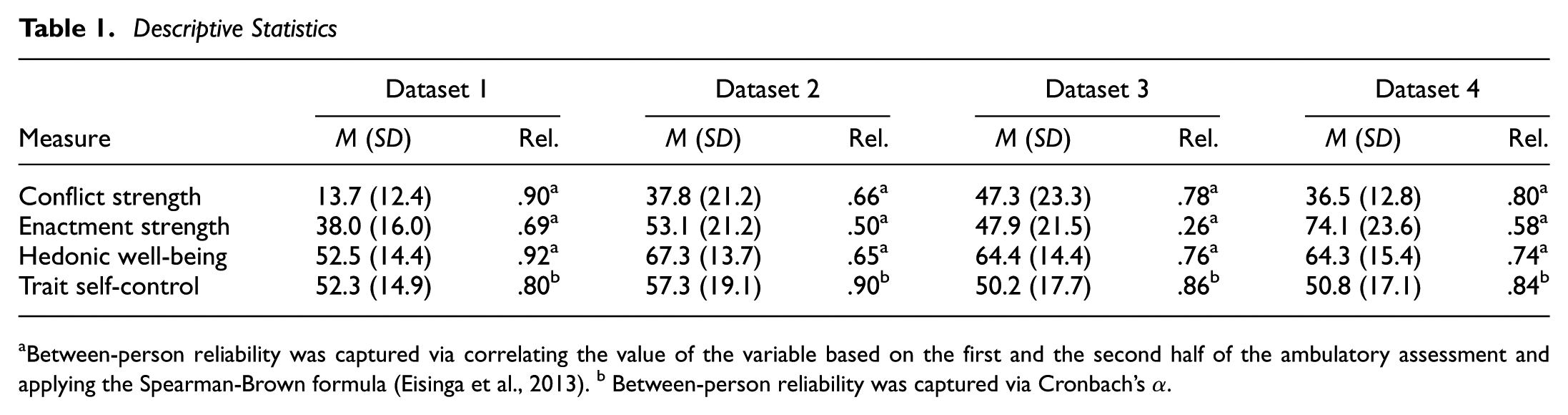
Between-person reliability was captured via correlating the value of the variable based on the first and the second half of the ambulatory assessment and applying the Spearman-Brown formula (Eisinga et al., 2013). b Between-person reliability was captured via Cronbach’s
We then operationalized the two focal processes using momentary reports available in the four ambulatory assessment datasets. Because the datasets did not include dedicated scales, both constructs were derived from reported desire–goal conflict and desire enactment.
Conflict Minimization
Conflict minimization reflects the tendency to experience weaker desire-goal conflicts in daily life. Across datasets, this construct was operationalized using participants’ momentary ratings of desire-goal conflict strength (“To what extent did the desire conflict with a personal goal?”), harmonized across differing response scales. To align the direction of the measure with the conceptual definition, conflict strength scores were reversed so that higher values indicate weaker experienced conflict, reflecting greater conflict minimization. At the between-person level, this variable captures stable individual differences in the typical intensity of desire-goal conflict experienced across the sampling period.
Strategic Indulgence
Strategic indulgence captures the tendency to enact desires selectively when desire–goal conflict is low. Because no dataset included a direct measure, we operationalized it as a within-person association between momentary conflict strength and momentary desire enactment. Specifically, we estimated a person-specific slope indicating how strongly each individual’s enactment increased in moments of weaker conflict, controlling for lagged enactment and lagged conflict strength. This slope was then modeled as a between-person latent variable, capturing stable individual differences in selective enactment, with higher values indicating greater indulgence specifically under low-conflict conditions.
Although strategic indulgence is mathematically related to conflict and enactment, it is not a composite of these variables. Instead, it is a second-order construct capturing the degree to which enactment is contingent on conflict level within persons, conceptually similar to an interaction with the resulting random slope treated as an individual-differences variable. Modeling conflict minimization (overall tendency toward weaker conflict) alongside strategic indulgence (conditional tendency to enact as a function of conflict) therefore represents two complementary, nonredundant regulatory processes. This use of random slopes as stable between-person differences is standard in dynamic structural equation modeling (DSEM; Liu et al., 2021), and while the constructs may correlate, they remain theoretically distinct.
Hedonic Well-Being
Hedonic well-being was indexed via affect balance (Park et al., 2023), defined as the extent to which positive affect (PA) exceeds negative affect (NA). In Dataset 1, PA was the mean of four states (“excited,”“happy,”“relaxed,”“satisfied”), and NA the mean of five (“afraid,”“angry,”“anxious,”“depressed,”“sad”), each rated on a 0–100 visual analogue scale. In Dataset 2, PA was assessed with one item (“happy”) and NA with two (“guilt,”“regret”); affect balance was computed as PA − NA. Datasets 3 and 4 used a single bipolar affect-balance item (Dataset 3: “How happy do you feel at the moment?”; Dataset 4: “What is your mood right now?”), both ranging from −3 to +3.
Trait Self-Control
TSC was assessed at baseline using the German version (Bertrams & Dickhäuser, 2009) of the Brief Self-Control Scale in Dataset 1 and the English original (Tangney et al., 2004) in Dataset 2, 3, and 4. The questionnaire comprises 13 items using a scale ranging from 1 (not at all) to 5 (very much), with higher values reflecting higher levels of TSC.
Analytic Approach
Data were prepared in Stata 19. To account for measurement occasions nested within individuals, we fit two-level models using DSEM in Mplus 8.10 (Asparouhov et al., 2018). DSEM estimates the within-person effect of momentary conflict strength on momentary desire enactment as a person-specific (random) slope and simultaneously models this slope as a between-person indicator of strategic indulgence (Figure 1). This one-step approach accommodates differences in the number of observations per person and avoids treating slopes as perfectly reliable, reducing the risk of underestimated standard errors and inflated Type I error (Liu et al., 2021). Models were estimated with two MCMC chains using the Bayesian estimator (Gibbs sampler), default priors, thinning = 20, and a convergence criterion of PSR ≤ 1.005 (Zitzmann & Hecht, 2019), with a minimum of 2,000 iterations once convergence was achieved. Diagnostics indicated no model misspecification: autocorrelations were low (r < .20 or decayed quickly) and trace plots showed stable mixing.
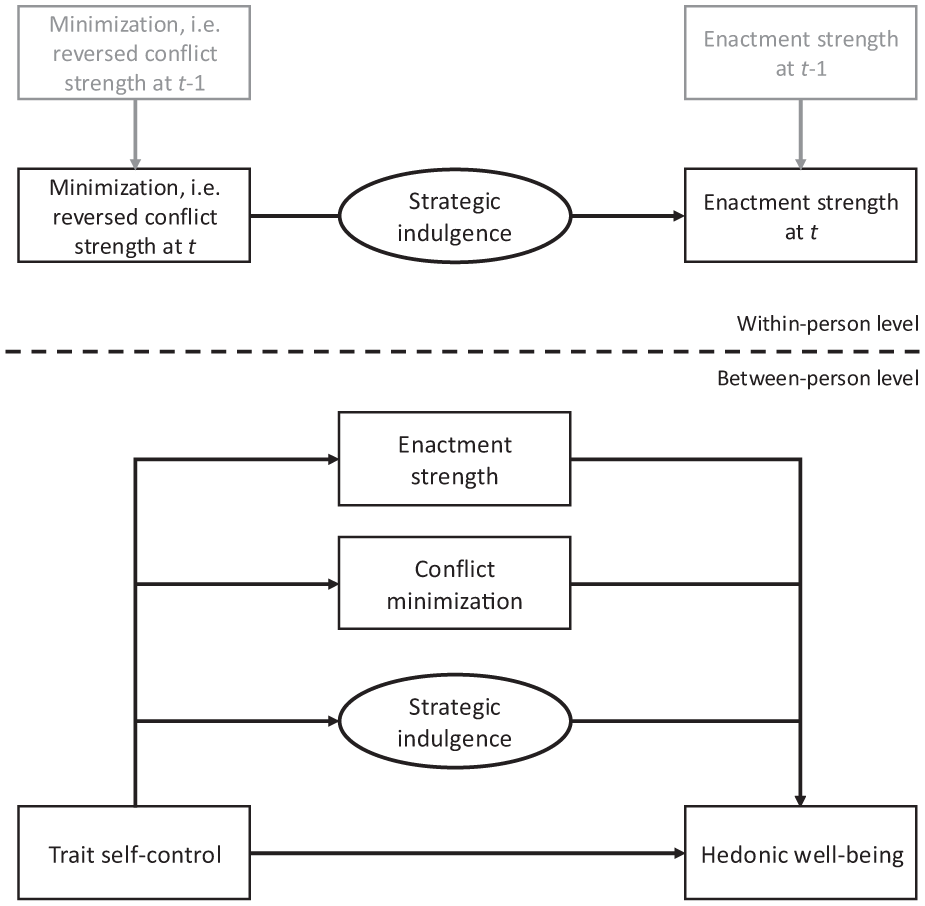
Schematic Path Diagram of the Multilevel Dynamic Structural Equation Model Note. Within-person associations such as the random slope of conflict minimization on enactment used at the between-person level are treated as latent variables in Mplus.
Because our focus was individual differences, we used a mega-analytic approach (Boedhoe et al., 2019), pooling the four datasets to increase the number of participants while controlling for dataset differences. 4 Pooling was justified by the strong similarity in measures and samples. Statistical significance was evaluated at α = .05.
Results
Before hypothesis testing, we examined the baseline association between TSC and hedonic well-being. As shown in Figure 2, TSC was significantly and positively related to hedonic well-being (total effect), conceptually replicating prior findings (Hofmann et al., 2014). We then tested whether conflict minimization and strategic indulgence account for this association.
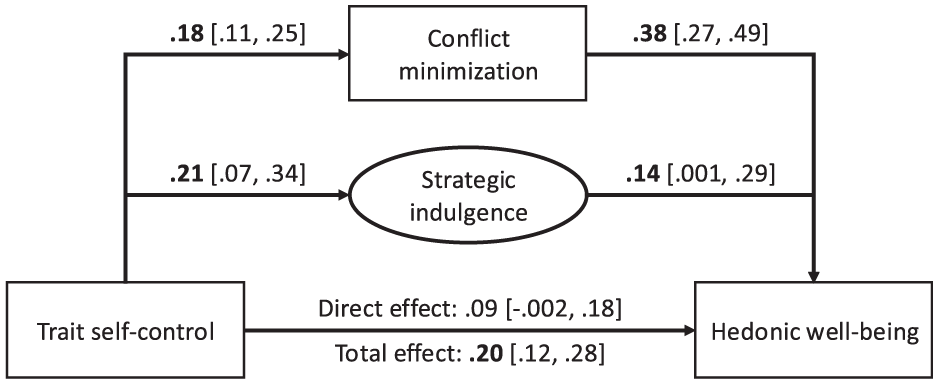
Mediation Model Testing Hypotheses 1–4, Showing the Standardized Coefficients and Their 95% CIs Note. Conflict minimization reflects reversed conflict strength. Strategic indulgence reflects the person-specific association between reversed momentary conflict strength and momentary enactment strength. Enactment strength was also included in the model as a mediator at the between-person level, but is not shown here because it was not relevant to the present research, but was included in the analysis to include all main effects.
Turning to the proposed mechanisms, TSC was significantly related to greater conflict minimization, that is, lower overall conflict strength (Figure 2), supporting Hypothesis 1. TSC was also significantly related to strategic indulgence. To illustrate this pattern, we dichotomized conflict strength (0 = no conflict; 1 = any conflict; original 0 indicated “no conflict at all,” values > 0 were coded as conflict) and ran a moderated mixed regression analysis predicting enactment strength using conflict, TSC, and their interaction. As shown in Figure 3, higher TSC was not significantly associated with reduced enactment of conflicting desires, b = −0.03, 95% CI [−0.16, 0.10], but was associated with greater enactment of non-conflicting desires, b = 0.24, 95% CI [0.10, 0.39]. Together, these results support Hypothesis 2.
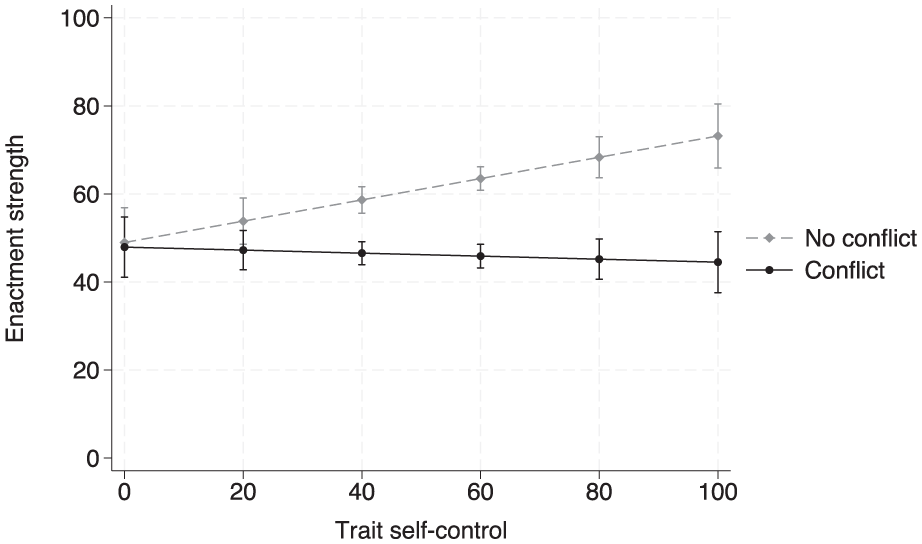
Simple Slope Analysis With 95% CIs of the Moderated Mixed Regression Analysis Predicting Enactment Strength Using Conflict, Trait Self-Control, and Their Interaction
Finally, we tested whether conflict minimization and strategic indulgence were related to hedonic well-being. As shown in Figure 2, conflict minimization was significantly associated with better hedonic well-being, supporting Hypothesis 3: individuals who experienced weaker desire–goal conflict than others reported higher hedonic well-being. This yielded a significant indirect effect of TSC via conflict minimization, b = 0.06, 95% CI [0.03, 0.08]. Strategic indulgence was also significantly associated with better hedonic well-being (Figure 2), supporting Hypothesis 4, with a smaller but significant indirect effect of TSC via strategic indulgence, b = 0.02, 95% CI [0.001, 0.06].
Exploratory within-person analyses showed a similar pattern. Momentary enactment was more strongly linked to higher momentary hedonic well-being when conflict was low, β = .12, 95% CI [.10, .13], than when conflict was high, β = .08, 95% CI [.07, .09], reflected in a significant enactment × conflict interaction, β = −.02, 95% CI [−.03, −.01]. Lower momentary conflict was also associated with higher momentary hedonic well-being, β = −.03, 95% CI [−.03, −.02].
As preregistered, Datasets 1–2 had already been used to explore Hypothesis 2. We therefore estimated the full model in all four datasets and examined Hypothesis 2 in the independent replication datasets separately (Datasets 3–4). In Datasets 1–2, TSC was positively associated with strategic indulgence, β = .32, 95% CI [.13, .48]. In Datasets 3–4, the association was also positive but smaller and not significant, β = .11, 95% CI [−.11, .31]. A likely contributor to this attenuation is the substantially smaller number of observations in the replication datasets (6,633 vs. 24,092), which may reduce the reliability of strategic indulgence as a within-person slope.
Because affect balance can obscure distinct links with PA versus NA, we conducted an exploratory sensitivity analysis in Datasets 1–2 (the only datasets with separate PA and NA measures). Conflict minimization was associated with higher PA, β = .32, 95% CI [.08, .41], and lower NA, β = −.59, 95% CI [−.73, −.44], further supporting Hypothesis 3. Strategic indulgence was associated with lower NA, β = −.31, 95% CI [−.48, −.13], but not higher PA, β = −.12, 95% CI [−.31, .06], providing partial support for Hypothesis 4.
General Discussion
This study examined how TSC supports everyday goal pursuit via two processes: conflict minimization (weaker desire–goal conflict) and strategic indulgence (enacting desires when conflict is low). Pooling four datasets, both processes explained the positive association between TSC and hedonic well-being. Individuals high in TSC experienced weaker conflicts and, when conflicts were weak, were more likely to act on desires. Conflict minimization predicted higher hedonic well-being, more positive affect, and less negative affect. Strategic indulgence predicted higher hedonic well-being and lower negative affect, but not higher positive affect. These findings extend previous work showing that high-TSC individuals not only avoid desires (e.g., Ent et al., 2015) but also permit enjoyable activities when these do not threaten long-term goals (Jia, Hirt, & Nowak, 2019). Importantly, our results provide the first ambulatory assessment evidence that both processes operate simultaneously in daily life and help explain why high-TSC individuals experience greater well-being. By examining generic desires across diverse naturalistic contexts, we address a gap in prior research that has largely focused on domain-specific behaviors or hypothetical scenarios, thereby advancing a more generalizable account of how TSC shapes everyday self-regulation. Because the captured desires were heterogeneous (eating, resting, media use, socializing, work), results reflect broad, domain-general tendencies rather than domain-specific mechanisms; strategies may differ across temptation types and contexts, and may not generalize to addiction, dieting, or health behavior.
Implications for Research and Practice
The present findings offer a nuanced view of self-control, suggesting that its effectiveness lies not only in resisting temptations but also in strategically navigating desire–goal conflicts. The association between high TSC and weaker desire–goal conflict is consistent with prior empirical findings and theories proposing that self-regulation partly involves minimizing exposure to conflict-inducing situations (Hofmann et al., 2012). However, it remains unclear whether conflict minimization reflects active avoidance or emerges as a byproduct of planning (Sjåstad & Baumeister, 2018), adaptive habits (Ridder & Gillebaart, 2017), or task shielding (Shah et al., 2002). Prior evidence suggests that both pathways may contribute: individuals high in TSC tend to avoid obstacles, perceive them as less problematic, and report higher autonomous motivation (Leduc-Cummings et al., 2022). These processes may reduce conflict both strategically and automatically. In addition, desire characteristics themselves may shape conflict experiences, as some desires are inherently more pleasurable or less disruptive than others. Supporting this view, prior research shows that individuals with high TSC are more likely to use self-control strategies, including temptation avoidance (Ent et al., 2015; Hennecke et al., 2019; Milosevic et al., 2025). An alternative account is that people high in TSC may simply value meaning and productivity over immediate pleasure (Bernecker et al., 2025), allowing them to avoid temptations more naturally and with less deliberate effort.
Our findings also raise questions about the extent to which the benefits of TSC reflect self-control processes per se versus overlapping traits such as intrinsic or autonomous motivation. Individuals differ in the enjoyment they derive from effortful or typically aversive activities (Czikmantori et al., 2021), and those high in TSC may experience greater pleasure from goal-consistent behaviors, independently enhancing well-being. When long-term goals align closely with personal values and self-concept, desire–goal conflicts may be experienced as less salient. Consistent with this notion, people high in TSC report greater autonomous motivation, even for unfamiliar or extended tasks (Converse et al., 2019; Leduc-Cummings et al., 2022), suggesting greater regulatory knowledge and skills (Hennecke & Bürgler, 2023).
The observed pattern of strategic indulgence may further reflect mechanisms such as (strategic) self-licensing, whereby individuals justify occasional indulgence without jeopardizing long-term goals (Prinsen et al., 2019). Evidence suggests that such licensing is strategic, reward-contingent, and driven by anticipated regret over missed enjoyment (Rishika et al., 2022). Individuals high in TSC may therefore be especially adept at balancing short- and long-term goals, resulting in fewer conflicts (Hofmann et al., 2014). Extending prior work, our findings show that such balancing is not limited to planned or domain-specific rewards (Coelho do Vale et al., 2016) or laboratory contexts (Jia, Hirt, & Koh, 2019), but manifests broadly across everyday desires. Nonetheless, future research should test whether these processes vary across domains with different risks, moral relevance, or long-term consequences.
From a practical perspective, interventions to enhance self-control should move beyond willpower training and temptation suppression (Friese et al., 2017). Encouraging proactive planning, conflict anticipation, and the identification of low-cost indulgence opportunities may foster more sustainable self-regulation and well-being (Jia, Hirt, & Koh, 2019). Overall, the findings challenge the view of self-control as rigid restraint, highlighting instead the benefits of flexible, context-sensitive desire management that integrates both conflict reduction and strategic enjoyment.
Limitations
Despite highlighting two pathways linking TSC to goal pursuit and hedonic well-being, several limitations and unexpected findings warrant note. First, the assessed desires were highly heterogeneous, so results reflect domain-general tendencies rather than domain-specific mechanisms. This limits direct translation to contexts such as addiction, dieting, or academic persistence; future work should test whether conflict minimization and strategic indulgence differ by desire category (Hofmann et al., 2009).
Second, conflict minimization is inferred from consistently lower reported desire–goal conflict intensity across situations, rather than from measured antecedent behaviors (e.g., avoidance) or situational regulatory behaviors (e.g., conflict resolution). Accordingly, the term conflict minimization is used descriptively to denote an outcome pattern, experiencing weaker conflicts, rather than a directly measured regulatory process. Future research combining ambulatory assessment with process-sensitive methods (e.g., experimental manipulations, behavioral tracking, or fine-grained temporal designs) is needed to distinguish how such lower conflict levels come about.
Third, strategic indulgence related to lower NA but not higher PA. Indulgence in low-conflict situations may be too normative or habitual to boost PA, or PA may depend more on desire strength than conflict. Because desire strength and conflict are not necessarily correlated (Hofmann et al., 2012), future research should examine when indulgence is affectively beneficial and how it trades off with guilt or other costs.
Fourth, self-report ambulatory measures may miss cognitive mechanisms and overlook cases where indulgence facilitates goals (e.g., restorative breaks). Future studies should assess not only conflict absence but also goal facilitation. Fifth, the correlational design limits causal inference; longitudinal and experimental work is needed to test directionality. Relatedly, alternative and reciprocal pathways remain plausible (e.g., time management, self-licensing; Prinsen et al., 2019). Higher well-being may enable strategic desire enactment or reduce perceived conflict, and effects may operate via goal progress, yet goal attainment and temporal ordering were not measured. Designs that include goal progress and allow competing directional models are needed. Sixth, selection effects may have biased samples: meeting adherence requirements may underrepresent very low-TSC individuals, restricting range and attenuating effects. Future studies should evaluate adherence-related selection and reduce participation burdens. Seventh, samples were predominantly young and female, potentially limiting generalizability. More age-diverse and gender-balanced samples are needed, along with tests of contextual moderators (e.g., work vs. leisure) and desire-specific features that shape conflict and enjoyment.
Conclusion
In sum, high TSC is linked to both weaker desire–goal conflict and more selective desire enactment when conflict is low. Across four daily-life datasets, these dual processes, conflict minimization and strategic indulgence, help explain higher hedonic well-being and align with evidence that TSC supports long-term goal attainment (Tangney et al., 2004). Rather than simply resisting temptations, high-TSC individuals appear to regulate flexibly, combining restraint and enjoyment to fit the situation. By directly comparing these two mechanisms across four independent daily-life datasets, we provide novel evidence that high-TSC individuals are not simply better resistors but more effective regulators who flexibly integrate restraint and enjoyment in line with situational affordances. Open questions include whether these patterns reflect deliberate strategies or byproducts of planning, how much they overlap with broader hedonic capacity, and whether they generalize across temptation types and high-stakes contexts. Clarifying these issues can refine self-control theory and guide more effective interventions for everyday self-regulation.
Footnotes
Handling Editor: Eranda Jayawickreme

Funding
The authors received no financial support for the research, authorship, and/or publication of this article.
Declaration of Conflicting Interests
The authors declared no potential conflicts of interest with respect to the research, authorship, and/or publication of this article.